In this candid monologue, Andy Campbell shares his personal anxiety about being on camera before pivoting to a broader critique of how corporate learning is designed. He argues that instructional designers treat learners as empty vessels, focusing on content delivery while ignoring the myriad personal, emotional, and contextual factors each learner brings to a training experience. Drawing on his teaching experience, he illustrates how the same lesson can yield wildly different outcomes because learners arrive with different mental states, life stresses, and motivations. Campbell contends that learning should not be a single, isolated event; instead, it requires ongoing reminders, practice, just‑in‑time support, and opportunities to fail and retry. He challenges designers to ask why a course is being built, what problem it truly solves, and whether formal training is needed at all. The video calls for a shift toward designing for the whole person—considering timing, environment, pre‑learning conditions, and post‑learning application—so that learning experiences become more effective and relevant.
Chapters
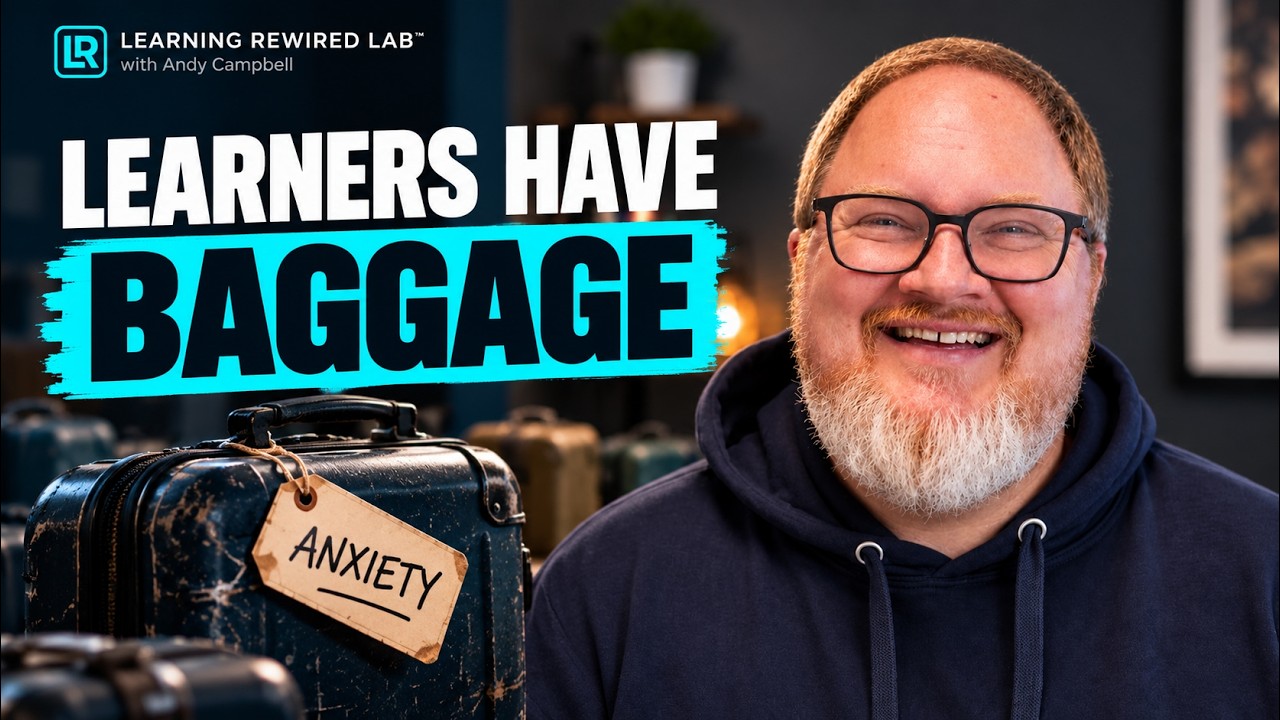
I've put off doing this for a while, like a while. And it's not because I don't have anything to talk about. If you know me at all, you know, that's definitely not the problem. It's because I have anxiety and sitting in front of a camera, knowing somebody is eventually going to watch this is not exactly my idea of a relaxing Saturday morning. I've recorded things before, and I remember watching myself afterward and thinking, why am I sitting like that? Why do I sound like that? What am I doing with my hands? Suddenly I'm not listening to anything I'm actually saying. I'm analyzing the weird guy on the screen. And yes, I know the weird guy is me. So I found plenty of reasons not to do this. I need a better camera. I need better lighting. I need to figure out the background. I should probably lose some weight. Maybe I need a better microphone. Maybe I should practice more first. There's always another reason. But here's the thing. I actually really like talking about this stuff. I've spent most of my career thinking about learning, building things, experimenting with ideas, and trying to figure out why some learning experiences work and others just Don't. So eventually I had to stop waiting until I felt completely comfortable because I'm probably never going to feel completely comfortable. And weirdly enough, that got me thinking about something we don't talk about enough when we design learning. We spend a ridiculous amount of time thinking about what we're going to give the learner, the content, the activity, The video, the scenario, the assessment, the job aid, all the stuff we're putting into the experience, but we don't spend nearly enough time thinking about what the learner is bringing into it because nobody showed up empty-handed. I'm sitting here right now carrying anxiety about being on camera. Someone else might walk into a training session after getting into an argument With their spouse that morning. Someone might be worried about their kid. Someone might have a manager they can't stand. Maybe they're completely overwhelmed at work. Maybe they don't, or they haven't slept. Maybe they're sitting there thinking, I have 14 things I need to get done today. And, um, somebody is making me take this course. And then we show up and say, welcome to your exciting learning journey. Come on. They're not a blank slate. They're a person. And I think sometimes designing learning as though we're getting this perfectly attentive human being who's just sitting there waiting for us to teach them something. That's not how people work. I learned that years ago when I was teaching. You could teach the exact same lesson to 2 classes and get completely different results. Same teacher, same lesson, same activity, sometimes even the same day. And one class is completely into it and the other one, disaster, because you're not really teaching a class. You're teaching a room full of individual people who All walk through the door carrying something different. Corporate learning isn't any different. We just got better at pretending it is. We put people into an LMS, we assign them a course, they click through it, they pass the quiz, and then we say, great, learning accomplished. But what if the person wasn't really there mentally? What if they understood it on Tuesday, But couldn't remember it when they actually needed it 3 weeks later? What if they understood the concept but had to absolutely, or had absolutely no idea about how to use it in their job? That's one of the reasons I've become pretty obsessed with the idea that learning shouldn't be treated as a single event because people don't work that way. We need reminders. We need practice. We need help when we're actually doing the thing. Sometimes we need somebody to explain it differently. Sometimes we need to screw it up once or twice, or if you're me, possibly 17 times. That's learning. And I think the more we understand the human being on the other side of the experience, the better our designs become. Not because we're making everything easier and not because every learning experience needs to turn into therapy. That's not what I'm saying. I'm saying context matters. The learner's environment matters. Timing matters. What happened before the learning matters and what happens after it matters even more. That's the stuff I'm interested in exploring here. Not just how do we build a better course? There are already a million videos about that. I want to talk about the bigger questions. Why are we building the course in the first place? What problem are we actually trying to solve? What does somebody need in the moment they're doing the work? And sometimes, do we even need training at all? That's probably going to get me into trouble eventually, which should be fun. But for now, I'm going to consider this a win because I've been putting off sitting in front of this camera for a long time, and I finally did it. So if you're someone who designs learning, builds training, works with SMEs, fights with an LMS, experiments with AI, or occasionally stares at a learning request and thinks, There has to be a better way to do this. That's what we're going to talk about here. I'll see you on the next one.