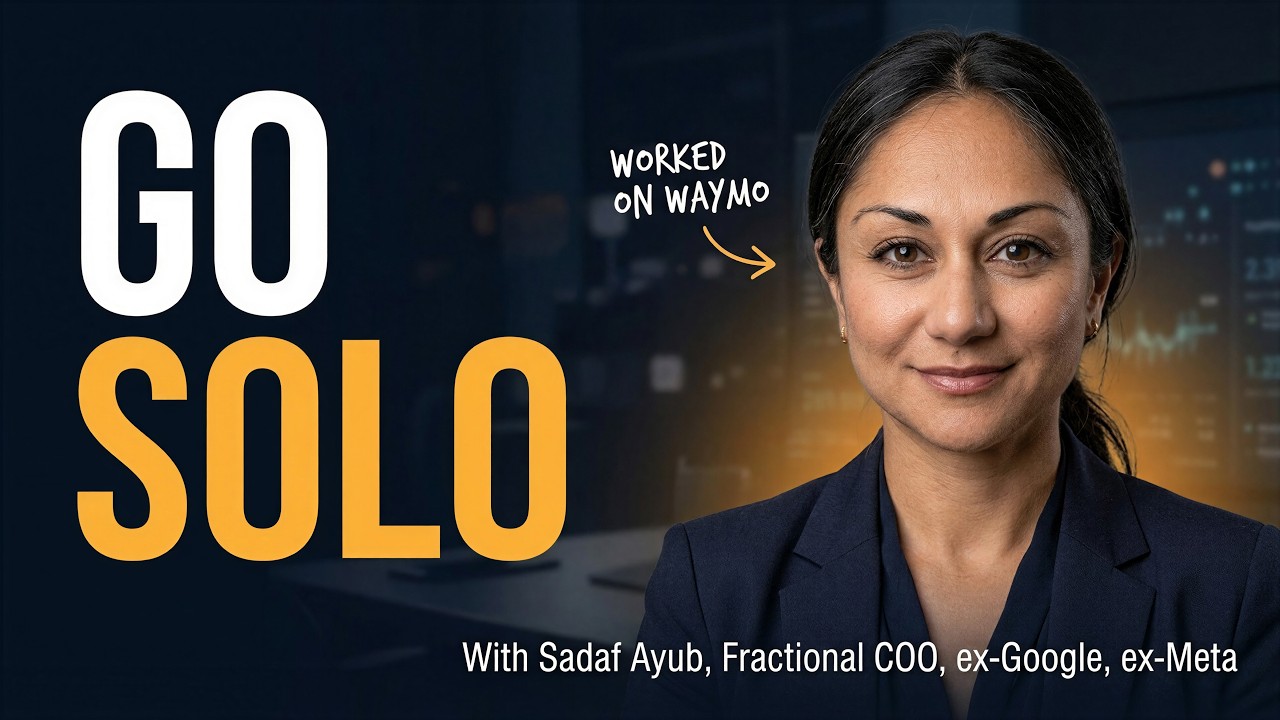
When a Solo Founder Should Finally Add a Co-Founder | Sadaf Ayub, Fractional COO, ex-Google, ex-Meta
In this interview‑style workshop, host Angelina Yang talks with Sadaf Ayub, a fractional COO with a background at Google and Meta, about the hidden operational and financial decisions early‑stage founders must make. Ayub explains her “underwriting” framework: start by defining the founder’s long‑term vision, then work backwards to expose gaps in technology, product, team, financing, and legal structure. She stresses that founders often mistake narrative for reality, especially around co‑founder relationships, equity splits, and financing choices. Key take‑aways include: (1) co‑founders should be chosen from trusted networks, equity need not be 50/50, and early “prenup‑style” agreements are essential; (2) personal and business finances must never be commingled – use proper loan or SAFE documents and involve lawyers; (3) self‑funding is viable but requires disciplined budgeting (≈ $20‑30K for incorporation, legal, and fractional staff) and clear milestones to decide if external capital is needed; (4) different financing instruments (SAFE, convertible note, loan) have distinct tax and dilution implications, and valuation caps must be modeled against future conversion events; (5) AI can help model scenarios but does not replace legal counsel; (6) open‑source founders must assess licensing and enterprise‑readiness risks early; (7) founders should habitually view decisions through the lenses of investors, co‑founders, and customers to avoid emotional bias. The conversation ends with a concise piece of advice: regularly step outside your own perspective to identify and address gaps before they become fatal.
Chapters
I actually see this mistake made a lot where founders early stage start commingling their personal finances with their business. Do not just move money into your account ever.
That's my first mistake.
I help founders close the gap between narrative and reality before it closes in on them.
How do I make sure that I do it correctly?
Just because you can raise doesn't mean you should raise because you're going to give up something.
Should I look for a co-founder?
I don't believe in all co-founder relationships need to be 50/50 or equal. It's kind of like a marriage. You should be thinking about worst-case scenarios.
Today I have Sadaf Ayub. She spent a decade inside Google and Meta on projects like Waymo and Google Cloud. Today we're doing something different. I've got a case study, a real friend's real startup, and Sadaf is going to run her first-hour diagnostic and to help guide the strategy of a potential startup.
Hi, Angelina. Good to be here.
It's been so long. I've been always wanting to have you on, and then time just goes by.
Yeah, we've been talking about it since April, but I'm excited to be here now.
I know, finally. I'm so glad to have an operator to be here. You are actually the only operator I've had so far, and you've seen it all, right? Can you describe what do you actually do?
Yeah, I'm super honored to be here, especially as your first operator. It's really hard to describe what I do because when people think of operations, they usually get caught up in kind of the day-to-day business operations type work, but I really think of myself as operating across the entire business stack. So I work across your technology, your business operations, your compliance, Your governance, your team, maybe even some HR, executing across all of those different domains and fundraising and really helping you underwrite the opportunity that you have in front of you. In a nutshell, I like to say that I help founders close the gap between narrative and reality before it closes in on them. This means that I like to identify all of the interdependencies across your entire business, really help you be in control of what that narrative is, whether that's for fundraising or commercializing or going to market with a product or even pivoting in your business. Really understanding what's the reality of where you are today with your business and where do you wanna be? I really like working back from the outcomes. So if a founder comes to me super early stage, I like to ask them, where do you wanna be in 6 months, a year, 5 years, 10 years? And working back from that, you can really start to expose some of the operational gaps in your business that you need to actually reach that goal. So for example, if a founder comes to me and hasn't even started anything yet, they just have an idea. I'll ask them, where do you want it to be in a year and what do you need to get there? So, are you set up financially to be able to quit your job? Are you really excited about this product? And do you know who your potential customers are gonna be? Do you need to fundraise to do this? And who are your target investors to do it? Really thinking through every single angle of that problem, right down to the technology. I really like thinking about this as an ongoing underwriting assignment where You have an opportunity, but there's also lots of risks and there's lots of gaps between what that opportunity is, what your narrative is, and what the reality is you're in today. And really closing that gap between that reality and that narrative piece by piece and understanding and being really decisive and being able to make decisions strategically about where you wanna go and what trade-offs you might need to make along the way.
So founders, at what stage are you mostly servicing?
I work with founders at every stage of the early journey, whether that you have an actually founded a company yet and you're just thinking about quitting your job or you're pre-seed and seed stage. Typically like to get involved super early where you haven't made mistakes yet, but to be totally transparent, I've learned a lot about what I do in my business from mistakes and from failures. And I worked back from those failures and I now have a framework where I can really underwrite all of the gaps in your business from what I've learned and what I've seen from other companies that have made mistakes. And I really love plugging in early because I get an opportunity to influence and really help a leader prioritize things that might bubble up later down the line.
I think it's a lot of my audience right now because a lot of the builders are empowered right now for building anything they want, they're passionate about, but then the question becomes what to build and how to sell. The backend of that whole thing, whole journey, is what you do. And then, you know, it's hard to think from a reality perspective.
Yeah, it's very difficult to think from the reality perspective. And I see more and more founders wanting to do something that they wouldn't have done in the past because they have access to all these great resources, whether that be through AI or through fractional resources that they can hire. I think it's a very exciting time to start your own company. But with that being said too, working a lot with AI, working a lot with these great tools, you can kind of get misled about what your reality is. And a lot of what I do around early on is really dig into the details about, okay, what do you really fundamentally have today? Do you have a product? Do you have an idea? Do you have a concept? And it's okay if you just have an idea, but really figuring out what is it gonna take to get from that point A of, I have this great idea, to we have this product and then we have this business, including like working back from, okay, I want this to be a billion-dollar business in 10 years. What kind of customers do you need to get there? Who do you need on your team to get there? What kind of investment do you need to get there? Even if you're starting as a solo founder, I really encourage all of clients to think through every detail about, do I need a co-founder? How much equity am I going to give them? How willing am I to dilute what I have in this company to take on the risk of bringing someone else in? And I think when you really think about it through this decision framework and through this really underwriting process of what your risks and opportunities are, I think you get an opportunity to really make strategic trade-offs and decisions and really own your own trajectory in your business rather than going along for the ride.
Do you have an, am I ready for building a startup? kind of assessment? I'm happy to share a link. I think if I just quit my job and decided that I'm going to do something, I probably missed 80% of what you just said. I'm just excited about the opportunity, what I can build. Most of the things you just said can be the gotcha for a lot of us. So yeah, please do share that.
Yeah, I'd be happy to share a self-assessment. The core of the self-assessment is really figuring out the reality of where you are and where you want to be, starting with what's your product idea? This is the narrative part, like where do you want to be product-wise? And then really like how far are you along in building it? That's the reality. And that could be, I haven't quit my job yet. And there's this like a decision tree type framework where if you haven't quit your job yet, okay, great. How ready are you financially to do that? Is your family ready for that? Time-wise and just commitment-wise, are you able to really step away from what you're doing?
Can we start from step 0 then?
Yeah.
You know, for the past few months, it becomes possible that one person, solo founder, can do something, or at least they can do the initial PMF testing even before they raise anything. Right. So between the moment somebody is about to quit their job and the day they actually have a product, there must be a lot of thinking going on in this journey, right? What are your suggestions?
Absolutely. And I love solo founders, so I have a little bit of bias towards that, especially in the early stages. I don't really see a need to engage a partner unless you are already very committed to working with them and you already love their style of working, their personality. Their product vision. Otherwise, I think going at it alone for at least early stages until you have proof of concept in your product is totally fine and very advisable from my perspective. From that kind of stage zero perspective, I really think you should be thinking about not just your product idea, but personally where you are in that journey and how much you're willing to invest. That could be invest financially, whether you're gonna self-fund this or whether or not you're gonna need to fundraise for it, because in this decision tree, if you do need to raise funds to do this, That could change a lot about how you approach your initial prototypes or your initial product development, because you can start having conversations with investors and really identify who's gonna invest in you. And from that, you're gonna get a lot of influence in your product. This is also why I really love when founders come to me and they've already self-funded an idea at the beginning, because they get full creative discretion over what they're building, cuz they get to build it themselves and for themselves. And I also really admire that kind of ability to put, you know, put your money where your mouth is and really build something that you think is gonna be impactful because every kind of decision you make along that early stage journey, let's say taking on a co-founder early stage before you fundraised or before you've really developed your product vision, that person's gonna influence too, and there's gonna be trade-offs within that. So sure, if you have somebody that you've worked with for 10 years and you really respect and really shares your vision, you should go into that relationship and establish a co-founder. But if you're not there yet, it's totally okay to just go at it alone and really start prototyping and start building. I have an extreme bias towards working with technical founders in my practice, especially very technical CEOs. Because I really do love the really product-driven and technology-driven type companies. And I think that with being a, a product or a technology-driven company, maybe you won't get good market signal upfront or sales signal, and maybe that won't be desirable to every investor early on, but you get an opportunity to build what you're passionate about building. And some of those products can be the most technically complex, and you get permission to be technically complex, the less trade-offs you make. Mm-hmm. So the less influence that comes in, if that means Not taking the co-founder, not taking the investor, self-funding, quitting your job and bootstrapping, all those things I highly encourage. And I think that there's great resources to be able to deliver that right now that weren't available to us a few years ago.
Do you think the first decision point is finance? The thought process is, do I have enough money to fund, or do I have a plan, a business plan to raise funds? So in such a way that can support my product building journey long enough for me to potentially hit something.
I think finance becomes a very important step. Hopefully once you've made the decision that this is something you're willing to invest in personally, I really think starting from that personal finance and personal investment perspective, that can be super intertwined for most people because you could really wanna be committed time-wise to something, but you've got too big of a mortgage to do it yourself. I would start the decision tree really at your personal commitment, including your personal finances. And then when it comes to whether or not you have to raise, That is very interdependent on what you're building and how much you need to do it. And that's why I really suggest working back from what you want to deliver at different milestones. I really like the working back from milestones model in my framework because you get an opportunity then to break it up into small pieces of, I need this much to deliver at this stage, because in all reality, you might not actually advance through all of these stages. So it is nice though to work back from that and have a real decision tree around, let's say you've decided, yes, personally you're willing to take that risk, and that next question is really like, how much money are you going to need? to do it? And then you come back and say, I can really put in this much realistically, and I can get this far with that. And then you have to reconcile whether or not that's consistent with where you want it to be. And if it's not consistent with where you wanna be at that next milestone, then yes, you should consider raising. But really, you start with what you're willing to do first. I do think some people do, can raise off reputation, and there are trade-offs in doing that usually. Can you raise? Because many people can raise, and I see this with my founders that self-fund. It's really like what financing path makes the most sense for the company you're trying to build and what does that path require you to give up? Because you will start to get signal from different investors that they want really favorable terms for themselves because you're raising with a PowerPoint rather than a real product, right? So the earlier you bring in an invest— investor, you're probably gonna get less favorable terms and you're gonna give away more. So it's, I like this idea of like the finance path that makes sense for you. Just because you can raise doesn't mean you should raise because you're gonna give up something. And of course, every situation's gonna be different, but typically when you're raising early on in your experience, you're gonna give up more. And that might not be just financial, that might be product direction or go-to-market strategy or vision, even design. Like, what does this product look like if it's UI-heavy product? Like, you're gonna get influence from your earliest investors. So you need to put all of that into consideration. And so it is really like financing path and the trade-offs with each kind of decision tree point, right? Yeah. So it could be starting to mix this model up of, I'm gonna put a SAFE in the company first, and I'm gonna give myself these terms, and I'm gonna be the first investor in my company, and then I'm gonna bring in a second investor because I know I need that extra million dollars or $2 million. But you should come in prepared to explain a defensible position about why you wanna maintain control over certain aspects of your business before you go to solicit investors. And I think that will give you ultimate control. So going in and just saying, I'm gonna raise a bunch of money cuz I can, or I should, or I need to, isn't really the right approach. I think the right approach is to go in and say, this is what I'm willing to give up and negotiate back from that.
I love it. So let's say if I decide to self-fund, sounds like it's a good starting point, right? How do I make sure that I do it correctly?
Yeah. And so even within that, you're not just negotiating when you're thinking about self-funding your business, you're not just negotiating between you and the corporation that you're setting up, you're also negotiating against your future investors. And your future employees even, or your future co-founder. So really, it's the mental exercise of deciding, you could just give yourself super favorable terms and write yourself a SAFE into the company, but then you may turn off your future investors for that reason, or you may turn off a future co-founder. So even when you're self-funding, it's not just a super favorable position for yourself. You still have to think about like, how is this gonna be perceived down the line? So if you think you can completely self-fund and be like that example of a billion-dollar startup being run by one person, then that's great. You can maintain all control. But if you think in the future you're gonna have to give away additional equity, the optics of that cap table are still gonna be really important regardless of if you were the first investor in your business. So really think about the future optics and trade-offs. And if you really think that you're gonna need to bring in an investor down the line, don't give yourself too favorable of terms either.
Wait, so you are saying I, Should not just move some money between my own checking account to the business checking account. Myself on a cap table, that's my first mistake.
Yeah, I think that I actually see this mistake made a lot where founders early stage start commingling their personal finances with their business. Do not just move money into your account ever. It's a huge mistake. You're going to both wrap yourself into some personal tax exposure issues and potentially make yourself uninvestable as a company because you cut too many corners. Get a lawyer involved, get someone to write you a proper agreement and think through what type of investment, whether that's gonna be a loan. If it's important for you to get paid back, position it as a loan. If you really want the investment, write yourself either a SAFE or another type of convertible note. Really think about what your different financing paths are when you're even self-funding and try not to just commingle. I'm gonna drop $100K into my business checking account. I really believe in doing things the right way and papering agreements, and you'll learn down the line when you get into diligence with an investor, or if you get acquired and you go through diligence and M&A, that cutting these corners are gonna cost you later.
What's the difference between convertible notes and a SAFE versus loaning myself some money?
Yeah, every single financing path is going to have a different structure. Writing yourself a loan, you do have to actually pay interest on the loan. You don't get necessarily just get away with being repaid and giving yourself an interest-free loan. The IRS frowns upon that. But if you do want to take out a, give yourself alone as a company, that's absolutely available to you. The SAFE is gonna be structured in the same way the SAFEs that your early investors are gonna participate in. And so when you're writing yourself a SAFE, you do need to take into consideration a valuation cap. And there is a lot of work to be done in coming up with the right number there because in a post-money SAFE, your valuation cap also will dilute the founder shares that are initially set up. So if you have a co-founder involved and you're doing a SAFE, even if it's self-funded, choosing that right target valuation cap is actually very critical for you To not accidentally, if you accidentally overshoot or undershoot it, or if you have follow-on investors that want the same terms as you, you really should work back from your end result of where you wanna land to pick your valuation cap rather than just choosing what standard or what, you know, other people do. All because like all of these things are interconnected financially and you could end up creating some dilution economics that aren't favorable either to yourself or to your future investors or to your future employees or your co-founder. And each of these circumstances are completely different. And so there There is no one right recommendation of what your valuation cap should be. There is a whole underwriting process of determining that number where you work back from where you think this business is really going to be when you reach a conversion event where the conversion economics will actually play out for your cap table. And there's a lot of financial modeling that goes into even simple decisions like, should I write myself a loan?
For founders who are builders and who has no idea what you just talked about, do you think they can chat with AI and to get a baseline understanding, a more in-depth understanding, and try to have AI to draft the first level of SAFE for them. I'm just imagining at the beginning of the journey, they probably very hard for them to judge whether or when should they pull in a real lawyer to handle these things, right?
Yeah, it's a really good question. Like, when do you engage attorney versus working with AI versus just asking for advice from people? I think it's a blended model of working with AI to really understand the economics of the decision you're making is really smart. And I think AI is really great at Plugging in different scenarios for if I choose this valuation cap on my SAFE and I reach these certain milestones and I fundraise this amount, AI can really help you build the decision framework around those metrics. And you're gonna get probably better advice on that working with AI or someone like myself who would help you think through kind of the financial reality of the situation and what the different dilution economics can look like in doing that, that modeling work. And I think that's smart to do before you engage a lawyer, but I absolutely do believe in engaging attorneys to write contracts. I don't believe that AI is completely an alternative yet to this work. There may be some kind of upcoming AI-focused startups that I've seen that are building tools that will help you, but I don't think there's a full replacement just yet for that kind of eternity, actually double-checking your work and making sure you've done things in a way that are not gonna come back to bite you later. But absolutely work with AI through the process of deciding the actual metrics of the deal you're doing with yourself.
Yeah, so that's a starting point then. And if we want more certainty or more insights or second pair of eyes, your suggestion is talking to domain experts or a real lawyer always helps.
Yeah, and I work with attorneys very closely in my practice, so I highly recommend engaging an attorney and then having either yourself or someone you trust as a strategic partner. And that's kind of where I jump in a lot of cases, really helping you think through what you want to commit to and what those trade-offs are, because an attorney is going to help you paper this deal and think about all of the different outcomes and trade-offs if you ask them to, but they're not necessarily gonna be involved in your business deep enough to understand whether or not it's a sound business decision. And that's where someone like myself or you with the help of AI could really accomplish.
How much do you think a founder should budget at this stage, like when they're starting out?
Yeah, how much should a founder budget early stage for attorney fees or—
For trying to clear the path, right? What you're talking about is more is getting you prepared operational-wise. So that you can put your efforts or energy into product building and talking to customers, right? Most founders want to spend energy on those. But if they were to invest in the operational process, like what you mentioned, understanding how do I write a SAFE with myself, for instance, or how do I get ready for incorporation and maybe starting to raise? That's something I think is another set of decisions that we need to make. And I want to know how much investment is needed for that type of work.
That's a really good question. Yeah. How much investment is needed early parts of setting up kind of the, all of the operations and kind of these early decision frameworks. Is that correct?
I know Stripe Atlas, I can just sign up and it can guide me to register for all kinds of businesses I want in the US, right? S corp, C corp, LLC, whatever. But that's a SaaS tool. It's probably not going to give me much guidance, right? Am I making the right choice? And if it's not you, I wouldn't know that I have to pay tax If I'm loaning money to myself? I had no idea that I have to do that.
Yeah, it's a really good question. How much should you invest in kind of that early operational infrastructure and also in setting up your earliest decisions in your business? I guess that really depends on where you're at and what resources you have available and what you're building and your own kind of understanding of how to position these things, right? If you're a second-time founder, you may already know how to do all this and you may be able to just go into Stripe and set up and incorporate, and you may not even need Stripe. You might just go straight into the Secretary of State's office and incorporate where you are if you need to. But ultimately, if I really think that a lot of founders underinvest in this space, and I think that where we see this come back to bite them later is when they do try to raise an institutional round and they do go through diligence with a future investor, or if they go through M&A through an acquisition, even if they're hiring a co-founder and they're poking around at what's been done already, I do think I think too many founders will underinvest in early setup of their company, and there's amazing tools out there that will really help you quick and dirty set things up. But they, yes, as you said, they will not actually guide you through that process. And so I think early on, if you're a first-time founder and you haven't done this before, you can augment yourself as much as possible with AI. But especially with the type of founders that I like working with, technical founders, a lot of them, their brain doesn't actually think this way. Mm-hmm. They aren't really thinking about the risk decision of this downstream impact of having not incorporated in the right or—
Right way.
Yeah. Being set up, having written themselves a loan where it wasn't actually papered or documented, and then they had a downstream taxes issue or how their corporate entity was set up. I've seen mistakes in corporate entity structures that have come back to bite when you wanna raise an institutional round later. You can even unintentionally mislead your future investors by doing that, and it can become a credibility issue down the line. If you have any resources, to invest in the space, I think you should early on because ultimately these types of founders that are super technical wanna invest in their product and writing code and building a real technology. And so this is where I think that the niche I've made for myself in my consulting practice is with highly technical founders. Because if you are willing to invest in, I'll be transparent, in the earliest stages, I offer my services for a huge discount because Because I understand both how valuable it is to deliver that work, but I also understand how many founders underinvest.
How poor we are.
Yes. How many of them underinvest in that space, in that, those early decision frameworks around incorporation and fundraising and really setting up your operating infrastructure. So getting in a fractional attorney that you can call for a low rate even and get advice from, getting in somebody who has incorporated a company before, who has hired accountants before and settled up Taxes and understood that whole kind of financial system before, I think you should put aside some money for that. And when you think about your earliest stage plans for budgeting, I really get involved a lot in early stage budgeting because I help a lot of founders decide either how much they're going to self invest in their startup or how much they're going to try and raise. And that whole raise qualification process is really eye opening for a lot of technical founders because they are thinking in terms of what will it take to deliver this technology. And I'm thinking about all the dependent relationships. Of actually you do, you are gonna need an attorney, you are gonna need an accountant, you are gonna need maybe an administrator or go-to-market person, a salesperson. And there's a relationship too between how your business grows and if you have a sales-driven business early stage, when the sales scale, what are you gonna need to deliver those sales? Your entire workforce grows as you grow. And so the financial modeling aspect of building a budget and deciding how much you need to get to a milestone has to take into consideration what happens once you reach those milestones and how much you have to increase. your spend to keep up with them. And so if you forget that aspect early stage and you just go and you get yourself a check from an investor, you might have asked for the wrong amount to actually get to where you need to go and you'll fail. And so that initial investment of maybe, I think a lot of startups early on spend like $20K, $25K, $30K in the first couple months just on setting things up, including if they're really trying to move fast, including attorney's fees, kind of some fractional workforce to get things off the ground, maybe someone like myself in an advisory relationship. If you really invest in those things early on, you'll avoid some of the earliest deal-breaking type mistakes that really can cripple a company a year from now after you've invested in a lot of this and it's become your baby and you're really emotionally attached to it. It can come back and bite you that you incorporated in the wrong way.
Maybe let's do the workshop. I wanna share with you a case study from And you can tell me what could go wrong and what is the potential consequence so that, you know, our audience can have a level of understanding with a concrete example. However, I have to say, I don't know about the business, so everything related to fundraising, I only know about the tech. Everything else, I'm just gonna make up something and for the illustration purpose of this workshop, so I'll just make up something. It's actually from my friend Nicole Koenigstein. We actually just had a workshop this morning, and I know that she wanted to incorporate whatever she's building, which is now an open source tool into a company. There's so many things I feel like I need to ask you, but you mentioned about finding a co-founder earlier. Should I look for a co-founder in my friend's situation?
Yeah. Should you look for a co-founder? I am very biased about looking for a co-founder. I think that it's really hard to find a good co-founder that isn't already in your close network. And I, when I say close network, not just somebody that you know from a person, But someone you've already known and worked with in the past. And I do think that when you bring in someone that you've never worked with before, even if they've been highly recommended to you and referred to you, there's a lot of inherent risk in that. And there's kind of this misconception that you need additional manpower early stage. And I see this a lot with 3 co-founder type relationships. Just, it does create too many cooks in the kitchen often. And working back from, oh, it's worse sometimes to have 3 co-founders, it can be sometimes better to have 2, but adding anyone into an equation that isn't fully aligned and actually able to collaborate and communicate with you properly is just gonna create more friction and more noise. So, you can go looking for a co-founder, but it's dating. You don't really know what you're getting yourself into, and you learn a lot in the process. But if you do have someone in your network that you've worked with before and you communicate very well with, and you negotiate well with, and you trust, that's always a better starting point than going out and doing these kind of speed dating type co-founder searches.
Because I remember YC, Y Combinator, their suggestion is you have to have a co-founder and they're suggesting 50/50 equity split as well, right? And I remember last time we talked and you're advising against that. So I'm curious, what's your take on that?
Yeah, I don't believe in all co-founder relationships need to be 50/50 or equal. I think you really need to take into consideration Who was there first? Who's put more time into it early on? Whose product idea it is? Who's contributing more? If you both came up with this concept for your business together on the same day and then decided to incorporate the same day and both quit your jobs on the same day and became full-time the same day, then sure, I think 50/50 makes a lot of sense. But that's not usually how things start. And asking someone who's been working on a product idea or a vision for at least a year to bring on a second co-founder and go 50/50, To me, not only creates constant struggle of who's really in charge and also almost like a, there's almost a little animosity off the front just because someone has contributed more. I think it's human behavior. It's very natural to think that it's unfair to be 50/50. I put in more and that can get exacerbated if let's say the second person coming in also is taking time off or is having a personal emergency and then it just exacerbates that situation even more. It also does create, it's depending on how your bylaws are structured and how your board actually operates. If you have also 2 co-founders who have, are 50/50 equity-wise in their co-founder shares and are also the 2 board members, you might create just some gridlock for yourself too, if that's how your board operates, that the decision power is simple majority. You don't have a simple majority in 50/50. And I do work with early-stage founders when they meet their co-founder on establishing and negotiating what their co-founder agreements, kind of joke that they're like prenups. A lot of the co-founder agreement is really working through what is the worst-case scenario? What happens? What is the tiebreaker? And what happens if one of us leaves, or if one of us stops contributing, or there's a serious conflict? And I do involve an attorney that I really like working with on these types of negotiations and papering the agreements, and sometimes even adjusting the bylaws of the company to reflect them. But I really do believe that 50/50 can be dangerous in an early-stage company.
This conversation is actually really hard from my perspective, because I think it's a lot easy— I don't know if other people think the same way, but it's a lot easier for me to say, hey, Sarah, why don't you join my company? I'm building this. It's very exciting and you are excited about it. You were convinced and we just decided to work on something together. And for us to start talking about, hey, we have to think about the worst scenario. If you don't wanna work full-time anymore, what happens? And all those kind of things. It's a hard conversation to have. When should we have that conversation?
You should have it as soon as you start talking about being co-founders. I actually think that it should be one of the first conversations that you As awkward as it sounds, it is extremely awkward. What's more awkward is if your company fails because your co-founder stopped contributing and you had no leverage on your board to do anything about it, and you ran out of resources, you spent all your money, and you failed. Having those awkward conversations upfront sounds really unusual, but you should know in some of your first conversations what happens if someone in your family dies and you can't contribute anymore, and you need to bring on, let's say that your co-founder is also the CTO and they're also the primary engineer on the product. You're gonna need to hire somebody else to replace them if that happens. Do they keep their salary? Do they keep their equity? How does that get repositioned where you can bring someone else on? You should have those conversations upfront. It's like a marriage. It's like doing a prenup where you should be thinking about worst-case scenarios and what the kind of economics of those scenarios are going to be upfront before they happen. When it's more emotionally charged, once someone in your family dies and you need to be stepping away from work, that's a more emotionally charged time to engage in that conversation than the awkwardness of bringing it up early stage.
Yeah. Good advice. So everybody taking notes. And let me wrap up for everything I've learned from our little workshop of my friend's startup. To make it more generic, anybody who's, let's say, working on an open source and thinking productize that open source solution. What we can do is think about whether I need a co-founder. That's, it's not off the table, but I should think about it. And if I do, I should have tough conversation on day 1. So I should think about what if either of the co-founders quit, what's going to happen, right? And put that into the contract. And second one is you're suggesting post-incorporation, if I decided that we're going to raise, we should decide our raise amount and our cap based on milestones. So for instance, depending on our goal, right? If our end goal is going to enterprise sales, we should be prepared to cover that phase of building and versus doing the solution architecting with a design partner. So all of those, and including potentially legal and ops costs as well, when we are thinking of raising. So that's a fair starting point, right? Did I miss anything or do you have other things that you want to cover?
I think that's a really good place to start, but I also think there can be Are there gaps in your current position, right? In this case, yeah, if you haven't incorporated yet, that might not be an issue, but really try to think about what makes this investment or this business inherently risky. So this is the hardest thing to actually think about very early stage. Are there inherent risks in the type of business you're building? In this example, it's like, are there going to be legal risks to what I'm doing? You've already delivered an open source offering. What type of licensing is gonna be necessary to really separate what you've already delivered in the open source to the public from what you're Delivering now, and are there going to be any legal risks behind that? Depending on how you've positioned what you've put out into the public to date, there may be some legal gymnastics to deliver it in the enterprise. And what are you going to have to take away from what's open source to protect yourself in the future from it being recreated? You might have to have then an open source license for each of your individuals that are— maybe that threshold is if you're not using it for any kind of monetization use, then can be free. But those are the kind of risks that you also have to think about early on that are inherent to your business that could, if not positioned correctly early on, bite you later? And what are the interdependencies there, right? Can you actually deliver this to the enterprise? Are you using other open source licenses that depend on not being monetized in within your own offering that you're gonna now reposition to the enterprise? That could be deal breaking.
Can you give me one piece of advice or my audience one piece of advice to make us a better founder?
If I had to give one piece of advice, advice to be a better founder, I would say really try to step out of your own position sometimes and think about things from another perspective. Try not to make emotional decisions. Try to think from the lens of the investor or the co-founder that you're bringing in, or the customer you're bringing in. Don't be so emotionally involved in your business. And when I say that, I don't mean don't be passionate about it, or it is gonna be your baby. It is gonna be very important But think from the lens of a different persona and kind of step out of your current persona before you make decisions. And I really think my consulting framework is very much focused on approaching everything from a different lens and approaching everything from the real data behind what is the reality of your business. You can live personally in the narrative and what you're pitching to your customers and your investors, And what you want your product to be. But when you step out of that positioning and you go into the lens of a, someone else, whether that be, yeah, investor, co-founder, whoever, you really start to see the gaps and you start to be better at addressing them. And sometimes you're not gonna close them, but it's better to have your narrative about why you didn't close them, why you didn't prioritize them when it comes up in a meeting with, let's say, like an enterprise customer. or an investor, it's better to be aware of all your gaps. And you can't do that if you're like too just in your own head and in your own narrative and in your own position. You really need to step into the lens of someone looking at it from the outside. And I do think that in my practice, I very much do that 'cause I come in from the outside. I'm not embedded. I am an external consulting partner and I will give you the real truth about your business. And that's what some of these risk assessments that I do, are really harsh realities and they can be really painful to digest for a founder who is living in this narrative of, we're gonna sell this much and we're gonna deliver this much and we're gonna close this enterprise deal. It is a painful process, but it is like the awakening of, okay, this is really what I need to do to get to where I'm saying I wanna be.
Thank you so much for the conversation today. Every founder in my audience or founder, aspiring founder to I think we're all running some version of a gap between what we say about our company and what is actually true, right? This is a common practice. We are probably struggling with reality all the time. It may not be a negative thing. I think it's positive in a sense that we ourselves are trying to close that gap as well, right? That's the whole point of building a product that can change other people's lives. But thank you for giving us the framework for underwriting this process, so we have a benchmark to evaluate ourselves on, such that we won't get Your last piece of advice is trying to get out of that zone that we are immersing ourselves in all the time and obtain this different perspective or lens so that we don't get too emotionally attached to what we do while still having our passion in what we build, right? Thank you so much for going so deep with me today.
Thank you, Angelina. This was super fun to do.
More from Angelina






Why Solo Builders Should Sell to Enterprises, Not Just Consumers | Joseph Enochs, Chief AI Officer