Angie Birmingham tests the Sony a6700 and Sigma 60-600mm lens on muskox and tundra wildlife in Nome, Alaska. She shares concrete settings: 1/1000s, f/6.3, ISO 3200. The video covers composition, field tactics, and her annual workshop.
Chapters
What's that?
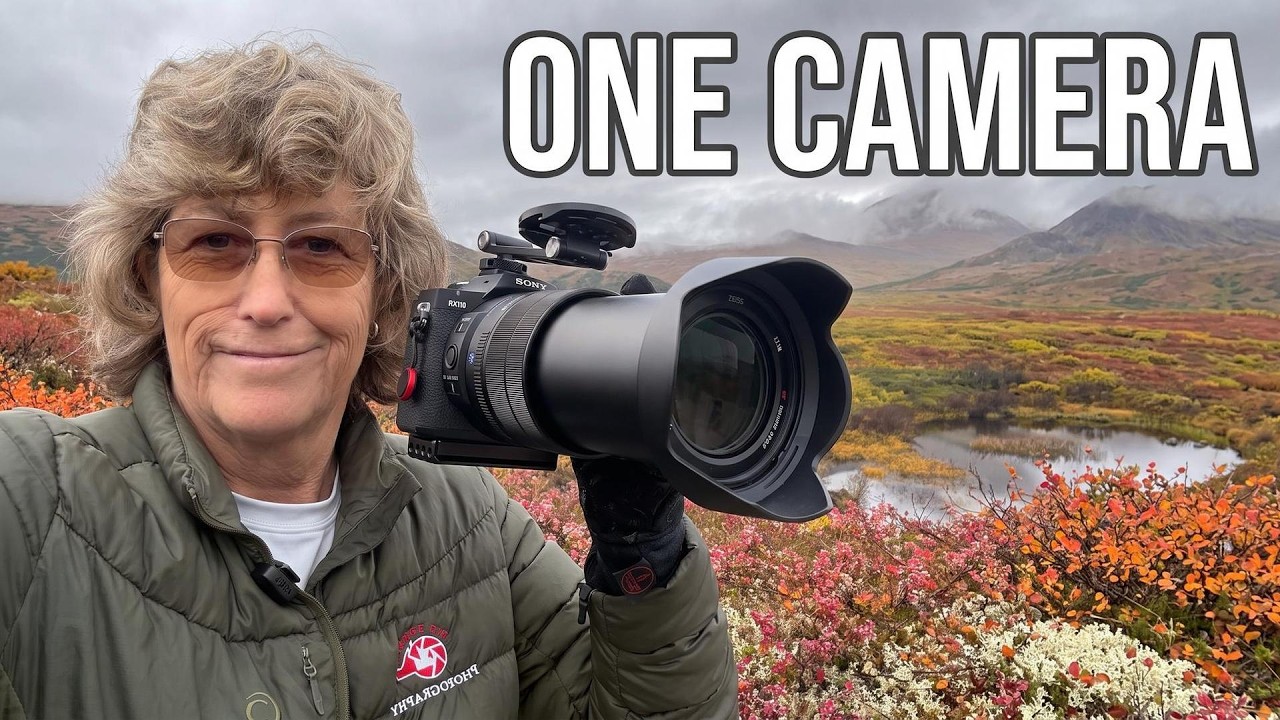
I hear you want to go to Nome, Alaska, where the muskox roam wild? Well, I'm here in Alaska, and I've got the a6700 paired with the Sigma 60-600, and we're gonna put it to the test. We're gonna get some muskox, some landscapes, maybe some birds, and see how well it performs. So let's, let's get to shooting.
So here's the plan for the next 2 days out here. We're going after muskox on the tundra, some landscapes with light, and whatever birds the wind happens to bring in. I brought the Sigma 60-600 Because that range is what matters out here.
Here we are in the Alaska tundra. We found a muskox, a young bull, and I've got the Sony a6700 and the Sigma 60-600mm, and my settings are— I'm at 1/1000 shutter speed, f/6.3 because that's wide open, and I'm at 3200 ISO. Let's see how this turns out. On a rock cliff and she's over there rubbing her little booty. I'm at 1/1000 shutter speed, f/6.3, and we'll let the ISO be where the ISO is gonna be. Let's get some photos of her. Something nice about photographing the muskox in the Alaska tundra is is that you have memory foam to sit down on while you wait for them to do something.
Let's check it out.
Right here looks like a really good spot. Notice all the berries?
They're called crowberries.
Here we go. I am down. Nice spot to sit while I wait. See, you can go from shooting muskox to waiting on muskox And photographing crowberries in the tundra.
With one camera. How cool is that?
Here I am on the tundra. I got a family of muskox in front of me. Looks like maybe 2, 4, 6, 8, maybe 10, 11 of them. And when you're photographing muskox, make sure you zoom in and get some nice tight stuff, but zoom out, get a landscape with them in it. Show where they live, show their zip code. So I'm going to shoot them at 600mm and then I'm going to back off and probably shoot them at 100mm and get that skyline that they're on. So this is what I came up with.
So let me just pause here for a second. So here's something that I don't mention much on this channel. Every place you've seen today in the video, the muskox and the beautiful landscapes, well, I've shot that with a group of photographers that are right by my side. Once a year, I bring a small group up here to Nome for 4 days on the tundra, and by the second morning, nobody's asking what settings do I use anymore. They're asking Where to next? Here's who came with us this year. If you want to come along next year, the link is in the description. I'd love to have you join us. If Nome is not going to work for you, I have other workshops coming up as well. You can find the link below and the dates. Okay, so back to Nome.
So we hiked up this hill. To find a group of muskox, and then it started to rain on us, but we had this incredible view, and I shot a couple muskox on the a6700 with the Sigma 60-600. I think they turned out pretty good. Let's take a look.
So those are all the frames that I kept from our tour in Nome with just one camera. Landscapes, birds, furry muskox. Not a lot of wildlife this year. But, you know, that's wildlife photography. The light and the color of the tundra did most of the heavy lifting for us. If you have a clicking problem, well, you belong right here. And if you want to keep learning together, come and join us over at Feathers and F-Stops on Skool. We share settings, we look at photos, we answer questions. I'll put that link below too. And don't forget to like and subscribe and ring my bell so you get notified the next time I post a video. Don't forget. See you next time and keep on clicking.