3 Reasons You’re Dating the Wrong Person
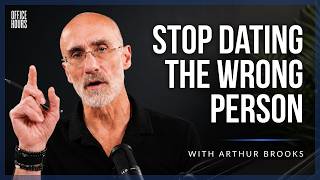
Arthur C. Brooks identifies three patterns that lead people to choose wrong partners: copying attraction to people already in relationships, being drawn to partners with substance-use disorders, and falling for Dark Triad personalities. He offers seven research-backed strategies to break the cycle, from meeting partners in low-drama environments like churches to recognizing your own tendency to fall in love too fast.
Chapters
Every romantic comedy ever made practically has the same premise. There's these two people who really like each other, but they're terrible for each other. They're not suitable for each other, but through a series of errors and misunderstandings, et cetera, et cetera, they suffer a lot, but then make it work and they live happily ever after. I mean, that's kind of the whole premise, but that's actually a pretty dumb premise. Maybe you have found that you don't date the right person, that you date the wrong person, maybe over and over and over again. How come? What's going on? I'm all about complementarity. I love of puzzle pieces that fit together in relationships. What I don't like are the ones where people are actually terrible for each other and trying to make something work that actually shouldn't work. What is today's episode? The 3 reasons you might be dating the wrong person over and over again and the 7 ways to stop doing that. Hi friends, welcome to Office Hours. I'm Arthur C. Brooks. This is a show about love and happiness, and I'm going to talk especially today about love, romantic love, and the problems in it. Now, this is a show that we run every single week about some of the biggest questions that people have ever asked me and, and how behavioral science and even some neuroscience can illuminate the answers to these questions. I hope you're finding it interesting and useful. For those of you who've been watching this show from the very beginning, thank you for staying with it. Thank you for sharing with other people. The whole idea is to lift other people up. I want to help equip you to become happiness professors just like me in your own way, in your own life. And sharing this, this show with other people is a good way to do that. So I appreciate that an awful lot. If you like the show, please do let us know what it is that you like, or if there's something you don't like, let us know that as well. We really like the feedback. It's really important to us. So do write in at officehours@arthurbrooks.com. That's the the email for the show itself. And if you want more content like this, you can get it by subscribing to my newsletter. That's at my website, ArthurBrooks.com/newsletter. And if you actually want to go a little bit deeper, we're actually running a series of retreats and you can find out about in-person events where you can be talking about these things with other people and indeed with me. So go to retreats.ArthurBrooks.com. As always, please like and subscribe and leave any comments that you've got. Any place that you're watching or listening to this show. You're not broken. You're meaning-starved. I talk to people all the time who are by any external measure successful. They built careers, they have families, they've checked the boxes, and yet something feels off. Life feels thin, like you're going through the motions, like you're watching yourself from the outside. And here's what I want you to know. That feeling is not a personal failing. It's not ingratitude. It's not something wrong with you. It's a meaning problem. And it's an epidemic. The modern world is extraordinary at giving us comfort, achievement, and distraction. It's terrible at giving us meaning. And no amount of success will fix that. I've seen it in my research and I've seen it in my own life. That's exactly what we work on at MEA, the Modern Elder Academy. In a program I've developed called The Meaning of Your Life. It's not a lecture. It's not a quick fix. It's several days of real work in a small group on the questions that actually matter. If what I'm describing sounds familiar, I hope you'll come take a look. As I mentioned at the outset, today's episode is about falling in love and staying in love. That is the number one topic when I teach my class to my graduate students at the Harvard Business School. I have a, I have a unit, a module module in the class called Falling in Love and Staying in Love. And quite frankly, they would keep me on that topic the whole semester. It's utterly baffling. It's very mysterious. Such a complex thing, seems so hard and yet so unbelievably important for most people so they can live a happy life. And it seems like it's getting harder in modern life, which indeed it is. And I've talked about that in all the episodes that I did about the meaning of life and the overuse of technology. I talked about how it's just It's a difficult thing. I'm not going to complain about technology today, about how the way that we disintermediate our relationships technologically, how bad that is for actually falling in love or making friends or anything. I've done that ad nauseam. I will do that in the future. Today I want to talk about more eternal problems that people have, some of the chronic issues that people have in finding the right person. Maybe you have found that you don't date the right person, that you date the wrong person, maybe over and over and over again. How come? What's going on? Well, I'm going to give you some information that you can actually use. If I do my job, you're going to see yourself. You're going to be able to break out of patterns because I'm also going to give you a whole bunch of solutions. What is today's episode? The 3 reasons you might be dating the wrong person over and over again and the 7 ways to stop doing that. Very practical episode. So do feedback. Let me know how you think about this topic and do you want me to talk about this more on the show? I really find this interesting and part of the reason is because I want you to find love if you haven't found it yet so that you can live a happier life. I'm a big fan of, of relationships that really work. Now, let's begin with a little bit of data. According to the Pew Research Center, and I quote their data all the time, this is really one of the very finest survey research sources that we have. When people are asked whether dating is hard, whether finding the right person is hard, people who are actively dating, 75% say, yeah, it's hard. 75% of people who are dating saying this feels really hard, and most people say the dating is getting harder. Now, a lot of that is what I've talked about in the past, about the way that we misuse technology, how the, the complicated algorithms are not a substitute for the complex in-person relationships. One of the reasons that I'm working with some app makers to get people out on dates faster and, and staying less time in the apps themselves because you need the complex information, not just some sort of algorithm telling you who your perfect date actually is. That just doesn't work. But if you're the kind of person who, who finds that you haven't just dated the wrong person, but that you're dating the wrong person over and over again, this is really an episode for you. Now, what does it mean for dating to be difficult? One problem that people often talk about is that they go on a lot of dates, but there's not very much attraction. That's kind of level 1 trouble. Higher than that is that they are attracted, but they're attracted to the wrong person and it leads to a lot of heartache. At the highest level is they're attracted to the wrong person and they can't get off that track. It's kind of like that movie Groundhog Day where they keep going back and keep going back to somebody with the same kind of sets of traits and they're in one ruined relationship after another. Now, our culture doesn't help here. I mean, every romantic comedy ever made practically is— has the same premise. There's these two people who really like each other, but they're terrible for each other. They're not suitable for each other. But through a series of errors and misunderstandings, et cetera, et cetera, they suffer a lot, but then make it work and they live happily ever after. I mean, that's kind of the whole premise, but that's actually a pretty dumb premise. You know, the truth of the matter is that doesn't even have anything to do with real life. I've seen this over and over again. I've seen this because I've been in education for such a long time with young adults who want this. The truth is that, you know, you shouldn't look at movies and say, oh, that's so romantic. The people who are truly terrible for each other and somehow make it work, that's just such a beautiful story. Why can't I do that? That's the wrong way to live your life because that's completely at variance with the way that things actually go. Attraction to the wrong kind of person, generally speaking, leads to sadness and frustration. Now, what am I not saying? I'm not talking about people who are attracted to each other who are very different from each other. That's a different thing entirely. I mean, I, you know, when I was 24 years old, I met a girl who was a year older than me who had never been to the United States, didn't speak a single word of English. I didn't speak a single word of her language. And that was a lot of difference there. We now have 4 grandchildren and we made it work, but that wasn't because we were bad for each other. It just meant that we were really different from each other and had to figure out how we were really good for each other despite the differences. And the truth is we were really good for each other. We were both single. There was no— there's nobody was being unfaithful to another partner there, which is a horrible way to start a relationship, generally speaking. We had the same values. We wanted the same long-term things. We wanted to be in a permanent relationship and love. We both at some point thought we wanted to get married. I knew that better than she did. I mean, she's from Barcelona and they're very modern people. That actually took a little bit of convincing on my part. We were ready for a long-term relationship, you know, so We were compatible in all sorts of ways. We were just really different. So I'm not talking about difference. And, and if you follow my work, you know that I'm all about complementarity. I love puzzle pieces that fit together in relationships because that kind of complementarity is the, the essence of what good relationships are. What I don't like are the ones where people are actually terrible for each other and trying to make something work that actually shouldn't work. Now, to be sure, if you date at all, you're going to make a mistake. I mean, not everybody, but almost everybody does make mistakes. And, and that's important because that's how you learn and grow. It's the same advice I give to people who are trying to start businesses. Look, it's not always gonna work. On average, an entrepreneur has 3.8 failures before her or his first success. You learn and grow actually from your mistakes, to be sure. The problem with entrepreneurship is when somebody keeps making the same stupid errors over and over and over and over again, you gotta break them outta that cycle. And it's the same thing with the entrepreneurship of romantic relationships. That's the ultimate startup is how it works. And so you gotta make sure that you're actually learning and growing and not making the same mistake over and over again. Hence the topic of today's conversation. Many, many people tell me that they feel like they're just attracted to the wrong type of person, and it turns out they probably are. There's a bunch of social science on this, and this is not an exhaustive list, but I'm gonna give you 3 big ways that people tend to be attracted to the wrong kind of person, which becomes a pathology, actually. And then I'm going to give you the 7 ways to break out of that. So the 7 ways are good even if you don't fall into one of these categories, because there's going to be 7 good pieces of advice for finding your soulmate. But these big 3, you might really see yourself or some variant along these lines. And this is a ton of research behind it. As usual, I'm going to drop a lot of academic papers into the notes. Which you can look at or not. Okay. Number 1, the first big problem that people have is that they find themselves attracted over and over again to people who are already restricted. Now, what do I mean by restricted? That's just social science talk for they're already in a relationship. Some people find that they're most attracted to people who are already mated, not necessarily married, but dating somebody else. That is a phenomenon that social scientists call mate choice copying. See, we can take all the life out of everything, can't we? Mate choice copying means that you find somebody who's already in a relationship inexplicably more attractive to somebody who's not in a relationship. There's a ton of really interesting experiments that actually look at this. There's one 2009 study. This is from the Journal of Experimental Social Psychology, which is a great journal. The title is The Ability to Judge the Romantic Interest of Others. Good place to start. In that 2009 study, there was a group of single heterosexual undergraduate women, and they were shown a picture and a description of a young man, a moderately attractive young man. They were told different stories about him, and so they gave his background and his interests, etc., etc. Those were all the same for everybody, but for half, they told the woman that he was, um, already in a relationship. He was mated, and the other one they told him he was single. Well, it turns out that the women found the ones who were already in a relationship— same guy, same picture, same, same life background— 4 times as attractive. So these undergraduate women said, oh, he's already in a relationship. Interesting. Now, you might say to yourself, why would these women— and by the way, it works the same way with men— why do they find people already in relationships so much more naturally attractive, all else held equal, which is what these experiments do? There's 3 basic reasons why people do this mate choice copying. Number 1 is just laziness. You know, is somebody else is doing the work for you to make sure that that person is domesticable, that that person is capable of carrying on a relationship. They're giving you the data that they're capable of doing so. And, you know, I mean, look, there's a lot of people out there and most people watching me here have had experiences where somebody looks good and they're not because they're just not good to be around. Well, if somebody else says they are, maybe you should take that seriously. But that's laziness, isn't it? The second is envy. So mate choice copying is a, is kind of an envious thing. That person has a relationship. I, I want that relationship. I'm going to see, I mean, I would certainly like to swipe that person's mate. Um, and envy is so super common. I mean, we're, we're, we're evolved to envy each other because We're a hierarchical species. We know who's on top and who's below. And if somebody has got a relationship and we don't, that's something that we want. And so that envy leads us to want a little bit, little bit of a mate swiping, I guess you'd call it. And last but not least is just basic social comparison. I want something that other people have because that's related to the envy part, I suppose. That's a, that's a, a mark of status that somebody likes me. And so this is one of the reasons that, or these are reasons why we would engage in mate choice copying. Now, to begin with, that's a disaster because it usually ends poorly. And interestingly, even when it's successful, it'll end poorly down the line. Why? Because your relationship will generally end like it started if it was built on taking somebody else's mate. People who are unfaithful to somebody else will generally speaking be unfaithful to you. Is how that works. So infidelity is super high in relationships that started with infidelity. This is one of the reasons that mate choice copying is such a bad strategy for finding mates, and you have to deal with this interest that you have in people who are already mated. You might say that's karma if you believe in karma. You know, you did that thing and that thing happens to you, to be sure. But it's also just, whether you believe in karma or not, unbelievably unethical. You know, trying to go after somebody who's already made it, that's double-crossing somebody whether you know them or not. So it's a bad strategy from an ethical point of view. It's also a bad strategy from just an odds perspective of success. And that's one of the reasons that people will often say the big problem that I have is I only like men or I only like women who are, who are already in relationships and it always winds up becoming a disaster. That's why. So that's the first big pattern that we see. Are you a mate choice copier? Hold that thought. The second big pattern that we typically see in the data that comes up again and again and again in the psychology literature is people who are weirdly attracted to the people who are addicted or who, who abuse substances or have addictive behaviors. And a lot of that, according to most of the people who do work in this, most of the social psychologists who do work in this, is it has very much to do with somebody's childhood. That's the whole idea, sort of the model of what it means to be an adult. There's one 2009 study for the American Journal of Drug and Alcohol Abuse. This is a quote. I'll just, I'll just, I'll just give you this quote. And the reason I'm going to read this to you is because this is the most academic sentence I've ever read. This is, this is the problem with academic writing. Nonalcoholic daughters of alcoholics were more than twice as likely to marry an alcoholic as nonalcoholic daughters of nonalcoholics. That's what it's like to read the academic literature. But you get the point. Among women in this study, if your father was an alcoholic, you're more than twice as likely to be attracted to alcoholics when it comes to pair bonding and mating. What is a man in your view? It's Dad. What did Dad do? He drank too much. That's the whole sort of psychology that's actually behind that. But of course, that's horrible. I mean, a lot of people think that they can solve their partner's addictive behavior. Most people— that's a, that's an exercise in futility to a very large extent. It's a bad idea to get into a relationship with somebody who's compulsively using, craving, hiding, escalating, experiencing withdrawal. And here's a reason for that. I've done a lot of work in this area. An addiction is a relationship, and I got news for you, it's the most important relationship to an addict. If you have somebody who drinks alcoholically, the booze is number one. You're not number one. And trust me, you're going to figure that out real fast because you'll be betrayed for the alcohol, the drugs, the gambling, whatever it happens to be. It's like a love relationship. There's a very famous book by a writer named Carolyn Knapp, K-N-A-P-P, called Drinking: A Love Story. It's a great book. It's a memoir of her struggles with alcohol where it really felt like a love relationship, because that's how addiction actually feels. The result of it is that if you're attracted to an addictive person, you're basically mate choice copying, but just with substances. That's a big problem. That's something you actually have to fix. Now, not just because it's, it's usually a doomed relationship, but because a partner's uncontrolled abuse of substances, that leads almost inevitably to psychological, physical, and social trauma. And the rate of divorce is way, way, way higher. Now, interestingly, I've seen data that show that men are more likely to divorce alcoholic wives as opposed to wives divorcing alcoholic husbands. Women tend to hang around it a lot longer and they sustain a lot more psychological trauma as a result of it. Men or women, you're not going to like it if you're attracted to somebody who's an addict. Again and again and again and again. You need to fix that. So stay tuned. Okay. Number 3, the third big pattern that shows up in the literature is that you're, you're attracted to somebody with a dangerous personality, with an antisocial personality. And, you know, you think to yourself, well, that's not possible. Why would I be attracted to bad people? Because people are attracted to bad people. And I'm going to explain exactly why. Now, if you've been following this show, you know where I'm going with this. I'm going toward the Dark Triad right now. I'm going to explain that here in a second. This is your first episode that you're watching. I'm going to explain what a dark triad is. But suffice it to say that long-term watchers of the show know that I talk an awful lot about people who have personality characteristics that are highly antisocial. Being attracted to somebody who's really quirky can be fine, can be okay, right? But the more neurotic somebody actually is, the more likely it is that the relationship is going to end in tears. And the more that the person that you're attracted to actually has an antisocial personality, the more dangerous it actually gets. If you're like me, you got to be drinking when you're in the gym and you have to be drinking something clean without any calories that will actually give you your electrolytes and all the good stuff. For me, that's LMNT. LMNT. You probably knew that already. It's a great product that helps you stay hydrated without sugar and a bunch of dodgy ingredients that are found in a lot of popular electrolyte drinks and sports drinks. No sugar, no junk, just electrolytes. Electrolytes that actually work. Give it a try. I like it. It's science-backed and made for athletes, fasting, keto, or happiness scientists like me. Anyone who sweats. So how do I use it? I use it in the morning, 4:45 in the morning. I don't like to drink anything with caffeine or anything that peps me up because I like to be real clear, and I drink my caffeine later. Element is just the ticket that I need. Give it a try yourself right now. You can get get a free sample pack with any purchase at DrinkLMNT. That's Drink, just like it sounds, LMNT.com/Arthur. Try it risk-free. If you don't like it, they'll refund your order, no questions asked. But you're gonna like it. Okay, now I'm gonna put a link right here to my episode on dark triads. When you're done with this one, go watch that one if you're interested in this topic. A dark triad is a personality constellation that's present in 7% of the population, according to Scott Barry Kaufman, the Columbia psychologist who does the best work on this subject. They're above average, the population average, in 3 different personality characteristics. Narcissism. It's all about me. Machiavellianism. I'm willing to hurt you to get what I want. And psychopathy, psychopathic traits, which is to say I will hurt you and not feel any remorse or any empathy or very little of that. Okay, so just to be above average on those 3 traits puts you in 7% of the population. And this is really bad for relationships when you're with one of these people. By the way, these make horrible friends because they tend to betray you. These make horrible colleagues. They take credit for your work. They make the worst bosses because they'll just mistreat you. But above anything else is how terrible it is to be in a romantic relationship with dark triads. They cheat, they steal, they'll empty your bank account, they'll break your heart. They're overwhelmingly disloyal to you. They will betray you. They will cheat on you. That's what dark triads do. And yet some people find that they're irresistibly attractive. Now, I know some of you are watching this going, wow, Will, that's me. I keep getting attracted to jerks. Maybe it's not just a jerk. Maybe it's something beyond that. Let me explain why some people would find romantically irresistible somebody with these personality pathologies. And if you don't have this, good for you. Maybe you're shaking your head going, how is it possible? Boy, is it ever possible because we see it again and again and again. Dark triads in dating markets are very good at getting you to fall in love even though they're not falling in love. So you've seen my work on this perhaps, but there's a neurochemical cascade that happens in your brain when you're falling in love. You're going through a series of changes neurochemically that's bonding you to the other person. Dark triads are very good at looking like they're going through this cascade. While you're really going through this cascade. Their whole objective— a dark triad, narcissistic, Machiavellian, psychopathic— it's all about me. I get what I want. They want to use you. They're not interested in learning more about you to see if they're falling in love. That's the normal thing to do for healthy people. They just want you to fall in love so they can get what they want, which is maybe getting you into bed, getting into your bank account. It's something that they actually want from you. Which is not a lifelong relationship. Here's where it gets really toxic, and here's where we actually see this happen again and again and again. Dark triads in the dating market are often matched up again and again with people, especially women, because this is where most of the research has been done. We don't know as much about this among men. Women who have a syndrome that's often referred to as emophilia— that's E-M-O-P-H-I-L-I-A— L-I-A. So not hemophilia, it's not a blood disorder. It's hemophilia, which is the tendency to fall in love very quickly, sort of pathologically quickly. Now, is that you? There are lots of people watching me right now. It's like, yeah, I fall in love really fast. Like I sometimes I feel like I fall in love after an hour or after, you know, two dates. You see this a lot. There is this, and, and again, it's not your fault. I mean, this is just something that some part of the population tends to do. Almost certainly that means they go through this neurochemical cascade of falling in love extremely quickly. They scream through the process. That's much faster than, than, than ordinary people. And it can be hard on you if that's you under the best of circumstances. Here's the problem. You will be attracted to, and you will attract dark triads if you're emo-phobic. Why? Because they can spot you a mile away. They're very good at spotting people who fall in love really, really quickly. And then they, these are the ones who will glom onto you and say, oh, It's like you'll confess, I feel like I'm falling in love after one date. And they'll say, me too, because you're bait. It's irresistible because you're the kind of person that can take the greatest advantage of. There's a lot on this. I'm going to throw a few articles into the, into the notes about this combination, both dark triads in the dating market, but the combination with dark triads and emo-philiacs, where the dark triad is going after short-term mating and the emo-philiac actually wants a long-term relationship, et cetera, et cetera. But suffice it to say that it's a complete disaster because it almost never works. The hemophilia is, which sounds really romantic, it's not good under the best of circumstances. It generally speaking means that people will jump into relationships. These are Vegas weddings, right? And what it leads to, very indiscriminate romantic bonds that look like true love at the very beginning. It turns out that are not. Multiple engagements, lots and lots of marriages. And when they involve the dark triad coming on the scene, which emo Felix once again find irresistible, Why? Because they can make themselves out to look like fellow emo Felix. Like, ah, I found my soulmate. We both fell in love in 2 hours. No, you just attracted a sociopath. And so a lot of people who date the antisocial personalities again and again and again and again are in this cycle. Maybe some of you are seeing yourself now. Maybe you know that you're dating the wrong person over and over again. Why would you keep doing it? Right. But part of it is because you might not know your way out, but part of it is a problem of cognitive dissonance. You know, cognitive dissonance for social psychologists is when you have two competing cognitions that they're in conflict with one another. And one of the cognitions is unbelievably pleasant and it's in conflict with another cognition that is extremely unpleasant. Which one do you go with? Because you have to resolve it or you can't move forward. You have to decide one's right and one's wrong. And so you decide that the one that's pleasant is right. So let's say that you have, you know, I'm feeling incredible love for this person. Cognition 1. Cognition 2. I've noticed that he keeps shoplifting, for example. I mean, it's like, this is a wonderful person and the love of my life, and this person is chronically doing illegal things that are really unethical and bad. And so how do you resolve that? You resolve that by disregarding the shoplifting. That's one of the reasons that even though you know somebody's not right for you because the person's married, because the person's alcoholic, because the person is clearly trying to exploit you, that you will disregard that information because you're resolving your cognitive dissonance in a way that you like best. We have to stop doing that. So what do you do now? Once again, if even if you're not falling prey to these three things, but you're not finding any satisfaction in the people that you're dating. Here are 7 strategies, things to keep in mind that will make your dating life better. And once again, these are all scientifically validated. And if you are a, a serial member of the wrong dating club— I've got the wrong person again and again and again and again— especially if you're falling in one of the patterns that we talked about here, these 7 strategies are really going to help a lot. Okay, dating strategy number 1: do the work. And stop relying on somebody else's judgment. I mean, mate choice copying is all about making somebody else do the work, but just in general, one of the worst dating strategies is caring what other people think about the person that you're dating. You know, if you're on a dating app, for example, you're looking at a dating profile and you're thinking, if I went out with this person, what would people think of me? That's pure social comparison, and that's a sort of laziness, but it's also a way to destroy joy in your life. Social comparison, after all, is, as they say, the thief of joy. That's attributed to lots and lots of people as a quote, even Theodore Roosevelt. But you know, it's true. When you consider a match, ask yourself, do I actually like this person? Not what would my friends think about her, or what will people think of me when I'm with her or him? Do the work and stop comparing. That's the first big lesson about what people do when they're actually dating in the right way with a high likelihood, higher likelihood of having a good relationship. Number 2, if you are falling in love too quickly, you are emo-philiq, the way to solve that is by being aware of it. Like anything else, you know, the reason that I do my work in the Science of Happiness is because people get happier when they understand the science and change their habits on purpose, which you can do. And then of course, best of all, when you teach it to other people. If you are, have a tendency toward emophilia, you need to know that so you can say, oh, I'm doing that thing again. I'm becoming unbelievably infatuated again. It's not a romantic thing. It creates tons of pain. It will cycle you through relationships that go too quickly. They become too intimate, too fast, where you wind up being heartbroken again and again and again, and maybe even a string of failed marriages, which is really hard for family life. It's really hard for getting on with your life. There's nothing beautiful about that. As a matter of fact, nothing fun about that at all. You're at high risk under these circumstances, and that means adopting some boundaries, actually putting some protocols in place on how quickly you're going to do this, how quickly you're going to do that. You actually have to pace yourself in a particular way, in the same way, by the way, if you knew that you, you have a tendency to drink too much at parties, that you're going to set up some rules for yourself. I'm not going to drink at this party, or I'm going to have 3 glasses of water before I actually have a beer. People have all sorts of rules that can keep them in check. You're in charge, not something having to do with your neurochemistry, but you have to know who you are and make some decisions. That's number 2. Number 3, expand your time horizon for your relationships. Now, this is an important one. When you think of bromance, what's the timeline over which you imagine it? Is it a week at the beach in Ibiza? Is it a semester in college? Is it the rest of your life? Well, it turns out that the shorter it is, the greater risk that you are of choosing a bad partner. This is not a moral point that I'm making. This is a very well scientifically valid— validated one. In 2018, psychologists were writing in the Journal of Sex Research Well, that's on the nose, isn't it? And they compared adults' mating timeframes with personalities of their mates. And the shorter the timeframe was for what they were looking for, the more likely they were to attract somebody with psychopathic or sadistic personality traits. You will magnetize yourself to that. Now, I'm going to tell you in a minute where to go to get those longer-term time horizons as opposed to the short-term time horizons. But the whole point is, think to yourself, about the time horizon that you envision. And here's the mistake that a lot of people make who are getting the wrong person over and over again. They have a long-term time horizon in their head, right? But they're putting themselves in a situation that looks like a short-term time horizon. Look, if you're meeting somebody in a bar in Ibiza and you're leaving in a week to go back to your home country, you might be thinking to yourself, I'm gonna meet the love of my life, and then we're gonna correspond with each other, and then we're gonna visit each other over the next couple of years and and then, you know, he's going to come to the United States and marry me. And, uh-uh, not likely going to happen. That's not how it works. He's in a short-term mating situation for a reason. So no matter what the time horizon is in your head, you have to actually make sure it's the same time horizon in your behavior and what you're saying. See what I mean? Number 4, focus on things that aren't what dark triads are good at displaying. Now, what are dark triads really, really good at displaying? Physical attractiveness and status. That's what they're great at. They're great at that. That's why they have the— they're virtuosos at dating profiles. And that's the stuff that dating profiles are talking about. It's like they have the best photos and they look like they have the best jobs and they're getting in and out of a Ferrari or, you know, whatever happens to be. Don't look for that. Now, I don't have to tell you, you know perfectly that if you had to choose, like, what am I looking for in a long-term mate? What's the best, the best odds that this thing— I'm going to grow old with a person? Good teeth? Nah, that's not it. How about a desire for faithfulness and exhibited kindness? Those are better odds. It's what it comes down to. So the more that you're actually looking for what dark triads are good at, the more likely you are to get a dark triad. On the contrary, look for something and be clear that you're looking for traits that dark triads are really bad at, like faithfulness and kindness. Focus on the things that aren't looks and status. Okay, that's number 4. Number 5, go look in the right place. This is related to this idea of time spans here. Look in the right place. Really interesting research shows that, that you have the highest likelihood of getting somebody with light personality characteristics, not the dark ones. If you look in places like your house of worship, a library, a voluntary organization, a running club, stuff that's not overtly sexualized, something that's more about meeting people as opposed to bodies is what it comes down to. You're most likely to meet a darker personality type in bars and in clubs and at beaches. I got nothing against bars and beaches. Bars and beaches exist for a reason. People can be very, very happy going to bars and Uh, sometimes I like going to beaches myself, but the whole point is when you're trying to meet your mate, you're much, much more likely to meet somebody who has a longer-term time horizon and therefore has lighter personality traits, more likely to give you a good relationship and break you out of a cycle of finding people with darker personality traits by meeting them in the places where they want to go so that they can meet their soulmate as well. That's what it comes down to. Now, what about online? I know you're thinking, you know, you have this question online, and the answer is that there are some apps that are more like bars and beaches, and there are some apps that are more like libraries and voluntary groups. You know what I'm talking about? Those that are actually loaded on values that are more characteristic of getting you out on dates sooner as opposed to lurking online longer, that are more— that have more ways for you actually to learn more about a person's values and values congruence. Those are the ones you actually want to look for is what it comes down to, as opposed to the ones that have really short-term time horizons. And the good apps are actually getting better at being more like libraries or volunteer organizations and less like clubs and bars. All right, number 6, here's a hard one. Stop looking for your ex. It's a really weird thing. What you find is that many people have this idealized memory of their first love. I've seen this again and again and again, and it's actually one of the reasons that there is a shocking statistic of the really high percentage of divorce proceedings that have a social media reference in them because somebody from the past reached out to them. Somebody from their past reached out to them because they're sick, because their marriage isn't working, or they're, or they're, they're, they're really dissatisfied with their mate. And they think, well, my first boyfriend or my first girlfriend or that girl, that boy that I met in college, they idealize it in a particular way and they're looking for that relationship again. Many people will sort of imprint this idea of true love from earlier in their life and they'll keep kind of looking for their ex again and again and again. There's a reason you broke up. Maybe it just didn't work out, but maybe that person truly wasn't right for you. And if you're trying to replicate that and trying to get your ex over, not literally your ex, but somebody just like your ex, you're gonna have the same problem again and again and again. I see this constantly. The same partner over and over and over again who looks like a person that they felt like they truly loved. If this is you, what do you do? You're not a prisoner of that behavior. On the contrary, one of the things that I teach my students a lot is something called the OSS, the opposite signal strategy. And there's lots of ways where you get a signal and you do the opposite on purpose and you will it. So for example, if you're lonely and you're depressed, what you want to do is curl up on the couch with a comfy blanket and a pint of Häagen-Dazs and watch Netflix by yourself and feel sorry for yourself. But that's the wrong thing to do. You have to engage in the opposite signal strategy of going out and riding your bike and calling friends and all the stuff that you don't want to do. Why? Because your brain is lying to you. Your executive centers are not working properly. You're impaired. And the same thing is true if you're a pathological pattern of looking for the wrong person over and over again. The opposite signal strategy is Not him. Not that. On purpose, go for the opposite of the thing that's actually not working for you. Even if you're like, I won't like that. Give it a try. That's all I can say. The opposite signal strategy is often a really good strategy. And last but not least is number 7. Stop romanticizing doomed love. Hollywood doesn't care about you. Hollywood wants to sell tickets. Stories about people that in real life would never work out. And if they worked out for 2 weeks, they certainly wouldn't for 2 years, or let alone 20. And we need to stop romanticizing these, these star-crossed lovers all the time. But, and again, this is not just Hollywood. I mean, this is the oldest trope in country and Western songs and even, even, you know, romantic poetry. Here's a little poem for you. All right. I don't want anybody to say that they're not getting the arts in this show. You left me boundaries of pain. Capacious as the sea between eternity and time, your consciousness and me. That's Emily Dickinson, who was not a very happy person, by the way. And that's a beautiful poem. That's really nice writing. That's a horrible basis on which to base your relationship. That's not romantic at all. That's just sad is what it comes down to. What you deserve is a person who's right for you, a relationship that's functional, that gets better over time. It doesn't mean it doesn't have problems. It doesn't mean you're the same. On the contrary, you're going to have lots and lots and lots of fights. But this is— you're looking for the person with whom you can have a, a deep values compatibility and a deep kind of friendship, a companionate love with plenty of passion that will last you to the end of your days. And you're not going to get that if you keep dating the wrong person over and over again. I hope this helps. Do a couple of questions and we're done. Polly Chandler wrote into the show, "I'm loving the new book." Thank you, thank you, thank you, Polly. Here's the new book, by the way, The Meaning of Your Life. "My challenge is that I'm listening to it on my phone as an Audible book. This might be in direct conflict with what I'm hearing about the impact of being on my phone. Even on my show, I talk about the phones. How do you reconcile a book that advocates for the numinous brain and yet is yet to get access to the content, have to be on my phone?" Okay. The problem with the screens is actually not what you're listening to, which could be like a CD or, you know, a cassette tape back from the old days. The auditory cortex of your brain is working. You're not working every part of your brain. You're not capturing your whole brain. The problem with phone use and scrolling is that it's, you know, it's the sound and it's what you're reading and it's what you're looking at, which is occupying a lot of the occipital lobe of your brain. Too much of your brain is involved and there's not enough of your brain to actually mind wander and to fill in gaps in the stories. Listening to something is perfectly fine. Just like reading a book is perfectly fine. That's a very natural and a very good thing to do. What I would recommend is no multitasking while you're listening to my book, Polly. So don't, you know, shop on Amazon while you're listening to my book or do 2 or 3 other things because then you're too occupied. So just, just listen while you're walking or maybe while you're sitting in your living room and, and, and that's fine. That's a good use of a device. And I'm not saying that just because it's my book. Second, this is from Lauren Prescott. Thanks, Lauren, for writing in at the website. Is there room for fun, less serious activities and leisure, such as playing a sport, trying a recipe, hosting a dinner party? These aren't contemplative, but they seem productive a lot more than binge-watching or scrolling. Boy, that's for sure. Now, when I did that episode on leisure, I'll put that in the links, I talked about the work of Josef Pieper, the great 20th century philosopher who is an expert in leisure. He called it the basis of culture. And he said that great leisure, deep leisure has 3 components, or it has 3 silos that you can be in. Number 1 is leisure based on deepening your metaphysical sense, your transcendence, maybe your spiritual life. Another is by learning something that they're not paying you to learn. And last but not least is deepening your love relationships. None of that rules out any of the stuff you talked about, Lauren, the whole idea of playing a sport. Learning about something, especially doing it with friends, fantastic. Trying a recipe, this is a learning experience. Hosting a dinner party, that's deepening relationships. That's great leisure as far as Josef Pieper is concerned, as far as I'm concerned as well. The whole point is actually doing one of those three things or something along those lines, doing something that's really generative to you as a person and to your soul, even though they're not paying you for it. That's really what leader is all about. Well, we're at an end. Please let me know your thoughts at officehours@arthurbrooks.com. Like and subscribe. Hit the subscribe button on Spotify, YouTube, Apple, wherever you're getting this podcast and leave a comment. I promise I read them all. And follow me on socials, on Instagram. I have a lot of content that's not appearing here or anyplace else. LinkedIn is also great, other platforms. And do order The Meaning of Your Life: Finding Purpose in an Age of Emptiness. That's my new book, which I'm on tour all the time. I hope I actually see you out on the road, but if not, I'll see you next week for the next edition of Office Hours. Thanks everybody.






