How to Be More Optimistic with Simon Sinek
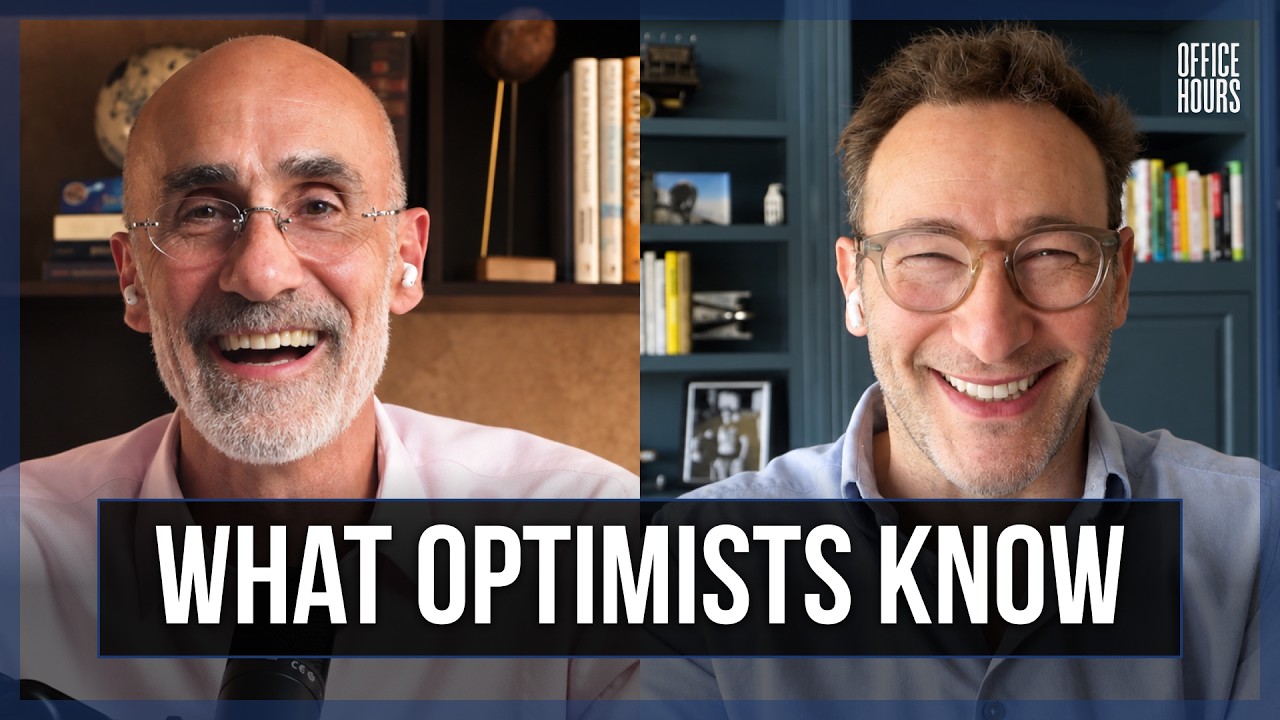
Simon Sinek defines optimism as an active belief in a bright future paired with clear-eyed reality. He outlines a four-step protocol: disengage from negative inputs, adopt a shared vision, tell a compelling story about why it matters, and build a concrete plan to get there.
Chapters
Your moniker is not, you know, acclaimed public speaker, number one New York Times bestselling author. It's optimist. What does that mean?
We're defining ourselves by our jobs or something we did 20 years ago. And the problem with that is the accomplishments get further and further away, become less and less relevant. And what happens when you no longer have the job? Then who are you? I'm very strict about defining myself by who I am so that if I stop doing any of the things I do, I'll always be an optimist till the day I die. People say to me things like, how can you be an optimist in these times? And my answer is always the same, which is like, well, what good is it being optimist when everything's perfect? Find a story that explains why all the sacrifice, all the heartache, all the, the 2 steps back are worth it. You could make more money, work fewer hours, you could do something else. What is so important in the world that all that suffering is worth it? Hi friends, welcome to Office Hours.
I'm Arthur Brooks. Brooks. This is a show about love and happiness and how we can use those ideas in our own lives and the lives of other people, specifically focusing on science and ideas. Thank you for continuing to watch the show. If it's your first time, welcome. I hope that you'll come back. And if you like it, if you've been here a long time or this is your first week, please do like and subscribe. That's one of the ways that we can train the algorithm, that the algorithm on YouTube or Spotify or Apple or wherever you're getting this to deliver this to more people. in their feed. And we want more people to be watching this show because love and happiness, who doesn't need it? Right? As always, if you have comments or criticisms, please write to us at officehours@arthurbrooks.com or put them, your ideas in the, or criticisms or comments in the, in the comments below, wherever you're watching or listening to this. Today is a special episode. Actually, I'm going to be talking about something that's adjacent to happiness. And that's, that's the subject of hope. I'll tell you who our guest is in a second, but first let's talk about why we would do an episode on hope per se. The reason is because we're teaming up with a collection of other podcasts for what's called a Be Hope Podcast Takeover. Oh, the invasion of the podcasts. You've probably seen this in other podcasts in your feed, but the idea is to spread a message of hope and optimism right now when the UN General Assembly, the United Nations General Assembly, is getting together in New York. That's happening as we air this episode. Leaders from around the world are coming together for that. And we want to inspire them. No matter what your views are on the United Nations, what they should or shouldn't be doing, we all want better leaders. We want leaders who are more hopeful, who are more optimistic, and who are getting a better vision of those ideas into the lives of the people that they govern. Well, I'm not doing this episode alone. I typically do, but not today. Today I've got a great friend with me, Simon Sinek. Most of you probably know his work. Simon Sinek is somebody who has been talking about meaning in life and who talks about himself, calls himself an optimist. It's the first word in his bio. He believes in this whole idea of optimism and hope. It comes out of his pores, but he's also an intellectual. He talks about what it is and how to get more of it. Simon was actually trained as an ethnographer. He has an interesting academic background. I'm not going to be focusing on that. I'm going to be talking more about what he's found out about people and how to motivate them to be their best selves, companies to be better too, for serving people and creating value and all the things that he's been talking about in public life. He's gotten pretty famous as a matter of fact, talking about positive things in a world that's so full of negativity. It's really quite a distinction. I have to say, he's somebody that I personally have a lot of love and respect for. Many of you have seen him appear on stages around the world. Uh, you've probably seen him on YouTube as well. He has some unbelievably popular TED Talks. His most popular one, the first one that he did was on the concept of why, the power of why, asking why, what is the why of your life? That's been viewed more than 60 million times. That's a lot. His lecture on millennials in the workplace, that's another one that he did, actually reached 80 million views in his first week and has been seen hundreds of millions of times since. He shares his inspiration and his writing through bestselling books, including His big bestseller, Start With Why, also Leaders Eat Last. I'll be talking about that a little bit with him and The Infinite Game, as well as through his podcast, A Bit of Optimism. You can actually see me on his podcast. I've appeared there numerous times. He's also the founder of The Optimism Company. The Optimism Company, I like that, which is a leadership learning and development company. And he publishes other inspiring thinkers through his publishing partnership with Penguin Random House called Optimism Press. Simon's a unique guy. He's a guy who lives what he actually talks about and has an interesting life as a result of it, but also gives us ideas on how we can be more optimistic and how leaders can be more optimistic. And you're going to take a lot away from this episode. Right now, you're like Neo in The Matrix. You can keep scrolling, experiencing a simulation of life, or You can wake up to how your attention is being harvested for profit. It's happening to people all over the world right now. You don't want to be productized like this anymore, but it's hard. Tech addiction is so potent because it's been designed to tap into your dopamine system. Just like heroin, porn, gambling. You've got the cravings. You're addicted. You don't like it, and I don't either. But I can't just tell you to stop doing it. That's hard. If you want to break free from the system, you need an incentive. Well, here's one. Why don't you join a phone company that pays you not to use your phone? If you want to reduce brain rot, get Noble Mobile. It pays you to use less data. It gives you an incentive to unplug. Noble Mobile is the phone plan that finally aligns incentives with what's good for you. Use less data, earn money back. And when you do, you'll be living once again in real life, and you're going to like how it feels. Simon Sinek, delight to see you as always.
It's a joy. Always good to see you.
Yeah. You know, I was just thinking about this before we started. Do you remember when we met?
A long time ago in Philadelphia.
In Philadelphia. Exactly. At a congressional retreat, we were speaking to the assembled members of Congress. Do you remember that?
We were. And we were the only 2 external speakers.
Exactly right. And I sat in on your talk.
And I sat at your talk and realized you were my older brother.
I regret the older part, but I love the brother part. No, it was great. And over the years, we've actually done a lot of things together. We've, we've, we spoke together on stage a few times. We've done the Aspen Ideas Festival. We've also spent some nice personal time together. And your work has been fundamental to my own. Me and so many other people have been over the years influenced by, for example, Start With Why. I saw that. I saw that famous TEDx talk, TEDx Puget Sound or something, right?
That is 100% correct.
Yeah. And I saw that and I thought, holy moly. And I thought about it and only This year, I actually finally wrote a book about the meaning of life.
I knew you'd catch up at some point.
But of course, I mean, I cite you because how could I not? And the striking thing when I first met you is that you, your, your moniker is not, you know, acclaimed public speaker, number one New York Times bestselling author. It's optimist. What does that mean?
So whenever they give me credit for something, or you see my name on the back of a book where I've blurbed the book or something, I'm very strict about it. I always tell them to reference me as Optimist and blah, blah, blah, blah, blah, all the other things that I've accomplished. And the reason is very simple, is because I want to be defined by who I am, not what I've done. You know, I think it's funny when you read people's bios, you can, you know, we write our own bios, let's be honest, right? And so you read someone's bio and it's like CEO of, New York Times bestselling author of, Academy Award-winning actor, you know, So we're defining ourselves by our jobs or something we did 20 years ago. And the problem with that is the accomplishments get further and further away, become less and less relevant. And what happens when you no longer have the job? Then who are you? And so I'm very strict about defining myself by who I am so that if I stop doing any of the things I do, I'll always be an optimist till the day I die.
What does that mean to be an optimist?
It's the undying belief that the future is bright. I think people confuse positivity and optimism. You know, there is such thing as toxic positivity. I've never heard of toxic optimism. You know, toxic positivity is the denial of reality. Everything's fine. Everything's good. Nothing to see here. Right. Which is, which can be very dangerous in, in, in, in a work context, in a personal context. Optimism is not naive. Optimism accepts reality. Optimism accepts darkness.
Right.
And optimism sounds more like, we're in this dark place together. It's a dark tunnel. I don't know how long we're going to be in here, and I don't know what it's going to take to get out, but I know one thing for sure. There's a light at the end of this tunnel. If we work together and take care of each other, we will get through this and we'll come out of this stronger than we went in.
So it is a prediction in point of fact, but it also has a lot of agency involved in it because the whole thing that you said right before, we're going to come out of this together, is if we work together, we take care of each other, et cetera, et cetera, right? In other words, we can still screw it up.
That's true too. Well, and I think to truly be an optimist, I've never thought about it in these terms, but I think it's hard to be an optimist alone. I think a prerequisite for optimism is relationship because it's one thing for one person to be able to say, don't worry, I'm going to get through this. And that is, grit will do that for you for a while, but exhaustion and time can sometimes take a beating. I think it's hard to be an optimist if you don't have the relationship with others and gratitude for the relationships you have for those others.
I'm sure you are, but do you ever reflect on the words of the anchorite, the 14th century anchorite Julian of Norwich? Or do you know this? You know her most famous quote?
This is—
first of all, I'm sorry.
First of all, this is such an Arthur Brooks thing to say.
Yeah, I know.
You're like, Simon, You know, I was thinking about Schopenhauer the other day, and I know that you think about Schopenhauer a lot. And what do you think about Schopenhauer? I don't, I don't know who you're talking about.
This is, that's the most Catholic thing ever. So I apologize for, you know, but you always attribute the best qualities to the people that you love. This is why it's very—
That's very kind of you.
But she has a very famous quote. And Julian of Norwich was an anchorite, meaning that she lived in solitude. And her most famous quote is this, and it could have come from Simon Sinek. All will be well, and all manner of things shall be well.
I completely agree with her.
Yeah.
The thing that upsets people, there's 2 things that I find very interesting. People say to me things like, how can you be an optimist in these times? And my answer's always the same, which is like, well, what good is it being optimist when everything's perfect? That's number one, is these are the times to be an optimist. This is when you need optimism, number one. And how can you be so sure, right? If you just look at what we're in. And I think optimism requires a long-term view and sometimes a very long-term view. My favorite, what keeps me going, what I'm constantly reminded by the founders of the women's American suffrage movement. Every single founder of the suffrage movement in America died before the first woman voted. Of course they wanted to live to see the first woman vote. Of course, of course. But the fact that they worked with such optimism, they worked with such surety that it would happen so long as they build the infrastructure, develop the relationships so that momentum can continue with or without them, they had a view of optimism that went, in their case, beyond their lifetime.
Are you naturally an optimist, or did you decide to be an optimist?
I think both can be true. In my case, my dad's a big optimist, and so it was around us as kids. My mother's a little more cynical, but I like the combo.
And she married a guy whose last name is Cynick.
I know, I know. The irony is there. I think both can be true. It's like talent versus skill. It's like one of them you can work at and the other one you're kind of You have a little bit of an edge. I think some can be— you can have a natural disposition and I think you can work on it because I do think at some level optimism is a choice. I do believe that.
I mean, and that's entirely consistent with all the behavioral science literature and even the study on identical twins on personality and happiness is 50% genetic insofar as half of the variance in happiness is explained by DNA. And so it has to be so with optimism as well. And you've gotten better at it over the years through The environment and the way that you live and your habits.
And the choices I've made.
What I'm hoping that we're going to get to today is the optimism protocols. I mean, I realize that this is the optimism optimization. How about that?
Optimizing for optimism.
Oh, nice, nice, nice. But I want to make one distinction here because there's just a little bit of a linguistic one, which is the difference between optimism and hope. How do you think about those 2 things in contrast to each other? Are you a hopeful person?
I never use the word hope. It's funny. I mean, I guess I do. I'm sure I do. If somebody were to go back and evaluate all the things I've said, I probably said it. But it's not one of those words that's sort of my go-to word. And it's not that I'm against the word, but to me, the connotation of hope lacks the agency. The connotation of hope is more like holding, crossing one's fingers and waiting. I hope I win the lottery. I hope this works out.
I hope I feel better tomorrow.
I hope I feel better tomorrow. It's kind of a waiting for the world to give you the thing that you want. Where to me, optimism, though of course there are external factors, of course, beyond our control, but to me, optimism is the clarity and surety. I think that the close bedfellow for optimism is vision, that I have clear vision and I'm going to strive towards that no matter what.
Interesting. So I hope I win the lottery. I hope I feel better tomorrow. I hope the economy turns around. I hope my health starts to improve, which is, you know, waiting for the outside world to change. Yeah. And then there's a, a more sort of theological understanding of that. So many religions, including Christians and Jews, see hope as a divine virtue insofar as that you're saying, I can do it, which adds the agency to it. So it kind of depends on how you define hope, doesn't it? Like anything else. I mean, we're looking at this interestingly, the verb to hope in Spanish is esperar. which also means to wait.
That makes sense to me. That's revealing. I mean, I think, look, I've obviously used the word hope, you know, when I say like, oh, you know, I hope they're going to be okay. There's a flash flood. You know, I hope they're going to be okay. You know, I can make a donation, I guess, but I don't know, you know? And even when Obama ran his campaign and the poster said hope, what he was asking the electorate is put your hope in this person. Yeah. I think waiting and hoping, I think, are very— that's a very— I think Spanish is revealing a truth there. And by the way, I think that's perfectly legitimate sometimes. When somebody says, I hope this works out, and somebody's other response is, just wait. That's perfectly legitimate. Give it time. Have some patience. It will be fine, is perfectly legitimate.
So I want everybody to be really clear on this, is that whether it's hope or it's optimism, There is a better future. We can achieve it, but we have to participate in that better future. Those are the 3 parts, the 3 Simon Sinek ingredients to optimism, correct?
Yeah, I think that's right. I believe that you have to earn the right to complain. I think it is unacceptable to complain about something political, for example, if you don't vote. When, when I talk about you earn the right to complain, the bar is incredibly low. Like you have to have done The minimal amount to contribute to the thing you're complaining about in order to complain about it. But if you have done nothing to contribute, nothing, I don't believe you have the right to complain. Then you can just hope.
Yeah, yeah. These are the ingredients. And by the way, there's no reason to get wrapped around the axle about this. There is a better future, but we all must participate to make it so.
And please don't anyone send me any emails. I don't care about semantic rabbit holes. It doesn't matter what the dictionary says. If somebody interprets the term hope the way I talk about the word optimism, and they're going to fight me that their definition of hope is different to— that's fine. Then the word hope is wonderful. The words are irrelevant so long as the meaning is consistent. And I think too often we fight about words when we should be dealing with meaning.
So I think that kind of what gets to this Distinction here is the famous Stockdale Paradox, named for Admiral Stockdale in the Vietnam War. He was an incredible Vietnam War hero. He actually went on to have this post-war career when he came back from the Hanoi Hilton where he was staying, notorious prisoner of war camp. He actually was the vice presidential candidate under Ross Perot in 1992.
I actually remember that.
Extraordinarily. Yeah, he was a great American hero. And one of the things that he talked about was the prisoners of war who survived and those who didn't. Those who died, they said, yeah, I, I, guys, it's like, you know, stay happy because we're going to get out of here by Thanksgiving. And Thanksgiving would come and go and they wouldn't be done. He said, oh, don't worry, we're going to be out of here by Easter. And Easter would come and go. And he said, they, they died of a broken heart. But the ones who actually survived were the ones who said, we're going to get out. I don't know when. That sounds like you. Is that fair?
I think that's 100% true. It's also the difference between a finite and infinite mindset. The ones that struggle, and my friend Leopoldo Lopez, who was the prisoner of, political prisoner in Venezuela, he was a prisoner of Maduro's for, kept in solitary confinement for 4 years and in prison for 7. He said the same thing, which is the problem is the goal, is the deadline. And when you have moving goalposts, it becomes demoralizing to the point of nothing is getting answered. So it's an infinite versus a finite mindset. And not to make the analogy, I know we're talking about philosophy and not business, but I think the same is true when companies define their purpose based on a finite deadline or finite goal at the end of the year, and then they just keep moving the goal as their purpose. At some point, you will feel like this job is not worth it, which is kind of like a giving up without the existential component.
Yeah, yeah. No, and in business, that's a really, really good point. And that's a point that you make in The Infinite Game, which is a great book also. We're talking a lot about Start with Why and your personal philosophy, but it's manifested along Leaders Eat Last, all these really important books that you've written. I mean, it just takes different shape in different ways. I see that Infinite Game idea with respect to hope, and what I talk about is relationships that work and relationships that don't. And one of the things that I find about marriage is die of a broken heart. It's not that somebody is abandoned. It's just that the promises are never met because somebody is waiting. And the intention is never actually to do the thing that's being promised. The intention is to say, well, no, there will be a better future. I will stop traveling. I will be ready to have children. No, no, no, not now, baby, but I will be.
I like that. And I agree with that. And I want to add a, I want to add a nuance to that, which is because the way you define this broken heart and broken promises. If you simply fulfill the promises, then you won't break the hearts. Speaking from a lot of failed relationships, I'm an expert in this subject, by the way. I think that's a very—
Field research for a certain number of years.
Yeah, exactly.
Exactly.
I did it for science.
Yeah, that's good of you. You just give and give.
I think that's a very high bar because I think sometimes And I think it's too high a bar and an unfair bar, if I may be so bold, because sometimes I think we say things with very good intention. And this is, you know, optimists run late a lot, by the way, because they think the train will be there exactly on time. I think people in relationships make promises, little p promises, you know, big P promises are a different conversation, but little p promises, like, with very good intention, sometimes ignorant of all the other factors. Like, I promise I'll be there on time. I left early. I didn't know there was going to be a— like, I left at the right time. I didn't know there was going to be an extra bad accident that day. The way I think of broken promises, or the way I think of a broken heart, is more internal. It's our expectation of another rather than their failing to maintain their promises. It's what I hear was promised versus what I expected. So one of the best lines I've ever heard I read in a relationship book that said, we all live with the fantasy that our partners can read our minds. Why didn't you do that? I didn't know I had to do it. You should know that you have to do that. Why should I? Because you and I are in a relationship and you know me. You should know that I would want that. That's where the broken heart comes.
Right.
As opposed to saying, you know what would make me really happy if you could do this? And the other person, instead of just saying yes, because then you set up broken promise, says, I want to, Can you help me? And I have found that living with the fantasy of recognizing that, that we all live with the fantasy that our partners, our colleagues, our friends can read our minds. I, I, that would, to me, changed everything.
Yeah. That's like, but that, I guess that would be a toxic optimism about your relationship, right? Is this sort of cockeyed optimism that the person who loves you so much can also read your mind?
Yeah. I mean, I wouldn't call that optimism. I'd call that hope.
You'd actually call that delusion.
I'd call that delusion. But we all do it. We all do it. We all do it.
Oh yeah. Yeah. Yeah. No, no, it's actually, you know, in the work that I do and the work that my wife and I are doing on relationships, we find, for example, a significantly greater than half of divorces are initiated by wives who are just deeply, deeply disappointed. They're disappointed in their relationships. They're disappointed in the fact that, you know, the, what they wanted in their lives has become unachievable. And the end of optimism is often the death of love.
I mean, look, I think one of the greatest damaging things that ever happened to relationships is the movie Jerry Maguire. I don't know if you remember the movie Jerry Maguire.
Oh, yeah. There's a sports agent, Tom Cruise.
Sports agent, Tom Cruise, right? And Renée Zellweger says, I didn't fall in love with who you are. I fell in love with who the man you can be. Please don't do that. Please fall in love with who somebody is, not who you think they can be, because that is a fantasy version of the person that they may or may not live up to. But there's a video that's going around on the internet that I really love, that when you treat someone like the person you think that they can be, they are more likely to become that person because they have the support. And that goes back to what I was saying before, which is it's relationship and support structure and our ability to take ourselves on with all that positive affirmation and reinforcement. Like, look what you did there. I knew that you could do that, versus how could you get that wrong again? Uh, but when we treat people as if they are already the person, they are more likely to become that person. I thought that was wonderful.
It really is. And by the way, that's the secret to parenting. The secret to parenting is treating your child the way you want your child to be. And, and, and, and sometimes you become disappointed, but more often than not, they live up to expectation. That was a point actually made by Dale Carnegie in How to Win Friends and Influence People in 1936. He talked about, let's give people a good reputation to live up to. And I remember that, you know, with our sons and daughter, we would say, you're actually very hardworking. In marriages, it's slightly a different thing. There's the old expression that wives think they can change their husbands and they can't. And husbands think their wives won't change and they do. And so our expectations about the future, I mean, I don't know if it's true, but the whole point is this, you got to have rational expectations and they should be positive ones and you should be an agent in making I'm sure.
I think sometimes we also have irrational expectations. And so the concept of narrative, and you can apply it to relationships, but you see it very starkly in businesses. The leadership team gets together and they're talking about the issues, and then the name of somebody on the team comes up and somebody goes, ugh, he's so lazy. And now the entire leadership team thinks of that person as lazy because that term has been used to associate with them. Then they come up with a stupid moniker. It's like, oh, it's Lazy Dave again, right? Lazy Dave didn't get the work done. Lazy Dave missed another deadline. Why are we surprised?
Right?
And now we treat Dave as lazy and we will seek all the evidence that Dave is lazy. We will come down hard on Dave because he's lazy, and eventually Dave will quit or get fired because he's lazy.
Right.
And so I've seen this happen a million times. We're all guilty of it, myself included. And when I recognized that we had narratives of people in our company that I don't even work with them. I don't even know if they are or not these things. I just believe the person who's their manager, who's their leader. And so when I realized it was happening in our company, I came up with a system to interrupt. And so if anybody said anything, and by the way, the same as creating heroes out of people, oh, they can't do anything wrong.
Right, right, right.
The hero complex is also bad, bad, bad. So was there anybody who would create an imagined a narrative about someone, I would expect anyone in the room to say, hold on a second, that may be true, or we haven't given them good direction. They're in the wrong position. They had a bad night's sleep. They got stuff going on in their private life, or they're lazy. Any one of those could be true. And benefit of doubt, I think grace, grace, giving people grace that sometimes we are the ones that are setting the expectation in our imaginations. And someone is not meeting the expectations that we set in our imaginations that have never communicated to anybody and never given anybody any feedback. I think we do this at work, and I think we do this in our relationships. And the idea of communicating the good, bad, and the ugly, and teaching people how to listen and how to communicate, is the solution to all of this stuff, because then it's all out on the table.
As you know from listening to this show, I've never been a supernaturally happy person. That's exactly why I've spent much of my life and my career trying to understand human happiness, not just academically, but in a way that I could use very practically. And you can too. I don't do research. I do me-search. Well, and you-search. My time in academia has reinforced a lesson I continue to rely on today. Happiness, well, and energy are best managed through deliberate habits and discipline. I take my personal habits seriously. I need to. I have a morning routine. I've talked about it on this show. It involves prayer and exercise and healthy eating and, and a lot of coffee. Well, taken at the right time. But in my creative work, I've long looked for a gold star supplement to that routine that helps me take charge of my day. I came across Magic Mind. Now, I was skeptical at first, honestly. Because there's a lot of noise in the supplement space, and, and most of it really doesn't hold up to the science or human experience. But Magic Mind has ingredients that I like: adaptogens, nootropics such as lion's mane, ashwagandha, cognizin, L-theanine. These are clinically backed compounds with real research behind them. Magic Mind is a 2-ounce shot that you take in the morning. You don't get jitters. There's no crash. It's just your brain working the way it's supposed to— calm, sustained, and focused. If the same cup of coffee every morning has started to feel more like a crutch than a ritual, or if you're just tired of it, it might be worth trying something that actually works with your neurobiology rather than against it. Right now, you can go to www.magicmind.com— that's all one word— and get 50% off your first order, plus a 100-day money-back guarantee. So you really have nothing to lose by trying it. You can also find Magic Mind in stores near you using the store locator at magicmind.com. Do you think optimism is falling generally today?
Yeah. Yeah.
Why do you think that?
Because pessimism sells advertising. Pessimism sells clicks. I mean, look at AI. AI, the narrative that AI is going to take everybody's job, AI is less popular in our nation right now than the war in Iran. And they did it to themselves because the pessimistic view of, and the scary view of AI was very good for fundraising. And that's why they did it, because it helped raise money. And then you had CEOs like Jack Dorsey announcing layoffs of 6,000 people because AI can do the work, which is an absolute nonsense. AI technology is absolutely not good enough to just suddenly lay off 6,000 people. We're just not there yet. But he overhired, he was bloated, and if he tells the market, oh yeah, I was super bloated and overhired and I got to lay off all these people, his stock price will go down. And if he says, we're replacing these people with AI, it looks like he's on the cutting edge. And so this idea of narrative and fear, and we know that what bleeds leads, we know that because you sell advertising on the news, If it was non-commercial, we wouldn't be in this predicament. But scary messages and pessimistic messages and our lizard brain that is much more attracted to those things because the paranoia keeps us alive. So yes, in general, I think not just for politics, but for short-termism, the drive for stock price, the drive for money, the drive to get reelected, and the sacrifice of cause and the sacrifice of service.
Yeah.
The simple answer is yes, I think there's less optimism.
And the negativity that's in the social media culture, of course, is adding fuel to all of this, right? Maybe it's the biggest engine of all of this is how social media actually replicates negative much, much faster than positive. Is that fair?
Negativity sells better. Victimization sells better. The reason you aren't doing well in your life, the reason you hate yourself is because of this person or this group of people or this gender or this, whatever it is, right? The negativity helps us feel less responsible for the positions we're in in our lives if it's somebody else's fault.
Is it fair to say that if there were some way to make optimism great again, to coin a phrase, that that would actually make the world a lot better?
The answer is yes. The way I would rephrase it is not optimism, but vision. And I did equate those 2 earlier in our conversation. What I want more of in our nation is leaders with vision. Leaders who can articulate vision, not just a short-term goal, not just a solution, but rather something, the light at the end of the tunnel, that if we all work together and do the right thing, expecting that we'll make mistakes, expecting that we'll disagree, that we will reach there. And whether it's all men are created equal or shining city on a hill, or ask not what your country can do, ask what you can do for your country. All of these are reclassifications, retellings of the same vision. That original vision from the Declaration of Independence. And, and it's an ideal. We'll never get there, but we'll die trying. And that's kind of the point.
You know, Daniel Goleman's work, of course, who's fantastic on leadership. And he has a great 2000, year 2000 article called Leadership That Gets Results. Looks at these 6 big leadership models. And some of them look good, but are terrible, like being a pace-setting leader who's hopelessly workaholic. That's the worst kind of CEO or A coercive leader who barks orders down the hall and intimidates everybody. Some of it's pretty obvious, but yeah. Yeah. But the, by far the most successful leaders in business were those who were authoritative, not authoritarian, authoritative. And by that, he meant that would be kind of Jim Collins level where they had a super clear mission and vision. Mission means here's what we do. Vision means here's where we want to go. And what they did was that they coached everybody to become had to do their part. They saw the part that everybody plays. These leaders would say, do you see a better future? Let me describe it. It's going to be great. And by the way, you have a part in it that nobody else can play.
It's going to be great is insufficient. It's going to be great is insufficient because it's going to be great is vague. And I don't know what I'm aiming towards. True vision is an articulation of a future state that does not yet exist, stated in terms so clearly That I too can imagine it myself. And by imagine, I mean it literally lives in my head, in my imagination. But my picture in my head is the same picture as your head, in your head. And so that's what vision is. And so it's going to be great. This amorphous nonsense, that actually doesn't help because I can't strive for great because I don't know what I'm going towards. I think that's true. And the way I would def— I don't like the word authoritative, though I agree with it. Whereas I think it's too easily misinterpreted. But another way of rephrasing authoritative is stubbornly optimistic. I think you are stubbornly optimistic that no matter what's happening, you're like, guys, just come on. Can't you see what we're doing here? Like, we're getting closer. Yeah, I know we got kicked in the stomach this month, but look, we're getting closer. We got momentum. Like, that stubborn optimism is something we would all, uh, uh, want to be a part of.
Well, at what point does stubborn optimism actually become delusion? You and I work with business leaders all the time. And, you know, you talk to people who have a vision of, in their heads, they have a bad business model, for example, right? How do you actually coach people on, on that?
Delusion, I think, is very usually, um, if you're stubbornly optimistic, you believe so much in achieving that goal for the greater good that you were willing to say, you know what, I'm not qualified to lead this company. You were willing to say, I'm the one getting in the way. I think if you're delusional, it's about you. I think delusion is you think you have a savior complex, that only you, only you. And I think that's false. I think the truly optimistic leaders recognize that they're a piece of a puzzle, but they're not the whole puzzle. Every great leader I've ever met never imagined they would achieve what they achieved in terms of fame or money or even rank. But no matter what, they were stubbornly optimistic about the vision that they wanted to contribute to, regardless of where in the pecking order they were contributing.
What are the personal practices that people listening to us should be considering to become more of an optimist?
Allowing one's brain, allowing one's mind to wander. We underappreciate boredom. We think any blank space needs to be filled. We bring our phones everywhere. I think they should ban bringing phones into bathrooms in restaurants because I'm now waiting outside a bathroom for 20 minutes because somebody has to go on Instagram while I'm waiting outside. We fill every blank space.
Yeah.
And allowing our minds to wander is absolutely essential because that's where imagination, but also it's very calming. And I think it's good for the body. I think it's relaxing as a— and you don't have any great ideas unless you allow your mind to wander. All the great ideas happen when you're In the shower or going for a run or in the car. That's because you don't have your phone with you and you're disconnected.
You need more white space. What then?
We put a little too much pressure on people to be visionary. Not everybody is visionary, right? Like, some people have better imaginations than others. Like, some people can draw better than others, right? Like, it's not a good thing or a bad thing. It's just like we have different attributes and characteristics. And not everybody has to be a visionary and have a vision like Steve Jobs or Martin Luther King, right? If you do have imagination, go ahead and, you know, come up with something and see it. If you don't, find someone who does, whose, whose vision of the world you really, really like and latch onto it. And that's what happens with great leaders. They put a vision into words that help me put what I want into words, right? I've been trying to say that. is what you'll hear people say. Or, oh my God, yes, that. So you don't have to have your own vision, but you do have to find a vision. And if somebody else has articulated it, follow their cause or steal their vision. Because great visionaries don't mind who's contributing from what angle. Steal it, steal it, add it to your company.
Who cares? Yeah. The make or buy decision is irrelevant when it actually comes to a better vision for your own life. Where do they go? I mean—
I think You have to take the world in, right? You have to be an informed person. Vision can come from absolutely anywhere. Vision can come from friends. Vision can come from political leaders. It can come from business leaders. Vision can come from the principal of a school who's got a slightly different way of raising the kids. And some of those visionaries are stubbornly visionary, stubbornly optimistic without the words. That's a little frustrating sometimes because sometimes you have to spend a lot of time with them to get it. I'll tell you a great story of this if I can. So I had the opportunity to do some work with the Disney Imagineers. They're the people who invent all the rides, all the shows, all the parades. And we talk about imagination, right? They invent and build all of it. I went there back in the day and I was talking to them about the concept of why, what it is, how it works, and all of this stuff. And I thought, you know what, I'll do a demo. So I picked a random guy in the audience. He had gray hair. I picked a gray-haired guy because I figured he's got some reps. He's not— because I can't do it with somebody who's been here for 3 weeks. So I just played the odds and I said, okay, what about you? And what I didn't know, and I found this out after the session, is that the company had a nickname for him, that I'm not sure he knew that this was his nickname. They called him Ice Chips because he was a cold bastard and people were not fond of working for him. He was difficult to work for. He had very high standards and he wasn't the favorite guy to work for. So I've randomly picked this guy and I start doing this little workshoppy kind of thing where I'm asking him all these questions to get to what his why is and why all of this hard work is worth it. And he tells this story, he tells this one story. I'll do the compressed version. He told it over the course of like 5 or 6 minutes. It was an amazing story. He tells the story of a brand new ride that had just opened at Disneyland, and he went on the first day to see the opening of the ride. On the ride, he noticed there was a guy in a wheelchair with his son waiting to get on the ride. And he said, Everywhere in the world, what people see is a guy in a wheelchair with his son. Only at Disneyland do we only see a father and his son. We're all crying. And in an instant, we understood why his standards were so high, because to him, he had to make these things work so perfectly that at no point did this guy feel like he was in a wheelchair. He just felt like he was at Disneyland with his son. Instantly, everybody got it and everybody wanted to work for him. And the people who did work for him had this instant sense of pride at the level that they were working at because the stakes were that high. But it was his inability to explain his vision to others that made him difficult to work for. The minute we had a story that captured the vision, because sometimes you don't need the whole vision, you just need a story that captures it, instantly we all wanted to work for him.
So optimism is the vision of the better future and how to get there.
By the way, and that's a hack, which is when you are thinking about what your vision is or the world that you imagine or why you do what you do, you don't— look, you can go through, I've got, I put many things out in the marketplace to help people find it, of course. But the hack is find a story that explains why all the sacrifice, all the heartache, all the 2 steps back. Are worth it. You could just go do something else. You could make more money, work fewer hours. You could do something else. What is so important in the world that you, that all that suffering is worth it?
So that you need a plan. I mean, this is one of the things you talk about in Start with Why, et cetera, et cetera. I mean, we're just kind of yakking at this point. Oh, a better future would be this. A better future would be that. No. How are you going to get there?
That's a hippie commune. We're all talking around— that's like free love with nothing. And that also has a shelf life. It feels good in the short term, just like being finite-minded and no vision, only goals. Both of those work very well in the short term for different reasons. But at some point, the constant moving of the goalposts and the goal setting, goal setting starts to feel hollow and not worth it. And the constant vision without action starts to feel like no progress and demoralize it. So that's why great teams are made up of people who are visionary and people who are really good at getting stuff done.
Yeah. Getting stuff done. And by the way, that's often the case, the division of labor with inside married couples.
Yeah.
Where you've got kind of the visionary for the better future. And then you've got the work, you've got the CEO and the COO.
Yeah.
2 dreamers. Sometimes you have trouble.
One of the most wonderful people that I have in my life, is somebody I used to date for many years, and we're both dreamers and we both have our head in the clouds and we get along so well. It was hard in a relationship, but my God, the fun, the camaraderie, we just got along great. But the question is, was that the right combo for a relationship that could last beyond the time that it did?
Which I guess was a question that answered itself in due course.
And a frustrating realization for both of us. Both in and after the relationship. Because we still get a lot of breaks.
Yeah, that's great. I mean, as it can be a great friend, it's just not necessarily the permanent pair bond.
And the reason is simple is because for the things that I'm incapable of, I need help. And I know I'm a really good helper for the things that are somebody else's blind spots or shortcomings. And, and, and that works.
So, so this episode is actually part of the Be Hope podcast takeover. That's, that's happening at the same time as the UN General Assembly.
I just had a realization, and you said this is because this is going with the UN General Assembly and that their theme is hope. So I can't help but think about politics, right? Which is, okay, world leaders, why don't you articulate vision in a way and set up the way you lead your nations with such optimism and such a stubborn drive for the brighter future for everyone That it gives us reason to be hopeful. Because I think we can be hopeful of our own nations and of our own world if we hear that our leaders have optimism and vision and we're willing to work together to achieve that vision. Then that gives me hope. That gives me more than optimism. That gives me hope. That's exactly what leaders are not doing. There's a great irony in all of this, that after this whole conversation, we've come a perfect circle. that our definitions are holding true, which is if the world leaders have agency and take it upon themselves and accountability and togetherness, then they will become the external factor that gives us hope. But they themselves can't be hopeful. They have to lead in a way that makes us hopeful.
And one important clarification, I think, which is that to state a reason to be hopeful does not include To tell people that if you elect me, then the evil people will come and kill you. That's not an optimistic frame. It has to be positive fundamentally, as opposed to the absence of the negative, right?
It's, I mean, it's what we talked about before, which is it's using fear to drive behavior. You know, what I've learned is that great visionaries, they view obstacles not as the enemy, but they view obstacles as the thing to go over or around in order to achieve their vision. Because sometimes you, you both talk about enemies. You both talk about obstacles. Ronald Reagan talked about the Soviet Union, right? The difference was Ronald Reagan wasn't trying to just simply destroy the Soviet Union. It wasn't just some enemy that he wanted to take down. It's that Ronald Reagan had a vision of the world, of how it could exist, and the Soviet Union was standing in the way.
That was a barrier to the fact that there were a lot of people that were not free.
Exactly. And once the Soviet Union dissolves, the vision continues. The vision continues. The vision doesn't conclude when the enemy drops out of the game. So I think that's a huge difference I've seen because rallying the troops against is useful and much easier, but it has to be rallying the troops for, except this thing's in our way.
So what is the policy version or the political version of step 1 in being a personal optimist, which was stopping being hypnotized by stupid nonsense?
I mean, we're talking in idealized terms because the reality is if being optimistic got them elected, they'd be optimistic. If working together got them elected, they'd work together. So let's be very clear that politicians are motivated by the incentive structure, not by anything else.
Oh yeah, no, no. So stipulate to the fact that getting elected is not prima facie evidence of virtue.
No. No, no. And they'll do whatever— they'll do and say whatever works. And we are living in a world now where we are not demanding our politicians work together. And so they won't. I think change always starts at home. I think the more that we at home learn to listen, learn to listen to whom those we disagree, we learn to find common ground with whom those we disagree. When we learn these things, we will demand them of our leaders and of our politicians, and then they will have no choice because that's what gets them elected. I think our politicians are a reflection of us.
Yeah. Oh boy, here we go. It's our fault. Well, actually, maybe so.
Kinda, a little bit.
Kinda.
Not completely. No, I know. It's never always someone's fault. Our parents taught us when it takes two to tango, or the truth is in the middle, or whatever metaphor you want to use. Right? Yeah, we are a bit to blame. And until we can take accountability for the way we behave, um, and the incentives and the demands we make, then it's not going to change. So, and by the way, it's much easier to change us than it is to change them.
Yeah, certainly at the individual level. Um, you, you grew up when Ed Koch was the mayor, right?
Yeah.
And do you remember when Ed Koch finally, after a decade, more than a decade, lost? Do you remember that?
Yeah.
He finally lost. Yeah. And do you remember he gave, giving a concession speech and he memorably made your point and he said, the people have spoken and now they're going to have to pay.
Both, both true and bitter all at the same time.
One aspect of your genius, if you'll permit me, Simon, your ability to teach policy leaders how to tell stories. Yeah. I've seen you do it. You go from the specific to the general in a very inductive and very beautiful way. And I've seen politicians with greater or lesser degrees of success use your stories as a matter of fact. But that's step 3. That was step 3 for the individual is paint the picture.
Paint the picture. Like, and again, it's a, it's a, it's a hack, right? Um, tell me a story that captures why all of the sacrifice is worth it. Like Ice Chip's story. Like, you know, because that's how we got there. Remember that was a, that was a 20, 15-minute process of getting into that story. Where you could work somewhere else, you could be happier, you could work less. Tell me a story that captures why all this hardship is worth it. Let me tell the story of this ride we opened. And he's telling me in his mind the stakes. He's not able to see that that's what it is until this moment. It might be an amorphous thing in his head, but the fact that he spent a career not explaining this to people, Even though he's such a good and noble guy, the only thing we could see was the high standards.
Well, what was holding him back is he didn't have a high morale team. And we all know that you can be unbelievably successful. And if you don't have a high morale team, execution is going to suffer because you're going to be churning through people and burning them out. And yeah, which is a problem for sure. And then of course, last but not least, any policy is tangible. How do we actually get there specifically? Not just pie in the sky, not just elect me.
What's the best strategy? And you recognize, oh. There are people better than me at some of this stuff. You know, I should get them on board, which is why you want to be— this is why you want to be visionary and inspiring because people will quit their perfectly good jobs to come and help you.
Yeah. But a visionary, an inspiring visionary person who also is effective, critically important. I mean, you see all these, I know a lot of CEOs who promised the moon and the stars and people want to run through the wall for them. And they reason there's, they realize there's nothing on the other side of the wall that we actually can't get there. I mean, and, and, and in politics, of course, the whole idea, if you elect me, Then our country's going to be okay.
Yeah. I mean, we're tangible animals, right? Dopamine is— we've demonized dopamine for the right reasons, but dopamine is a very important chemical in our bodies that makes sure we go find food, we find shelter, we accomplish things. We are very visually driven animals. This is why writing down your goals and all of this stuff work, because we're visually driven. So vision is great, but at some point I'm going to need proof to keep me motivated. Vision will inspire, but the, but the progress and the proof will motivate.
Before we finish, can I summarize what I think are the 4 big points of this conversation I want everybody to take away and see if you agree?
Sure.
Number 1, people need to ask themselves not what I am, but who I am, which by the way, is an enormous departure for most people. Who am I? It's actually a frightening question. for a lot of people, or an unasked question. But the who question is at the heart of your own why, not the what.
I'd go with sure. But if you want what the who really is, because it's one of the biggest criticisms I always get, is like, Simon, in your golden circle with why, how, what, you forgot the who. No, I did not. Who we are is the sum total of all 3 of those things in balance, that I know why I do what I do, I'm disciplined in how I do it, And what I do, the results that I produce, the progress that I make is tangible proof of why I started in the first place. And when you have all those 3 things in balance, you will know who I am. And so will I.
That's what I meant. That's what—
Well, then yes. Then, then a resounding yes.
That was brilliant of me. Don't you think? That number 2 is whether you call it optimism or hope, what we're talking about is number 1, the, the, the assertion that there is a better future. The second, that it is achievable, that we all must participate in that achievable, better future. That's really what we're talking about here, right? Check. 3, this is a show about happiness. You will be a happier person if you're an optimist. Take our word for it.
Just trust me on that one.
Trust me on this one. But to be an optimist personally, really there's 4 things. There's a 4-step algorithm here. So this is the optimization of optimism. As it were, we're in an optimization culture. One is, is stop being hypnotized by the nonsense that's around us. The world wants to keep you hypnotized. The world doesn't want you to be awake. You know, the awareness that actually comes from being fully alive is a problem for a lot of the world because, you know, we are putty in the hands of a lot of forces out there if we're not. And that might mean putting down your phone and it might be stop listening to negative voices. And if there's something that's probably hypnotizing you, Identify it, turn it off so that you can be fully awake.
Can I tweak it?
Of course.
Let's tell people what we want them to do, not what we don't want them to do. So instead of telling people to stop listening to noise or stop listening to the hypnotism and stop listening to the negative, let's tell people to seek out and listen more to positive voices, to things that inspire us, to things that make us feel hopeful.
And to do that, you have to be unencumbered by the stuff that was actually blocking that.
If you're going to do that, you're necessarily going to put the other stuff away.
Second is build or buy, find or create a vision of a better future, your better future and other people's better future.
In terms so clear other people can see it too. Yes. Amen.
And how do we make it so clear? Step 3, you need a story, not the data, not the math, not the model. You need the story. And by the way, there's all kinds of stuff we've talked about on the show again and again and again about how the imprinting that actually comes from a story, because we are Story-based animals. The story that explains the why of this vision, that explains it so that you understand it and that other people understand it. And part 4, which is kind of like the 4th noble truth of Buddhism, is the Eightfold Path. No, it's the plan to actually get there.
Life is a pilgrimage and recognize that the plan is written in pencil.
Exactly. Which, by the way, that is a, that's not a side note. That's intention without attachment, which is a very fundamental Buddhist concept, right? That we've covered it probably ad nauseam at this point. Um, okay. Now let's finish up on what all of, all the people, cause I'm sure that the entire UN General Assembly is listening to this podcast.
No, no, this is the, this is the second time they're listening to it.
Yeah, exactly right. To be a more hopeful policy leader in a time of difficulty in the world, which suffice it to say is true. And by the way, that's always true. Stop hypnotizing people. That's number one, right?
Be a force of inspiration.
Yeah. And that force of inspiration is step 2, state a reason to be hopeful. And that's a positive vision. Look, either you believe it or you don't, either you believe it or you don't. And if you don't believe that there's a better future, get out.
Yep. I used to, I used to say this to companies. I like, I'd stand in front of companies and, you know, there'd be a newly declared vision. And I would say, look, We're not asking for everybody to sacrifice and believe desperately in this vision. That is unrealistic given the company of this size. Unrealistic. But what we are saying is that if you just want to come to work, clock your card, do a good job, and go home at the end of the day, and that's all you really care about is just let me do my job and I'll do a good job, we're actually totally fine with that. What you're not allowed to do is sabotage. If you don't believe in the vision, you just want to like make it, you just want to like live my life, leave me alone. I'm good with that. Not everybody has to buy in or believe. What you're not allowed to do is sabotage.
Right. So 2 is state a reason for a hopeful future, a positive vision, not a negative one. 3, okay, now go tell a vivid story of that better future.
That's, that's 100% true.
And number 4. Is set out tangible policies, write the map that actually will actually get us there, that people are going to believe so that they know what they're signing up for and that you know what you're signing up for as well.
Nothing good ever got accomplished without actually doing things.
Simon, this has been helpful as always. I've learned a lot and I hope our listeners have as well. And I know the UN General Assembly is going to be rocking and rolling because of talking to you today.
Maybe they'll invite us to speak to them together and we can have a reunion.
Wouldn't that be great?
That'd be so fun. This was great. I love talking to you. I always leave smarter. You help me see things I didn't see before. And just, just generally, I think you're, I think you're pretty awesome.
I admire you a lot.






