The Mission Generation: A Conversation w/ Arun Gupta on Reclaiming Purpose and Rebuilding the Future
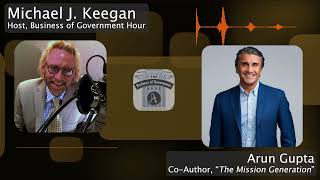
In this Business of Government Hour interview, host Michael talks with Arun Gupta—CEO of the Noble Reach Foundation, venture investor, and co‑author of The Mission Generation: Rewrite Success, Reclaim Your Purpose, Rebuild Our Future—about a new mindset he calls the “Mission Generation.” Gupta explains that the Mission Generation is not defined by age but by a desire to blend personal ambition with civic responsibility, a mindset that spans early‑career, mid‑career, and late‑career professionals. Drawing on his experience in venture capital, academia, and public‑service programs, he describes how the rapid changes in geopolitics, technology (especially AI), climate, and great‑power competition have made purpose a stabilizing force for talent. A central contribution of the book is the “Compass Capital” framework, which reframes career development as the accumulation of six inter‑related forms of capital: mission, trust, health, learning, experiential, and financial. Gupta argues that, like financial capital, the other five can be deliberately invested in early and allowed to compound, giving professionals a language to make non‑linear career choices and to communicate value to both private‑sector employers and government agencies. Gupta also outlines systemic barriers that deter mission‑driven talent from entering government—rigid pay bands, lengthy hiring cycles, and clearance processes—and highlights ongoing reforms such as the OPM TechForce initiative and Noble Reach’s Scholars program, which aim to streamline hiring, create civic sabbaticals, and build bridges between private‑sector expertise and public‑service impact. He shares early data (e.g., a 10‑fold increase in applicant pool, 80 % of scholars wanting to stay) to illustrate growing interest when purpose is framed effectively. The interview concludes with a call to senior government leaders to recognize the value of purpose‑oriented talent, to adopt the language of Compass Capital, and to view the nation’s 250th anniversary as a rallying point for building an interdependent system that leverages the best talent for solving the nation’s biggest challenges.
Chapters
What is the mission generation? What motivates talented professionals to pursue careers in public service today? And how can government attract and empower a new generation of leaders who want their work to have purpose and impact? I'll explore these questions and so much more with Arun Gupta, CEO of the Noble Reach Foundation and co-author with Professor Thomas Fuhrer of the new book The Mission Generation: Rewrite Success, Reclaim Your Purpose, Rebuild Our Future. You wear many hats. You're CEO of Noble Reach Foundation, a venture capitalist, you know, right? Lecturer at Stanford University, adjunct professor at Georgetown. I'm wondering, Arun, how did all of these roles converge into this new book, um, Mission— The Mission Generation, and What drew you to write it now?
You know, it's a great question. So, you know, the lens of which, you know, we were writing this book and, and what brought me to it was, you know, look, my father was in the Navy for 40-plus years. And, and so public service has been in our family. My professional career was, as, as you noted, as a venture capitalist. And the latter half of that was in investing at this intersection of mission tech and entrepreneurship. So you saw the magic when you could bring the entrepreneurial ecosystem to solve mission-driven problems alongside government at scale. Then I was a lecturer and teaching at both Georgetown and Stanford. And I think it opened my eyes a bit as well then to the ecosystem there where students were really thinking about how to build their careers and were feeling like they were having to make a binary choice between doing something that would provide them financial security security and independence or feeling like the alternative was to do something meaningful. But they didn't see the intersection of that. And, you know, in the world I was in where we were investing in companies that were entrepreneurial companies that were for-profit solving mission-driven problems, you felt you were around it. So it was like, how do we, how do we talk about that more? In the first book, Venture Meets Mission, we took a very kind of ecosystem approach. Like, how do you take the venture ecosystem build bridges with government to solve problems at scale. And that helped us launch Noble Reach. And one of the core tenets was there is like, how do we get our best talent to go into these ecosystems to solve these problems? I think as we were launching these programs and finding ourselves in different settings talking about that, you realize that people were all searching for the same thing, and that was purpose right now. And that in a world that was changing very rapidly between geopolitically, technologically, environmentally, great power competition, there's a lot of uncertainty. But the only stabilizing force in that was really kind of mission and purpose. And we saw that in the numbers with the people always used to ask us, like, how are you going to convince young folks to want to go into public service? And our theory of change was actually people really want to. The problem is we haven't— modernize the infrastructure, the language, the systems to be able to connect them to these kinds of mission-driven opportunities. And as we saw the recruiting numbers kind of— in 2 years, our applicant pool went up 10x. It spoke to that there's something more meaningful there. And as I would share this with folks, it was really this notion of like, it would be great to highlight that. Right? Like, if you can't see it, you can't be it. And sharing stories of people doing it, what they were getting out of it, and that we were in a point in time right now where, you know, and I think the 250th honestly plays into this as well, where I think there's a, you know, a more visible dialogue taking place of like, what's our civic compact look like? A sense of civic renewal. And, you know, most importantly, you know, how do you how does personal ambition coexist with civic responsibility, right? And that needs to be an and, not an or. And so I think with everything going on about a year ago, we felt like it was the right time, if we could, to push and get something out there that captured what we were seeing, at least through our programmatic view, and then highlighting stories of people that were bridging these two narratives.
So Arun, let's start off with the foundational idea. Who exactly is the Mission Generation, and why does the book insist that this isn't a generational label defined by birth year?
So it's interesting, you know, we started— if I'm honest about it, we started thinking about the Mission Generation as being this next generation coming in. And as I alluded to earlier, as we started chatting with mid-career folks at the tech in business, in government, and even academia, and then even late-career folks, we realized that the notions were very similar. And that what the two core themes was that people were looking for pathways to kind of combine personal ambition and civic responsibility. And, you know, as a result, like, we don't think this is something that only younger folks are feeling and addressing. But the mid-career person that's spent 15 or 20 years in whatever their role may be is feeling that same sense of like, how do I give back? How do I get meaning out of what I'm doing? And look, my cohort of folks that are now maybe starting to become empty nesters, as we think about our next phase, we think about ourselves as probably having another 20, 25 years in us, right? And so the way you think about how you spend that changes. It's one thing when you think you have like a 5 or 10-year run ahead of you. But when you start thinking of 2025, you're really thinking about like, what am I building? What's my legacy? What does it play out to? And what I found is the common theme with a number of those folks that are able to bridge that is being able to have these nonlinear careers where you work across different sectors, build networks across different groups. And for the younger folks, what we're what we're trying to do is highlight that, you know, they can't see it, they can't be it, right? And so how do we show stories of people that have done it? And that's what we have found, you know, the uniting theme around the Mission Generation as being not just one defined by age, but really a mindset of, look, I want to do well. There's nothing wrong with wanting to have financial security. I mean, that's like, a basic need and necessity. But, you know, I think we're also thriving. How do I combine that with a sense of connectedness and civic responsibility? And so the way we talk about it in the book and, you know, why we draw on the 250th right now, it's that 250 years ago, our founding fathers created a system, a brilliant system for independence and a system to allow us to be independent. And I think that, you know, the opportunity for the mission generation is now to take that and, you know, build a system for interdependence, right? So that we create more of these crosswalks where people can— we recognize we are actually still dependent on one another. And, you know, I can take skills that I've learned in a certain area and be able to move that into another sector over time. In that the way we think about it is that, look, my dad had one job for 40 years. I had a career, multiple employers for 40 years. Going forward, people will have 4 to 6 careers over their lifetime, right? Over 60 years of working. And in doing so, that changes the way you start thinking about the decisions you make. An example, if you're coming out of school you know, you don't need to be thinking about the decision you make as something that you're having to own for the next 30 years. You feel like you can, you know, it's a chapter, it's not the entire book.
So Arun, when you and Thomas Fuhrer, who your co-author is, um, we're kind of putting this together, you saw data, I think it was like 86% of Gen Z, 89% of Millennials consider a sense of purpose essential to job satisfaction. But I'm wondering, picking up on your last point, um, that you mentioned Do these numbers reflect a genuine, as you said, cultural shift, or are they just aspirational, what people are saying they want versus what they're actually choosing? Any insight there?
No, it's a, it's a, it's a great question. I think it's a little bit of both, if I'm being honest with you, Michael, right? I do think there's in that data, you know, people being more aspirational with what they want. But I also do think there's a meaningful cultural shift. I see it in the teaching, being on campuses and the kind of questions students ask. How employers are now recruiting as well. And, you know, again, I think it comes down to, you know, especially with the younger folks, you know, look, they're coming off of COVID they're coming off of geopolitical conflict, and are seeing that for the first time that we've had in decades. They're seeing, you know, environmental uncertainty. They're seeing great power competition emerge in a meaningful way. And then you've got a technological disruptor like AI, which, um, also provides a lot of anxiety. And so I think with that, and this is what we kind of pose in the book, when things are changing so rapidly around you, what we say is that, like, we think mission and purpose are going to be your only stabilizing force. You know, over decades we've created pe— our identities around what we do or who we do it for. You know, the prestige of working for a certain kind of company, or the prestige of having a certain type of job. Versus the why are we doing it and what are we contributing in doing that. And I think the former, the who we do it for and the what we do, are getting disrupted real time, right? And when you, when you just go and follow the herd with wherever the, you know, the career centers are telling you to go work, it can be disorienting when the game changes because you haven't really centered yourself around mission or purpose. And if you centered yourself around that and then gone and pursued opportunities, even if things change, you have something that's stabilizing you. And so I think that is a cultural shift that we're seeing. Having said that, right, and the reason I say it's both is I still think our systems are pointed to the old scripts, right? So our systems don't support what I'm just saying. Right? And so that's why I think it's a little bit of both. I think the individuals— there's a cultural shift. But at a systemic level, we need changes in the system. We need changes. And I don't— when I say changes in the systems, this isn't like regulatory or anything like that. This is like how we think about it, how we talk about it, how we talk about success. Those are the kinds of things that we need to kind of— how do we show stories of nonlinear careers? How do we show young folks that— You know, their first job doesn't define what they're going to do for the rest of their life. You know, those are all small things that have big ripple impact. And, you know, I think that's what we're trying to hit at.
This has been a great setup because I think the book itself, the frameworks in the book, they're really practical. And you introduced in the book the Compass Capital, 6 forms of capital: mission, trust, health, learning, experience, and financial. Can you walk us through The framework— why structure it this way, and why does it matter for how people in or considering government careers should think about their own development?
Yeah, so, you know, this was kind of the, the real, um, I think, inspiration for deciding to write the book was just seeing that, you know, look, we have a system where, you know, the words we use define the system that we, we create. Right. And so when we talk about, you know, net worth in our society, if wealth is what you accrue, net worth is what you bring to the table. But when we talk about net worth, we talk about it in a very unidimensional way. You know, net worth usually means how much you have in your bank account. I don't think people conflate it with anything else. And so if that's the case, then the decisions you make and the systems you create, you know, circle that and reinforce that. And what we were trying to highlight here, and you know, this is the benefit of looking back on my career, right? And giving, you know, whether it be my, my own kids or, you know, my 22-year-old self advice, you know, anyone that's had that, they realize that like a successful career is far more than that. Right. And, um, but how do you put language around it that frankly, you know, has it feel like capital and, and, and has the same dynamic of like financial capital. And what I mean by that is that you invest in it. Over a period of time. The earlier you invest in it, the more it can compound over a period of time. You're not investing the same amount every year, but, you know, doing a little bit all along the way helps you. And so what we try to highlight with the frameworks is beyond— and with the very basic baseline of like, we acknowledge financial capital is important, right? Like, this is not about like, let's just all be altruistic and not have to worry about that, you know, like, People's financial security is incredibly important. But along with that, right, when you think about like how you think about your own personal balance sheet or your portfolio view, um, and you think about, you know, how those compound when giving advice to young kids, is that like, look, trust capital is incredibly important. What's trust capital? The relationships, the networks you build. Invest in those early on because those will compound over years. And I look at my own career 30 years later, like the relationships I built in my late 20s and early 30s, you know, are allowing me to do things today that I would've never imagined I could do. Learning capital, the capacity to continue to learn, right? We have institutions that still kind of are telling you like, hey, we're, we're preparing you for a career and here's the skills you need for that career. And we're seeing with AI that that's constantly gonna get blown up and change. The only thing that's gonna keep you ahead is, is, is curiosity. That's what people bring, experiential capital. This gets to the point of like, you know, if AI can go deep, like really what helps define you over time is like the different experiences you have, right? Like the fact that I can look at the same dataset as someone else, but if I'm just, I've only done, you know, I've been, you know, in one sector, I'm gonna look at it one way. But if I've been in 3 or 4 different environments, whether it be geographic locations or size of company or entrepreneurial, different sectors, and I see the same data, I'll process that differently. And that's deeply human. You know, health capital, right? Like, we, we downplay this, you know, um, in our culture, but obviously— and there's a lot more now being written about it— but the importance of taking care of your health, right? And being sustainable. Again, as people are going into this, they're going to be now working for 60 years, right? And so even the idea of like How do you pace yourself for that? How do you take— taking career breaks can become a norm in this context. And then finally, mission and impact. At the end of it all, we believe that meaning and financial capital don't need to be opposing each other. They should be aligned. And so we propose the framework there also because we believe experience, learning, health, trust, and mission, those are deeply human qualities, right? So in a world where everyone's like, oh my God, AI is gonna disrupt everything, you know, like what human qualities do you bring to the table? And we think these are what they are. We share it through stories of people that have used that to really, you know, build their career in a meaningful way. And so that's how we kind of came up with the framework and why we structure it the way we do. And so look, I think it has very different ways of looking at your careers. Back to the way we do the Noble Roots Scholars Program. Like, when I go to talk to students, you know, I don't say like, hey, come in and be a public servant. I'm— I just said like, why not have one of your careers be public service? What it does is it lands differently because they look at it and go like, oh good, I don't have to make a decision for life right now. I'm not ready to. Um, I'd actually like to learn more about what I care about, what I want to do, and It gives them a language to say, look, right now I may not be optimizing on financial capital, although I'll do fine, but I'm actually investing in my learning capital. I'm going to learn a new sector, new, new languages, new things, my experiential capital. And in this, I'm going to, I'm going to invest in my trust capital, like networks of people that over the next 10, 15, 20, 30 years can be helpful to me. And so. It gives another language for students to be making, or young people to be making decisions. But I actually think it's the same language for mid-career and late-career folks too. Having been teaching, you know, I'm always amazed at the number of people that get caught in this trap of like, what's my starting salary, with a $10,000 difference in making decisions based on that, right? And you want to shake them and say like, in the course of your 40 years of working, like, this is a rounding error. You should be making your decisions at this point on these other capitals because they will compound more effectively, um, as long as you can, you know, you have your basic financial stuff taken care of. And so that, that was a lot of what was driving it, was just seeing this firsthand with how I thought students were making decisions arguably against their own personal interest, but because it's the script that they were given that they should be maximizing on.
So there's a persistent tension in government talent conversations around agencies who want innovative-minded, mission-driven people. But, you know, the institutional structures of government— and let's take, for instance, the federal government, US federal government pay bands, hiring timelines, clearance requirements— if that's the case, they often drive those people away. So I'd love to get your, you know, insightful perspective or honest assessment, if you don't mind, of whether government is reforming fast enough to capture that generation?
Yeah, it's a great question. Look, it can always be going faster. Having said that, I feel like there's a lot going on in this direction today. So our program at Noble Reach with our Scholars Program, we're now collaborating with OPM and their initiative called TechForce. And TechForce is really designed around this, right? Like, how do we get our top tech talent coming into government at scale, right? They now want to, you know, pull in 1,000 of these young folks coming in. Part of that is the clearance requirements, and we're in some of these conversations, and I know there's others going on about like, how can you streamline that so that while students are at school and the work that they're doing, that they may, you know, you can start having them work through the clearance requirements? Again, to me, this is— the technology is there. This is about leadership. And so how do we change the hiring timelines so that it's okay to get your offer in November but not start until June? Just because other places are forcing you to interview and do things in the late fall timeframe, but you don't graduate till June, we need to make sure that we, you know, modify the system so that it reflects the current realities. For these folks. So we can't expect them to say like, hey, look, we can't get back to you until April or May because we would need you to start within 60 or 90 days, because then they're not going to let an existing offer just go to the wayside for the uncertainty of maybe getting an offer or not. What I can say is that all of those conversations are definitely happening. And so I am optimistic that there's, there's a will not only by the work that Scott Cooper's team at OPM and TechForce are doing. But you can see the agency heads are also clamoring and thriving for this talent because they realize to meet the objectives that they have, they need this. And then also, as far as the pay bands go, I think the pay bands widen obviously in the mid-career piece. And here I think the conversation that we pose in the book is like, how can we start to create a system whereby we can have something you know, like civic sabbaticals where firms would— if you've been there, you know, for 10 years or so, you can take a year or two and go into public service. And, and having those bridges in some capacity to enable them to come back, and then you can come back to your job without having, you know, lost space in that. And those conversations are happening right now. And so, you know, I think what we're trying to do with the book is to highlight the art of the possible, and then hopefully stimulate more discussion and dialogue around this. But also, you know, the reason I think, um, I'm cautiously optimistic is that, again, with, with leaders that we talk to in industry and tech or finance or business, but also with academic institutions and then in government agencies, there's a willingness to kind of say like, hey, look, how can we do this differently? And the ultimate thing I think we're trying to do with the Mission Generation is highlight like, we've got the best talent in the world here in the US. We just do. But they're trapped in their certain ecosystems, right? And then it's hard for people to leave that ecosystem and go to another one. But how do we create those bridges where we're allowing that to happen so that what we're doing is leveraging the best of the best to solve our biggest problems? And I think that opportunity exists today in a meaningful way.
Before we close, what would you most want listeners of the show, The Business Government Hour, many of whom are senior government executive policy leaders and public management practitioners and academics, to take away from your book, The Mission Generation?
For the government leaders, one, I hope they take away a sense of gratitude for the work that they're doing. And a sense of being seen for the work that they're doing and the importance of the work that they're doing. And not to conflate the notion of like getting, you know, young folks and tech-forward folks in as anything more than helping them accelerate the work that they're doing in the current environment that we're in. And highlighting for them that actually And it's interesting, Michael. I think when I talk to government folks and I talk about our program, they're like, well, do kids really want to come into government? And so the other thing I really want to leave them with is, absolutely, they really do if we can talk about it in the way that they're used to it being talked about, right? And if we can give them those experiences. And we're seeing that with our scholars. Like, in our first cohort, 80% of them wanted to stay in even after their term was done. And the question is why? And the why is that they saw the problems that they were getting to work on and the people that they were working on them with to be far more interesting than some of the things that their more prestige pathways coming out of school were getting to do in the places that they were doing it, right? And so what we'd like the mission generation to be for this group is to give them a language, right? Of which when they're recruiting and which when they're going and talking to folks, like, hey, look, this isn't about financial capital only. Come work for us and we'll give you greater experiential capital. You'll build these trust networks that you don't— you wouldn't have otherwise where you go. And all of this will— and you'll get a different kind of experience that you'll be able to carry forward with you for the rest of your career, that these will compound in a way. That will enhance your career, whether you're on the inside or the outside of government, in a way that nothing else will, right? And so, you know, I think that would be the message that we would like to leave, you know, senior government folks with. And also that we're at a— I think we're at a really important inflection point where we can create the mission generation within our construct here in the US, and the 250th can be the rallying cry around it. And, um, that we do need a system that's not only focused on independence but interdependence, right? And, and this would be the opportunity to do that.
This has been the Business of Government Hour, a conversation with Arun Gupta, co-author with Professor Thomas Fuhrer of The Mission Generation: Rewrite Success, Reclaim Your Purpose, Rebuild Our Future. Be sure to join us next time for another informative, insightful, an in-depth conversation on improving government leadership and its effectiveness. Until then, subscribe, download, and listen to the entire interview at Apple Podcasts, Spotify, Audible, or on your favorite podcast app. And as always, at businessofgovernment.org.
More from Arun


Leading Innovation in State Government | NobleReach Scholar Melissa Lopez-Barbosa