Charlie Munger speech - Advice for a good life - Commencement Address - USC
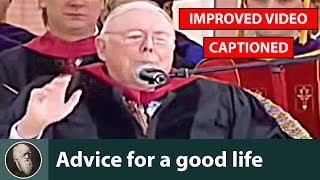
Charlie Munger on earning trust, learning across disciplines, and thinking in reverse to avoid mistakes. He warns against ideology and self-pity, praises checklists and seeking evidence against your own ideas, and uses Buffett and Cicero to show how concentration and assiduity compound over a lifetime.
Chapters
Well, no doubt many of you are wondering why the speaker is so old. Well, the answer is obvious. He hasn't died yet. And why was the speaker chosen? Well, I don't know that either. I like to think that the development department had nothing to do with it. Whatever the reason, I think it's very fitting that I'm sitting here because I see one crowd of faces in the rear not wearing robes. And I know from having educated an army of descendants who really deserves a lot of the honors that are being given to the people up here in front. The sacrifice and the wisdom and the value transfer that comes from one generation to the next can never be underrated. And that gave me enormous pleasure as I looked at this sea of Asian faces to my left. All my life I've admired Confucius. I like the idea of filial piety, the idea that there are values that are taught and duties that come naturally and that all that should be passed on to the next generation. And you people who don't think there's anything in this idea, please note how fast these Asian faces are rising in American life. I think they have something. All right. The I scratched out a few notes and I'm going to try and just give an account of some ideas and attitudes that have worked well for me. I don't claim that they're perfect for everybody, although I think many of them are pretty close to universal values, and many of them are can't fail ideas. What are the core ideas that have helped me? Well, luckily I got at a very early age the idea that the safest way to try and get what you want is to try and deserve what you want. It's such a simple idea. It's the golden rule, so to speak. You want to deliver to the world what you would buy if you were on the other end. There is no ethos, in my opinion, that is better for any lawyer or any other person to have. By and large, the people who had this ethos win in life. And they don't win just money, just honors and emoluments. They win the respect, the deserved trust of the people they deal with. And there is huge pleasure in life to be obtained from getting deserved trust. And so and the way to get it is to deliver what you'd want to buy if the circumstances were reversed. Occasionally you find a perfect rogue of a person who dies rich and widely known. But mostly these people are fully understood by the surrounding civilization. And when the cathedral is full of people at the funeral ceremony, most of them are there to celebrate the fact that the person is dead. And that reminds me of the story of the time when one of these people died. And the minister said, it's now time for someone to say something nice about the deceased. And nobody came forward, and nobody came forward and nobody came forward. And finally one man came up and he said, well, his brother was worse. That is not where you want to go. That's not the kind of funeral you want to have. You'll leave entirely the wrong example. A second idea that I got very early was that there's no love that's so right as admiration based love, and that love should include the instructive dead. Somehow I got that idea and I've lived with it all my life and it's been very, very useful to me. A love like that celebrated by Somerset Maugham in his book of Human Bondage, that's a sick kind of love. It's a disease. And if you find yourself in a disease like that, my advice to you is turn around and fix it. Eliminate it. Another idea that I got, and this may remind you of Confucius too, is that wisdom acquisition was a moral duty. It's not something you do just to advance in life. Wisdom acquisition is a moral duty. There's a corollary to that proposition which is very important. It means that you're hooked for lifetime learning. And without lifetime learning, you people are not going to do very well. You are not going to get very far in life based on what you already know. You're going to advance in life by what you're going to learn after you leave here. If you take Berkshire Hathaway, which is certainly one of the best regarded corporations in the world, and it may have the best long term investment record in the entire history of civilization. The skill that got Berkshire through one decade would not have sufficed to get it through the next decade with the achievements made Without Warren Buffett being a learning machine, continuous learning machine, the record would have been absolutely impossible. The same is true at lower walks of life. I constantly see people rise in life who were not the smartest, sometimes not even the most diligent. But they are learning machines. They go to bed every night a little wiser than they were when they got up. And boy, does that habit help, particularly when you have a long run ahead of you. Alfred North Whitehead said at one time that the rapid advance of civilization came only when man invented the method of invention. And of course he was referring to the huge growth in gb, GDP per capita and all the other good Things that we now take for granted, which happened just started a few hundred years ago, and when before that all was stasis. And so if civilization can progress only when it events the method of invention, you can progress only when you learn the method of learning. I was very lucky. I came to law school having learned the method of learning. And nothing has served me better in my long life than continuous learning. And if you take Warren Buffett, if you watched him with a time clock, I would say half of all the time that he spends is just sitting on his ass and reading. And a big chunk of the rest of the time is spent talking one on one, either on the telephone or personally, with highly gifted people whom he trusts and who trust him. In other words. It looks quite academic, all this worldly success. Academia has many wonderful values in it. I came across such a value not too long ago. Several years ago, my capacity as a hospital board chairman, I was dealing with a medical school academic. And this man, over years of hard work, had made himself know more about bone tumor pathology than almost anybody else in the world. And he wanted to pass this knowledge on to the rest of us, and particularly the people that treat cancer, bone cancer. And how was he going to do it? Well, he decided to write a textbook that would be very useful to other people. I don't think a textbook like this sells 2,000 copies, but those 2,000 copies are in all the major cancer centers of the world. He took a year's sabbatical, and he sat down at his computer and he had all the slides, because he saved them and organized them and filed them. He worked 17 hours a day, seven days a week for a year. That was his sabbatical. At the end of the year, he had one of the great bone tumor pathology textbooks of the world. When you're around values like that, you want to pick up as much as you can. The other. Another idea that was hugely useful to me was that I listened in law school when some wag said, a legal mind is a mind that when two things are all twisted up together and interacting, it's feasible to think responsibly about one thing and not the other. Well, I could see from that one sentence that that was perfectly ridiculous. And it pushed me further into my natural drift, which was into learning all the big ideas and all the big disciplines, so I wouldn't be a perfect damn fool who was trying to think about one aspect of something that couldn't be removed from the totality of the situation in a constructive fashion. And what I noted since the really big ideas carry 95% of the freight. That it wasn't at all hard for me to pick up all the big ideas in all the disciplines and make them a standard part of my mental routines. Once you have the ideas, of course they're no good if you don't practice. If you don't practice, you lose it. So I went through life constantly practicing this multidisciplinary approach. Well, I can't tell you what that's done for me. It's made life more fun. It's made me more constructive. It's made me more helpful to others. It's made me enormously rich. You name it. That attitude really helps. Now, there are dangers in it because it works so well that if you do it, you will frequently find you're sitting in the presence of some other expert, maybe even an expert that's superior to you, supervising you. And you will know more than he does about his own specialty, a lot more. You'll see the correct answer when he's missed. That is a very dangerous position to be in. You can cause enormous offense by helpfully being right in a way that causes somebody else to lose face. And I never found a perfect way to solve that problem. I was a great poker player when I was young, but I wasn't a good enough poker player. So the people failed to sense that I thought I knew more than they did about their subjects, and it gave a lot of offense. Now I'm just regarded as eccentric. But there was a difficult period to go through. And my advice to you is to learn sometimes to keep your light under a bushel. One of my colleagues, also number one in his class in law school, a great success in life, clerked for the Supreme Court, etc. But he knew a lot, and he tended to show it as a very young lawyer. And one day the senior partner he was working under called him in and said, listen, Chuck, I want to explain something to you. Your duty under any circumstances is to behave in such a way that the client thinks he's the smartest person in the world. You've got any little energy or insight available after that, use it to make your senior partner look like the smartest person in the world. And only after you've satisfied those two obligations do you want your light to shine at all. Well, that may have been very good advice for rising in a large firm. It wasn't what I did. I always evade the drift of my nature. And if other people didn't like it, well, I didn't need to be Adored by everybody. Another idea. And by the way, when I talk about this multidisciplinary attitude, I'm really following a very key idea of the greatest lawyer of antiquity, Marcus Tullus Cicero. Cicero is famous for saying, a man who doesn't know what happened before he's born goes through life like a child. That is a very correct idea of Cicero's, and he's right to ridicule somebody so foolish as not to know what happened before he was born. But if you generalize Cicero, as I think one should, there are all these other things that you should know in addition to history. And those other things are the big ideas in all the other disciplines. And it doesn't help you just to know them enough so you can prattle them back on an exam and get an A. You have to learn these things in such a way that they're in a mental lattice work in your head, and you automatically use them for the rest of your life. If you do that, I solemnly promise you that one day you'll be walking down the street and you look to your right and left and you'll think, my heavenly days. I am now one of the few most competent people of my whole age cohort. If you don't do it, many of the brightest of you will live in the middle ranks or in the shallows. Another idea that I got, and it was encapsulated by that story the Dean recounted about the man who wanted to know where he was going to die and he wouldn't go that way, go there. That rustic who had that idea had a profound truth in his hand. The way complex adaptive systems work and the way mental constructs work, problems frequently get easy, I'd even say usually are easier to solve if you turn them around in reverse. In other words, if you want to help India, the question you should ask is, now, how can I help India? You think, what's doing the worst damage in India? What will automatically do the worst damage, and how do I avoid it? You'd think they're logically the same thing. They're not. Those of you who have mastered algebra know that inversion frequently will solve problems which nothing else will solve. And in life, unless you're more gifted than Einstein, inversion will help you solve problems that you can't solve another way. Let me use a little inversion now. What will really fail in life? What do we want to avoid such an easy answer? Sloth and unreliability. If you're unreliable, it doesn't matter what your virtues are, you're going to Crater immediately. So doing what you have faithfully engaged to do should be an automatic part of your conduct. You want to avoid sloth, unreliability. Another thing I think should be avoided is extremely intense ideology, because it cabbages up one's mind. You've seen that, and you see a lot of it, you know, in TV preachers, for instance. You know, they've all got different ideas about theology and a lot of them have minds that are made of cabbage. And. But that can happen with political ideology. And if you're young, it's easy to drift into loyalties. And when you announce that you're a loyal member and you start shouting the orthodox ideology out, what you're doing is pounding it in, pounding it in, and you're gradually ruining your mind. So you want to be very, very careful with this ideology. I've hit you. It's a big danger in my mind. I've got a little example I use whenever I think about ideology, and that's the Scandinavian canoeists who succeeded in taming all the rapids of Scandinavia and they thought they would tackle the whirlpools of the Aran rapids here in the United States. The Death rate was 100%. A big whirlpool is not something you want to go into. And I think the same is true about a really deep ideology. I have what I call an iron prescription that helps me keep sane when I naturally drift toward preferring one ideology over another. And that is, I say I'm not entitled to have an opinion on this subject unless I can state the arguments against my position better than the people do who are supporting. I think only when I've reached that state am I qualified to speak. Now you can say that's too much of an iron discipline. It's not too much of an iron discipline. It isn't even that hard to do. It sounds a lot like the iron prescription of Ferdinand the Great. It's not necessary to hope in order to persevere. That probably is too tough for most people. I don't think it's too tough for me, but it's too tough for most people. But this business of not drifting into the extreme ideology is a very, very important thing in life. If you want to have more correct knowledge and be wiser than other people, the heavy ideology is very likely to do you in. Another thing, of course that does one in is the self serving bias to which we're all subject. You think the true little me is entitled to do what it wants to do. And for instance, why shouldn't the true little me overspend my income. Well, there once was a man who became the most famous composer in the world, but he was utterly miserable most of the time and one of the reasons was he always overspent his income. That was Mozart. If Mozart can't get by with this kind of asinine conduct, I don't think you should try it. Generally speaking, envy, resentment, revenge and self pity are disastrous modes of thoughts. Self pity gets pretty close to paranoia and paranoia is one of the very hardest things to reverse. You do not want to drift into self pity. I have a friend who carried a big stack of Lenin cards about this thick. And when somebody would make a comment that reflected self pity, he would take out one of the cards, take the top one off the stack and hand it to the person. And the card said, your story has touched my heart. Never have I heard of anyone with as many misfortunes as you. Well, you can say that's waggery, but I suggest that every time you find you're drifting into self pity and I don't care what the cause, your child can be dying of cancer. Self pity is not going to improve the situation. Just give yourself one of those cards. It's a ridiculous way to behave and when you avoid it, you get a great advantage over everybody else, almost everybody else, because self pity is a standard condition and yet you can train yourself out of it. And of course the self serving bias. Serving bias. You want to get out of yourself thinking that what's good for you is good for the wider civilization and rationalizing all these ridiculous conclusions based on this subconscious tendency to serve oneself. It's a terribly inaccurate way to think. And of course you want to drive that out of yourself because you want to be wise, not foolish. You also have to allow for the self serving bias of everybody else because most people are not going to remove it all that successfully. The human condition being what it is. If you don't allow for self serving bias in your conduct, again, you're a fool. You just aren't competent. I watched the brilliant Harvard Law Review trained general counsel of Solomon lose his career. And what he did was when the CEO was aware that some underling had done something wrong, the general counsel said, gee, we don't have any legal duty to report this, but I think it's what we should do, it's our moral duty. And the general counsel was totally correct. But of course it didn't work. It was a very unpleasant thing for the CEO to do and he put it off and put it off and put it on and do course why the thing eroded into a major scandal and down went the CEO and the general counsel with him. The correct answer in situations like that was given by Ben Franklin. He says, if you would persuade, appeal to interest, not to reason. The self serving bias is so extreme. If the general counsel said, look, this can erupt in something that will destroy you, take away your money, take away your status, it's a perfect disaster. It would have worked. You want to appeal to interest, you want to do it with lofty motives, but you should not avoid appealing to interest. Another thing, perverse incentives. You don't want to be in a perverse incentive system that's causing you to behave more and more foolishly or worse and worse. Incentives are too powerful. A controller of human cognition and human behavior. And one of the things you're going to find in some modern law firms is billable hour quotas. And I could not have lived under a billable hour quota of 2,400 hours a year. That would have caused huge problems for me. I wouldn't have done it. And I don't have a solution for that for you. You'll have to figure it out for yourself. But it's a significant problem. Perverse associations also to be avoided. And you particularly want to avoid working directly under somebody you really don't admire and don't want to be like. It's very dangerous. We're all subject to control to some extent by authority figures, particularly authority figures that are rewarding us. And that requires some talent. The way I solved that is I figured out the people I did admire and I maneuvered cleverly without criticizing anybody. So I was working entirely under people I admired. And a lot of law firms will permit that if you're shrewd enough to work it out. And your outcome in life will be way more satisfactory and way better. If you work under people you really admire. The alternative is not a good idea. Objectivity maintenance. Well, we all remember that Darwin paid special attention to disconfirming evidence, particularly when it disconfirmed something he believed and loved. Well, objectivity maintenance routines are totally required in life if you're going to be a correct thinker. There we're talking about Darwin's attitude, special attention to the disconfirming evidence and also to checklist routines. Checklist routines avoid a lot of errors. You should have all this elementary wisdom and then you should go through a mental checklist in order to use it. There is no other procedure that will work as well. A last idea that I Found very important is I realized very early that nonegality would work better in the parts of the world I wanted to inhabit. What do I mean by non egality? I mean John Wooden, when he was the number one basketball coach in the world, he just said to the bottom five players, you don't get to play your sparring partners. The top seven did all the playing. Well, the top seven learned more. Remember the learning machine because they were doing all the playing. And when he got to that system, Wooden won more than he'd ever won before. I think the game of life in many respects is getting a lot of practice into the hands of the people that have the most aptitude to learn and the most tendency to be learning machines. And if you want the very highest reaches of human civilization, that's where you have to go. You do not want to choose a brain surgeon from your child among 50 applicants, all of whom just take turns doing the procedure. You know that's not the way to get the really important. You know your airplane's designed that way. You don't want your Berkshire Hathaways run that way. You want to get the power into the right people. I frequently tell the story of Max Planck when he won the Nobel Prize and went around Germany giving lectures on quantum mechanics. And the chauffeur gradually memorized the lecture. He said, would you mind, Professor Planck, just because it's so boring to stay in our routines, would you mind if I gave the lecture this time and you just sat in front of my chauffeur's hat? And Planck said, sure. And the chauffeur got up and he gave this long lecture on quantum mechanics, after which a physics professor stood up in the rear and asked a perfectly ghastly question. And the chauffeur said, well, he says, I'm surprised in an advanced city like Munich I get such an elementary question. I'm going to ask my chauffeur to reply, well, the reason I tell that story is not entirely to celebrate the quick wittedness of the protagonist. In this world we have two kinds of knowledge. One is plank knowledge. The people who really know they paid the dues, they have the aptitude. Then we got chauffeur knowledge. They have learned to prattle the talk and they have a big head of hair. They may have fine timber in the voice, they make a hell of an impression, but in the end they've got chauffeur knowledge. I think I've just described practically every politician in the United States and this and you are going to have the problem in your life of getting the responsibility into the people with the plank knowledge and away for the people who have the chauffeur knowledge. And there are huge forces working against you. My generation has failed you to some extent. We are delivering to you in California a legislature where only the certified nuts from the left and the certified nuts from the right are allowed to serve. And none of them are removable. That's what my generation has done for you. But you wouldn't like it to be too easy, would you? Another thing that I found is that an intense interest in the subject is indispensable if you're really going to excel in it. I could force myself to be fairly good in a lot of things. But I couldn't be really good in anything where I didn't have an intense interest. So to some extent you're going to have to follow me in. If at all feasible, you want to drift into doing something in which you have a natural interest. Another thing you have to do, of course, is. To do, of course is have a lot of assiduity. I like that word because it means sit down on your ass until you do it. And I once. I've had marvelous partners all my life. I think I got them partly because I tried to deserve them. And partly because I was wise enough to select them. And partly, maybe it was. Maybe there was some luck. But two partners that I chose for one little phase of my life had the following rule. When they created a little design, build, construction team. They sat down and said, two man partnership. Divide everything equally. Here's the rule. Whenever we're behind in our commitments to other people, we will both work 14 hours a day until we're caught up. Well, needless to say, that firm didn't fail. The people died, honored and rich. It's such a simple idea. It's such a simple idea. Be happy. Another thing, of course, is the life will have terrible blows in it. Horrible blows, unfair blows. It doesn't matter. And some people recover and others don't. And there, I think the attitude of Epictetus is the best. He thought that every mischance in life was an opportunity to behave well. Every mischance in life was an opportunity to learn something. And that your duty was not to be submerged in self pity, but to utilized the terrible blow in a constructive fashion. That is a very good idea. And you may remember the epitaph which Epictetus left for himself. So here lies Epictetus, a slave, maimed in body and the ultimate in poverty. And Favored of the gods. Well, that's the way Epictetus is now remembered. He said, big consequences. And he was favored of the gods. He was favored because he became wise and he became manly. Very good idea. I've got a final little idea, because I'm all for prudence as well as opportunism. My grandfather was the only federal judge in his city for nearly 40 years. And I really admired him. I'm his namesake, and I'm Confucian enough that even now I sit here and I'm saying, well, Judge Munger would be pleased to see me here. So I'm Confucian enough, all these years after my grandfather is dead to carry the torch for my grandfather's values. And Grandfather Munger was a federal judge at the time. And there were no pensions for widows of federal judges. So he didn't save from his income. Why, my grandmother would have been in penury. Being the kind of man he was, he underspent his income all his life and left her in comfortable circumstances along the way. In the 30s, my uncle's bank failed and couldn't reopen. And my grandfather saved the bank by taking over a third of his assets, good assets, and putting them into the bank and taking the horrible Assets Exchange. And of course, it did save the bank. And while my grandfather took a loss, he got most of his money back eventually. But I've always remembered the example. And so, when I got to college and I came across Haussmann, I remembered a little poem from Houseman, and it went something like this. The thoughts of others were light and fleeting of lovers meeting luck or fame. Mine were of trouble and mine were steady. And I was ready when trouble came. You can say, who wants to go through life anticipating trouble? Well, I did. All my life I've gone through life anticipating trouble. Here I am well along in my 84th year, and like Epictetus, I've had a favored life. It didn't make me unhappy. To anticipate trouble all the time and be ready to perform adequately if trouble came, didn't hurt me at all. In fact, it helped me. So I quit claim to you, Houseman and Judge Munger. The last idea that I want to give to you as you go out into a profession that is frequently puts a lot of procedure and a lot of precautions and a lot of mumbo jumbo into what it does. This is not the highest form which civilization can reach. The highest form that civilization can reach is a seamless web of deserved trust. Not much procedure, just totally reliable people correctly trusting one another. That's the way an operating room works at the Mayo Clinic. If a bunch of lawyers were introduced, a lot of process. The patients would all die. So never forget, when you're a lawyer, you may be sold for selling this stuff, but you don't have to buy it. You may be rewarded for selling it. You don't have to buy it in your own life. What you want is a seamless web of deserved trust. And if your proposed marriage contract has 47 pages, my suggestion is you not enter. Well, that's enough for one graduation. I hope these ruminations of an old man are useful to you. In the end, I'm like old Valiant for truth in Pilgrim's Progress. My sword I leave to him who can wear it. Sa.
More from Ashish



'Rs 5,000 Cr By FY30': Aurionpro CEO Ashish Rai Reveals His Plans To Grow 30% Annually

Ashish Rai, Group CEO of Aurionpro Solutions on How India Is Emerging as a Global Tech Hub

Global CEO Ashish Rai on CNBC-TV18 | FY25 Results, Growth Strategy & FY26 Outlook

Aurionpro Group CEO Ashish Rai on CNBC-TV18: Growth strategy and Fintra acquisition



Ashish Rai, CEO of Aurionpro, featured on ET Now discussing Aurionpro's Arya.ai acquisition


Ashish Rai, CEO, Aurionpro Solutions, in an Exclusive interview with NDTV Profit