Insights from Global CEO Ashish Rai on NDTV Profit's "Know Your Company" show

NDTV Profit’s "Know Your Company" episode analyzes OrionPro, a software/IP-products company serving banking, payments, mobility and garments. Hosts review FY24 financials (revenue Rs.887cr; EBITDA Rs.190cr; PAT Rs.143cr; 3-yr revenue CAGR ~33%), balance sheet (net cash ~Rs.309cr), cash flows (CFO FY24 ~Rs.160cr), shareholding (promoter ~27%), valuation (~57x trailing four quarters EPS) and a recent ~Rs.90cr acquisition of Paris-based Fenixis. Management (CEO Ashish Rai) guides 30%+ revenue growth, EBITDA margin band of 20–22%, higher R&D spend (~Rs.110cr, ~9–10% of revenue) and an order book ~Rs.1,100cr split ~60% TIG (Technology Innovation Group) / 40% banking. The show gives a composite rating 6/8 (mostly positive fundamentals; valuation expensive).
Questions this video answers
Rs.887 crore
About Rs.190 crore
About Rs.143 crore
About Rs.90 crore (net loss)
Approximately 33%
Chapters
Foreign.
Welcome to kyc, a brand new show and NDTV profit. And in this fast paced world of stock market, investors are bombarded with information. But what they often lack is a deep comprehensive understanding of the companies they invest in. Know youw Company is a show designed to give you regular investors powerful, actionable insights into the fundamentals of a single NSE listed company every single day. And today we talk about technology company OrionPro. Now talking about OrionPro, this is another one of those companies which has actually done very well over the course of the last many, many years. And in terms of focus, as I've already mentioned, that the company is in the technology space. In fact, it is a global provider of IP layer products, platforms as well as services. And essentially in terms of what it does, it enables enterprises to accelerate that digital innovation. Moving on, if you just consider what areas it focuses in, well it serves the banking, mobility, payments and the garment sectors. And that said, even in terms of your overall revenue pie, we have software services contributes to about two thirds of revenue and the balance comes from equipment and licenses. But as we always do in the show, well, what we do in general is that we take a holistic view of the entire company in terms of the kind of growth they have seen. The top line, bottom line. Through the income statement we talk about the balance sheet, cash flows as well as return ratios and among many other factors we also highlight shareholding, street credentials, street coverage as well as valuation picture to give you an idea about how the company has done. And we also give these companies a thumbs up or a thumbs down in terms of ratings and then we totally total it up to tell you what the company is all about. So. Well of course in this case to assist me with taking you through these many parameters we have with us Rucha, who's also going to take us through everything that we need to focus on as far as Oran Pro is concerned. Rucha, thanks for joining in. Let's start by taking a look at the growth for the revenue and the bottom line, how things panned out here.
Right. So as you rightly mentioned, this one is a software company and has really done well. But let me straightforward move to the income statement for FY24. Revenue is at around 887 crore rupees which implies a three year CAGR, that is compounded annual growth rate of 33% which is a very healthy number. EBITDA as is at around 190 crore implying a 3 year CAGR of 32%. Well profits are at 143 in FY24. But mind you, in FY21 it were net loss negative of about 90 crore. Moving on to positive 143 crore in FY24. So income statement check is a clear thumbs up.
Right. As far as the balance sheet is concerned too, it's on a steady footing because if you consider the shareholders equity that stands at 54 crores but which is not a very large amount. But when it comes to its gross debt that's stands at around 23 crores which is very small as against cash reserves standing at around 330 odd crores. In fact even on a net basis cash stands at around 309 crores. So when it comes to the balance sheet there doesn't seem to be an issue at all. And it does seem like this pretty steady flow and state of the balance sheet. But what about the cash flow statements? Rucha?
Right. So cash flow is healthy over here. If you look at the CFO of FY24 it came in at about 160cr positive versus 40 crore positive in FY23. But there was slight bit of disappointment when it came to the second quarter numbers actually. But that might not give the investor a whole perspective, you know, because it is a midway. So if you look at financial year performance, healthy cash flow based on FY24 performance of course.
So as Rusha was pointing out, you know, mid through the year because the year is still in flux. The there we tend to see, you know, not the complete picture which is why we are not giving you the September numbers even though the companies do report September numbers. But because of the fact that cash flow from operations for the past, well two straight years has been positive, we're going to give that a thumbs up as well. And from there on we move on to return ratios. Now return ratios are healthy, they're not bad at all. So return on capital employed is 19%. Return on equity is 20%. And the reason why we're giving it a neutral rating is because a very strong, well you know, return ratio would be well over 25% for both ROCE and ROE in this case. This number is not unhealthy, but it couldn't be better which is why if we just go by the thumb mark we're going to give it a neutral rating. But shareholding as well, I believe it's well held in general.
Yeah, 27% promoter. So good kind of free float is what we could see. We around 78% free float. But let's break that down to Domestic institution holding around 3% of domestic institutions as we can see on our screen, and foreign institutions of about 14%. So healthy mix, not too much of promoter holding and free float on a healthy scale.
Yeah. Okay, and we move on to street credentials then. Well, it's done reasonably well. So firstly we've in the last 12 months it's giving you a return of 56%. Its dividend payout is not very high, but I wouldn't put it against the company because this is in growth phase. So naturally it will want to use all its profitability back into investments, into the business too. Which is why we give it a thumbs up given the kind of 56% returns in the last 12 months. But street coverage is, well, not there in general yet.
So no one actually covering this talk on the street. I don't know why, but I think a potential healthy return could be a trigger for analysts to have this talk under their coverage.
Yeah, we must remember that in terms of absolute size, the company is not that huge. So while, and as, and when we do start seeing, you know, a little bit more of coverage from, well, some of your relatively smaller names even sell side brokerages for that matter. And then eventually of course you will start seeing a little bit of more institutional play as well. And you know, not to forget that in terms of foreign institutions, they still hold 14% which means that I'd reckon at some point in time down the line we will start seeing a lot of these buy side analysts also cover stocks. And that's when you start getting ratings as far as the street coverage is concerned. But for now, given the fact that it has no street coverage, we're not going to give a negative rating but we certainly will give it a neutral because we have nothing to work around with. But finally moving on to valuations, Rucha, how do things look there?
So all of the things which we right now talked about was largely thumbs up for the company, but this could be slight bit of disappointment because valuation is at 57 times last 4 quarters. Now here we cannot take FY26P because we don't have the analyst estimates for FY26 EPS. Therefore let's look at the past last 4 quarters EPS. Based on that the P ratio comes at around 57. Compare comparing this with someone like Oracle Financial 48 times which is also very high but still on Pro is higher than of us as well, but loss of someone who is covering software services as well and product services as well at 25 times. So valuation is too high for this company. Maybe because of the recent stock rally is what we could see over here. So this therefore we've given a thumbs down on valuation because it is expensive.
Right, Fair enough. Okay, so that's as far as valuations are concerned. That brings us to giving the company a total in general if you consider all the times right now. Well, you know, the income statement, the balance sheet check, cash flows, return ratios. Well and among the other factors we have the shareholding along with the way the stock has moved in terms of street coverage as well as the valuation picture. While this brings us a total to around 6 out of 8 which isn't too bad for the company, its size. That's the, you know, overall ratings that we have had. But we must remember that this is not forward looking. This is a rating based on what the company has done. Of course, as far as forward looking statements are concerned, we come to that because we are actually going to talk to the management to tell us about what's in store. But before we go to the management, let's also very quickly consider the strengths, the weaknesses, threats and opportunities for the company too. And I'm going to start off with strengths. So the strength, what potentially could be seen is as we're looking at a little bit of recovery in the banking space than the fact that a company has low debt doesn't exactly work against it. In fact that's a tailwind for a company in terms of weaknesses. Again, you know, the cash flow generation has been patchy, it's been volatile and the shareholder payout is also relatively weak. We must also remember that as far as the shareholder payout is concerned, the promoters only hold about 27% balances held by the public at large. And which means that this could be another one of those well aspects that could work against. But what about opportunities and threats? Pruja Right.
Opportunity is number one, low competition because we don't have a direct competitor as in, you know, software services. There are so many competitors within the product sides. There are very limited players over here. Next one is the rising IT adoption by clients. As we could see the recent commentary it is growing. Cy24 was the year for it. So that is one of the points and expansion in US which is currently just 7% of the revenue so it drives majority of its revenue as Agam had mentioned previously from India. So US which is currently 7% could also be a opportunity for expanding with their threat could obviously be the geopolitical and macroeconomic risks which were weighing heavy since past couple of quarters on various IT companies be IT software or product services. And also the big IT clients might foray into the products business as they are falling into R and D space as well they might foray into products business and this could be a potential threat to Oriental Solutions.
Well, even in terms of the latest news, well from what we understand is the company's acquired Paris based firm called Fenixis, this isn't a very large acquisition, it's for about 90 odd crores. But it gives you an idea about the kind of strides that the company is looking to make, the kind of markets that it wants to address. This specific one is a Paris based company as I've already mentioned and it actually caters to the fintech space and it will help Oran Pro while building out in the building out its footprints in Europe as well as the Middle East. And on the back of that we've seen a bit of rally too moving in. It does seem like the acquisition itself, at least as far as news reports are suggesting there was, doesn't seem to be very, very expensive. The stock itself of course has consolidated over the last three to four months. It has made a high a life hack of well over 1900 rupees per share. At the moment it moves around 1730 odd rupees per share and it does seem like it's taking its time. But you must remember that you know we've seen this consolidation come in after a bout of a handful of very strong earnings, well trajectory in terms of your quarterly, well earnings and that has actually led to some very, very sharp moves coming in because I'm looking at where the stock was trading at around exactly last year was somewhere around 800, 900 rupees. So the stock has doubled from the last year as well. In any case, speaking of the outlook, let's now put the focus on the management and listen to what they have to say. We earlier caught up with Ashish Rai, Global CEO of Orion Blow Solutions and here's what he had to say about the company's growth prospects. Going in listening to a slice of.
That conversation conversation we've now grown at 30% plus for the last four years. The guidance this year is again to go north of 30%. I think we feel good about it for the first half of the year we've sort of paced well. The order book is in a great shape. Most of the strategies that we put in place in terms of expanding into Middle east, going on the channel in Southeast Asia, building out the banking product stack, the closed loop to transformations in the U.S. i think all of it is tracking well. So we feel good about delivering the 30% plus growth for the year and driving EBITDA within the guided range.
Okay. Okay. So talking about ebitda, let's talk about what kind of range do you expect achieving going forward, especially in, in FY26, because FY25 is about to end if I look at quarterly trend or the year on year 10. Okay, let's talk about the first half of FY25 versus 24. There was a slight bit of decline in terms of margin. So what kind of margin are you targeting? And the levers is what I'm looking forward to.
Yeah, so I think margin bandwise we guide a band of about 2%. So we said EBITDA this year will be between 20 and 22. We feel good about sticking to that range. At our pace of growth, you know, when the business is growing at 35, 40%, it's hard to really guide the margin down to a fine point. So I would not read too much into margins either going up or down from, from one quarter to the next. By and large, we will stick to the band and within the band, you know, it may be up or down where it is and once in a while it may be even outside the band. But that's got a base. The pace at which you're building new product out, the pace at which you're delivering new projects. We just expanded into mid least. We announced two back to back wins in Saudi Arabia. On the transit side of business, we expanded to Europe. So there is a lot of, sometimes expense gets front ended. By and large, for the full year, we will definitely stick within the band. And if it goes up and down a little bit from one quarter to the next, I would not read too much into it.
Okay, so 20 to 22%. Just, just trying to make a sense over here. 20 to 22% would essentially mean a flat or a degrowth in terms of margin. So I just want to understand the 30% kind of revenue, what the company is achieving that is not essentially converting into margin, is it? So, so, so what kind of expenditure is weighing heavy on the bottom line?
Yeah, so I would not really count it as a growth in margin. So by and large they've been quarters where you've gone slightly about 22. They've been quarters where you've gone towards lower end of the 20. But by and large I think we've been at about 21%, give or take. So I don't think it really has changed much the way to look at Our margin obviously, you know, as the, as the software side of the business scales up, as a tech platform side of the business scales up, there is, there's the profitability in the business improves. But we have been stepping up our sort of spend in R and D over the last few years. It's gone up, you know, three years back it was at about 60 odd crores level. This year it will be I think slightly north of 110 crores. So some, somewhere in the range of between 9 and 10% of the top line is going into R and D. Right now we do not really capitalize any R and D. So all of that is expensed out. The commitment or the plan that we have, which we've been fairly transparent over the last several years since we pivoted the business, is that the profitability of the business, as the various software businesses scale will improve. For the next two to three years we'll try and keep a bit of margins between 20 and 22 and as the profitability improves, we'll pull the excess back into the R and D budget. So you'll see the R and D expense climbing up year on year. We'll have more products coming out. We've got a lot of investments around payments, a lot of investment around AI. So you will see the R and D bucket going out and we'll have a lot of enablement of newer and newer markets for our software as we expand. Right. So for the next two, three years I will say margins will remain more or less in the band that we've said and the R and D expense bucket will keep on increasing year over year.
Right, right, right. Okay. So the excess profit actually goes into R and D and you expense all of that out instead of capitalizing. And just very briefly, is this your long term plan or are you maybe looking forward to reduce your R and D spend and then growing more profits in next three to four years? Very, very brief plan.
Yeah. I think the idea is to keep on expanding into newer markets. So I believe the headroom for growth, the size of the opportunity in front of us right now is so large that we will have to keep spending on R and D to maximize the long term value for the shareholder. As and when you get to a stage where we mature and the growth rates come down, I think that will be the time to think about it. That's not in the next few years.
Okay, sure. Okay. Good luck. Actually it's good if the company is expanding and you are actually spending or R and D or they're Fair enough. But let's move on to talking about a little bit of segmental change because this is what is weighing heavy, especially on the IT software companies. You know, bfsi, that is the banking space, which is actually seeing green shoots. You know, many companies are seeing green shoots over there. And you also had mentioned last time that BFSI is picking up for you. But the decent earnings commentary by Accenture actually reveals that discretionary demand is still under pressure. So how do you reconcile this one for your investor? Number one, looking for demand in the BFSI space and number two, discretionary demand yet to pick up. Is that impacting audience now?
Yeah, so I would not really compare ourselves to services vendors like Accenture and all. I think so. We are enterprise tech layer. We provide enterprise applications, enterprise software, we provide platforms, we provide payment systems. I think we, since we pivoted the business four years back to try and build a global products and platforms player. Rooted in India, of course, but playing at the global stage. The goal was to build out tier one products in areas where we can see the demand Runway, where there is a transformation need going on, whether it's closed loop to open loop transformation on the, on the transit side, whether it's transaction banking transformation. So we, you know, where we play, we see a very, very strong demand in the banking segment. Almost 70% of our businesses is some element of BFSI. We see a very strong demand in transaction banking, we see a very strong demand in corporate lending. And you also see a lot of movement where banks are moving away from custom software into enterprise products, into mature enterprise products to bring in the best practices the way that we make. So I think we don't see any slowdown in demand momentum. I don't think I understand enough about Accenture's business or the IT services world in general to really be able to comment on, on spend around that. But we do see a movement from, you know, in the areas we are in, we do see a increased demand for products. Right. I mean both the segment.
Right, right. Got that. Okay. So your sale of so so broadly for our viewers, the company actually operates in two different segments, the software services and the equipment and product license over there. Correct me if I'm wrong. Sheesh. But majority of your revenue comes, comes from the software services side. Even the margins over there are very healthy. If I look at the September quarter, around 79% of the margins is what we clocked over here. So this kind of mix, you know, almost 60 to 40% of your revenue is there. So what kind of mix do you look at them looking forward. If you say earning 80% margins in the software side of your business, do you aim to increase share from the software side and reduce from the product side?
Yeah. So the way I would try to answer this is this. I think it's probably easier to address by the business segments, you know, in terms of domain. So banking Software is almost 55% of our revenues. I do believe that will continue. That's right now going at about 50% plus. I think that will continue to grow at 40 to 50% for the next couple of years. The other side of the business Technology innovation group, a large part of it is transit payments. I think there is a massive demand across the globe on systems actually getting upgraded to open loop systems. And we've expanded the US into Latin America, Central America, etc. We're seeing a lot of global success, including in India as well. And I think that will continue to grow as well overall. So I think from a business segment standpoint, I think most of our segments will continue to see fairly strong demand. We will be able to defend margins as they exist because a lot of margin is based out of IP and I think that is a fairly strong moat around it. To the extent possible the business improves, we'll keep investing in R and D for each of the product stacks and keep on expanding it. Enterprise AI is a huge bet for us. We believe this is a significant opportunity for us to lead the world in terms of the product stacks that we built out in terms of AI making the enterprise applications AI native as we go over the next few years. And I think that again will continue to propel both the growth as well as the margins for each of our products.
Right. So let's move on to latest order book and pipeline you mentioned about healthy order book and conversion of that into revenue is also happening. You have around 1,100 crore in INR this kind of order you have. So can you tell us the breakup between tig, that is the Innovation Group and also the banking and fintech. Because you, you, you very much bullish on the banking side of the business. Can you give us a breakup and the kind of momentum going ahead in these two aspects, please?
Yeah. So between T and banking I think the split is roughly 6040t slightly longer term contracts and the split is higher. Banking is growing very fast right now. It also moves from, you know, selling, sells and delivers a lot of it within 12 to 18 months. It also consumes the order book faster. Right. So right now it's a little bit north of 1100. We'll publish it at the end of the quarter. So we'll. We'll publish the new number, but the last one we published was a little bit north of 1100. And about 60% is TIG and 40% is banking.
All right, there you have it. That's the management of Orion Pro telling us about all that is in store for the company going forward. But with that.
That.
It's a wrap on this edition of kyc. Lost my lined up on the other side. You're watching NDTV Profit.
More from Ashish




'Rs 5,000 Cr By FY30': Aurionpro CEO Ashish Rai Reveals His Plans To Grow 30% Annually

Ashish Rai, Group CEO of Aurionpro Solutions on How India Is Emerging as a Global Tech Hub

Global CEO Ashish Rai on CNBC-TV18 | FY25 Results, Growth Strategy & FY26 Outlook
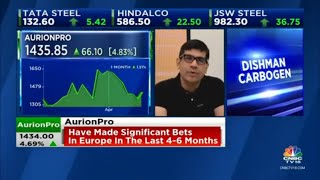
Aurionpro Group CEO Ashish Rai on CNBC-TV18: Growth strategy and Fintra acquisition


Ashish Rai, CEO of Aurionpro, featured on ET Now discussing Aurionpro's Arya.ai acquisition


Ashish Rai, CEO, Aurionpro Solutions, in an Exclusive interview with NDTV Profit