How Self-Awareness, Intuition & Breathwork Unlock Human Flourishing with Emma Seppälä
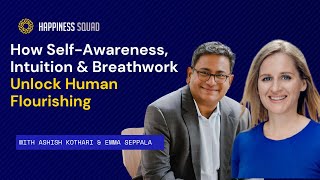
Dr. Emma Seppälä explains how breathwork, meditation, and self-awareness rebuild resilience and creativity. Sudarshan Kriya, a specific breathing technique, resets the nervous system and helps veterans with PTSD. Leaders who build psychological safety unlock better thinking in their teams.
Chapters
Welcome to the Flourishing Edge, the podcast where we share weekly tips on making flourishing your competitive edge. I'm Ashish Kothari, your host and each week we'll dive deep with flourishing experts, change makers and executives to share best practices that can help you unlock higher performance through science based interventions. Let's step together into the edge of what's possible and live work and lead with more joy, health, love and meaning. Emma, it is so lovely to have you with us. I know it's been a long time coming, but I'm excited that we are recording this together.
Thank you, Ashish. It's nice to be here.
Look, I've been such a big fan of our work. We also share a fair bit of spiritual lineage between the art of living and the amazing sky meditation research that you did. I loved your new book, Sovereign. It's been a little while now that it's been out, but I think it's more relevant today than it's ever been, this work. And I just want to start with that. First. Tell me a little bit about Sovereign. What does it mean to be sovereign in today's world? And what personal and professional moments, Emma, led you to write this?
I mean, I think it's just really easy this time to be swept away in the current of everything that's coming at us through the media, through our lives. The lives are accelerating constantly, more every, more and more every year. And to be so caught up in that and also caught up in concepts, ideas, belief systems, behaviors that keep us trapped and keep us unhappy. You know, whether it's self loathing, like people don't think they have self loathing, but most people have self loathing according to, you know what, what we see, you know, every time I, a group of executives and I ask them, you know, how many of your self critical, 99% of the people have raised their hand, they believe it's good for them. What the data shows is being hard on yourself actually. Is it? It hurts your resilience, it hurts your intel, your ability to respond in a way that's most effective. It hurts your emotional intelligence, your decision making, your creativity, your well being, your physical well being, your sleep and so forth and so on. So that's like one of those beliefs that's out there like, oh, I need to be self crit, order to self improve when it's actually, no, actually you need to be self aware but not self critical because that actually stops you from being in your full potential. So that's just one example. But there's just so much you know, that without realizing, we do like, oh, when we feel bad, what do we do? Oh, maybe we scroll or drink or, you know, over to overwork or over exercise or hide from our emotions, you know, and those are things that, again, are addictions really. Addictions that keep us stuck in these stress cycles and the cycles of depression, anxiety, and so forth. So there's just so much, you know, coming at us constantly also through the media. And, you know, we're. It's almost like we're swept up in a whirlwind of repressed feelings, belief systems that are messing with our mind. And then this influx, this assault really, of information coming at us. And then you wonder, like, you know, you go through your life and then you wonder, who am I and what am I doing and why am I not happy? And so sovereignty is really a couple of things. One is becoming aware, self aware, but also aware of how we're living our life. And then the reclaiming control recreate, reclaiming mastery over how we want to live our life.
Yeah, it's so beautiful. I mean, you had me at hello, you know, with the book in my Hard Wired for Happiness book, you know, that I wrote two and a half years ago. Self awareness is literally at the heart of the sunflower of the nine practices. And that's where we have to start. Because if we are not aware.
That's right.
Nothing else becomes possible. And most of the time, our suffering is psychological, created by our own projections, our own stories. And I think that part really, really resonated. I think the other one in here, you know, you have it in your cover itself, Emma, which was so beautiful that, you know, you highlight that our times, like the only constant is change. And even that the speed of change is seeming so much. There is so much coming at us that unless we really turn inwards and start to master our inner worlds by first becoming aware of how we are creating our own suffering, we have no shot at thriving in the outside world.
Yeah, and I don't. That's something that's completely kept out of education for most people who are raised at least in a Western culture. It's just so foreign. You know, these notions are ancient. You know, the contemplative traditions in India and China and East Asia in general have talked about this for millennia. And here we are, you know, living at a time, like you said, such an extreme time. And I always just think we live in such an extreme time of spe and of stimulation and overwhelm and the news and the horrors and everything that's happening. You know, the more comfortable our life is, the more dangerous, also the worse are becoming. Right. It's just the technology is both helping us but also creating atrocities. Right. So, so there's. The more life becomes overwhelming really, and extreme, the more you need to do an extreme act to counterbalance and keep your balance, which is meditation, which is silence, which is going inward. It's like you need that to balance it. Otherwise you're basically like being whiplashed by the tidal waves coming at you. And that's the beauty. We do have the ability to claim our sovereignty through these kinds of practices.
So talking of technology, something that has really swept the world by storm is AI. Everybody's talking about it. Large companies are taking that to get 20, 30% of their workforce out. Even just two days ago there was an article around managers don't have time because the middle layer is being eliminated and companies are almost using, oh, I eliminated X number of people as a, you know, like this shield of like, oh, like look, we are really doing the right thing in this world where there is so much uncertainty, there is so much threat. I think especially in the middle of the organization, you know, they don't have the agency, they don't have information. They're almost like being put into this victim mindset and in a state of like, you know, you don't control your own. Talk to me about sovereignty. Talk to me about how these practices that you talk about, cultivating stillness, wisdom, mindfulness, can be so, so critical for humans as we shape the direction of AI.
Well, I mean, I think in order to cope with the change and the layoffs and all that, being able to maintain that inner stability is going to help you be resilient, but also more creative and innovative in of what your next steps are. And so interesting because so many companies talk about innovation, creativity being so important. And it's like, how are you treating people that are stressed out? And, and what we know from the data is that we are most creative when our brain is in alpha wave mode, which means when our brain is relaxed. And so you're going to be most innovative, come up with the best ideas. When you are in a state that is in a meditative state, you know that it's obvious to anyone and anyone you ask, when you come up with your best ideas, they're going to tell you in the shower, I'm walking the dog, I'm outside in nature. Well, what's happening there? You're not sweating with stress at your computer, right? When you come up with Your best ideas. So in order to like, if you did get laid off, this is how you're going to get your next. Maybe you have a business idea, maybe you think of a colleague working someone out somewhere else that you'd forgotten about that you're going to contact, ask about another job. So I think that's. But also, how are you going to use this AI tool? You know, how are you going to use it? Are you going to use it for good, for bad? You know, I just read an article about a boy who had a conversation with ChatGPT about how to commit suicide and whether to commit suicide. And he got, he got encouraged to commit suicide and told how to. You know, it's. Yeah. So the question is, like, how are we building these tools and how are we depending. This is a tool to use. It's not a substitute for your own mind. It's not a substitute for an innovative. There's no innovation coming out of AI. There is not just a regurgitation of stuff that may or may not be the kind of things that you want in your mind.
Yeah. Or may or may not even be true. We were having this conversation with somebody yesterday actually at my son's school where I think it was so telling. One of the teachers was trying to remember this passage that he had read and asked another teacher and he said, you know, let me just ask. So he went into ChatGPT and actually typed it and like, tell me exactly what this was. I'm trying to. I don't exactly remember. And it came back and said, yes, here's what it is. It was and it wasn't right. So it kind of remembered the kind of rough story, but the out ending was completely like, it was not. But to somebody who doesn't know, it would take that and believe that. Right? Would take that and believe that. And I think this is where I think the danger is. My son, talk about two days ago, he's 15, showed me this video of one of the tennis players, Medvedev, like you'd believe it. Taking this at, at the US Open, taking the, the, not the coach, but you know, the referee and like literally pushing that chair down onto the ground and saying, okay, you're going to give me a fine. You can decide how you're going to walk out of it. And I was like, oh my God, did that happen? Because you can believe that, right? I mean, with the anger, with kind of his history, we can believe it. And then he goes, nah, that's just AI. But it was so real, Emma. And I think this is where there is so much harm that can come. Because oftentimes, up till now we've said, if I see it, then I believe it. I don't believe it if I hear it, but if I see it, I do. And now you can see something and still don't believe. And again, I think that's why I loved some of your work. And you say, look, cultivate, still net, go into your wisdom, ask the questions, question your biases. I think they become so powerful, Right?
Yeah, no, absolutely. And it's interesting because I think these old wisdom traditions out of India, out of East Asia, they tell you, you know, question what you see even before AI, right, like, is this a dream, is this real, is this the ultimate reality? And in a way, these deep fake videos or whatever they're called, everything, it's like, well, what I see on the news was that just created? I don't know. Yeah, don't know. So where do we turn? You know? And in a world like that, it is all the more important to tune into your own knowing and intuition. We have, we're wired for intuition. It's something that has been programmed out of us because schooling is only focused on the rational, the logical, hardly on creativity, which is a form of intuition. Creativity is intuition. I mean, absolutely right. It's the same family. Intuition sounds like this sort of woo word, but it's not a woo word that you're doing all the time when you're being creative. Right? But we're wired for it. And when it's trained in children as a young, a young age, they naturally blossom with it. You know, my kids have done an intuition program. It's offered by the Art of Living because I've seen what happens to the kids who learn that. I mean, I know a 24 year old, she's now helped find three missing people with just going into meditation. And because she's had this training done and I've done my own kids have done the program, I was like, okay, let me just see what happens. My youngest son, he can, he knows what's going on. If it's behind us. Put something behind his head or you blindfold him, he could do things. You would think, oh, what is this, like some kind of circus trick? It's not, but we're wired for this. But we are taught that we are only supposed to use our rational mind. And then we get then, and then you're taught just believe what's told to you. Okay, so then you're completely taken out of your own Sovereign knowing, your own sovereign intuition, your own insight, your own feeling of what's right, what's wrong. Instead you're told, believe what you're told and only think this way. Well, that's problematic, especially now in the world of AI and the know of. I don't know what's real anymore, I don't know what's good anymore. You have to have your internal compass. And that's the beauty of these practices that we're talking about.
So let's get into them. You know, this notion of knowing, trust your knowing and question your beliefs. This was the reason why I was also so drawn to Eastern traditions. In fact, you know, one of the things that fully convinced me, you know, I did a 10 day silent meditation, I did vipassana. And I love what they start with. This experience is your experience. Don't trust anything because somebody says the Buddha said it or the teacher said it. The only thing you should believe is your experience. Tune into that, be with that. Somebody else's retreat. Experience is theirs, the teachers is theirs, your teaching is yours. So let's go in. You highlight six different moves, six different set of tools, right? Really to be able to cultivate our sovereignty. I want to start with this intuition first because we were just talking about me, about this. Talk to me a little bit and share with our leaders what are some ways in which we can really start to tune into that. What's the research behind the gut brain connection? How can we start to listen to those signals in this increasingly noisy world?
Well, you know, like we were just sharing. We've been taught to be rational, which is great, but rationality is a tool, right? How do you come up with your best ideas? I'll share the story of Lynn Tilton, the owner of the largest woman owned business in America. An amazing woman. And she, you know, she worked on Wall street in the 80s and then in her 30s she was done. She'd made enough money, she was going to move to Florida with her daughter. Kind of maybe that was going to be it. And then she had this moment of insight or an intuition or a dream. Her father came to her, he had deceased when she was a teenager and they had experienced what it was like to have the main breadwinner pass away the stress of that on the family. And he came to her and said, this is not what I had in mind for you, you know, go ahead. And there was something else, you know, for you to do here. And so she got this, this, this intuition. And then so she decided, okay, she was going to help families not experience losing a breadwinner the way her family had experienced. And so she bought companies that had been left for dead, that consulting companies had abandoned, and she brought them back to life, like companies we know, like Styla Makeup, for example, or other. And they diverse, like a helicopter company and a paper factory and this and that. And she saved 800,000 jobs. You know, at one point, she was a CEO for many of these companies at the same time bringing them back to life, which is itself an act of genius, especially because they had been given up for, you know, and she made billions of dollars. But it started with an insight, but it was actually coupled also with a desire to help people. I think that's very powerful, probably to add that on as part of your. Whatever your intention is. But the point is, this all came to her in a vision, this came to her in a dream, as an intuition. She wasn't going to be doing this. You know, and if you think about it, most entrepreneurs or creatives, the insight just comes. It's like, why don't I do this? You know, why don't I do that? It's like, but where'd that come from? I just came. Right. And so that is a gift. And that's something that, you know, research shows, like neuroscientists have shown that when we have a complex decision to make, for example, we make a better decision when it's coming from our gut feeling, as opposed to thinking it through. Now, if it's a simple decision, like, my phone's broken, should I get a new phone? That's simple. You don't need to. But if it's, I've got a new job offer, but it's in a different country. How would it impact my family? Like, what will my spouse do, et cetera, et cetera. It's complex. You need the gut feeling. What neuroscience shows is the gut feeling is superior. The military's been studying intuition for decades and decades. Um, it was made fun of in a movie called Men who Stare at Goats. But they still continue to this day. They're still continuing to research.
Absolutely.
So many soldiers came back having saved someone else's life for their own because they followed a gut feeling. And it's a, you know, it's an edge. If you can have intuition as a soldier, you kind of have an edge over the other side. Right? So. And then finally, I think the research I was sharing, also about creativity and innovation, we know that our brain is most likely to come up with aha. Moments, creative insights, when it's in alpha wave mode, meaning it's in a place where it's not highly focused, it's not so sleepy, it's going to go pass out. It's in that in between state which you could think of as a meditative state of mind. It's not a non stressed state of mind in which you are in a place of relaxation and you're not actively involved. You're not scrolling through your phone, you're not, you know, even when we relax, we're doing something active. We're staring at a screen, we're scrolling, we're doing. You're robbing ourselves. Even kids, right? Kids are the most creative beings on the planet. You know you used to sit in the back of the car and stare out the window and daydream as a kid. Well now you've got screens built into your back, the front, your parents seat. Just stare at the screen. I mean we're robbing ourselves and our children and researchers. There's been a creativity crisis in schools over the last 20 years. Creativity has dramatically declined. Well, these are the people who are going to be running the world later. What about their intuition? What about their creativity? Right. Don't we need that? Sovereignty is reclaiming, reclaiming your right to access your own intuition, understanding what that even means and accessing it and that when you can not. Not to say that you disregard rationality. Of course not. Rationality is a tool. But innovation is what's going to give you the insight or the ideas or what to do next and what might be best.
You know the, the story you shared reminded me of this book that I just read last weekend called Everybody Matters by Bob Chapman where he talks about Barry Wehmiller, a highly capital intensive construction company. Right. They make capital equipment. But when he asks when he's asked what does your company do? He answers we build people.
Yeah.
And the interview said and how do you measure success? And he says based on the lives we touch. This is a company that is $3.5 billion, 16% year over year, internal shareholder value growth higher than any S and P or any other index over 30 plus years through the ups and the downs. It's a 300, 200 plus company. 200 plus year old company. They focus on people because it's the right thing to do, not because it drives profits, because it's the right thing to do. Yes. The profits show up and they outperform because they are able to put people who are, who have been lied to, fired, betrayed, not seen, treated as cogs in the Wheel and they make them safe, they build trust, they infuse meaning, they give them autonomy and flexibility. Your voice matters. And then through that, help them. He doesn't use those words, but I think that's what he's doing. And I'm making the connection here, Emma. He's helping put them into more intuitive states, spaces that allow them to be intuitive, creative and come up with ideas that has driven. They've bought 80 plus companies, Emma. That's how they've grown. And in every company they instill this way of being that nobody believes initially. But he has patience and he's like, I'm not going to expect somebody who's been lied to four times to trust what I'm saying, that this is the way we run it. And that's what that story reminded me of. And around, you know, he did it to save lives, he did it to transform lives. And I think it's beautiful. And I think intuition is the way to go. And today, every company I think about, at least the larger ones, we're trying to fill up space. We get little productivity. We want to get rid of people so that we can fill up those who are left with even more versus creating space for tillness, creating space for deep work. Giving them environments where they are can be, you know, in these states that you're highlighting to tap into their intuition. What a big mess.
Yeah, absolutely. And I mean, research shows, and I teach this in the relationships chapter of the book, but also at the Yale School of Management. Like the research shows that leaders who lead in this way do better, are happier, their employees are happier, their employees families are happier, their bottom line is bigger. As you, as you described, it is the future of work. I mean, I always think, like, why is it that kids don't want to go to school? Like, why wouldn't you want to go to school? Shouldn't it be super fun and amazing? Why do people don't want to go to work? Shouldn't it be fun and amazing to go to work? Shouldn't there be people there that you care about? Shouldn't there be an. A sense of freedom and happiness and creativity like you said? Why not? It doesn't make any sense for people to think, for kids to think school is hell and the work is hell. Like, it doesn't have to be that way. And what research shows as leaders who lead in a way where they make people feel happier and seen and heard and valued, their business thrives. It is the future. And everyone else is going to tank, but it just always Shocks me. How many companies, especially tech companies in Silicon Valley, are just driving their people?
Absolutely.
And I'm like, you know, if you think you're successful now, how much more successful would you be if you actually took care of people?
Yeah. So let's go there next. Sovereign Relationships is another one of your chapters in your book. You know, you've highlighted obviously the research, we've all seen it. So if you're a leader, right, you might be a vp, a director, or a senior director and you're like, you know what, I want to lead differently. I want to really lead with deeper relationships. What might be two or three moves they can make, Emma, that helps them bring the magic of sovereignty to their teams and to their workplaces. This conversation is brought to you by Happiness Squad, where we help leaders build new mindsets, new habits, and transform their ways of working to truly flourish. If you're ready to unleash the untapped human potential in your organization and operate at your best, come Visit us@happinesssquad.com and start your journey today.
The first thing to do is they have to become, like we were saying earlier, self aware. So you, you want to treat others better than you should meditate. You need to spend time alone and quiet because if you're constantly reactive, you actually don't know how you're responding to people. And then if you're surprised about how they feel around you, well, it's because you don't have that self awareness. So the most important thing if you want to have better relationships with others is have that relationship with yourself where you're meditating daily, where you, in whatever capacity, like, if there's a lot of anxiety. For me, sitting down and doing mindfulness when I had a lot of anxiety was not an option. That's, that was just not going to work for me. But so I learned the sky breath meditation, the breathing meditation that helped me calm my nervous system and then be able to meditate. So find the shoe that fits. That's number one. Right? So, and the second aspect is, once you've done that, then can you help people feel seen, heard, valued and appreciated? That's all anybody wants. That's what everybody wants. It's so simple. The question is, well, how do you do that? You know, I often think like, okay, so you know, how do companies command loyalty? Usually it's money and benefits, right?
Yep.
And say like, okay, so what if the company next door offers you more? Can they buy your loyalty? Yeah. Right. So is that loyalty? That's not loyalty, right? And then I. But then if you think about a mentor who was there for you at some point, whether it was in your youth or your young adulthood or your early professional life, they were there for you at no benefit to themselves. They just saw the best in you and they wanted the best for you. If you could think of that person, if they called you right now or you were in the middle of something really important, would you immediately take their call? And if they sent you a message saying something urgent is happening, please call me, would you immediately call them? Yeah. That's loyalty. Did they. Did that person pay you anything? Probably not. But they gave you everything you needed. They saw you and cared for you for who you are, and they. At no benefit to themselves. They wanted the best for you. That is so. That is something no money can buy, and that is something you never forget in another person. And that loyalty stays forever. That's loyalty. And somewhere along the lines, it's been just completely lost in the modern workplace.
Yeah. One, the need to be valued. Being valued by your boss and by your company. In the research I was doing at McKinsey showed up as the top two things, way above money and others that people value. Right.
Was what? The need to.
The feeling valued by your boss and by your company. Being valued, being seen.
That's right.
Right. I matter.
Whether you're 2 years old or 95, it's the same, you know. Yeah, sorry, that just probably. You probably heard my glass there. Whether you're two years old. Yeah. Whether you're two years old or 95, we have the same needs. And it's like there's this idea that, like, you walk into the workplace and suddenly it's a place of transaction. Like, it's a different. No, you have the exact same needs. And data shows that when, you know, when you have a difficult relationship with your boss or whatever your relationship is with your boss, it impacts your heart health, your chance of heart. Heart attack, high blood pressure, cardiac arrest. This is directly correlated with your relationship with your supervisor. So it doesn't. It doesn't matter that, oh, it's just my boss. It's just work. It's, you know, different from my personal life. Our body registers threat or registers, you know, hostility in the same way, just as it registers communion and kindness in the same way, no matter what, whether you're at work or at home.
Yeah. I love your work with Kim Cameron. Both of you published a paper around energizers and creating energizing workplaces, where you talk about so much of the research Right around how we can cultivate and be these, we can create these heliotropic effects by recognizing how we are operating and shifting to some different ways.
Yeah.
And I, and I absolutely loved it. And I think relationships matter. That's Jane's work on positive connections and high quality connections. Right. It's so, so critical. Let's shift a bit. Emma, talk to me about one of the other pillars of sovereignty in your book. And that one is around sovereign emotions.
Yeah. So you know what's interesting is no matter how educated someone is or how high up in an organization or how many degrees they have, most people have as much knowledge about what to do with their negative emotions as a 5 year old. Just none. You know, we've learned so many things, so many skills, so many this, so many that no one's ever taught us what to do. When we're angry, when we're anxious, when we're fearful, when we're sad, when we're raging, we're just taught to suppress, push it down. And so we become these adults that are oh so successful or oh so this or oh so that. And we're a mess when it comes to emotions. And so because we've not been taught, it's easy to fall for the food or alcohol or overworking or over being overly busy or just to try and not feel. And everybody's walking around with all of this stuff and then it comes out in inappropriate ways or research shows when you suppress your emotions, it negatively impacts your relationships, whether it's your spouse, your colleagues, et cetera. Research also shows that when a leader suppresses their emotions, it negatively impacts the culture of their team. However, when we're able to handle our emotions, sovereignty of our emotions, one of the key facts of this is being able to feel our emotions. But we live in sort of a society where we don't want to feel bad ever. Right. There's so many distractions that could be given to you so you don't ever have to feel so many things you can consume, so many things you can do. And as a. But the, the problem is that whatever your drug of choice at the end of the day, that's still there. That feeling is still there. Only you're worse off. You're more beat up by your own drug of choice. Right. And as a leader, it negatively impacts your. So what do you do? You know, and sovereignty is first of all the ability to feel. So when you are feeling sad, when you are feel, feeling angry, being like a child, like a child is angry and they Feel it with their whole body and then it's gone like minutes later. An adult can be angry for the rest of their life.
Yeah.
And so again, the self awareness comes into play. The ability and endurance and courage to feel. You know, somebody might have the courage to do an ironman and the strength to do it. Who will not feel their emotion. You know, it takes guts, it takes, it takes courage. And that's why when I talk about sovereignty, it's a combination of self awareness with courage. You have to be bold and you have to be brave to let yourself feel, to let yourself go against the grain, to. But at the end of the day, how are you going to be on your deathbed? Do you want to regret living a life you didn't live, drinking yourself numb, working yourself numb or whatever? Or do you want to. Do you want to die? Feeling like I lived my fullest life, I gave of myself fully and I was in complete sovereignty over my, of my feelings, over my life. So. So that's one thing, you know, is the ability to feel. But then also that allows you then to be able to reappraise, which is being able to think about the situation from a different perspective. It gives you the ability to move through trauma like many of us are carrying trauma. So doing things like the breathing exercises, the sky breath meditation that the art of living teaches and so forth, they help you move through trauma. Like veterans that I've worked with, I've worked with many veterans, both in our research studies and personally, who thanks to these practices, were able to overcome all the suppressed trauma that they had and move on with their lives and become very successful. So those are tools that we can use. But the first thing is really to become aware of all this. Wow, how much am I suppressing men? I'm. Men in particular in this society are only allowed to show anger. Really?
Yeah.
But oftentimes a man who's angry is actually sad. A person who's angry is actually sad. But it's only expressing in this manner. I mean, women societally can show their emotions, can feel their emotions, express their emotions more. Men, especially in the U.S. i would say there's so much suppression that's ingrained, whether you're in the military or not.
Yeah, you know, it's. I got into this field about 10 years ago and it gave me a completely different perspective on my first 20 years of consulting work that I was doing. You know, I would walk in with these large companies, we're doing these large scale cross functional transformation programs. Emma and I never had the language to say what was actually playing out on the ground. Right. You would have these meetings every week where the R and D person, the marketing person, the manufacturing person, the procurement person, and the project manager would be in a room, right? Talking about stuff. But the mood in the room was one of complete resentment and distrust and stories. Everybody thought, all the procurement guy wants is to buy the cheapest thing. He doesn't care about anything. The manufacturing guy had a story that all the marketing guys wanted was create seven more colors that make their life difficult on the manufacturing line. It drives no value for the business. The marketing guys thought about the manufacturing guys. You're just lazy. How hard can it be to just change from a red color to a blue color? Like just, just do it. And it allows me to get after all of these. And they wouldn't have the real dialogues because of this mood of resentment. Right. We would lose 20, 30% of the time. People would get really angry. Many of them won't depress it. They would then do things like, okay, we're fine, like, let's move on and. And then go back and completely reverse. There was so much of the energy that was wasted because we didn't have. We didn't actually name what was present. Hey, there is a fundamental level of you don't even like each other. You don't trust each other. Even though you're in the company. You don't even believe you're going after the same thing. Let's talk about that. Who cares about the idea that we are talking about? And unless we do that work at an organization level and what you talked about at an individual level, what are you feeling? Most people often when you ask them, they say, oh, I feel nothing below my neck. I'm like, yeah, that's a feeling. The feeling is called numb. Yeah, right. What you're feeling is numbness. But if you feel your emotion, you can move through it. You know, Sudarshan Kriya, or Sky Meditation was so transformative for me as well. I want you to share a little bit about the research you did, Emma, because you were one of the first researchers who really, really looked at that practice and, you know, studied it among different populations. Share a little bit about that research and the massive effects you saw on the impact on that, on kind of being able to work through trauma, being able to shift out of the states that people are to more joyful states.
Sure. Well, I was in New York during 9 11. So that day I, you know, after that day, I had a lot of anxiety. You Know, I was young, I was 23, 24, and I had a lot of anxiety and I didn't know how to handle it. And I, you know, I tried mindfulness, but mindfulness is not a good first step when you feel. You just were aware that you're anxious, but it's not actually helping you. Right. And I tried a lot of different things. I didn't want to medicate. And so. And then I walked into this class, sky breath meditation, and I thought, what is this breathing stuff? It's so weird. And. But I found that when I started doing the daily practice, it completely transformed my life. I was able to excel at what I was doing. I was able to move through life much more relaxed, much more at ease, and much more successfully. And I thought, this is so interesting. It gave me sovereignty over that, that experience. And to this day, I still practice daily. And. And about 10 years later, I was working with veterans with trauma in my postdoc years, and I was working with Richie Davidson's neuroscientist. And we, I was looking at these veterans that were coming back and they were trying to do meditation interventions with them, and they're like, oh, the veterans are leaving our study. I was like, well, yeah, and you have a lot of anxiety and you're told to just sit there and watch it. It's. It's.
Watch your brain play the same over and over and over. That's not helpful.
Yeah. And I thought, well, the breathing really helped me. Let's see if it could help them. So we ran a study with veterans, and many of them came in thinking, what's this hippie dippy stuff? But they were being paid to be in a study, and they did participate. And after one week, most of them qualified as no longer having post traumatic stress. They said, thank you for giving me my life back. It's amazing. They even officiated one of their weddings. I mean, I stayed in touch with the participants. And then we replicated the study with the Palo Alto va, compared the breathing to the gold standard therapy for post traumatic stress. And we found that the breathing was equivalent to and or superior to the therapeutic process when it comes to emotion regulation at the level of the brain and so forth. And, you know, it's giving us sovereignty. And we live in a time when we need things to work, work well and work fast. We don't have time. No one wants to sit in therapy for 30 years. You know, it's just hard. And so this is a methodology that through breathing, in a sense, reprograms Your nervous system sets it back to where it should be. What we found was that physiologically the veterans no longer responded with the same anxiety levels as they did before. They had like a normalized anxiety, not just one week later, one month later, and one year later. Suggesting this sort of, having learned this practice shifted their nervous system for the good, for the, for the, for the long run. And so we've also run a study at Yale University looking at stressed undergrads and seeing if we could prevent them from burning out over the course of semester. Mental health declines, there's a lot of burnout and so forth. So we wanted to see, can we boost this? Can we prevent this? And what we found was that we compared, we had the Sky Breath meditation, we had a mindfulness program, we had an emotional intelligence program, control group. And at the end of the semester, it was the breathing group that had the most benefits when compared to the control group by far. And so what I believe is happening is it's not just addressing the mind, you're also going into the physiology. Now there are a lot of breathing practices out there. If you go on YouTube, everyone's a breathwork master now. And you know all the things. And I have to say I cannot, I don't know about other practices. I cannot stand by them. I have not researched them. But I do know, and you probably know this too, that in India for, for millennia now, there's been the practice and, and teaching of breathing practice for different purposes.
Yes.
So like certain practices were for going to war, other practices are for calming the mind. So what are you doing? What are people teaching out there? I don't know. You know, when I first started doing research on breathing, everybody thought it was nuts. Now everybody's doing breathing like it's a big thing, it's a new fad. And I always say, like, be careful where you're learning and where you're learning it from. I can't speak to all breathing practices. Some are going to agitate you because they're supposed to be doing that. Right? So. But the Sky Breath Meditation is I find to be a very complete package that really helps people settle and then it gives them a home practice that they can practice. So yeah, it is really moving to run these studies just to see the, what happened to the veterans. And yeah, in fact there's a non profit called Project Welcome Home Troops where veterans, military, active military and their family can learn the practices at no cost. So definitely something to check out for people and then anyone else can learn it through art of Living.
Yeah, no, thank you. You know, it is so true. Everybody today is a teacher. Everybody today is a coach. Everybody today is. And for so much that is out there, which is by the way, only gotten further amplified by AI because anybody can go create a seven step thing and go write it, you know, and as long as you tell the story. But I think these tools, if not used the right way, can do more harm than good. And even if, if not taught the right way. So I think the ones that I have actually found, I think, Emma. So there are two that I always, I studied, you know, the Sky Meditation, which Rishri, actually I first met him when I was 21 years old. I was around 20, I was at IIT and he in 95, 96, had brought that to IIT in India. And so that's when I first had a chance to kind of do that practice with him. And it's, it's, it's. And I'm so appreciative of the research that you actually did because many people, yeah, go like, what's this breath? This is so weird way of breathing. Like, this can't be. But I think your work and that data that you shared, right. I think it gives people belief that, okay, go try it. The other breath work that I found to be so powerful is the Shambhavi Mahamudra that Sadhguru initiates over a two day program. Again, something that is really, really powerful. He's got other researchers who've looked at that, but there's so many others. You know, I think many of these programs are at pretty low cost. And so if people are saying cost is an issue, these are available to people, they can do it. And I think for many people who say, I can't meditate because of, again, I'm too anxious, my mind flows. There are other ways. Find the good teachers is I think my big takeaway. And go engage with them. Right? Go engage with them, learn it. And I think it can transform our lives. And I think it's a really powerful way. Emma, have you been. I'm just curious. You obviously done this research. You've taken it to all of these different organizations. Are there any companies you've been able to move into, like really making this almost, you know, we have all this training that companies do, but are there certain companies that you know of that are actually starting to adopt Sky Meditation as a core part of at least an option? Even if it's an optional training, if it's not mandatory? Because we go back, people are our biggest assets. We want people to be creative, we want them to be innovative, we want them to be sovereign. Here's something that can fundamentally shift that culture and the individual feelings of fear, anxiety, stress into something more. And so I'm curious if you're seeing this happen in the workplace.
There are companies that are adopting this program as part of their training. And the ones I didn't know, there's a couple companies where I know that they have their entire staff do it and they are very successful. Makes sense. You know, you take good care of your people, you help them show up at their best, you help them release stress and feel better. You support them in doing that. It's not just lip service. So much of the like corporate wellness stuff is lip service, you know.
Absolutely.
And PR in a way. But those companies do really, really well. I mean, really well.
So look, just keeping an eye on time. I want to ask you, I want to end with this question. Emma, you are one who truly lives, reads this work. You have so much going on, right? Between your teaching, between your advisory work, writing a book, spreading the message. You are a mother, you are, you know, a daughter. There's just, you're a spouse. There are so many things coming at you. You don't, you don't. You have a pretty fast life. What are some of your personal practices? You mentioned sky meditation as one of them. What are some other practices that are your kind of part of your repertoire that allow you to kind of truly operate at this high level of innovation, creative, productive, kind person that you are?
Well, what I. So I really benefit from the sky breath meditation and it's offered through art of living. And there, there's another meditation practice that they teach called Sahar samadhi. So I really for myself have found that to be where I put my.
That's your foundation, one path.
I have just this one sort of school, I guess you would say. So I do that for about. I do yoga and then the sky breath and the meditation in the morning. So about an hour in the morning and in the evening I do another half hour of meditation. So that, that's non negotiable. And you know, a lot of people are like, well, I don't have time for that. It's like, you know, I don't have time. You know, like you said, you know, Gandhi said, you don't have time to meditate for an hour a day, then meditate for two. You know, I mean, it's true because that's where you gain everything you need to do everything else faster Better and from a place that you can actually feel good about. And then I do try to go outside every single day as you, you know, I have green all around me. Like, I just, I know about the data on nature, but I also myself feel such a need for that. And I think we live in these little boxes inside a little room with no light. And it's, you know, then we wonder, why am I down? Why do I not have perspective? Why am I, you know, so I try to go outside, even if I'm in a city or wherever I am, just go outside and walk every day. And then I just try to remit, remember to be. Have perspective and be grateful. You know, just one trip to a country that's not in the developing world is enough to show you just how fortunate you are to have water you can drink out of the tap, you know, Right. Drive in a car on a road that. Where the car doesn't bump so hard, you think it's going to like, leap off into, you know, I mean, we basically live in heaven here if we're able to, you know, if we live in the western world. And it's so easy to fall into negative thought spiral. And yet, no, like, gratitude is sovereignty over. Like, there's so much to be grateful for every single moment. And then I have really good boundaries with technology and with the news and all that. And the media have very good boundaries with that because I don't want that to take over my life or take my mind out of the present moment. And then finally, I would say the last piece is service, doing things, doing community service in some way. And whether that is, you know, going out and helping in some capacity or even just having the intention daily, like, let me. Every person I meet, let me treat them with kindness. Let me leave them feeling better after they left my presence than feeling worse. Does that make sense? Or like, let. Let me uplift. Yeah, yeah, yeah.
I think those are beautiful. Five practices that you talk about that I think are so. I think there's something that everybody should adopt, especially those who feel they don't have the time and they're operating at this high level. I think this can truly transform. Yes, those moments. Right. Make you more effective. Thank you for joining me, Emma. It is truly a joy to know you. Thank you for all the groundbreaking research work that you have done and you continue doing to spread this message of sovereignty evermore. In a world where people feel like a victim, your book offers the tool for them to be an agent of flourishing for themselves and for the world around them. So thank you.
Thank you, Ashish.
Thank you for joining me on the flourishing edge. If today's conversation inspired you, share it with someone who's ready to flourish too. Subscribe, leave a review, and stay connected for more tools to achieve breakthrough performance through flourishing. Until next time, keep learning, practicing, and growing into your fullest potential.
More from Ashish











Reducing Regrettable Attrition in Organizations by Fixing the System, Not the People Reducing Regret