Leading from Within: The Vulnerable Path to Flourishing with Eleanor Allen
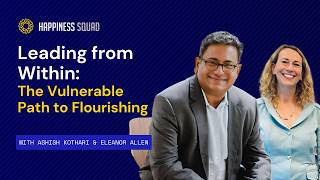
Eleanor Allen, former CEO of Water for People, describes how she moved from over-controlling leadership to vulnerability and listening. She adopted practices like a "head, heart, plate" check-in at meetings and found that real workplace flourishing requires measuring turnover and engagement, not just offering perks.
Chapters
Welcome to The Flourishing Edge, the podcast where we share weekly tips on making flourishing your competitive edge. I'm Ashish Kothari, your host, and each week we'll dive deep with flourishing experts, changemakers, and executives to share best practices that can help you unlock higher performance through science-based interventions. Let's step together into the edge of what's possible and live, work, and lead with more joy, health, love, and meaning.
Eleanor, it is so wonderful to have you on our Flourishing Edge podcast, my friend.
It's wonderful to be here, Ashish, with you in person, I must say.
Yeah, look, I'm so excited about our plans for 2026. We'll get to that shortly, right around what we are launching together. But look, I want to just start by asking you this question because you've seen the world of work from so many different vantage points, right? As an executive leader for an engineering firm to the CEO for B-Labs to the CEO for a not-for-profit and now somebody who's kind of focusing on flourishing. When you look at the state of work today, what do you think most leaders are still misunderstanding about flourishing?
I think there are a lot of things to answer that question. I think the first thing that comes to my mind is how much their own personal state of being affects their organization.
Yeah.
It's not another program and initiative that someone else can do, but leaders have to take care of themselves in order to take care of their organizations.
Yeah, I think it's beautiful, right? Like, it's not for something out there. It starts from something here, right? Those who stuck in survival can't create thriving ecosystems or thriving organizations, right?
Because they're— they don't have more to give. They're suffering themselves.
Yeah. So what was that point in your own journey when you realized that the way you were operating, the life that you were leading you had hit the limit, and for you to break through, you needed to flourish yourself. What was that story and breaking point for you?
Well, I stumbled upon it in a way by accident. I didn't know what I didn't know, and I didn't know that things could be better or that things were actually even that bad. I was living my life. At the time, I was CEO of Water for People. And I got offered an opportunity to do an inner development program. One, I didn't know what that was. And two, it sounded really scary. But three, someone said, oh no, you just got to just do this. And I said, what is it? It doesn't matter. Just go in.
You got to—
it'll be really good. So for whatever reason, I believed that person. I applied for it and I got— it was sort of a scholarship. It's a program for different CEOs from social impact organizations all over the world. And even when I showed up to the first retreat, I still didn't really know why I was there or what we were going to do. And they were purposely not telling us much. Long story short, it became a huge transformational part of my life. Mostly of the self-discovery and the things that I found out about myself and my habits and my behaviors and those that were holding me back and those that were, could be in reach if I decided to go for them and figuring out what I really wanted in life and how to get it.
So what were some of those behaviors or beliefs that you realized in that program that were limiting for you?
Well, as you said, I'm an engineer by training, so my growing up as a professional was pretty formal, very masculine, controlled, in charge, got all the answers, got it figured out. If I don't know, I'll find a way to solve the problem. Little emotion, no vulnerabilities, No saying, well, I don't know, I have no idea, actually. Um, no, that just wasn't how things were done the way I grew up as a professional. And just when I was in my inner development program, COVID hit. So we didn't quite have the last third of the program until after COVID. But actually, in hindsight, it was beautiful because No idea what to do with COVID right? We didn't have a playbook. I'm running a nonprofit, 100% reliant on philanthropy. We thought we might go out of business because a lot of our fundraising was done in person, in-person events, and our work was all over the world. But yet we, we were isolated. So I had to be vulnerable in the sense that, you know, I don't know what's going to happen, but guess what? We have to do this together. I don't have the answers. Matter of fact, I don't even know if I go right or left, but I need the help of you, team, organization, board, to figure out what to do. How do we pivot? How do we recreate ourselves? How do we survive short term? We don't know. Is it 2 weeks, 2 months, No one thought it was 2 years, right? At that time, it was more of the, maybe we can make it through the summer. So it was just a nice coincidence that I was able to, like, let my guard down and be much more vulnerable at that time to figure out the future of the organization and practice some of these things I had been learning in sort of burning platform, urgent way. About it's okay if you don't have the answers. It's okay to ask for help. It's okay to try things differently and experiment a bit.
Yeah. So what were some of the things that were part of the program, new practices, new habits, new way of being that you learned, right? Rewiring of old habits, old patterns that allowed you to create that foundation of being comfortable standing on not knowing? Ah, this is all the answers. Yeah.
So I can think of a few things. First, I didn't tell my, my team, my direct reports that I even was in the program because I was very self-conscious. I was sort of embarrassed, like I'm supposed to have it all figured out. Like, what was I doing going to these retreats talking about myself. Like, it was also very indulgent, self-serving, I thought. But when I came back, I think it was— I'd probably been in the program a year and came back from one of the retreats, and my team said, what did you do last week anyway? And what were you— where were you? What were you actually doing? So I said, oh, I'm in this actually, this program. It's been really amazing. And they said, you know what, we actually notice when you come back, we like you better. I said, why? They said, because you're calmer. You don't jump to conclusions. You actually think a bit more before having to know the answer and saying, okay, let's do this. You take more time before you make decisions. And that's working out better for us because you move really fast and sometimes you move too fast and the decisions you make maybe it could have used some more thought. So I said, huh. And I was calmer, actually, you know, this brought a lot of calm to my life. So, and I was more willing to hear feedback. So I said, tell me more. And so they started elaborating on some of the things they had noticed, me not having to talk as much, being a better listener, asking for more input for decision-making. And then when we would have like all staff meetings with employees from around the world, they said, you need to share some of the things you're doing. I said, no, no, no, no, no, I'm not doing that. Yes, you need to do that. The employees will love this. And so then I was scared again, but okay. So I started experimenting a little bit about some of these, my own self journey I was on. With this inner work. And then I shared a bit about some of the struggles I'd had with one of my sons. He was a teenager at the time and we'd had, we'd moved a lot. We'd had some family struggles and he was very angry with me, particularly my job moving him around. Yeah. And I had just reconnected with him. Interestingly, on one of these retreats, he was living in Austria and the retreat was in Austria. And after that week retreat, I went to his place and I said, you know, I want to share some things with you about the moves we'd done. We'd been in Brazil, we'd been in Puerto Rico, we'd been in Colorado, and, you know, a lot of things we never talked about. And I just wanted to apologize for some of the decisions I made thinking I was making the right decisions, moving the family, living in new places, learning new languages. And he said, thank you for sharing that, because I didn't think that at all. It was horrible. And so we talked about these things that we had not actually talked about, even though they were there, they were in the air in the family, but they were very sensitive and it brought us a lot closer together as, as mother and son. So that was also amazing. Because it had been this thing in our family for a while.
Yeah, that's such a beautiful story, right? As I think about my own teenage son—
teenagers are hard—
and as we grow and kind of this, you know, notion of being able to connect with kind of when there is attention, right? Yeah. How do we resolve that versus It's just staying on. And so what a gift. Yeah. To be able to catch it and to be able to, to resolve that.
And I think another thing important for me in my journey was just what you just said, talking about it. My way I grew up, the career I had, you don't talk about stuff. Keep it in there, keep it inside, and you go on like you got everything under control. Yeah. And so if I think back to my whole life, it was about keeping emotions inside and not talking. So that was something I had to practice and learn. I still do. It will forever be a practice. But yeah, but it's so much nicer to be able to talk through things than keeping it all inside.
Yeah, I mean, I see it all the time. I'm sure you do, Eleanor, too, right? That there's so many leaders who feel that they need to have the shield, this anchor, this heavy armor that I'm carrying. Yeah, you know, don't even want to share my own emotions with anyone. I maybe don't even want to feel the emotions because they feel uncomfortable. About sharing it with others. And yet our emotional lives control so much of our behaviors. Yeah, it's not our rational cognitive thoughts. It is often the emotions, especially the strong ones, either that make us act out or other ones that keep us from not engaging, from putting up walls, from pulling back. When what's really needed is to be able to move towards.
Yeah, right.
When I've seen the damage it does to relationships, personally, organizations.
Yeah, I was just— you remind me, one practice that came about during this time of my experimenting was not rushing into a meeting, right? Like everything was rush, rush, one meeting to the other. So in the inner work program, we just, we were more intentional and slower. So I started working some new little behaviors into my team meetings, and one was starting every meeting with time to connect with each other. And we called it head, heart, and plate. Head, heart, and plate. So you can share one thing or more, but at least one thing that's either in your head In your heart or your plate, where— what's— where's your attention today, right now, right at this meeting? So plate is— was often like, I have this huge to-do list, I deliver— well, you know, work, more work stuff. Heart was often people, and head was like anxiety or worry or whatever. But once we had that with each other, we took care of each other because we knew someone's mom was sick, someone's kid was struggling in their new third grade class, someone went to the doctor today and got some results they didn't like, they didn't know what to do or whatever it was. Yeah, it became this connective tissue between us. We got to know each other more as people rather than just colleagues. Sure. And it was made a huge difference.
Yeah, I bet it also created a space where, you know, people didn't feel that everybody's got perfect lives and I'm imperfect, right?
Right.
So when people share their struggles, um, I think it, it gives other people permission to share theirs. It does. And often sharing lightens the load. Yeah, right. You know, we want to create compassionate workplaces places, we have to first know there is suffering, and that requires people to share that suffering rather than feel like they can't.
Right. And then when you share, you also— humans generally want to help, right? So if you say your kid's sick, you're like, okay, go, I got your back, I got you covered today, I'll take your whatever incoming visitor, I'll take care of them, don't worry about it. So it's sharing a burden in a positive way as well.
So, you know, from your seat as, as a CEO, having led so many organizations, I want to talk a little bit about, right, you experienced a shift. You were in the role before and now you were in, you know, in the same role, but a new observer. Because of your own work that you had done and some language around what was happening. What were some 2 or 3 behaviors that you started to see, you know, as you kind of look back at your old life to say, oh my God, here were the behaviors, uh, that were causing suffering in organizations? And as you look, or here's the 3 behaviors that actually can create the right conditions for self, for flourishing?
A lot of them are communication issues, challenges. So things that came really clear to me that were not clear at all were thinking about people I'd had conflict with or maybe having conflict with, that there are absolutely two sides to that and everyone has a shared responsibility. Yeah. So what is your share of the responsibility? And either going into that drama triangle where you're like, oh, I'm the victim, that so-and-so, so me, I can't believe they did this to me, or doing the opposite of overcompensating, doing the hero, like, oh, I can do it for you. Don't worry, Ashish. Like, I got, I got that. I'll just— never mind. I can do it. I'll do it for you. Wait a minute, you didn't ask me to actually do that for you. So really understanding how to have the right amount of responsibility. And as CEOs, I always felt like I needed to help everybody out and I was giving too many things. There was too much going on and I needed to take an extra bit of work myself. Well, that was really annoying. And when, when I got to this point with my team that we were really good at saying, you know, okay, Eleanor, you're in my business now. You don't need to be here. Let me go find you something else to do. And instead of being offended, be like, okay, I got it. Like, I got to stay in my lane. I'm weaving into yours. Let me get out of my lane. So being a lot more aware, self-aware of my responsibility. And in that role, okay, as a CEO, what are the things that are the highest and best use of my time that only I can do? There are lots of things that I can do that I'm competent at, but there are many of those things, if not most, other people can do and probably do better.
Yeah.
So how do I minimize my to-do list to make sure I'm adding the most value? That I'm empowering others, that I'm not stepping on their toes, and that I'm actually finding things where I can be in my zone of brilliance. That's really hard. But I didn't even think about that stuff before until I started unpacking my own insecurities and fears and overcompensations for this because I had to, like, have it all together. No, like, I definitely don't have it all.
So I have a question for you. So one of the reasons why I see so many leaders step into things that they have no business stepping into is a huge need for control. Because as the person, they're like, I'm responsible for performance. I'm responsible for execution. And if I don't do that, it's gonna get messed up and it's gonna come to me. How did you satisfy that hunger or that fear?
That was a huge fear, and I know exactly what you're talking about. And I have some clients right now that I'm working with that have this going on. It's so common. And for me, it was just, it was almost like re-getting to know myself and saying and being confident and being good enough and not having to do that extra bit to have that control or be that one to make the decision. Let someone else make the decision. Let them learn. Let them make a mistake if they're going to make a mistake. I'll have their back if they do that, but I don't have to make that decision. I've already made those decisions. Moving along. And just having that confidence in self that it'll be okay. There'll always be something more for me to do. I think a lot of those fears are, what if I don't I'm not needed anymore? What if someone else is better at it than I am? What if they really see who I am and I'm not actually that good? Yeah. And just telling that voice in my head, like, that's not useful. Tone it down. Just trust the things will be okay. And you don't have to—
it's not easy. It's not easy.
It's a constant struggle. But even identifying that little voice, I didn't, it was subconscious before, right? I wasn't totally aware of how many times a day that little voice is saying, make that decision, take control, make the answer first on that email, make sure you copy those people. All those things that take so much energy.
Comes back to the point of if you are carrying so much burden and you're suffering, it's very hard to create flourishing.
Yeah, it's no space. So I want to go there.
In your experience, when you've seen flourishing efforts fail, what are some of the most common failure modes you've seen? Flourishing, well-being, you know, efforts— everybody's investing so much money in that, and yet most of them are failing. What are the most common failure points?
Uh, well, one is like superficial stuff, like we have massages on Thursdays and we have free snacks in the break room and we have flex time. And okay, why do we have all these things? Because people are very stressed out. But what's causing the stress? Well, maybe the workload isn't is too much. Maybe they're not feeling safe at work. Like understanding the root causes of the stress. And by the way, oh, leadership team, leader, CEO, how much of that stress goes all the way back to you? Look in the mirror. Guess what? The creators of the culture are the people leading the organization. And being able to say, I'm directly linked to these things happening in my organization, these people having these things, burnout, disengagement, worry, stress at work, that disassociation of CEOs, leadership teams, etc., thinking that's not their responsibility. Like, let's just make another HR initiative. Let's just get some pedometers and have people take walking meetings and all will be well. No, it's Yeah, those are Band-Aids to, to the symptoms, but they're not solving the problem. Yeah, it's not a perk.
Fundamentally about the way we were. Yeah, that is the source of it, right? Not going there. Yeah. What are some other things that you notice why these programs fail to return?
This conversation is brought to you by Happiness Squad. Where we help leaders build new mindsets, new habits, and transform their ways of working to truly flourish. If you're ready to unleash the untapped human potential in your organization and operate at your best, come visit us at happinesssquad.com and start your journey today.
Uh, fail to have any return on their investments.
But they don't measure anything. Like, how are you going to know? Okay, so key factors for, for what makes a flourishing or well-being, a great workplace is higher productivity, higher engagement, higher loyalty, less absenteeism. So productivity might be harder to measure, but some of those things you can— turnover, absenteeism, you can absolutely measure. Why are people leaving? Why are people not coming to work? What is causing them to disengage from their work and actually having those conversations with them and listening and understanding and figuring out like the trail back to the root causes. That's really hard work. It's like sleuthing, Sherlocking back to—
But I'm with you, right? I think that was one of my own insights as I kind of grew up in the world of ops. And kind of moved into this notion that, you know, when it came to physical assets, we measure hourly, if not daily, right? We take action within 24 to 48 hours when parameters go off the standard. Yeah. One or two standard deviations and you're kind of taking action right away. And we're really entrusting, you know, those teams at the frontline, at the coalface, and we trust them to come up with ideas that we might offer them help, but we're trusting them to know the best. And yet when it comes to our people assets, we barely measure. We measure once a year. Most organizations still don't actually measure what percentage of people are stressed, right? They don't measure that. What percentage of people feel financially that they can't make ends They don't want to measure it.
It's a huge stress.
They don't want to know the answer, right? They don't measure it. And then, when they measure it, you know, they try and do one-size programs that address everything when, you know, all of a sudden now you're rolling something out that doesn't actually connect to the real challenge with the team. We're doing a purpose journey when purpose is not the issue for that team. It might be trust. Yeah, it might be workload, right? And, you know, when we look at the data, like almost 72% of well-being is actually at the job team organization level, not individual. Yeah. And 97% of burnout is actually because of demands and enablers which are not individual-based. And so when we offer EAP programs for those who are struggling or wellness programs for those to increase wellness and put all the burden on the individual but actually don't address the core ways of working, why are we surprised that we don't move the needle, right? And hence have to go heavily on the moral or the ethical grounds of we should do it because our people, you know, we should take care of our people.
It's the right thing.
It's the right thing. Yes, it is the right thing. We absolutely do it. And that doesn't actually preclude us from still measuring, are we getting the returns on the investments that we are making? Because if we are not meaningfully moving the needle on business performance, then there are, you know, then we shouldn't, then we should think about other ways why that is. Yeah. Because fundamentally, if we take care of our people, they will take care of business. That is true. And hence, we should be able to measure it.
And if they love what they're doing, they go above and beyond. Absolutely.
Yeah.
The other thing I— is one of my ahas after being CEOs, did so many engagement surveys, right? So are you happy with your comp and benefits? Do you have trust in leadership? Do you understand the mission and vision? Do you like the purpose of your organization? Those are all employee looking up at you know, something, something above them, some company, some organization. But very few questions about that person. Yeah. Or, you know, how are you? How are you? What are you worried about when you come to work today? Do you— are you making a living wage? You worry about your paycheck? Do you have job security, insecurity? And like, do you feel like you can like you have a voice here, that you can have an influence here. All those things are really important to feeling good and feeling good about where you work and how you work. And when you don't have that, I've been in organizations where there's that, that fear and that there isn't the psychological safety, the amount of time that people and me, and I can think of me in one instance, spent talking about the bad people writing emails about the bad people, talking in the water cooler, in the kitchen, at the lunch— like, so much energy lost trying to resolve a problem that wasn't in our control in the first place. But if someone had been paying attention, it wasn't hard to fix. It was communication and behavior management and setting expectations and holding people accountable to those expectations, those in leadership roles.
You've operated in for-profits, not-for-profits, both realms, right? Quite extensively. Not that common.
No, a little eclectic looking back at my career. But yes.
What are some commonalities or differences when it comes to the state of flourishing and the drivers that contribute to it as you looked at your for-profit world companies versus not-for-profit world companies?
So one thing similar is that my for-profit world in engineering, I'm a water engineer, so went into that world to improve the quality of life, engineer systems to improve the environment and public health, human, human experience. So that had a very strong purpose in my case. So purpose has been really important to me. So then going into nonprofit, I had become disenchanted with public companies, for-profit, shareholder primacy. I thought philanthropy was this solution to all evils, save the world. Well, no, it's not. But I had to learn that my way. Also super purpose-driven, much more mission. We say, you know, nonprofit speak is mission-driven.
Many people find meaning at work. Yes.
But what's interesting, when I went not knowing anything about nonprofit work was the lack of rigor. Again, engineer speaking, and the scarcity mentality of resources, but the inefficiencies in managing those scarce resources. Yeah, like I went from huge projects that were managed, you know, like amazingly, right? Very efficient, very productivity-oriented. Coming over into nonprofit, very much smaller budgets, but like, how do we even know we're meeting goals? So there were no metrics, no scores. So things I implemented over the course, and, you know, people who worked with me at that time would have interesting feedback whether they liked it or not, you know, but, you know, really brought into that project management mentality. We are the stewards of this money. We're not the owners, but we steward it. We need to get results for this money. We need to find metrics for our programs. We need to show progress. And this was all about impact in our case, serving people with water connections and sanitation. So it wasn't just counting connections, which was the old way, but like, how are we really changing these communities for the better and changing the system of government to actually provide the services So we can go out of business and focus on something else. But just, it was so different going into that world of nonprofit from a world that was very schedule, scope, schedule, budget driven into, okay, let's figure out like what we're going to do today and how we're going to spend today. But what's the big picture? What are the outcomes we're looking for and how are we going to know when we've had that impact? And can we maximize that impact and can we do it differently? And then at the same time, working with a whole different cohort of employees that were number one is the mission, number two is efficiency and productivity and all the things that are sort of bad because they're business-oriented, but bringing them all together in a combination that actually worked. And, um, that was pretty cool.
Yeah, what I'm taking away is, right, on— in— for many for-profit organizations, there is a huge gap in people finding the work they do meaningful.
Yeah, right.
Even if you're doing kind of— even if you work for a pharma company, how it translates to the person on the line, they might not connect directly with or see how what they're doing actually is impacting in the bigger world. That is never an issue in not-for-profits.
No, it's very clear, right?
Lack of meaning is a big driver of friction losses that we see in organizations. Yeah. And then the other one is, you know, feeling valued, feeling appreciated. When it comes to not-for-profits, I work now with several not-for-profits in the Olympic space. High level of finding meaning. But where I find they feel most depleted is because they're so mission-centric. People have breakthrough all kinds of boundaries in terms of work-life, um, too much work, not enough resources. And so just, you know, people aren't even taking care of themselves and constantly operating from scarcity, um, them being scarce. You can't create great things out there if you're operating from from there operating on fumes all the time.
Yeah, right.
And again, what was interesting was for not-for-profits and for-for-profits, what I found common in both. So here, you know, low meaning, high meaning, right? I think life force, I would some extent stress in the amount of work, etc. Not-for-profits, that's a much bigger driver I found for burnout.
Yeah.
Than for-profits, right? Because to some extent, people always disconnect and they're doing things more efficiently. And so, they can get a lot more done with a lot less. But you know, the other thing that I found that was actually quite common between the two is whether you're not-for-profit or for-profit, people don't feel appreciated for what they're doing.
Yeah. Right.
So that lack of appreciation being valued, I often find is this common lever that actually exists, that you matter and what you do matters and we appreciate you. So I'm curious if you had the same reflection as you kind of operated in that world around mattering.
Yeah, so yes, and definitely similarities and differences. One, I should go back to that program I did. The whole reason that program existed, the Inner Development Program, was because there was a huge burnout of social sector CEOs for all these reasons you said, because the drive to— the mission drive is so strong and you can never achieve the mission, whatever it is. It's this huge burden. So huge rate of burnout, depression, divorce, all kinds of things. And so philanthropists pulled money. To keep, to make these leaders whole so they could flourish in the organizations. It was wellbeing at the time before flourishing was the word. But another thing that you made me think of was in nonprofit, because of the scarcity of resources, I remember when I first got to Water for People, I said, well, show me the training program. We don't have training. We don't have budget for that. So this whole— we call the philanthropy myth, right? Like, there's no overhead available to run the business, the organization. It's not— what the heck? That's the stupidest thing ever. Everybody needs training. Everyone needs to understand how to run the organization, whether you're making profit or you're making impact. It's the same skills.
In fact, even more because you're having to do more with less. Yeah.
So that whole thing first, well, I didn't know about it. I was like, well, that's no. And then like, oh, well, that's, you know, the best person we can hire because they won't take— that's the salary is half of what it could be. No, we're going to get the person who wants to be here and wants to be here as their number one job. And they love this job and we will only take the A+ person. No more settling for people who are, just can't get another job? No. So just retooling the mindset. We're awesome. We do amazing work. We only want people who want to be here and do this work with us, 'cause we're on a mission to solve the global water crisis. Like, are you in or you're not? If you're in, walk this way. And then when we got to the, like what you're saying, being recognized, you know, I've learned now the science behind it, right? Like, for every bad thing someone says to you, you got to say 5 or 7 or 10 good things, right? Because you only hear the bad thing. So that constant reinforcement of gratitude and thank you and you're doing a great job, and you might be in Denver but you're working on a project in Uganda, and guess what?
If you hadn't done that, telling those stories from them here, bringing those voices in, right?
Bringing those experiences in and hearing people's stories and the mattering of why the Uganda team is grateful for the 3 people in Denver who actually did the fundraising for this school or whatever, when it was like not connected before. So feeling like you're part of the team, what, that what you do contributes to the greater mission and that you can see how you connect to that. And so we instituted global recognition programs, global leadership programs. And just, and a lot of, you know, interestingly, it was a small organization with 300 people, but we were in 10 different countries. So big cultural differences, but everyone worked in their little stovepipe because we didn't have the money to take the time to get to know each other. Well, no, this is an investment in us to make us work together better. So just changing a lot of these things didn't cost money, but it was a mindset thing. And just saying, we do need the resources to manage these programs. So we do an awesome job and we'll find that money somehow. We're not gonna be beholden to just these program grants that don't spend the overhead. Well, any donor that has any kind of enlightenment about that, You would never invest in a business that didn't have a management team. Why would you invest in a nonprofit if there's no management team? It's just this weird thing that I think is mostly a US creation about philanthropy has to be skinny down. So all the money goes to the program. Well, that's all great, but if there's no one to administer that, it's a waste of money.
Exactly. It's infuriating. I think it's a really big shift that's needed. So my friend, I mean, that was one of my, you know, as I was looking at this data around 2020 to 2022, that was one of my big aha moments where I thought initially before 2020, right? So I was on this journey since 2014. And till 2020, those 6 years, I fundamentally believed that stress, burnout, you know, were issues for insecure overachievers, CEOs, people at the senior leaders, you know, banking, large companies, Fortune 500s. And in 2020, when I started building this offering, back then I was at McKinsey, around adaptability and resilience, I realized how actually lopsided my view had been. You know, I realized that burnout and stress lack of flourishing was higher in not-for-profits than for-profit. It's a huge problem. It's not the other way around.
Yeah.
Social workers, essential workers, teachers, doctors, therapists were struggling with stress and burnout way more than bankers and private equity and consultants, right, and venture capitalists. Because they were like stuck in just being able to put food on the table and doing this work that they believed so, wanting to make this difference, right, that they would put themselves and everything else in sacrifice of that. That became my— and then I realized, you know, small, medium businesses were struggling with it even more than the big businesses. So like my whole worldview around this topic got completely turned upside down, which led to, you know, me starting Happiness Squad because I was like, look, unless we actually fundamentally address this challenge around these broken ways of working, you know, leadership programs and serving the senior-most clients in for-profit organizations is not going to solve the problem. And we're solving, first of all, a much smaller problem. Yeah. If you look at it in the magnitude and the extent of the piece of the pie.
Yeah, right.
It's a very small problem. Like, it's a very small— it's really, really hard, but it's still a pretty small slice when 70% of the challenge is actually outside. And I wanted to be able to create an approach and a system that would be able to solve these challenges in a way that it was cost-effective. Things didn't need to be that expensive. You know, one of the beauty of lean programs, the way Toyota runs them, is the teams can do the work because this is not about doing things outside of work. This is about changing work. Yeah, this is about integrating this into what people are already doing to create capacity. And so I'm really excited about, you know, coming together with you and taking some of this work out into our Colorado companies.
I know.
Into, you know, all the B Corps, into not-for-profits, into the engineering space. I'm really, really excited about what we're going to do together. And the first thing we're partnering on is this Flourishing Leaders Summit that's coming up. It was your idea. You started it. I just decided to jump on the bandwagon because I know it's such a great idea. So share a little bit with our listeners around what is the Flourishing Leaders Summit? What are you hoping to accomplish in that day together and why people should join?
So I, I have a dream. Part of it is to bring this day to life. So back to the story I told about my inner work program from the Well-Being Project, I've wanted to replicate my experience since I've had it in all different ways. I did some, started that at Water for People. And at B Corp was a little bit because it was already predispositioned to taking care of employees. And then coming out on my own, I started last year working on— I did virtual programs and it was like mini, mini courses in what I'd gone through. One, one big difference in what I've learned is what I went through was all about me, individual. It wasn't about the organization. It was about making the individual better and more whole to be a better organizational leader. But I've really combined the two things, making the individual stronger as a leader and more flourishing, but also helping envision what a flourishing organization could look like and helping set that roadmap.
It's important to tie the two. Yeah.
So last year, my first program, the Executive Flourishing Program, we created blueprints for organizations. I didn't do enough work on the personal individual side. So this year I'm working on another program that's more individual and still do the organization.
Yeah.
And my—
Both of them together. Yeah.
And so what I wanna do on April 29th is do that like an intensive for one day because I really wanna be with people. I do a lot of virtual work as you do. It's just different when you're in the room and you can look people in the eye like we're doing right here. And I just wanted to do something in person and I felt like the time was right to do it in Denver-Boulder. There's enough momentum here. And then with your network and my network, which are different, but we're going for the same thing. Yeah, it's an experiment, but I know it's going to be an amazing day and I hope people listening will come join us. And you'll get— for those who can't imagine what this could be, we'll do some background on the science of flourishing, what it means, because there is science behind this. We're not just making it up, right, Ashish? We're taking people's research and applying it to the workplace. Then we'll do some pulse checks on how each of us is doing at work and then look at our organizations and how we can take our— grow ourselves as leaders and really make our organizations flourish. So at the end of the day, it'll be a working day. You'll, you'll have tools that you take home and homework you've done with the group, and you'll have met amazing people and had incredible conversations. And Matt Lee will join us from— he's a researcher at Harvard, Professor at Baylor, part of the Global Flourishing Study. He'll join us for a little fireside chat, uh, and yeah, it'll be magical, right? Yeah.
So people walk away with their own flourishing assessment and they individually how they're doing and some practices that they can start to increase their capacity for adaptability and resilience, right? And then afternoon, we focus on helping them get an assessment of how their organizations are doing. Yes. And how again, they can take some of the learnings to start to make a difference. And through that, right, connect with an unbelievable other group of people because It's hard to do this work alone. And by the way, if you only do this work yourself, you miss from the ideas that all the other people have. Yes. So no, I'm really, really excited. And I think, listen, if you are somebody who thinks about we shouldn't just survive, work should not just be a way to earn a paycheck, but work should be a way, a place, a means to help each one of us individually and collectively grow into the best versions of us. Come join us.
And we're starting a community, right, Ashish? This is the start of the baby.
The beginning.
Yeah, we want to— this is not a one-off.
No, this is not one and done.
So come join.
And like, listen, it doesn't matter if you're in HR, right? If you're a functional leader, you're a team leader, every individual has the ability to be an agent of flourishing. Yes. And come join us.
Businesses, nonprofits, government agencies, it doesn't matter either because it's all about the organization and creating this environment for employees to flourish. Amazing, my friend.
I'm really excited. Thank you for driving down. Thank you for doing this.
My pleasure.
And I'm excited for, for the Flourishing summit. The dates are April 29th, April 29th in Denver. So we'll put the link on where you can sign up, details about, about the summit, and we hope to see many of you there. Excellent.
Thank you, Eleanor. Thanks, Ashish. Cheers.
Bye.
Thank you for joining me on The Flourishing Edge. If today's conversation inspired you, share it with someone who's ready to flourish too. Subscribe, leave a review, and stay connected for more tools to achieve breakthrough performance through flourishing. Until next time, keep learning, practicing, and growing into your fullest potential.
More from Ashish











Reducing Regrettable Attrition in Organizations by Fixing the System, Not the People Reducing Regret