Mindfulness as the Ultimate Leadership Skill: Mastering the FLOW Framework with Pauline Leung
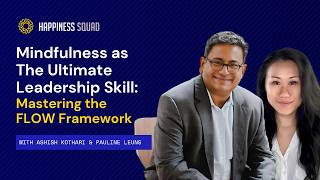
Pauline Leung, a former L'Oréal senior leader, explains the FLOW framework for mindfulness-based leadership: Focus, Learning, Ownership, and Well-being. A motorbike accident in Vietnam led her to Thích Nhất Hạnh's teachings and sparked her mindfulness practice. She shares micro-practices for leaders and links the framework to how elite athletes build habits.
Questions this video answers
I used to think hard work alone guarantees success; now I believe mindfulness and healing childhood wounds are essential for effective leadership.
Journaling (even on a napkin) to capture thoughts and reflect.
Robin Sharma's *The Leader Who Had No Title* (plus Thích Nhất Hạnh's *No Mud, No Lotus*).
How can I enjoy my day more / add more joy to my everyday work?
"SexyBack" by Justin Timberlake.
Chapters
Welcome to The Flourishing Edge, the podcast where we share weekly tips on making flourishing your competitive edge. I'm Ashish Kothari, your host, and each week we'll dive deep with flourishing experts, changemakers, and executives to share best practices that can help you unlock higher performance through science-based interventions. Let's step together into the edge of what's possible and live, work, and lead with more joy, health, love, and meaning. Welcome, friends. Today on the Flourishing Edge podcast, I'm joined by Pauline Leong, a dear friend of mine, a former senior leader at L'Oréal, a high-performance coach, yoga teacher, and a holistic health practitioner who has spent years translating mindfulness into the language of leadership and results. In this conversation, we unpack 3 big insights. First, why mindfulness is the critical foundation for high-performance leadership. Second, mindfulness is so much more than just meditation. Mindfulness as a way of being that grounds you in the present moment with full awareness of your thoughts, triggers, body sensations, and what's happening around you. And finally, Pauline shared her powerful FLOW framework—focus, learning, ownership, and well-being—that anyone can leverage to transform their leadership and impact, especially in highly demanding environments. So friends, if you want to lead with more presence, clarity, and sustainable performance, this episode is for you. Let's dive in. Pauline, I'm so excited, my friend, for this conversation and to host you on our Flourishing Edge podcast.
Likewise, such an honor to be here.
Look, I followed your work for a while. We had a chance to meet in New York, right? And what really, for me, what I love about your message and your work that you're doing is the fact that mindfulness, you clearly talk about mindfulness and you say mindfulness is a leadership skill. Absolutely. Mindfulness is not a nice-to-have, right? If you want to be a leader, you need to actually cultivate a practice of mindfulness, and that helps you become a better leader. Unpack that for our listeners and dig into that a little bit about why do you feel that is so critical.
Absolutely, absolutely. And I first like to take one step back. To really explain what the most important thing right now for all of us is, as we work so many hours a day, is that the most pain and suffering there are, I would say, caused by many factors, and one is leadership. And when you think about leadership, one of the main reasons why leaders are not at the level as they want to be is their level of consciousness. And there are many more factors, but the one controllable cause is their level of consciousness. And that's why mindfulness is so important, is that mindfulness, being mindful, is a choice. It's a decision, an intention, and then an everyday choice. So that's why when we speak about mindfulness being a leadership practice, Without mindfulness, there are just so many, I would say, skills or feedback, because companies can do all this leadership behavior surveys and the leaders have the feedback. So you cannot say that they don't know. They cannot say that I was unaware that I had to practice. I was unaware that this is how I come across. But it's the level of consciousness that they can catch themselves for their own mindfulness to be able to catch themselves and to choose, do I continue to behave this way, or am I mindful enough to tell myself to stop, observe the room, and choose a better reaction? So that's why mindfulness is truly a leadership skill that leaders can decide to practice. Yeah, I love that.
And I think it's— and for those who are like, break it down a little bit, right? Because there are many people who are listening, they might say, oh, consciousness feels a bit too woo-woo. Yeah. It's too kind of Eastern tradition, crazy stuff. We're all about performance. And so talk a little bit about when you talk about Look, leaders need to be conscious. And to be conscious, you need to be mindful. Absolutely. Unpack consciousness and what do you mean by consciousness?
Absolutely. And I think that is almost the right question that you are asking me. Because when it comes to mindfulness, the first unpack is that mindfulness doesn't mean meditation. Meditation is a practice that you do preferably at the same time, at the same place, and something that you have scheduled, 20 minutes to practice sitting in silence, non-judging, with loving kindness. However, mindfulness is a moment-to-moment practice that is not in full stillness, but it's to be aware of your thoughts, aware of your triggers, aware of your body sensations, aware of the surroundings, and your awareness to the people around you and what they say and what they do, how they impact your energy. So mindfulness is, I would say, therefore very different from meditation. And a lot of people in corporate, whether it's corporate America or just the corporate world, they often say, we don't have time for mindfulness, we don't have time to sit still. And I think the first unpack really is that Mindfulness is consciousness, which is in-the-moment awareness.
Yeah. And I think that's really important, right? It is for sure true in all the work we do. People think about— in fact, one of the practices, the first practice we introduce in Rewire is a mindful start. And I open by saying, look, I am not asking— I am not the 100,000th person who's telling you to start your day with meditation. Right. Right? Like, I think you should. I think I do. I have a 30 to 45-minute early morning meditation practice. But so whether you do that or not, I'm not asking you to do that. Right. It's your choice. But what I will say is start your day mindfully, which means being present. Exactly the quality that you're talking about. Exactly. And I think it is so important, Pauline. It so resonates with me. Like, it's a very simple move, and yet it is such not common practice, it is so important because frankly, in the last 25 years, I think we have all given— lost our ability to be present. Absolutely. We've all become dopamine addicts because of the smartphones and constant notifications and bells and triggers, et cetera, et cetera. You know, I remember when I first got I came to the US in '97 and '99 was the first theme park visit that I did. And I loved it. And I remember, you know, there are long lines at Six Flags. And what did you do? You looked around, you talked to everyone, right? You would meet people you didn't know. It was a theme park, right? Like, and you're talking and you're seeing, and then you're anticipating as you're kind of getting closer and closer, you start to see this a roller coaster and you're like, oh my God. And every time it passes by, your heart skips a beat because you're like, I'm this close now to being on this roller coaster. Amazing experience. And today we get into an elevator to rise 4 floors up and nobody is actually around. They're in their phone, right? We stop at a car, we look at our phone. So there is this continuous— we've lost our ability to be present. And what you're inviting us to say is, and if you're not present, then how can you lead?
Absolutely. If you're not present, you are not aware. And self-awareness is a form of mindfulness, to be self-aware of what is going on so that whenever you have a thought, you can ask yourself, is this a thought coming from facts or coming from your own internal story? But if you don't practice mindfulness, you are reacting instead of responding to the team. And I really feel that that, together with being present, I would say is the two most useful benefits But there's so many more, better decision-making, active listening. So if you, if we are talking about for the team to feel safe, but we constantly react and we are not responding with kindness, with honesty, or in certain areas with certain boundaries, if they are your manager who are reacting to you, if you don't set your boundaries with kindness, without mindfulness, you can't do that. So That's why it is truly a leadership practice. And I think one of the most beneficial practice a leader can do is this mindfulness.
Yeah. Nobody needs to teach little kids, 1, 2, 3-year-olds to be mindful. Right. They're lost in what they're doing. Absolutely. Right? But as adults, I think we are not. In fact, I came to this only by the time I was 43. Or 44, rediscovered the power of mindfulness. I'm curious, Pauline, what was your introduction to mindfulness? I know you're also a yoga practitioner. And so I'm curious, like, you know, you've been in leadership roles. You were at L'Oréal, you know, have led large, huge teams. When did you first discover the power of mindfulness and decided to make it a practice for you?
So that was when I turned 31 years old. At that time, I was already one year a young general manager at L'Oréal. I was doing my assignment in Vietnam, so I was the youngest general manager for the smallest country of L'Oréal. And at that time, I was so lost in having my title and being there. I felt very lonely. I also felt— and that was one thing that cost me a a lot of pain was that I felt like a victim. I felt, how can the group do this to me, to put me there? And everything that I was doing was two things. One, constantly proving myself. As I heard from many people ask me, how were you able to get this role? You were a marketing manager before. How can you become marketing to general manager? What is it that you did? What is your secret? So that was one thing that I truly felt I have to prove myself that I am worthy.
No judgment there. No judgment there, right?
Yeah, it is a common story, I'm sure. But the second story was, apart from proving myself, was also my own overachieving mindset that coupled with being a victim and also feeling I have to prove, I also felt that I have to be constantly doing my best. And knowing that the country like Vietnam is such a small country, if I did well or if I did not do well, it's literally the smallest drop in the bucket of L'Oréal. But I had my head so full because my whole identity was me being a GM, was that I found myself too important. So I had to make myself busier, more successful, and achieving. So even if I would gain profit again, If I lose, it's a drop. If I win, it's also a tiny drop. I wasn't moving the needle, but in my mind, I was the most important person. And one moment that was really for me this turning point, this wake-up call, was after one year of doing this work on a Saturday, I felt, I woke up and I felt so lonely. I was not in a relationship. It was just me and this beautiful big apartment downtown Ho Chi Minh City. And I thought, I have to go out and run. I have to be physical. One thing that I can do is work on my body. So let me be in my healthiest self. So I put on my running shoes. I was listening to this really loud pumping music, and I ran the streets of Saigon. It's like 90 degrees. So for those who are listening, it's like 32 Celsius, super humid, 95% humidity. And I think 30 to 35 minutes in my run, I didn't see a motorbike coming from the left side and was in a busy intersection and it just crashed into my left thigh. And there I was, country general manager of L'Oréal Luxe, on the intersection. And it was just like blood, sweat, tears, everything just like flowing from my eyes, my head. And I was just laying there. And I remember so vividly that I looked up at the sky and was thinking, What am I doing? This is not success. This is not happiness. This is not what I want. And I remember that afternoon after my hospital visit, I remember I was on my couch and I chose to have a better life for myself. I didn't know how. I had no idea. But a few days later, when I was walking the one of the malls in Vietnam and the L'Oréal office was there. I came across a book from Thích Nhất Hạnh, Peace Is Every Step. And I opened it and that's how my mindfulness journey started to understand that peace is in every step or in every breath that we take. And that was for me, my turning point into getting to understand what mindfulness is.
I don't know if we talked and if I shared, I am a huge fan of Thich Nhat Hanh. I don't have too many regrets in my life, but there is one regret that I didn't get a chance to see him before he passed. Yes. And actually visit him in the Plum Monastery in France. I actually have the Plum Village app. I meditate. I have a different meditation practice, but I always follow that app. With a guided meditation by him every morning. It's the most— Yeah. I have the gong activated on my phone. So every hour it just plays the gong as invitation to stop and just breathe. So beautiful. And just connect. So beautiful. I've read so many of his books. So I think we have a shared love, my friend.
Oh, I didn't know that. But yes. Shared love, shared just this beautiful messages from, from him. And I was very humbled and grateful that I was able to see him in the Blue Cliff Monastery here in New York. Oh, wow. In the year that I moved. So I left Vietnam. So that was another turning point. I left Vietnam, had no idea what I was going to do in New York. On the day that I arrived, I found out that 2 days later, he was doing a day retreat, upstate New York, and I went there. And it was just exactly where I needed to be. And it was also a lesson that I made the right choice to come here to New York.
Beautiful. So you've created a powerful framework around high performance and mindfulness, right? Right. Integrated together. You call it Flow. Yes. Talk to us a little bit about the different components of flow, and then let's unpack a couple of them.
I would love to. And first of all, I would love to share, because what you shared, for example, with children, you don't have to teach them. They are naturally in their flow element. And how we learn flow while we are now as adults, very often we think it's the yoga flow, or how Stephen Kotler explains it, is when you are in this undivided tension and where everything just works. It clicks. You're creative. The flow framework, as how I practice it and how I now come and combine mindfulness and high performance, is that, that when I started practicing mindfulness, I went back to L'Oréal, worked another 9 years for the company, and then transitioned into human resources. And at the same time, in my free time, I studied high performance science and became a high performance coach. And that's when I realized is that how can we make mindfulness and the yoga practices relevant for those who have a high demanding responsibility in a high demanding environment? So when I combine both, then we speak the language and we are making the theories relevant for those who are in the corporate space. So in short, FLOW is an acronym, and F stands for focus and everything that we just talked about, which is truly the presence, present moment, and to give your undivided attention to what it is that you're doing, but in this mindfulness lens of presence, which is nonjudgmental. Because very often, even while we are working or even while we are talking right now, I catch myself sometimes when I do a big keynote, during my keynote, there's this nanosecond that I wonder, am I doing well? So it's truly a practice. So focus really stands for that. And it's a coaching journey. Sometimes I do it with the workshop with companies. It's really a beautiful way of how to practice the F of flow, which is focus. Then the L stands for learning. And learning— the most high-performance professionals, they understand that once they believe they know enough, that's they actually no longer learning. And it's a very, I would say, Buddhist philosophy as well, with the monks, and they always share this story about their teacup. And for them to be able to drink and really savor the tea is that the cup has to be empty in order for you to pour tea. And that when you are pouring tea in a cup that is full, you're not only hurting yourself, but everyone that is sitting on your table. So that is really this philosophy of how can we learn. So L really stands for learning, but how to learn in the right way, in the right moment, for the right reasons, and that you're learning to understand, that you're learning to upskill yourself in the right, in the right environment as well. And then to go quicker to O, it's for ownership. So once you understand that you as a leader, it's your responsibility to own your leadership skills, to own the results. Doesn't mean you control the results. It's the complete opposite. It's to actually let go and delegate, but you own the results. You are responsible for it. And this whole framework of ownership, there are a few steps for you to go through for you to fully understand how to own well without controlling. It's actually letting go. And then the, the W truly stands for well-being. And that's something that since 2013, I became a holistic health practitioner. And together with yoga practices, that's something that really is about holistic health. So it's physical, psychological, emotional, spiritual health, social health, and how to fully embody that in the corporate space.
You know, I love it. Focus, learning, ownership, and well-being. Holistic well-being. Whole person.
Whole being. Whole being.
If you look at any of the athletes, we just wrapped up US Ski, right? We just wrapped up the Milan Olympics. And, you know, as you look at so many of the athletes, whether it is in skiing, it was most visible now. You look in gymnastics, I was reminded of the Simone Biles comeback, not just a comeback, but just a whole level of performance at Paris. Michaela Shiffrin, so many others. You see these elements all around them. I remember this one talk by Rafa Nadal. Where he talked about every ball, that ball is where he's present. Every point is the point that he's present. He's not like, it's not the game, it's not the score. If I am not present on this ball, if I don't reset and focus on this moment, right? That's the disturbance I don't want. You talk about learning. The greatest athletes continue learning. And continue learning so you can keep getting better. You will have a coach. You know, how often in leadership are we not learning? We think, I know enough. Now my job is to kind of lead, but like, you know, yes, I learned the technical skills, but how much are we really learning about ourselves, learning to continue to get better? Ownership, again, another one that I see so missing, and that's why I can imagine how impactful your work is. Oftentimes, we think about ownership of outcomes and feeling, and hence really needing to drive. When you really drive is ownership of actions. And then really surrendering to what's happening, learning continuously what worked, what didn't work, delegating, trusting towards getting there. So I think ownership also resonates. In the case of ownership, I was reminded again of this interview at one of the US Opens. I'm forgetting the athlete, but they said, hey, what do you think? What happened here? And he was like, look, I was not at my best and the other person was, right? And I'm owning that. And I'm going to learn from that versus say, here's all the things to blame about why this happened. He's like, no, it's on me, right? And then well-being, of course, right? I don't think anybody gets to be at a high level Olympic stage without really mastering holistic health. Absolutely. Any executive, any leader, if you're listening, you are no different than an Olympian. The amount of pressures, the amount that people are under, how fast the world is changing, agility, dexterity, adaptability. I think— This conversation is brought to you by Happiness Squad, where we help leaders build new mindsets, new habits, and transform their ways of working to truly flourish. If you're ready to unleash the untapped human potential in your organization and operate at your best, come visit us. At happinesssquad.com and start your journey today. You can't pour from an empty cup. And I think if you're not sleeping enough, if you're not moving enough, if you're not eating enough, if you're not taking care of your well-being, just know that you are fundamentally hamstringing yourself. So true. So true. You're like a big ship with a big anchor dragging.
Absolutely, absolutely. And I do think that there's so many similarities, high-level executives and the top athletes. However, the only difference is that very often an executive might have a coaching session once a week if they're lucky, and the rest of the time it's them holding themselves accountable. And I think that's the big I would say, aha moment for every leader is that they absolutely have to step up. It's almost like that they are even more responsible for what they do because there's no group of coaches surrounding them, providing them the best meals, or even giving them a text message at 9, like, time to go to bed. And they don't have that. So, I 100% agree. It's at that same level. And the support system is really— and that's why I'm very grateful together with you, Ashish, to provide this line of work to executives because it's really something, especially in this modern time, what executives need. Yeah.
No, it's great. And if we want to change the world, right? Depleted people create depleted systems. Absolutely. Yes. And I think if we are able to instead fill and help people lead differently with focus, learning, ownership, and well-being as foundations, how much impact we'll have. So let's break a couple of these out. Let's go into learning and talk a little bit about what are some practical ways, if you're a leader, you can start to think about really making learning a super skill?
Yes, I would, I would. I think as an intention, every single morning, it's to truly have whatever, even if it's a meditation or a mindful moment, or when you step into a room, that transition moment that sometimes is 5 seconds, it's this intention to say, I am a forever student. What am I here to learn? What am I here to teach? And what kind of facts can actually make me change my decision? And for them to really, at any given moment, if they feel that they know enough, there's actually only two actions: to adapt or to adopt, because everything is always changing. So this learning mindset is to know that after a meeting, if everything stayed the same, you did not adapt or you did not adopt, meaning the meeting was useless. And every single person has to have a key takeaway. Without that, the meeting wasn't successful. So as a leader, have this intention, but also a very active way of learning. With the team is to do a roundtable or for 5 people to share what was my key takeaway, and for the leader to share their takeaway as well so that they shared their learning point. And I think the more that we have these micro habits of learning, and it doesn't have to be very complicated. The most important in the FLOW framework is for things that practical, easy, a 7th grader understands when you explain that, what was your key takeaway in the meeting? And key takeaways means that you had an aha moment. It means that in your whole body, you resonated with something, and it will stick with you. And because you share the learning moment, that's when you truly learned. Because learning is not right in the moment, and then after you forget about it. So you share it, in your group meeting the next day, you explain that concept that you learned the day before. The moment that you teach is the moment that you learn, and you bring that, you carry that forward. And that is one of the best ways to learn something, is to grasp it and then teach it.
I love those. Imagine how the meetings would feel different, both for you and for everybody else. If you showed up in every meeting with curiosity to say, what is there to learn? Yes. Right? In a world that is changing so rapidly, how would it change? You know, I know for me, if I showed up with a mindset of learning, a lot of pressure of performing goes away. I don't need to know all the answers. I am here to learn. I might have some perspective, Right. But there is a lot that we can learn together. So I think that's really beautiful, Pauline. And then this notion of also teaching, right? When we teach, I'm always reminded of Richard Feynman and his ability to just explain the most complex topics to a 5-year-old. And he always said, if you have to teach, it deepens your learning. Absolutely. And you really make sure you fully get it versus kind of, yeah, I get it, but I don't really. And such a powerful, powerful way to deepen the learning. Any other micro practices like those when it comes to learning, Pauline, that you kind of talk to your leaders about to embrace?
Yes, one of the practices for— and I shared it with many leaders as in this, I would say, in this year or even in the past years, Leaders are getting more and more stressed because of society, politically, everything that's going on. So they're getting more stressed. So the moment I'm in a session with them, the first 10 minutes, and I really try to stop them and for us to move forward, is complaining. And they complain about things happening to them. Everything is not on their side. So the moment that I talk about this open mindset and about learning is truly to ask yourself, what can I learn from this situation? Why did this happen for me instead of to me? And very often we hear this phrase all the time. And when we hear, we're like, oh, I heard about this term already, or heard about that phrase already, that things are happening for me. But we really have to embrace it and then to vocalize it. Why did this happen for me? If they didn't get the promotion, then I actually hear from some leaders like, oh, actually, it worked out because we are actually thinking about our second baby, or this actually works out because I wanted to return back to school and do my MBA. So very often when you go deeper into But what is it that you can learn from something that is happening for you that you realize that you learn so much about things that you can control, things that you cannot control, and that you also learn that things are working out for you. And I really believe that this is one of the most beautiful ways of practicing in-the-moment awareness is to have this learning mindset open, the growth mindset open, that even, for example, if you don't get the promotion, it could be also a very honest reflection of perhaps you do not have the skills yet. And it might be painful, but by asking yourself, what is it that I can upskill myself with, you can learn more.
And instead of being in this victim mindset, Yeah, I think that's what resonated a lot to me, right? Rather than be a victim, you're saying be an agent. Be an agent. And to be an agent, you have to be oriented towards learning. Absolutely. How can I learn? How can I develop? How can I make the most of it? Yes. The lenses through which we choose to see. There is one that comes to my mind, Pauline. I think so. I am a lifelong learner. My learning practice is reading. I love reading books. And there is so much, right? I'm on my, I think, close to 765th book in this field around flourishing. And then it's always new things to keep learning, even if it is a different way of saying the same thing. And these podcasts are my learning practice where I get a chance to learn from you, from so many others that we actually have. And so my other invitation, right, to the listeners is you choose your way to learn, but make sure every day you're learning something new. Right. Right? Every day, end your day saying, what did I learn today? Yeah. And if you didn't, commit to learning something tomorrow, right? And it can be about learning in the work context, but also learning broadly. Learn a skill, like maybe you know, don't know how to paint and you want to learn to paint, or maybe a musical instrument, or you're interested in a topic outside of the norm that you want to learn. And implicitly, by doing that, what you're also doing is you are keeping your brain health, right? You're constantly learning. You're forming new neural pathway. It is one of the most powerful ways in which you can actually increase your health span. So good. Delay dementia, you know, all of these kind of ailments that come with we get older. It's up to you, right? Yes, absolutely.
You can learn. So good. So good. And I really think now that you're saying that, there's one element of the focus that I actually did not highlight. It's not just the focus of presence, but focus what matters to you. So for example, if you indeed rightfully say with learning, you expand your brain capacity, your brain health is going to be benefited from that. And if your focus is to improve your brain health, there's this bigger reason for you to then show up consistently. So high performance is not something that you do once in a while, it's consistently. So you have to ask yourself, if learning is indeed something that you would love to have as a consistent practice, why do you learn? Is it for fun that you're learning? Is it for a specific reason? Is it for a specific skill or it's to do something that truly is a rewarding act? Um, it could be a performance that you want to do for your loved ones and you Therefore, are training to, to dance or to sing. And at some point it's also, and I love that about Steve Jobs, who say that sometimes you might not like your work, but the better you are at your work, you tend to love your work more. So the same with the hobbies and the things that we do is once we are good at something, you'll love it more. But in order to get to that point, it's really, why am I doing it?
Yeah, beautiful. So let's talk a little bit about ownership, because I think people are often quite confused about what does it mean to own.
Yes. So ownership, or other word is really responsibility. And a lot of, I would say, misconceptions is that when you own something, you control it. And controlling, they believe, is micromanaging it. And the moment that you control something, it doesn't mean that you control that outcome. By, in a, in a, you know, like a metaphor way, is that when you hold something and you control it too tightly, there's no air and people can't breathe. But ownership is really responsibility of the processes, the responsibility when you are a leader, you are responsible for the environment, you're responsible for the culture, you're responsible for the, I would say, the, the, all the soft elements that the team need in order to thrive. And together as a team, you're working on the best outcome, and the best outcome will be the best work. Might not be the work that you wanted it to be, but it can go beyond. And if it isn't at that level, then what's there to learn? So ownership is really the whole process of it without holding things too tight. The moment you hold it too tight, you are destination-focused, and whoever is destination-focused, they will never take the scenic route. They will never enjoy the work, they will miss out on all the beautiful sky and the sun out there because you're only fixated on the outcome. So ownership is really feeling responsible and know in your role that you have, what is it that you can control, and everything that you cannot control, it doesn't mean that you're ignoring them. It's to create this environment so you can cope with everything uncontrollable better. And for you to know that things that we cannot control, how can we set certain boundaries so that— and I know that very often boundaries is not very well perceived in companies, but a boundary is really for you to say, this is what I can tolerate. This is what I can give, but beyond that, this will impact my team, and I cannot let that happen. So it's in a very factual, in a kind way to really own what is it that you can control and whatever you cannot control, how to cope with that better.
Yeah, ownership, as I hear you, right, as they say, in fact, especially in the world we are today, Helene, where there's so many things moving so fast and so many things that are actually outside of our control. If we combine the sense of ownership to say your ownership is actually to learn, take your second element. I think that's the only way to thrive in this complexity. Otherwise, you don't control most of things happening out there. Every day there's a, we have tariffs, we don't have tariffs, it's 10%, it's 15%, you know, now it's this country, now it's that country. Even in that environment, think about it, so much is outside of your control, but you can own, number one, what can I learn from it? That increases agility. Also, what I loved about it is if you, as a leader, You are trying to get somewhere on making sure you're setting the right conditions with your team. So rather than telling them what to do and holding tightly, again, learn what each person on your team needs and take ownership to give them that. Yes. Right? Yes. Give them what they need to be at their best, to give their best ideas, to give them the skills, to give them the right coaching. That was one of the big pivots for me, Pauline, as a young engagement manager at McKinsey, where my initial contract, oh my God, I gotta control everything because I'm the one who has to be delivering all this. The moment I shifted towards really getting to think about, let's assume positive intent. Everybody on my team is trying to do the best that they can. Instead of If I can focus on what do they need the most to get to where we want to go, once we had a shared objective where we were going, everything changed, right? Everything changed. And so that was the other part about ownership that I actually really, really loved about your story is like really think about own what you control, which is what the resources are you can provide with your team. Right. And truly, truly own that. I love that, my friend. So for our listeners who want, if you want them to really start to integrate and be a good owner, what might be 3 things you might recommend they start right away?
The first, especially if they have a leadership position, the first is to ask, why am I a leader? It seems like a very simple question, but if you don't ask yourself, why did I take this leadership role? Then the level of ownership is only as high as your focus, which we know from step 1, it's not easy. So are they indeed practicing mindfulness or not? But if they are not practicing mindfulness, it's for them to to every single day ask themselves, I wake up in the morning, I go to my job, but why do I have this specific leadership role? And the second, in terms of ownership, is a bit of what we talked about, is that today, and they have to look at their schedule, what are the things that I can control. And very quickly, very quickly, it will be my energy, my level of, of just my level of presence. And if they've answered their first question well, they would say, what I own is to be there. For the team so that whenever there is a moment of decision-making, they own the process of decision-making. When we know, when you and I, we always work with the stats of Gallup because they have amazing results. They're just such an eye-opener. If we know that so many of the employees are disengaged, So what happens when you don't own the decision-making process and you as a leader, you just share, you just state that this is the decision and the coming month, this is what we execute. But a leader who owns the process of it, they know that when the team decides something, they will execute it better because it was their idea. So as a leader, when you own the process of it, you will ask better questions. You will use more curiosity for them to actually share what the best decision is so that when they move forward, they're so much more engaged and they will own the project themselves because it was their idea. It was initially the leader's idea, but with the right coaching and with the right questions, they basically guide the employees, the team to share that. So I would definitely say that that is one of the best ways to increase ownership is for you to know what is it that you can own. And the process itself is something for them to practice. And then very quickly, one of the outcomes would be not for you to make a decision, but for the team to do so.
Yeah. Beautiful. Look, if there is one thing you take away from this conversation, friends, I know I'm taking away, and I think it's a beautiful reflection, that mindfulness does not equal meditation. And mindfulness is a moment-to-moment awareness that we can bring, and it can truly help us become better leaders. So it's fundamentally a leadership practice. Yes. Is optional. Mindfulness is not. No. Mindfulness is table stakes, right? If you want to be a great leader, because it truly will allow you to sense and get a much deeper understanding of what's happening within you, what's happening around you, and from that place, be able to find your way forward. And Pauline, I love your framework. Find your way forward using FLOW: Focus, Learning, Ownership, and Well-being. My friend, I would love to end with some rapid-fire questions from you, uh, answers too. It's one of my favorite parts. Um, so here's the first one. What's a belief you've changed your mind on?
Oh, wow. Um, I, very quickly, um, I think how we are brought up doesn't determine your success. That's what I always believed. And right now, complete opposite, complete opposite. I always thought if you just work hard, it's okay. But without being mindful, you don't know your own triggers. And I truly feel that that is something so important, is to heal your childhood wounds. It's your responsibility. Talk about ownership. As a leader, you have to own your traumas. In order to lead well, you have to be well.
In order to lead well, you have to be well. What's a habit or a ritual you rely on when life gets hard? Journaling.
Because when you journal, there's no excuse for you not to be able to do it. Sometimes with yoga, I'm like, I don't have my mat, I'm in my jeans. But journaling, even if it's on a napkin, for you to write down your words and the thoughts and the recurring sentence that you sometimes tell yourself, It's an eye-opener. So it's journaling, and when you have a bit more time, is to reflect on the journaling.
What's a book or a research finding that everyone in this space of flourishing, mindfulness, leadership, high-performance leadership that they should know about?
Apart from all the books of Thích Nhất Hạnh, I think one of the books that really changed my leadership skills, or just me being as a leader, is The Leader Who Had No Title from Robin Sharma. I read that book when I was 32, so it was like 1 year after my accident with the motorbike. And for me to understand better of what leadership means, which is really your servant mindset, you're here to serve, and all the examples that Robin Sharma shares in the book, from a hotel maid to an actual CEO, that every single level The whole school is here to serve and for every single one to actually lead without having the title itself. It was for me like an eye-opener. I think it should be in all the business schools. It was that impactful to me.
Oh, wow. One of Thich Nhat Hanh's favorite books for me is No Mud, No Lotus.
Oh, yes. Love that.
I've read that so many times. A question you wish more leaders asked?
A question. I think a question would be, how can I enjoy my day more? I don't think enough leaders, either it's to me or that they ask themselves, how can I add more joy in my everyday work. Yeah. And they take it very serious. And even though we do serious things, we don't have to take it that serious. We can have a bit more fun.
Yeah. How you live your days is how you live your life. Totally. Couldn't agree more. And joy and happiness is a superpower because the science of happiness is the science of human performance. Yes. Yes. A playlist or a song that turns your frown upside down?
It's Sexy Back, Justin Timberlake. Love it.
I love that song too. It's amazing. So next time I hear that, I'll think about you, Polly. Such a happy song. Such a happy song. Well, my friend, this has been a real joy. Ashish Kothari, thank you for doing all that you're doing. I think we so desperately need mindfulness, the power of mindfulness, and really integrating it into high-performance leadership the way that you're doing. I think it's a prerequisite. High performance is built on a foundation of well-being and presence. So thank you for what you're doing to spread the world. Word around this into, into the corporate world.
I appreciate you. It was such an honor. Thank you so much for having me.
Of course. Be well, my friend. Thank you. Thank you for joining me on The Flourishing Edge. If today's conversation inspired you, share it with someone who's ready to flourish too. Subscribe, leave a review, and stay connected for more tools to achieve breakthrough performance through flourishing. Until next time, keep learning, practicing, and growing into your fullest potential.
More from Ashish











Reducing Regrettable Attrition in Organizations by Fixing the System, Not the People Reducing Regret