The Human-Machine Partnership: Mastering Level 7 Leadership with Jack Swift
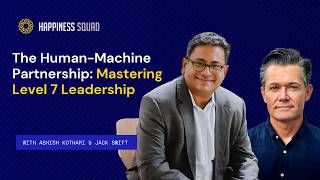
Jack Swift argues that a leader's state of being, not just their actions, drives performance in AI-driven workplaces. He outlines practical techniques like breathing exercises and the ABC grounding method to shift teams from reactive to coherent states, and introduces an AI coach called L7 that operationalizes these practices.
Questions this video answers
Toughness is not about persevering. It's about having the courage to sit still and listen.
I go inward with a short meditation, then outward into nature—an hour of sitting and an hour‑and‑a‑half in nature, even if it's just looking at a tree from a window.
"Comfortable with Uncertainty" by Pema Chödrön – 108 short practices for embracing uncertainty.
How am I showing up? (Leadership is an inside job.)
"One" by U2.
Chapters
Welcome to The Flourishing Edge, the podcast where we share weekly tips on making flourishing your competitive edge. I'm Ashish Kothari, your host, and each week we'll dive deep with flourishing experts, changemakers, and executives to share best practices that can help you unlock higher performance through science-based interventions. Let's step together into the edge of what's possible and live, work, and lead with more joy, health, love, and meaning. Jack, I can't tell you how excited I am to be in conversation with you, my friend, on your new book that just comes out, I think, in March.
Yep, early March.
And I was sharing with you earlier, just before we started, you know, today, since morning, 7 a.m., I've been deep in the book and I've read so many of those, so many of the chapters. And so I'm just excited. I think it can truly be a transformative book. And this episode hopefully will be transformative for leaders who are struggling to thrive. They're just surviving in the complex world that they're navigating. And I'm hoping they'll take several ideas away from this beautiful work.
Me too. I feel very aligned with your work. And I deeply appreciate where the work comes from, that your experience at McKinsey and so much time with so many companies seeing individuals struggling to find purpose, struggling to regulate their nervous systems, and in that really suboptimizing output. I feel the same from my own experience as an individual. Having been that executive, having been that entrepreneur, having been that founder and feel it. I can viscerally feel what it feels like to be in that spot. And I don't wish anybody that feeling of helplessness. It's probably too strong a word, but it's a feeling like I'm sub-optimizing. I'm not doing all that I can do here to create the right outcome. So I feel very aligned with you and I look forward to exploring together.
Amazing. So look, I want to start with the big idea of your book, which is your state of being is the primary driver of your leadership and your life. Unpack that for us.
Well, let's parse out this concept of doing versus being, because so often I find that people are just doing, doing, doing, doing. And they've been doing for a long time. They were really working hard in high school to get good grades, to get to the right university, working really hard, doing everything the professor at university said they had to do to get a good grade in college. Then doing so much to get the right job with the right firm. And very few people in my experience have stopped the doing to be, to really sit for just a second. And I've seen a study, and I'm not sure it's true. I've seen a study that people would rather shock themselves with an electrical impulse or electrical pulse, electrical shock, and they would sit still for 10 minutes. Yeah, multiple times. Yeah. Once is enough for me, but if it's more than once, even worse for them. But this concept of being, that to me is where coherence is found. And so in sitting still and just being with your nervous system, with your emotions, slowing the thinking down, that's the spot where you can find values alignment. You can find a place where the body starts to feel safe. And when the body feels safe, psychological safety, creative juices will flow. It's a spot where you move into enjoyment out of the fight or flight stage that we find ourselves in with doing, doing, doing. In being, the emotions can be regulated, the physical body can relax, and then you can move with much more intention. So purpose just is right there, right in front of you. And so the internal condition that allows for good judgment is also the same place we find enjoyment. And in that enjoyment, we're creating from a place of what's possible versus creating from a place of, if I don't figure this out by tomorrow, I might get fired. Nobody likes to play in that space, that creative space. We've all learned to do it really well. If I don't get this paper done tonight, I'm not going to make a good grade. If I don't get this project done, I'm not going to make my bonus this year. Right. That's creating from a place of scarcity, creating from a place of, like, I have to get it done. It's a fear-based place, and it doesn't last very long. It's not sustainable, and it's really not good for the body. So the thing, if there's nothing else that people take away from this conversation, it's that their state, the way they show up, determines their reality. And it determines the ability to move into enjoyment and create from a place of what's possible. And that's a lot more fun. And it increases productivity, both at an individual basis as well as on the team basis and then at the company level. So, it's a really wonderful place to spend time. There's a lot less pressure. It's a lot more fun. And that's what I hope for anyone listening.
Yeah. And that so resonates with me, right? I was studying this when I was at McKinsey and around the second half of my career at the firm, right? I discovered HeartMath, HRV coherence. We started looking at all of that data. And what I found, right, was almost 80% of the time, if not more, leaders are operating in that fight, flight, freeze, adrenaline, cortisol, fueled way of seeing the world, right? That's how they're seeing the world. So they're constantly in this activated sympathetic nervous system state. And that's why this notion from that place, there is no curiosity, there is no innovation, there is just habitual reactions and frantic movement. And to our listeners, just think about this for a minute. And see how this resonates with you. Most of you wake up. The first act is to put our body into a sympathetic nervous system response. We pick up our phones, the alarms jar us, and we open it up, and it's already got notifications of news, which often are not good news. They're often filled with, here's what's happening in the world, or you have emails, or you have Instagram pings. Right away, we are in this state, and we are on that state almost all day long. We're going from back to back to back meetings. There is no space for stillness. We're just on a go, go, go till we come home. We're exhausted. We have dinner with our families. Maybe we'll, at this point, the load is so much, we'll just put on a TV and again, watch and consume till the time we go to sleep. And so we've almost trained ourselves for doing, right? This notion that if aliens looked at us, they won't call us human beings. They will call us human doings because we don't like to sit still. We don't like to stop. And that's why I think I loved that you started with that. And I have to tell you this, Jack, there's a book that I read, and just reading that book brings me into a state of calm. And that book is called You Are Here by Thich Nhat Hanh. The book itself is a reading meditation. Your book this morning did that for me.
Thank you.
I was reading it, and I could just see my nervous system calm down because right in the beginning, you introduced breath. And even as I was reading, I was starting to breathe more deeply. And from that place, right, each of the words were kind of right away they caught me and I was like, wow, this is gold. So friends, this notion of being is a really critical one.
Let me jump in here too, because I don't want people to think that you and I are sitting on a mountaintop meditating, just being. Because to me, it's like Frank Sinatra said, right? Frank Sinatra said, "Do be, do be, do be do." And that's really the concept here from my perspective, which is do, be, do, be, do, but take time to be before you do. And in my book, Level 7 Leadership, one of the reasons I feel it's so important is because AI is busy augmenting our systems into other broader systems all the time. So if a leader or an individual is not showing up with coherence because they haven't taken time to be and they're just do, do, do, do, do, do, do, that's to your point, a sympathetic nervous system place that in an exchange with AI is only going to get amplified, amplified, amplified, amplified. So the trajectory there in an exponentially fast-paced environment is really not what we want to see. But I want to just come back to the point is I don't think either one of us is advocating for just sitting in the yoga position and paying attention to our breath. Yeah, pay attention to the breath. Take a few deep breaths, do some box breathing before you go into a meeting and then execute and then sit back and learn and listen. What happened in that meeting? How was it different? How did I show up differently because I took those breaths? Then execute again. So it's a do, be, do, be, do, be, do.
Exactly. I love that. And there's a lot of, and this is not Jack and me just sitting here, right? Again, talking, this is so much grounded in neuroscience and complexity theory.
Yeah.
You know, I discovered the work of Bob Anderson, Jennifer Garvey Berger, Dave Snowden, you know, in my, around 2014 and '15 when I was shifting from doing large-scale ops transformations to organizational work. And the research from Harvard literally highlighted that even back then, only 20% of people were at a stage of development, their way of being and seeing the world that enabled them to thrive in the complexity. 80% were stuck just surviving. And that number, I think, is so much higher because the world has become more volatile, more uncertain, more complex, and more ambiguous. And hence, finding coherence that you highlight right up front in the book is so critical. And so, for our listeners who don't know what coherence means, let's go into that a little bit and define that for us.
Yeah. I mean, coherence is this place where there's alignment in your system, where your nervous system is downregulated. You're in parasympathetic state. You are thinking clearly because you're not your emotions. Emotions rise. You may feel angry, irritated. Maybe the meeting's not going well. You may be excited, joyful. It's been a great morning, very productive at work, but you're not that emotion. You can observe the emotion, but you're not the emotion. So from a coherent state, you have this clarity. This alignment that moves from gut and HeartMath Institute will back this up all day long into the heart center, the most powerful electromagnetic field we have in our body that's emitting this easily measurable field of information to the mind and all of it's working together. Right? So, when we're in a sympathetic state, fight or flight state, it doesn't work. And a great example of this is on the battlefield. And I mentioned this in the book. I don't know if you remember it, but there's been quite a few studies that when fired upon, if you and I are on a battlefield and we're getting shot at, right, less than half of the people on the battlefield are actually going to fire back. That's how powerful that freeze state is or that flee state, that less than half the people who are getting shot at will fire back. That's amazing to me. But I think that gives you an idea of what, and you just talked about this, increasing complexity in the workplace will do to people, increasing ambiguity will do to people in the workplace. The speed at which AI is bringing evolution and change is exponential. Humans can't even conceptualize exponential change. We're very linear thinkers. So here we are in this exponentially accelerating world that's multidimensional, by the way. We're moving the way we learn to move from the third industrial revolution in a linear format, sort of plotting forward, thinking we can outpace, work harder, work longer the machines. Not anymore. The machines, they're much more precise. They don't sleep, they don't eat, they can move faster than us. So it's not going to work anymore to just go faster or work harder. This 9-6-6 workweek piece is not going to be effective, I don't think. I think it comes back to coherence. Back to be an aligned gut, heart, brain, clear, moving into the relaxed system, the parasympathetic nervous system to maintain clarity. And that coherence then echoes from the leadership into the organization, cascades out across the whole organization. And then with the right organization working in a harmonic format with AI is amplified by the precision, the speed, and the scale that this augmented intelligence brings to the equation.
Jack, bring it to life for us. Your story around building Tiffin in an AI-driven environment, really bring this to life, this notion of we're not talking about doing this work when you're sitting in a mountain or in an ashram in a retreat, right? We've all done that. We've all gone down there, but this is about in the ground, in the playground of work. Share that story of how you realized that you needed to actually shift the place from which you were leading if you were going to achieve greatness for yourself, for your teams, and for the organization.
Yeah, I mean, I, I've experienced stress in multiple formats, right? At West Point as a class president, as a Division I athlete, and it Ranger School, Airborne School, as part of that special operations training in the Army. Um, I've experienced stress. I had never felt more like a failure than when I tried to apply all of my tools from my Janus Henderson days as the executive there, an executive who was running the fastest growing, most profitable division of Janus in the time. That was me. Taking those skills and applying them at Tiffin. I, at Tiffin as a CEO, I felt like a failure because those linear skills, the work harder mentality that helped me a lot at Ranger School, that helped me a lot as a young executive in the financial services industry, didn't work anymore. It didn't work in an AI-driven fintech company. That was committed to starting 10 companies in 2.5 years and was growing with partnerships with JPMorgan, Hamilton Lane, Franklin Templeton exponentially and in multiple directions all at once. My personal operating system, the one I had learned and operated very effectively on for a long time, didn't work anymore. I was blue screening, rainbow wheeling for the Mac users out there. There were so many apps running, my system was shutting down. It just wasn't working. And so that was the point I realized that my leadership style had to evolve. And I think a lot of people are facing this. A friend of mine calls it the messy middle, whether it's the— I don't really think the messy middle is entrepreneurs and founders. Those folks are already operating at the edge. They're looking for different ways to do things because they're experiencing the blue screen, the rainbow wheel, because it's so ambiguous in the space they're operating in. But it's the executives in a lot of more traditional spaces where none of the things that they learned, forgive me, but through their time at McKinsey or Harvard Business School, whatever, they're not working. What do I do? What do I do? What do I do? And that's the spot where I think learning Much of what you're teaching through your work, what I'm trying to bring through with Level 7 Leadership: The Blueprint for the Human-Machine Era is about slowing down, creating internal coherence, internal coherence that then becomes relational coherence within an organization, then becomes a stable foundation, psychological safety, for a learning organization. This is like Peter Senge's work. And from there is augmented by the human-machine partnership. So, these feedback loops can go faster and then you can get to purpose-driven execution. That sequence doesn't work at all without coherence with the individual leader. And when I was at Tiffin in my first real role as a technology executive, as a CEO there, I had to find that out the hard way by failing and failing and failing and realizing that the way I was operating wasn't going to work in this new reality.
Well, you know, the word— you have a way with words. And I know you say I'm an engineer and, you know, but I think there was a particular way you phrased it and you said, I could smell the ammonia in the room, and I could smell the ammonia coming from it. And that was a smell I was aware of because I had experienced it in the battlefield. But here I was, and it wasn't just me, but here was the whole room. And we are operating from that state. And you realize that this isn't working.
Yeah, I mean, it's a real smell. It's a smell when the body shifts to burning muscle. Because it's just in full overdrive. You know, you know, when you're working on your laptop and it starts to just hum so loudly and it starts, the fans start to blow and you're like, man, I hope this thing doesn't shut down. That's what happens in the sympathetic nervous system when it's just burning through everything trying to keep up. And then the output, the odor, it smells like ammonia. So, we would go into these OKR meetings once a week and in this small space because we were still earlier, we were probably a Series B company at this point in time. I was like, "Man, I know this smell. This is the smell from when I was a plebe freshman year getting hazed at West Point. This is the smell that I know from Ranger School. This is the smell of ammonia. This is the smell of extreme stress." And it's not just me. You know, it's everybody, dev team, go-to-market in these meetings. It's not just me that smells like this because everybody's working and they're running on overdrive and this is not sustainable. What are we going to do to make a shift? And that's when we started to implement things like we brought in a chief mindfulness officer and started doing qigong every Wednesday at noon so we could slow things down, move into our parasympathetic or relaxed nervous system so we could start to come into coherence, bring the heart and mind into coherent format so they can start talking. And this is where we were able to get back into a clear path and move forward with clarity, which you know what that does for the performance of organization. It's amazing.
I see it, by the way, all over the place, Jack. So I want to get into a little bit of What did you do to shift? But to play this back, this is not just startup life. You know, I have the privilege of working with the leadership team at USC and Snowboard. We are also about to start a big transformation with a food company. And, you know, a massive company, so much changing around them, right? Their people are being asked, not just AI, but, you know, all of a sudden, if you run plants, you're having to deal with, oh my God, if ice shows up, what am I going to do? Right? They're dealing with so many initiatives coming at them that they don't know which one to do, which one not to do. You have to keep the business running and you have to transform. And you see it all over the place. You see it all the time. And instead of for a moment stopping and choosing to show up differently, we say, we have no time to show up. We just go. Go, go, and go. So, talk to me a little bit. You talked about mindfulness officer and bringing in a qigong expert. But talk to me a little bit about what are some of the ways if as a leader, you say, well, that is me. I'm feeling this. I feel I'm stressed all the time. I feel it in my system that the system is acting highly reactive. What might be some things? Where would you start? What might be 2 or 3 things that you might start with an individual, but you might do with your team in that moment that will start to create a bit of space for something else to emerge other than our reactive conditioned responses?
Yeah. Well, you, you brought something up in me when you said the ski and snowboard team. So really cool to know that you're working with them, and I can't wait to see what kind of results you achieve there. So much fun to watch the Olympics happening right now.
So exciting. It starts up, and I'm so excited for what is going to happen there.
Me too. Me too. And it reminds me of— so after I left Tiffin, I was the CEO of something called Liminal Collective. And at Liminal, we worked with the most elite performers in the world. So the most elite athletes, snowboarders, skiers, basketball players like San Antonio Spurs, entrepreneurs, corollary to SpaceX in Europe, and the special operations community. And in that seat, I had an opportunity to learn a lot from those elite performers because they're they're used to playing at the edge. They're always looking for a way to do something amazing, right? And they're never— the most elite performers in the world are never really leaning into the old frameworks. They're looking for new frameworks, new ways to do things. So, Michael Jordan, for example, he wasn't saying, I'm going to practice basketball harder He reimagined the game of basketball. To bring it back to ski and snowboarding, Andy Walsh, who built Red Bull's Human Performance Center and was one of my partners at Liminal Collective, he worked with Shaun White in preparation for the last Olympics, a great snowboarder. It was never about helping Shaun to hold an edge in a snowboard better, right? It was really stepping into other systems, learning to to work with the internal system of the elite performer. And this is what I would suggest for anybody who's going through experiencing really just the rapid transformations happening all around us. And it could be impacting one industry differently than another, but it's going to impact all of us. The aspects of kind of what to do first is really simple. Just find your breath. It's here, it's now, it's a here-now breath. And breathe in here and breathe out now, and you find yourself in the present moment. And the present moment is a space that we shape everything in the future. It's how we build the future. So just coming into that breath, and then doesn't have to be complicated. There's a lot of different breathing techniques out there. Andy would say just breathe out longer than you breathe in.
Yep.
And immediately your heart rate's going to slow down every time. So, if you breathe in for a count of 4 and you breathe out for a count of 8, great. Now, you're in the present moment and you're slowing things down. You're bringing down the tempo inside your system. Now, if you get to that place and you feel like you can imagine that your feet are very firmly attached to the earth or the floor beneath you, and you're anchored and supported and secure, now you're moving to this place of psychological safety and you're feeling stable. And there's a little acronym a friend of mine, Simon Hamble, taught me, and it's ABC. And first it's arrive. So now we've done it through the breath. We're here. We're now here. Now balance. So you kind of find your balance, like left to right, and then center. ABC. And the center point is usually in around the heart center. And so it's top to bottom. So now you find yourself more centered in your heart. There's a lot of intelligence there. Your breathing is now calm. Your feet are touching the earth, feeling grounded. And from this place, you can start to do things like imagine how to solve that problem differently, how to show up in a meeting with your team in a way that's more coherent and stabilizes the whole room. So bringing it back to snowboarding, you know, these are the sort of things that Shaun White would do, at least Andy tells me that, I never worked with Shaun personally, to be able to imagine what kind of new tricks were possible. And I think that a lot of athletes practice this, you know, Andre Agassi talks about in his book, you know, how quickly he can reset between points, right? So let's just learn from the best in the world. They're already out there doing amazing things, running sub-2-hour marathons, incredible tennis matches. Athletes are a great place to learn, but executives could learn a lot and bring it back into their work and not seeing it as so like the athlete's work is so far in, just as a place to learn and grow, you know, because you don't have to be, um, be controlled by our emotions. We don't have to be our belief systems. We can let those go. We can come into different states. You know, usually it goes belief, state, and trait. That's how I think about it. So letting go of some of the beliefs, like this meeting is going to go really poorly because the one last week went really poorly— maybe, maybe not. What if you take a couple of deep breaths, you get centered, you arrive, you're centered, you're balanced, then you go in, you're more coherent, you go into the meeting You reshape it. It can be different. So, these are very simple things that anybody can do anytime. And it doesn't take any time to do this.
Yeah. And you talk about something, you can do it for yourself, right? Before any key meeting you're going to go into, find yourself and ask yourself, where am I? And if you're finding yourself worried about something or reliving the meeting in the past, Find your center, get present. You highlight this notion of even starting meetings with your team, getting into coherence. This is one of those moves that I also highlight. I talk about for leaders to say, imagine, because mindfulness still in corporate world feel like this woo-woo thing out there. And I said, and I gave the analogy, Jack, of saying, if you look at any oil and gas companies, Many oil and gas companies have just built this into their protocols that they start meetings with a safety moment. So they'll say, because safety is so important, because an accident in an oil and gas factory kills hundreds of lives and it's so critical, they say, you know, safety moment. You know, they start meetings and saying, look, here's where the exit is in case of fire, in case of hurricane, et cetera. Imagine if you started meetings with one mindful moment, right? Just giving people a minute, a space to land with their bodies and their minds, right? Land with your minds. Bodies don't have a choice but to live in the present. But our minds can be all over the place. We can only breathe in the present and use breath just collectively as a team to just center and just notice that one minute. What that does to the meeting, right? It'll change the tone of it.
It would change the dynamic of the entire room. And at Tiffin, we did this with some of the, the biggest executive teams in the, in the world. So they would come to visit us in Boulder, and these are teams who were thinking about investing at the time. And we would have folks there from New York or San Francisco. Their minds are all over the place. Is this deal going to get done? What's happening to our business? And these are companies that may Some of these companies touch 40% to 60% of the households in the United States. And they would come into the boardroom and would say, hey, would you mind before we get started if we could just take just 1 minute of just silence, just for everybody to really arrive and be in this space before we talk about all these important decisions? And I think they thought it was pretty woo-woo. But they did it and it works every single time. Yeah. And it's 1 minute. It's 1 minute. And everybody is much more in the room. So, they're both present and coherent and there's a bit of alignment that comes into play. I talk about this concept of rhythmic entrainment in my book and it's just this if you observe whether it's grandfather clocks or metronomes from pianos, if you observe them singularly, they're all different rhythms. You put them in a room together for a few hours, they're all the same. Yeah, the same rhythm. And this is physics. And this happens with the human systems too. So if one system can come into coherence, other systems, in this case, other human beings in the space will follow. Now I'm going to extend a little bit out into the edge, a little bit on the edge. I believe this happens with AI systems too. So the more coherent the human is, the more clear, the easier it is for the AI to support that human and not bring back a bunch of hallucinations and noise that causes the whole team to be off. So coherent, single human. Comes into a meeting room, asks everybody to pause for 1 minute, what you were just saying, right? Or what I was sharing about some of these senior leadership teams. Now, you have rhythmic entrainment, the whole room is in coherence. And then, now, whatever happens with that coherence as these folks go out and start engaging with their devices or maybe in the room they're typing in their phones, you have systemic coherence which achieves better result over time. No question.
Yeah, I think it's a powerful concept. It's akin to, you know, Kim Cameron, who has done amazing work on positive leadership, talks about this heliotropic effect, right? This notion that we are drawn to light. Our systems are also drawn to coherence, right? Coherent systems out of coherence will over time learn to get into coherence. There's a really beautiful YouTube video of a scientist that he shows 5 different metronomes in different ways. And then he— and they all literally start to actually move one after the other in coherence. So you can see it, right? It's a real phenomena that can happen. And I think that's available for us. That is very much available for us.
No doubt.
So play with that in your next meeting, right? Take a minute before you go in. First, you get into coherence. Second, now extend it with your team and say, let's start with one mindful minute. Let's sit in silence and let's breathe. Breathe at 4, breathe out at 6 or 8. Really simple. And then we're going to start a meeting from there. This conversation is brought to you by Happiness Squad, where we help leaders build new mindsets new habits, and transform their ways of working to truly flourish. If you're ready to unleash the untapped human potential in your organization and operate at your best, come visit us at happinesssquad.com and start your journey today. I want to go to the next element of your framework, from coherence to relational alignment. You know, we want to move fast. And trust can help us do that. And so I want to talk a little bit about that relational alignment concept in your framework in Level 7 Leadership and the role of trust, how you've seen it make or break, and how specifically, if you're a leader, can you start to deepen that trust that allows amazing things for humans to do?
Yeah, thank you for bringing that up. I mean, I think there's no speed in any organization without trust, full stop. You know, if you try to go fast without trust, it's just chaos. And so it's imperative. And I think there's also an old framework here that needs to drop away and a new framework that needs to come in. And it's a very powerful new framework. There's really two component parts to it that I'll share here in a few minutes that I think are incredible builders of both coherence and trust. But Jeremy Utley's work in idea flow and the concept of why does some organization have so many better ideas than other organizations? Well, and he's a Stanford-based professor. He's a really bright guy. What did he find? Psychological safety. The organizations that had more ideas had better ideas. People that are willing to share without being worried about being judged, they just shared more, more ideas, better ideas. But that comes from a place of trust. And frankly, this is kind of where I think servant leadership breaks down in the age of AI. Because it's very difficult for a servant leader to execute with enough speed to build trust. If I, as a CEO, go around and have discussions with all of my subordinates and I learn a lot of different things, but then I don't ever execute on it because the world changes in the meantime, that's eroding trust, not building trust. So how do we build trust? I think in modern firms, the first thing is letting go of the belief that as the leader, I have to know what the answer is. That's ego. That's not helpful. I need to believe that I can come into coherence and feel and sort of think into where things are going. But I also need to accept with very rapid iteration and closed feedback loops, I'm going to be wrong a lot. So I don't need to know better. And the team collectively, if they're operating in coherent format, they don't need to know. They just need to be willing to learn fast. And that's what distinguishes, you know, high-performing organization in today's world versus a low-performing organization, in my opinion, is the rate at which they learn. And so, what can a leader do if they're not the one that shows up knowing better? Because that's the old way, you know, you have a single leader, Jack Welch, he knows better. You know, Jim Collins, you know, single leader might show up and say, here's the BHAG, this is what we're going to do. You know, this is how we're going to get our flywheel working. Those concepts are still foundationally sound, but at speed, they actually erode trust versus building trust. Because we don't have 3 years to work on a BHAG or 5 years anymore, we have months. And weeks to iterate as the market evolves. So, the two most important things that I think leaders can do to build trust in today's organization are one, say very confidently, I don't know. I don't know. Why did things fail last week? Why is our go-to-market strategy not working right now? I don't know. That builds a lot of trust because it's the truth. It's the truth.
That's right.
It's the truth, you know, and it resets the coherence of the whole organization when the leader speaks that level of truth. I don't know. And go ahead, do you have something? What's coming up for you?
I was going to say it is so true, right? Because when you're— first, leadership can feel heavy if you feel like you need to know the answer. But the second is implicitly you only have one perspective. In a world with multiple perspectives and forces shaping what's happening. And so the chances of you having the full answer is off. And unless you're able to say, I don't know, you don't give permission to the 10 other people around you who might not know perfectly what the answer is, but they might have hypothesis that collectively we can sense into and experiment and try.
Yeah, it unlocks so much with the team when the leader says, "I don't know," because they're engaged in, "Well, let's figure it out together collectively. I'd like to be a part of the solution." You know, they always say, "Victory has many fathers and defeat has none," right? Everybody wants to be part of a positive solution. Everyone wants to be a part of a positive outcome. They want to be part of a victory. So when the leader says, I don't know, then with the right level of psychological safety, you start to build trust. It's an upward spiral of trust because it's okay not to know and it's okay to learn together. So what can we learn? What do we know? What data is inbound? How do we use AI to help us parse through that data to see what's really available to us? How do we do that faster? Each time we learn, each time we build a little bit more trust. Because we're learning together, together, together. And it's an upward spiral versus a downward spiral, which we don't want. And the second thing that people can, that leaders can do to build trust and ultimately speed an organization is to say, "I made a mistake. I made a mistake." Because you know what? You have to make mistakes if you're going to operate at speed. That's the only way you can learn. And, you know, 10 years ago, 15 years ago, these are the frameworks that were breaking me and causing me to go into blue screen when I was at Tiffin. It was forbidden to say you made a mistake. You may not get your bonus. You may get fired. You're an idiot. You know, how can you survive as a McKinsey partner if you make a mistake? It's impossible. Today, any team that I'm in, I advise companies today, I advise early-stage companies, I sit on paid boards for large companies. I love it when the leaders come and say, hey, I made a mistake. Because it doesn't matter. What matters is what do we learn? And when everybody starts to show up and they realize it's okay to not know, it's okay to make a mistake, but what's really important is the learning and the learning together. And we're going to support each other in learning together. Now, we're building trust at speed. And trust at speed is what distinguishes performing organizations and high-performing organizations from those that are lower performing. I mean, again, back to sport, if we'll just go back to a quick analogy there, you can see it when you watch a basketball game. Who trusts somebody else on the court when they're passing passing the ball. And you can see when they trust each other and they're like, hey, I made a mistake, I missed the pass, versus it's your fault, there's blame, now it's a downward cycle, trust is eroding. Hey, I missed the pass. Who cares? Let's go. What do we learn? Don't post up here, post up there. Great. Now we're learning together. We're trusting each other more. Now we're moving faster. We're getting more points. That's where we want to be with a high-performing organization. That's what coherence looks like, or coherence looks like in speed.
You know, as I reflect on that, I'm reminded of the original research that Amy Edmondson started to do when she coined the word psychological safety. You know, she went to study teams, right? She was studying these NICU teams and looking at seeing which teams, high-performing teams, right? What do they do differently? And what she found was high-performing teams, much to her surprise when she first looked at the data, had much higher number of mistakes than they were logging, right? Versus other teams that had much lower number of mistakes. And that initially puzzled her. And she said, like, I don't get it. Like, why are there more errors, more failures here than here? Till you realize that the reason that was is these teams were psychologically safe, trusted each other, were learning teams and were willing to learn from their failures and continue getting better. Whereas these other lower-performing teams never acknowledged failures, put them underneath, nobody wanted to talk about it, and were hence making the same mistakes, most of them not reported. Just because failures aren't reported doesn't mean they don't exist. And friends, in today's world, if you're not failing and if you're not celebrating failures at the pace at which the world is moving, You're not learning, you're not moving fast. And so you have, and I really love it. You know, one of the clients I worked with, they instituted a monthly meeting where the whole point of the monthly meeting is for people to come and share their failure stories. Where did you fail and what did you learn? Right. And initially people were like, oh my God, are you kidding me? Like, is this real? And they were like, yes. And it took a month and a second month and a third month and it required the leaders to say, Here are 3 things that I did that I failed, that didn't go as planned. Here's what I learned. Here's what we're doing different. That people started to say, wow, actually this is true. And then all of a sudden, right, people had permission to talk about what was not working, what was learning. And all of a sudden innovation improved, creativity improved, productivity improved because we were not in the blame structure.
That's right.
Yeah. But that's, you know, but Jack, going back to like, but it requires coherence. Because if you come into the meeting in a reactive state and you talk about failures, you're going to blame.
Yeah, it's spiral. Yeah. And that shame, blame piece, guilt, those are low, low emotions. They're really difficult to get out of. So you don't want to go there. And so I try to avoid those and try to find ways to neutralize those so you don't end up in that space. But I'd like to just bring up two more points that are coming up for me in line with what you're thinking, what you're saying with teams that are coming together and sharing failures. You know, I think in the last two or three years, it's been really popular to talk about showing up authentically, showing up vulnerably. And we're touching into all those points right now, right? And I think that's incredibly important for those people that are listening. And they want to think about what's the next thing, I think is to show up aspirationally. What do we aspire to do as a team? So if we can get to the place where we can show up and say, I don't know, I made a mistake authentically, we're learning. Now what's the next level is to aspire to be in a place where we learn so fast, maybe we don't even need a weekly meeting. We're just sharing every 15 minutes. As a group and we're aspiring to move collectively in a very, really, it's in a flow state, but in a very organized format. So this is where we get to the flock of birds, right? Or the school of fish with what's called a murmuration where there's a fluid movement with the body. It could be in the NICU, it could be in the boardroom, it could be on the factory floor. but there's a fluid movement because the trust state is so high. All that needs to happen with a single bird in a flock of birds that's moving, and you can, if you're not familiar with the term murmuration, this is the aspirational piece. The, the, the, we aspire to, to move in like a flock of birds in a murmuration. But all you have to do is to trust the bird next to you. And when they move to a little bit to the right, you move a little to the right. And now you're in this sensing field. That's far beyond— it's a speed far beyond the meetings and far beyond the words in meetings or the presentations that encapsulate data. And now you're moving really, really quickly. And that level of coherence is where I believe we need to go to be the leading half of the human-machine team. That humans that can move with that level of coherence can show up that level of coherence, then we can really go because machines can react to that with speed and precision that we've never seen before through AI. And so I just encourage the audience to think about, okay, oh, yeah, we can do the meeting, we can show up, we can say, I don't know, or I made a mistake. Check. I invite you to think about what would it look like to have a an aspirational team that it moves so fast and so in trust that they're in flow and they're always learning really real time. And that's where I think we're going next.
Yeah. And look, the reality is the following, right? There's so many teams today that the mantra in many organizations is speed. We got to move fast. We got to move fast. We got to move fast. How many of you, if you're listening, have in some shape or form got agile running? You've brought people in, they've told you there's a scrum master, you're doing your sprints, maybe they're 2 weeks, maybe they're 3 weeks. You know, you've got all these charts, you're moving forward, you're training people how to do agile. Ask yourself, are you teaching people how to be agile? What are you doing to get people into coherence? What are you doing to truly do distributed leadership, trusting each other, moving with each other, listening to each other, sense-making together? If you want to be fast, that's what you need. And yet so many people say, I'm doing agile, I have an agile pod, but guess who makes decisions? All of that needs to go all the way up to the organization for somebody to say, go do X or go do Y. Or even if you're trusting the teams, you haven't taught them how to create that coherent state, not just coherence within yourself, but coherence with each other and that trust that allows you to operate at the next level. So if you're struggling with agile not delivering, if you're struggling with all of your innovation and your aspirations, you're trying to move fast and you're wasting 30 to 40% of your time in meetings, and you all know it. That's 30 to 40% of your time in meetings is wasted. You're just circling around, not naming the elephants in the room. And just try this, try these practices. Be coherent. Show up saying, I don't know. Show up saying, I made a mistake. Here's what I learned. Tune into what, Jack, you're highlighting is step back for a moment and say, what's our higher purpose? Where are we going? And practice these, and I promise you, you will start to move fast.
Couldn't agree more.
So I want to go next into once you start to do that, you can start to unlock your third element that you highlight, which is systemic learning. Learning that is not up to just one, but you're trying to make sense, make a lot faster. So talk a little bit about systemic learning. Jack?
Yeah, I mean, I think we've touched on a lot of elements of it with understanding where are we opening feedback loops or learning loops, where is— where are we not closing those and it's straining the organization, being aware of moving decision-making down to the smallest element possible. So I call them pods in my book. You know, with the pods, giving them as much authority as you can so that they can learn quickly and then eliminating the layers that exist between the pods and the senior decision makers. So establishing and maintaining systems of transparency, you know, you know you've lost it when a pod of 6 or 8 people is working on a particular project. They're maybe doing a sprint to push to production, and then whatever's happening is being fed back up the chain of command in a series of presentations, PowerPoint presentations or whatever presentation stuff. You've lost it. It's raw data being fed back as quickly as possible, probably in something like 14 days. It's being able to keep a log. What bet do we make? What do we think would happen? What happened? And being able to see that real time, not being polished, no polish here. That's theater. Drop the theater. It's just the data. Then you're moving into systemic learning and systemic learning at speed where you're closing feedback loops very quickly. You have a very specific order of understanding what you intended to do. Maybe it's in a 14-day period. What didn't work well? What do we learn? Move on. And then the next piece is building in inspections, you know, which are really rituals. And this is where we get a chance again to move from the old way to the new way. The old way was, okay, with these inspections, let's say they're every 6 months, every 3 months to 6 months. The old way was we're going to, you know, there's going to be executives are going to spend a lot of time polishing a presentation to show what they want to show. And hide what they want to hide. And this is the exact opposite of that. This is building enough psychological safety, enough coherence in the system. So at the systemic level, the feedback is coming through in a very direct format without emotional charge. So this is where trust again is really important. Here's what we expected to happen. Here's what happened. Here's what we learned in a 3-month and 6-month format. And then other things that I think help systemic or systematic learning is to listen to the edges, right? That's where there's a lot to be learned. And I think oftentimes we don't focus on those folks that operate on the periphery that have very specific tasks and objectives and very specific functions and teams, but they have a lot of information that they can offer to the broader group. Another way that it's important to build systems that learn is by honoring reflection. And reflection from the edge is just as important, if not more important, than reflection from the center. And the center in this case would be the leaders that are making decisions, you know, with the dev team or whatever. And the edge would be, you know, who's the most junior member of the team? What do they see? You know, it's funny, somebody and I was talking to somebody like a week ago or so and they said, you know, who's your mentor? Like, who's the person? You know, I'm 52. Who's the person who's like in their 60s or whatever? And I'm like, I have a couple of people that I consider mentors that are in their 60s and great guides. But for me today, my mentors are 30, they're 35. That's where I'm going to learn the most. Right. And sometimes those folks are in those more junior roles on a team. That's the edge. Edge listening. There's a lot to be gained there because they see the world differently, the edge players do. And they oftentimes can see where the future is going much better than those of us that have been doing something for a long time that are stuck in our own belief system that's now having to show up with certain states and traits that have evolved over long periods of time that maybe create a lens or a film over what we're able to see. So, Those are some of the ways you can bring in systemic learning. I have a decision rubric that I bring through in the book too that I think is helpful in systematizing some of these things. But hopefully that framework that I've given you is enough to dig in on.
Yeah. And, you know, just remember, like, if you say, okay, listen to the edges, here's what it also involves, right? Any dashboard, any scorecard, Any data at best is backward looking.
Great point. Yeah.
At the pace of change and innovation, especially when you look at what's being launched today in terms of AI, the new competitors that are entering, politically things that are happening, things that are happening in our neighborhoods and communities, your salespeople, your plant people who are in the front line They have real information. It might not be all data, but they have got their in it. Figure out a way to get that intelligence from that, feed that as raw as that might be combined with the data. And now you've got a system that both is making sense of what you have, right? It's your rearview mirror, but it also is creating a much bigger landscape of what is coming in front of you, your dashboard. and that's how you can steer your car better. You know, we're not in stable worlds. We're not in worlds where things take 3 months, 6 months, 12 months. Things are happening every day, every week, right? You have to be able to make sense of both. And I think that's an important skill. If your decisions are only looking at what's happened in the past, know that the moment, by the time you make a decision and you move, it's already solved for something that happened in the past. It is irrelevant to what's happening right now.
I think it's a great point, and it just reminds me of all the autonomous vehicles on the road, and we sit in those and lean into the LiDAR systems to allow us to drive forward. Imagine if we just drove those vehicles with only the data from the rearview mirror. What would happen? We would crash. And I think this brings us back to coherence, which of course is something I get very excited about. But listening into the full body system beyond just the logical mind is very good at taking past experience, rearview mirror, probability weighting it and saying, this is what's going to happen in the future because the one time we failed to get the big enterprise deal done, Now I'm going to probability weight that it's not going to happen this way in the future when it may not be true. So what I encourage leaders to do at the rate of change that we are in today and supported by the precision and speed of AI is listen to your gut, listen to your intuition, sense into where things are going from the edge, sense into what's really behind the data. Not just the data, because that's, you know, that's what LiDAR is doing in an autonomous vehicle. It's sensing into what's ahead of you. And we trust that, right? And we can't see it. And, you know, we use Wi-Fi networks all the time. We can't see them. And so just because we can't see what our intuition is telling us and what we feel in our bodies doesn't mean it's not real. And I think oftentimes it's a great indicator of what's to come. Much more so than the linear mind that is probability weighting things based on some data from the past or their rearview mirror.
Yeah. And look, friends, we're not going to go deeply into intuition, but I recorded a podcast. I think it is about 6 or 7 episodes ago. And you can look it up, search for Emma Cepula, who's a Yale researcher. She's done a lot of work around happiness. She's done a lot of work around meditation. She's somebody who studied that extensively and researched it. You can train people to be more, and you can train your intuition. And there are proven approaches she talks about in her book, Sovereign. Look into that because in today's world, going back to a state of being, cultivating your Intuition can be the biggest superpower that can guide you in the future because things are moving way too fast and our past will— if all you have is looking at past to make decisions in the forward, I can promise you one thing, it will fail you in 90% of the situations. In the 10% stable, yeah, fine. But majority of where you're trying to go, it's actually going to fail you. So build your intuition, get to coherence, make sense, build relational trust, integrate systems learning. These are not just nice-to-have concepts. These are fundamental must-haves. And Jack, I can't wait to share the book you sleep— it's filled with so many practical— what I loved in each chapter is in the end, you have a set of practices. You say, hey, here's the whole set of practices. Pick one, right? Pick one, start that, pick the next one. You'll have enough in there. For a long time. But what will happen is as you start to do them, you'll start to see that externally the speed is not changing, but internally you're speeding yourself up. Not because you're running faster, but you're actually making decisions in a lot more smarter way. You're sensing, you are skating to where the puck is going to be. To use an old analogy rather than where the puck is right now.
Yeah. And I, I don't think I've announced this anywhere publicly, so I'm going to do it here right now. I have a QR code in the book that is linked to an agent that I built that's built on top of the information that's contained in the book. So those practices you're talking about, they're static, they're printed in the book. You know, I like to think they're great and they're going to work for some people. But the agentic AI capability set with what I, the agent is called Level 7 or L7. L7, interact with it. It's got great reflective practices. It can build templates for you. You can work through a series of practices from the book and then ask L7 for more practices. Or if you want to fine-tune a specific piece, I want to train on my intuition, what can I do? L7 will guide you through that process. If you're learning a lot through L7 and then you say to her, hey, I'd like to bring this into a template that I can use across my whole team, she'll give you that. And it's going to be built on top of layers and layers and layers of iterations of other leaders that are personalizing their exchange with L7 to get what they need from it. Reflective practices, being able to lean into specific exercises and show up differently in a more coherent way and bring that to the whole organization or bring more systemic learning to the organization. L7 will guide you through all that. That she's going to continue to learn every single day. She's been learning for a long time now. I've been working on tuning her. There's leaders that are using her today, and they're finding her very productive. So while I'm really excited about Level 7 Leadership: The Blueprint for the Human-Machine Era, the book, I'm probably more excited for the body of knowledge that is going to develop in this agentic AI format.
Amazing, my friend. We could talk for hours. Right. There was a part of me that says, let's go chapter by chapter. But just looking at time, maybe I want to end with a set of rapid-fire questions for you. And then we'll end with, like, if there are just 2 or 3 practices that you want people to just take away, go try this now. By the way, I played with L7. It was fantastic. I did go into that this morning. Thank you for putting that out there. Sure. So first question, what's a belief you've changed your mind on?
Toughness is not about persevering. It's about having the courage to sit still and listen.
Yeah, beautiful. What's a habit or ritual that you practice when life gets especially hard?
I go first inward, so meditation. And I can do that very quickly. It doesn't need to be for 20 minutes. And then outward into nature. And so, every day, I practice basically an hour of sitting and then an hour and a half of being in nature. And look, if I'm in the city, if I'm in London or I'm in New York and I don't have a chance to get on the trails like we do at Boulder, I can just look at a tree out the window and still feel like I'm connected.
What's a book or a research that you wish everybody should know about?
There's so many here, but I think in this space that we're in, I would probably say Comfortable with Uncertainty is the one. We've talked a lot about pace today and how things are shifting and moving and getting comfortable with uncertainty. That's by Pima Chodron. Is probably the best book to do that. It doesn't take much time. It's 108 ways to do it, and they're a page or two. So go for it.
What's a question you wish more leaders asked?
How am I showing up? Because ultimately, leadership is an inside job.
Yeah.
That's the—
So powerful.
Biggest thing you can do for your company, for your team, for your family, for your life. Ask yourself, how am I showing up? How do I want to show up? And it's up to you to change it. And you can. You can change it right away.
A song that lifts you up?
One Love. No, the song is One by U2. One Love, One Heart. It's a great song and it always makes me happy.
Thank you, my friend. This has been an amazing, amazing conversation. Look, I am so grateful for you. I've spent close to 7 hours today on this book. I'm going to continue reading it over the weekend because I still have 8 more chapters to go. I'm going to play more with L7 because I really like it. I think that's the path where we are going as a company too. You know, across these models that we have, what we are trying to do is actually build a platform that will allow people to go from knowing to doing. It'll put them into practice. What we want to build is a coach that truly is something that people can ask and get guidance on. And L7 is an amazing, amazing coach that can act to put many of these practices into life for you. But as we end, if there is one thing, if there is one thing, one tip one practice that you say, hey, listen, if you did nothing else, we talked about a lot of things on how to be a great leader in this modern, in this age of AI. If there is one thing you'd invite them to say, go do it now. What would that be?
Be present. Be with your breath. Be present.
Beautiful. Jack, thank you so much. So appreciate having you. Grateful to have you as a friend and in community.
Thank you so much. It's been fun. I feel we're very aligned in our work, which is amazing. Thank you for taking time to dig in on a bunch of really interesting topics today. And I'm sure that we're going to be able to make an impact together, and I really value that. So thank you very much.
Thank you, my friend. Thank you for joining me on The Flourishing Edge. If today's conversation inspired you, share it with someone who's ready to flourish too. Subscribe, leave a review, and stay connected for more tools to achieve breakthrough performance through flourishing. Until next time, keep learning, practicing, and growing into your fullest potential.
More from Ashish











Reducing Regrettable Attrition in Organizations by Fixing the System, Not the People Reducing Regret