Unlocking Human Potential Through Soldiery with Former EVP at The Coca-Cola Company Ahmet Bozer
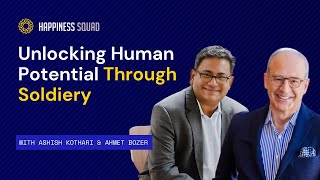
Ahmet Bozer, former Coca-Cola executive, spent eight years building Soldiery, a personal-growth framework treating every role as a platform for self-development. The model has four acts: find your direction through meaning, aim for impact with a legacy mindset, perform with excellence by discovering your rhythm, and hack your growth by responding to challenges rather than reacting.
Chapters
Welcome to the Flourishing Edge, the podcast where we share weekly tips on making flourishing your competitive edge. I'm Ashish Kothari, your host, and each week we'll dive deep with flourishing experts, change makers and executives to share best practices that can help you unlock higher performance through science based interventions. Let's step together into the edge of what's possible and live, work and lead with more joy, health, love and meaning. Hi Amit. So delighted to have you on our Flourishing Edge podcast. Thank you for joining, Ashish.
It's wonderful to be here and thank you for having me as your guest.
Yeah. Look, you've had such an amazing journey. Amit, we were just discussing earlier, right? 25 years, Coca Cola, a senior executive, you were leading the international business for a big, big part of it. I'm curious how that journey and those leadership roles shaped your thinking about human potential and flourishing.
Yeah, you know, I've sort of somewhere around the midpoint of my career, it basically dawned on me and I more deeply realized that every business is a people business. And then, you know, if you want to honor that belief, you have to work in ways to create environments where people flourish, because when they do, then the business does well. This is one of these maybe less tangible, softer side of business. But it's true, I believed in that. And then I said to myself, if that's true, it really starts with me. So whatever I do, I have to first be a role model in it. And so that set me into viewing my role, whatever it was at Coke and even later on my family roles or my community roles, as sort of platforms on which I can become a better person, I can become a more capable professional, I can become more resilient. And so all of these roles, I view them as platforms. And that got me to sort of slowly develop some sort of an approach to how do I grow myself, how do I become a role model for people? I lead that. A person that really grows and develops themselves. Then I of course, tried to reflect that on my leadership approach for others to the extent that I could. And all of that worked wonders with me. You know, the results to one side, I've had good results, I had a good track record. But the fulfillment I got from that was, I think, at least equally important for the great results that I was able to or we were able to realize. So when that career, when my career came to close, I got really fascinated by this topic and I asked myself the question, I tried to scale up this approach in my professional life. Can I scale it up? Great. More greatly, can I scale it up to the whole world? And you know, one of the presentations I've attended gave me a very profound insight. You know, they said in businesses you have yearly plans and then you have sort of like three year plan or five year plan. And they said actually that three year plan or five year plan, probably if you don't do it at all, nothing would change because. And I found that to be so true. You know, we do it in good faith, but in the end, so much changes that instead this person said, you know, you should really think about your much longer term vision. 10, 20, 30, 40 years, even. Even. I took that to mean even for times beyond your lifetime. And then sort of take steps that build toward that very long term vision. Yes, have a one year plan so that you know what steps you're going to take and stay anchored on that very long term. So this gave me the idea that if I could develop a model for an individual to unleash their own potential, take the leadership of their own growth, to be a leader of their selves, and if that got embraced by people around the world, so this model had to resonate across cultures and life stages, then maybe I could scale this approach to personal growth, to unlocking one's potential around the world. So that's. And then when I retired from Coke, I was fortunate to have the flexibility to decide what I wanted to do with my time. And I wanted to be definitely producing something that meant the most to me because I worked in this way, because I became passionate about unleashing human potential, people and all of that. That was the fun part of my job. Why don't I do that? And I worked on soldiery for eight years. So the book was finished eight years and 8,000 hours later. It was a road with a lot of pain and a lot of learnings. I realized in this process that running a company was easier, especially if I think about the last five, ten years, because. But this was extremely rewarding. Very rich experience, very rewarding. So I was able to finish it. And that's the story behind it. Really?
Yeah. No, I love it. Look. And it so resonates, Ahmed, by the way. You know, this notion of investing and helping people become the best version of themselves is the real job of leaders. Right. Leadership is not, I learn a business, by the way, if you do do that, you get higher profits, you get higher, higher productivity, you get lower attrition, you get all the benefits. But it comes through people. Right? That was my research at McKinsey. That's what I've, I've dedicated my life to is helping a billion people flourish. And I want to help them flourish through business. Right. That's, that's really the, the goal and awareness and increasing self awareness in, in the model that shows up at the heart. So, amit, your story. Eight years, 8,000 hours, and soldiery was born. The word soldiery itself is intriguing. Tell me a little bit about how do you define it and what makes it different from traditional ideas of personal growth or leadership development.
Yeah, let me just explain a little bit about how I came up with it, because in there is what really means. So I was reflecting on what is personal growth? What does it feel like? And my belief is that personal growth is both inside out and outside in. The inside out part is about being aware of your thoughts, emotions, and, you know, mental models and being able to sort of evaluate them as to, are they helping you? Are they hurting you? Are they helping you to grow? Are they inhibiting you? So this takes a lot of introspection and self reflection, which is best done on lived experiences, you know, when you go through, you know, but then you have to evaluate them and you have to decide to change. Now I said this feels like self surgery. It's like you're doing self surgery, but then is self surgery of what, you know, I thought a good word to use would be the soul, self surgery of the soul. And here comes this one word called soldiery. But then I have to explain, you probably noticed that in the first chapter in the book. I don't mean to use this word to say that we can operate on our souls, because I believe we can only connect with our souls, because when we connect with our souls, we sort of relinquish control to something greater than ourselves.
Yes.
And so we are actually operating on our psyche, thoughts, emotions and mental models as we operate on them. What we do facilitates a connection with the soul. And that makes us whole. That makes us a whole human being. And that whole human being isn't in a cave or isn't in meditation or isn't detached from daily life. I thought we could do this as part of our everyday life.
Yes.
We can't do this perfectly, but we can strive to do it better each time. So this is how, you know, the spirit of soldiery is this. And that's how the name has come up. What makes it different from the others? To come to your other question, or maybe would you like to react to what I said before I move to that question.
I actually love that. Right. I think this notion of soul, we are more than our mind, we are more than our body. Right. We are not our feelings, we're not our thoughts, even though that's how we experience ourselves. We are living on our own dream, not realizing that we are the one who's the actor, director, viewer, villain, protagonist. And the only place from that, that we can actually do that. Right. Is from this place of the witness who's seeing it all. Right. From this more of a higher level place. So that really resonated with me because it's a very core part of awareness, work and hardwired for happiness. I loved Soldiery because this notion of the soul, you know, the space from where you are witnessing it all can act as the foundation. It's the connection point to the whole. And from that you can start to kind of understand how you're perceiving components of what's in your awareness and then really operate on that to go back to your wholeness rather than these really distorted 1 2% ways in which we have been experiencing the world. So I think it's beautiful. I think it's. The word is so creative. I'd never seen it and it really resonated with me, so.
Well said, Ashish. And the only couple of things I would add is, you know, when you and I talk about Soldiery in the ways we just did, it sounds like it's somewhere out there unreachable. But no, my whole goal with Soldiery is this is the philosophical foundation.
Yes.
We act on this in everyday life. And the whole purpose of the book is to show how.
Yeah. I'm reminded of this beautiful. I know you're a bit. You. You're a big lover of Sufism. I am too. And there's a. There's a particular beautiful saying by Anais Nen who says, you see the world as I see the world as I am, not as the world is as it is. And that's. That's what this work is all about. Is starting to become curious about how is it that I'm seeing the world.
This is so. You know, I had this quote in earlier versions of the book before I finalized, especially when I was talking about the sense of self. To describe the importance of sense of self to our growth and how our awareness of that is so important. And what underpins that is this quote from Anais Nin is like, we see the world as we are, not as it is. So it is so true. And the moment we become aware of that and the moment we start transforming how we see the world by sort of keeping our sense of self in check. Then we connect more with life and we get wiser, we become more open hearted. Everything flows from there. So.
Let'S walk us through. You put this model together. I'll put this up. Right. We'll see if we can put that. I think it's a beautiful model. Walk us through a little bit of the different components of the model and how they work together. So yeah, just give us, give our readers an overview and we'll see if we can put a picture of this in one of our show notes, et cetera, for people.
Okay. Yeah. So I am a very systemic thinker, trying to solve. We have to get the components of the system right and then, you know, we learn to work with that system. So it started with three questions. One is, what exactly is growth we keep talking about? So it rests on the premise that we have unbound potential. Our lives are not long enough to discover all of it. So growth is about discovering ever more of it every day. So what is growth then? And so the first pillar of this model is that definition which is becoming increasingly capable, impactful and resilient. Now, if that's the growth and if it's the human being we're trying to grow, what is the human being? What does it consist of? That was the second question. Because if we understand what the human being consists of, we can then contemplate how we can grow it. Because now we have a definition of growth. So, and this one was in the self map in that diagram that you showed. And this can get a little complicated. And I advise in the book that, you know, just try to understand it holistically first. And then as you sort of go through the book, you'll understand it more. So at the risk of maybe overwhelming listeners a little bit, I'll try to explain this. And you please stop me if I'm getting into too much detail. But I think of the self as an inner self and the outer self. The outer self is the easier part. It's the roles that we play in life. As for me, I'm a husband, I'm a father, I'm a professional, I'm a son, I'm a brother. All these roles we play in life, whatever I consider to be important. And through these roles I engage with what I call the human ecosystem. You know, we exist in ecosystems. You know, it's like geographical or human. These are all the people who have come in and out of our lives who have left a mark on us, whom we have left a Mark on. So that's our human ecosystem. And through these roles, we engage with that human ecosystem. And that's the outer self. Now, the inner self is more complex. So at the core of this inner self is, that is 4D beings, as I've defined it, four dimensional beings, which is we have the ability to experience life physically, intellectually, emotionally and spiritually. The first three of those are we experience in this thing we called life, which is defined by time and place. Our spiritual dimension goes beyond that. It's a little more difficult to define. But I define it as our ability to experience a connection with something greater than ourselves. So that's the 4D being at our core. That's what we are. This 4D being is governed by a council of three, as I call it. This council of three has our will in it, is one of the players. Think of your will like the CEO of your company. It drives you to do things. It drives you to go out of your comfort zone and grow. Then you have this thing called your conscience. So if will is pushing you forward, conscience is telling you the right and wrong. And so it's like this silent board member of your enterprise who doesn't speak much. You can stifle it. You can decide not to listen to it and it'll get ever more quiet, or you can listen to it. But if you listen to it, it'll tell you the right from the wrong. And then in this council of three, there is what I call this antagonist, this potential antagonist called your sense of self. That's all the thoughts that you have about yourself. The reason I call this an antagonist is that the sense of self could dominate this counsel. It can make the will work for itself. It can make, and it can stifle the conscience. Because I could use all my intellectual, spiritual, not spiritual. I can use all my intellectual, emotional and physical capacities to bolster my sense of self or to protect my sense of self. I live a life that is just serving the sense of self. And the sense of self has this innate power that it can do that. Now, will has the to keep it in check, to control it, but it also has the vulnerability to fall prey to it. So that's the council of three.
Now, if we stay there for a minute, Amit, I think what in here, what really all of this made sense to me. It really resonates. I've always described this notion of we think about awareness. So our listeners who played back, we can almost think about. You're talking about the two levels, right? Of how does the world Experience me, which is your outer roles. How do I experience the world? Which often is in the domains of the physical, emotional, intellectual. Right? And then there is a third level deeper. You call it the 4D. I just talk about a third level of awareness, which is an awareness and leaning into a question that so few people lean into, which is who am I? So who am I? How does the how do I experience the world? Through what beliefs models am I experiencing the world and how the world is experiencing me? What roles am I playing? How am I coming across? And that first one, which is who am I? People have spent lifetimes looking into that. And to me that is the door to your spiritual D. Right. That's your core of who am I? How am I different than others? And recognizing this deep sense of inter being that we constantly live in. So I love that this notion of these, you know, you talked about the inner and the outer and then recognizing that fundamentally life is a growth journey. Even though for many people we experience life as an accumulation journey, right? We come with nothing, we're born with nothing, we leave with nothing. And all through our life we accumulate and leave everything in here. But by the time we realize that we've already lived our constantly trying to drive to achieve what we are trying to achieve, but only oftentimes finding the divine and that connection in the last parts of our life. And what I love about your work and the model and I want to get to your four acts is it's an invitation to actually get to that place a lot sooner and live into those as part of your life rather than retiring, moving to an ashram, leaving everything out there and say I'm going to get to it later. It's an opportunity to grow in that dimension through your life.
You've could, I couldn't have said it better, Ashish. Thank you. So articulating that so well. The only thing I would say is I haven't written this book as a guide to the divine. I am not qualified for that. I can personally experience that myself. But my life philosophy basically is something like when the matter comes to the issue of the divine, I will speak if I'm asked, but I will be very careful to not impose any religious views on anyone.
Absolutely.
So I was very sensitive to that in writing this book and I tried to keep it, you know, if you would see that in chapter four I stopped at the border of saying do not ignore life's existential questions and I listed them. One of them is, is there a creator? If what is it like? And Is there afterlife? You know, what's f? These are life's existential questions. My advice in the book was to remain curious about them. Use any religion, any philosophy, science, to sort of open your thinking about these life's existential questions. But the most important element in creating that personal philosophy is your own experiences. So experiencing the truth in those existential questions in your own life in some ways. So basically that's been my approach and I have not positioned soldiery as a divine path by any means. However, I haven't excluded that. You know, I was very clear that one of the concepts of Sufism was where I became inspired in developing a part of this model which is about the sense itself. So I just wanted to clarify that nuance.
Yeah, no, for sure. Look, I mean, you know, when I. I am an avid reader, Ahmed. Over the last 10 years, I think I've read close to 700 book books. My book, which I wrote three years ago, there were 450 books that inspired and I read all the way from spiritual wisdom traditions. You know, I read the Bible, the Quran, I read many of the Sufi works, the Buddhism, the yoga sutras. So I went down that whole rabbit hole. And then I also read all the work in psychology and the sciences around, you know, fear and anxiety and compassion, all the positive psychology work. Then I was looking at neurosciences. And you know what was amazing for me and that was kind of my insight and I think that's how I've experienced your book too is it's really three layers, one on top of the other, right? I mean, what I found, which is really, really cool, was the practices, because that's what you invite people to do. It's practice. It's how you experience your reality. And the only reality you should buy into is your reality versus what somebody tells you, right? Many religious texts will say believe in this. The purity of some of the work is known practice and believe what you experience, which is also what you're saying. But what I found was amazing was the practices are so consistent across all the different spiritual traditions. They're common. The reason why to practice is different, but the practices are the same. The same practices that we've known for thousands of years now show up in positive psychology with proof around. They work because we experience the world differently. And what I've also found, the same practices from a neuroscience point of view, when you look at how our brain changes show that our brain is actually fundamentally changing. So this notion of you see the world as you are, not as the world is, you Can. The neuroscience can show how your neural pathways are changing, how your brain structures are changing. Psychology talks about how that affects how you experience the world. And the answer is a journey back to source, however you define it. So I found that to be very fascinating, and I loved that as well. It wasn't lost on me that while these practices were deeply spiritual, you didn't have to be a spiritual or believe in it. And you're not imposing your views. What you're inviting people to is to practice. And that's where I want to go to. Next is your four acts that you highlight. I would love to go through those one at a time. And because that's the invitation on how you can actually live this work.
So well said again, thank you. So let's get through them in any order you'd like.
So let's start with the first one. Find your direction.
So I heard a lovely word. It doesn't fully explain what I mean, but because the phrase is so lovely, I have to use it. I just learned it. It's called the arrival fallacy. I don't know if you've heard it. It's like, you know, we're wired to arrive at something, some position or some financial. And that's fine, by the way. You know, I'm learning that none of these things are necessarily wrong. Arrival fallacy isn't necessarily a fallacy in my view. It's just that it's incomplete.
Yes.
You know, it's just one side of the coin. We can't live a life saying, well, don't have goals, you know, don't try to. No, you will have that. But it's incomplete in the sense that some things in life are ever evolving and we have to sort of be comfortable that things are ever evolving. Finding your direction is something like that. And I try to focus on the concept of meaning. I know that the term purpose is used more widely, but the term purpose sort of creates in my mind, sort of an end point that I have a purpose to achieve at a certain point in time. The word meaning is broader for me, and it just keeps the horizon much wider. And I wanted to have a very clear definition for it. Meaning means, what is my answer to the question of why do I exist? Why am I on this earth now? Finding that meaning is one of those things that we have to part ways with our urge to arrive at something. So it's an ongoing process. And the way, in my view, it works is that there are three interconnected journeys one can take. These are all inward journeys. Which is fueled by your outward experiences that you can take so that you cultivate within yourself the right conditions for a sense of meaning to emerge from within. And those three journeys are opening your heart to love and then harvesting wisdom from your lived experiences, and then constructing your personal philosophy of life on life's existential questions. And these are all interconnected journeys. When your heart is more open, you actually become wiser. When you connect with the truth, you can fall in love with the truth, and then it all sort of comes together in your philosophy of life and finding your direction. This act is to remain on this journey. Now, I don't guarantee my readers that they will find their meaning of life, but even if this journey doesn't culminate in a sense of meaning that people sort of, yes, that's the meaning of my life. This is why I exist on earth. The fact that they are opening their hearts and they're growing their wisdom and they're becoming wiser through a philosophy is they will begin sourcing inspiration from life itself rather than only in meditation or only in like a walk in the nature, so that they learn to be inspired by life itself. And that will guide them and direct them. That's finding your direction. Now, if you have gotten yourself to a point that a sense of meaning has emerged, whether that's love or truth, connecting with truth or service or your own growth, whatever, or something else, then that's your direction. And how can you connect all your life roles to that direction? What does that direction mean? As you function as a father or a mother, or as you function as a senior leader in an organization, as a community member?
You know, your three invitations remind me a bit of Viktor Frankl's man's search for meaning and the three ways in which he defines finding meaning. Right? The first one, of course, is through achievement, through acts, doing something, you know, his drive to keep logotherapy alive and bring to the world. His manuscript was taken from him on the first day he showed up and was torn. And that kept his will to bring that into the world and not let that go away became a big source of his meaning. The second he highlights, which is closer to what you talk about, which is love is relationships. Relationships can be a big source of meaning, right? For a mother for raising her children, doing other things in the world, being able to kind of support. We make meaning through supporting our colleagues. And then the third, which was making suffering, giving meaning to suffering. Because his notion of if you don't give meaning to suffering, then suffering is wasted. And so. But Your invitation to say meaning. Find a way to give meaning. Because to your life and it's an ever going. It's not like you've gotten there and now it's done. That can keep evolving because your life keeps evolving. You will keep doing different things. You will face suffering along the way. Relationships will come and go, but it's just a compass. But the invitation is make sure that every day that you live, you are living. This conversation is brought to you by Happiness Squad, where we help leaders build new mindsets, new habits, and transform their ways of working to truly flourish. If you're ready to unleash the untapped human potential in your organization and operate at your best, come Visit us@happinesssquad.com and start your journey today towards something that you want to go versus unaware, unintentionally, in a habitual pattern, just because that's what you did the day before. Yeah.
Yes. There are many similarities. I'd like to just make one addition to your recap of that. I have an approach to love which takes it beyond human relationships. I recognize that we cannot define love. You know, we can sort of try to describe it. No description, no definition will ever be complete because it just is beyond words. But in my attempt to do it, I positioned it as what I called an enduring attraction. Enduring attraction that naturally brings out the best in yourself. Now, that attraction could be to a person for sure, but that attraction could be to a cause, to a job, to an idea, to a vision, to it could be to more abstract things. So experiencing that.
That's beautiful. That is beautiful. Thank you. Yeah.
So that's one sort of slant of the love. Love isn't just confined to human relationships. I think. You know what, this helped me a lot thinking of it this way. When people say it's all work and work, life balance, I say I love my work. And it's love that makes me do the right thing for it. And it just pulls me and it just brings out the best in me. What is wrong with that? And experiencing love, if we could just towards one thing in our lives is all we need. Now that doesn't mean you should be completely off balance and all of that.
Yes.
That love actually you can carry that. You carry that attraction to home. Or it could work the other way. You can have an attraction at home, you can carry it to work. So that's why I had this broader definition for it. Yeah. And then that achievement part actually takes us to the second act more so than the first act, which is the.
Impact yeah, so let's get into that. Aim for impact.
So obviously love, wisdom and a life philosophy, those are sort of key pillars that we cultivate within ourselves. But what do we do with all of that? You know, we do, we just go and try to flourish financially, take care of our family and is that it or is there something else? By the way? Again, this is not binary. You know, we have to fulfill both. But you know, what's the way to fulfill both? I always, you know, came across people saying, yeah, when you're explaining, when you're trying to convince people to something, you have to tell them what's in it for them. And that's right, you know, and we always ask what's in it for me? But you know, what that does is it just dilutes our psyche, our thoughts, our emotions from the potential impact we can create in the world. Ideally speaking, if we trust the fact that as we make an impact on others, it's going to work out for us. What's in it for me is going to realize if we do this in a smart way, so we don't want generally give the impact, we can make the kind of attention it deserves. I say it from the moment we contemplate it to the moment we realize it, because we say what's in it for me? Too soon, too quickly and we sort of channel our minds that way. So what can we do that naturally we are an impact oriented person and that it works for us in terms of what's in it for me, it works for us not in basic things such as landing a job or getting a promotion or our children being successful and all of that. Yes. But also have a higher sense of fulfillment which connects our individual presence with our collective presence. So that's the next level in our fulfillment. So that's the question aim for impact addresses. What are the inward journeys we can take to become a naturally impact oriented person? And that impact grows over time and then it fulfills us not only on basic life goals, but also in terms of higher levels of fulfillment. That's what the second act focuses on. And it talks about two things. Basically, I try to keep things very simple, approaching our life roles not with a transactional mindset which says what do I give, what do I get? But with a legacy mindset. What are the legacies I can create? And in there, embracing a definition of legacy, very broad definition of a legacy which includes the thoughts, emotions that you inspire in me, is your legacy or the same. What I do is a legacy, but also what I deliver over a 10 year period in soldiery is also a legacy. But approaching that with a legacy mindset. And the book talks about that, but that talks about the doing part of our role, then there's the being part of our role. So if you embrace a legacy mindset but act on it with human qualities that bond us to one another, then our impact really grows. Both what we do and how we do it creates a profound and lasting impact on others. Do we know the effect of that? No. The ripples we create is unknown and unknowable. And I talk about many examples of that. But really taking those inward journeys and becoming truly impact oriented in our lives gives us a much better chance to make a lasting and profound impact and reach fulfillment of basic things as well as higher levels. If we follow this path of a legacy mindset and embracing human qualities. So that's the second.
Yeah, it's beautiful. Doing and being right, Doing and acting in service of other rather than self or a higher purpose and acting humanly right. We can get so obsessed, but kind of road roll our way over other people towards kind of whatever that service we want to do. And your invitation is, don't do that. It's actually how you move towards that legacy that you want to create. What do you want to be remembered for? What do you want to be remembered? The impact that you've had in the world. Yeah.
And just to add a nuance to it, though, I wouldn't like this to be perceived as an altruistic approach to life. I'd like to position it as reaching an enlightened sense of self interest. Because Gandhi, I finished that chapter with Mahatma Gandhi, is saying, I will probably misquote it now, but if you want to find yourself, you have to lose yourself in the service of others. So that's why I chose the language of impact orientation and tried to convince the reader that impact orientation doesn't mean that you're asking any less for yourself. It's just the way you go about fulfilling your basic or higher levels of needs through impact rather than just a plane. Just be in the service of others. Kind of.
Yeah. Or from a completely survival mindset.
Yes, yes.
Right. So let's talk to the third one, which is perform with excellence.
Yeah. Now that gets us from aiming for impact to doing it. And again, because I thought about it systemically in this act, I tried to look at a human being sort of half like, like a intellectual being, but also the abstract parts of being human. So that rests on the following. First of all, it focuses on excellence, not perfection. And excellence is just like the kaizen in Japanese culture, or continuous improvement. Day in and day out. It's always in one hand you have this ideal vision of yourself. On the other side you have this current reality. And every day you are competing with your previous best. That's excellence. That's the road to excellence. Many sayings would say, you know, discipline is what's required for excellence. But I wanted to expand that concept. It's really not discipline, it's the rhythm. I think we all have our own rhythm of for excellence, and we're going to have to find that rhythm. However, to find that rhythm, you do need excellence. Sorry, you do need discipline. But if you let that discipline stifle your rhythm, that's not good. So that discipline should leave enough space for you to find your rhythm. So I then focus on rhythm in what that would give you excellence. One is personal planning. And I think about personal planning is like taking a timeout in a basketball game. I was a basketball player. What does a coach do in a basketball game? It says, hey, team, you know, here's what's been happening and here's why we're doing well. Here's why we're not doing well. And you know what? To really win, we're going to have to do X, Y and Z. So look at the past, look at the future, what you're going to do, and then boost morale. All right, I believe in you. You can do this. That's what personal planning is. It's taking those timeouts to look at your past, contemplate your future, and reset your psyche for winning. However you define it now, this past could be yesterday, it could be the last year, it could be the last five years. It's up to you. It's up to the individual. What's the cadence of this? What's the rigidity of this? Sometimes you might just take a time out outside of any planned time. So how can we. So the chapter talks about, the book talks about how you can find your own rhythm of personal planning in this spirit. But then there's also time, the most precious and scarce resource we have. We don't even know how much time we have left. Am I going to die tomorrow? I don't know. So managing time is another area where finding our rhythm matters a lot. And there we focus on not the outward looking things of managing time. Yes, people should do all of that, but what are some of the thinking habits that we have that if we worked on, will allow us to use time more efficiently? And effectively. And again, each one of those had their own rhythm. Then comes the real performance. Right? Excellence in performance. How do you prepare for those performances? Again, that takes a very inward view. I'm sure our readers do a wonderful job of preparing the messages. They're going to say, the slides and all of that. But really what matters is your psyche at the time you perform. Are you coaching yourself just like a coach does, or seeking help from your human ecosystem to ensure that you're going to be at your psychological best when you're performing. Are you taking time for that? So finding your rhythm in that kind of performance and then finally, you know, there's the base, there's your core. How is your overall well being? Are you taking care of that? Are you intellectually well, emotionally well, spiritually well, physically well? So what are you doing, you know, to make sure that. So you have to find, just keep trying to find your rhythm in every single one of these areas. And when that rhythm begins to settle in, excellence just follows naturally in any life role you play, whether at work, at home. So that's the third app. Yeah.
I mean, look, there's so much wisdom in here, right? It is. You have to find your direction, you have to aim, but neither of those are sufficient unless you take the journey in a way that allows you to get there, which is all of your elements around. If you do things that are not tied to your rhythm and you don't change or shape your rhythm that allow you to get there, you won't be successful if you don't manage time. We all have 24, seven. We are all, you know, it's finite. It doesn't matter if you're rich or poor, young or old, we all are given 24, seven and really being able to use your time wisely. I do a lot of work with USA Gymnastics, USA Ski and Snowboard. And so this notion of being your biggest coach, internal coach, and kind of really making sure you can get there and you're able to coach yourself to greatness and yeah, no great performance is there without our core well being. So I love, I love, I love the. I love all of those. They definitely speak to me. Walk us through your last act, the fourth one. Of course, there is a fifth one which is grow Forever. But like, let's really talk about hacking your growth. So even if you do all things, you still have to hack your growth. You have to recognize and how do you get back on track when you go sideways? So talk a bit about that, Amit.
So everything we talked about I call that the offense game in life, which means all the decisions about our direction, the impact we want to make, the human qualities we embrace, how we're going to pursue excellence, these are all up to us. So it's in a way like an offense game. Yep, but life throws us a lot of challenges, and that's where the defense game comes. So we just can't grow by only playing offense. We also learn how to play defense and hack. Your growth defines a way of approaching the challenges that life throws our way in a growth minded way. And there it focuses about. It starts with, how are you reading the challenges that you're facing? And I use the term reading because do you really understand the situation correctly? And in every understanding of a situation we have a lot of judgments, of course, and the judgments we make in how we understand actually determines whether we are setting ourselves up to overcome that challenge or not. So I talk about making those judgments with a smart bias for positivity. And there's a definition of that. It's not blind optimism, but it's basically the belief that whether it's people, events, the world, the macro developments, there are always positives and negatives in. That's the duality of life. Life is always dual. So it is relentlessly looking for the positives, digging them out and working with them, whether it's in people or events. That's a smart bias. Positively, it's smart because some people or some events lend themselves to that at all. So smartness comes in by knowing. But my belief is most of life is in a gray zone. You know, what may look to us as negative, what may look to us, it's all gray. And when you're in that gray zone, approaching things with a smart bias for positivity can change things in your favor. And I share some examples of that from my business life. So that's reading the challenge in a constructive way. I call that reading the challenge in a constructive way. Then I propose a framework. Now that you've read the challenge, are you reacting to it or are you responding to it? So I define responding to it alongside three criteria. One is, are you driven by a vision of how you want to emerge out of this situation? That's like taking charge. Yes, this is what happened to me. But here's my vision of how I want to emerge. And then when you're crafting your approach and making your decisions, are you opening up to all the resources that you have within yourself and within your human ecosystem to chart your course? And once you've decided what you're going to do, are you preparing yourself inwardly in a strong way to act on it? So I define that as responding. If you're doing these, again, I'm not proposing rigid criteria which says if you're not doing this, that I think every individual as they read this book, as they face a challenge will have to decide what parts of this is really relevant to me in dealing with this challenge. That's for the user to determine, but it sort of gives you a map for you to determine.
Yeah. And I think it's really, you know, I think it's even recognizing that most of us react habitually. There is a way we react to challenges, there's a way we react to life. And the invitation is instead of letting habits drive us, let's actually create space so we can choose our response that, that is most suited for what is being called right now. Yeah, respond or react is beautiful. And then you talk a little bit about reflecting and renewing.
Yes, yes. I find that some of the more difficult things we go through in life, if you give it a bit of a distance and this could be years and go back and reflect on that event with a cool mind, with this framework, I've done that with this framework of did I read it right, did I respond or react? If you do that after some time has passed, there's a bit of emotional distance. You actually discover deeper insights about yourself that matures you.
Yes.
And that's the reflect and renew I call that you actually become more aware of your default mode. What you described, your reflect out of habit. And when you realize, oh, my default mode is this and I'm going to change my default mode, what you end up doing is that your default mode transforms into a growth mode, that now by default you approach things with a growth mindset. So that's reflect and renew. And so, yeah, and then by the way, I have to talk about these as separate chapters, but everything is connected to everything here, right? You know, your wisdom, your love, your character, human qualities, they come to, they are activated through these challenges as well. And if you approach these challenges in a growth minded way, the cycle goes back. You're opening up yourself to love, you're building wisdom, all of these things happen. You're basically growing your whole self with each testing experience.
Yeah, look Amit, I've loved it. I've read your book. I think the model is beautiful. It's very systemic. It reflects the systemic thinker you are. And it's very practical to be lived and experienced in our day to Day life. So look, I am so deeply appreciative of what you have done. If I could invite you to. For our listeners, there's a lot here, right? Starting with the inner you, the outer you, the growth journey, the four acts. If there is one simple thing that they could start with to try, that gets them on the path, right? Not to complete or even make lots of progress, but just start the soldiery journey. In addition to getting a copy of your book, what might be a practice that they can start to experience within themselves the wisdom that you've captured here so they can going back to us. They don't have to believe you or me. They can start to believe their own experience.
Yes, and that's such a lovely question. And I will honor the fundamental premise of soldiery in answering that which is empowering people to find their own path. So what I would say is if they like this approach, if they like what they heard, read the book once, okay? And as you're reading it, become aware of what resonated the most in the context of what they are going through in their lives right now. Just pick your number one area. Because I crafted this model in such a way that you can start anywhere and then move on to anywhere after that. And then you do it at your own pace. So pick one, but then stay with that, okay? Try to, you know that one area you picked is whether a new thinking habit or whether a new routine, whatever that may be, make sure you sort of stick around with that until you internalize it. When you feel you've internalized it, do the same thing and go to the next one. But the reason I say the read the whole book is try to construct in your mind some sort of a holistic picture of how this model works. Try to see how everything is interconnected. Maybe have a discussion with friends, maybe have a discussion on your podcast of how things are all related in this model. Once you sense how they're all related, pick one area. Work on it. Pick one area that your life is calling for. Everybody's lives are different. I can't prescribe, you know, Ashish, go do a personal planning system. You are the best person to decide for where to start. My job is to set it up so that you can start anywhere you want.
Thank you, Amit. I so appreciated the book, this conversation. Thank you for being on our podcast and I really do look forward to seeing you next time you are in Denver.
I will definitely reach out. And Ashish, I have to tell you, you have given me such a lovely opportunity to talk. And I'm honored that you have read it so well and you have ask the kind of questions that you have asked. I have to tell you, good questions asked on the book to me are the biggest rewards of my eight years of work because it shows that you have cared for it and you have really taken your time. So thank you for giving Soldiery a chance to be a part of your life and your listeners life.
Thank you my friend. Be well. Thank you. Thank you.
Looking forward to seeing you in Denver.
Absolutely.
Thank you.
Thank you for joining me on the flourishing edge. If today's conversation inspired you, share it with someone who's ready to flourish too. Subscribe, leave a review, and stay connected for more tools to achieve breakthrough performance through flourishing. Until next time, keep learning, practicing, and growing into your fullest potential.
More from Ashish





Reducing Regrettable Attrition in Organizations by Fixing the System, Not the People Reducing Regret