Retire in South Africa? Here's What Your UK Pension REALLY Gets You
In this video Rob (AskRobAnything) evaluates whether a UK State Pension – alone or combined with additional income – can support a retirement lifestyle in South Africa. He outlines three income scenarios (State Pension only, State Pension plus a modest private pension, and a higher‑income/own‑property scenario) and walks through the real monthly costs of rent, medical aid, food, utilities, transport, domestic help, taxes, visas and hidden fees. Rob explains UK tax residency rules, South African tax obligations, and the need to consider double‑tax agreements. He details visa options, especially the Retired Person Visa’s R37,000 monthly income requirement and processing times, and shares his own experience of applying for residency. For each scenario he provides rough Rand cost ranges (e.g., R10‑15k rent for modest apartments, R2‑5k medical aid, R5‑8k food, etc.) and concludes that the State Pension alone is insufficient for comfortable living, a modest private pension makes retirement possible with careful budgeting, and a stronger income or property ownership offers a comfortable lifestyle but still requires planning for utilities, security, maintenance, and currency swings. The video ends with a call for viewer comments and a reminder to seek professional tax and immigration advice.
Chapters
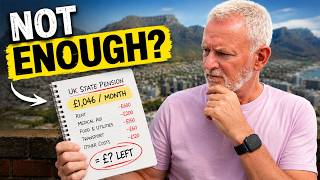
So many people, including us, say South Africa is cheaper, and in many ways it is. But if you're retiring on a UK pension, that's only half the story, because once you add in rent, you add in medical aid, tax, visas, food, transport, domestic help, and the cost people forget, the answer is not as simple as Cape Town is cheaper than the UK. So today I'm testing the real question: what does a UK pension actually buy you in South Africa? And more importantly, would it be enough to retire here? Now I'm I'm using the UK because it's my second home, it's what I know, but many of the ideas and thoughts will apply if you're in the US or Australia or New Zealand or anywhere else in Europe. I'm Rob, James is working next door, so you've just got me today, a spreadsheet, and hopefully no dodgy maths today. I'm retired and we spend part of our year in South Africa, so this isn't just a tourist question for us, it's something that we've had to really think about properly. And to make this useful, I'm going to share 3 test scenarios. So scenario 1 is on the UK State Pension only. That's the hardest one and probably the one that most people are going to be curious about. Scenario 2 is the State Pension plus a modest private pension, and that is where South Africa may start to look more realistic, but only if the numbers are managed carefully. And then Scenario 3 is more comfortable retirement income where you have a stronger pension income, investments, rental income, or you already own a property. And for each one, I'm going to look at the real cost. So we're talking about rent, we're talking about medical cover, so medical aid or insurance, we're talking about food costs, we're talking about monthly utility costs, how you're going to get around using transport, if you're going to have a cleaner, so domestic health, what tax you might have to pay, and visas if you want to stay there longer than a few weeks. And also, I want to cover the hidden costs that so many people just forget about, because there is a big difference between coming to South Africa for a holiday, spending a bit more freely, eating out, doing the wine farms, and thinking this is amazing value, and actually living here for a whole number of months at any one time. When you live here, you have to think about, as I said, rent, electricity, medical cover, transport, visas, tax, and the boring things that never make it onto Instagram or YouTube videos. So let's start with the pension number. The full UK pension is currently £241.30 per week, that's about £12,548 a year, or roughly £1,046 a month. So that is the UK pension. And I know that people are going to say in the comments, what about a South African pension? Well, this video isn't really geared towards that. It's not a cost of living video. It's simply to say, if you're an expat or you're a retiree and you want to see if your pension that you get in your home country will go far in South Africa, then this— we're going to cover that in today's video. Now when you convert those numbers I just shared into rand, it looks like a much bigger number, and that is where people can get easily carried away because the amount that lands in your bank account is not the same as the amount you can safely spend. So before we spend a single rand, we need to talk about tax. Look, I know it's not the most exciting sentence ever said on YouTube, but it does matter because the UK State Pension is tax taxable income, and if your only income is the full new State Pension, you're currently just under the personal tax threshold. But if you have a private pension or maybe some rental income, you've got some savings interest, or any other income, then that may well take you over the tax threshold, and this is really important to understand. So if you're only spending part of the year in South Africa, say coming here for the UK winter like we do, you should not assume that you've left the UK tax system behind. You need to check your UK tax residency. You also need to check your South African tax position, so talk to an accountant. And you also need to understand how any double tax agreement applies to you. This is definitely not tax advice, just a disclaimer here. I am not an accountant, but this is me saying don't get seduced by the exchange rate and forget that HMRC actually exists. Then there is the visa question. You can't just decide to retire somewhere because the coffee is cheaper. A standard tourist visa that you'll get automatically upon entry from most European and US countries gives you the right to spend 3 months in South Africa, but for many people looking at South Africa for the whole of the Northern Hemisphere winter, the Retired Person Visa is the obvious route. That route is often linked to proving that you have around R37,000 per month in qualifying income. Now, that income might come from pensions, annuities, investments, rental income, or other types of passive income. And that matters because the State Pension alone is nowhere near that amount. Now, getting the Retired Person Visa is not instant either. Some guidance quotes 4 to 8 weeks, but to be honest, I think that's really optimistic. So safer planning window is around about 12 weeks, and to be honest, it can take much longer than that if Home Affairs is busy or if they ask you for more documentation. So this is not something, if you want to go down that route, that I would leave to the last minute. But this, if you followed us, this isn't the route that we decided to take. So we decided to skip the retirement visa and apply straight away for residency based on finances. And that means that the monthly retired visa income requirement doesn't apply to us in the same way. Now I'm mentioning that because just to say that there is more than one route to staying longer in South Africa, and your route changes depending on your numbers, and immigration rules also change. So please don't rely on this YouTube video for your application, but go and talk to a consultant that specializes in helping foreigners getting their visas in South Africa. That is what we did when we applied for our residency, and to be honest, there's absolutely no way we would have got it right if we hadn't worked with them. So it is money well spent, and you can get initial conversations probably for free with them. And just to say that we'll be doing more about our residency application in a future video because there has been some movement on that since we applied in November 2024. But until it gets to its conclusion, nothing is affirmed, so I'm waiting for that point, hopefully over the next few weeks, and then I can tell you more about it. Okay, so now let's look at the real cost of living, and the first scenario is: could you live in South Africa on the UK State Pension alone? So that's about £1,046 per month before you consider any tax, transfer fees, or exchange rate changes. So let's assume that you're going to be renting, and in Cape Town, rent is the first big issue. Now, if you want a modest place away from the most expensive areas, you might be looking around about R10,000 to R15,000 per month. However, if you want to stay in central Cape Town like Sea Point, Green Point, or somewhere more coastal, that can easily go much higher to around R20,000 plus per month. And I'm talking predominantly here about a one-bedroom apartment. And one of the things to check really carefully is internet, because for a 6-month furnished rental, Wi-Fi will often be included if it's a serviced apartment or an Airbnb-style let. But in a normal private rental, it may well be separate. So for example, we rent our apartment out and it doesn't include Wi-Fi typically. So before you compare rents, ask exactly what is included. Is— are you getting fiber Wi-Fi? Are you getting electricity, water, parking, cleaning, backup power, which you probably don't need so much need nowadays, but just make sure you know about all of that stuff. Then there is medical aid. This is one of the biggest differences from the UK, as we covered in a previous video which I'll put a link up here to. So you— in South Africa, you don't have the NHS safety net in the same way, so private medical costs are a real thing to consider. So for one person, you could easily be looking at several thousand rand a month depending on your age and the level of COVID that you go for. This is something that we'll be sorting out when we are next in Cape Town. Then there's food and household basics, and again, I've done a cost of living video before on this topic. So you might manage carefully on around R5,500 to R8,000 a month for one person— that's Rand— depending on how you shop and how often you eat out. And yes, I know some of you will say that you can live on a lot less than that if you shop around, but I'm just using some average numbers based on our own real experiences. And then another thing to consider is utilities, and they can cost from 2,000 to 3,500 rand a month. So we're talking about water and electricity and so on here. Transport may well be sort of 2,500 to 5,000 rand a month depending on whether you run your own car, you're just relying on Uber, or you choose other public transport options like Citybus. And to bear in mind that hiring a car is one of the more expensive costs in South Africa, and that's why we're going to be buying a secondhand car as a runaround when we're next in Cape Town, but we can leave there when we are not there, and hopefully it will start again when we come the following year. Now I talked about internet and mobile phones, that could be another R800 to R1,500 per month, and then there are some of the things that make life easier. So for example, you might want to have a cleaner or some domestic help. Now I paid around R350 per visit for a cleaner, and she was with us for about 4 or 5 hours, so that works out about R70 per hour., and if you do that once a week, then that's R1,500 per month. So yes, domestic help is much more affordable than in the UK, but it is a still monthly cost that you need to consider, and it doesn't arrive for free just because you've got a British accent. So when I look at this state pension alone, my honest answer is this: it would be really tight to survive just on that in South Africa. It may well be cheaper in many ways, and the weather's definitely better and the lifestyle's definitely better, but if you need rent and you need to pay for private medical cover, then quite frankly the UK State Pension alone doesn't give you much wriggle room, and suddenly it doesn't become retirement freedom, it becomes about careful budgeting in a nicer climate. Now let's look at a more realistic second scenario option, so we're talking here about the State Pension plus a private pension. Let's say your total monthly income is somewhere around £1,700 to £2,000 a month, and this is where South Africa starts to look a lot more possible. But the biggest cost and choice is still rent, because the rent cost decides whether South Africa feels comfortable or stressful. And if you choose a popular area and you want a nicer apartment, then the money can go up quickly. Now, if you did choose to live a bit further out, you obviously need to think about your transport costs and you probably aren't going to be able to eat out constantly. And if you consider all of that, then the numbers can work better. The danger is living like you're on a permanent holiday. Holiday Rob is dangerous, he orders a glass of wine, but Retirement Rob is a bit more boring and checks the electricity bill, and that is the difference. On holiday, you might look at a restaurant bill and think, well, this is great value compared to London, and it definitely is, but if you're doing that 3 or 4 times a week every single week,, it becomes part of your real cost of living. So at this middle-level income, South Africa can definitely work, but it needs planning. You need to make careful choices. You need to decide where you're going to live. You need to know what medical cover you're going to need. You need to know whether you're going to drive or take public transport or Ubers. And you also obviously need to have a bit of a buffer because exchange rates can move, prices can rise, which they definitely are, and of course life happens. Okay, now let's look at the third scenario. This is a more comfortable retirement income. So here you've got a stronger pension, you might have some investment income, maybe rental income, or you own your own property in South Africa. And in that case, South Africa suddenly becomes much more attractive. And this is where you start to have lots of choices. You can choose a better area to live in, you can afford stronger medical cover, you can eat out without thinking about it too much, and you can afford to run a car., and you can also budget flights back to the UK and the US if you have to go. You can hire domestic help, and you can build that all-important buffer for emergencies. But comfortable doesn't mean careless, it means just that you have more choices. If you own your own South African home, then like we do, the equation changes again, because as I've said, rent is one of the biggest costs, and we all know that rent in Cape Town especially is going up and up and up, so removing that makes a huge difference. But owning your own property doesn't mean living for free. You still have lots of levies and management fees, you've still got city rates and taxes to pay, and you still have water and electricity and sewerage to pay for as well. And you may well have to have contents and building insurance, you might have to think about security costs, obviously repairs and maintenance, maintenance, and sometimes special levies if you're in an apartment block or an estate, as we've had this year where they needed to re-waterproof the outside of our building. So we've had to pay an extra levy for the last 6 months. So if you own your own home in South Africa, the real comparison isn't rent versus nothing, it's rent versus the ongoing cost of ownership, and that ongoing cost needs to be in your budget. Costs. Now these are often some of the things that people forget. You may well need to pay for an accountant, as we do, to get tax advice. You may well have to pay a consultant to get your visa or residency advice, which I highly advise. You've obviously got to factor in medical aid. You might have to factor in dental costs, flights home, car costs, insurance, security, home maintenance. And currency swings, because we've seen— since we've been going to Cape Town, we've seen currency swing from R18 to a pound to R25 to a pound and then somewhere back in the middle. And of course you also need to factor in higher prices in the areas that are more popular. This is why I don't like the simple comparison that just says South Africa is cheaper for expats. Some things are definitely cheaper, and some things are better value, but some things are expensive, and some things are just quite frankly different. And it's dangerous for you to apply the only way it would work in your country onto South Africa. That's a kind of arrogant thing to do, that we've made that mistake before, but of course it doesn't work like that. So for UK viewers, the pension and tax questions matter, as they will do for any country that you're coming from. For South African viewers, the cost of private healthcare, security, electricity, and transport will be very familiar to them. And for any of my American friends who are watching, South Africa may still look very affordable compared to many parts of the US, but healthcare, visas, and residency still needs proper planning. So can you retire in South Africa on a UK pension? Well, on the state pension alone, I would say no, not comfortably and with a challenge, and probably not realistically if you need to rent or pay for private medical cover. On the state pension plus a modest private pension, possibly, but your location lifestyle choices will matter a lot in that scenario. And with a stronger pension, investment income, or your own property, South Africa can be a very good lifestyle, but it's not a magic cheap retirement button. The wrong question is, is South Africa cheaper? The better question is, what kind of life does my income buy after tax, healthcare, visas, housing, and flights home. And for us, South Africa absolutely makes sense. We absolutely love the lifestyle, we love the weather, we love the people, the food, the wine, and we love that feeling of space and light that you only get in South Africa. But I would never tell anyone to move here just because rent is cheaper or lunch is cheaper and better quality than you get back in your home country. The dream is absolutely real, but the spreadsheet has to survive contact with real life as well. So if you're thinking about retiring in South Africa, tell me in the comments where you're coming from and what costs worry you the most. Is it rent? Is it healthcare? Is it tax? Is it visas? Are you more concerned about the politics or safety, or is it something else? And if you haven't subscribed to our channel, please do hit the subscribe button now. It doesn't cost you anything, but it tells the algorithm that people are interested in our channel and if you hit the bell button as well, then you'll be alerted every Sunday when a new video goes live. But otherwise, this is Rob and James, who's sadly working next door, and we will see you next time. And by the way, I promise that James will be making an appearance more on this channel soon. It's just that he's really busy with work at the moment, and I'm— because I'm retired, I'm able to record some of these videos during the week. Anyway, over and out for now. Have a great week, and we'll see you next Sunday.