We Love South Africa, But We Do This To Stay Safe
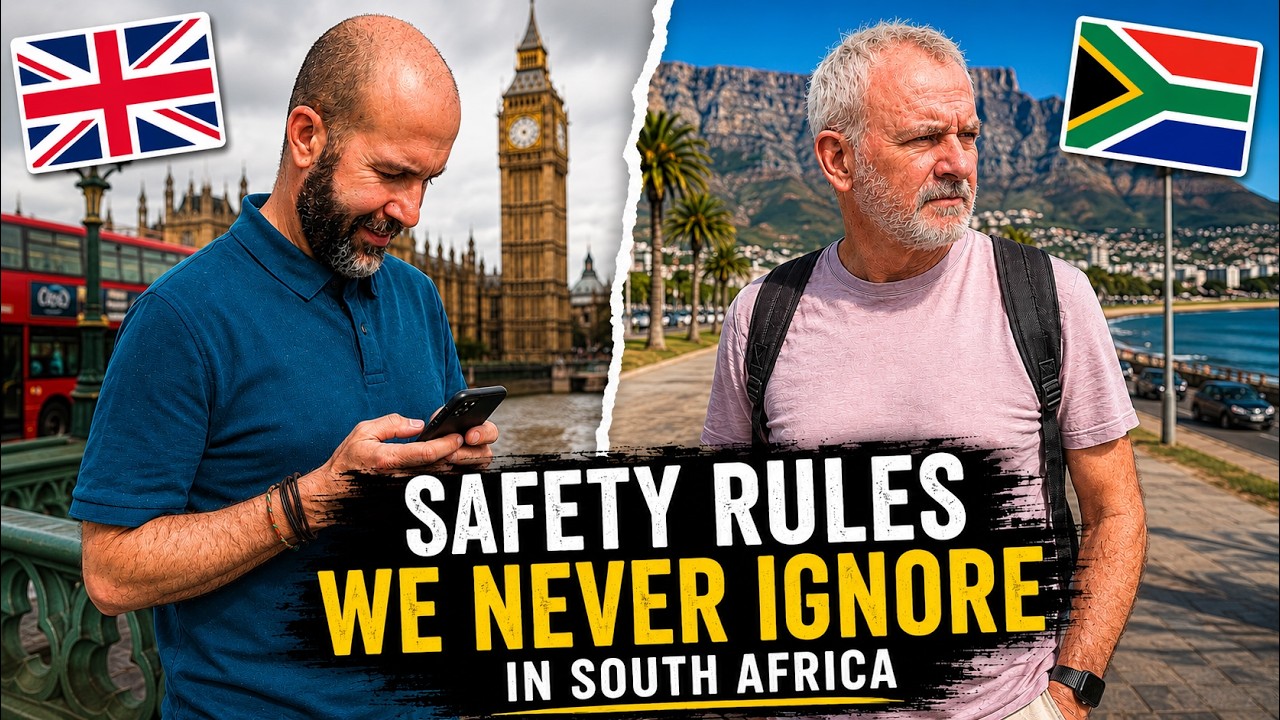
In this travel‑advice video Rob and James share five concrete safety rules and one bonus tip for visitors to Cape Town, South Africa. They stress that the country can be safe if travelers adjust their habits. Rule 1 advises planning routes in advance, staying on main roads, and avoiding sat‑nav shortcuts that could lead to unsafe areas; they also outline what to do if a car breaks down. Rule 2 focuses on vehicle security – keeping valuables out of sight, locking doors, and using local car‑guard services. Rule 3 warns against “tourist” behavior: keep phones, wallets and cameras hidden, use a watch for navigation, and appear confident. Rule 4 recommends never walking after dark, instead using Uber or Bolt, and even forgoing a rental car if staying in the city. The bonus tip stresses downloading and setting up ride‑hailing apps, arranging local data, and avoiding airport scams before leaving the terminal. Rule 5 stresses choosing accommodation in safe, well‑reviewed neighborhoods with good parking and easy pick‑up for rides. Throughout, the hosts adopt a reassuring, practical tone, emphasizing forward‑planning and common‑sense measures to enjoy South Africa’s attractions without fear.
Chapters
Every time I tell someone that we are going back to South Africa, there's always a bit of a pause, and then they say, "Yes, but is it safe?" Oh, and as much as that question really frustrates us because we hear it every time, I do understand why people say that. The answer is it can be safe, and certainly I am never scared.
After all, we absolutely love South Africa, but we do behave differently there, and we are more conscious of our security. And that's really the point of this video. There are 5 safety rules I follow in South Africa, plus 1 surprising bonus rule that I'll share later on. And I'm sharing these not to scare you, but to help you enjoy your trip without being naive or fearful.
Rule number 1 is that I don't let my sat nav save me 5 minutes. Now, in the UK, if I was driving and my sat nav said there's a route that can get me there 5 minutes quicker, I'll probably take it. But in South Africa, not so much, especially, for example, if I was driving from the airport into Cape Town City and the sat nav took me off the N2 because it thought it would save me time, then I definitely wouldn't take it. I would stick to the main motorway because getting there slightly later is much better than not getting there at all or having some issues because you've gone down some dodgy roads or ended up in the middle of a township somewhere. Because fastest doesn't always mean best. So what I would do if I were driving from A to B is I would plan my route in advance. I would make sure that I'm on the safest main roads and the biggest roads as well. If I can take a motorway, I would, and then I would stick to that route even if my sat nav offered to take me off. This is a problem that a lot of people find and end up getting themselves into trouble. So especially with, uh, sat navs like Waze that will always try to route you what it thinks is the fastest route. So, um, if you can set it to staying on main roads, then I would absolutely do that. And of course, like I said, I would set the route in advance so I know exactly where I'm going, even if my sat nav decides it wants to take me on a different route. Now, another thing that's worth talking about is what happens if you break down. God forbid, none of us want that to happen. And obviously you may well have heard stories about people getting broken into when that happens. So if you do break down, stay in your car, lock your doors, put your hazard lights on, call the rental agency or Emergency Assist, and stay in your car until the recovery arrives at your destination, and if someone stops to try and help you, then just be really, really mindful and careful about actually opening your window to those people. Now, another thing to say, because I've seen this question asked a lot both in comments on these videos and in South African forums as well: if I'm landing late into Cape Town and it's after dark, I would take an Uber or a Bolt to my accommodation and then pick up my car the next day, because the last thing I want if I'm tired is trying to figure out where I'm going and then being slightly nervous about driving in the dark. And in Cape Town, there are a lot of car rental places in the city centre, so you don't have to go back to the airport the next day. You can just find a local car rental place to wherever you're staying and then either walk or get an Uber there and pick up your car the next day.
And once I've arrived, the next rule starts before I even start or get out of the car. Now, Rule 2 is simple: if anyone can see it, then they can steal it. And this is one of the habits that I'm most mindful of when I'm driving around in South Africa or when I arrive at my destination. Now in the UK I might leave my sunglasses on the seat, but in South Africa I want to make sure that I have taken everything and put it in the boot. So whilst I might drive around like this in the UK, I most certainly wouldn't in South Africa, and when I arrive I make sure I take these things I put them away out of sight and obviously take my phone with me because out of sight is out of mind, and if anything is lying on my seat and maybe I'm sitting at a traffic light then that is a temptation for someone to try and break in. Now when I'm driving I always leave my windows up, I always make sure the first thing I do is lock the doors so that I'm giving myself lots of security. And if you're British or a foreigner in South Africa a car guard might seem like a really strange concept. These are people that you'll see when you park your car, often in high visibility vests, and they are going to help you get in and out of your car parking space, and they are going to look after your car for you, and in return you're going to pay them a few rand when you come back to your car. Now these aren't people who are trying to scam you, these are people who are generally being a bit entrepreneurial and trying to earn some money, so my advice is always carry some small change with you and give them 10, 50, whatever rand when you get back, and you have peace of mind that your car will still be in one piece and in the same place with no broken windows when you come back to your car.
The next rule is where a lot of people give themselves away. So rule 3 is don't walk like a tourist. Now in the UK, I wouldn't really think anything about walking around looking at my phone and checking out Google Maps but in South Africa you probably want to be a little bit more wary about that. So be prepared, plan your route before you go out, and don't walk around with your phone in your hand or with your earbuds in your hand, or even worse, with your wallet in your hand or all sticking out your back pocket, because you're just asking for trouble and asking for someone to kind of say, "Can I borrow your phone?" and walk off with it. And this isn't about being scared, it's about not making yourself an easy target. So if I do need to check my map of where I'm going, well, I'm either gonna put it on my watch or I'm gonna step into a coffee shop or somewhere quiet and check where I'm going and then put my phone in my pocket and carry on on my way. So you want to try and look like you know where you're going even if you're not entirely sure. And of course don't walk around with a camera hanging round your neck. When I'm filming in South Africa, I use a really small camera so I can be really subtle about it and basically I'm not trying to broadcast tourist, tourist, tourist! Tourist to, to anybody that might decide that I'm an easy target. Rule 4 is probably the biggest difference between the UK and South Africa. As night falls in the UK, I wouldn't think twice about walking 15 minutes to a restaurant, but on the other hand, in South Africa, as soon as it starts getting dark, I would always choose to get an Uber or a Bolt or drive to wherever I'm going. And even if it's on a street that would be completely safe to walk during the day, at nighttime I would still get an Uber to get to where I'm going. I still enjoy the city, I still enjoy drinks, evenings out, dinner, meeting friends, and so on. I just don't walk to get there because it's just not worth the risk, and taking a taxi in South Africa for a foreigner is really, really cost-effective. To be honest, if I was just basing myself in the city and I wasn't going to go further afield, I wouldn't rent a car. I would use taxis all the time. For me, the rule is simple: the sun goes down and Uber goes up., and that's definitely one big difference between Cape Town and the UK. And that brings us to a bonus tip that I want to share with you, because to be quite honest, a lot of people make it really hard for themselves even before they've left the airport. And here's my bonus tip, and that is to download all the apps you're going to need before you even need— leave the airport. So I'm going to make sure I've downloaded Bolt and I've logged in and I've set up my payment, I'm also going to make sure that I have downloaded Uber as well and any other apps, because you do not want to be trying at the airport to download the app and then put your payment details in. That's just a stress that you just don't need. And you've set up the app if it's the first time you've used it, and for Bolt, that could well be the first time because that is a South Africa-specific app, I think. Now, Cape Town International Airport has good free Wi-Fi, so if you've downloaded the app before you get there, you can log into the app at the airport, you can order your Uber or your Bolt and then head down to the e-hailing area, and it's really well signposted so that you can pick up your cab from there. A piece of advice is that when you come out of arrivals, you're going to see lots of people holding up their signs saying, 'Do you want a taxi? Do you want a taxi?' Lots of them will even hold up signs saying Uber on them, but do not trust those people because they are not from Uber, and they could well screw you because they could try and take you on a really convoluted route and then charge your fortune. Whereas if you've ordered your taxi on Uber or Bolt, you'll know exactly the route that you're going to take, and therefore you know how long it will take and how much you're going to pay before you even get in the cab. And of course, you can match the number plate to the car when it arrives. Now, if you are going to need to use your phone locally and you want to buy some local data, then at the airport you will find places, kiosks like Vodacom or MTN, where you can buy data straight away. And if you're not doing that, then make sure you've turned off your data roaming so you don't end up with huge charges, because South Africa isn't necessarily one of the countries that your contract at home covers you for. And if you don't turn off data roaming, then it's going to connect using that contract. You're going to pay a fortune. Now, these are just small things that you can do, but trust me, they will make your life so much less stressful if you organize it before you actually touch down in Cape Town and then set all of this up once you're in the airport before you leave. So if you're not buying data, you can take advantage of the free Wi-Fi. And rule number 5 is one that you definitely shouldn't underestimate when it comes to safety, and it starts before you've even booked your flight, or just after you've booked your flight, but certainly before you leave to head to South Africa. And that is about picking the area that you choose to stay in not just based on views and price, but based on things like location, security, parking, and also recent reviews. You know, if I've got a car, I want to make sure that I've got easy off-road parking. If I'm using Uber and Bolt to get around, I want to make sure that it's an easy place for them to pick me up. I want really clear check-in instructions, and I want to know that I'm on a street that is both safe and yet quiet at night. And let's face it, a bargain price apartment in the wrong place will completely ruin your trip. And will give you a very negative view of Cape Town and South Africa. So I don't know about you, but when I was booking Airbnbs or apartments on Booking.com or hotels, I'd much rather pay a little bit more and have the peace of mind that I'm in a really great touristy location, so I'm not going to be on my own, rather than feeling on edge all the time and being a bit nervous every time I go outside the door, even if that is at nighttime, to go outside the door and wait for a cab to arrive. Because the last thing you want to be doing is standing there with your phone open waiting to see where your Uber or Bolt is and feeling really nervous because you're worried someone's going to come and steal your phone because the area you've chosen to stay in feels a little bit edgy. Now I have shot a whole series of videos about different places and different areas within Cape Town that you can stay in, so I'll put a link up there and you can go and watch those videos to help you decide which area you want to be in. But if you're thinking about Sea Point where we're based, Green Point, De Waterkant, or the V&A area, or Camps Bay, then you're not going to go far wrong. And for me, the first two of those, that's Sea Point and Green Point, would always be my choice because it's quite cosmopolitan. Yes, it's touristy, but there's safety in numbers, there's lots of things locally, and it's fairly safe to be walking around as well. So yes, when I list all of this out in a short 10-minute video, it does sound like a lot. You certainly are going to be a lot more conscious about these decisions that you make and about doing certain things than you, you would necessarily be in your own country. But at the end of the day, it's just sort of common sense. And actually, I'd apply a lot of these rules anywhere I go that I don't know very well. So you're definitely going to be thinking about routes, you're going to be thinking about whether you hire a car or use public transport, taxis. You're going to be thinking about where you park. You're going to be conscious about carrying your phone in public and, and making sure that you're not desperately trying to download an app in public. You're going to think about whether you can walk somewhere, even if the weather is absolutely beautiful, whether actually it would be smarter and safer to take an Uber or a Bolt. And as they say, guys, forearmed is forewarned, which is why I wanted to record this video, and I've spoken about safety before, but I just wanted to share with you kind of like my 5 top tips. And trust me, all of this safety consciousness and forward planning is absolutely worth it for the amazing climate, the amazing countryside, the amazing people, the food, the wine, the drinks, and just the kind of vibe that is Cape Town and South Africa that just feels so unique to that place. That being prepared to be conscious of your safety, absolutely is worth it to experience the beauty that South Africa has to offer. And you know, these habits that I've talked about become second nature in the end, and once you kind of have them embedded in you, then you just relax and you enjoy your trip. Look, and I know it's not all sunshine and roses, and yes, I've heard stories about robberies, about break-ins, about thefts, about dodgy things that have happened when people have taken the wrong turn. But if you apply these simple rules that I'm sharing with you today, that won't happen to you, and you will have an amazing trip. And let's face it, in 12 years of us going to Cape Town and exploring everything that South Africa has to offer, driving all over the place, often for hours on end without seeing anybody else, we have never had, touch wood, anything bad happen to us. And that's partly because we are applying these rules So long may that continue. So if you are planning your first trip to Cape Town, then go and be prepared and don't be scared. Now, if you want to learn more about cost of living and, as I said, areas to stay, then go and watch our latest videos on comparing cost of living from the UK to South Africa and a whole raft of other videos that we have recorded about Cape Town and South Africa. But other than that, this is Rob and James, who's working next door, and we will see you next time for more travel adventures.