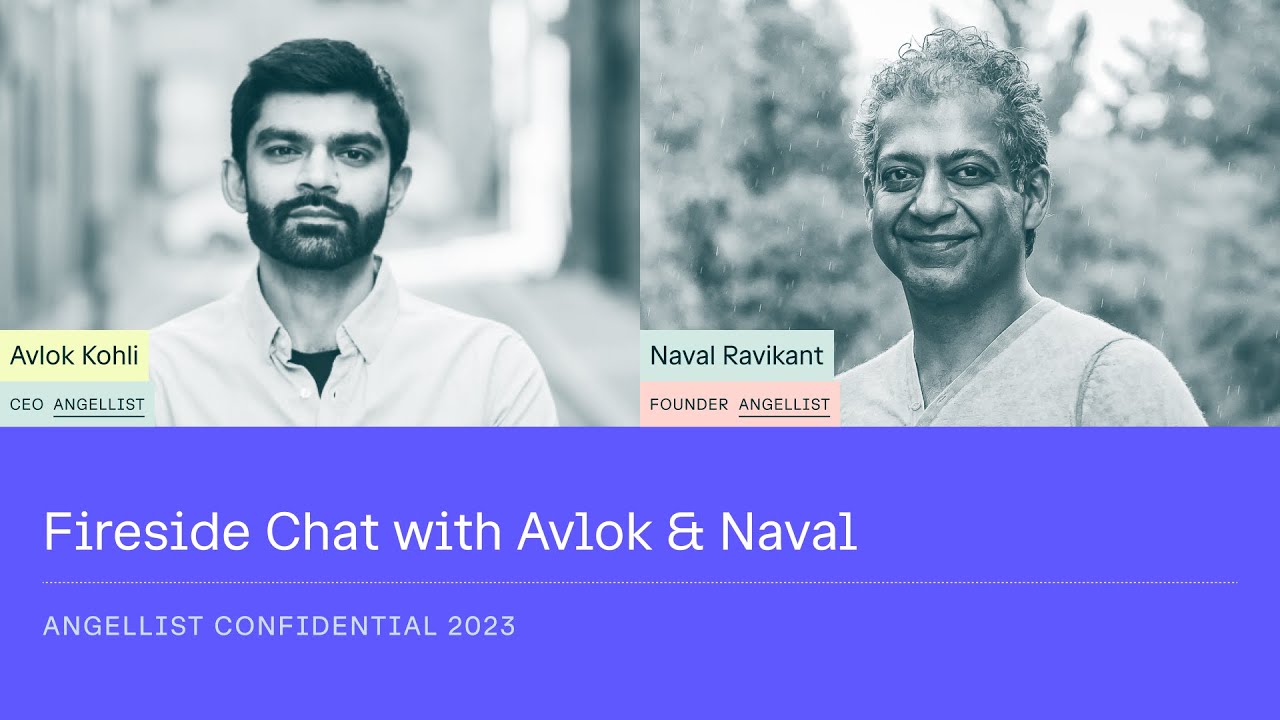
AngelList Confidential 2021 Keynote | Avlok Kohli & Naval Ravikant
This content was created by Avlok Kohli. This content was uploaded by Avlok Kohli. This is a YouTube keynote titled "AngelList Confidential 2021 Keynote | Avlok Kohli & Naval Ravikant" (recorded 2021-09-28). The excerpt is a live virtual presentation and product demo led by Avlok Kohli with Naval Ravikant, announcing AngelList Venture updates and new features: syndicates, traditional and rolling funds, AngelList Capital Network metrics, USDC-enabled investing, deal partners, roll-up vehicles, and a major launch called AngelList Stack (bundled incorporation, banking, cap table, fundraising tools, employee offers, data rooms, banking/cards, etc.). The talk explains how these products reduce founder friction from idea to fundraising, describes pricing/waivers, and includes a walkthrough of the Stack demo and fundraising workflow.
Chapters
All right, I think we are live. Hello, hello. Okay, so let's get going. Hey everyone, uh, welcome to the 6th Annual AngelList Confidential. Um, like last year's event, uh, we decided to do this year's virtually as well. This way we can actually have GPs and LPs across the world join without having to come into a physical location like in San Francisco or somewhere else. Naval and I will take you through a few big announcements today. We're gonna cover what's been going on with AngelList Venture and then get into a big announcement later on. Now, before we get into the meat of the announcements, I wanna start by sharing why AngelList was founded, uh, we were founded on a really simple premise. It was to always serve startup. This is our universal belief that guides everything that we do, um, how we make decisions, how we build products, what we choose to build. Uh, it all comes down to this, serving the startup. And there are really 3 main things a startup needs: capital, talent, and customers. And of course, with AngelList Venture, we're really focused on the capital side. So that's what we're gonna focus on today. Now, let's take a look at how capital makes its way to startups. You can think of this as a funnel where at the very top, you have all of the capital in the world, and there's a significant amount of capital. And what used to happen in the past was capital gets allocated to a very small number of VCs,, and then those VCs would allocate this capital over to startups. But there was this natural choke point because there were only so many VCs, only had so much time in the day to meet with companies, to meet with startups and to fund them. And, you know, this choke point was actually very narrow. I remember when I started my first company in 2011, I could fit on a one single sheet of paper the number of investors that I could go talk to. I think it was like 20. So it's a very, very small number of VCs that are investing at the earliest stages. And so this natural choke point, we had to improve it if we wanted to see more capital making its way to startups. And so that was the first problem that AngelList really double-clicked on and went to go solve. And the way to solve this problem was to actually increase the number of VCs, make it easy for founders and operators to become VCs. Now, in terms of how VCs get created or how they allocate capital, they allocate capital through something called a venture fund. It's the fund structure. So let's just take a look at what starting a venture fund used to look like. It used to be extremely complex, extremely daunting. You'd have to hire an entire team, 6 to 7 service providers, lawyers, compliance, regulatory, tax, back office. It was just really insane, and it would cost upwards of $1 million just to get started. Now, if a fund costs $1 million, uh, just to get going, that means you have to raise at least a $10 million fund to get into venture and to start investing in startups. But to raise a $10 million fund requires you to get an anchor LP. So the only way to get into venture in the past used to be working at a large fund. You build a track record, and then eventually spin off, and hopefully you get an anchor LP to get going. But several years ago, AngelList decided to compress and bundle all of this into a simple offering and completely integrated and automated through software. And what was created was, was this fund structure where you could tap a button and you get a venture fund, and everything was bundled— legal, regulatory compliance, taxes, all the software needed to raise from LPs, and all of the costs were compressed. And over the years, we launched several products around this. Of course, the first one being syndicates. The way to think about syndicates, these are single investment funds. In the past, what used to happen is an angel investor would go to a founder, they would invest $50,000, and that would be it. But with syndicates, what they could do is they could invest the $50K, they could then raise another $200,000 from their own network of investors, and then make the investment into the company at $250K versus the original $50K. And of course, this was amazing for founders because they just have a lot less investors to raise from. They could just raise from an angel investor who amplifies their check with syndicates, and that's it. They can get back to building. And then we launched a couple of fund products, first one being traditional funds in 2016, where with traditional funds, we compressed the cost so that you could now run half a million dollar funds and million dollar funds. So you wouldn't need to go find an anchor LP to get started. You could be a founder, an operator, and you could start a fund, start building a track record and deploying capital. And of course, last year we launched rolling funds where We further reduced the friction around fundraising, and rolling funds actually are these always open funds where you could accept capital at any time. You never need to shut down the fund for new capital or for fundraising. You can just keep scaling it up. And fast forward to today, we've built a robust infrastructure that's scaled up. We're now managing $7 billion in assets on behalf of our GPs. They've funded 10,000 startups, of which 151 are unicorns. And they're investing in 57% of all the top-tier US VC startups at this point. But we didn't stop there at just delightful fund administration. We actually took it a step further. Uh, GPs on the platform can raise their, uh, from their own LPs, uh, for their funds, but they can also tap into what's called the AngelList Capital Network, where they can raise from additional LPs who are AngelList-driven, AngelList-sourced. So these are LPs they otherwise would've never met if it weren't for AngelList. And just a few weeks ago, we announced that the AngelList Capital Network is annualizing $1 billion a year. This is $1 billion a year in fresh new capital that GPs would've never otherwise had access to. It's absolutely incredible. And of course, through all of this growth, we kept shipping. That is simply in the DNA of AngelList, just keep shipping. And we shipped something called deal partners, which are these flexible partnerships at the deal level. And we've seen incredible adoption here. We've seen funds create scout programs on top of this. We've seen GPs give out these deal partnerships for doing deal diligence or for helping a portfolio company. And since launch, 1,600 of these deal partnerships have been created. That's 1,600. That, that's incredible. That's just within a few short months. And today we're actually going to be announcing a new feature for GPs and LPs around USDC. So starting today, LPs will be able to invest via USDC on any USDC-enabled syndicate or fund. And the process is really simple. In the closing flow, there will just be an option rather than ACH or wire, there'll be USDC. You click it, you see this modal, you can scan the QR code, you can copy the ETH address, uh, and you can just go to your wallet and send it, and that's it. And now you've, uh, invested via USDC. And this is just the beginning of several crypto-first features that we're actually going to be rolling out across AngelList. So if we just take a step back and we think about what we're building for GPs, at a high level, we're really building workflow software plus capital. Now, fund administration, of course, fits within the workflow side, and Capital Network is in, on the capital side. And we really think this is the killer combo behind why GPs choose to work with AngelList. And taking it back to our ethos of serving the startup, we think this is incredibly important because this is how founders and startups actually get more capital coming to them. But then earlier this year, you know, we asked ourselves a question. Now that we've expanded the funnel for VCs, Meaning we've seen a lot more founders and operators getting into the VC industry. What more can we do for startups? Uh, there's still a lot of friction in the fundraising process. So we really dug in there and we landed on focusing on workflow software because there's still a lot of steps to fundraising and we felt like we could remove it, eliminate a few steps and make it a lot easier for the founders. So earlier this year, we launched roll-up vehicles, and roll-up vehicles allow a founder to raise from multiple investors and just roll them all up into a single line item on the cap table. And we've just seen incredible success out of this one. It instantly struck a chord with founders, and we're now seeing this as the default in most fundraisers. But then we, you know, we double-clicked a little bit further, And we kept asking, what other part of the journey can we really help founders with? And we looked at all parts of the journey, and we ended up focusing on this part of the journey where a founder has to go from idea to fundraising. And it's incredibly complex. You know, starting or having an idea as a founder is, is really a feeling of optimism. You're just excited. And when you have to go from that excitement to creating something, uh, creating a company that's fundraising ready, it's just an absolute nightmare because there are all of these specific choices, uh, and, and tools, uh, and vendors that you have to work with that you don't really know too much about. So you have to figure out incorporation, banking, cap tables, fundraise logistics, all of it. In fact, here are just a sample of some of the steps that every founder has to go through They read posts about corporation types, choosing from several incorporators, waiting weeks to get the docs, filling out PDFs to open up a bank account, sending PDFs to investors like the SAFE docs, manually reconciling wires, and it just keeps going. Honestly, it's just a bunch of brain damage. You know, I've personally started 3 companies, but I've incorporated and set up the stack for 5 other companies because anytime a founder friend asks me all of these questions, I just go do it for them. There's just too much context in there and it's just the quickest path forward. Now, fortunately, AngelList is actually very good at automating the mundane, automating all of these steps and making it really, really, really delightful. And so we decided to do something about this. So I'm incredibly excited to say that starting today, no founder will ever have to go through any of these steps ever again. All they'll need to do is create what's called an AngelList stack, and they're just gonna get a fundraising-ready startup. And we bundle everything in, incorporation, banking, cap table, all the fundraising tools, and so much more. It's just all in there. And in fact, let's just go through a demo right now. Alright, so here I'm gonna go through the incorporation process. For this one, it'll be screens just in the interest of speed, and then other sections I'm gonna show you the real product. So in here, all the founder needs to do is go to angelist.com/start and they hit create a startup. They'll be shown this form. They enter some information about the company. They enter the founders, whether it's one or two or however many. Enter ownership information here. Again, incredibly simple, straightforward form. And then they can see these smart defaults that we've set. What we've done is we've figured out what all of the pros do, what all the second, third time founders do, and we've loaded all in here with smart defaults. So we'll actually suggest the number of issued shares, authorized shares, uh, all the vesting terms. Everything's in here so you can really feel like you're starting your company like a pro.
And then there's actually, uh, one thing, one, one thing I would add in is like some of these smart defaults are actually kind of difficult to pull off because I think a lot of people start companies these days and they don't do founder stock or even like a percentage of it. They don't know what the trade-offs are, they don't know what the right percentages are. Different lawyers have different opinions. It can get complicated. You're in a rush, so you end up not doing it. And here we just standardized it. So you'll have a certain percentage of your stock as founder shares. It'll sort of be the industry standard terms, very much like how SAFE Docs standardized fundraising parameters and left open just a few key terms like what's the post-money cap and are you giving pro rata for fundraising. We're kind of doing that across the board for your entire company setup, for your vesting, employee offers, stock type, stock value, amount authorized, board of directors setups, all of that stuff. We're taking all the knowledge that we built up and we shared with Venture Hacks and with AngelList over the decades. 'Cause a lot of people go and read Venture Hacks to try and figure out what these parameters should be set at. And we set them into very nice defaults and give you clean documents, cap tables, equity issuances, legal work, it's kind of click of a button, which is frankly how founders wanna do everything these days.
Yep, 100%. And so once you accept these terms or the structure. Again, simple one-time cost of $500 and everything is included in here. And then you sign the agreement and you hit finish setup and that's it. And if you have multiple founders, then all that founder, all the other founders need to do is come in and sign. And once all of the founders have signed, we kick off the process to file with Delaware. File for the tax ID number. The founders don't need to do anything. Everything is taken care of on the backend. And once we have all of that done, we send an email to the, to the founders and they can come in and they can now see all of their docs in this beautiful product right here. They can see their certificate of incorporation, EIN, everything is in here. Everything that's needed to set up the company, they'll just find all the docs here they can have as a reference for the future. And in fact, once we've done that, also in the stack, we set up their cap table. It's completely integrated, completely automated. You don't need to manually manage spreadsheets and upload it anywhere. This is all integrated in here. So as you can see, we've got this set up with two founders, Simuk, myself, and then we have stock option plan in here. Again, it's all automatically loaded up. So now what happens once you've created your company? What does a founder need to do? They need to go raise capital. They need to bring some money to the bank account so they can start spending on either hiring or vendors or anything else. And so in order to do that, we've also built in beautiful fundraising tool. And so we can go into that right now. You can actually kick off a new round. With the different stages all in here. But in the interest of time, I've already set it up here. So here we see we actually have a pre-seed round all good to go. And all you need to do is send investors this closing link. And this is what they're going to see on their end. And they can invest, they can e-sign. And because we also set up the bank account, they can actually see the wiring instructions. It's all enabled. You didn't need to— you don't need to send around PDFs anymore. You don't need to manually reconcile. It's all this integrated. So let's assume the investor comes in and invests $2,500. Then what happens is when they send it, because everything is integrated, we'll actually see their funds arrive and we'll mark it off as funds received. So it's all in there. And then the cap table again is automatically updated with the SAFE in there. And as you can see it, it's in here. The SAFE of $2,500. Again, completely integrated. All you need to do is send a link and you can close all investors with a single link. And this plays really nicely with RUVs. So you can actually close investors directly on the cap table, or you can use an RUV to roll them up into a single line item, line item on the cap table here.
Yeah, you can run your whole fundraising from this dashboard and manage the offline investor closings just as easily as you manage online investor closings. And then your cap table is always up to date immediately. Uh, if you're familiar with, uh, doing a round with SAFEs, very often it's very hard to keep track of the actual dilution because they're set at different post-moneys, and then you have an equity round coming on top, and next thing you know, you're diluted way more than you thought you would be because of the order in which the SAFEs can convert. And you always have to call your lawyer, and everyone has a different complex spreadsheet for this. And we just automated the whole thing. Once you integrate the sending of the SAFEs, the electronic signing, the wiring, the cap table updating, and the banking, and keeping track of everything. It's just all in one place, and it can just be really smooth and seamless. So you can run your whole fundraising from this dashboard without handholding from your lawyer, without having to go to Excel, without having to build complex models, and you can even scenario model and see what the effects are gonna be of adding anyone at any valuation. The whole thing is just, you know, it's like iOS style. Once you put it all together, it just works.
Yep. And now let's say you've raised your round and you have capital in the bank. You can actually manage all of it within this banking section. And this is a full, full banking account that's in here. Everything's included, including debit cards. So let's say you want to pay vendors, you can come in and set up new physical cards, new virtual cards for your team, or you can do it by, by spend type. So you can actually have a separate card just for SaaS spending, which is what we did here. Uh, so if we go in here, uh, you can actually copy paste, uh, this card number and you can start using it to purchase, uh, software like Notion or Airtable or anything like that. Um, now you can also, uh, keep track of all the transactions that happen. You can create new accounts. Uh, so you're not just limited to your checking or deposit account. You can actually create new ones on the fly over here. Of course, we've built in wire transfers, ACH payments, internal transfers between accounts. It's all baked in, all built in here. So this is actually everything you need for startup banking, all within this, within AngelList stack. And now the next thing you do is you need to hire yourself. Well, you can come into the employee section and you can actually hit add employee and you can hire yourself or you can hire others here. Now, one of the other neat things that we've embedded in the Angela stack is something called offers, employee offers. And one of the hardest things to do when you're an early stage startup is to communicate the value of your equity to others. And so we've actually built in this offer portal. We, we make it super easy. So over here we've preloaded this with an offer for Ronnie, who's a candidate. And you can just send him a link and the link itself will walk Ronnie through everything about the company and the full offer summary. You can see the total comp, uh, and you can see it's split by cash and equity, and you can see how it could grow over time, the vesting schedule. It's all in here. And in fact, all these sections here are configurable, customizable for your own company. Uh, so you don't need to be, uh, pigeonholed into a standard template. So you may have a separate template for your own company and you can customize all of this over here. And the candidate could accept the offer all in here. And again, like everything being integrated in here, that's a theme. It automatically can show up on the cap table. And we of course have set up Angela's stack to be very team-friendly. You know, startups as they grow end up having lawyers, and accountants and others that need to access different tools like this. And so it's all very team-friendly, meaning you can come in here and you can grant access by specific and set permission levels for specific parts of Stack. So you could have an accountant come in and only have access to the banking, or you can have, or you can have someone on HR people only have access to equity in the cap table. So again, these are all very configurable and you can set granular permissions so you can have your team come in and also help you manage, uh, the Angela stack. And there are a few other bells and whistles here. Um, we actually built data rooms. And so when you're raising your round, let's say you want to send out a deck and you wanna keep track of, uh, who's seen what and, uh, what percentage of the deck they've looked at. You can come in here, you can create a data room. Uh, again, we've preloaded it with a pre-seed deck., and you can also look at the statistics of who's, you know, how, how often this has been viewed. It's all built in, all baked in. Uh, you can actually set passcodes on it as well for privacy. And, uh, last couple of things on AngelList stack here. Uh, you can send investor updates. Uh, again, this is a really good way to, uh, manage investors, um, on a monthly basis or quarterly basis. As well as a whole bunch of parts and services. We integrate 490 evaluations here, and there are a whole bunch of discounts on other external vendors that you want to work with. Okay, great. That's it for the demo. Again, incredibly excited that we're rolling this out. So no, no founder is ever going to have to go through this again. They'll just be able to create an AngelList stack and they'll have a fundraising-ready startup. And like I mentioned earlier, anyone can now go to angelist.com/stack and hit create a startup and get going. And there's the $500 one-time cost, but for any GP, really any AngelList customer, any GP or LP that is referring a founder, all they need to do is tell the founder to enter their name in the process and we'll actually waive the $500 as well.
So it's basically free for any vetted startup. They get banking, they get cap table management, they get incorporation setup, uh, employee offers, SAFE issuances, roll-up vehicles, all of this stuff. So you can just build and run your whole startup on here and just not even have to worry about anything until you're pretty far down the road.
Yep, exactly. Yeah, and our— the way we're approaching it is we want to make sure that startups have everything they need to succeed in the early days. And so we don't plan on charging at the earliest stages at all. This is why we're just— we want to make sure every vetted, every credible startup can get started instantly, get set up on a stack and grow their, uh, and grow their company. Okay, great. So now, you know, taking a step back, I want to share a mental model for how to think about the products that we're building and how to think about the actual ecosystems. And on the left-hand side, you can really think of everything we're doing around GPs and LPs, syndicates and funds in the funder side of the ecosystem, including the Capital Network. And on the right-hand side is really the founder side of the ecosystem with roll-up vehicles, and with AngelList Stack. And these ecosystems actually feed on each other where one makes the other better. And so of course, if you have companies that are on AngelList Stack, then all the wires would arrive instantly from any fund investing in those companies, as well as better reporting that flows up and, and so much more. And of course, as we decrease the friction for startups get going from idea to fundraising, we believe we're just going to see many more startups get started, incredible startups get started. Okay. And yeah, so that's it in terms of wrapping up the, the big announcements. Now over the next few days, we just have an incredible number of sessions. We're doing several deep dives into GPs, LPs, as well as founders. And then we have several fireside chats starting with Semmel Shah for today. And then we're talking with Emily Choi and Gokul Rajaram tomorrow. And of course, wrapping up a fireside chat with Naval on Thursday. So again, thank you for tuning in and thank you for attending another AngelList Confidential. I hope you all enjoy it and have a wonderful rest of the few days.
Thanks everybody, look forward to seeing you in the next few days.
More from Avlok

Knowing When to Sell: Lessons from Two Very Different Exits with Superhuman + AngelList

30 - Network State Conference 2025 - Avlok Kohli on why Angellist built their Founders Cafe

Why LPs Are Using STABLECOINS to INVEST in Startups | Avlok Kohli on TBPN April 4th

Avlok Kohli, CEO of AngelList on How He Turned AngelList into a $4 Billion Dollar Company | E18
