The Rise of Artificial Intelligence | AngelList Confidential 2022
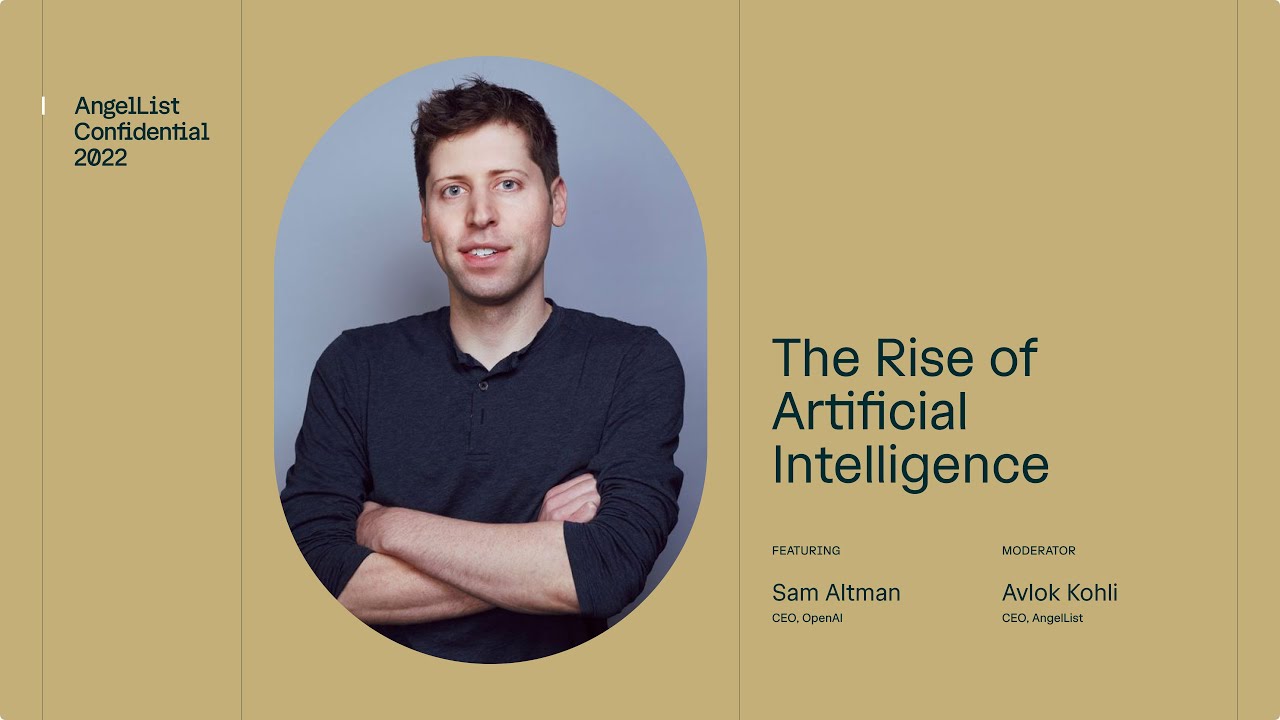
In this AngelList Confidential interview, host Avlok Kohli asks OpenAI CEO Sam Altman to explain why artificial intelligence (AI) will be the defining paradigm shift of the 2020s, comparable to the iPhone’s impact in the 2010s. Altman describes AI as an "on‑demand intelligence" platform that dramatically lowers the cost and speed of cognitive labor, creating a qualitative leap in what is possible across many domains. He discusses how AI will reshape work, noting that while many cognitive tasks may become cheap, there will still be categories that remain valuable for humans (status goods, Veblen goods, and roles requiring human judgment). The conversation moves to AI’s role in software development, where assistants will increasingly automate coding but full autonomy remains uncertain within five years. Altman highlights a highly under‑estimated impact: AI‑driven acceleration of scientific discovery, potentially increasing the pace of breakthroughs by orders of magnitude, with profound societal consequences. He then outlines three under‑discussed societal challenges: (1) wealth redistribution and the breakdown of traditional capitalist incentives, (2) equitable access to powerful AI resources, and (3) global governance of AI use and values. The interview also covers the AI value chain, distinguishing large base models from fine‑tuned specialty models (e.g., a legal AI), and how most companies will build on a few powerful core models. Finally, Altman advises students and founders to dive into AI research or work at AI‑focused companies now, emphasizing the urgency of gaining expertise before the shift fully materializes.
Chapters
So Sam, thank you for taking the time. As you know, core focus of the event this year is really focusing on the big trends over the next decade, so we can inspire the next generation of founders. And, you know, as I look back over the last decade, it's pretty clear that iPhone mobile was really the big paradigm shift of the 2010s. And in a recent interview you did, you mentioned AI as being the paradigm shift of this next decade. Can you elaborate on that? And if you're a student or founder getting started today, what would your advice be for what they can do to prepare for this paradigm shift?
Yeah, look, paradigm shifts are always hard to call, so I could be wrong here, but it feels to me at this point like the, if you just look at the sort of Cambrian explosion of new things being built that are, you know, really delighting people, getting real significant usage. It seems to me like AI is the platform that the industry has been waiting for in that, in that sense. And what people are doing with building on top of generative models in all these different modalities is really quite— and I'm excited to see it.
You know, the, the mobile shift was easy for people to wrap their heads around, right? Because You have a mobile phone in your hand and I can't remember who said it, but it's kind of the remote control for your life.
How do you— I don't know the benchmark he sees, but it was a great quote. It really kind of like got that.
Yeah, like you press a button, something happens in the world. What is that pithy statement you think for AI as a paradigm shift?
I mean, the way that I talk about it is just like on-demand intelligence. That is like, you know, way less expensive and way faster than for these narrow areas than what you could get from a human. So, you know, I think like a category people are quite familiar with now is these, these image generators. You could definitely like go off and have, you know, like an artistically talented person generate images for you. But it took a while and it was not like close to free. And one of the things that I think we're seeing— which is true for much of technology— is when you make something way faster and way less expensive, it is a qualitative shift in what's possible. And people pointed out when the kind of iPhone is remote control for the world thing came along, they're like, well, why do I need this thing called Uber? I can just call a taxi. And when the very first image generators launched, it's like, well, why do I need this? I can just pay an illustrator to do it. But it turns out that the world doesn't quite work that way. And when these things change by orders of magnitude on these two axes, it's really different.
So if the cost of cognitive labor is going to near zero, is it the cost of any type of cognitive labor? So you think that any type of work that requires cognitive function that's not tied to physical labor effectively is game for AI to rewrite and change how we do work.
There will be categories where we want them to be expensive. You know, like the famous example, there's some name for these kind of goods, Veblen goods maybe. But like people want wine to be more expensive. People like handmade things. They, you know, they want certain art to be really expensive. So there'll be plenty of things where like it's related to status or exclusivity or something. And, you know, we want that to be expensive. Mm-hmm. There will also be categories where we like, I think, you know, really want a human involved. We don't just wanna be talking to a computer. Mm-hmm. And there will be a lot of things there too. And then I, I assume, although I don't know exactly what there will be, that for, you know, quite some time there will be certain categories where humans are just much better than AI. The way that we're building AI, at least right now, is a very alien intelligence. In the same way that like birds sort of inspired us to build airplanes, but airplanes work super differently than birds or insects or whatever. The intelligence that we're building now is somewhat inspired by how we believe it works in humans, but very, very, very different approach. And so I suspect there will be surprising strengths and weaknesses to both kinds. And thus there will be plenty of roles for humans. I also think whenever you're on the left side of the major technological revolution in human history and you try to predict the jobs on the right side, that's always really hard to do.
But— Yes, speaking of predictions then, one thing that's been on my mind is the role of AI in increasing the productivity per engineer or per scientist or per designer. I actually just went through a, I was actually using Replit and their AI assistant and I got, I was programming something and I got that done in a fraction of the time it would've taken me even, even a few months ago. It got me thinking about what is the role of AI gonna look like in the next 5 years as a programmer? Is it, is it one where it's an assistant and then you still need to curate the code or is it truly gonna turn into, you you just speak, like, speak to the AI in terms of what you're trying to get done and it'll just do all of the code for you. Like, where are access to—
Totally a question of timing. I mean, what I, what I expect to happen is that the assistant just makes you more and more efficient and learns to do more and more things with less and less supervision from you. And eventually it gets like really good at the whole thing. But that will take a while. Does that happen in 5 years? Like, yep, maybe for some tasks. I sort of doubt for all.
Right.
But like 5 years at the rate the field is moving is a very long time. And so I wouldn't want to make any strong bets about what it won't be able to do.
Yeah. And what's the limit? I was going to say like, what's the limiting factor that would prevent it from doing all of it? Like what is that change that's required?
Well, I don't think we know yet where it's going to break down. But there's like many places where I can imagine our current techniques hit some sort of bottleneck. I don't think it'll be anything fatal, but we'll have to go off and do some new research, figure out some, you know, medium-sized or maybe even large-sized new idea. Um, but like our— the way we have made progress, OpenAI, is we just like knock down whatever's in front of us, and then when we get stuck on something new, we go do more research and figure that out. Um, and you know, when we started OpenAI, we were kind of felt like more on our own in this way of thinking, but now there's like A lot of the world is operating kind of in this direction and with a lot of excitement and energy. And so I think like things can happen even faster now.
Mm-hmm. Yeah. You also had a tweet recently that piqued my curiosity and also what led to this ask. I'll state it. AI is a rare example of an extremely hyped thing that almost everyone still underestimates the impact of, even the medium term. I'm curious, like, what are the high probability non-consensus examples of this in the medium term?
I think everyone is like, you know, AI is the new hot thing. I get it. It's cool. It generates these images for me. And people even say like, okay, you know what, maybe it's going to do all cognitive labor or, you know, 90% of cognitive labor at 1/1000th of the cost or whatever. But if you actually stop and think about what that means, and if you actually stop and think about even further than that, like, okay, once it's going there and once like AI learns how to do science and we just, the rate of scientific discovery, scientific progress goes up by like a factor of 1,000, what that means for the world. People may say the words, but they're certainly— they don't seem to be acting like we're heading towards that kind of world very quickly.
And that— so that's actually fascinating. Uh, you know, on the one hand, AI today is an amplifier for humans and can assist humans in adding to the wealth of scientific knowledge. But there's another world that you're describing where AI is adding to scientific knowledge on its own. Did I understand that right?
I actually don't think it matters if it's fully autonomous or if it's helping with humans. What matters is like, is the pace of that scientific discovery is happening 1,000 times faster than the world today.
Yeah.
And if it is, that has sort of like breathtaking consequences for society, whether it's fully autonomous or not.
Yeah. And what do you think the limiters would be in that world? Is it Is the rate of adding to scientific knowledge then really going to be limited by physical atoms? Or do you think—
I should add, by the way, we said earlier on this call that the price of intelligence, the cost of intelligence, trends toward near zero. That's what I hope happens. But maybe there's a bunch of other reasons where electricity gets super expensive, GPUs get super expensive, and it kind of just, there's like a market price for intelligence and it doesn't fall as fast as we'd hope because the kind of the inputs just sort of like rise in price like crazy. I don't think that's what's gonna happen, but, but it, it could. But assuming it doesn't, like think about how much society has changed in the last few hundred years. Now there are just some limits to how fast I think society can change and how quickly people and institutions take to update and do things in new ways and whatever. You know, you see where people get pretty set in their ways and, and not always negative or bad ways, but that, that could happen. But imagine that all of the scientific progress since the beginning of the Enlightenment until now, we had in a 1-year period. Like, you know, and, and, and also it's like this exponential curve. So it's, it gets really steep in the next 500 years or whatever. Like what, what happens if you compress all of that into one, you know, everything that we're due on the current trajectory in, in, in 500 years into one.
Mm-hmm.
Like it's chaotic for sure. Society has a hard time adapting for sure. But like we can cure all disease, we can travel to the stars, we have like unlimited power. Who knows? But that's something that I think, yeah, that's in the underhyped category.
Yeah. I, I know that OpenAI does a lot of work around societal structures as well, right? How does society need to evolve? What are the top 3 things or even the top thing you're thinking of to help society adapt to this rate of change? Because what, what you're talking about is the rate of change is increasing year by year. And society itself, even if we look at it today, has had a hard time adapting to the rate of change for the last decade. Theoretically, if you end up adding all of the scientific knowledge of the past several hundred years in one year, things break. So I'm curious, like—
So there's a lot of things that people have been talking about a lot that I'm not going to rehash, like how do we reskill people for new jobs? How do we build resilience? How do we build better judgment so people know if they're kind of looking at fake content, generated content, or not?
Mm-hmm.
It's all of the stuff that people have already discussed. I will talk about 3 other things that I think are underdiscussed rather than rehash the same, even though I think those are important and huge. Um, number 1 is, uh, I think we're really just gonna have to think about how we share wealth in a very different way than we have in the past. Like the fundamental forces of capitalism and what make that work, I think break down a little bit. And so, you know, is it like some version of like a basic income or basic wealth redistribution or like, you know, some sort of version like that? We're trying to study that. I think it's collectively underexplored. And again, I think people just haven't internalized what happens if the playing field shifts this much. So they assume we can just sort of like tweak, you know, a small tweak on capitalism will work. Um, number 2 is how access to these systems work. So the, the resource that I think should matter most in a world with AGIs in it is like who gets time slices to use the AGI, what we decide it gets used for, uh, stuff like that. And then, and I think like that's just gonna require thinking about access to that limited resource in a very different way. And then the third one is governance, like who decides what you get to use the systems for, what the rules are, what they will do and not do. Like, how do we get to like global agreement treaties, whatever it's going to take on that topic? How do we agree on what the set of values is going to be? And I don't think we're like, so those are three things that I think we're like, are gonna be really important and that we're not well suited for.
How do you— that last point's really interesting on the governance piece. How does it not turn into who has the biggest guns gets to control how to govern this type of a system?
I mean, I think there's a bunch of examples of why it's not going to go that way. I think the kind of nuclear Mutually assured destruction rollout was bad for a bunch of reasons, but it's like, it's still like interesting to study. And it's even more interesting to study like the paths we didn't take there that were also considered. But I think when you have something that like threatens to upset the global equilibrium, there's just like a lot of possibility there.
And you said something else that was really interesting around the basic assumptions of capitalism or capitalist society starts breaking down, especially as you have this AGI that takes off. Can you expand on that a little bit more? Is it that you think most of the problems will effectively be solved, or if there is a problem, then the AGI can solve it since the cost of intelligence is getting to near zero? So the assumptions that we have had of a past society of entrepreneurs and capitalists around it and creating value, all of that changes? Is that where you're— Yeah.
I mean, if you let yourself think out sci-fi fiction dream world really far where you can be like, okay, AGI, um, start a new trillion dollar company.
Yeah.
And it can like be the CEO, it can figure out how to go raise capital, it can do all of the engineering, it can do the marketing, it can do the distribution or whatever. And you type this like one thing into a prompt and pushed enter and it like went off and did that. Like, that's weird.
Um, yeah.
And how we like think about a world like that is not, is not super obvious.
Yeah. Yeah, it's— I mean, the theme of the event is over the next decade. And but I had a question here. Over the next century, what does this look like?
And century is too far. I don't know how to predict that far now. That's in the fog of war.
Yeah. Yeah. But digging into a bit of what you're saying, thought I had was, what if you had an AI that can actually sense problems and frustrations that people are having? Determines where the product is, the company needs to be, design and writes the code, ships it. Like where are people actually needed in this value chain, right?
Or it's a good question in the value chain.
It's a good question. And, and you just have this system that just keeps feeding on itself and goes, I am here to serve humanity and I will solve any and all problems for humanity and I'll capture some value to pay for my energy and then off you go.
That's fine. But then like who gets that? The excess value created, like who gets that?
Exactly.
Like there's an answer under our current system. I don't think it would quite work.
Yep. Whoever puts in that first line that says build a trillion dollar company.
Doesn't feel quite right.
Yeah. And related to this, what are the quality of life impacts that you think we're gonna see? So assuming we figure out the governance mechanisms and we figure out a lot of the hairier questions to solve around who gets the end value. Putting that aside, I've heard you say we're going to have the ability to have incredible educators, so very personalized education system for each person, medical care. What are some of the other things that you think will be significantly better in a world with AGI?
I think there's probably nothing that I can say here that is new and insightful. I, I like, I kind of believe it's like all gonna get a lot better really quickly and it won't always be in the ways that we think. Like if you ask people what they wanted from an AI a year ago, uh, even the people who spend all day every day generating images now and found all these great use cases for it probably wouldn't have said that. Um, you know, they might have said like, I want a better search engine, or maybe they would've said, I want, you know, a better or something. But like also before we launched Copilot, like no one believed models could write code this well. And so like, I kind of think the answer is we're just gonna like, when we, when we see something useful, we think the technology can do, we're just gonna try to put it out there in the world and then hope it keeps getting copied.
Mm-hmm. Yep. Makes sense. Uh, so it, it's a little bit more emergent than anything else.
For sure.
Right. So we're essentially discovering new ways to using technology versus imagining some future that's far out and saying, this is exactly what it's going to turn into. So that makes sense. And then how do you think about the value chain? So getting a little bit more into startup generation and startup creation around AI, how do you think about what that value chain ends up looking like? Is it that there's one company like OpenAI that everyone feeds into for the, for the model? I've already described there's a middle layer where you have more specific models, but then what happens at the the tail end of that? Is it a lot— is that really just a consumer interface that sits on that model? How do you think about the value chain evolving?
Um, my guess is, uh, well, there will be areas where you can go far with small models like image generation, for example, and those will just widely proliferate. My guess is that the most powerful models will be quite large. There'll be a relatively small part of the world that can— number of companies in the world that can train them. But yes, then the value that is built on top of those with fine-tuning or whatever else will just be absolutely tremendous.
And what are some examples of the fine-tuning and like why is that at a different layer than the bigger model?
Once you have trained a pretty good base model, then let's say you have like now a pretty good general-purpose text model, but what you really want is a legal model like AI lawyer.
Right?
And you could go train from scratch, you know, something that would like try to say like, you know, do everything that a first-year legal associate could do. But that'd be hard, um, for a bunch of reasons, one of which is the model wouldn't have learned basic reasoning, and others, it wouldn't have all the world knowledge of everything else. But if you start with this model that knows everything a little bit and then give it just a little bit of data to push it in the direction of being a really good lawyer, I think that's a much easier path and sort of what I would expect more of.
As you think about the base model and what it needs to learn relative to the more specific model, what's the difference? What's an example that the base model just needs to learn because that's the base for everything? And then what's an example that, uh, for the, like, I, that was a good exa— uh, good framing for the first legal associate. What's something that that needs to learn on specifically?
Well, that, I mean, it needs to be, you know, familiar with like all I don't know, case law ever, right? Example. And it needs to be able to like know the standard kinds of things that first-year associates are expected to do. And it needs to have like practice drafting documents and getting comments back from a partner and incorporating those and everything like that.
Right. Got it. So the base model is basically training on everything.
I know, I understand the whole world, you know.
Yeah, I got it. So understand the whole world and now have to understand the legal world. And so that's how you think about these more specific models and how they get trained. Yep. Got it. Got it. Fascinating. And so if someone kind of going back now to the one of the first questions I asked, if you're a student or a founder today, if you could just, if you were to point them in a single direction for how to prepare for this world, would you say go work for a company like OpenAI?
Would it be just start doing some AI research or just start doing anything in the field? Like start building, come to OpenAI, whatever you just like get like, don't, don't miss out on this one. Like, just get up to speed now would be my advice. However you do it.
Yep, makes, makes total sense. Well, great, Sam. I want to be respectful of your time. Uh, this is—
it's a nice talk to you.
Yeah, likewise. Have a good one.
More from Avlok

Knowing When to Sell: Lessons from Two Very Different Exits with Superhuman + AngelList

30 - Network State Conference 2025 - Avlok Kohli on why Angellist built their Founders Cafe

Why LPs Are Using STABLECOINS to INVEST in Startups | Avlok Kohli on TBPN April 4th

Avlok Kohli, CEO of AngelList on How He Turned AngelList into a $4 Billion Dollar Company | E18
