What Does Product-Market Fit Mean When Hype Tanks?
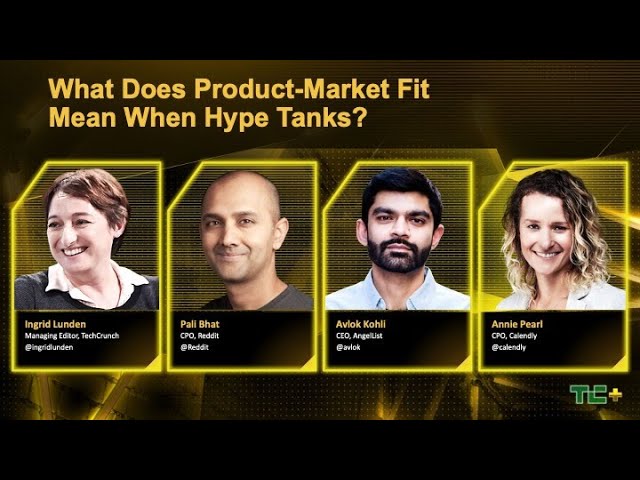
This content was created by Avlok Kohli. This content was uploaded by Avlok Kohli. This is a YouTube panel discussion titled "What Does Product-Market Fit Mean When Hype Tanks?" (video published 2023-01-18). It's a moderated conversation about product‑market fit, growth and scaling strategies, fundraising expectations, dealing with copycats, localization, branding and team sizing. Participants include a moderator (labeled Speaker A), Annie (identified in discussion as Calendly’s Chief Product Officer), Avlok Kohli (AngelList executive and former founder who sold his company to Square/Block), and Polly (a Reddit product leader). The session includes audience questions via Slido and covers concrete examples from Calendly, AngelList and Reddit.
Chapters
Hey everybody, how y'all doing? Thank you for sticking around. Hi guys, it's been great to have you here and thanks so much for joining us. So I'm just going to repeat what Alex said for starters, which is that I would really love to get your questions. They really want to see your questions on product market fit. We've got 3 amazing people here. Uh, you've got access to some incredible people here, so you should definitely use it. Anything that comes to mind, Send it to me over Slido. I think you all know how to do it. And I'll make sure the questions get woven into our conversation. So let's just— I'd love to just start off, if that's OK, with just a couple of little icebreakers to just ask each of you a question, just going down the line, if that's OK with you guys. OK, let's start with Annie. Woo-hoo. Actually, Annie, this is a tough one. It's a tough one to start with. I'm so nervous. Yeah, don't be nervous. It's going to be fine. Listen, you are the Chief Product Officer of Calendly. Not only— this is an incredible company that's totally had, you know, just came out of the blue with this boom with scheduling, which really took off during COVID I think. You are its first Chief Product Officer, which to me says something about the task of building product at the company. So you really— it was a one-hit wonder. And you guys are now tasked with trying to figure out how to grow into your $3 billion-plus valuation after you raised all that money last year. So maybe we can just start with that. You know, how, how is that? How do you face that challenge? I feel like that is the ultimate product-market fit challenge in a way.
Great question to kick us off. So let's see. So Calendly really started off as a very horizontal scheduling automation platform and really We really started off trying to solve the problem for my founder and CEO, Tope, who was in sales and was having really a frustrating time going back and forth via email to get deals closed. And so we started off on this journey about 7 years ago building a very horizontal scheduling automation platform. And that's really, you know, with virality built into it. So we had an incredible acquisition channel that was profitable and we could essentially, anytime anyone used the product, they'd invite another person into the product. And it's sort of this beautiful product-led growth machine. And what happened through that journey is what we started to see was we'd get pulled into a product-market fit pull into certain ICPs or departments within organizations. So anyone in an externally facing role, sales, customer success, recruiting, we started to see like really high engagement from those users. And so what that told us was, you know, the first chapter of Calendly was all horizontal and we, you know, were able to capture a lot of market share and build this really, viral, profitable business. And now next for us is how do we now go deeper to serve the departments that we have developed and found incredible product-market fit with? So the journey we're on now, we kind of call chapter 2, is how do we now go serve the recruiting teams or the sales teams or the customer success teams in a much deeper way than we could with just the horizontal platform? And then I think from there you go, okay, now that we've kind of nailed the end-to-end scheduling market, both horizontally and vertically, How do we now leapfrog into what's beyond scheduling? And so for us, we sort of think about the broader meeting lifecycle as the next horizon that we'll go after once we've sort of completed the journey going deeper for the departments that we serve today.
So I know I've written about some of the vertical moves you guys are making in acquisition and so on. Do you think you're going to have to rebrand, though? Because I mean, the name really sticks you to something. Your name is a certain product, in a way. Calendar.
Yeah, it's a good question, I think.
Are you going to be calling yourselves product? Productively, productively, productively.
It's a good question. I think, you know, branding and the name of the company is important, but I think maybe more important is being able to like really solve the team-based and the collaborative-based scheduling scenarios. So that's more where we're focused right now, but it's a good point. I mean, Calendly is pretty synonymous now with scheduling time with someone, right? Send me your Calendly link. So that's great from a brand perspective and gives us sort of the authority to go build new products on top of that brand, but we are not currently talking about a rebrand or a rename.
Okay. But that sounds interesting. You're not talking about it now, but listen, that's a conversation for the other stage. Perfect.
Perfect.
We do the big business conversation. We're gonna stick with product market fit here, so I won't dig too deep on that. Avlok, now you are very interesting because you have kind of two sides to your background. You were a founder. You sold your company to Square. Congratulations. Now called Block. Then now you're at AngelList. You've got a very, very different perspective on product market fit, I would think, between being a founder and now doing what you're doing at AngelList. How would you say your previous life, given that AngelList is— your customer base is startups, how is that informing what you're doing? I mean, do you constantly sit— If I were one of my customers, what do I need? Or how is that playing out for you?
Yeah, so AngelList's ethos is always build for founders by founders. And so everything we do puts founders on the pedestal. And so that actually bleeds into how we build product. And the platform itself serves GPs who start funds, LPs, people who invest in funds, and founders.. But when we think about products we're building for GPs and LPs, it's always with the founder in mind. And so a lot of my experience of being a founder helps because I can pretty quickly assess, hey, if we're going to make this move or if we're going to offer this to GPs and LPs, does this put the founder in a better position or worse position? And a good example actually is a product we just launched a few months ago. RUVs, and it very clearly put more power in, in the hands of the founder and less in the hands of GPs and LPs. And again, it's always really putting founder on the pedestal and asking, is this what's great for them? And that's actually the case for any platform where there is an ecosystem. You always have to make a choice on who you're gonna prioritize first because there will always be a trade-off decision that you need to make. So that's actually how it's helped. It's just because I've been a founder, I've been through the fundraising cycle, acquisition cycle, product-market fit cycle. I'm able to empathize and understand all aspects of it and then lead AngelList into building for the ecosystem itself.
Okay, cool. Okay, Polly, your question is— so what's interesting about you is that you came from a pretty enterprise background. You spent years at Google, but most recently at Google Cloud. Which is, you know, really the most businessy end of what Google does, obviously. Now you're at Reddit, which is really the other end of it all. You're like fully into the consumer game now. How is that— has that felt like a complete, you know, just schizophrenia or something of trying to think of product in such a different environment? How are you doing it and why? Like, you know, why did you move into something that's so deeply different from from what you knew?
Yeah, so first of all, I had an opportunity to work on a bunch of different things at Google, spent over a decade there. So it was a lot of fun, well before Google Cloud ever got started as well. But really for me, Reddit is all about communities. And as a Redditor, longtime Redditor myself, it was just an incredible opportunity I couldn't pass up to work with Steve and team to, to create this platform and build on this platform that brings community and belonging to people everywhere in the world. And it's one of those unique opportunities where Reddit's large, 500 million users visit Reddit monthly. Yeah, but the opportunity is to be serving many, many billions of users around the world because Every single person needs to belong to a community and wants to belong to communities, and we offer that uniquely to them.
Do you feel like the fact that you were doing enterprise product most recently and now you're in this very, very consumer product, do you think that that was a sort of conscious choice by Reddit? Because they have so much of a harder kind of— they have a real mandate to make money, right? Like, they've really spent so much time building community. And not really thinking so much for the first chunk of its life really about itself as a business, as a revenue-generating business. And yet now that is very much a part of what they're doing. Would you say that that's maybe one of the reasons why you joined?
I think one of the big reasons why I joined Reddit was because it's this opportunity to create that community platform and take it to everyone. Yes, we need to create a sustainable business as well, but our mission comes first, which is community belonging and empowerment for everyone in the world. So that's the primary focus. And the good news with Reddit is we're now in a place where we can sustainably fund our own growth. So—
Excellent.
So we're in a good place.
Okay, hold on. Backstage, this iPad does not work. I don't know if anyone's gonna hear me, but I won't be able to take questions from the audience. Anybody backstage? Let's see if they come out. Anybody backstage? The iPad isn't working. Okay, cool. All right, let's see what happens with that. Okay, in the meantime, I want to ask you some questions. So first one is, what do you believe is the— when you're a founder and you're building product-market fit, What is— and I would like to go down the line on this one if that's okay— either a big do or a big don't? What is the biggest mistake you can make or the best thing you can do? You can choose to answer however you want, and you can respond to each other if you want. Who should we start with? Anyone want to go first?
I can start.
No one's gonna get out of answering.
I'll start.
I'll start.
Yeah, okay. First, I think just definition of product-market fit. Million definitions out there. I think at the highest level, it's you You've built a product that a market wants, right? There are people that want your product. I think the reality is it's much more nuanced than that. There's really kind of 3 pieces of product market fit. One is kind of acquisition. Have you actually built an acquisition channel that's sustainable and that's profitable that you can sort of rely on month over month growth, right? If you get a big PR announcement, you get a bunch of users in top of funnel, and that dries up, you don't have a sustainable model for getting users into the platform and doing so in a profitable way. Away. So you have to think about acquisition. Then on the retention side of, OK, you got all these users in your product. How do you know that there are a sizable number of them, or enough percentage of them, are sticking around long enough? And so we talk about the retention curves start to flatten is when you sort of know that you've reached some level of sustainable percentage of users using your product for a long period of time. And then the last piece is business model, right? Are these people actually willing to pay for your product, or have you figured out how to monetize them? So I sort of start there because I would say the dos is you kind of have to think about all three. You can build an amazing product that people love, and they want to use, but if you don't know how to reach people and you haven't built a sustainable acquisition model, or you don't know how to monetize them, then there's sort of no business there.
That's really for B2B. I mean, I would say for consumer, do you think that the sustainable part is a priority in the same way?
Absolutely. I mean, yeah, that's probably the—
Yeah. I'll just build on what Annie said. Absolutely, it's important to have that sustainable cycle, but it comes from building a product that a large number of users love. I think as a founder, as you think about building products, the first thing you think about is, hey, do I love this product and does it solve a problem for me? But then you have to ask yourself the question, and that's a great starting point, but ask yourself the question, does this solve a problem for a large number of users? Because if it doesn't solve a problem for a large number of users, you are always going to be struggling to figure out how to acquire those customers because there isn't that natural pull. Right, so that's piece number one. And then just to add to what Annie was talking about, I really think having a differentiated solution makes a big difference, especially when there's hype cycles. There was a time last year and even now where everyone talks about community and everyone tries to latch on to that buzzword. For Reddit, we live community, we breathe community. And we are all about community, right? And so that makes a huge difference. So find out like what is that thing that you are uniquely about and that you're all in on as opposed to like also being about machine learning or AI and like whatever else is like popular in that particular day.
Do you think that like if you're building community and that's really your first thing and then suddenly you're like, oh, here I'm now going to be offering you products, it sometimes can feel like a betrayal in a way. How do you broach that?
Yeah, so as we think about it, the good news is that we are in an extraordinarily large unbounded market. It's literally every single person on the planet needs this. So we are fortunate in that way to focus on a mission that's truly for every single person. Now sometimes you don't have that luxury. And if you don't have that luxury and you're focused on something a little bit narrower, right? Then it's important to actually make sure that you really build for your customers in a deep way. I'd love to hear from Avlok.
Yeah, Avlok.
Yeah, I would say on the do category, you wanna think about product market fit as multiple iterations, especially in the early stages when you're building something, you don't naturally know it's gonna work for a large audience, right?, right? A lot of this happens organically. And so very early on, what you're really just looking for is, is there a pulse? Is like, in what you're building, are people pulling it out of you? Because most of the time you're just fighting apathy, right? People don't have the time or day to listen to you, to use your product. They have their own things going on in life. So the problem you're solving has to resonate so deeply that customers are banging down the door trying to get in. There was recently with AngelList, we launched a product that, and we knew it had product market fit when people were literally messaging friends of mine on LinkedIn asking to get in because we had a waitlist and we did no marketing on it, no paid, nothing.
Which product was that?
That was Rolling Funds. It was like from all angles, everyone was trying to get in., just to, to use that product. And our UVs had similar characteristics. And that, that typically is the, um, sign that you have something. And then from there, what happens is you discover more things. You move into adjacencies, you get into larger markets. Uh, Facebook famously was only scoped to, um, colleges and just one college to begin with, and then went from college to college to college. Now, sometimes you know that the your product will be useful to a larger market, which is great, but sometimes you just don't know. It actually is more art than science very early on. And so going back to the do, I think you want to keep the team size small, focus on iterations, and just keep going until it has a pulse. And I, you know, I made this mistake myself as a founder where I built a product, it was somewhat growing, and then I added paid ads on top of it In my mind, I'm like, great, it's gotta grow. Month-over-month growth is all that matters. And yeah, we grew month over month until we hit some point where it was like, well, the retention isn't where it needs to be. And what happens if you get too focused in doing that early, you miss the art, the early art of creating a product that the world just needs. So very early on, my main advice always is keep the team size small, focus on the iterations, and Look for that organic pull that's coming from customers, and you'll know it. Like, when customers need your product, they will literally bang down the door. And you all know it too. Imagine the first time you used Uber, Airbnb, Google, right? You can't live without those products. That's the bar for product-market fit.
That's a great answer. Okay, I'm going to pull one of these questions now from the Slido, which is very relevant to what you've just said. So it's from someone called Roshka. Most of these are anonymous, but whoever Roshka is, thank you for the question. Any advice on timings, meaning what should be the longest period for defining product-market fit? So if that— does that question make sense to you? I think it's a good one. It's basically what you've just described, but let's say, how long do you think is a good enough time to do that before you say, look, we have to just stop iterating and just do something here?
Yeah, that's a tough one.
It is tough.
My answer is going to be a non-answer in that If you as the founder, if you don't have that next idea or spark of an idea that you want to go chase and test, then you know it. You should just call it. But if you do and there's some other insight that you have, then you should absolutely go pursue it. But you have to be incredibly honest because sometimes you just get stuck in confirmation bias. It's like, no, there's got to be something here. You keep chasing. By the way, I'm describing what I did early on. That was my first company. I just kept chasing and chasing and chasing. Chasing, and 3 years into it, I was like, okay, this is not, this is not working. And so I would say you wanna, you actually want to be honest with yourself and see, do you actually have another idea that's worth testing? And if not, call it. Another thing I've seen founders do is just time box it. So every quarter is an experiment, and then that way it's ultra methodical. So every quarter they'll give themselves that amount of time, ship it, test it with customers. If it's not working, the next one, the next one, the next one. I don't know if that advice works all the time though, because sometimes the thing you're building just requires more time. And so it's not a perfect advice for everyone.
Yeah.
That must work when you have enough staff that you can do that while also having people building kind of more sustainable stuff that might not last past a quarter.
Yeah. I have a slightly, I don't know if it's controversial view, but I think founders should keep the team sizes incredibly small early on, mainly because the rate of iteration when you add it, increase the team size, slows down. So my view is whenever you add people, any grown group of humans gets slower as it scales. And if you're trying to iterate with a larger group, you will just be slower. And so instead, you actually want to find people that have multiple skills in one. So someone that can code and write copy, or someone that can code and design. And so you can go through multiple iterations pretty quickly.
Okay. So I'm going to ask another question, which I think is perfect for Annie, if that's okay. So if product-market fit is too good, don't you become the perfect sitting duck for bigger companies to attack? How do you avoid that? And their event, their thing is how to avoid what happened to diapers.com, because that's what Amazon did, and that's how they ended up killing them. It came up this morning on stage with Marc Lore. And that's actually perfect for you guys, because I mean, there's something, you know, I'm pretty sure right after I wrote about how Calendly raised all that money, Google came out with a calendaring product on Google Calendar. And I mean, you know, this is like really tough, tough gig. Yeah. How do you avoid that? I mean, you guys had such good product market fit. You did get attacked.
Yeah. Yeah, I think, well, I think every company— product-market fit is not static, right? Product-market fit is something you have to consistently be sort of nurturing, right? And so every company hits a point where they hit what's called product-market fit saturation, right? Like, you've either already acquired some high percentage of the number of users in the market you're going after such that it's irrelevant to getting that last 10%, or your product has been optimized to a point there's no more juice you can squeeze out of the product, Or you have someone come disintermediate you and there's a competitive change or something happens with technology. So our job as product leaders is, is to really stay ahead of that and say it's gonna happen. It happens to every company. And so you kind of have to consistently be thinking several years ahead to say, okay, are we gonna go— there's really 3 places to go, right? I can either take this product and adapt it to new users in my existing market, new geographies, new segments. I can go build a new product within my existing existing market to better serve different users that I don't serve well today, or I can move to a completely different market and build a new product, right? Those are my three options. And I think most important in all of that is where are my points of differentiation that give me, you know, the strength to say I can actually succeed in whatever I'm gonna go do. Is it, you know, my distribution channel? Is it technology I have, common components that I could use? You know, and that's your way to stay ahead is you say I actually have an advantage to go build a new product in a new category ahead of someone else because I, I have something something within, you know, that I have some shared capabilities that I can use that will allow me to be successful. So I think the job of founders even early on is to know that it's going to happen. And so you're just consistently thinking about, okay, now I'm going to go adjacent here, I'm going to go up here, I'm going to go over here, and what are the capabilities I'm building along the way that will allow me to, you know, leapfrog whatever situation I find myself in? Because you're going to find yourself in that situation.
So basically, a good product or a good founder, a good product person or founder founder person will be constantly thinking in that way. That you're, even when you're in the real, in the heart of having all your audience, you're already thinking like in chess, what's gonna be my next second, third, fourth, fifth, sixth move.
By the time you actually have to, by the time that it comes, that you've hit the wall, it's usually too late, or at least you're gonna take you another 2 years to really get the next product to market, find product market fit. And scale it.
Do you have something to add to that?
I'll just build on what Annie's talking about. Ultimately, product market fit as it's defined by you early on is likely product market fit for a feature. And yes, the feature can get attacked by a competitor or by a larger company. But if you truly understand what the need of that customer is, right, and of your customers are, then you can keep building and yes, they can keep copying you,. But you have to define the space. And so just talking about Reddit, we are talking about communities and belonging. It's not one feature, it's a set of things. So yes, other people can build one of those things, but usually you have to create that solution that works for your customers.
So Avlok Kohli, I'm gonna ask you a question. It's not on this list. I'll go back to the list in a second. But so funny thing about product market fit, that I can see is that it was, in a certain time, it was in that same category as TAM, total addressable market. It was the kind of thing that founders were very much into pitching to investors. And investors needed to see the answers to those to evaluate the investment. Given that we're in such a tighter market now, where investment is not as quick to come by as it was before, and I would say that investors very much have the upper hand now in those negotiations over valuation and all kinds of other things. Where is that parameter coming in now, would you say, from where you're sitting? Because you're sitting in between in that whole ecosystem. Where is PMF standing now for the— do they ever call it PMF?
I don't think so.
I like it.
Yeah, so I would say for— basically, I think the question summarizes as, How does a new capital cycle fit in in terms of do founders need product-market fit now to get funded or not, right? And so the way you actually want to think about fundraising is there's fundraising before product-market fit, and then there's fundraising after product-market fit, and how companies get funded pre and post are actually very different. So pre-product-market fit, it's typically more of the belief in the vision, right? Like how large could this be? Could— would customers really want this product that you're building? And you're typically looking at pre-seed, seed stage. That's typically the bet that pre-seed and seed investors make. Then as you get into Series A, B onwards, things become a little bit more systematized, and that's when you get into more around how does it grow? What's the growth rate look like? What do the moats look like? What if this gets attacked? So there are actually different ways of thinking about it. I would say that the pre-seed and seed market has gotten tighter, but hasn't actually changed at the same rate as the later-stage market, like Series B and C.
It hasn't trickled down so badly yet.
It hasn't. And actually, what's happening is some of the later-stage investors that were playing there actually went earlier. So there's still a plethora of capital there, but it has slowed down. Deal velocity has slowed down for sure. But I would say the expectations of product-market fit haven't changed. And sure, in the prior capital cycle— by prior, I'm referring to the massive sort of boom late 2020, 2021, where more things got funded than it really should have. And, you know, I think people believed something had product-market fit when it really didn't. And so a lot of that has receded, but it hasn't gotten to the point where companies are not getting funded. So another way to frame it is If you have product-market fit, you will absolutely get funded. If you have a great idea or hypothesis around product-market fit that's in large markets, you'll absolutely get funded. But everything else on the margins that were copycats or that were quick follows, all of that is less likelier to get funded. At least that's what we're seeing in our data.
That's interesting. So you would say that investors have gotten— they scrutinize it a lot more now, the whole product-market fit concept.
Yeah. Yeah, I think diligence is longer now. So what was happening, if you just think about the capital cycles, and this capital cycle, by the way, is just macro cycles that play out every few years. When you have a lot of capital that comes in, it typically goes into venture funds. And when you have a lot of venture funds that are looking at the same deal, you have competitive dynamics that kick in. And then founders will start saying things like, Hey, I've got a term sheet. I got to sign this term sheet by tomorrow. Are you in or not? Then that's when diligence goes out the window. It's like, well, shit, this sounds interesting. We don't have time to do the full diligence. We may as well just give the term sheet. That has gone. Now, there's not as many of those deals happening, and so people have more time to diligence product-market fit.
Cool. Okay. Polly, I'm going to ask you a question, which is actually a very businessy question. But it's very relevant to the product market fit question that we're here talking about. Um, it's anonymous, but it's a really interesting one. It's, why has Reddit kept its UX more or less the same over the past decade? Is it planning on a visual overhaul? And that's a great one. So you're a really interesting product guy because you're there, you're there building all this interesting cool stuff around NFTs and You know, other kinds of monetization and really kind of breaking into new frontiers of where Reddit could go as a product. And yet its actual product, the mainstay of the whole thing, has largely remained exactly the same. So what about that aspect of the product? And where are you going on that? And are you going to update that? Do you think you should never ever update it because it's done so well? If it ain't broke and all that stuff.
Yeah, this is a great question. So whoever's asked it, thank you. This is a question that we think about all the time.
Yeah, it must be a big one for you guys.
The thing that we've done at Reddit is a really good job of evolving what our user experience looks like, but do it in smaller increments. Because once you have a large group of users using something, every change you make will actually cost something to the users to adopt. And so one of the things you wanna be very thoughtful about as you all are building your own products is looking at what you need to evolve and what you need to keep constant. And if there are pieces of your, of your solution that are actually working, don't change it, right? Just for the sake of iteration or sake of evolution. But then look at places where you can actually make your solution better. Give you one example, right? We were looking at how Redditors show up on Reddit. And it was just a username. And we just had a username listed in gray text for the longest time. And one of the things we did was over the last, and this has happened over the last year and a half or so, is we've introduced this concept of avatar to Reddit where users can go in, they work in a studio, and they can customize their own avatar so They show up how they want to, and it represents them, it represents their interests, and it truly gives them the flexibility to be who they want to be.
And it doesn't feel markedly different from what Reddit already is. Yeah, that's— it doesn't feel different thing to think about with product-market fit. What feels like a complete shift versus just an expansion of what's already there?
Exactly. And that involves— and, you know, we, we suddenly saw like droves of users starting to adopt this, the solution, and And now, of course, to your point, we've introduced collectible avatars that can be created by Redditors for Redditors. It's, it's on the blockchain. You can mix and match, you can transfer it to other Redditors. So it's really created this ecosystem. You can take it off Reddit if you want, and, and you'll see that users will adopt it. In this particular case, you know, we had over 3 million Redditors create crypto wallets in order to adopt this product. It just shows you the kind of scale that's there in just a few months. And this was, we launched it over the summer, and in just a few months you have all these users adopting it. And so really think hard about where you want to keep the product as it is, and then evolve it in places where you think you can actually solve a problem or make it more additive.
Okay, cool. This could be a question for any of you actually. It's an important one from Chris Knight. Thanks, Chris. Which is, when you're scaling a business for global markets, what advice would you provide in terms of understanding and adjusting what you offer as product market fit? So how much is the regionality and localization coming in for you guys? Do you feel like it's hard and inefficient to have to do that for different regions? Or do you try to think about things always in that way of scaling to different markets? Is it a bad fit if it's only for one small region?
No, I don't think so. I think it's a question of, okay, if we just think about from a pure business scale perspective, it's a question of are there a small number of users that'll pay a lot, or you're trying to get a lot of people to pay a small amount, right? That's really, that's a deeper question to ask. But, you know, I was thinking about product-market fit by region. It's real for some companies. So AngelList, we play at the intersection of security law, fund structuring, and then operations and software. So it's a pretty large intersection there, and it's very dependent based on the region. So everything that we do and we build is with the US securities law in mind, and then as soon as you go to UK or you go to India, all of a sudden you do have a big build to take care of, and then you have to basically assess how large is the market, and does it make sense, right? For Reddit, it's of course a different set of things to think about. Probably not as much of a friction as you go and market into other markets, probably more cultural and language than anything else. So I think it depends on the business itself.
Language is a big deal for us. We do want Reddit to be available in every language. And then there's all the cultural things, right? For instance, in India, people care a lot about cricket. Cricket is almost like the national religion, right?
And the UK.
Yeah, and the UK, that's right.
Australia.
That's right, and Australia and a few other countries around the world.
Maybe it's more global than you think.
Yeah, yeah, it is certainly global. There's actually a World Cup in cricket happening right now that I stay up really late for. It's happening in Australia. So yeah, certainly. But then if you look at, the United States, and it's not even the United States, right? You have to think about it in like specific like cities and what do they care about. And we care about like the 49ers here, and in Seattle they care about the Seahawks and the NFL. And so there are all those nuances that you have to actually think about.
So there's always going to be permutations that are localized. Yeah, absolutely. Okay, Annie, this is something that Avlok touched on, but I think it's a, it's a Good one, and I want to ask you this one, which comes from— I think it was anonymous. But the crux of it is, when you're in the process of evolving product-market fit and you are finding things are not growing or catching on quite as well as you had hoped, when do you throw in the towel?
Yeah, thank you, anonymous.
Thanks a lot.
I think I touched on this a little bit earlier, the kind of pure definition of when the retention curves start and flatten out, which essentially says users who started on day 1 in a cohort, you look at them over the course of 12 months, what percentage of those users are still using your product? And hopefully that doesn't flatten out to zero. That flattens out at something like 30%, 40%, something like that. And that's when you start to see, OK, so there's a large enough percentage of users who are still using my product over a certain time period. And so I think you want to pay a lot of attention to those that data, and in particular, make sure that that data is applicable to your product and the market that you're going after. So if this is something that's not used very frequently, then how you're measuring retention is going to look very different than a daily active use kind of product. So I think you want to really understand the frequency of use and the core actions that your users are taking in your product to define a metric that you can say, here's how we know when we have success. Our retention curves will look like X. And so I think once you have that parameter, then you can sort of say, we actually know this is gonna take us a year because this is a product that people only use once a quarter. And so we need the data to sort of mature that long in order to feel comfortable.
You're willing to wait longer for some things than others.
So I think it's really understanding your users and the frequency of their use and the core actions to determine when are we gonna decide this is success or not and have we gotten there.
What's the challenge of that like though? 'Cause I mean, I can imagine there must be a lot of headbutting going on between finance teams, and product teams, or the CEO that's really wedded to something, really just wants something to happen, wants something to be a thing, or your investors or your board. Who gets the upper hand in these things? It really depends, right?
I think it starts with that definition of what is success and what's the time period. You talked about timeboxing, right? It's like, if we don't reach this metric by this time period, then we're going to move on. And I think if you have that alignment, then you're just tracking your metrics and you're reporting out on them, and then you sort of make call. I think the challenge becomes when you don't have the metric, it's very subjective. Well, I think we should be doing that. We gotta wait a little bit longer. We haven't seen, you know, X, Y, and Z happen. And so I think if you can get alignment on the, like, core thing that's gonna define success or not, and that will change at every company. There's not, like, a standard definition. Then, you know, that's at least one way to prevent the sort of opinions.
Yeah, and do you think, would you say that it's best to kind of come up with that before you launch something? Absolutely.
So everybody has the same idea rather than, like, Yes, retrofitting a metric after you're—
Everybody sign this piece of paper, this commitment to this alignment.
I think that's very, very important.
Yeah, OK. So here's a good one, which I know that you touched on copycats in the— we don't invest in them. Investors don't want to see that right now. And we touched on copycats a little with you too. And I said, what happens when you're basically getting your product made? OK, but let's turn that question around the other way, which is if you are getting copied, those copycats are doing it, how do you double down and make sure that what you're doing— like, what would be your advice for making— to fend those copycats off and to really come out as individual and the original and the best? I don't know. Maybe I'll ask you, Polly. Not that you guys have that problem at Reddit, because Reddit is just that's so unique. You're really lucky in that way, you know.
Yeah, so certainly the mission, the mission with Reddit has made it unique, and it's the community that makes it unique.
Yeah, there's really no mistaking it. Everyone knows Reddit unless you're 4chan. Just kidding, very different.
Yeah, so in terms of like what you do if you're a founder and someone's trying to copy your product, I think the key really is what's that differentiated and deeper insight that you have about customers? Because it's easy to clone a user experience. It's much harder to actually solve the problem in a deep way. And I think that's where like you'll start seeing a fundamental shift in how much you're growing and whatever metric you're using, right? You might be using like quarterly growth, et cetera. Or you might be, if you're in a consumer product like Reddit, you're looking at daily active users and you're looking at the number of monetizable daily active users, et cetera. So whatever metric you're using, you will see those start to shift. And then if you're switching over to Annie's side, if you're in the enterprise, because I spent a little bit of time in the enterprise, you'll start seeing customers switch from the competitor to you. And so one of the things that I used to track all the time is switchers. So it's people who've actually used a different product who are switching to you. And so you really wanna like focus on what are the set of things that you're solving uniquely.
Mm-hmm.
Honestly, if every single thing has been built by another competitor and they've solved the problem too, that means you are getting your lunch eaten. Unless you've figured out what else to build. So you've made a holistic solution. Again, goes back to truly understanding your users and the problems that they're having.
Yeah. Yeah, I think that's been the kind of interesting thing about Calendly is that while you get a Google or whoever building it, you kind of are doing something in a very unique way. And you've got this kind of loyalty of your users, which is what I think you build on. I think that's exactly what you're saying. Listen, I'm so sorry to say it, but we're out of time. It's been so lovely to have you all. You're all so interesting. So interesting. I think there is a Q&A stage going on elsewhere, and at least a couple of you are coming, if not all of you. Thank you so much. Thanks, everybody.
More from Avlok

Knowing When to Sell: Lessons from Two Very Different Exits with Superhuman + AngelList

30 - Network State Conference 2025 - Avlok Kohli on why Angellist built their Founders Cafe

Why LPs Are Using STABLECOINS to INVEST in Startups | Avlok Kohli on TBPN April 4th

Avlok Kohli, CEO of AngelList on How He Turned AngelList into a $4 Billion Dollar Company | E18
