H.O.W. #16 with Ben Relles, Head of Innovation for YouTube Originals, and The Showman of the WG'04
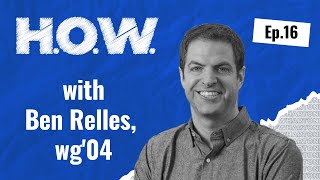
Ben Relles went from selling pretzels and starting a dot-com to launching the viral "I Got a Crush on Obama" video, which became Barely Political. He built that into a network YouTube acquired, then produced comedy specials with Will Smith and Katy Perry as YouTube's Head of Comedy, and created Good2Vote, which registered 165,000 voters in 2020.
Chapters
Hello everyone, and welcome to the new episode of How: Humans of Wharton podcast. Today we're thrilled to have Ben Relles.
Thanks for having me.
Ben is a legendary Wharton MBA class 2004. He is a co-founder of the Comedy Club, the head writer for The Follies, the off-off-Broadway production. At Wharton, among many other things.
Thanks for having me.
I'm curious, can you tell me about what in your childhood made you into your sparkly, funny self?
Oh wow, we're getting right into it. From my childhood, um, I would say I grew up with a lot of, uh, people around me who were constantly trying to tell jokes, including my dad my brother, my sisters. So I would say there's a lot of competition in my house for who could be the most sparkling, you said? Sparkling and funniest? We'll go with that.
And how do you think it shaped who you are?
I mean, I like to think I'm somebody that doesn't take things too seriously.
That's awesome. And so how did you manifest that when you were at Wharton?
When I got to Wharton in 2002, there was something called Preterm, and Preterm was like just the class of 2004 students getting together. And so it's kind of bizarre thinking now that I thought this was a good idea, but I met someone named Kofi Kankam, who I still talk to all the time. And I had done standup comedy before Wharton a little bit, He had done stand-up comedy a little bit. And we came up with this idea of like, what if we did a charity comedy show where we both do comedy and we get other Wharton students to try to do comedy and we bring in a headliner from New York? And that's not like the kind of thing I would do now. I think I would be way too self-conscious. But Kofi and I started riffing on this idea of like, let's do an end of preterm comedy show. And we had like 10 different students try comedy and write like a 3-minute set. And then we had, I think Jim Gaffigan actually came in and was like the headliner. And that ended up being a really exciting thing. So we ended up doing 6 more shows. I think we raised like $26,000 over the 2 years. And I still have some students that say to me that was one of their Wharton highlights was trying to write a 3-minute comedy set and do it on stage. So that was the Wharton Comedy Club. And then as of last year, it was still going. It lasted like you know, 18 years or whatever it's been since we graduated.
Well, I'm really glad that you did it. I for one really enjoyed it.
Appreciate it.
And it was a great way to learn about our classmates.
Right. Oh, that's true. That was like the thing which I think if I was trying to position this as a like job interview, why did you do a comedy club? I think some of it was it gave me the chance to get to know other students And then those students would try to be able to tell their story in like a nice, concise 3-minute set of jokes. And so, yeah, I'd like to think that was maybe another benefit of it is it like gave people a way to get to know their classmates through a different lens.
And then what about your summer internship?
My summer internship at Wharton was kind of a mistake and it was a good learning experience, but we were interviewing in whatever it was, February, March. And I got an offer from Wyeth Pharmaceuticals. And at the time, I think somebody advised me, you know, summer internship, you want to go to a big company, there's a lot to learn there. You want to go to like a name that people recognize. And so I felt like, all right, I am majoring in marketing and I'll go to a pharmaceutical marketing job. And it just wasn't a good fit for me. I like being creative. I like, the entertainment business, and I also like marketing, but this was, I think I worked on a product called Titus Cycling, and it was like 8 years away from launching, and we were working on some early research. So it was interesting learning what that kind of development cycle looks like. It's always good to eliminate something you know you don't wanna do, but for me personally, summer internship, by a couple weeks in, I felt like, All right, this is not probably the right fit for me. I did do that for about 6 weeks, and then I think I spent my last 3 weeks between summers interning with 2 comedy agents named Rick Dorfman and Mike Berkowitz. And I love that. That was a lot of fun. Got to learn the comedy business from 2 guys who represented all the top talent.
To backtrack a little bit, Yeah. You had entrepreneurial experience before Wharton.
Yes. Yeah. So I'll give you a little of my pre-Wharton story. I— my high school job was selling soft pretzels at like parades, baseball games, stuff like that. When I got to Wisconsin, where I went to college, I actually decided to go to Sam's Club, buy like hundreds of soft pretzels, and sell them before the football games. And that went super well. I was, uh, I remember like the day all my roommates were laughing at me. I pushed out this cart at like 8 in the morning and we sold like $1,000 of pretzels in a couple hours. So I think in college I started to be like, all right, I like the entrepreneurial stuff. I also had a couple things completely fail, but we don't need to talk about those. Uh, and then by Senior year, I decided I really wanted to try to start a company coming out of Wisconsin. So I started a company called Market Vision with two friends of mine, Kenny and Dave. And I basically had a startup from age 21 to 26. The first couple years were excellent. We kind of caught the wave of the dot-com era and we were doing a lot of college marketing, selling posters. And then by year 4 or 5, first of all, we wanted to get off the road. This was a business where we were like traveling college to college and we started to have a lot more competition. So yeah, I had a startup from 1997 to 2001. And then in 2001, I started to feel like, all right, if I want to try to build a company, then maybe Wharton would be a good way to build the full skill set so I knew what I was doing.
Yeah, good choice. And you were already married when you went to Wharton. How did she take, you know, instead of going to honeymoon, you took her to business school?
Well, we did do a honeymoon. We went to Hawaii and that was pretty great. Yeah, I think that first of all, when I applied to business schools, I applied to Wharton and Northwestern, I think. Maybe UCLA, but I really wanted to go to Wharton partially because it's such a great school, but partially because I grew up in the Philadelphia area and so did my wife. And so, you know, all of our friends were in the Philadelphia area, all of our family. So that definitely, you know, made things a little bit easier. It wasn't like I was moving with my wife to a new city and she had to meet all new people. If I was going to like Thursday night pub or something, she knew plenty of people in the area outside of Wharton. So that definitely made things probably easier for being just married.
Well, uh, I actually, um, uh, I watched, um, Miguel, Diego, and Pierre, uh, do the podcast, and they talked a lot more about, you know, like, um, what kind of values are you trying to instill in your children, and, you know, like the whole, like partnership angle, and I really appreciated it. You know, it was really incredible to see men talk about those stuff, those things, you know, like, uh, the, like, emotional intelligence and stuff like that.
I, I mean, I, I don't know if I have emotional intelligence. I definitely value that stuff. We get, uh, like, you know, free access to therapists at my company. I work at YouTube now, and so I was talking to my, uh, therapist person about values and she had me do this great thing where basically you had like 70 different values and then you picked your 10 values that were most important to you. And so, you know, for me, family, friends, you know, those were top 3. And then you kind of go through all of these 10 areas and decide how well do you think you're doing against all of these values that are most important to you. And I thought that was really good. Not that you were necessarily asking that, but, you know, for me, I was like, okay, if family is number one on my list of values here, then I need to figure out a way to carve out more time to just be with the family because so many other things can, you know, start to eat up all your time. Or, you know, for me, creativity and coming up with new ideas, that's like a top 10 value for me. I know that's when I feel most excited, most alive. And so, you know, I'm always trying to sort of reassess, okay, of the things that I love to do, is there enough of that in my day? So that was definitely something that, you know, came out of that.
Speaking of creative, I know you started the Good to Vote campaign last summer. Can you tell me about that?
Kind of an interesting story how it came about. So in 2020, during the election, voter registration was way down because of the pandemic. People couldn't go to register to vote at the DMV, and you couldn't go to register people to vote at concerts. So I felt like there could potentially be a way to sort of gamify voter registration, do it a different way. And I came up with this idea called Good to Vote. And the basic idea is normally you see celebrities, music artists, with like PSA kind of stuff. You know, don't forget to vote, it's so important to vote, your country depends on it, all that kind of stuff. And I felt like that probably does not get people to like register to vote in that minute, to just be reminded to vote, that there was a way to gamify it that could be better. So what I came up with was Good2Vote, and that was the idea that a celebrity, a YouTube influencer, a music artist could say to their fans, "Let's make a deal. If 500 of you guys register to vote, I'll do this crazy thing. I'll release an old tape of me in high school, or I'll get a tattoo, or I'll shave my head." And that way people would be like, "All right, let's make this happen." So I came up with that idea. Then around September, after about a month of not being able to get people to do this, I got Headcount, which is like a big voter registration group, to partner with me on this. And I got a YouTube channel, Vsauce, Michael Stevens, the guy from my Barely Political days, to do one of these where he said, "I'll tell you what, if 500 of you register to vote, I will shave my beard off." And then, sure enough, he puts out this video in early September, And within like 24 hours, 2,000 people registered to vote. And from that, it was like, okay, we are actually onto something. So me and the 3 people who I was working on this with were suddenly like calling everybody we could to try to get more people signed on to do this. And we started to get some momentum. Samuel L. Jackson did one where he said he'd teach people to curse if enough people registered. And then we did a Mean Girls reunion where Tina Fey said if enough people registered to vote, she'd reunite the Mean Girls. And then we did one with Leonardo DiCaprio and David Dobrik, and we did one with Jennifer Hudson, and we did one with, I don't know, Laguna Beach, a whole bunch of different places. And eventually we registered 165,000 people to vote with this campaign, which was pretty unprecedented as far as, you know, celebrity voter registration drives go. So that was in 2020. Now it's a full year since we started that, and we're just starting to think about, could we do this again for midterms? And if we did it for midterms, what would that look like? Because midterms are more about getting people out to vote, not just registering to vote. But that's been my main cause the past year, is voter registration Knowing how much influence YouTube creators have and how much gamifying things like this can work, are there ways to build on what we did well in 2020?
That's awesome. And so, so what did you, uh, what did you end up doing after school?
So yes, uh, my first job after Wharton was a rotational program with Omnicom. It was called the Omnicom MBA Residency Program. And, uh, it was great. The basic idea was, you would go to 6 different companies over 3 years, 6 months apiece. And from that experience, you would learn digital marketing, PR, media buying, advertising, come out of it and really be well-rounded in the world of advertising and marketing. So I did 5 of those stints, one in LA with TBWA, and one in London with BBDO, and then I did, you know, another one in media buying in New York with a company called PHD. And then after my 5th one, I actually took a full-time job at an agency called Agency.com, which is what they want you to do in the program, to kind of like get a full-time job coming out of it. And that job was in strategy, specifically around how do you, you know, in that role, use, you know, social media, websites, digital to figure out, you know, best way to connect with people. And I was only there for about 6 months before I actually left Agency.com to start my own YouTube channel. So I did 3 years of the rotational program, 6 months at Agency.com. I liked Agency.com, but it wasn't a great fit for me because I think I just wanted to make things and be more hands-on. And when you're in the strategy department at a creative agency, sometimes you don't have that same kind of ability to really be a part of the creative process. And so, yeah, I kind of just made my own YouTube video that blew up and then I left and went independent.
Tell us about that. What was the video about?
Okay.
Or who, rather?
While I was at Agency.com, I was given this assignment to really understand YouTube and how we could use YouTube effectively. And while I was there and researching YouTube, I also got kind of hooked on this idea of YouTube that anybody with a camera and idea could create a video and reach millions of people. So I started to play around with YouTube myself. The first video I made on YouTube got— I can't remember what, like 10 million views. I was completely hooked. And then in June 2007, I put out a video called "I Got a Crush on Obama." So, um, so Ben, how did you come up with the Obama Girl video? I was walking home from work and I had this idea because I was hooked on YouTube to try to have a viral video. And I had this idea because I was a big Phillies fan to write a song about the second baseman Chase Utley. And I wrote this song called "I Got a Crush on Chase Utley" because I was like his biggest fan. And the idea would be you would have this whole love song about Chase Utley. And then as I was like planning the whole thing out, I sort of felt like this is only really going to be talked about in Philadelphia. Started to lose interest in the idea. Then I heard people talking at work about Barack Obama. I was a big Barack Obama fan and I was like, I should make a whole music video about Barack Obama because the election's not for another year plus and everybody's going to be looking for things to talk about on YouTube with politics, but there's not that much to even talk about. So came up with this idea to do a pop song about Barack Obama. I found a woman who, uh, would write the music because I already kind of had the lyrics another woman who would play the part of Obama Girl, and her name was Amber Ettinger. And then the morning of the actual, uh, music video, I actually found the two directors, Kevin and Larry, on Craigslist because I kind of at the last minute felt like, you know what, I should get people who have directed actual music videos before. So pulled this whole thing together for about $1,500 and then shot it in May of 2007, a music video about how Barack Obama was this incredible, smart, handsome presidential candidate. And then we put it out in June 2007, and the first day, like nobody saw it after I had told everybody I knew that this was like the perfect mix of what works on YouTube. The first day, I think maybe like 10,000 people saw it. And then the second day, Jake Tapper did a little story on it on ABC News blog where he worked at the time. And once that blog post went up, then Fox News put it on, and then CNN was putting it on their network every like hour. And suddenly this music video we did, I Got a Crush on Obama, was this like big sort of early viral moment in the early days of YouTube. And so I was at this jobagency.com and I had this video blow up, and I started to talk to different companies that were investing in online video. And one of them called Next New Networks said, we want to buy your whole thing, your website, your YouTube channel. You'll come over and be our head of comedy programming. And so basically like 3 weeks after I put that video up, I sold my YouTube channel, which only had this one video, to this company Next New Networks. And that was my next job for the next 4 years was building this YouTube channel. Eventually we got to like 3 billion views and I think something like 4 million subscribers, and also helping next new networks figure out what it means to launch and build a YouTube channel.
That's pretty incredible.
Yeah, it was fun.
And, and you ended up meeting him, uh, more than once even, didn't you?
Yeah, I got to meet him a few times. Uh, the first time I met him was at a fundraiser in Brooklyn, but it was like a second. It was really quick. Didn't get to really introduce myself. It was more like him, you know, shaking a bunch of hands at once. Then my website, uh, Barely Political, and the company I worked for, Next New Networks, were acquired by YouTube in 2011. And so I actually started working for YouTube full-time in 2011. Can tell you more about my, my job there, but while I was at YouTube they actually brought YouTube stars and YouTube experts into the White House to meet with President Obama and talk about the Health Care Act and talk about how he could use social media. That was kind of the idea. And so as part of that, uh, I got to sit in a room with him and a bunch of other big YouTube stars at the time— some of them still are— and talk about you know, what it, uh, what it means to use YouTube. And he was really smart about using social media. Then that was probably 2012, I want to say. Then later we were invited to the White House to meet with Joe Biden about a different initiative. And while I was there, again with, uh, a bunch of big YouTube stars who were going to meet with Joe Biden, there was a separate meet and greet with Barack Obama and Joe Biden. And so I went in this room. It was like me and 20 other people, and they— there's like a U-shape. And so they both start, you know, at like one end and work their way around. And I was like all the way at this end. And so I met Joe Biden and Barack Obama was here and he was making his way around. And I was like, it's just, they were both like really talking to people. So I figured out, well, maybe I won't get a chance to actually meet Barack Obama. Um, but we'll see how this, uh, you know, how this goes. And then when he got to me, uh, I introduced myself. I said, you know, thanks for everything you're doing. And I work at YouTube and my, you know, he says something about my, my kids watch YouTube all the time. And then he went to the next person. But then the next person also worked at YouTube and they were like, President Obama, Ben did that Obama Girl video. And so then Barack Obama came back to me and he's like, oh, that was you. Okay. All right. I like that one. I don't know if Michelle liked it, but I liked it. He said something. Ah, that was like the highlight of my life. I got to, you know, spend a nice quality 45 seconds talking to him. So that was good.
That's, that's pretty incredible. Tell me a little bit more about your start at YouTube.
When I was at Next New Networks, we had this channel Barely Political. Barely Political was political comedy, mostly about Barack Obama, but eventually that election was pretty crazy. It was Sarah Palin and John McCain and a whole bunch of characters. And so we had one of the top YouTube channels up until January 2009. Then Obama took office. Suddenly politics was not, you know, front and center every day. And we actually lost a lot of our audience. I was at Next New Networks. We had like the number one channel in the company. And we lost probably half our audience in March, you know, April, May, as there was suddenly political comedy was not the thing. So, uh, I had this team of writers and comedians, and fortunately for us, YouTube actually had a program, uh, where they were giving $100,000 grants to different YouTube channels who had ideas on how they could make their channel bigger. And so we pitched this idea to YouTube called The Key of Awesome, where we'd use the Barely Political channel that had like 2 million subscribers at the time And every week we do another music video parody. And so that series, The Key of Awesome, ended up being way bigger than any of the Obama Girl stuff ever was. I think one of the videos has 180 million views. It's like a Ke$ha parody thing. We did songs about Batman and Twilight and, you know, a little bit of political stuff. But basically right when YouTube was, you know, really blowing up in 2009, 2010 with creators who were doing like regular series of content. We had this show called The Key of Awesome, which was one of the top 5 shows on YouTube, I'd say. You know, every video was getting 20, 30 million views at its peak. Um, we spun off a channel called Vsauce. One of the editors I had hired named Michael Stevens, uh, was looking to do other stuff. Next New Networks was looking to have other successful channels. So we started Vsauce together and that ended up being the number one education channel on network, on YouTube. And then in, yeah, like 2010, I started to hear that it was possible that this company I was at, Next New Networks, of about 40 employees would be acquired by YouTube so that YouTube could have in-house experts who understood what works on YouTube and why. And at first I was actually pretty resistant to that because I really liked having, you know, my channel and my team, and we were like the big channel at Next New Networks. And then we were going to YouTube where they did, you know, like billions of views a day, and I didn't think anybody would really care about our, you know, individual videos. Although funny enough, uh, 10 years later of out of everybody that came over in that acquisition from Next New Networks, I think I'm the last one still at YouTube full-time. Everybody else, uh, went on to different things, and I am still all in on YouTube.
And you've had several different roles with YouTube.
When we first got to YouTube, Next New Networks turned into the Next Lab, and the idea behind the Next Lab was that we would, uh, take all the things that we were learning about what worked on YouTube and help share that with the YouTube community. And so I still got to run Barely Political, and I still got to, you know, oversee the channels that came over in the acquisition, but my role changed a little bit. Now it was like, how do I scale what we've learned, and how do I take these things and turn them into kind of playbooks and you know, workshops and all that. So I still loved the barely political stuff. I did have a little bit of money to invest and experiment with other creators. And I spent a lot of my time basically trying to communicate to as many people as possible, creators, brands, etc., what works on YouTube and why. And so that was my job from 2011 to say 2015. And then in 2015, uh, YouTube decided that they were going to do a new version of YouTube Originals. And because some of my investments that I had made while I was doing this thing called the Creator Innovation Program at YouTube in the, in the Next Lab, uh, I was actually recruited over within YouTube to be the head of comedy for YouTube Originals. And so in 2015, I moved the family out to LA, took on a completely different role where it was really all about how do we find shows that we feel like will, well, initially get as many views as possible. And then that kind of switched to how do we do shows that will get people to sign up for YouTube Premium, which is a subscription service. And now I'm still at YouTube Originals, but we're back to everything we're doing being free and available to everybody.
What have been your favorite projects that you've done since you joined YouTube?
From YouTube Originals, I would say a few stand out. I'm from Philadelphia. I got to work on a project with Will Smith where on his 50th birthday, he jumped out of a helicopter live on YouTube. On a bungee cord. And that was like a big live special and kind of a thrill that I got to actually work with Will Smith. I did a project with Paul McCartney, which was kind of surreal. Got to do a live show at Grand Central in New York. And let's see what else. Yeah, a couple other just like surreal moments with celebrities and music artists. We did a 4-day livestream with Katy Perry. Uh, we did a show with Kevin Hart, but actually I'd say the ones that were most meaningful were probably more with the YouTube creators. I started as a YouTube creator, uh, at the end of 2020, uh, I got to do a project with MatPat, who is a— Matthew Patrick is a creator who does a fundraiser, and we made a, uh, project which raised $3 million for St. Jude's Hospital where he does a live stream on his channel. So that was YouTube presenting this, um, live special. He had like 20 different channels on it. And I think there's a lot of that that happens on YouTube that people aren't always aware of, that there'll be these creators that have huge audiences that do use their platform for good. So that was another good one.
So it sounds like you found a really great mix of creative and business in your career. In retrospect, do you think you had to go to business school to do what you do?
Um, I mean, I definitely don't think I'd be where I am now if it weren't for business school. I don't know if you— you know, I know you don't have to go to business school to be a development executive at a TV network, uh, but for me personally, I do feel like it was really invaluable that I got to go to Wharton, both in terms of just, you know, the relationships I made. I feel like I became a more well-rounded leader genuinely, you know, coming out of school and then having to start some of these projects like Barely Political. I feel like it was largely leaning on things I learned while I was in school. I still feel like, you know, you mentioned like I've found the perfect balance of business and creative. I don't know if that's true. I feel like I go back and forth and I've had moments where I'm like, I just want to make videos again. And other moments where I feel like I'm really lucky to not have to, you know, be on this grind of like constantly making YouTube videos. And so this is a pretty good middle ground that I'm in now. But I would say Yeah, for me, getting to go to Wharton gave me the opportunity to sort of like really learn from everybody around me. And from somebody who had just like started a company and basically just worked with the same 4 people for 5 years, Wharton ended up being something that was, you know, a way for me to kind of fast-track getting a lot better and a lot more well-rounded in ways that have benefited me, you know, far beyond Wharton.
What did you like the most about your business school experience?
For me, I'm guessing you get this answer a lot, but it was 100% getting to meet all these different people in such a condensed period. You know, I started a company out of undergrad and it was, you know, a very small team. And then you get to Wharton and you're in this cohort of, 70+ people from all different countries, all different industries, all different perspectives. And in addition to it just being a lot of fun to meet new people every day, it also felt like really priceless to be able to work on these projects and feel like, wow, I'm surrounded by the smartest people I've ever been surrounded by. I'm learning new stuff every day. And now it gives me a way to continue to call up anybody who I met during those 2 years. And I do it a lot to get advice, think about ways to work together. I think, yeah, it's certainly meeting the people for me was the most valuable.
It's interesting that you mentioned that you call your Wharton friends to get advice. Meanwhile, to me it sounds like, oh, at every stage you knew exactly what you wanted to do and you just went after it. So how does it— what is the reality of it?
Definitely not that. It's definitely not that. I feel like I've had like 4 or 5 points when I was just like, oh my God, what do I do next? And it was from getting a lot of advice that I figured out what to do. When I was in undergrad, my senior year before I started a company, I definitely felt completely at a crossroads of what I should do. When the company didn't work after 4 years, going to business school was something that I decided on after meeting with dozens of people who had been to business school, who didn't recommend business school to try to get that perspective. Then Yeah, definitely. Like even when I was at Wharton trying to figure out what I should do afterwards, I felt like I was the type of person asking anyone and everyone, and I do it to a fault. Anyone who knows me would say, just make a decision. You don't need to call your 10 Wharton friends, your dad, your sister, your wife, your friends from high school every time you have to make a decision. But I don't know, I feel like For me, the thing I've done probably best in my career is I've just been completely shameless about asking for advice and, you know, asking people when I have no idea what I'm talking about to explain to me, you know, what I should be factoring into a decision. So, and that was the case, you know, when For example, I sold the Barely Political brand. I remember calling Kofi and I remember calling all of these people who was in the Entrepreneurship Club and trying to understand like, should I try to do this on my own? Should I sell it? I've got this other offer to, you know, take funding. And so I'm always looking for that type of advice. And then, yeah, along the way, I feel like I just get a lot of benefit out of calling people and spitballing ideas. And they can call me too, by the way. I don't know, you know, Your audience can obviously call me anytime with YouTube questions or anything else.
Well, so we ask this question most of our guests. How would you complete the sentence, Wharton is blank?
To me, Wharton is a completely unprecedented opportunity to meet people who will add value to your life for the rest of your life. Yeah, for me, getting to go to Wharton gave me the opportunity to sort of like really learn from everybody around me. And from somebody who had just like started a company and basically just worked with the same 4 people for 5 years, Wharton ended up being something that was, you know, a way for me to kind of fast-track getting a lot better and a lot more well-rounded in ways that have benefited me, you know, far beyond Wharton.
Thank you so much for joining us today, Ben.
Sure.
I really hope we get to do more stuff with you and more episodes.
I would be happy to come back anytime.
And thanks, thanks to everybody for watching.