Anticipatory Leadership: Why Waiting to React Is the Most Expensive Decision Leaders Make
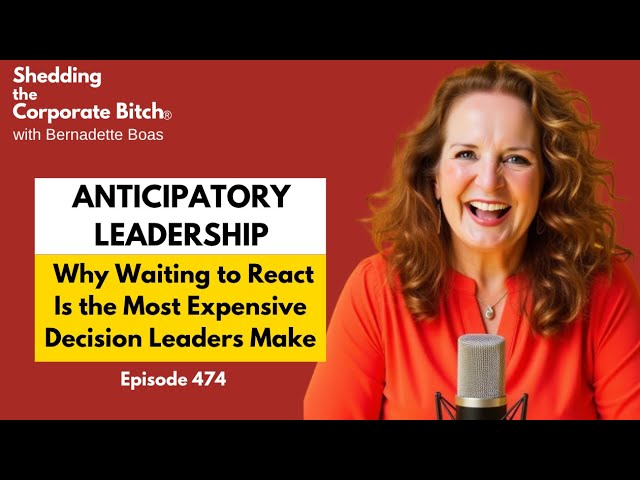
In this episode of the Shedding the Corporate Bitch podcast, executive coach and author Bernadette Boas argues that reactive leadership is the most costly decision leaders can make in today’s fast‑changing environment. Citing a 2024 McKinsey report that only 25 % of executives feel prepared for disruptive change, she explains why leaders must move from reacting to anticipating future trends, especially as AI, economic volatility, and political shifts accelerate disruption. Boas defines anticipatory leadership as a proactive, opportunity‑focused mindset that uses environmental scanning, scenario planning, adaptive decision‑making, and change shaping to stay ahead of threats and capture emerging possibilities. She walks listeners through each component, offering concrete examples (e.g., quiet signals of AI‑hungry talent leaving a firm) and data (World Economic Forum 2025 forecast of 40 % of jobs being radically transformed by 2030). The episode then outlines five future‑ready leadership skills—strategic foresight, adaptability & learning agility, AI & digital fluency, scenario thinking & stress testing, and emotional & cultural intelligence—explaining why each is critical and how leaders can begin developing them. Boas provides actionable next steps, self‑reflection questions, and resources (coaching sites, prior podcast episodes) to help C‑level and VP leaders embed anticipatory practices into their culture, reduce stress, and build resilient, high‑performing teams.
Chapters
An alarming statistic I recently read in a 2024 report from McKinsey is that only 25% of executives feel fully prepared to lead their teams through disruptive change. Now, today, considering AI, the economic climate, the political climate, all of those are creating enough disruption to create havoc within our organizations. And now is not the time for reactive leadership. You must be focused on what is coming down the road, even if you aren't sure, feel uncertain, or you aren't fully prepared for it. The cost of not looking around the corners and doing the research will be far too great for many leaders, risking their own success and that of their teams and the business. So in this episode, we're discussing what is the impact of reactive or traditional leadership versus anticipatory leadership. What is anticipatory leadership and its components that have such influence on your success? And what is the framework of strategies you could be putting into place in order to be able to lead your team and the business through any type of disruption, change, or even transformation? So you'll walk away with specific next steps you can take to move ahead versus react from behind, making everyone successful.
Welcome to Shedding the Corporate Bitch, the podcast that transforms today's managers into tomorrow's powerhouse leaders. Your host, Bernadette Boas, executive coach and author, brings you into a world where the corporate grind meets personal growth and success in each and every episode. Let's do this.
Let's talk through a scenario you might find yourself in. You are a C-level executive or maybe VP, and you must decide whether to invest in AI-driven customer insights, pivot to a new product line, or invest in upskilling your employees. What do you do? First, you can take time to really research any trends, insights, and observations. Such as, for instance, you might come across the 2025 World Economic Forum that found that by 2030, up to 40% of current jobs will experience radical transformation due to automation and AI. But what does that mean for your workers, your business plans, and your overall future? What then should you and other leaders be doing today to get prepared and to get ahead of it? Now, that doesn't mean that you automatically from the above choices go with invest in team development. It might mean that you have to do all three. You might invest in AI insights, invest in pivoting to a new product, and invest in upskilling and upleveling your people. The key is leading through the disruption that is here right now and growing and the opportunities that are going to be presented to you as a result of any disruption that comes down the line. Now, many leaders will tell you that chaos and disruption opens up a world of possibilities. And I'm one of those individuals that say, look for the opportunities, look for the diamond in the rough, the diamond in all of the chaos that you may not have considered before, because so many of us get comfortable with where we are and they avoid the uncomfortable nature of change. And so they stay stuck in asking the same questions, looking for the same answer, coming up with the same ideas and strategies, and not really working their way outside of that. Not looking around the corner, not looking at the big picture, not looking down the road 2, 3, 5 years from now. And according to many researchers, The future is not 5, 10, 15 years down the road. The future of change, transformation, and disruption is right now and in the short term. So one key question you— so one key question you could be asking yourself is, what decision have I been avoiding because the future seems too uncertain? And that needs to be your starting point in really understanding how you feel when it comes to working through change, let alone chaos and disruption, and what you are avoiding. And yet, what are the possibilities and the opportunities being presented to you that you can then strategize on and begin pursuing, putting in place, and achieving results from them? What is the difference between reactive leadership or traditional leadership and anticipatory leadership. First, for many, it's comfort. As I mentioned, they know what they know, and the fear crops in when they don't know what they don't know. And so anticipatory leadership, it allows you to look around corners, look down the road, and anticipate trends and make strategic moves before the competition or the crisis forces a reaction. Because that reactive leadership or traditional leadership is all about waiting until the problem blows up in our face, and then we have to react quickly to find a solution to it. Anticipatory leadership provides some comfort, some breath, some pace, some cadence to actually solving that problem over time. Anticipating what may happen. And if it doesn't, hurrah. But if it does, you already are prepared. You already have a plan. And keep in mind, your competition is for talent as much as it is for revenue, profit, and market share. So in that scenario I painted around whether or not you would choose AI Insights pivot to a new product line, or uplevel your people in leadership, you need to consider all three of them. And I see too often when business starts declining and all of a sudden the disruption and the chaos is being created, the stress levels are heightening. The first thing that leaders will do is make critical cuts in key aspects of the business that actually is going to be critical to them moving forward. And we had this discussion in our last episode all around the leadership shift that millennials are forcing, and that's overall connection, development, opportunities. And I spoke to Susan Ainoa all about Solubana leadership, and it all centers around really ensuring that your people are developed, your leaders are elevated, and everyone is using their gifts and their skills, of which you'll only discover when you provide some specific resources and specific opportunities for your team members to really discover what they are and how to leverage them within their role that they have today, but anticipating where their role might go in the future. So take a look for that. You can go to ballofirecoaching.com/podcast to find that episode, as well as on our Shed the Corporate Bitch TV YouTube channel. All right. Traditional leadership, reactive leadership. That's all about once a problem arises, we're going to focus there and we're going to throw all, all our weight against solving that problem. It's crisis-driven. It's short-term. And it's only when typically, but shit hits the fan. Whereas anticipatory leadership is opportunity-focused. It's risk mitigating. It's proactive. It's medium to long-term horizons that then you're gonna sit down, you're gonna strategize on the what-ifs and what's possible and what are the opportunities. And work your plans and your solutions around that. And even your, the direction of the company, the direction of the team around that. So it's far more proactive, not predictive. You're not looking, you're not predicting the future. You're using insights, trends, observations, research to anticipate what might be coming down the road and working your plans and your models and your direction based on that. What are the components of anticipatory leadership that you'll really wanna understand? And this would be great information for you to share with your peers and your team members so they too become more anticipatory versus reactive. And that will set you up immediately today to find your way and transform your team and your culture into that more proactive, strategic, opportunity-focused direction versus the reactive crisis-driven that could just cause stress and overwhelm for everybody. 4 key components of anticipatory leadership that you really want to dig into and start acting on is environmental scanning, scenario planning, adaptive decision-making, and change shaping. So let's dive into each one of them a little bit more. Environmental scanning is all about trendspotting, looking for are the weak and strong signals that you're reading about, you're hearing about, you're dialoguing about. Maybe you're even debating and arguing about within the business, anywhere within the business, whether that's within your teams, within the leadership team, and even from external sources like other businesses, other leaders you're networking with, so forth and so on. So this is not about being surprise. It is about doing the homework. And if you're a data person or an analytical person, you will love to environmentally scan for trends and weak signals or strong signals that are, is indicating that an adjustment needs to be made. But it's not about being surprised. All right. So most leaders scan the environment only when a problem is already loud. So that goes back to reactive leadership. What's loud? Declining revenue, employee attrition, competitor's big move. And environmental scanning means that you're training your leaders and you're training your team members to notice those quiet signals before they become obvious threats or opportunities. Recently, one indicator to one of my clients was the fact that multiple team members, multiple employees with strong analytical skills and AI ambitions were looking elsewhere, were looking outside the company. And therefore, even though it was subtle and it was only a mention or two, kind of in the scuttlebutt of their team, That is a quiet signal that should raise bells in regards to getting under the covers and understanding not only what is it that they're seeking in that they are gonna be looking elsewhere to leverage and get involved in that trend of AI and leveraging skills that maybe they're currently using and/or is a gift. And Susan Ainoa last, episode talked all about gifts and skills of team members. Another reason to go back and listen to that. But it's also important to then immediately start asking questions and digging into, all right, wait a minute, let's look at how we need to adapt and adjust into leveraging AI for, especially for automation. And therefore, how can we be leveraging both their skill and their desire to be in this space? Within our current team, or at least within the business before you lose high potential employees. And so they immediately went and started digging in and working to understand and working to then address and find solutions short-term and long-term for not only that one or two individuals that were scuttlebutt, so to speak, but also just down the road. For any of the, their employees. You're looking for trends. You're looking for shifts in customer behavior, or in this case, employee behavior. You're looking for any new technologies, any new automations, any new processes that are being generated as a result. You're looking for external factors. You're looking for any regulatory or economic political changes that are going on that you're reading about. And if you're not doing a lot of reading online or in paper, in LinkedIn, with all the experts that are out there, on forums, on Reddit, then you really need to start kind of tapping in and looking intentionally for those quiet signals, but also those loud bangs of what might be coming down the, down the road. And then of course, then there's workforce expectations, like the flexibility that individuals want. In that conversation with Susan Ayanola, we talked about millennials and multi-generational workforces. So they're looking for a very different work environment and the use of their skills than previous generations have. So the workforce expectations would be around things like flexibility, leveraging their gifts and their skills, ensuring that the values of the company match and align with their own personal So these are areas that you really need to start paying attention to within your team and externally in order to get ahead of it and be an anticipatory leader versus reacting to it. Anticipatory leaders, they don't dismiss any of that as noise. They ask, if this grows, if this quiet noise starts to grow, what does it mean for us as a team and as a business and me as a leader? And therefore, what do we need to do? So the goal isn't prediction. The goal is not prediction. It's early awareness. Let me repeat that. It's not about prediction. It's about awareness. And awareness, just like your own self-awareness, is key to ensure that you are protecting, are protecting the assets that are most critical to the business. People being one of them. Now, scenario planning, scenario planning. It speaks for itself. It's looking at multiple scenarios that could be going on that you might even create of your own and looking at contingency strategies. So what if this were to happen? What if that were to happen? What could we look like if we did this instead of this? And this is where leaders really stop betting on one future and really start being well aware that there could be multiple degrees of the future or multiple views of the future coming down the road. And so scenario planning is deliberately breaking the assumption of what if we're wrong and moving more into What if this particular scenario happens of the multiple scenarios we're painting in order to really be able to anticipate any change or disruption that might be coming? And according to Harvard Business Review in 2023, companies that actively practice scenario planning report 60% higher revenue growth and 45% lower disruption cost. During market shocks. It's all about not just forecasting one outcome. Leaders have to build 3 or 4 plausible futures, each based on different assumptions. Now, as you work through that, and as you come up with these 3 to 4 plausible futures, and as you start asking questions and crafting, you know, what that, those futures would look like. And the impact to the business, impact to the team, impact to the products, impact to the processes and procedures, impact to the overall infrastructure. Then what you also want to do is you want to test your current strategy by asking a number of questions, because what you're looking for is here we are currently, here's what we're anticipating the future to look like. Where are our gaps? What do we need to do to get from current to future? And do it more proactively, more thoughtfully and intentionally, as opposed to waiting until the bottom drops out and then we're reacting. To then test as to whether or not your current strategy will hold up to these futures, you can ask yourself questions such as, is this holding up? What is holding up? What aspects? What components? What parts of our current strategy holds up, which ones break down, which ones are no longer relevant, which ones are completely disrupted and eliminated. And where are we overexposed? Meaning where are we reliant and heavily dependent on maybe one product line, one market stream, one client demographic. On one workforce model, on one marketing strategy. You want to ask yourself, what is holding up? What is breaking down? And where are we overexposed? The power here is in accuracy. So it doesn't mean that we're looking for you to have all the answers from this scenario planning. We're looking for you to be prepared. It's all about being prepared. And it's been proven time and time again that teams that have rehearsed multiple scenarios, multiple futures, make faster, calmer decisions when reality shifts. And just think about it. If you are that prepared for any of the scenarios that might happen, and again, you're not predicting, you're anticipating. So you might come up with 4 scenarios and then a 5th comes along. But that readiness, that preparation creates not only the calm and the faster decisions, but it creates more confidence in your, from your people. It creates more steadiness, more certainty of direction, more trust that you, the team, and the company have a direction, have a path, no matter what happens. And even if the scenarios that were painted don't happen and a fifth one pops up and surprises everyone, you don't lose that trust. You don't lose that foundation. You don't lose that confidence. Because they know that the process that you've now instilled within the culture of the organization will then be used to get on board as quickly as possible and work through that fifth scenario. Now, adaptive decision-making. This one is about— this third component is about iterative and feedback-driven decision-making. This replaces the myth of the perfect decision. I like to think of my clients going after imperfect perfection than perfection. And so that's relevant here. So in uncertain environments, waiting for certainty is a great liability. Adaptive decision-making treats decisions as experiments with no final verdicts. And experimenting is both fun for many, it's strategic. It's proactive, it's anticipatory, and it gives everyone the opportunity to look at all the strengths and the weaknesses of a decision, of even one of those scenarios of the futures that you painted earlier. And it allows leaders to decide which is the best available information, not the perfect data. Because again, you're never ever going to have the perfect data. You're never ever going to have perfection. There will always be kinks in the armor. There will always be gaps in the data. There'll always be shifts in that scenario that you painted for yourself. We're not looking for perfection. We're looking for the best learning, the best ideas, and the best path that fits where our business is and needs to be in the future. So this approach reduces fear. It speeds up execution and builds organizational learning. And then teams stop hiding their mistakes and start surfacing any insights, any learnings, any gotchas, any best practices, which then just adds on to the intelligence over time, the knowledge, the learning over time. That the team members and yourself as a leader are gaining as a result of that adaptive decision-making. Now, the fourth one is change shaping, not just managing, but this is all about mindset. This is all about ensuring that your leadership mindset ties to everything that is being worked on. Being created, even being disruptive. Managing change is reactive and we don't want reaction. We want anticipatory, right? So it assumes change happens to the organization when you're a reactive leader. Anticipatory leadership shapes change and assumes the leaders can influence the direction, pace, and meaning of that change as a result of the above three components of anticipatory leadership: the environmental scanning, the scenario planning, the adaptive decision-making. Change shaping really means framing the narrative before anxiety fills the vacuum. The number one complaint I get from employees regarding their bosses is that while they understand that a boss might want to protect the employees from bad situations or bad decisions that have to be made or bad results that are going to impact them financially. They would prefer their bosses to be extremely transparent and upfront as opposed to just keeping it to themselves because that's just coming off as distrust. And that's just coming off as protecting themselves and not the employees. And, you know, all your employees, they're big girls and boys. They have to be able to handle bad news as much as good news. And change shaping is all about ensuring that your team is actively involved in being completely transparent about the challenges ahead, involved with what decisions should be made to the company, because they're the ones who are going to have to adapt and work into those changes, be involved in the learnings and the insights and the trend spottings. So they're out there. They should be environmentally scanning as well and bringing that back to you and to the organization. Everyone is working towards shaping the future of the team and the business. They should be involved in those imaginings of the future and those scenarios of the future. They should be involved in designing the systems and the incentives and the processes and the procedures and the transformation and the skills that are gonna be needed for the organization. Because again, they're the ones who are going to be living in it. They're the ones who are gonna have to deliver on it. They're the ones who are going to have to be measured and rewarded or de-incentivized as a result of it. Be sure that you're not just asking your team members to get on board, with whatever it is that you or the leadership team is coming up with, but that they're actually invited to the table and actually asked to contribute their own expertise, their own experience, their own desires for the future, and where they might have great ideas about how to combat any of the disruption, change, or transformation that will be coming down the road. This is why anticipatory leaders often face less resistance, even when change is significant and hard. If you have questioned whether or not your team trusts you and that you are leading them, not just managing them, then be sure that you are focused on change shaping, not just managing. All right, let's look at skills that are gonna be needed by leaders in the future. As a result of all of that, let's look at the skills that are going to be needed in the future of leaders in order for them and the business to be successful. You might be able to draw some conclusions as to what these are. You're going to require— you're going to need to require strategic foresight. So understanding those long-term trends, those political shifts, the market signals that are being sent. Adaptability and learning agility. They're, they need to be agile. And agility isn't just about speed. It's about the ability to learn, unlearn, and relearn effectively. And so you can always assess your team members, assess your leaders, your direct reports, even their direct reports, and determine whom amongst them are not easily coached, easily taught, easily learned and unlearned to really understand how easy or hard any change or transformation is going to be within your team and the organization. And according to DDI Global Leadership back in 2024, 79% of successful leaders credit learning agility as their number one predictor of future success and long-term success. Along with strategic foresight, leaders are going to need to be agile and they're gonna need to be adaptable. They're gonna need to learn, unlearn, and relearn very effectively. And of course, we can't go without talking about AI and digital fluency. Understanding AI's role in strategy and operations and decision-making is absolutely critical today, let alone with coming down the road. And so whether it's predictive analysis, intelligent process automation, AI-driven customer personalization, looking at how it will change your processes, your procedures, your systems, how it will change the look of the roles that you have on your team, ensuring that you understand AI and overall digital fluency, analytics, data is going to be critical. And then that brings us to very similar to scenario planning is leaders are going to have to be very skilled at scenario thinking and stress testing. So if we look at that scenario planning we talked about earlier, we want to avoid single points of failure strategies, and we want to ensure that we have an understanding of the various scenarios that could happen. And what solutions we have to any one of those scenarios. So then we can adapt, be agile, make decisions quickly, and learn from our mistakes, learn from what works and what doesn't work so we can keep moving forward. Scenario thinking and stress testing is going to be critical. And then lastly, there's always been a lot of hoopla around emotional intelligence. But now it's getting more discreet in that you need to be very skilled at both emotional and cultural intelligence. And what that looks like is you need to be able to manage change and uncertainty while keeping your team engaged. Now, that sounds somewhat easy. Many of my clients would tell you, oh, that's easy. And yet, if you were to speak to their employees, they don't align, they don't match up. And so what that looks like is that not only do you need to be self-aware and you need to have empathy and compassion, and you need to be able to coach and develop your people, at the same time, you going through change and that disruption and possible chaos yourself, you need to still be able to handle all of that, manage all of that. Along with not knowing what the future looks like and what's coming down the road, along with making sure your team always stays elevated in engagement, connection, collaboration, and overall contribution to the team and the organization. And so all of that can be very overwhelming for many team leaders. And so focusing on these 5 skills is going to be absolutely vital for any leader going— as we move forward. And as AI creates faster and more disruption in the workplace, you're going to need to be able to learn, relearn, and unlearn even faster. So let me remind you what those 5 skills are: strategic foresight, adaptability and learning agility, AI and digital fluency, scenario thinking and stress testing, and emotional and cultural intelligence. If you even, as your coach, I would tell you, pick 1 or 2 of those 5. Don't try to attack all 5, especially if you're missing or you have gaps in each of those 5. Pick 1 or 2, focus on those for the next 30 or 60 days. Involve your team in your desire to transform not only your leadership, but the team's effectiveness as a whole. And start chipping away at what each one of those 5 mean. What are some actions you could be taking in order to then move the needle and start shifting the culture and your overall leadership style in the direction that you're looking for so everyone's successful going forward. As we wrap up, let's just reflect on some of the things that we've talked about. We've talked about it, that fact that anticipatory leadership is about preparing, not predicting. We talked about how you wanna frame ready skills and blend them with human and technical competencies to ensure you have what you need, not only today, not only a year from now, but down the road as a result of the scenario planning that you might do, as well as the adaptive decision-making. Frame your every skill and blend them with human and technical competencies. And then work on those things like scenario planning, change shaping, and the other components of anticipatory leadership that we've been discussing. And then culture and mindset. Is absolutely key here. Is that— is the gold standard for what it's going to take for you to be successful as you move forward. And don't be scared by that. Don't get intimidated by that. If you're here with— within this community, you are a powerhouse leader. You might have gaps. We all do. But now we're looking at the future and we're anticipating it because we're not going to wait around. For the world to change, and then we have to react to it. And so that's gonna create even bigger gaps and more gaps for many of us. And that's good. That's learning, right? And so take that learning and just figure out what you need to do to fill up those gaps, whether that's for yourself or for team members that you have, because culture and mindset shifts really amplify the effectiveness of our skills, of our gifts, of our talents. And that's what we want for ourselves and our team members, because that's just going to elevate everyone's success over time. And then here are some questions that you could be asking yourself to really put yourself into this anticipatory leadership mindset and make note of it, reflect on these questions, and then decide along with which of those 5 strategies we discuss that you're going to act on. So some of those questions look like, what emerging trends or weak signals am I ignoring today? Which future skills are we not developing in our leadership team? How often do we run scenario planning exercises? And how often should we for the next 2 to 3 years? And are we fostering a culture that rewards anticipation and adaption over reaction? And that's a really critical question because many cultures are about being comfortable knowing what we know and not being comfortable with not knowing what we don't know. Get comfortable being uncomfortable. Get comfortable with being uncertain. Get comfortable with not having all the information, especially the perfect information. And just anticipate, ask the questions, play with the scenarios, and decide what the gap is between where you are currently and where you need to be. And then work a plan and start taking actions with your team, involving your team, not just asking them to get on board so you can then move into any type of disruption, change, or transformation in the most confident, certain, and anticipatory way. Share this episode with your colleagues and team members to help everyone prepare themselves for what's already here and what's coming. Be sure to subscribe and follow the show as well. Leave us a review so other powerhouse leaders can find the show. You can go to ballifiercoaching.com/podcast. And should you need any help, any guidance, any coaching, any support in you working yourself through moving from reactive to anticipatory, then also reach out and let's have a conversation. You can go to coachmebernadette.com/discoverycall and let's talk for 30 minutes and I'll leave you with tips and strategies you can act on today to begin making the shifts that you need to continue being the powerhouse leader you already are. I'll see you soon. Bye.
Thank you for tuning into today's episode of Shedding the Corporate Bitch. Every journey taken together is another step towards unleashing the powerhouse leader within you. Don't miss any of our weekly episodes. Subscribe to our podcast on Apple Podcasts, Spotify, or wherever you love to listen. And for those who thrive on visual content, catch us on our Shedding the Bitch YouTube channel. Wanna dive deeper with Bernadette on becoming a powerhouse leader, visit balloffirecoaching.com to learn more about how she helps professionals, HR executives, and team leaders elevate overall team performance. You've been listening to Shedding the Corporate Bitch with Bernadette Boas. Until next time, keep shedding, keep growing, and keep leading.
More from Bernadette



From Stuck to Leading, Episode 2 — Meet the 5 Inner Fears Destroying Your Leadership



