Breaking through Imposter Syndrome with Jillian Parekh
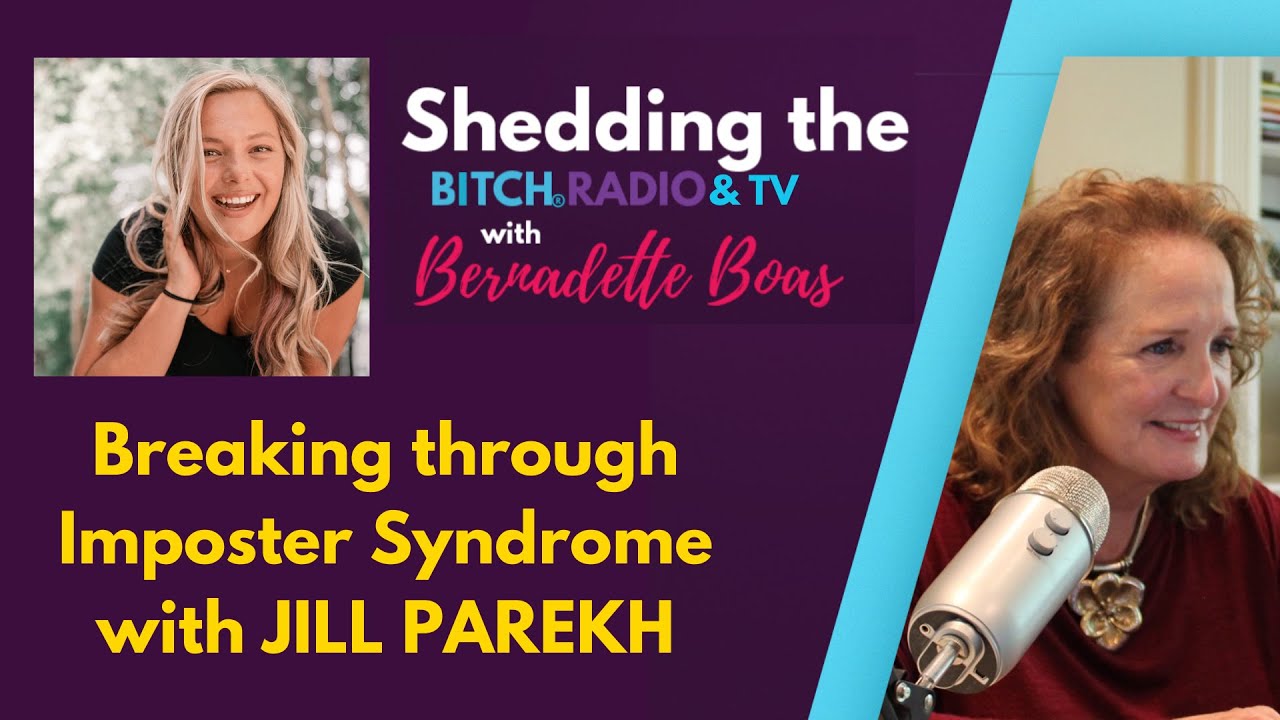
Life coach Jillian Parekh discusses imposter syndrome, which affects roughly 70% of people and often starts in childhood. She uses NLP and breathwork to help clients rewire self-doubt, and recommends naming your inner critic, keeping an accomplishment journal, and sharing your thoughts with someone trusted.
Chapters
Are you ready to create riches in your work and life? It's time for Shedding the Bitch Radio and TV, where you can discuss, debate, and get advice on how to discover and shed the bitches of fear, insecurity, self-doubt, and negativity so you can realize your dreams and life purpose and create and accelerate the riches in life you deserve. So let's welcome your ball of fire host, Bernadette Boas.
Welcome, welcome, welcome everybody to another episode of Shedding the Bitch Radio and TV. We are broadcasting across all of our platforms, whether that be our Shedding the Bitch Facebook page and Twitter page, Shedding the Bitch TV on YouTube, as well as BlogTalkRadio and anywhere you get your podcasts. So be sure to continue to do what you're doing in regards to rating, subscribing, following, leaving comments, all that kind of good stuff. We absolutely love it. We have a great show for you today because we're going to talk about a subject that is very dear to my heart, and I've spent a lot of years, um, shedding that. So we're going to talk about breaking through imposter syndrome. But before we do, I just need to thank our new and ongoing viewers and listeners, um, all your attention onto the show with your ratings and subscriptions and likes and comments, and even suggestions on the topics you want to hear about and the experts you would love to get to know has been critical in us building our fellowship. So we so, so, so appreciate that and continue to share and let anyone that you know that could really use some advice, some tips, sometimes tough love, or just join in on great conversations like what we're going to have today with our guest. Just let them know to come and join us on any one of our platforms across, um, all your different social media sites. So, uh, I need to thank our sponsor, NG Tax Solutions. Uh, Debbie Snelling and her team does fabulous financial and tax services work for corporate and small size businesses, and she can support anyone around the country and can help with your personal and business needs. So be sure to go to ngtaxsolutions.com and learn all about her and her team and the work that she could do for you and your business. And then we always want to thank because we're so honored that a local, more Georgia-based company, Up Top Roofing of Atlanta— Jay and his team have come to me over the several months and said, I've been following your program and everything that you're doing for about 5 or 6 years now. We'd love to support you. The mission and the cause is great. So be sure that if you are in Georgia and you have any home services or roofing needs, check Jay and his team out at up-toproofingofatl@yahoo.com. All right, but again, thank you to all of our new and ongoing, uh, listeners and viewers. You have made the program just kind of pop over the last, uh, 8 or 9 months, and we so appreciate that and want you to keep doing it too. So let's introduce our subject for today. Again, it is breaking through imposter syndrome. And I'll leave you with a rich question after we're done the introductions so you can ground yourself in the subject just in case you come on and you're like, imposter syndrome, don't know what it is, don't think it applies to me. I bet you in some aspects it will. So wait for your rich question as we get into this conversation. But we're going to talk about the fact that imposter syndrome is the persistent internalized fear of being revealed as a fraud, and it can have negative effects on one's mental health, their thoughts and emotions, and the opportunities they take. Now, we want you to be listening for, and we're going to be discussing, 3 key things: what imposter syndrome is and how to determine if you're struggling with it, and what— I'm sorry, what imposter syndrome and how it will completely change your I'm not good enough thoughts. And then we want to give you tools and strategies to work towards silencing your inner imposter. Now, our fabulous guest— I'm so excited to talk with her— is Jillian Parrick, is a life and success coach who specializes in helping women break through imposter syndrome. With a BA in counseling psychology-related practices and an MA in interpersonal conflict, Being a Master Neuro Linguistic Programming, NLP practitioner, and being certified as a breathwork facilitator, Jill helps women release past experiences in which they learned they weren't good enough so they can feel capable and qualified with the knowledge and experience they already have and regulate their nervous systems so they can reduce the stress and anxiety that imposter syndrome inflicts on their daily lives. So help me welcome Jillian to the show. Hi, how are you?
Hi, thank you so much for having me. I'm so happy to be here.
I am so excited to talk to you. I love, love, love this subject. I told you that before we came on to the program. Um, and yet at the same time, I'm always curious before we dive into it. Uh, you kind of mentioned where you're from, but help us understand who you are and, and what you do so we can get a better feel for who Jill is.
Yeah, yeah. So I had this like feeling of I didn't belong basically my entire life. I just felt like I didn't know enough. I, I didn't belong in any seat that I put myself in. And I had that feeling, it was kind of like an undertone type of feeling throughout my childhood and then as an adult. But it really started to come online when I was in university and started getting degrees and started getting jobs and entered the job market, and then I started the business. And I was like, what is this feeling of, of like not being enough? And I found in university, I found that it was actually called imposter syndrome and that it wasn't just something that I was feeling. It was actually like a phenomenon that a lot of people, like 70% of people experience. So I was like, okay, like I wonder where this could have come from. It took me through a journey of figuring out who I was. And I didn't think that I would actually overcome it until I became a coach myself and realized that it had— I had to feel good enough to sell my services and to show up and to help other people. So I really started to realize that this is something that I can actually overcome versus it's just a part of me. Part of me. So I kind of fell into coaching. I wanted to be a therapist and I did all the schooling and everything for it. And then I was like, there's kind of like an income ceiling and there's a lot of rules and I don't really vibe with that. So I was like, I'm just going to start a coaching business and see what the fuck happens. And it has been amazing. And it's really helped me to overcome that inner imposter that I thought was an actual true part of me.
Right.
And it's not at all. It's a— it's, it's something that a lot of people experience, and we need to talk about it.
Sure. Okay, but going— staying with your story and your journey first though.
Yeah.
What— when you kind of started feeling those feelings, um, what exactly were they? How did they kind of project themselves? And then what specifically did you do to kind of say, all right, I need to address this and these are the steps I'm going to take to do that. And that's before probably you even kind of started your coaching practice and started helping other people do it.
So what was your journey? Yeah, so it showed up for me in university when— it actually showed up the strongest when I was in my class for my— master's degree, and I was in class and somebody said, "Oh, I had a friend that tried to get in, but he didn't." And I was like, "They're not just letting everybody in? What do you mean?" And when she was like, "No, I think there was like a list and you had to get accepted, obviously." And I was just thinking to myself, where did that thought come from that they just arbitrarily allowed me into this program, right? So I started doing some research and being like feeling not good enough, feeling like I'm fooling people, like kind of having that thought of needing to prove myself and needing to overwork and overdo so I could prove that I belonged anywhere I was. So it was this underlying feeling of I'm not doing the best I could do. I'm not good enough. I'm not actually as smart or as capable as others are perceiving me as, or I'm fooling them, or they're gonna figure it out. So once I actually started removing the shame in terms of researching it and looking into it and being like, oh, other people have had this thought as well, and I started reading about it, I was like, okay, So if it's not actually me, what is it? Where did it actually come from? So I actually started digging into my past experiences through therapy and like really understanding why I thought the way that I did. And it was an accumulation of things, right? It was the things that have happened in my childhood and societal norms and cultural norms and all these things that came to this conclusion for me that I was not enough.
So was that easy?
No, fuck no.
I just want to make sure that, like, you know, you're saying it so naturally and I can understand it, but for the— you know, because it couldn't have been easy for you to walk through that.
No, it was hard because I think that we just all internalize that it has to be me. I'm the problem. Like it has to be me and something that I'm doing wrong. And even if you think about personal development in itself is a lot of people start doing it because they dislike themselves and they want to like themselves. And they don't realize that the objective is to actually love yourself more because a lot of people are trying to be enough for other people or be enough for their job or be enough for their business or enough for their clients, whatever it is, without realizing that I just need to be enough for me. I need to be enough for me. So even though I think it's good that you just get started in terms of building up your self-worth, if it helps for you to start at like, no, it's for other people and it's for my job and all those things, if that helps, great. You're going to eventually learn that the objective is to love yourself more. And I know it's all like, okay, whatever, Jill, love myself more, whatever. That's so That's so stupid, but it's actually so true, you know. It is.
I have this, I have this concept, and it's a program of mine. It's called, um, It's Not— It's a How-To, Not a Woo-Woo. Because had you told me that, you know, just like you expressed it, you know, if you had asked me and told me that all I have to do is love myself like 12 years ago, I would have told you to go fly a kite. I would have just told you to get out of my space, you know. But you're right, you're absolutely right. Now Self-awareness, though, is very challenging for people. Why is that? Why, especially with all the experience you have in NLP and breathwork, why do you think it's so hard for people to really be aware of who they are? Forget about spending time judging other people, but why is it so hard?
It's because they're afraid that they are going to find more guilt and shame. Underneath whatever they're looking for. They already feel bad. Why would they go looking for something that's going to tell them, hey, you are actually the problem. It's, it's your thoughts and it's your feelings and it's how you're viewing things. Like, nobody wants that, right? I find that women are more open to it than men, which is an interesting conversation that we could have at some point. But, um, I also find that sometimes when people are so afraid to like look into it, it is because they're afraid to find more guilt about themselves, more shame about themselves. They don't want to feel worse. And if you try and tell somebody, you know, you are fully responsible for your happiness, a lot of them are like, fuck you, no I'm not, all these things have happened to me, how dare you say that, right?
Right.
No, it's—
oh, it's so true. It is so unbelievably true. I was just having a conversation with someone that You know, after my— where Shedding the Bitch came from, after my firing, I had to say, wait a minute, it has nothing to do with the person who fired me and why they fired me. It has to do with me. And, you know, and as hard as that was, and it was hard, you know, I get, you know, you have to do it. Now, what did you find? What did you find on the other side of you being willing to ask the hard questions of yourself and to face whatever might have come up? You know, what did you discover on the other end side of that?
I discovered that the more that I accepted myself, there was nothing I could do that could possibly be wrong or bad, or I could not screw anything up as bad as I thought I could. And this kind of sounds like super deep and heavy, but like I had this thought that I was a bad person. So I had this thought like, "Oh, I'm a bad person. I'm going to be revealed and eventually I'm going to be revealed that I'm some bad person." And I had to actually realize, actually, no, I'm not a bad person and it's not helping me. It's not helping anybody in this life if I continue to believe that. So I had to realize that like there is nothing that I could uncover that would be so detrimental to me that I couldn't go on. Because I think a lot of people are afraid to feel their feelings. Yeah. Um, because it's not so much the feeling they're afraid of, they're afraid of what they're gonna do as a result of the feeling. They're afraid of the self-sabotage that comes after the feeling. And we have very prehistoric brains that tell us you're going to die if you feel anxious. You're going to die if you feel sad. You're going to die if this happens. And it's actually not true. So I think if we're looking at starting to uncover things about yourself that you can work through and release to become the better version of yourself, a lot of people are afraid they're going to get stuck in the guilt and the shame. They're going to get stuck in, "It's me. I'm the problem." So it's a lot easier to believe that everything else is the reason why we are the way that we are, all of our experiences. And I'm writing about this in my book about imposter syndrome that is coming out this year, but about how we need to acknowledge everything that's happened to us and forgive ourselves for it. But we need to acknowledge it no matter how small or insignificant you think it is, no matter how small and, and, oh, but this person had this happen to them and it was so bad, so who am I to complain about this? We need to acknowledge it all so you can release in and let it go. So I think for me, like, I had a normal childhood, I have great parents, and I still grew up with things thinking, well, because I didn't have like neglect or really big, big trauma. I'm just complaining. I should just be grateful, all these things. But I still experienced a lot of hardship, especially being a person with a speaking disability. And I have ADHD that was undiagnosed my entire life until like last year. So I had some hardships that I just disregarded. I was like, it's not that hard for me, but that did nothing for me. It kept me stuck. Yeah.
I love that. I absolutely love that, considering, considering you're on the much younger scale than many. I mean, because I, I didn't start doing this work until I was 48, you know, and I always wish that young women in their 20s, you know, in their teens actually, uh, you know, would have that opportunity to kind of walk into really just appreciating everything about themselves, good, bad, or indifferent. And so I applaud, I applaud, I applaud you. And I'm curious, do you have young clients? Like, yeah, do you pursue like the millennials? Do you pursue the young clients versus those that are more mature or seasoned?
So I work with a range between like, I would say, early 20s to— I think my oldest client is in her late 40s. So it's something like that. But like, I don't think there's ever a bad time for us to like—
Oh gosh, no, no, no, no.
—do this work ever. But it's so cool seeing how society is changing and seeing how we are putting more emphasis on emotional and mental wellbeing. Right. And realizing that like it starts so young. It starts in childhood. Like I have a lot of thoughts that contributed as to why I didn't feel good enough because as a kid I didn't feel heard. I felt misunderstood. I felt small. So I kept myself small throughout my entire life. And then I started a coaching business where it required me to show up and say what I thought. And I was like, no wonder I'm having all these problems with marketing and selling because I was never taught that I can use my voice, I can use my authority in a way that I don't think I ever learned how to. Yeah.
Oh, I mean, I absolutely love that because you're absolutely right. And we need more of you on the younger side to even get into coaching and to get into the whole space of personal and professional, you know, growth and mindset. Yeah, I absolutely, absolutely love that. Now I want to touch on the fact that, um, you are a, uh, you are a Master Neurologistics Programming, NLP, uh, practitioner. So yeah, you touch on and educate, um, just in case our— any of our viewers or listeners don't know, first off, what is NLP? And then how does that work into the work that you do?
Yeah, so it is learning how the subconscious works because the subconscious is— it holds all of our beliefs, it holds all of our experiences because your brain works as a computer and it just wants to take the path of least resistance. So it's been building up all of these experiences in terms of your childhood, in terms of what's happened to you, in terms of what you learned was good and bad, what you learned was right and wrong, and it's forming your entire life and it's forming how you view your life. So for example, if you grew up believing money is bad, rich people are evil because of the way that your family talked about it and the stuff that you consumed as a kid, you'll grow up having those beliefs automatically ingrained into your brain. And when I bring in NLP, it helps you become aware of these are all just thoughts. They are all just thoughts that you continuously believed and believed and believed. And with the brain, confirmation bias will show you everything that you believe and it will provide evidence and evidence and evidence because that's what you truly believe. So when I start to incorporate NLP, it's realizing these are all just thoughts that you have ingrained in your brain for years and years and years, but you can change them and you can start to open yourself up to thinking a different way and being a different way and then building that evidence towards who you want to be and what you're trying to create. Because let's say for example, again, like I grew up in a family where like they did kind of think that way about rich people. And then here I am again trying to run a business and trying to make money. And I was like, but it's so conflicting that I'm trying to make all this money, but then I'm saying to myself, rich people are bad, rich people are evil. That's going to cause some issues, right? So I It's recognizing those competing intentions within your brain and actually leading you towards the thoughts and beliefs that will actually work for you in the direction that you want to go in.
So I'm curious, when it comes to both thoughts, and then you mentioned earlier, there's experiences and events in people's lives as early as when they're children. Yep. Do you kind of walk them through like an inventory? Do you have them kind of just sit back and kind of consider, like, you know, from childbirth to current, like, what are those events and encounters and experiences and thoughts? So they can get an inventory almost of what it is. I mean, how do you—
how do you do it? Yeah, we usually start with like, what is currently holding you back? Like, what are the things you're trying to achieve and are not working? And then we work kind of backwards as to why they're not. Because I think it can be a little bit overwhelming to be like, hey, we're going to tackle everything that has ever happened in your childhood today. We don't do that. It's more so like, what is coming up for you currently? And what do you think has happened in your past or the things that somebody has said to you or the beliefs that have been ingrained in you, how do they play a part? And then usually a lot of other things come from that because I usually work with somebody for about 6 months to a year. So a lot of things can come up in that timeframe. And I also think, and I'm sure you think this as well, is that like we're always working on ourselves. There's always things that come up. That we're like, I thought I dealt with that. But then there's a new level of business, there's a new level of life, something else comes up. And I don't like to look at it as it's just like, okay, you're going to work on this and then it's done. It's like, it's a journey. It's a journey of worthiness. It's a journey of realizing that like you are worthy, you always have been. And these are just thoughts that you will have to challenge and kind of like, uh, like work through as they come up, right?
But I would expect— or, you know, I shouldn't assume, so I'll ask you. So, but along the way, you're giving them tips and tools and techniques that they could be using. So even though they might have tackled one thing, when it comes up again, they have what you've provided them. Exactly. In order to then address it maybe the same emotion comes up, but it's a different situation they've put. For sure. Yeah, I love that. And then how about your breathwork? Because you're a breathwork facilitator, so how does that come into play? And trust me when I say I have to breathe a lot.
We all do.
I find myself needing to breathe a lot. But how does that work really complement also the, the coaching that you do?
Yeah, so it's not enough to just work on our thoughts. We also have to like categorize the feelings in our physical selves as well, because trauma and emotions get stuck in the body. They're, they're stuck there, and they can, they can, uh, really create us to be like reactive. They can stress us out. They can cause anxiety. And how I use that particular tool is helping my clients work through the stuck emotions that get stuck in there as a result of trauma and experiences that they've had. So we don't only work on the thought work, we also work on how it was categorized in your body when somebody said something where you didn't feel good enough, or when something traumatic happened and you because you were a kid and you didn't know any better, you learned from that experience, "I'm not good enough," and you categorize that in your body, you know. And because we work on such an automatic system, our thoughts create our feelings. So we can get super stuck in certain feelings because that's just how we're feeling all day long, and circumstances don't change. Our thoughts or our feelings. Like, we think, once I sign this client, I'm gonna feel so good and all this stuff. And it's like, nope. If you feel anxious, you're just gonna carry that anxiety into whatever your experience you're having. So when I talk about helping you break through and overcome imposter syndrome, it's so important because it's not that it's never gonna come up ever again. You just have tools and your resources, and you have more empowered thoughts, and you feel better, so you can tackle it and have more emotional resilience. Yes.
Yeah, I love that. I absolutely love that. So breathing, you know, plays a significant role in our stability, maybe even our sanity, right? Is that what you're saying?
Yes, it, it completely changes the bells and the neurons in our body because when you are relaxed, in a relaxed state, it allows for neuroplasticity which is changing our thoughts. So if you're in the stress response, if you're stressed out, you can't change the way you think because your physical self is trying to protect itself. It's just trying to stay alive. But when we are relaxed, when we are open to receiving, when we are calm, that is when you can start to change your beliefs and change your thoughts because you feel regulated and you feel safe.
And breathing does that. Oh yeah, yeah.
I love it. It's amazing. I love that.
I love that. Now there's gonna— there's this— I, I'm very curious to ask you this question. Um, because I often come up with very different viewpoints from people about it. So, and I love the fact that, um, you touch on it in your work. So what do you think about the whole fake it till you make it?
I hate it. I hate it. I hate it so much. Why? Because it doesn't actually solve the problem. It just causes you to believe that you need to show up in a way that's not authentic to yourself because again, you're authentic self, it still isn't good enough. You still have to fake it. Right. And I think that confidence is just self-acceptance that someone else can see. Right. And when you accept yourself, when you believe you are good enough and worthy, it's going to come off as confident and you don't have to pretend. So when I hear fake it till you make it, I just think it doesn't actually solve the underlying problem. So it could work for you in the moment, but I'm all about like getting deep and getting pretty and like getting to the root of it so you don't have to fake it, so you can be seen as your true, authentic, real self and believe this is good enough. Okay, but—
okay, but you said something key there because I love it. I love it. I love that. And that's what gets in— gets, you know, these conversations, because I'm like, I'm all for it. However, that said, I certainly don't advocate thinking that it's the solution to what's keeping you, you know, kind of stuck or insecure or unsure or dealing with imposter syndrome. But I definitely believe that in an instant or an incident or a situation that you don't necessarily need to fall prey to what might be kind of, you know, beating you down, that you can kind of put your mind on. My dad used to— I'm one of 12, and we'd sit around the dining room table, my— and there's, there's 6 girls and 6 boys, and he'd say, okay, shoulders, shoulders back, chest up, you know. And, you know, and, you know, there's that temporary opportunity, I'll call it, to kind of fake it until you kind of get through it. And then of course, I, I agree that you can't use it as a permanent solution, that it has to— you have to work on what it is that's causing that, that need to mask who you are.
Yeah, yeah. Because I think too that if we tell ourselves that we're faking it, then there's no confidence being built in terms of like I can actually do this without faking it. I have to resource from somewhere else instead of resourcing from that own innate worthiness because of course we're all gonna feel anxious or nervous whenever we're doing anything, right? That would be nervous for anybody in terms of like an interview or something like that. But I know that I'm not faking it. Like I know even if I stumble or if I say something stupid or whatever. Like, this is me and this is who I am, and I know that what I have to say is extremely important and valuable. And that, to me, actually working on that is so much more rewarding than just telling myself, well, you can fake it and like you'll get by, and then you'll want to die the second they turn off the camera. You know what I mean? But I hear you and I respect it.
And that's okay. That's okay. But I, you know, I love always bringing that up because it always kind of creates some sort of spark there. Totally. Now, and you, you do, you know, I think you mentioned that you do know and believe that people can overcome imposter syndrome. Do you have any tips or any strategies for how our listeners and viewers might take their first steps in doing that, apart from going to her website, everybody? Yes. And checking her out, um, there. But, um, you know, what, what do you, what do you share with your, uh, prospects or clients initially when they come to you with this? And wait, wait, the more important question is— hold on a minute— the more important question is, is it similar to your experience as to when they discover that, that's, that, that they have something going on and they may not be able to put a label to it, but at least they—
is that what, when they come to you Yes, it's usually like the feeling of not being good enough, and it comes up in more than one area. It doesn't have to come up at work or with their business. It starts to come up in other ways, um, and it's stopping them. It's stopping them from taking some sort of action or feeling good as they're doing the action, um, and sometimes they feel like the other shoe is always going to drop and they've just gotten to the point, right? Right? Like they've just gotten to the point where it's like, fuck, I can't live like this anymore. Like I feel like I'm always afraid that someone is going to see me for what I really am or find me out and it's all going to come crumbling down and I'm sure as you can relate when you're building a fucking business from the ground up and you're afraid it's all going to come crumbling down, that can be terrifying.
Yes, absolutely. Career— forget about if you have your own business, even a career. And all of a sudden you're like, I'm gonna walk into a conference room one day and they're all going to be looking at me and going, what are you doing here? You know, you don't belong. Okay, now, now we'll go to— so what are those initial things, or what kind of initial tips would you have that you could share if someone wanted to kind of do some work around this? Where would you have them start?
So I would first start with telling them to give their inner imposter a name. So this is the voice of your negative thoughts. It is the person who's in your head being like, you're not good enough, you can't do that, this isn't possible, who are you to do that? And it's realizing these are not your thoughts, these are not actually indicative of your true self. It is, it is an accumulation of experiences and things that told you you weren't worthy to hold you back, to self-sabotage you, but you can choose differently. But because we've all been thinking these things for years and years and years, it's not going to be automatic. So first start with like, what is her name? What's his name? Like I have Rhonda. So Rhonda is who I started out. I called her Rhonda. I don't know why I called her Rhonda. And I was like, when I hear the thoughts of like, you're not good enough, you can't do that, like, ooh, like this is too advanced for you, or whatever happens, I'm like, oh, that's Rhonda. She's coming out to play. And let me tell you, this just gets easier over time because we are— we don't learn to not identify with our thoughts. We can think that we are our thoughts and we're just having thoughts, but no, like, you are not your thoughts. And the sooner you learn to separate them and be like, that's not actually me, that's, that's something else, but it's, it's not me. Um, so that's the first thing I would say is give your inner imposter a name, something fun. It can be actually somebody who really used to hold you back or tear you down, or it can be just some random person. It really doesn't matter. So I just think it's really important to separate your thoughts and the thoughts of your inner imposter, because that's exactly who it is. It's not actually your true voice who is helping you achieve all the things. It's trying to hold you back, keep you safe. It's that mean girl in school. And once you start separating her from you, you'll realize, wow, I have a lot of these fucking thoughts all day long, and I can see how they would be holding me back. So that's my first tip. What do you think? Think about that.
I love it. As a matter of fact, I'm sitting here going, I hate when people call me Bernie.
I would never call you Bernie.
I'm always like, I'm not a guy. And, you know, and I think I'm gonna call my inner imposter Bernie, because it'll make me like be like, no, I'm not Bernie.
I love it. I love that.
So good. Keep going.
And then my second tip would be to have an accomplishment journal. So this is a journal where you keep your wins, you keep your successes. I started mine probably a couple of years ago and I started just adding things in there like my degrees, awards I've received, certifications, all those things. And I try to add to this journal every day. So I add one or two things that I've accomplished or that I've done. And it, it really helps me feel like I am doing a good job and like I am actually paying attention to the things that I've accomplished and that I've done. And the reason why this is so important is because people who struggle with imposter syndrome usually are thinking that their worth is in the future. So their worth is contingent on the things that they have to accomplish in the future, and they completely negate the amazing things that they've already created, or they think that the things that they've done in the past don't matter, their experience in the past doesn't matter, um, and it just causes you to think again that you're not good enough. So of course, if you have this actual this actual physical tangible thing in your hand in terms of look at all these things that I've accomplished. And like I'm talking like big wins, small wins, whatever it is, I include it all. So if somebody says, hey Jill, this piece of content was amazing, thank you for saying this, I add that into the journal. Like I really don't rationalize anything. I just allow myself to receive the win, to receive the success. And then my third tip is to not let it sit in shame. So hire a coach, talk to a therapist, talk to your friend, talk to your parent. Actually start to say like, "Oh, I'm having these thoughts and I'm having these feelings and this is how I feel and I know they're not true but like I just need to tell somebody." And when you do this, you, you, you are shining the light on your thoughts and your feelings and you're allowing it to not sit in shame because when it comes to shame and feeling like we're the only people who have these thoughts or I'm only thinking this way and I'm the one that's not good enough and everyone else is, we stay in silence and we stay in the dark and we keep ourselves small. And then we tell ourselves these stories of people don't have it as hard as me, or they, they aren't actually struggling with this. I actually am a fraud and they're not. They have all this confidence. But you'll realize that everybody has fear and anxiety. Everybody has times where they don't feel as confident or as sure of themselves. And like I said, 70% of people experience imposter syndrome. So it's really important for you to know that a lot of people have these thoughts of, "I'm not doing enough. I'm not good enough," and they're not true. And the reason why I do the work that I do is because we need to know that we are not the problem, that like you just think that you can't have the things that you want or the things that you want to do because of something that's wrong with you, but there's nothing wrong with you. And the more you look at your experiences and realize, oh yeah, like I interpreted this as meaning that I'm not good enough, but that's actually not true. And actually like reassessing and reframing these things in your life that have led you to feel not good enough, you realize that you can actually do and accomplish whatever the fuck you want. So that third tip is, that third tip is is to tell somebody, is to open up the conversation and to actually start these conversations with somebody else so you don't feel as alone. So those are my 3 tips. So name your inner imposter is the one, track your accomplishments with an accomplishment journal is the third, and then tell somebody is the third. Love it. Love it.
And it appears as if my laptop's camera fry. It appears that the issue is I can't find the camera anywhere on my Mac. So thank you for carrying that through. Yeah, on your own, you're such a pro at this. Um, and who needs to see my face anyway? Why not just see—
we love your face.
Well, yeah, exactly, exactly. Now I do want you to share, um, information in regards to, uh, the couple of downloads that you have on your website. And, um, everybody can go to Jillian Um, parekh.com/click-here. It's right there. Look, I'm pointing below and I'm not even on camera. But so, uh, Jill, go ahead and share, uh, with everybody if you would, the couple of downloads that you have, because everyone who's listening and watching, I think it's imperative that you start doing some work. And Jill would advocate that as well. And she's got the tools. She's got the tools.
So yeah, so there's the There are a couple there, and the first one is a 15-day worthiness challenge where you will get an email to your inbox for 15 days once a day, and it has either a meditation with breathwork, an EFT tapping sequence, which is moving negative energy throughout your body, or a journal prompt. So these, the Things will rotate over the 15 days and they will help you uncover and release those experiences that we were talking about earlier in the episode. And you will do this work for 15 days and feel more worthy and good enough at the end of those 15 days. And then I also have the 3 Days to Overcoming Your Inner Imposter Challenge, which is a shorter or condensed challenge that will help you overcome that inner voice that is telling you that, that you are not good enough. Um, and so those are the two freebies and then they will eventually lead to if you would like to work with me and I work with both entrepreneurs and career women who are looking to overcome imposter syndrome to create more abundance in their lives, whether that looks like getting more opportunities at work, higher paying jobs, higher paying clients, whatever it is. I truly believe that feeling worthy and feeling good enough and stepping into your highest self will allow you to achieve that. So that's all at that link.
That is awesome, awesome, awesome. Yes, go here and you're going to find out tons of information about Jill. And just absolutely love your approach and your philosophies and the foundation of which you built your business on. And you should be— this is going to sound like an old woman talking to— but you should be so proud that you— thank you— turned your own identity into a successful business. And I absolutely— Bernadette, I absolutely have loved this conversation. And I apologize that— no, thank you— you're talking to a speaker at the moment. Um, but everybody, please, JillianParekh.com/click-here. Learn all about her, download her, um, her freebies, as well as look into her one-on-one coaching. Jill, thank you so much for being here. I so appreciate it.
Thank you for having me. This was awesome. And yes, thank you so much. You're welcome.
And for everybody else, speaking to those that are watching, that is, um, watching a speaker. Uh, thank you so much for being part of this week's Shedding the Bitch radio and TV broadcast, and we look forward to having you right back here next Tuesday at noon Eastern time. Thanks everybody, bye!
Thank you for taking part in Shedding the Bitch radio and TV with Bernadette Boas. We would love to know what your biggest takeaway was. Go to Shedding the Bitch on Facebook or YouTube and leave a comment. You can also subscribe to the show on Apple Podcast and YouTube so you don't miss a single episode of the show. And with your input, we can help other powerhouse women just like you find the show and decide if it's right for them. Learn more about Bernadette at balloffirecoaching.com. See you next week.
More from Bernadette



From Stuck to Leading, Episode 2 — Meet the 5 Inner Fears Destroying Your Leadership



