Career Playbook for Women in Business with JJ DiGeronimo
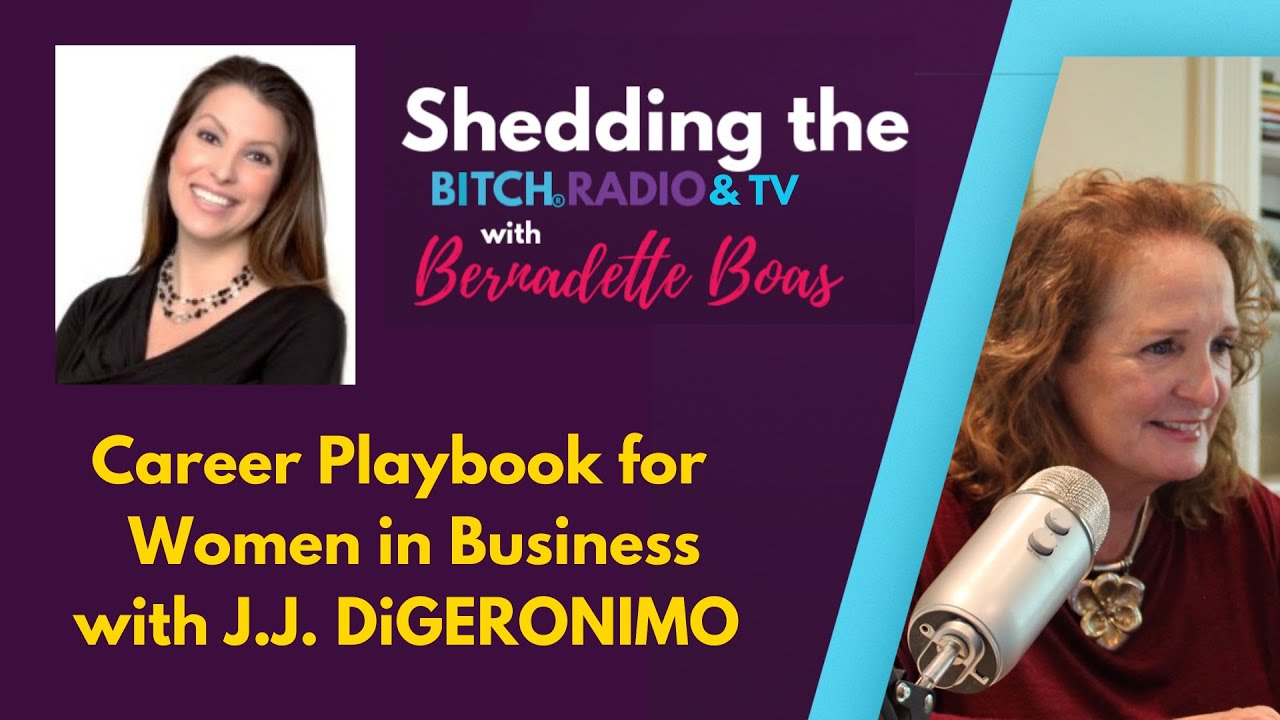
In this Shedding the Bitch Radio episode, host Bernadette Boas interviews JJ DiGeronimo, president of Tech Savvy Women and author of Accelerate Your Impact. The conversation centers on why professional women need a concrete career playbook to navigate corporate and entrepreneurial landscapes. JJ distinguishes between working on a career versus in it, outlines common pitfalls such as self‑doubt, imposter syndrome, and the tendency to under‑communicate achievements. She emphasizes the critical role of sponsors—people with social capital who actively advocate—over traditional mentors or advocates, and provides a three‑metric framework (brand, operations, revenue) for quantifying impact. The dialogue moves into practical strategies for securing board seats, building cross‑gender networks, and creating women‑focused groups. JJ also shares inner‑work practices—mindfulness, journaling, and reframing “no” as a step toward “yes”—that help women overcome limiting beliefs. Throughout, she references her books, a companion podcast, and a growing community of practitioners to give listeners concrete tools for building influence, visibility, and lasting career momentum.
Chapters
Are you ready to create riches in your work and life? It's time for Shedding the Bitch Radio and TV, where you can discuss, debate, and get advice on how to discover and shed the bitches of fear, insecurity, self-doubt, and negativity so you can realize your dreams and life purpose and create and accelerate the riches in life you deserve. So let's welcome your ball of fire host, Bernadette Boas.
Good day, good day, good day everyone, and welcome to another episode, fabulous episode. I'm so excited of Shedding the Bitch Radio and TV. We are broadcasting across platforms, so whether you are watching us on Facebook, uh, uh, Twitter, or YouTube, or you're listening to us on BlogTalkRadio or any one of your podcast streaming services, we appreciate your likes, your tweets, your shares, your follows, your your ratings, all of it, um, because you have been helping us to really grow our audience of both viewers and listeners, and we certainly appreciate that. Before we jump into today's fabulous conversation, I do want to thank a couple of our sponsors. NG Tax Solutions is a full-service financial and tax services company who pretty much handles anyone from small business to corporate, personal, and business. So if you have any needs anywhere in the country for financial or tax services, then please reach out to Debbie Smelling and her team. They're fabulous. I've been working with them for about a decade and they're terrific. So reach out to them at NGTechSolutions.com. Another one that I'd love to give a shout out is more local to Georgia, but Jay and his team provide awesome home services and roofing needs. And he came to me uh, being part of the community for about 6 years now. He came to me, uh, back in late fall and said, I love what you're doing and what Shedding the Bitch is all about, would love to sponsor you. So please, if you have— are in Georgia, uh, specifically Atlanta as well, and you have any roofing or home services needs, reach out to him at up-toproofingatl— uh, I'm sorry, up-roofingofatl@yahoo.com. All right, let's dive into this conversation because you know me, my corporate background, my entrepreneurial journey, all of it. And today's conversation, especially for us women, is going to be all around having a career playbook for women in business. So we're going to talk about the fact that many professional women aspire to advance in their careers, yet many encounter a sea of obstacles because they don't have The Playbook to Navigate Corporate Cultures and Organizational Landscapes. With more than 20 years experience in the tech industry, our guest JJ DiGeronimo is no stranger to navigating the twists and turns of moving from entry-level positions to leadership. She's learned firsthand that securing the next position, a board seat, or even starting a new initiative often requires women to enhance their relevance, establish new sponsors, and expand their network. And I want to emphasize too, for all of my entrepreneurs out there, this is very relevant to you as well. So sit tight and listen. In her book Accelerate Your Impact: Action-Based Strategies to Pave Your Professional Path, JJ offers a series of proven initiatives that high-impact men and women leverage to accelerate their professional paths. So we're going to talk about a few things. We're going to talk about the fact that there is a difference between working on your career and working in your career. We're also going to talk about the common career pitfalls, especially for women in business. And lastly, the importance of career sponsors. And yes, I just love the subject. So let me introduce our guest. JJ Dai Geronimo, the president of Tech Savvy Women, shares leadership and inclusion strategies to retain, develop, and advance professional women. Her work is featured in many publications, including Forbes, The Wall Street Journal, and Thrive Global. JJ includes these experiences along with hours of research in her award-winning book, Accelerate Your Impact, which complements her first award-winning book, The Working Women's GPS. In addition to her books and keynotes, JJ is a featured columnist and host of the popular podcast Career Strategies for Women That Work. So help me welcome JJ. How are you, JJ?
Oh, I could not be better. Thank you so much for such a wonderful introduction.
Oh, you're so welcome. I'm so excited because this is a topic that's, you know, dear to my heart, um, especially when it comes to women, uh, women in business. And I know, as I mentioned, a lot of what we're going to talk about, it also hits home for those entrepreneurs, those business women that own their own business and they're developing them and need a lot of these same strategies. So first let's though get to know JJ. So tell us a little bit about you, the woman, and then we'll get into all the business stuff.
Well, that's great. So I've been an entrepreneur since 2014. It's my third attempt over the last 30+ years. Prior to that, I have a degree in computer science and I spent the first two decades, most of which in Silicon Valley, with startups and technology. I spent about 7 years in Atlanta living there, which I love. And, you know, I started a women's group in 2008, and in doing so, I realized I was not alone. So many women are struggling with self-doubt, not knowing how to maneuver the landscape, looking for sponsors. And I really just started collecting stories and interviewing women because I, in 2008, I had 2 kids under 2, I had a global job, and I just thought this having it all was a bunch of BS. And I was thinking Clearly I did not get the playbook. So little did I know that so many women were just making the best of it. And now having a daughter of my own, I really was empowered to figure out how to help the next generation women because this situation of doing everything at home and everything at work is really not working.
Yeah. And so that's obviously this last attempt, as you put it, um, into your entrepreneurial journey. Um, that was the driving force. And then you decided— is there any particular industries or segments of corporate that you kind of hone in on, especially because you were in Silicon Valley for so long?
Yes, yes. So I have an active group called Tech Savvy Women, and a lot of my work is in tech and STEM and male-dominated careers. Because when we were doing this 5, 10, 15 years ago, there's a lot of teams that have 1 or 2 women, you know, and they feel like they're on an island so often. So finding ways to connect those women and recognizing that we are not alone, that we do have a tribe of women behind us that share best practices and help each other advance both in the workplace and in life.
You mean there aren't women that are just nasty to each other? I mean, there's such a perception, right? There's such a perception. Yeah.
And like I tell my daughter, I mean, she's a teenager now. I've learned so much about the psychology of working and advancing and You know, and I've done a lot of seeking myself even over the last 5 years of how do I get rid of this nagging voice in my head that constantly tells me I can't. And I think for so many of us, you know, when we experience that nastiness, generally it's somebody's having such an internal struggle and it just kind of comes out that way and it really has nothing to do with you.
Yeah, absolutely.
Absolutely.
You know, that's that saying that says, 'You'd be surprised at how little people think about you.' Yeah, it's like so true. It rang so, um, loud for me like 10 years ago when I was doing a lot of this struggle that you're talking about, and I just had to figure out how do I shut her up, you know, that little devil on one shoulder and listen to the angel on the other shoulder. Um, now what is it other than your children, or maybe that's the key thing, but what is it that really inspires you and has helped you kind of, to your point, kind of quiet that, that conversation in your head, uh, to what it is that you're doing?
It's taken a long time. I mean, I'm almost 50, and I feel like it's really taken me a long time. I've done a lot of spiritual seeking, and even in the last 5 years of meditation and mindfulness and solo retreats and, um, just finding ways to spend time with myself that's very nurturing because I find that I can only do the work I'm doing if I feel good about myself. And most of the time, all of us struggle with not being good enough or not feeling you're hitting on all cylinders all the time. But I do think the nurturing of your own soul is absolutely critical.
Love it. And so you said meditation. What are you recommending to your career women especially corporate career women, they kind of don't think about a lot of that. Don't— isn't, you know, aren't they a little bit closed-minded to the self-care, the personal growth, transformation, all those woo-woo words? Do you still find that women are kind of closed off to that, or have they evolved over, over time?
Yeah, I love it. I love that question because it's so timely. I feel like with everything that's happened over the last 18 months, people are really burned out, and the usual mechanisms, a massage, a little vacation, is really not filling them back up like it used to. And I probably have met with 15, 50, 50 practitioners in the last 7 or 8 years. And I actually just started a community to bring these practitioners together with women to talk to them about sound healing and face reading and hypnosis and all these things that I think, to your point, are always behind these closed doors that are not easy access for women. And I'm trying to take the mystique out of it because honestly, without these practices, it would have been very difficult for me to really get centered and really step into my most, I think, passionate work and purposeful work.
Yeah, I absolutely agree. Just 2 seconds of me. I grew up in technology as well, retail, then technology, and certainly was the only woman at the table for many, many, many years. And definitely didn't even consider the fact that I had to take care of myself first, you know, that I had to recognize that I was actually a human being, not a robot, and that I had emotions and feelings, and that was okay. It's just a matter of learning, right? Um, so you reference, um, you know, kind of women showcasing their accomplishments, um, you know, and women don't necessarily step in to that. Uh, why do you find that that's important?
And is it—
and is there a difference between women doing that in corporate, and then is there a difference to the women that are on their own like yourself, um, you know, showcasing their accomplishments?
Yeah, that's a great question. So my first book, I really talked about just aligning your energy when you have young kids and you really, you know, kind of lose yourself when you're trying to juggle so many plates when your children are younger, you're handling older parents, or, you know, spouse's children. But my second book, Accelerate Your Impact, I took all the questions I gathered from professional women for about 4 years. And so many of them were questions I had or didn't even know I should have had. And one of them is really about women and how they present their material. The reality is, is that women are judged based on what they've accomplished, where men are judged based on what is possible. And so when you think about that in forms of a resume, a deal, positioning a new client, women often talk twice as much or share twice as much info, but only a third of the detail. So really crystallizing your accomplishments in a metric format is absolutely necessary. Absolutely necessary. And especially if you're an entrepreneur, because you have to take the guesswork or the risk out of the decision.
Right.
And for many of us, whether you're in corporate or you're an entrepreneur, when you're positioning yourself, your products, your solutions, Taking the risk out is one of the biggest obstacles you have to do or overcome when you're in those situations.
So breaking that down, so would that look like a woman, a career woman, kind of emphasizing that, you know, I was responsible for putting, you know, $50 million onto the bottom line? I, you know, I helped to acquire X number of clients or new sponsors into our organization. I mean, when you say to kind of put the measure, you know, into the conversation, is that what you're wanting from them to kind of honor? I call it honor their riches, but honor with—
Yeah. So basically there's 3 metrics you can do: brand, operations, or revenue. And everything almost in business comes down to those 3 vectors. And so anytime you can talk about revenue, obviously you want to. Anytime you can talk about enhancing the brand, putting the business in front of X amount of people or creating the footprint or the eyeballs, and then back-end operations is equally as important. How do you streamline things? How do you get things done? Have you added applications, removed steps, taken the timeline down? Whatever it is, there are metrics and you just have to think about what those are because people hang on to numbers.
Right. Now, but you made an interesting comment about the fact that women have always had to justify their accomplishments while men you know, they're looked at for their potential. So that— I find that very interesting. How can a woman then kind of position her potential? Like, what does she need to be doing to kind of almost look like a man when it comes to what others are looking for them, toward them, for?
Yeah, it's a great question. I mean, one of the best things you can do is get a sponsor. You know, a sponsor is more than a mentor. A mentor gives you advice, meets with you. When the conversation's done, it's sort of done. A sponsor actually actually takes it a step further. They leverage their social capital to help you. So that could be getting you a meeting, speaking up on your behalf, adding you to a shortlist, putting you in a seat you might not necessarily get on your own. And I think for many of us, if we want to sort of shorten the cycle to get from here to there, sponsors are critical to that piece.
Yeah. Okay. So, excuse me. Now, do you also talk about advocates and therefore what is the significant difference between mentors and advocates and advocates and sponsors? Or is that middle piece not relevant?
Yeah, I mean, advocates obviously can— sponsors are critical because they have more social capital than you have. So advocates may or may not, they could be an equal level to you, they could have more, but you really need people that are in rooms that you're not invited to, but you need to be mentioned in.
Yeah, I love that. That's like the perfect image right there. That is the perfect image right there. And I— and wouldn't you say that that's just as relevant for entrepreneurial women as it is to corporate women? Because for instance, um, I've been on my own for 12 years. I've had 2 main sponsors in companies that have then brought me work and have talked about me even in other parts of their company. And therefore they're, you know, they're my sponsor. So isn't it— is it a technique and a strategy that even entrepreneurial women as well as corporate women should definitely be pursuing?
Absolutely. Whether you want to get on a board, get promoted, or get a customer, it doesn't matter. Oftentimes you need that word of mouth referral that has to come from somebody other than you.
Right.
And knowing who those people are are absolutely critical. Because, you know, when I give keynotes and I talk about this, sometimes people come up like, oh, can you be my sponsor? And I'm like, oh, I'd love to. But really, you need sponsors in rooms that you need to get into or that are making decisions about you, your work, or your business.
Right. Well, that's a good point. What does— what does it mean to go and get a sponsor? What should a career woman like, you know, what type of person, how do they go and approach them? You know, is a question that I've gotten over the years. But what do they say? I mean, you know, like, hey, will you talk about me in the next board meeting? You know what I mean? So, you know, can you paint a picture or some strategy?
You have to be really clear on your goals. Like, what are you trying to accomplish? What are your gaps? Where do you need help? And who are the people that can help you close those gaps? And you don't want to be running around asking for help until you get all your ducks in a row. Oftentimes I encourage women to hire a coach or to get a business partner or somebody to talk through the steps because you don't want to be just haphazardly, you know, making connections and asking for help without really being ready for that help so that you can maximize the opportunity.
Right. Yeah, I love that. Absolutely love that. And again, do you see that there is a difference in that pursuit for men versus women?
Sure. Oh yes. I mean, men have a much easier time networking at higher levels in the org chart or even in the community. I mean, just look at any of the boards in Atlanta or any other city. Boards are generally men, generally white men, and they help each other all the time. Where women, we have some kind of prove-it mentality, but also women are more comfortable networking at the level they're at and often aren't invited to the dinners, conversations, golf outings which often stifle us because we don't have that natural connection with people outside of the office, right?
But, you know, all that rings in my head is excuse, excuse, excuse that a woman would have. So can a woman go and establish her women's club? You know, I mean, could— can she go and establish like a network of, of, you know, kind of women and men that could help I mean, women need men.
I mean, that's the reality. Women need men. You could have as many women's groups as you want. Listen, I have two women's groups of my own, so I'm a big women's advocate. But men often hold the keys to strategic positions, accounts, P&L. And, you know, you really need to have those types of relationships and to do— to get where you need to go, you need to understand where those people already spend their time and kind of where do they sit. And I'm a big proponent of women on boards. Boards more now than ever because you get access to people you would never get access to in your everyday life. And so finding things you're passionate about— I have a whole chapter on how to get on a board. I've interviewed many women on their strategy. I'll just give you a clue: oftentimes you're not tapped on the shoulder. You actually have to position yourself for a board that you're interested in. And generally it starts by creating interest, doing some side projects, getting involved with the executive director, you know, to make that path smoother and more evident for you when board positions become available.
Right. Okay. So speaking of board positions, what is, what is it? What's the main incentive for a woman to go and seek out a board position? But then the second part of that is, and at what level are they in a company when they should go and start seeking board positions?
Great question. So a couple of things that come to mind. Boards provide access, network exposure, experience. I mean, you really get a plethora of skills and visibility that often you don't get when you run your own business or even if you are in a corporation. I would say that you probably have to have about 20 years of experience before you pursue board seats. Now, sometimes, you know, give and take depending on the size of the board or the organization. And I think if you can get on for-profit and nonprofit, that's key. Nonprofit is more work and they often require a donation to the organization where for-profit, you know, sometimes you get a stipend or a gift or sometimes you get a little fee associated with it. But I feel like most of the women I encounter are always saying, well, I'm not ready. I don't have the experience. It's not time yet. And I sort of feel like, why not? If you have something you're passionate about or you have a connection that's a neighbor, a friend, a brother, sister that has a board or needs a board seat, why not apply?
Right. And what level of the organization should they be in when they start looking for a board position?
I mean, it depends. If you're working for GE, that's going to differ than if you're working for, you know, a small startup. You know, your titles will vary based on the role you're in. But I think knowing what kind of value— if you're an accountant, if you're a lawyer, if you're a technician, if you are in tech or in, you know, product design, making sure that you position the value you bring forward and how you can help the organization advance their goals.
Okay. But the process is the process that you would be applying, meaning putting like a piece of paper or automated online. And therefore, does title matter when it comes to that?
Or honestly, your first few boards, you may find a board online, but honestly, most women that I've met, their first few boards are through word of mouth. They know somebody already on the board. They know the executive director. You generally are not applying randomly to a board seat.
That's true. That's true. That's true. And how do you see men and women, whether it's a board or it's for an advancement or a new role, how do you see men versus women evaluated for those positions or for an advancement or for a board? And therefore, what should women do apart from showing the value? Which you already mentioned. Yeah. But what should they do to really kind of make themselves stand out?
Yeah. Have people call on your behalf. Have people send emails. Have people, you know, voice why you should have the role. When I was writing my second book, I talked to the CEO of my previous company and we were talking about executive positions. And he said, you know, oftentimes when I put an executive position up, every person that was a man would get somebody to call, stop by, write an email, send a text. Where women would just submit their resume or send me an email and nobody would call or contact me on their behalf. And I'm like, that's because we don't know. We don't know. We think our good work should speak for itself. But in reality, your good work gets you where you are and might open a door for where you want to go. But you often need strategic people to speak up on your behalf when you're making that leap to these really important positions.
Is it? But is it, JJ? Is it really that they don't know? Versus that's when all of a sudden their limiting beliefs and imposter syndrome come, comes up and they know that those are smart things to do. I mean, women are smart. We know that there are things like that we should be doing, but then we start getting all kind of fearful of, you know, the fact that, oh, I'm gonna look pushy or I'm gonna look arrogant or I'm gonna, you know, do you really think it's that they don't know or it's that they—
I think women are real followers. They dot every i, cross every t, and if the job description or the request says send your resume and send me an email, women are going to do exactly what they're told to do. And I just don't think in a lot of cases they think they need that extra incentive or momentum because generally women are producing at such a high level in these really demanding roles. And so sometimes I think they don't know. I know I didn't know. I sort of thought my good work would get me there and I didn't really realize that I really needed those extra external voices to support my submissions.
Yeah, well, I think it, you know, because I had totally different experience in my corporate career. I mean, I guess because I'm one of 12, and so my— and I have 6 brothers, so my dad pretty much raised us as like guys, you know, when it comes to go after anything that you want and make sure they know, you know, who you are and what you do and how wonderful you are. Um, and so I, I do, I, I do find it very interesting and fascinating, you know, that dynamic of men versus women. Um, but what would you also say, like, what do you see, um, not, I guess, transpire— what does it look like when a woman does start kind of, you know, executing in a state of fear or kind of retreating because of insecurity? What, what do you see, you know, women looking like when, when they're trying to get after what they want in their career?
Yeah, I think the most obvious thing that comes to mind is when women tell me what they want, before I even get to say anything, they tell me why it's not going to work.
Oh wow, that's one thing.
Another thing is I always hear like, oh, I'm not ready yet. When I do X, Y, and Z, then I can do it. And I'm a big believer in letting them tell you no. Let them tell you no. You know, if you're 60 or 70% there, just submit it. Just submit yourself for the role, the opportunity, the solution, the project, whatever you're submitting. 60 to 70%, let them tell you no. And believe me, they will. But don't tell yourself no before you even have an opportunity to have a conversation.
Yeah, yeah. That no word, boy. Oh, what it does to somebody. You know, for years, rejection, it was like, ah! You know, like, no, I don't want to hear that word. But yeah, you're absolutely right. We just have to be okay with no. Yes. Yes.
And no is like so insightful in so many ways. Like, I'm a big collector of nos. Like, every no is closer to a yes. So I'm like, if I get this no and that no, it's a numbers game. I will get a yes.
Right. I love that. A big collector of nos. I love that. That should be like a billboard or something like that. Yeah. And I think it's just perception.
You shift your perception to say that no is closer to a yes. So let me just keep getting my nos and it's not so devastating. We don't create this big story, as Brené Brown would say. We're not creating this big story of why I wasn't picked or why I didn't get the deal or why I didn't get promoted. There's no story. It's a no and I'm continuing to move forward.
Right. Is there a value though to really seek input on what, why it was a no? Especially, I don't know.
I mean, I guess it depends. If you get no to the same thing 6 times and you think that's your line of work and you keep getting no, then yes, yeah, you definitely need to seek it. But if it's kind of something like it was a long shot, you submitted, you didn't get it, I wouldn't waste my time. Honestly, I would be more interested in what I'm thinking, like the Brené Brown, um, is so powerful in the stories you tell yourself. And like, what do you say to yourself after you get the no? That's what you should be investigating. Like, how are you talking to yourself? Are you gonna support yourself the next time just 'cause you got a no this time? And how are you gonna get over that self-talk? Because the first couple nos are really, they're really hard to move around. And if you don't kind of work through the stories in your head and giving, positioning yourself for the future, you could be stifled from that point forward.
Absolutely. And do you have a particular method that you use with your clients to help them do that? I mean, it sounds so easy when people talk about that, but what might be—
I mean, I think writing down the stories. I write down my stories all the time. Like, I catch myself. I don't know how many people do mindfulness, but mindfulness is about being in the present moment. And oftentimes we're living in the past or planning for the future. And mindfulness is really about what am I thinking right now? What is myself saying to myself? And really documenting what those stories are. And I think seeing the patterns that you create for yourself might give you insight to why you are not moving in the direction you desire.
So carry a journal, tape recorder, something.
Use your phone, notes.
Use your phone, yeah.
But you can only collect your stories if you're in the moment. Like if you're somebody who's constantly like, I think the biggest thing, the biggest way I have defeated myself is by spending really almost every moment prior to mindfulness either reflecting on what happened for the day or planning for the next day. So little time did I spend in the current moment, and I literally had no joy. I had no joy because I was so busy reflecting or planning that I was never in the moment that was wonderful with my family, my friends, activities. I was always writing that next presentation, doing that proposal. And I think for so many women, we, we just lose so much happiness because we're so busy doing.
Yeah, yeah, yeah. And so journaling— it would— were you journaling when you were, when you were kind of paying attention to your stories? Were you writing them down? Were you—
yeah, I definitely wrote them down, but I just even sometimes just sitting and listening, like how I would talk to myself and like what was going on so that I to kind of just inventory. I, I think it's an inventory. And if it's— you do that through journaling, or if you do that through taking notes on your phone, or just paying attention. Uh, I really had to really kind of work through my own stories, right?
Yeah, I love that. So tell us about your book. Tell us about your latest book, and what can we expect or look for, or how can we leverage it? And how can women leverage it?
Yeah, so Accelerate Your Impact is my second book, and I actually just created a podcast on just 15-minute snippets from the book. And I really encourage women's groups to use them as discussion in case— and even I create questions for every episode so that you have a tool to talk through them. And many, many women's groups use Career Strategies for Women That Work, the episodes, as tools to talk through common challenges for women in the workplace. Whether you're an entrepreneur or you're in the corporation. I think women struggle, as you mentioned earlier, with a lot of the same things, right? Am I relevant? Do I have a network? Do people see me for where I am or where I want to go? Do I have sponsors? You know, all of those things are instrumental if you want to increase your impact, which may mean going up, but it also may mean, you know, making a bigger impact in the work you're already doing. Oftentimes you have to become more relevant and more aligned to what's important to you next.
Yeah, no, I love that. Okay, so was that Career Strategies That Work?
Yeah, Career Strategies for Women That Work is the podcast, and there's very quick episodes, 15 minutes each.
Right, right. Oh, and I love the fact that you, um, you anchor it with a question that then they can have a conversation about as a group or for themselves. Yeah, that's awesome, that's awesome. So what else would you want women to consider or do when it comes to really focusing on them coming up with their career playbook? What do you see a career playbook to be? Yes.
So for me, a career playbook is really getting clear on where do you want to have more influence and impact next? What is already in place and what is the work you need to do? And I think that the book Accelerate Impact really gives you step by step on things that work critical when you get that no, or you go get ready to apply and you're asked not to apply, whatever that is for you. You put a big proposal together and you don't get the work. How do you turn those nos into yes? And really, it starts from the inside out.
I love that. And I love that. And so at the same time, when you're getting those nos, there's so much to learn from that no, that simple two, two-letter word. So the career playbook. Now, you're obviously— your sponsors are in there, you know, that part of your playbook. Maybe a network of other women, network of men and women, you know, the opportunity, their accomplishments, so they can talk to their accomplishments. So almost like, you know, I can almost like visualize, tangibleize what this playbook might look like. Absolutely love that. That should be your next goal. Oh yeah, my next goal.
Book, it's underway right now, is I'm talking about what I'm doing off the side of my desk. Well, so what are the activities I'm doing off the side of my desk that are helping me work through my stories, giving me more strength and more personal passion and alignment for where I want to have impact next? And a lot of that has to start from within. So my first two books are kind of how do you take care of other people and keep your job going? My next is how do you get promoted? How do you get the right job, the right work? And this one is how do you work from the inside out?
Oh, I love it. Say it again about the side of the desk.
Working off the side of her desk. Yeah, off the side of her desk because it's just, oh gosh, I feel like so many women have something else they're doing, right? They have a candle business, they're reading tarot cards, they're doing something for their children's school, they're helping their parents, they're setting up medical plans. Like women off the side of their desk are so critical to the economy and to the wellbeing of their families.
Oh my gosh, it is so absolutely true. And to your point that you mentioned at the beginning of it, they have to kind of track those accomplishments so they can demonstrate their value that they're bringing to what it is that they're seeking in any way, shape, or form, whether they're strong or strong, whether they're small or that value-packed corporate business type of accomplishment. Accomplishment. Um, I absolutely love it. I absolutely love it. Now, any last tips before I let you go? I let you go.
Well, I just think the one thing I have seen time and time again with women is that we are more alike than we're different, and that we all are trying to make a bigger difference in the world. And any way that that happens for you is powerful. We don't have to compare ourselves to what someone's doing down the street or down the hall or in the same community. We all have value. And I think being continue to align to your inner compass is the biggest and most important job that you can do. And if it doesn't feel right, don't do it. And if you're done doing it, start something else. Like, don't limit yourself based on what's happening outside you. Empower yourself based on what's happening inside of you.
Yeah. And, and so, because I love what you just said about not comparing, uh, and so is that all inner work? I mean, obviously it is, but How instrumental is the not comparing when it comes to that inner work?
Well, I think the more inner work you do, the less you care about what other people are doing because you realize you really are on your own journey. And whether you're in a great relationship or not a great relationship, a great corporate situation, a great business, you know, I think all of us can seek. And, you know, my big initiative next is Together We Seek. Let's see what's out there. Let's see what really lights you up and how do you empower yourself from the inside it out because we need more women at more tables. And by jamming leadership down their throat, it's not working. It's not working. We need to be empowered and illuminate the world from our soul. And I think for many of us, giving ourselves permission to figure out what that means to us is really the next level of work we all should be doing.
Oh my gosh. What a powerhouse you are, Miss JJ. I absolutely love it. And I definitely wanted, um, here, um, as you go forward with these books that are coming out, please keep them— keep us in the Shedding the Bitch community, um, in touch in regards to those so we can help get those messages and those, you know, notifications out to people. Because everything that you talk about is so resonating and powerful. And yes, I'm right there with you. We need to help women rise up and really kind of take and own what it is that they're so, so great at doing and being. Um, absolutely love it. Any last comments?
I think the biggest lesson I've learned in the last couple years is that life is happening for me and not to me. So everything that's happening to you today, yesterday, last week, next week is happening for you. Life is perfectly orchestrated for you to learn the lessons you've chosen down here And that being— embracing the opportunity to learn and grow rather than acting like a victim saying, "This is happening to me. Can you believe it?" is something you can give yourself starting right now. So why is this happening for me? What do I need to learn? Regardless of the situation, you have to believe that it's perfectly orchestrated for you.
Yeah. And JJ coming to you, whether you're watching or listening, was designed specifically for you and beautifully for you. Thank you so much, JJ. And everyone, please go to JJ DiGeronimo— I'm sorry, JJDiGeronimo.com— and learn all about her. Check out her books, make sure you understand how she could support you. Um, and, uh, I, I'm so happy, and, and it was a real honor to have this conversation.
Me too. Thank you.
Thanks, JJ. And for everyone, thank you so much for being part of our program today. And be sure to join us each and every Tuesday for another episode of Shedding the Bitch Radio, and I'll check you out on the other side. Talk to you soon. Bye.
Thank you for taking part in Shedding the Bitch Radio and TV with Bernadette Boas. We would love to know what your biggest takeaway was. Go to Shedding the Bitch on Facebook or YouTube and leave a comment. You can also subscribe to the show on Apple Podcasts and YouTube so you don't miss a single episode of the show. And with your input, we can help other powerhouse women just like you find the show and decide if it's right for them. Learn more about Bernadette at balloffirecoaching.com. See you next week.
More from Bernadette



From Stuck to Leading, Episode 2 — Meet the 5 Inner Fears Destroying Your Leadership



