Employee Engagement and EBITDA: The Leadership Formula Most Executives Overlook
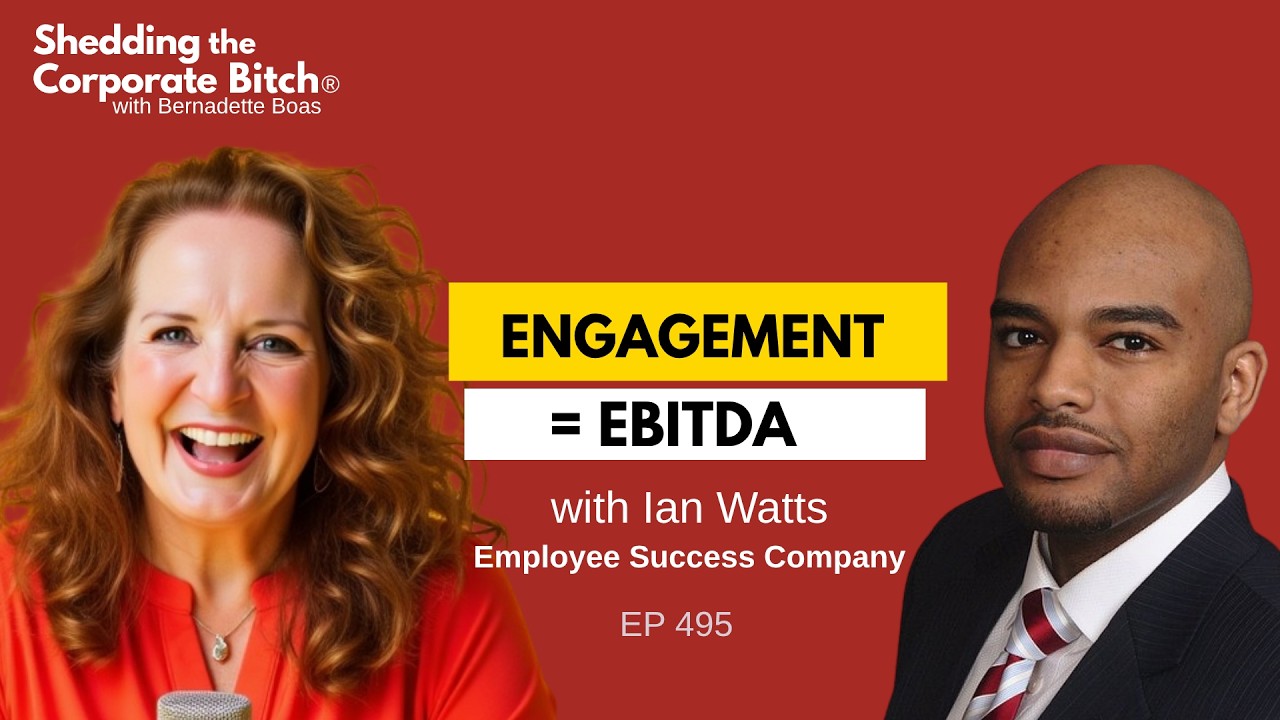
In this episode of the "Shedding the Corporate Bitch" podcast, host Bernadette Boas interviews Ian Watts, founder of Employee Success Company, about the critical link between employee engagement and financial performance. Watts argues that 90% of leadership failures stem from a lack of caring rather than a lack of skill, and he introduces his AXE/ACTS framework (Aspirations, Calling, Transformation, Support) as a practical method for shifting leaders from transactional task‑management to heart‑centered, people‑first leadership. The conversation covers the business case that higher engagement drives EBITDA—citing Gallup’s 21% profitability boost and quantifying disengagement costs at 18% of salary—while also highlighting the cultural and habit‑based barriers that prevent leaders from adopting this mindset. Watts explains how values, self‑leadership, and the “Law of the Lid” shape organizational culture, and he offers low‑budget, actionable steps (quarterly one‑on‑one conversations, curated learning resources, and support systems) to embed the ACTS method. He references the Dream Manager model as evidence that focusing on employee aspirations can cut turnover by 50%+. The episode closes with a call to intentional caring, modeling, and succession planning as the ultimate returns of heart‑centered leadership.
Chapters
Have you considered that 90% of leaders don't have a team performance problem? They have a caring problem. Their teams are waiting for someone to actually lead them with heart, not just manage them like robots. Ian Watts has spent his career inside that gap, working with organizations where the difference between a team that delivers and one that barely shows up comes down to one shift: moving leaders from managing tasks to managing hearts, dreams, and aspirations. According to Ian, that shift has a framework that he calls the AXE method. And in this episode, he's gonna walk us through it. Ian is an author, speaker, and within his own business, Employee Success Company, he is the person companies call when engagement surveys stop being a surprise and start being an emergency. You can learn more about Ian and the work that he does at employeesuccesscompany.com as we get into this conversation. Stay with us.
Welcome to Shedding the Corporate Bitch, the podcast that transforms today's managers into tomorrow's powerhouse leaders. Your host, Bernadette Boas, executive coach and author, brings you into a world where the corporate grind meets personal growth and success in each and every episode.
And how are you? Welcome, welcome, welcome.
Thank you so much, Miss Bernadette. I appreciate you having me, ma'am.
I appreciate you being here. I love the area of focus that you have to really amp up employee engagement and retention. And so one of the first things that jumped out at me that I wanted to ask you about is what do you see to be the future of leadership as a result of everything that's going on and piling up on top of leaders today?
There are two things that are coming to mind, and I feel like I have the two different angels on my— I have the devil, I have the good angel, the bad one on my shoulders because I'd like to believe that the more opportunities that I have to spend time with people like you where we continue to evangelize the importance of heart-centered leadership and the importance of being very intentional and the fact that engagement equals EBITDA, I'd like to believe that the future of leadership is very bright. But I will tell you, it seems like the human race is a hard-headed bunch. It seems like we have to mess up quite a bit and we over-index, and then we have to go back to the fundamentals. Because at present— and I haven't looked in the last few days— but just in the tech sector alone, we were at over 75,000 jobs that have been lost because miraculously AI seems to be this wonderful elixir, and I am all for progress. I am all for using technology, but I think we are using technology more broadly speaking to our peril if we believe that we can completely strip our organizations of people because it's people that make the organizations go. It's people that have the institutional knowledge and the contextualized knowledge that machines don't. And so I have some concerns, but part of the reason that I'm optimistic is because I get a chance to sit down and have conversations like this with you and your audience. So hopefully we can carry the torch of strong leadership, personal leadership, and the fact that we are still, despite what we sell, product or service or combination of the two, we're in the people business. And the first client that we have are those that are closest to us.
And yet some companies are really missing that equation. You mentioned engagement equals EBITDA. I don't know. And I, like you, talk with a lot of business leaders and there's so few that really even make that a metric that they track, measure, and report on. What do you see the trends being when it comes to making sure that they're aware that there is a metric behind the fact that engagement does equal EBITDA?
I think you said it. The first thing is to make people aware. So it's hard to change, it's hard to transform in any area before we become aware of it. Then the next question is, what do we do about it? Because here's what I'm seeing. Unfortunately, most of the time, and I get it because I've been an entrepreneur since I was 19 years old, so even I can become much more transactional in nature than what I'd like to be. So though I'm unemployable right now, unless it would be strategic in helping me achieve or fulfill my ultimate vision, if I were to just play a game and someone were to interview me and ask me, Ian, what are you not good at? I think that the very things, if you're not careful, that can make you strong can be a weakness. In my case, I'm really goal-oriented. And when the pressure cooker is on, I know that even I could become much more transactional in nature and much less relational. So I think that's just something to pay attention to. One of the things going back to though what some of the companies are doing, I think the big problem is they are waiting until it becomes somewhat of a crisis before they pay attention to the fact that, hey, here's what Gallup says. That companies that are more engaged are 21% more profitable than the less engaged companies. Here's what we know, that employees who feel that their organization cares about them are 3.5 times more likely to be engaged. But here's where the gap exists. Only 24% of employees actually feel that way about their employers. And so what you find Like most of us, we pay a whole lot more for pain relief than pain prevention, right? We typically come in and we are the salve to people's wounds and they have to be in enough pain. Just, just a part of the human, the human condition that by and large, many of us, until it becomes really painful and we bumped our heads enough, do we realize, oh, this revolving door is not because I necessarily selected the wrong candidate. Right? That could be the case. But no, this revolving door is because you brought the candidate in and you didn't engage them properly, and now they're looking for the exit. You brought the candidate in and you treated them like a human doing as opposed to a human being. You brought the candidate in and you treated them like a cog in a wheel or a part of a unit as opposed to looking at them individually and saying, I see you, I hear you, and it's not my job just to give you a good salary and benefits. I think long gone are the days of 30 and out where people stayed in one position and the bar, the ultimate bar is how good your pay was, how good are the benefits. Those are important, but here's what we also know. Salary and benefits will bring people in,. But it's culture that gets them to stay. And cultures are made up of people. I think that's what a lot of people, they really forget a lot. I know that years ago, you don't see it as frequently now, and then I'll pause. You would see a lot of those funny signs that managers would have on the door, like, check your problems before you come in. We don't live our lives in a vacuum. Life has a way of lifing on all of us. And so those of us who humanize the process of leading people I think we do well.
And so when you mentioned heart-centered leadership earlier, is— are you touching on that?
I am. You simply have to care. If you look at people as just a means to an end, you dehumanize them. And we feel that because what people are asking, based upon how we are wired from a neurobiological perspective, is Am I safe? So we have brought people in, and for those of us who have the privilege of leading, people have entrusted to us their lives, their livelihoods, and that of their families. And when we demonstrate to them that we are not worthy of that trust simply by not treating them like an actual human, then not only do we do them a disservice and we help usher them out the door to people who will care for them, And I'm not saying that your business has to be a church. That's not what I'm communicating. I know that in many instances you'll have a lot of HR leaders who are a bit skittish because they've tried programs, right? And many people will deem what they did as fluff. But the reality is, despite the fact that there may have been a lot of failings, the intention is right. I think just the execution is wrong, but it has to be modeled. You have to really demonstrate that you're psychologically safe. So being a heart-centered leader is just simply being a leader that demonstrates, I care about you as a person. You're more than just performance. You're more than just a number. I care about you as a person. Now, do we have a business to run? Should we be looking to be more effective and efficient? Absolutely. But if we're going to lay off people, did we help to upskill them before we did? Did we try to reposition them? I believe, especially as an entrepreneur, in creative destruction. One industry ushers— is ushered out by the old industry, is ushered out by the new. So I get it. But I believe ultimately, even when you do have to go through layoffs, I think it's not necessarily what you do, it's how you do it. It's a part of business. Because if I don't lay you off, then the entire company fails. Everyone loses, including the people that we were looking to serve at the highest level with our products or services. I'm not saying it to be unrealistic. I'm not just saying that we all have to sit around and hold hands. And sing kumbaya, but there are real metrics that are associated with this. For example, less than 30% of employers— employees are engaged. That means you got upwards of 70% of people who are either disengaged or actively disengaged, which is a whole separate and dangerous issue altogether because they're actively campaigning against the company while they're on your payroll. And I just read a stat recently that costs disengagement 18% of the employee salary. It is an expense. So if you got 70% of your people, if people wanted to measure what does this look like, 70% of your people, just for simple math, multiply, get all of the salaries, multiply that by 0.7, and then multiply that by 18%. That's how much it's costing you by having people who are disengaged. Because it's often a silent deal that we don't see. You'll even have high performers who are still performing, yet they still walk out the door. High performers have something that's inside of them that says, I don't care what's going on, my personal standards of excellence won't allow me to do less. But that doesn't mean you still have my heart. Because here's what happens, going back to what we talked about earlier, or what I mentioned, salary and benefits will bring people in. You can buy a hand, but you have to win a heart.
Yeah.
And that's what a lot of people aren't getting.
And why, why are leaders struggling so hard to recognize and move from that transactional tactical aspect to more of the heart-based people side of things when they see and they hear from experts like yourself just the cost that it has to them and the company?
Sure, I— there are a number of things that come to mind, not the least of which is their values, because despite the fact that we can have this conversation and show the data, maybe they simply don't value people that way. For some people, it is a means to an end. And if I have been doing this, and yeah, it's painful, and perhaps I could be more profitable if I engage, and obviously we know that they would, It's not just values, it's habit, right? So it's really hard to break any habit. It's really hard to change someone's value system. And then too, when things are not to the point that we talked about earlier, when I don't have a headache, when it's not acute, when it's not bothering me, it hasn't risen to the level of priority as maybe other things that seem to drive the needle more quickly. So I think it requires leadership that has the right values. It also requires leadership that's not afraid to do the hard things because it is hard, right? Especially if you haven't had it modeled, especially if you haven't been developed. We hear this all the time. It's an Irish phrase that I love. It says that life is better felt than telt. I believe the first level of leadership is self-leadership. How can we get ourselves to do what's in our own best interest? Not to negate the interests of others, but can we do what we're supposed to do when we're supposed to do it despite how we feel? That's the first level of leadership. But beyond that, what we're doing is modeling. And for many people, if they haven't had it modeled, and if their value system isn't in alignment with those that are heart-centered, and if they have just been really insulated from the damages of not embracing this, yet they're still able to produce really good results. Success can be a really, really bad teacher because it can hide a multitude of challenges. So when things are going well, why do anything different? It sounds and feels like a whole lot of investment, and I hear you, but I'm still doing well, so why break something? Why fix something that's not broken?
And that is a very hard mindset to break through, isn't it?
It is. It's a, it's really hard, not just for leaders, just people as humans. Yeah. It is hard. Neurobiologically, it is really hard to break habits. It's really hard. When you talk about the science of habits, you have 4 components. You have cue or trigger, then you have a craving, you have a response, you have a reward. That's on an individual basis. Organizations also have habits. And we would group that into culture. Culture is hard to shift and it has to start. It's a top-down deal. And that's just really hard. Some people will never get it, unfortunately.
Let's touch on that because I have an issue with that. I have an issue. I agree that culture starts from the top.
Sure.
However, I find, I wonder if you find that some leaders use that as an excuse as to how they're operating. Versus them saying to themselves, I can do something different and start modeling a culture for my team, for my business. I don't necessarily need to go with that.
I 100% agree with you. Some people— I want to make sure that I say the phrase appropriately. If I want to do something, if it's truly in my heart, nothing will stop me. If I don't want to do it, Anything will stop me. So I do think you have different leaders and you find that there are a lot of siloed cultures, some bad, some better, some really bad. You have that, especially in larger organizations, right? Among teams. But the very first leadership book that I picked up was The 21 Irrefutable Laws of Leadership by John Maxwell. And the very— and I never forgot it. The very first law— I don't remember all of the laws, but I do remember the very first law because it really struck me like a lightning bolt. It's called the Law of the Lid. So we are the leadership lid on our organization or our team. And so as we contextualize this for culture, even if you have leaders who are really good and who model it, sometimes the culture is so strong that they're limited in what they can do. And what it ends up doing is frustrating them because they can't affect change a bit more. They don't necessarily have the autonomy to withstand the cultural winds, so to speak.
Yeah.
And so what you find is it just gets so hard to continue to push against the culture that is not something that you believe in. And that's why it's so important to ensure that the values align. They're not just things that you read in a book and you put on a wall and that people regurgitate. Yeah, I want to make sure that my values are in alignment so that the culture won't swallow me whole. We've heard this, that culture eats strategy for lunch, right? It's really hard. It's like you're sucked into a vortex. So yes, I commend the leaders who, despite the cultural context that they find themselves in, they make a decision that I'm only going to adjust but so much before it interferes with who I am as a person. Here's how I'm going to treat my people. And then what you end up finding is when many of those high performers and great leaders transition out, they're not transitioning out by themselves. They're taking their best people with them. True.
And that's one thing they don't talk a lot about. That's one thing that they don't talk a lot about. Let me ask you something. You have a framework for enhancing engagement, the ACTS method.
Yes.
And how can that be leveraged in improving the culture and improving that, that engagement equal EBITDA and all the problems that we're talking about?
Sure. Thank you for asking. For the sake of the audience, I'll explain what the ACTS method is. The ACTS method is a methodology that I developed designed to drastically enhance engagement, and the underlying magic of it is to create a deep sense of reciprocity in your people. So think about this. Think about someone who was so instrumental in your life, perhaps in spurring you on and challenging you and encouraging you to greater heights. Maybe when the bottom had fallen out, especially in my case, and I know what it's like to have the bottom fall out, and it sounds like a really great and triumphant story, but it sucks when you're in the middle of it. But you had somebody who gave you this wonderful balance of tough and tender love, and they challenged your fears and insecurities and immaturities, and they gave you the balance of this tender love when you have fallen on your face and you had done everything, you didn't know how you were going to make it, but that person stepped in and they helped to pick you up and dust you off. Is there anything you wouldn't do for that person because of how instrumental they were in your life. Even if you didn't have that person in your life, most of us know what it feels like, or at least would be desirous of someone like that. That's the underlying magic of the ACT method. It creates a deep sense of reciprocity. So the A in the ACT method stands for aspirations, helping people to achieve their greatest goals and dreams, irrespective of what their current position is, or maybe what they aspire to within the company. That's separate. I want to have a conversation and get all into you. What are your personal goals and dreams? How can I help you do what makes your heart pant? So the A is aspirations. The C stands for calling, because most of us know what it's like to invest time and energy to achieve a dream only for it to feel like it's fool's gold, because we thought it would give us this fleeting sense of fulfillment. And again, we don't check our emotions, we don't Life has a way of lighting on us all, right? So we don't leave all of our challenges and we don't check our humanity at the door. So we have to be mindful of this. So the C is calling, helping people to discover and demonstrate what they're called to do. The T stands for transformation. How is it that I could help you not just professionally, but transform you when you go home personally? How is it that I help you be a better partner, husband, wife? I want people to reframe how they see their job. This is not just good salary and benefits, but when I come to this particular place, I've never experienced anything like it. They're helping me achieve my personal goals and dreams. They got a coach and they give me training, not for anything job-related potentially. They are helping me to discover and demonstrate what I'm uniquely called to do because I believe all of us have that void and that yearning in our heart to be of service and feel valuable. And the only thing that does that is not stuff and things and money. You come to the end of that and you realize there's something deeper. But when I go home, I'm a better husband. When I go home, I'm a better— I love my kids better. So it's not just training to help you for your current position or one that you may aspire to. It is training and coaching to help transform your life both professionally and personally. So the first 3 letters in the AXE method are employee-centric. The last letter is similar or akin to employee assistance programs in that we work with the executive leaders to say, hey, how can we put in a system of communication and structural support with budget and leadership where we are there for our people during life's most critical moments? And we're there when the doctor says to the spouse, there's nothing else we can do. We're there when the kid is getting in trouble. We're there not just for challenging moments, but what happens when you buy a new house? Hey, this is a major accomplishment. We just want to know we're so excited for you. Here's a gift card in the basket. Or when your kids go to school, hey, we really appreciate mommy or daddy. We want to encourage you in your collegiate journey. Here's a bit of encouragement, whatever that is. So that's the ACTS method and all of that. Based upon a psychology perspective, is designed to create a deep sense of reciprocity. So people staying is the bare minimum standard. They're going to give you everything, everything that they have, because again, you didn't just buy their hand, you really got to know them and you won their heart, and you're spurring them on in a way that all of us want to be spurred on. So it's not rocket science. So if you were to ask me, you know, what's a practical takeaway right now today. Here's what your people could do today. Let's assume you don't have any budget where you can't meet with your team members individually outside of the office and treat them to lunch. Set a meeting anyway. Say, perhaps you may even want to repent, I have not been the leader that I believe I should be and you would want me to be. I haven't gotten a chance to know you as well as I'd like to. And if you will permit, If you will entrust me with it or to my care, please share with me what is it that you dream of if time and money weren't a circumstance. And then practically, once a quarter, even if you have no budget for this and you can't buy books or you can't send them to trainings or you can't bring them in some coaching, what you can do is once a quarter watch 3 or 4 hours worth of YouTube videos that are free to say, based upon your goals or dreams, I need you to check these out because I think this will spur you on and move you further faster. So I'll stop there because I've said a whole lot more than what I intended, but obviously I get excited about it. Apologies.
I know, don't apologize. It was awesome. But I want to make sure we have A for aspiration, C for calling, T for transformation. Was the S systems or support?
Support. If I missed it, my apologies. I got carried away. I get excited, but I got way excited.
No, you said systems and support and I just wanted to make sure which one it is.
Yeah, it is support. It is putting— it's implementing systems of support structurally. So that's a lot of alliteration, but the S is for support during life's most critical moments.
And what— so going back, because I loved what you opened up with in regards to heart-centered and engagement equals IBITA, when a company implements this ACTS method, tangible hard metrics have they been able to see and really experience?
So let me just tell you about my anecdotal experience and how I even reverse engineered this. So I've hired probably over 400 people. And when I was thinking about, because I've spent the last 2 and a half decades serving smaller companies, I happen to be a small business junkie, but because I wanted to have deeper impact is why I started transitioning to the bigger boys, so to speak, the boys and girls. And I asked myself, what was it that I did that kept people from leaving me? And not just leaving me, but giving me everything they had. And it wasn't because I was so special. It's because my people knew how special they were to me. So tangibly, I did not have people who left, and the people who stayed were always—
I—
hey, go home, this will be here tomorrow, right? Just going above and beyond, right? The discretionary effort that we look for to measure engagement. It's the discretionary effort that's important. So Practically, well, I would say that if you look at Gallup, it's the 21% more profitability. Now here's the deal. It has to be rolled out across the entire company to get that type of, those types of numbers. Sure. But to get some metrics that are even beyond my own, have you ever heard of The Dream Manager?
I'm not sure that I have.
That's a great book that I would encourage that you check out because they've taken this much further. Only what I would correlate as the A in the AXE method. So what they do is they install what's called a Dream Manager literally into the company, and they have their own office. And this Dream Manager's job is to help people achieve their goals and dreams. And they've cut turnover by 50% or more.
Wow.
With this Dream Manager. So check out Dream Manager. These are not just, especially when you look at turnover and you recognize that turnover costs between 100% all the way, if it's an executive position, 400% of that employee salary. So if we can stop that, if we decrease our turnover by 50%, and that I would liken that only to the aid— they do nothing with calling, nothing with the transformation, nothing with the support that I'm mentioning. I won't say nothing with the support, it is, it's undergirded with support, so let me preface.
Yes.
But what they focus on is just the goals and dreams of their people.
Nice.
Imagine if they're getting those results, if you undergirded what you're doing, your engagement efforts with something like the ACT method. And there may be other methodologies, but basically touching on all of the aspects of the human.
Okay, so then one last question I have for you is you summed up the framework and gave a call to action to everyone, but is there any additional action or tip that you would want to provide our listeners and our viewers as to what they could be doing to really amp up their engagement and even the heart-centered leadership of their leaders?
Sure. So I'll make a statement that may seem like it's in left field, but you actually have to care. If you're going to implement something like this and do it with success, this presupposes that you actually care. That's one thing. But the thing that I wanna leave your listeners with is that you simply have to be intentional. You have to be intentional. You heard me mention earlier that life is better caught than taught, or the Irish way of saying it is better felt than telt. So a lot of what you're doing from a leadership perspective is modeling, but that's not all that you should be doing. You shouldn't just tell people, just watch me. You should sit down and be very intentional about designing plans for each and every one of your people, not just a team plan and how you guys are going to work together. Just be intentional about how you approach developing every individual on your team because the benefits are worth it. Now, I would like to impose that my greatest success is my succession. And I believe that if many of your audience members embrace that philosophy, I think they would do well. And I think that the returns are outsized, not just in the tangible, but the fulfillment that they will experience as well about being able to be transformative in someone else's life.
I love that. What a great way to wrap this conversation up, because yes, succession should be top of mind, and yes, putting a focus on it. Oh, I love that. Ian, thank you so much. This has been Fabulous. And I want to mention to everyone, please check out Ian and all the work that he is doing, especially around his ACT method. And you can do that at employeesuccesscompany.com. As well, you can follow him on both LinkedIn and Instagram at Ian M. Watts. That's Ian M. Watts. Ian, thank you so much. This has been fabulous.
This has been nothing short of amazing and time flew by. So thank you for having me. I appreciate it.
You're very welcome. Wow. What a powerhouse conversation with Ian Watts of Employee Success Company. From heart-centered leadership to the real cost of disengagement, Ian gave us so much to think about and actually to act on. If you're a leader who's ready to stop buying hands and start winning hearts, I want you to check out Ian's Axe method. That's aspirations, calling, transformation, and support, a powerful framework for driving employee engagement and retention. You can learn more at employeessuccesscompany.com and be sure to connect with Ian on both LinkedIn and Instagram @ianmwatts. If today's episode resonated with you, be sure to subscribe to Shedding the Corporate Bits so you don't miss a single topic or guest. We have each and every week. And as always, thank you for tuning in. Bye!
Thank you for tuning in to today's episode of Shedding the Corporate Bitch. Every journey taken together is another step towards unleashing the powerhouse leader within you. Don't miss any of our weekly episodes. Subscribe to our podcast on Apple Podcasts, Spotify, or wherever you love to listen. And for those who thrive on visual content, catch us on our Shedding the Bitch YouTube channel. Want to dive deeper with Bernadette on becoming a powerhouse leader? Visit balloffirecoaching.com to learn more about how she helps professionals, HR executives, and team leaders elevate overall team performance. You've been listening to Shedding the Corporate Bitch with Bernadette Boas. Until next time, keep shedding, keep growing, and keep leading.
More from Bernadette



From Stuck to Leading, Episode 2 — Meet the 5 Inner Fears Destroying Your Leadership



