Employee Voice or Difficult Conversation with Janet Taras
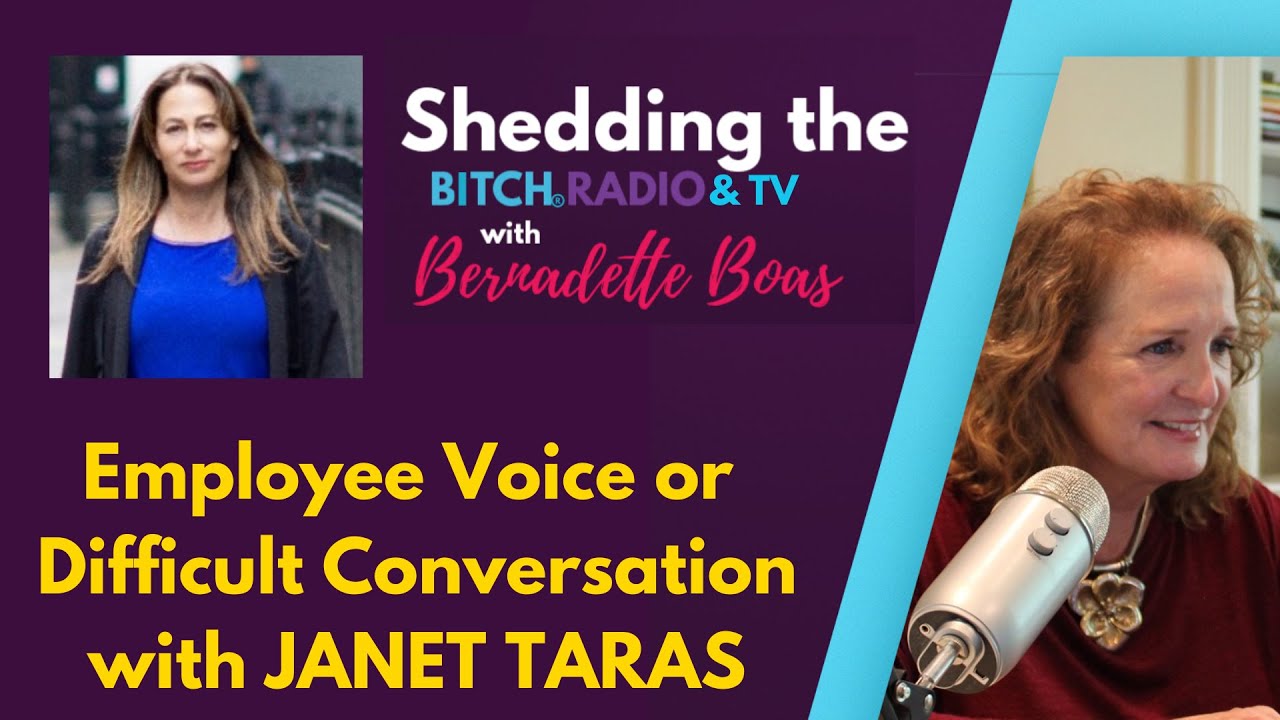
In this episode of Shedding the Bitch Radio and TV, host Bernadette Boas interviews organizational psychologist and founder of Speaking Rights, Janet Taras. The conversation explores the concept of employee voice, its historical roots (Hirschman’s exit‑voice framework, Van Dyne’s later clarification), and how it is often misunderstood or conflated with whistleblowing, idea generation, or collective bargaining. Janet shares real‑world, sensitive examples—challenging unfair policies, confronting gender‑biased remarks, and addressing offensive client language—and describes the personal and professional risks involved, including loss of business, damaged relationships, and career setbacks. The dialogue highlights a paradox: organizations publicly encourage speaking up, yet many employees (less than 2 % in her research) actually do, especially when they do not fit the dominant culture. Factors such as perceived permission, cultural fit, and identity protection influence who is heard. The discussion moves to solutions: psychological safety must be championed from the CEO down, with clear policies, measurement, and reinforcement. Training is needed not only for employees to voice concerns but also for managers to receive feedback constructively. Janet recommends a three‑level approach—organizational (leadership commitment, safety), managerial (training on receiving criticism), and individual (personal manifestos, audit of current climate). Practical steps include conducting a mixed‑methods audit, developing reliable survey instruments, creating policies that embed voice into rewards and performance metrics, and encouraging individuals to articulate how they prefer to be challenged. The interview concludes with a call for honesty, self‑reflection, and collective responsibility to make employee voice a genuine, effective driver of change.
Chapters
Are you ready to create riches in your work and life? It's time for Shedding the Bitch Radio and TV, where you can discuss, debate, and get advice on how to discover and shed the bitches of fear, insecurity, self-doubt, and negativity so you can realize your dreams and life purpose and create and accelerate the riches in life you deserve. So let's welcome your ball of fire host, Bernadette Boas.
Good day, good day, good day everyone, and welcome to Shedding the Bitch Radio and TV. I am Bernadette Boas, and this is being brought to you by Ball of Fire Coaching. And I am so excited that you're here today because we have to, definitely have to address for you how to deal with difficult conversations, and more specifically, um, whether it's an employee voice or difficult conversation. So that's what our guest is going to share with us today. A lot of information, great stories, and a lot of tips for you to walk away with. But before we get there, let me just thank our new and ongoing viewers and listeners. You are doing a fabulous, fabulous job in regards to tweeting, sharing, rating, subscribing, leaving comments, and especially the comments about who you want to hear from and what topics you'd like to learn more about. And those two things are key to us ensuring that we're bringing you exactly what you need to create riches in your business and life. So thank you very much for that and continue doing so. I also want to thank our sponsor, North Georgia Tax Solutions. They are a full-service tax and financial services company and they serve the, the entire United States. And Debbie Snelling and her team are just fabulous. I've been working with her for about 10 years and highly, highly recommend that if you have any personal or business financial services, and tax needs, that you reach out to her at NGTaxSolutions.com. All right, now let's get into this conversation, shall we? We are going to discuss employee voice or difficult conversations. Having hard conversations in the workplace can create a lot of stress, lack of productivity, and even fear for an individual. We will discuss why it's difficult to have challenging conversations in the workplace, what risks there are when approaching those discussions, and what the benefits are for using your employee voice at work. Our guest will also provide tips for handling it. So she and I, both of us, would love you to listen for the importance of speaking up, and then the paradox of employee voice. And lastly, understand how the experience feels for both the employee and managers. Now, this is going to relate to anyone, whether you're entrepreneurial or in a corporate career. So our guest is going to definitely touch on some great tips and advice that you can use, especially, especially in the workplace. So let me introduce our guest. Janet is, is an organizational psychologist and the founder of Speaking Rights, a training consultancy that focuses on equality, diversity, and inclusion, particularly in the area of communication in work. Janet is also an award-winning speaker, trainer, and consultant who offers valuable insights in how to— I'm sorry— into how to better navigate conversations about equality in the workplace. The core of her material identifies key elements that prevent equality and how to successfully challenge norms while equipping clients with the tools to confidently navigate change. Janet has spoken in over 25 cities, inspiring thousands of people to confront challenge. She is an entrepreneur who founded 2 businesses. She has lived in 6 different countries and is slightly dog obsessed.
Woo woo!
Love it, love it, love it. She also— check this out— she also likes to rap. She also likes to rap. So help me welcome to the program, Janet Tyrus. How are you, Janet?
Hey, I'm good. How are you? I love that intro. That was good.
And of course, anybody who's dog obsessed, because my community knows how dog obsessed I am. Same.
Yeah, it's hard not to be. They're so cute. It's, it's really—
yeah, they really— I had 7 dogs in my house this past week.
Wow. Oh, that's heaven. Heaven.
Yes. Yeah, my friends just kept on being— you know, I have a wonderful backyard, so they kept like Hey Bernadette, do you have time for the dogs for the weekend? Sure. Do you have time for, you know, overnight?
I see you were dog sitting at the same time.
Okay. Dog. Yes. I'm dog loving. I like to call it. I'm dog loving at the same time, just because they're, I just welcome, welcome, welcome the unconditional love of pets.
Yeah. Yeah. That's it. And those little eyes, how they look up on you at you and just trust you and are amazing. So yeah, feel that.
Okay, but you also have to share with us because you're my second guest in less than a month that likes to rap. Really? Yes.
Okay, who was the first? I mean, really impressive.
Ryan, um, Forlón, and he actually uses it in his, uh, speaking.
Oh gosh, I have to write that down. Okay.
Yes.
Um, so yeah, I— so that where it came from was about 5 years ago, I was going through a bunch of very frustrating stuff from a feminist perspective. I had a lot of misogyny being thrown at me at the time, and I was frustrated. And you know that women aren't really supposed to be angry, of course, you know, it's not a good look apparently. So, so what happened is around that time, my daughter was studying different, different ways of of, of singing or different types of music. It was a music class, and rap was the topic of the, of that week. And I heard it and I thought, what a brilliant way to just get it all out, you know. And, and so I started getting into it, and then I started taking rap lessons. Um, I did. Yeah, I know. Um, and then I actually started to, um, to write the songs myself. And then how it all came about was for International Women's Day about 5 years ago, I wrote a feminist, uh, rap song, and the organization of International Women's Day picked it up and they said, we love this, this is so cool. So they put it on their site, um, and yeah, so it actually ended up getting lots of views, a lot more than I expected. And then they said, do you want to, do you want to, um, uh, what do you, you know, work together on this? Um, collaborate. Thank you. And they I said, yes, however, I don't really think I should be the one rapping. I think that we need to find younger rap. So that's what we started to do. So every year we sponsor a rapper and they create the International Women's Day rap song, the official one. So you could go on to IWD 2022 and just go into the creative section and you will find my— our raps, but it's really the artist's rap. Still. I help make it, right?
That is so cool. Yeah, well, you might want to take the advice of this— well, not the advice, but, you know, I mean, Ryan literally incorporates it into his speaking and his coaching, um, and it's fascinating. I mean, it is fascinating. I would not ever be able to do that, so I applaud you.
I, I tried it and it did not work in the UK. So I'm, I'm in the UK, just so you know. So I tried it and a lot of companies were like, nah, Wow. Yeah, they, they just wouldn't. So no, I won't. But I think it's found its place. It's found exactly where it needs to be, and it's really inspiring other people.
That is— that— congratulations! Kudos to you.
That—
and especially, we just had, you know, last month or earlier in the month, we had International Women's Day.
Well, yeah.
So that— oh my gosh, I will definitely go look for it. I would love to go look.
Absolutely.
OK, we're talking about though employee voice or difficult conversations. So first, before we get into it, we all know what difficult conversations are. But help us understand what is— what do you mean by employee voice?
OK, well, it's actually a good question. Employee voice, the construct, was created by somebody called Hirschman in the 1970s. And he wrote a book called Exit, or, or I can't actually remember, Exit or Speak. But the idea of the book, then this idea of employee voice came about. But it almost became a little bit confusing because people were like, well, what does that mean? You know, does it mean that it's like unions' collective voice? Or does it mean that employee voice is when you come up with a new idea? Or does it mean when you're promoting something or selling an idea? It actually could be even dissent or whistleblowing. It could be so many things. So it got really confusing. And I think it's up until the late '90s, Van Dyne was the one who started to separate what employee voice meant. And then it has grown and actually evolved since then. The area of employee voice that I am most interested in is the area where you are challenging somebody's either behavior or status quo. Okay, so that would be, for example, you disagree with your boss, for instance, your manager's decision, or even a colleague where you disagree on something, on a behavior. It could be something that they said that you found it was offensive. It could even be a client. Um, I had an interesting, uh, situation two days— yeah, two days ago where I was meeting with a prospective client and he said something that I thought was extremely offensive. Um, so, you know, what do you do? You want the business, but— or, you know, so, so it's one of those— I was fascinated by it, so I just, um, I started to research it and it was— I ended up becoming part of my dissertation of my master's degree as I studied my— from my for my organizational psychology degree. And that's what I spent a year and a bit doing. I did my own research. I interviewed loads and loads of people, all on how to challenge upwards, but also challenge each other in sensitive situations. So not just challenging a, you know, a random idea. I'm talking about the sensitive stuff.
Right.
So that's what I mean by employee voice. Right.
And I love that you pointed out the sensitive stuff. Because that's really where the kind of almost like the rubber meets the road. It's kind of like that's what's going to cause, if not addressed, like you said, employees leaving if they aren't able to or don't raise their voice or use their voice. I love that. And so, okay, so sensitive. Define sensitive. Give us some examples. You gave a couple, but give us some examples of what you've encountered with the clients that you've had, especially you've spoken and worked all over the world. What kind of are those real tricky, tricky, tricky situations?
So I guess one of them would be challenging, let's say, imagine if you are working in an organization, your manager has set a policy which you think is unfair, okay, but everybody else accepts it. Everybody else accepts it, and being the only person to actually disagree with it because you don't think it's going to work, or you don't think it's actually going to work in anyone's interest, and it could cause some, some issues for you personally, um, that would be a situation where it would be sensitive because you have everybody else in the team supporting the manager's decision. Whether they really do or not, you're not sure. But yeah, you disagree with it. So that is one situation that happens a lot. Another situation would be speaking up to a bias, to somebody who— so my situation 2 days ago, for instance, I was talking to this prospective buyer and he said, I hope it's okay to say this on the Okay, so he said it was for a group of CEOs he wanted me to talk to, and I said, well, who's in the group of CEOs? And he said, well, it's mostly men. There is one woman, but honestly, Janet, she has more balls than all of the guys there. And it actually, it took me a bit, I'm not gonna lie, it took me a bit to realize what he just said. I continued on with the conversation, and then when I got off the phone, I realized That's really actually quite stereotypical and, and very harmful because what he's done is he just equated strength, which is what he was saying about this woman, to balls, which is the male anatomy, you know, and, and actually saying that if the— a woman couldn't possibly be strong unless she has balls, right? So, so I thought, and again, like I said, it took me a minute to figure out why it bothered me, so I didn't say anything at the time, but I then had to figure out, well, do I confront him and actually let him know, or do I just say nothing and probably get the job because he really liked me? So I decided to do it. I decided I'm going to let him know. And so I wrote him an email. Here's what the problem was. I hope you take this with the sentiment that I actually mean it, which is to help you and make you see in a different light. And he was very polite about it. He said, thank you for pointing it out. And I never got the gig. So you do have to be realistic when you do speak up. You can lose something, and that is what the dangers are with speaking up and speaking out, right?
At the same time, at the same time, wouldn't you say, Janet, that you, you know, you just as you thought, you had to? I mean, it couldn't go unaddressed, whether or not you got the gig or not. Just the, the mere fact that it just could not be said, right?
So you say that, Bernadette, but it was in my research, um, I found that it was, yes, 100% of women, or, or people, I would say 100% of people, it doesn't have to be women, um, that, you know, what you give them an imaginary situation, they would all say, yes, I would out, but actually the ones who do are less than 2%.
That I don't— yeah, that may, you know, that I understand. Okay.
Yeah, because you have to put yourself in that position. You have to put yourself in a power position. So one of my, one of my research interviewees was in a situation where she had to do it because it was a situation she felt if she didn't speak out, it was for the good of all of the people that she was, you know, representing, which was Black women. And, you know, so she did, but she did at her consequence. She also didn't get a promotion because she spoke out. A lot of people would just stay, say nothing, right? Um, and, and instead gossip about it afterwards. So it's— there's a lot to lose. You want, um— and that's what I started to find out. It's a lot easier said than done. And the paradox you spoke about— sorry, I'm very passionate about this— the paradox talks about this a lot of this is that— and again, in my research, I found so many companies out there saying, speak out, you know, disrupt, you know, be that change you want to be, etc., etc. But when you actually looked at the company itself, it does not encourage that behavior. It really doesn't.
Why is it so hard? Why is it so hard?
Okay, well, there are reasons if you want to know.
Yes, absolutely. I think we all need— who's watching, who's listening— we all need to And I want to even emphasize too, this applies, you know, to obviously corporate we're talking about, but at the same time, even in your own business.
Yeah.
If you know, even if a stay-at-home, if someone, you know, is a stay-at-home in the, in your own community, in your own household. So yes, please.
Oh yeah. For instance, in the example I gave, that was my own business. I lost a client because I chose to speak up. That doesn't mean I'm not going to get them in the future, by the way. So I, and I probably will, you know. So yeah, no, this applies to both small business or business owners and employees. But there is a cost. And the reality behind it is that people tend to get punished if they are in disagreement with the norm. So when somebody disagrees with you, Bernadette, you Just try to imagine that feeling. If somebody who also might be junior to you or somebody that is new to the business, they've just walked into the industry and they say, "Yeah, I don't really think that this is gonna work." And they say it maybe in a way that you don't like it. It feels like a slap in the face. But what happens is instead of you saying, "Oh, that's horrible and get some experience and come back," or something that you want to say, but you don't. Instead, you will not call them again. So again, in your own business, it would be, okay, I don't want to speak to that person as much. In an organization, it will be, yeah, let's not invite her or him to this meeting. You know, it would be the small things that you won't see that will actually start to affect you. And there is a certain amount of punishment that actually comes along. So it's scary. It's scary for people. We also know that it's very needed. People need to speak up because things like Chernobyl, things like Enron, things like major issues that have happened have happened because people won't speak up. Right. So we know it needs to happen. But we also know that realistically, it's, it's a lot of people think it's pointless unless you are going to win the situation. Right.
So, um, so now let me ask you something though before we move on to another, another angle of this. Is, is it, uh, more of a tendency of punishment to women or to men when they speak up? Is there a differentiation there, or—
okay, so now, now I could go into certain, um, themes that, that I have discovered over, over time. The answer is it's not necessarily about gender. Sometimes it is. It's not necessarily about color. Sometimes it is. So it's more the point of, do you fit in? Okay, so that is the big— so in an— this is for a corporation, of course. Do you have permission? Do you actually have the permission? If you are working in an organization where everybody looks like you, acts like you, and you fit into the culture,, you will be heard a lot better than if you don't fit into that culture, right? And that's the saddest part because it's actually the— and, and I think the world's starting to wake up to this, and this is what I spend most of my time doing, is, is getting people to understand the, the need for diverse views and people who don't look like you to actually be able to speak up. But at the moment, we're not there yet. And, uh, and so you have permission to speak up when you fit into the existing norms, whether that's man or woman. So I would say it's more often men. That's another sad part. So if it's— I have situations where I know women who have tried to speak up and the man just never even considered their opinion to be, you know, in fact, there would be words like, oh, you're not saying this assertively enough. Right, or you're not, you're not aggressive. Speak up, would you? You know, but all it that's happening is she's just not like him. Yeah, so, but then there's other situations where gender makes no difference whatsoever. It's just a matter of fitting in.
Yeah, yes, yes. And, and having the permission, um, having the permission. If you don't have the permission, then that's where the risk comes in.
Correct.
Is that right? That's where the risk comes in, is if you don't have permission and you're gonna butt the system, so to speak. Yeah, then you just have to be aware of the consequence or the risk.
Yeah, and, and the consequences are you sever relationships with whoever it is you're speaking to. Um, your consequences are that, uh, you will not be seen as a team player. Um, you won't be seen as supportive. Uh, you won't be seen as somebody who is actually in it for, for the team. On the other hand, we're getting a bit better. So this is another thing that I find. You are able to, let's say I was to come to you and say, Bernadette, I have some feedback for you, okay, and you would say yes, and I would give you some feedback, and it was hard-hitting, but you say, thank you, you know what, that was useful, okay. Then I come back, let's say a couple months later, and I say, Bernadette, I have some feedback for you. And this time you're like, oh right, uh, okay. And you, you listen to it. But the third time you're like, for crying out loud, you know, seriously, would you, you know, be quiet? And then by the fourth, you're— I have already become a troublemaker. So it's almost like it's— we're, we're getting a little better, but we're not there yet. Because then you kind of tip over that, that special tipping point, and then you are the— not the enemy, but you don't— you're no longer welcome into our, into our in-group. You're in the outgroup, right?
So yeah, well, yes, but you know, you'll have a lot of executives, right? You'll have a lot of executives, um, that will also say, but I don't want yes people, I don't want yes men and women. But yet when you say no, you know, you're, you're also saying that that's where, you know, the risk and the consequences come in, is because what, they, they really don't mean that what they're saying?
I think that again, you have to remember employee voice means many things. So if it's a new idea, you know, something like, you know, I don't want— I like your idea, Bernadette, but actually what about seeing it like this? That would probably be a lot easier to stomach than you just said something that was biased. You know, so I think that that's where there is a difference. And again, obviously this has to to be done respectfully. So I get it. I also have to say the research brought out a lot of interesting points for the, the people who are being challenged themselves. So it's, it's very difficult to, to hear these things, and you do want it to be done in a particular way, right?
Okay, so on that note, what would you say about what, what are the emotions, what are the feelings that the person that is being challenged, what are, what are they kind of experiencing that could cause them either to shut down or open up? What, what's their like little arc of what they're experiencing?
Another good question. So I think that what you are doing is they're experiencing— maybe the person who is speaking up almost does it because they have to. Like this one woman that I was telling you about, she, she knew she had to do it for for the good of the people she was representing. Whereas when you are receiving it, it's almost like, what are you protecting? OK, so for a manager, let's say that it's somebody who's a little bit more junior to them. Are they protecting their authority? Is it possible that they're threatening their authority? So, or if it's not a manager, maybe it's just a colleague. Is it that you're threat— you're protecting your respect or your credentials within the team? So it's about understanding what it is that you will be threatening, because the fact is there, until the system changes, and the system has not changed, we are still supposed to protect our, our know-how. We have to be experts. We have to be authoritative. We have to be all of that stuff. Then we're going to actually still be protecting something until that changes, right? So, so it's— of course it's going to be a fear. That's what they're feeling. They're feeling afraid. They're feeling, I wonder if I'm going to devalue myself. I wonder if I'm not going to seem as, um, authoritative as I need to be. As a— let's say it's a manager, um, if it's a client, it's actually, you know, you are threatening the fact that they think that they should be in control, not you. They think that because they are paying you, they have the right to be the ones to challenge, not the person who they are paying. So there's so many levels, but there could be some anger there that they're feeling as well. Protection, all protection.
Yeah, all protection. Interesting. And how about the person? Because it does take a lot, you know, it does take a lot, you know, for one to go to your boss or to go to a client. Both of those situations are not fun or easy. So what are they going through? What are they experiencing to where they're even willing to push through it? Because they, they believe it's right.
So, so I find it's, it's one of several things. So they are, they, they know that they're taking a chance. They, they are, they all know, and there's not one person I have seen so far and helped and worked with that did not feel they— there was a risk involved. But what pushed them through was either altruistic, so something that they were— they thought for— was for the good of others, or there was a sense of identity protection. They, they all— sorry, that's not right. They had to prove themselves. So, so it's not protection, it's actually assertion of if they don't speak up, this is, this is not going to sit well with who they are as a person. Right? And then the final thing that would push them towards it is that permission element. So you would find that people who are, who are really good at their jobs, for instance, they have more willingness to actually challenge. So if they were, it didn't matter whether they fit into the culture or not, they are bringing in the numbers, right? Then they felt they had that ability, that permission to then point out things that were right or wrong.
Yeah. And we're not necessarily talking about those people who just like to complain and say no just for the hell of saying no, right?
No, that's so— you know what? So I'd like to define employee voice right now, which is what I should have started with. Employee voice in this particular situation that I am talking about is a proactive conversation that is meant to help the organization. Not to vent. It is not to complain. That is something that everyone has the right to do, but not in the organizational context. So the employee voice is there to help or avoid a disaster, like what some of the things, the Volkswagen emissions scandal, or, you know, whatever. And it's to help the company progress, not for any other reason. Not selfish.
Yeah, yeah. OK, also, I'm glad, I'm so glad that you expressed that because I'm sitting here thinking, Gosh, I know that because I used to be that way. I used to— I mean, I would raise up— I was never a yes person. I would raise up the no. I had, you know, I knew the consequences, the risks, but I would do it anyway. But there was also a degree of like arrogance there on my part. But how did it work out? Yeah. And at the same time, I would also, you know, raise up issues that weren't maybe even issues just to kind of see what type of chaos I can create.
And did that work out for you? Like, how did people receive you?
Um, for 12 years, actually, probably for about 25 years, it was received, it was accepted. Because that's, I guess that's the other thing I want to ask about, because it was accepted because I was such a massive producer and a, you know, revenue generator for the, especially the two companies over those 20, 25 years. But at the same time, ultimately, when it, it was— it— I was meant to go to the next level, like max out at the next level, which was significant already, um, that's when it wasn't acceptable enough anymore and I was given my pink slip.
Really? Right, right. Interesting.
Yeah.
Yes, but I've got the ultimate punishment then.
I got the ultimate punishment. So, you know, understanding risk is also— but at the same time, it was because of both raising up good issues, but more so because I just raised up issues to raise up issues. That's just shedding the bitch. That's where it all comes from. Right. But I was definitely curious about that, and I'm definitely glad you explained the employee voice.
Yeah.
Proactive, positive, to move the company, move the team, move whomever forward. That's awesome. How can we— you know, how can employees, how can managers, how can the organization as a whole, especially, how can they make it easier for people to really believe that they can have and use their employee voice?
So this is where it has to come from 3 levels. The first— and now let's talk about firstly in the corporate setting. Okay, right. So from a corporate point of view, if you work for a company— or it doesn't have to be corporate as in big, it could be a small business— um, it has to come from the top when it comes to the organizational level. So that's the organizational level, has to start with psychological safety. So I'm sure you know about psychological safety, right? Yeah, so, um, so just making sure that people are allowed to speak up and that there will be no punishment and from that top level. That only can start from the CEO of a company demonstrating it. So I was doing a talk last week for International Women's Day and the CEO was there. And I said, if you don't allow somebody to actually disagree with you in public, nobody's going to do it.
Right.
You know, so you have to see and feel that it's okay. The culture of the organization also has to change. So it has to become a little bit more flexible, meaning that the way you are evaluated and the way you actually are measured is not based on how authoritative you are. It has to be based on different elements. So how you are measuring your leaders is important because then you go to the second level, and that level is your managers. And they need to know that they're safe to allow their employees to speak up, and also that it's safe to speak up to their their managers, right? So even, I mean, and there's more than 3 levels, obviously. There's usually lots and lots of levels. So it has to filter down. And then the middle level is really important because they're under the most stress, right? So there has to be training in addition to the psychological safety training. There has to be training on how to receive feedback. OK, we have a lot of people doing a lot of courses on how to speak up, but very few on how to receive that criticism.
Right.
Right. Because it's hard. And how else are we going to get good at it other than practice?
Right.
Right.
Good at it. Good at anything that we're doing or good at using our employee voice, good at communication, because I know you're a communications expert.
Well, I would say good at receiving criticism.
Okay.
Yeah, so good at, um, when somebody tells you that something's not good that you've done, you've worked really, really hard on, um, how do you do, how do you, how do you react to that, right? So that's the training that, that middle level has to have, because if you're going to get people to speak to each other or upwards, you also have to be good at receiving the criticism, right? And then the third type of, of level is really about teaching people how to speak up in a way that is both respectable and yet efficient and effective. So I think that that's— there's lots of work that needs to be done from a— sorry, the dog is barking— from an organizational level through the manager level through the employee level.
Right. Now, where Where does construction come in? Like, it being constructive as well as respectful as well as efficient, you know, is that at all those levels as well as teaching them how to be constructive in the way you receive and even to give?
So I think that that has to be done at every stage. Um, what is— what has to be done is what is constructive, what is Respectful is very personal. So I think that making sure that our, our voice is heard has to be in a way that the person, the listener, can hear. Okay, so which means that you have to have a conversation. Back to my conversation strategist. It means you have to have pretty open conversations of how would you like me to challenge you, right? How is the best way? You know, can we accept that, that it doesn't have to always feel comfortable, um, but maybe we'll agree that it should never be done in, in public? Yeah, that's for me, that's my thing. I don't— I, I, I just— I retreat and I, I really crawl into a ball when somebody starts criticizing me in public because my fences come right up and I no longer am listening. So it has to be done in, in private. And of course, then how do you say those words even in private? It's hard, right? But that conversation is really needed. So it's actually quite individual. It's something that we have to go through with everybody, and that includes your colleagues, your managers, and if you're in your own business, your suppliers as well as your customers.
Sure. Yeah. And would you say too that when you say that, especially when the psychological safety has to start at the CEO level and to really understand how one is going to give and receive, is it part of their mission? Do you work with companies to embody it into their mission and their cultural values and their principles? Do you work it, work it into all of that so it's all very cohesive?
Yeah, I mean, very often, Bernadette, it's already there. They just don't do it. So it's, uh, you're actually just living the actual values. Um, but what actually needs to be done is policies need to be written up. Um, so that's the, the consulting side. I do a lot of, of training, but I do a lot of consulting at the same time, helping people make that real. How do you build that into your practices? How do you build that into your policies? How do you build that into your rewards? How do you build that into your, even like your pun— not punishments, but your critiques and how to help people develop in different ways when they're not actually exceeding or maybe doing so well on that person-to-person basis. So, you know, it's about measuring and then making sure that actually you can implement it through every single level, in every single function, and into every single job. Otherwise, if you're just training, it's not going to do enough.
Yeah, no, absolutely. Absolutely. It's almost like, you know, it has to have some stability to it. No, that's not the word I'm looking for. It has to have like a foundation to it to where then you have reinforcement and sustainability. That's the word I was looking for.
Yes.
Reinforcement and sustainability. Would that make sense? Would that—
That makes beautiful sense. I love that.
Yeah. Because I'm thinking to myself, you know, one, it sounds easy, but then at the same time, when you start looking at corporations, it sounds so arduous and so complicated. And who would you say— because, you know, well, who would you say has the responsibility to making that happen?
So it has to be every single person. It's too easy to wait for the other person to do it. And again, especially in my research, when I was doing my research, it's like, well, it's not my job, meant that nothing was going to change. So it means sometimes it starts from the bottom and goes up. Sometimes it's the top down. Sometimes it's just people coming together and saying, you know what, we need to work together to find ways to solve this. But if not everybody is involved, and if not everybody doesn't, has a little bit of buy-in, then it won't happen. And, but the, I, in my opinion, the most important responsibility is from the organization. You cannot, and what's been, I think, the mistake over the years has been that we are training employees to do it. But there's not been enough responsibility from the senior leadership team, from, you know, the executives out there. To actually— they'll sponsor some training, but they won't necessarily do it themselves. So it's really got to, to be that level that has to, to take the, the, the— what do you call it— the horns by the head or the, the bull by the horns. Yeah, I'm really bad at that, all of these.
I mean, I am too, so don't worry about it. Um, and, and that really touches on too— that's funny because that touches on too the fact that— talk about having difficult conversations. So someone like yourself, I would suspect, and you can, you know, confirm or not, that you're the one sometimes that has to point these things out and actually has to use your own voice to share with the leadership team where they're not necessarily stepping up and leading and doing the work that's going to then ingrain it into the organization, correct?
Correct. And that's why people hire me because it's a lot easier for a consultant to do that than somebody within the team. Yes, I am often doing it. But I can tell you, much like yourself, when I was growing up in the corporate world, I was the same as you. I used to speak up all the time. And sometimes, I, depending on the, the role, I was seen as an influencer and Janet's very creative and very— and other times I was a complete nightmare. I was, I was a troublemaker. I was stay away from Janet, um, you know, so it's, it really did depend. Um, but I, in the end, like, I lost a job because of it because the woman just couldn't deal with, with my, um, directness. Um, and I did try, of course, it's both of our responsibilities, um, but, you know, I did try to mold myself, but in the end there wasn't that much that she was willing to actually give either. So it's, it's very, very difficult for person— for people within the company to do. You need sometimes to have some help externally, and then you start to do it.
Well, you need somebody externally that will hold up the mirror, you know, and kind of not force you, but, but, you know, incent you to kind of look at your flaws, right?
Correct. Yeah. And challenge you.
Exactly. It's so true. It's so true. I love this. I love this. Okay, so if, um, if we had individuals out there, uh, in their own business or in a, you know, corporate business, no matter how big or small, um, who wants to figure out how to get this to work, you know, what would you recommend that they do? Are there like initial steps that they could start taking? Ensure that they do have kind of this structure around employee voice?
Yeah, I think the first thing that you would do is look at, do an audit, see, see what your organization, where they're at. You know, how safe do people feel? What's the reality? Because if you don't understand your benchmark, you won't be able to improve it. And you know, or can you measure it, right? So, so that is the That's the first thing I would do.
And is that like a survey, did you say?
No, an audit is a—
oh, an audit. Okay, an audit.
Yeah, but it's like a qualitative and quantitative research that you, you actually do. Um, it could include surveys, it could include— that's— but then they have to be— again, I come from the world of academia where everything had to be done properly. So it's, um, you know, the questions can't just be random questions, they have to be reliable and, and, um, you authentic, that they actually will make a difference when people are asked and they're not going to be persuading somebody to actually answer in a certain way. So qualitative and quantitative research is really what you want to start with. What are the holes? Where are people actually feeling uncomfortable and how can we actually— then once you get that, you say, well, where do we want to focus on first? Because you can't change everything in a day. Yeah, that's for sure. Unless if you are working on your own, you can. So that's something. So the next And then the last bit of advice, I suppose, is for those of you who can change this in a day, think about how you would like to be challenged and write it down. How do you think that the right words would be, how you would receive it best, and then share that with other people when you're working with them. You know, this is something that I have. I could say this is my manifesto, and one of the things that in my manifesto is that I like it when people challenge me. However, here's my, my list of how I prefer to do it. You know, this is, this is my suggestion. Nobody does that at the moment. So I think that's a really good tip for everyone to start with.
I love that. And, and, and it touches on what I'll do with my clients is I will, I will show them kind of an assessment that I've done of myself, which shows kind of how I like to be communicated to, what, you know, how I like to be managed, how I like to receive feedback. And I asked them the same thing. And so that, yeah, that would be— that would make life so much easier, wouldn't it, if we can all have those type of conversations with one another?
I think so. Yeah, absolutely.
Powerful, Janet.
Powerful. Thank you.
Powerful.
Well, you do it already, obviously, so you already incorporate this.
Well, I do. I, I do. And, you know, and I think I told you before we even came on that this is a subject that's that's dear, dear, dear to my heart. And we can't talk enough about it, of how to deal with these difficult conversations and how to leverage your, in your words, employee voice. That's why I just absolutely loved what the work that you're doing is, because we just can't focus on it enough. We have to be able to have those difficult conversations and provide that mechanism to our employees, to our teams, to our managers, to the leaders of the company, you know, you name it. So yes, yes. Any last tips you'd like to share?
Yeah, I suppose the only last tip I would share is to say that we all have to be honest with ourselves. And the more honest you are with yourself, the more honest you will be with, with the other person of I suppose your feelings of being challenged or challenging. So start with an authentic conversation with yourself and then start the conversation from there. So if it doesn't start with you, it won't necessarily be something that comes to fruition because we have to stop lying to ourselves, just like the organizations have to stop lying to themselves. If you're going to say speak up, be specific, you know. Don't tell us all to speak up and then fire somebody for doing it. So honest. That's what I think everybody looks for these days. Start with yourself and go outwards.
Amen to that.
Amen. All right.
Awesome. Love it. Love it. Love it. All right, everyone. So if you want to learn more about Janet and the work that she does, please go to speakingrights.com and be sure to reach out to her. You can also follow her and connect with her on LinkedIn. But definitely go to speakingrights.com and just learn how you can start kind of embedding into yourself, your team, your organization using employee voice. I just absolutely love it. Janet, thank you so much for being part of the program. It's been fabulous.
My pleasure. Really, thank you for having me. It was an honor.
Oh, thank you. Thank you.
Thank you.
And for everyone in our Shedding the Bitch community, we love having you here. We love having your tips. And your recommendations for speakers as well as for topics. So please join us each Tuesday at noon Eastern time, and I will see you next week for another episode of Shedding the Bitch Radio and TV. Talk to you soon, everybody. Bye.
Thank you for taking part in Shedding the Bitch Radio and TV with Bernadette Boas. We would love to know what your biggest takeaway was. Go to Shedding the Bitch on Facebook or YouTube and and leave a comment. You can also subscribe to the show on Apple Podcast and YouTube so you don't miss a single episode of the show. And with your input, we can help other powerhouse women just like you find the show and decide if it's right for them. Learn more about Bernadette at balloffirecoaching.com. See you next week.
More from Bernadette



From Stuck to Leading, Episode 2 — Meet the 5 Inner Fears Destroying Your Leadership



