Engaged Leadership: Empowering Women and Transforming Corporate Cultures with Sabine Gideon
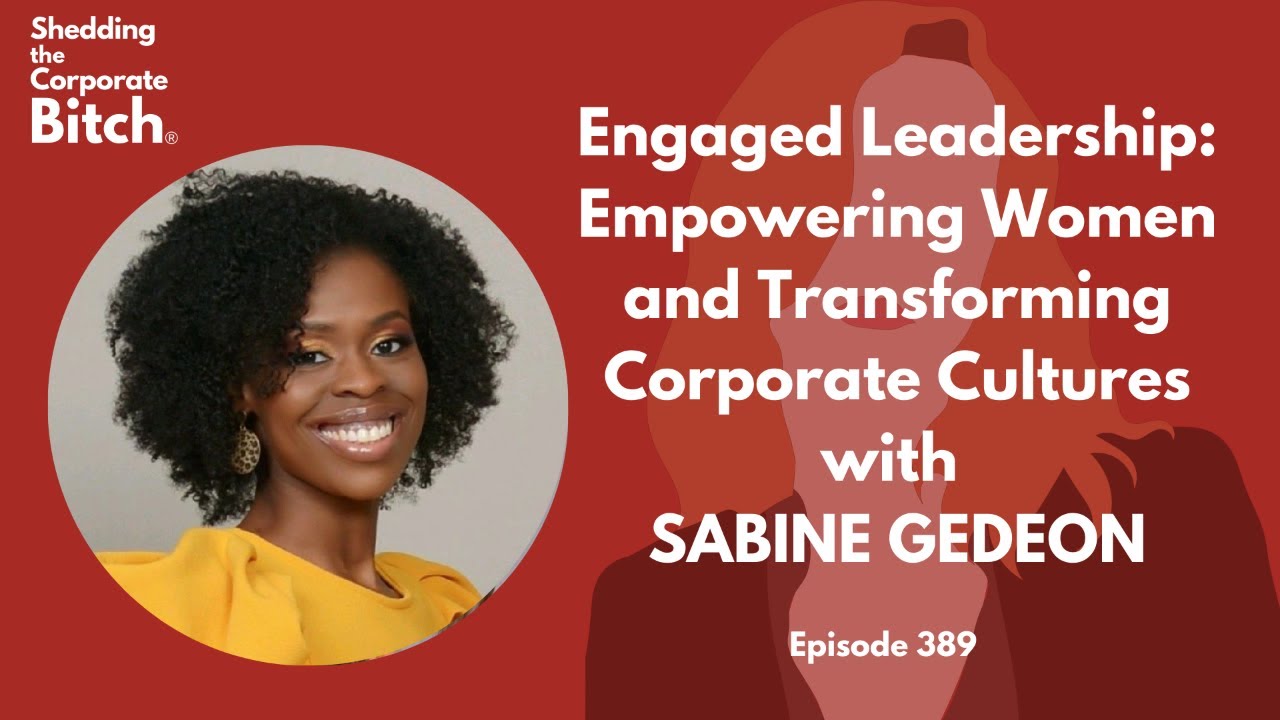
This content was created by Bernadette Boas. This content was uploaded by Bernadette Boas. This is a YouTube-hosted podcast episode titled "Engaged Leadership: Empowering Women and Transforming Corporate Cultures with Sabine Gideon" (published May 28, 2024). It is an interview-style conversation hosted by Bernadette Boas (Shedding the Corporate Bitch / Ball of Fire Coaching) with guest Sabine Gideon of Gideon Enterprises. They discuss engaged leadership, rehumanizing leadership, women owning their power versus being merely "empowered," social capital, handling difficult conversations, feedback, and Sabine's work (including her book Leadhership Reloaded and free resources at sabinegideon.com/gifts).
Chapters
It's time for women to take control of creating their own career paths, becoming engaged leaders that others can't ignore, and changing the status quo of corporate leadership. Because today's business cultures are just not cutting it for the people, the leaders themselves, and the businesses. Our guest, Sabine Gideon of Gideon Enterprises, is here to help all of us learn How to become the engaged leader that demands power, influence, and authority. Help connect on a personal level with your own people so that you understand what they need to be successful, and in turn, you're successful. And how to stop minimizing your worth by being empowered versus you're already powerful. All this goes hand in hand with providing the support and leadership your people and company wants. Even, even when it comes to having difficult conversations with them. So let's become those powerhouse leaders. Stay with us. Welcome, welcome, welcome to Shading the Corporate Bitch, the podcast that transforms female corporate executives into powerhouse leaders by showing them how to shed the challenges and overwhelm along with any fear, insecurity, self-doubt, and negativity holding them back. I'm your host, Bernadette Boas of Ball of Fire Coaching, bringing you powerhouse discussions each week to share tips, advice, and sometimes tough love so you create the riches in your work and life you deserve. Let's do this. Sabine, welcome, welcome. How are you?
I am well. Thank you so much, Bernadette, for having me. I'm excited to be here.
Oh, I'm excited to have you here. And we're going to be talking a lot about a lot of different things— engaged leadership, gender equity, social capital. But before we do, I always like my listeners and viewers to get to know the guests on a more personal level so they can relate to them and maybe find an opportunity to connect. So what should we know outside of the workplace about Sabine?
Yeah, thank you for that question. And so I, as I was sharing with you before, I'm actually an immigrant from Haiti. I migrated here just shy of 4 years, being 4 years old. And I grew up in Connecticut. And so now I live in San Diego, California, which I feel like is the opposite side of the world. But having been an immigrant and first generation of a lot of things, I had to learn a lot of things the hard way, which is why I'm excited to have this conversation, because I think it is my background and my earlier upbringing that helped me navigate the world of corporate and now entrepreneurship in the way that I've been able to do so. I'm excited.
Yeah, good, good. And what took you out to San Diego, though?
Oh, that is a long story, but I'll make it short. It was— I came out here for an event, and it was the first time that I was here in California. I had made the transition out of corporate America with no clients, no idea what I was doing, just a hope and a wish and a whisper from God, basically. And after being here for a weekend event, when I went back, and I had already been in the space where I was praying, like, where's the next place that I'm going to be sent to? And it came back here at California, Southern California, San Diego. Like, the way everything just opened itself, like, you know, there's those times in those periods in life where things— doors just open and it's so effortless. So that's what led me out here to San Diego. Some days I'm still trying to figure out what I'm supposed to be doing out here, but I was obedient and I'm here.
Right now, that's all. And you, you'll find your footing, and you're young enough to find that footing and figure out, you know, what exactly your purpose is. But you support corporate professionals now, probably along with some entrepreneurs. So, and being that you have that experience, um, that's going to be awesome in regards to what it is that we want to talk about today. So let's dive into that, because what I first want to understand from you and your viewpoint is how do you perceive engaged leadership to be? What does that look like for one of our listeners or viewers?
Yeah, so that, that is a loaded question in itself in the sense that leadership or the definition or the expectations of leadership is shifting so quickly in our environment and in the workplace. So I know people are tired of hearing about the pandemic, but really it is the catalyst for so much of the change that we've seen. So, you know, we went from environments where it was very command and control, uh, you know, hierarchical, and that's how it was, where now we're seeing the shift of, you know, almost like the inmates are running, running the, the shop here, in the sense that, you know, uh, employees are recognizing like, hey, we spend a lot of time here, and therefore, you know, we want to have a say in what our day-to-day looks like. We want to have a say in the decisions that are impacting us. And it's really challenged leaders to move away from, hey, all I'm going to focus on is, you know, these core competencies, as you know, right? Like the traditional core competencies of business acumen, strategic thinking, and all those pieces. Those are important, don't get me wrong. We need that, we need that piece. But you look at the competencies that have risen to the top over the last, uh, couple of years. So we're looking at empathy, we're looking at communication, emotional intelligence was always up there, but it's become the things that were considered soft skills, if you will. Now they are at the top. And I heard someone refer to them as power skills versus soft skills. And I loved that reframe of it because that is where you get to really connect with people. When you take away the role, you take away the stuff, if you will, of the doing. And you look at the way that we're being, that's what shifts. And that's what allows you to not only, you know, cast your vision, but to get people to buy in and move towards that. And so to me, engaged leadership is that space where you are now marrying the business results, the hard skills, if you will, with the power skills, and that you are tuned into not only what's happening in the marketplace, but what's happening in the workplace with the actual individuals who are supporting you to reach whatever mission or goal that you have.
Love that. Absolutely love that. And, and what really was popping up for me at first, I'm sitting there going, yeah, they need to figure out how to be more flexible and more, you know, and more adaptable and, you know, whatnot. But yet you brought in the whole empathy, the, you know, emotional intelligence aspect of it, uh, meaning and meaning go heart to heart, right? It's go heart to heart as opposed to almost brain to brain. We need to get more empathetic. Leaders need to be more engaging, more collaborative, get to know their people. Is that what you would include in all of that?
Absolutely. Even in my book, I talk about redefining and rehumanizing leadership. I think that that is such a key piece. We need to rehumanize leadership, not just with the people who are sitting in the seats of power, but rehumanizing how we lead ourselves, really rehumanizing how we lead in our homes, in our communities and everything else that it starts with who we are being versus who we are doing, because our being is always going to reflect in how we show up and what we do.
Well, I absolutely love that. And also the whole platform, if I could call it that, of your book, Leadhership Reloaded. So share with us a little bit about that.
Yeah, I'd love to. So what inspired it was really, again, the pandemic, and not necessarily the pandemic, but the conversations following the pandemic. So as we knew, as we know, you know, there was a period of time where there was a mass exodus of individuals leaving their jobs. And when they started to look at the data, they realized that a lot of the people who were impacted and who were making those decisions were women, either because they were now school teachers or they were caretakers or the weight of everything. They just couldn't do it anymore because they were leading at home, they were leading in the workplace. And so what I was triggered by was the narrative where it wasn't this appreciation of the fact that women had been carrying so much in the workplace, in the home, in the community. It was just like, oh, they caused the great resignation. And so it was one of those— everyone has those catalyst moments, right, of those triggering moments where it's just like, wait a minute, wait a minute. Do you not recognize the weight that we had? And then the other piece that triggered me was that women in general— and I know I'm generalizing here— that though we carry this weight in society, there's almost a depreciation of our own value that we have agreed to, if you will, based on societal norms. And I just wanted to shift that narrative because there are women who are plowing, there are women who are game-changing. We may not all end up on the Fortune, you know, top whatever list, but there were women in our day-to-day community who had been doing the work or doing the work or sharing that passion. And so I wanted to create the space where I shifted it away from victimization, if you will, to the place of not even empowerment, but women standing in their power and standing in their truth and being able to own, this is what I do, this is who I am, and this is how I navigate the world. And this is how we— and not to bash men by any means, but this is how we ensure that there is balance and the world operates in the way that it needs to, right?
No, fair enough, fair enough. So you, you made mention in that piece about we've agreed to it. So break that down a little bit so we can all get real as far as what your, what your observations, you know, were around us agreeing to the devaluing of our, you know, almost like our social capital.
Yeah, yeah, great question. And so I know that is a harsh thing to say in a very broad generalization, right? So I'll put it out there.. But when I think about narratives, and I'll give an example of something that I hear quite often, and I'm sure you do too, right? So conversations around imposter syndrome, right? So, you know, at one point it was great. This is my opinion. At one point it was great because it finally gave language to that feeling that we all, or that experience that we all had. But you notice how here we are still in 2024. We're referring to imposter syndrome and it's always targeted towards women. Men and women experience imposter syndrome, but it went from something that was meant to empower us in a sense for us to give language to, to now it becomes the thing that we identify with as, okay, I have imposter syndrome, which is fine because we all experience it. But now I feel like it's a— consciously it is a hindrance. Another thing is this whole notion of the empowered woman. Right. And so, again, at one point it was about like, yes, you are great, you are powerful. But then when you really dig down behind it, at least from my perspective, when we think about empowered, right, there's a level of that or there's an undercurrent of that that almost insinuates that it was power being given. Right, that it is almost a permission that we've been given to, quote unquote, be empowered. Why are we empowered and why are we not powerful? We don't go around talking about men being empowered, right? They just stand in their power. So it's been a couple of things that I've noticed that not only were they assigned to us, but that we received and we accepted and we welcomed and we just kind of stood there versus questioning Well, why am I empowered and not powerful?
Right, right. You know, I— all I can say is amen, amen to that. And I think I even, you know, if I were to look back, not in the last like 10 years but prior to that, I probably would have to agree that I gave a lot of my power, uh, away by finding that it's around empowerment and not the fact that I was powerful and I had influence and I had value and worth. Um, so yes, I can see how, uh, that continues, uh, just like you said in regards to your observations. So what do you— what do you say to women that are kind of allowing, you know, that that— what would I call it— that ownership of and that diminishing of their worth and power? What would you say to them to get them to shift from that?
Yeah, so I start with two questions, and they are simple questions, but by, by far the hardest questions for most people to answer. Who are you? And what do you want? And again, very simple questions. However, they're hard to answer because in working with clients and I've asked this question even at workshops, who are you? And everyone goes through, well, I'm a mom, I'm a daughter, I'm a this, I'm this, I'm the VP of this, I'm the executive of that. Okay, let's get through the titles. Let's get through identities. Let's strip all of that away. Who are you? And the truth of the matter is most people can't answer that question. Most people are stumped.
Right.
Because we have taken on the identities that have been given to us since childhood, basically. And we get to a place where we've become all of these things that people, society, our family, culture, you name it, said that we have to be, that we're not even showing up as our authentic self. And as much as that word authentic gets thrown out, right, the truth of the matter is a lot of us, we are being who we thought we needed to be, who we were told we were. And so when you go through that process, and it's a process, don't get me wrong, like, you're not answering that question in one sitting. If you do, like, you should bottle that up and start selling it. This is a process of shedding and decoupling other people from yourself to get to the essence of who you are. Because when you get to that place, when you strip everything else, that's where your power is found. That's where your identity is found. That's where your confidence is rooted in, because no one can take that away from you because no one has given it to you.
Right.
And then from that place, you answer the question, well, what do I want? Then at that place you are now in your creative power. You are then deciding consciously what it is that you want to create in the world around you. And, you know, for people, it— even if they are in a corporate environment, that could just be, this is the type of team that I want to create, or this is the type of culture that I want to create within my team or within the organization or within, you know, whatever the sector it is that I'm working in. This is the type of culture I want to create in my household. So we get to then move away from being unconscious in our day-to-day of just like, I go to work, I do the thing, I come home, to know I am actively co-creating what my experiences are and the experiences of those around me.
Yeah, yeah, powerful, powerful, powerful. The who that you talked about, do You know, is there multiple layers to it in your mind? One, the bigger one being the fact that it's all the labels that society has put on us and that we've, we've just become accustomed of— become accustomed to over the years through our life. And then the second— could a second layer be that there's individuals, many women, that are fearful of acknowledging who they are truly because that could bring up a whole slew of other insecurities and fears that they have?
Yeah, all of the above. Um, Marianne Williamson's poem, Our Deepest Fear, right? It's, it's not the darkness that scares us, but it's the light that, that within us that scares us. And so I, I can quote that, that poem all day long, but when you think about it, it's the, you know, you— we have to dig. We come into this world like almost a clean slate, right? And depending on the challenges or the experiences of our parents and our caretakers and school, uh, teachers and all of that, we are taking on everybody's drama, everybody's thing. And it's almost like by the time we're ready to, to formulate our own thought, we have the thoughts of everyone who was in our space when we didn't have the ability to rationalize or to say, oh, mom's just having a bad day, right? Like, we took that as, okay, I'm bad, or whatever meaning we assign to it. And then we grow up in the world, and at no point in the school system, at no point in general society, is there ever a place where people are encouraged to take some time to get to know yourself. We expect people at the age of 18 to decide what they're going to be for the rest of their lives. Like, how ironic is that? And then we're telling them like, oh, this is the pathway. You pick one path and you go down that. Who said? Who said? At 18, I don't know about you, Bernadette, I didn't know who I am. I'm still discovering who I am. Right. And so it's the system and the way that we're brought up conditions us to be in this space where we just— we're taking in, we're taking in. And then not only are we taking in, but we're just modeling everything that we see. And so I know I love your story and the fact that you were like, I was ambitious, I wanted to be successful, and so I was emulating, you know, what I saw as success. Most of us, even if you're not, you know, overly ambitious, you're still emulating someone, you're emulating something.
Right, unless you're totally in touch with yourself and then it's all you. But 99.9% of us are not, you know, doing that. So what is the drawback? What is the impact to women in leadership and/or their, their path into leadership if they're— they don't get in touch with truly who they are and what they want.
Well, too, you get to live life less than who you could be in the sense of not less than as a person, but not experiencing the full power of your glory and of your essence. That's first and foremost. Second, I'm a true believer that we all have greatness within us. We all have this amazing whatever purpose. That we get to create in the world, this footprint that we get to leave. And so there's that piece. The thing that I'm most— in this particular case is, for many of us, we had to learn the hard way. There are a lot of things that we had to learn the hard way. There are a lot of scrapes, a lot of bruises that we had to learn simply because we didn't have the models in place, like in terms of other women, to show us a pathway that was outside of the norm. So when you think about the daughters and the nieces and the granddaughters who are coming up, if we don't do that, if we don't do the work, then we leave a legacy of young girls who are insecure and riddled in fear and feel like they have to compete with other women and everything else. And so I feel like we have an accountability. This goes back to the leadership that we're all leaders. We have an accountability to do the work, not just for us in our lifetimes and what we get to experience, but that we leave a trail, because I believe success leaves clues. We leave a different trail for the next generation that is coming up so that they don't have to endure what we endured.
Yeah, yeah, absolutely. And there in itself is a great, you know, what you want, you know, a great legacy, a great why for doing everything that one's doing. Uh, I want to kind of then circle back to the main topic of our conversation is leveraging all of this that we just, you know, learned and became maybe even aware of for the first time, but the importance of it. And how can all of that be an engaged leader? How can that help with our relationships with our employees to the point of even handling difficult conversations with them?
Yeah, great question. So I'm going to do this from two spaces, right? So first, engaged leadership. There's a lot of self-leadership that starts there, right? So when it comes to, especially now, you have from a workplace perspective, I admire everyone who is leading others in the workspace because now you have a variety of different things that you have to be aware of., if you will, versus back when I was in corporate, some of these things didn't even have words to them. So from an engaged leadership perspective, you start humanizing it. Every person is individual. So we talked earlier, right? Like, if you just saw me, you'd probably be like, okay, she's a Black woman from San Diego. Actually, I'm not, right? Like, there's a whole nother culture that I was born into. Being from Connecticut, all of these layers have created my lived experiences. From an engaged leadership perspective, before you can even motivate someone, even if the conversation is a happy conversation, you have to know who that person is. You have to understand, well, what is it about them? I remember this one time, and I'll give this example. I was coaching a manager. In this particular case, it was a he. And the individual that he was managing was a young woman who had different life experiences. And he didn't understand that based on his approach, that she felt discriminated against or she felt like she didn't have his support specifically. And so I asked the simple question, and the challenge from an outsider could look like, okay, well, she's not meeting expectations. But when I asked the simple question of, well, what motivates her? They've been working together for a year and a half, Bernadette, and he didn't know the answer to that question. When you think about engaged leadership and having conversations, this is a human being. You can only get people to come along when you understand what's the WIFM. For those, WIFM is what's in it for me. Part of that is getting to know your people, what motivates them, What, you know, what, where do they light up? What are the things that they don't necessarily like to do? What are some of the lived experiences? And you don't have to be a therapist here. I'm not saying become a therapist, but what are some of the lived experiences that might impact the way that they perceive, you know, your feedback or your, um, your constructive criticism, if we want to call it that. So you start by getting to know your people and asking really basic questions upfront and creating the space where people can communicate to you in a way that, one, you're receptive. I think that's another piece, if I can divert here, is that I've had leaders go and not only give feedback but ask people for feedback about themselves. And that is a very humbling experience for leaders. It is. Very humbling. But the point is, you have to be able to receive that feedback because it is a gift. It is a gift. And take action based on that feedback. So anytime that you're giving someone feedback, it should always be a two-way streak. Imagine being in a relationship where you were always telling the person what they weren't doing or what they were doing right, and no one ever said anything to you. Doesn't benefit you.
Yeah, absolutely, absolutely. We have a lot of discussions here about feedback and the importance of it. Um, and so Therefore, are you saying that if you're getting to know your people, you know what motivates them, you know, you know what they want, what they don't want, how they want to be communicated to, how they don't— are you saying that it then makes the difficult conversations you need to have with them and that difficult feedback that you have to deliver to them easier?
Absolutely. Absolutely. I mean, it's, it's like if a stranger walked up to you and they were like, you're ugly. You'd probably look at them like, okay, something's wrong with you, whatever, right? But if someone you cared about or someone who cares about you says that, you're going to have a deeper emotional connection to what it is that person says. It's the same thing. Please don't tell your people they're ugly. But the point is, if people know where the heart from which your feedback is coming and they understand it, I watched something recently. It was a clip by Adam Grant, and he says before he gives people feedback, he'll say something to the effect of, I'm going to give you this feedback because I know you and I trust that you're smart enough, or however he put it, to rise above this, right? Or to rise to this. And so he elevated that person. He encouraged that person before he gave the feedback. And so that's people. We're people. We want to be encouraged. We want to be motivated, and we'll take feedback. But with the heart that this person who's giving the feedback actually wants to see me win and wants to support me so that I could get to the next level.
Gosh, I— yes, I absolutely agree. And I know exactly which Adam Grant clip that you were talking about. I saw the same one, and it is— it's, it's so dead on, you know. And how do you kind of inform your clients to look in the mirror And think about what do you want in regards to feedback from your, from, you know, your peers, your employees, your people, or I'm sorry, your bosses. And therefore, isn't that what your employees would want too?
Yeah.
Does that make sense?
It does. It does. And so I'm thinking about a client in particular, and in this case, this person wanted to give some feedback to someone that they were coaching or they were mentoring the way that the organization is structured. The person is working on their project, but it's not a direct report. And so, you know, as we're going through the coaching process and the feedback for this person to give, you know, the client had some resistance because they were like, I don't need that. Like, I don't do that with my manager, or I don't get that. And I was just like, pause. Pause. We're supporting this person. This is what this person needs. You may not need that, or you may not get that. It doesn't mean that it's not needed, and it doesn't mean that it wouldn't support you. So I think the other piece too is oftentimes we lead and we coach and we mentor in the same manner in which we were led and we were coached and we were mentored, which again, it makes sense, right? We're modeling what's in our environment. But at some point we have to say, okay, just because I was coached and mentored and led that way, is that— was that the best for me? Did I appreciate that? Did I gain anything out of that? If I could go back to a younger version of myself, what would she have needed? And then show up. I mean, obviously don't project that onto the other person, but show up as what you needed, not what you necessarily got or experienced.
Absolutely. And wouldn't you say to that person, go and ask for the information you want. If you know, if you want this now, you can go and ask and tell your, your boss what it is that you need and want in order to be, you know, more successful. I love this. We— I mean, we could go on forever and there's so much more we could talk about. So we'll definitely have to kind of like think about how we can bring you back. But what would you leave our listeners and viewers with when it does come to being an engaged leader and using it in in all the ways of building their own social capital, their own influence, their own power, you know, and it, yes, it supports their employees and providing and helping with difficult conversations. But what would you say to them so they can be that power for that powerhouse, as we say here, leader?
Yeah, great question. And so I'll use a quote from Oprah. You get what you have the courage to ask for. I think I'm paraphrasing here, right? So this goes both ways. When it comes to you leading others and understanding how to best lead them, it starts with asking them, how can I best lead you? How can I best support you? What is it that you need? And then at the same time, being courageous enough to ask those around you, whether it is your direct reports, whether it is your senior leadership or others, what it is that you need to be supported. Um, because again, just because you don't have something or you haven't gotten something doesn't mean that it's not available, right?
Yeah. Sabine, Sabine, Sabine, this has been fantastic. Now I know you have a number of free resources, um, on your website at sabinegideon.com/gifts. So everyone first check her out at sabinegideon.com, but then put that /gifts on there and you'll find some resources. Tell us a little bit briefly about what you have for them.
Yeah, so on the site I've created a bunch of, what do you call it, workbooks and guides around procrastination, around mindset, around leadership. So you can find that there as well. Um, also you'll see link to my podcast, which I need to update because it's now, um, Women of Power, Purpose, and Prosperity. No longer She Leads Now, but you'll have access to that. And so once you sign up for these gifts, they're free downloads and you can get them immediately and be part of the larger community.
Great. Stop. Okay, I'm going to have you repeat and take out everything about your podcast. Use the real name that it's going to be.
Okay.
By the time this comes out in May or June, I would suspect it's going to be done.
Okay, fair.
And plus, we don't want to do a fix. Like, we don't want to, like, have you diminished, you know, by going, oh well, it's not really that anymore. Um, okay. Um, all right, so I'm going to start with the question again. Okay. All right, so yeah, you're welcome. Absolutely. Um, all right, Sabine, I know you have a lot of great gifts and resources on your website at sabinegideon.com/gifts. Tell us, what do we get?
Yeah, thank you for that. So when you go to the website, you will, uh, be able to grab some free downloads around mindset, around procrastination, time management, leadership. Um, and you'll also get access to the link to my, uh, my podcast, which is Women of Purpose, Power, and Prosperity.
Awesome. This has been fantastic, Sabine. Thank you so much for all that wealth and knowledge. I greatly appreciate it.
Thank you, Bernadette. It was an honor to be on the show.
And everybody, please, sabinegideon.com. Check her out. Also follow her on LinkedIn. Look up Sabine Gideon. Look for that smile. And for those listening, just, you know, put in there Sabine Gideon. And then of course, grab her gifts at sabinegideon.com/gifts. Again, thank you. And I'll look forward to staying connected with you.
Same here. Thank you.
You're welcome. I noticed in this conversation with Sabine that I say I love it a lot. And I do. I loved it. She was such a powerhouse, providing us some great tips, strategies, and even experiences of her own and her own clients when it comes to becoming that engaged leader. And yes, difficult conversations was an element of it. But at the same time, it was really how do you get to the point of being an engaged leader? Because until you get there, Can you have that confidence and that certainty and that self-belief to where there's no such thing as difficult conversations? It just is a conversation between two people to ensure that we're adding value to them. And maybe if we're doing our own self-assessment, as she recommends, that we're also getting value from those discussions. It's not enough for women to feel empowered. That's almost kind of diminishing the fact that you're already powerful. I just absolutely loved the little, you know, just droppings that she, that she had throughout the discussion. She had so many great tidbits to offer us. And I'm curious, what did you walk away with? What will you start really thinking about and considering and shifting into? Or what kind of tip did you walk away with that you can start leveraging even with your people at work? I'd love to know. So you can be sure to follow me on LinkedIn and leave me a comment. Or if you have any questions for Sabine or myself, you can leave them there. And of course, if you have any challenges of your own to become that powerhouse leader for yourself, for your team, and for your business, then be sure to book a call with me and let's chat. And I'm so glad that you were here with us this week, and I'll look forward to having you for another episode of Shedding the Corporate Bitch.
Bye!
More from Bernadette



From Stuck to Leading, Episode 2 — Meet the 5 Inner Fears Destroying Your Leadership



