Find Positivity with the Blind Blogger, Maxwell Ivey
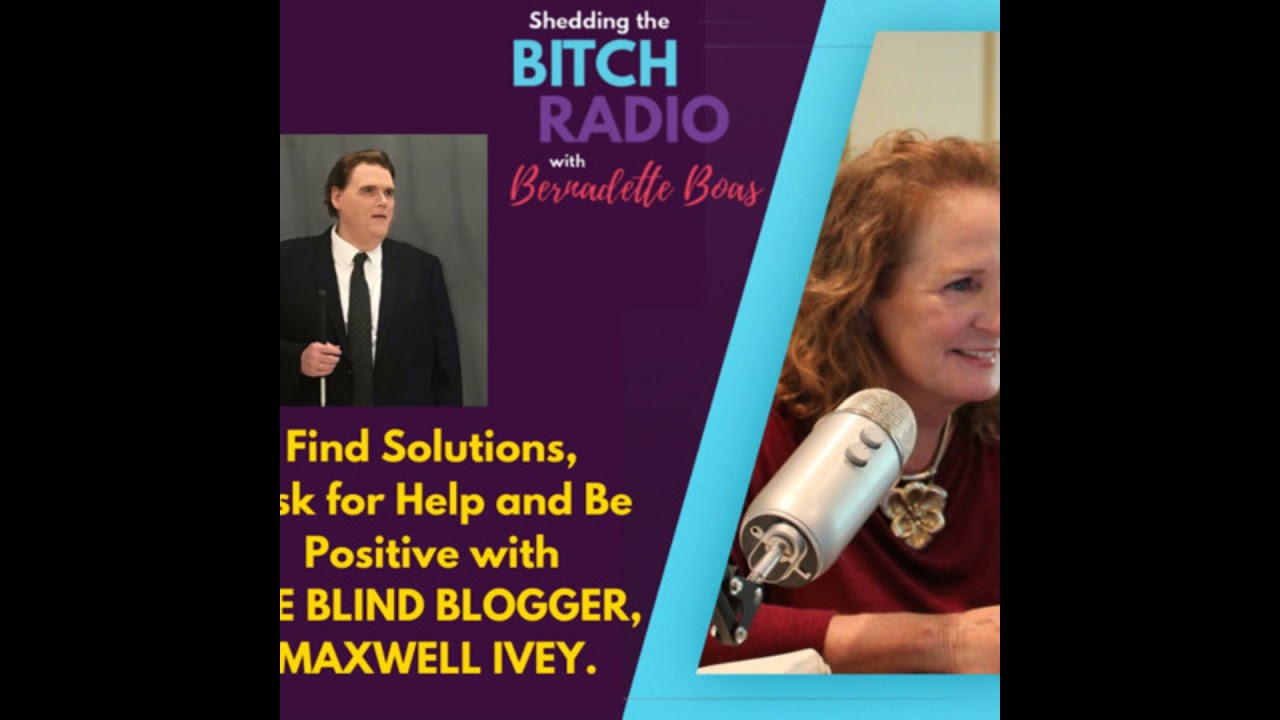
In this Shedding the Bitch Radio episode, host Bernadette Boas interviews Maxwell Ivey, known as the Blind Blogger. The conversation weaves through Ivey’s life story—from growing up in a Texas carnival family, confronting progressive vision loss due to retinitis pigmentosa, and losing his father—to reinventing himself as an amusement‑equipment broker, self‑taught web developer, author, speaker, and online media publicist. Ivey shares three guiding principles: (1) actively seeking solutions, (2) asking for help without shame, and (3) cultivating positivity. He details practical tactics for building community (e.g., Facebook groups, email outreach, free publicity course), navigating travel blind (relying on strangers, canes, dogs, or asking for assistance), and turning inspiration into concrete action. The dialogue also highlights the importance of mentorship, gratitude, and giving back, while emphasizing that asking for help benefits both the asker and the helper. Ivey promotes his books—Leading You Out of the Darkness into the Light and the Blind Blogger travel series—and his free 3‑hour publicity course that teaches entrepreneurs how to leverage podcasts, radio, and social media. Throughout, the host reinforces the episode’s “rich question” about improving willingness to ask for help, framing the discussion as a roadmap for listeners to shift from fear and self‑doubt to proactive, solution‑oriented mindsets.
Chapters
Hello and welcome to Shedding the Bitch Radio, where you can discuss, debate, and get advice on how to discover and shed the bitches of fear, insecurity, self-doubt, and negative mindsets so you can realize your dreams and life purpose and create and accelerate the riches you want in life. Join us here live every Tuesday at noon Eastern and dialogue with us at 818-572-2910. You can also chat with us at blogtalkradio.com/sheddingthebitch or share your stories on our website at sheddingthebitch.com. Whatever the bitch is that's holding you back from living your life to the fullest, it's not worth giving up the riches in life that you deserve. So call in now and let Bernadette Boas know what's holding you back. 818-572-2910.
Welcome, welcome, welcome everyone to another episode of Shedding the Bitch Radio, and I'm so excited about today's conversation because not only is our guest very enthralling and has a magnificent backstory, but at the same time he gets really simple about finding solutions, finding help, and finding ways for you to become positive. And he wants to share those principles that he's learned and he's gained and he uses in his own life, um, in order to then help you in yours. So Before we get there, before I introduce our, our lovely guest for today, um, I just want to thank, as I do each and every week, I want to thank all of our new viewers and listeners. You're finding us on our YouTube channel, Shedding the Bitch TV. You're finding us on BlogTalkRadio, Shedding the Bitch Radio, and you're also finding us on any one of the streaming services, whether it's Apple Podcasts, Stitcher, iTunes, and a number of other, other ones as well. And you're providing us ratings, likes, follows, subscriptions, comments, suggestions on topics and on guests. So please, please, please continue to do that and be sure that you're even, even subscribing and following and liking this particular episode. All right, and then always go back to ballofirecoaching.com or to blogtalkradio.com to get any other of the episodes that we've had over the number of years we've been online. So we are grateful for that, as well as we can't do this without two groups of people. One is our ongoing tribe, community, fellowship viewers, and so grateful, so grateful that you continue to go out to shed the bitch TV on YouTube, going to Shedding the Bitch on Facebook because we stream there, uh, BlogTalkRadio and any other streaming services. And, and again, continue to provide us that feedback, suggestions on topics and guests, and help us to really ensure that we're bringing the best and most, you know, high-quality topics and guests, uh, and discussions to Shedding the Bitch Radio. All right, thank you so, so much. And of course We couldn't do this without the support of our ongoing sponsor, North Georgia Tax Solutions. Debbie Snelling and her team, a magnificent team, provide full-service financial and tax services to small to corporate-sized companies and individuals all around the country, not just North Georgia, all around the country. So be sure to reach out and, um, and learn how she might be able to support you and your business or personal financial and tax needs. You can go to ngtaxsolutions.com for more information. Tell her I said hi, if you would. All right. Okay, so let me introduce our topic before we introduce our guests. We're going to be again talking about the 3 principles of finding solutions, asking for help, and also determining how you can find positivity in your, in your day when maybe things aren't going so well, all right? Now, a rich question that I have for you today and for our guests and for all of those new viewers and listeners, a rich question is something that I ask you to really consider and ground yourself on as we get into a conversation. So you might show up thinking, "Oh, well, this really doesn't apply to me," when in actuality, it most definitely does. So your rich question today is, how can you improve your willingness and ability to ask for help and find solutions? Because many of us don't. We try to do all these things on our own, and we really don't need to be. You don't need to be. So I want you to be thinking about how can you be improving asking for help and finding solutions to whatever challenge or opportunity that might be going on in your life. All right, consider that as we get into this conversation with our guest. And our guest is Maxwell Ivy. He is known around the world as the Blind Blogger who has transformed himself from a failed carnival owner to respected amusement equipment broker to award-winning self-help author, motivational speaker, online media publicist, and host of What's Your Excuse? So I want to welcome and bring in Maxwell. How are you, Max?
I'm doing great. How are you doing, Bernadette Boas?
I am doing fabulous. So where do you reside? Where are you hanging out today?
I live in Conroe, Texas, which is just a little north of Houston.
Very cool, very cool. And what's it like there these days?
Well, today it's hot. We'll probably get into the 80s, if not 90s, but we're expecting thunderstorms and a lot of rain. We've been told to expect about 9 out of the next 10 days to have rain.
Oh, oh, oh.
And we're already well ahead of our spring rain time, or spring, if not annual rain totals. We had 11 inches of rain in May and We generally get 21 inches of rain for the whole year.
Oh wow, oh wow, oh wow. Well, prayers to you and your entire community because seriously, because you know, water, water, water can be, you know, can create very dangerous situations. So please, please, I hope you and everyone through that region stay safe and sound.
Well, we appreciate the the prayers and the encouragement because this area is generally fairly flat, so it doesn't take much rain to cause street flooding, home flooding.
Yeah. Well, stay safe. Stay safe.
We will.
Thank you.
You're very welcome. All right. So I want to kind of go back and really kind of learn and help our listeners and our viewers learn about your own backstory, about where you come from, and more importantly, because it's a big part of your story as a blind blogger, but what is your experience been? Have you been blind since childhood? Did it happen at a certain point in time? And kind of what has that done, you know, to your approach and your attitude toward life and living?
Sure. Well, first, I grew up in a family of carnival owners here in Texas.
Wow.
Yeah, all I ever wanted to do was to be in the business and be the next generation. I also, from an early age, knew that I was going to lose most, if not all, of my vision to retinitis pigmentosa, or what most people call RP.
Okay.
So, And I think both of those things kind of went together because when you grow up in a family that runs a small business, especially one that has so many difficulties and is dependent on, you know, a lot of variables that you have no control over.
Sure.
I learned from an early age that you're never going to have all the resources, talents, or skills you want to. So you just have to find a way. And you know, the most important thing you do with a carnival or a circus or a rodeo is get open. So no matter what happens during the week, you know that nobody cares what your obstacles were. All they want to know is can they ride the Ferris wheel and buy a funnel cake on Thursday or Friday night. And if they can't, then you're in trouble. So you know, you've You find you have like a— I was once told I've taken a graduate level course in creative solution finding.
I bet.
Yeah, yeah. And the other thing is, you know, my vision, it was— I had perfect vision at first. It decreased gradually. I was diagnosed at 5 that I had this and it continued to go gradually until I entered junior high school. I had a big drop-off of vision then, which is fairly common for men with RP. We tend to have a big vision loss during puberty. It stayed constant until I graduated from college, and then it decreased quite a bit again down to what I have now, which is light perception, or what I think of as total blindness because I think it makes it easier for most people to understand and talk about.
Right, right.
But going back to how this affected me, My vision was never the same from one day to the next, you know, one month to the next, or a year. So, I, you know, over a few years I went from being able to read a regular print book in a dark room to having to have more light, to having to have a magnifier, to, you know, using larger print books, to using a screen, a closed-circuit television that would blow up the print and put it on a screen. And then eventually having to go to audio and learning to read Braille. And so all these, you know, continual adjustments, they basically taught me, you know, you don't have much control over things, so the best you can do is just deal with what you do have control over. And it really taught me flexibility and adaptability and learning to accept the situation as it is and do the best with it that you can at that moment. And of course, you know, whenever you have a setback or, you know, you have disappointments and failures, you will learn that your decision that you made at the beginning, you know, is probably not the best thing you could have done.— but all we can do is the best we can today. So, you know, and I find a lot of people, you know, they get caught in those decisions they wish they could have back kind of situations, and my vision loss pretty much taught me that I didn't have that luxury.
Right. But was there a point for those that have gone through some trauma, some tragedy, some, you know, real challenging obstacles like you. Was there a point though where you kind of were questioning why me, you know, that you went through the anger stage and all the other stages they talk about when it comes to loss or grief, or did it— was it gradual as you explained from 5 to college to where you just simply were, you know, adapted and, you know, and I would give you— I would say resilience, courage, Courageous, brave. I would add all those in there as well.
Right. There were, there were moments, but they didn't last. And, you know, I like to tell people that I was blessed to be in a great situation because my family were not the kind of people who suffered you feeling sorry for yourself, you know, and in our family, you If you cried about something, that meant you weren't— that meant you were wasting time you could spend on, you know, what are we going to do about it? I went to good schools. And one thing that I do appreciate more than a lot of people do is your education in the US depends a lot, a big, you know, just a huge amount of your experience depends on where you're born and where you go to school. And I was lucky enough to live in a district— that had money, so they had orientation and mobility instructors, Braille teachers. They had people in their special education area that actually wanted to teach us how to learn and how to get through the difficulties of being a blind student as opposed to just pushing us through the system and making sure we were there each day so they would get paid for us until we graduated kind of a situation. That was very good. I had strong family, optimistic, positive people who did stuff and who wanted everybody else to do stuff too. Then in high school, I found a scout troop here in the Houston area for visually impaired boys, and that helped out a lot. Along the way, I've had a lot of great role models, great experiences. For the most part, other than maybe a few hours or a day or two along the way, for the most part it was all more about what do we do next than it was about, oh, this is a horrible situation. I know I've read books from some other visually impaired people, people with disabilities, people who have been through trauma. I mean, heck, I've had some of them on my podcast. I know how blessed I am not to have had the, you know, considered suicide stage that some of them have gone through, you know, the depression, the anxiety, the anger. I am so blessed not to have had much time in, in that purgatory, let's call it.
So yeah, what a great way, what a great way to live, right? I mean, what a great way to handle a, you know, a hardship and an obstacle that so many, like you said, could go down the wrong path, and yet because of your family, because of your surroundings, you were able to kind of ignore all of that and just move forward. I mean, God, that's— we should all learn.
Yeah, you know, people, they say that it takes a village, and most people say it tongue-in-cheek, like, yeah, it takes a village. But, you know, in most people's cases, there has to be those influences. That's the difference between, you know, somebody who's born in poverty in Africa that becomes a success and somebody who's born in good surroundings in the U.S. and becomes a drug addict. It is so true. And it's not only the people, it's the lessons that they teach us and the way we accept and internalize those messages.
Yeah, I absolutely agree. Now, Let me ask you something, Max. Would you say that if, if you were talking to someone and being a speaker and an author that you are, when you're speaking to someone that doesn't have those, those fortunate, you know, tribes and fortunate resources, what do you suggest that they do? What are some things that they could do to kind of then build their own network on their their own so they don't kind of, you know, hold to the, to the past and the regret and the self-loathing and victimhood.
Right. And I appreciate the question. I have a good friend named Alex Sanfilippo, and he's a longtime business coach. One of his favorite quotes is, the best time to plant a tree is 20 years ago. The next best time to plant a tree is today. So I would encourage people to start building the community today. And I I do a lot of interviews and I always, always make sure I mention this. On my website, you know, there's a contact form and people don't have to want to buy something from me or hire me in order to reach out to me. So if you don't have at least one person in your community right now who you can share what's going on and they will listen, try to understand, and offer at least one kind word, then start with Max. If not, you know, at the beginning of this interview you mentioned your platform, the Facebook group. I would imagine that a Facebook group for Shedding the Bits Radio, Shedding the Bits TV, is full of lots of confident, positive, encouraging types of folks. So I would say that would, you know, my group, the What's Your Excuse group over on Facebook, same thing, very encouraging, upbuilding, supportive. So if you don't have those people, then then why don't you have one? And I would say, you know, reach out and say hi. And, you know, you don't have to share your entire life story on day one, but that would be what I would suggest to people. And in my first book, Leading You Out of the Darkness into the Light, one of the things I did in there that I'm really proud of was to include my email address so that people who were working on the exercises in that book would have at least one positive voice that they could share their progress or their frustrations with.
Right, right. And please repeat the name of your book again.
My first book, Leading You Out of the Darkness into the Light: A Blind Man's Inspirational Guide to Success. And it shares my— a little bit of my journey from wanting to be carnival owner to being the person that I am now. But, you know, it has a lot of practical advice. And, and in addition to my email, I also give people my answers to the same exercises that are included in the book.
Fabulous. Well, oh my God, that's so unique. That is awesome. Well, everybody wants to relate, so if you're willing to kind of disclose and be open and, you know, and authentic and transparent. I mean, how, how great is that to help others do the same?
Well, I appreciate that. It's a very high compliment coming from you. And, and that's what I did when I was working on the book was ask myself, what do people really want and need? And my overriding desire was I didn't want this to be a book that somebody would read and it wouldn't affect them. 'Cause you know, you know, there are lots of people who have read the book, listened to the audio, they've gone to the seminar, and they still haven't taken any action to become the person that they want to be. And I, I really didn't want it to be that kind of a book. So I appreciate the compliment.
Yeah, no, absolutely. Anything I always say to people, and it's a program that I have, it's called It's Not a Woo Woo, It's a How To.
I like that.
Yeah, because it's like, you know, yes, it's great to give all this inspiration and all this motivation to people, but unless they put it to work for them, then, you know, it's for naught. And so I love that. I love, love— and they can get all of your, all of your information on your books on theblindblogger.net, correct?
Yes, yes. And I just wanted to comment on what you said there about Inspiration without action doesn't really accomplish anything. People have often asked me how I feel when others say that I inspire them or I'm an inspiration. At first it made me mad because I personally didn't see myself as being that kind of a person. It made me uncomfortable, but eventually I came to this conclusion, which is if you're going to call me an inspiration, tell me what did I inspire you to do. I want to hear at least one concrete action you took because of my inspiring story because I agree with you. Inspiration without action is meaningless.
Right.
So true.
I love that. Absolutely love that. So everybody, while we're talking, theblindblogger.net. Be sure to go out there and check him out. All right. So you are— So you're being raised in a carnival family, which is fascinating because I used to love carnivals. Well, I still do, I just don't find any where I am. But, and then you kind of went, switched over to being more of a, like the carnival rides and the equipment and whatnot. So what was that? What was that transformation and how did that influence you? Your life?
Well, that happened. That was one of those transformations I didn't plan on and, and for a long time didn't enjoy and even had a little trouble getting past. I had more trouble getting past no longer being a carnival owner than I had dealing with my vision loss.
Oh wow.
Oh yeah, yeah, because I didn't just— here's what happened. In 2003, my dad passed away to lung cancer. So at one— in one short day, I lost my father, my best friend, my business partner, the most encouraging and uplifting, upbeat people that I've ever known. And so for a couple years, we were able to keep the carnival going and then we weren't able to pay our insurance. So we had to go into business with my uncle's carnival. Now, my uncle and his family had competed with my family bitterly over the years for bookings. To the point of if it— if it— if we could tell the stories, it could be a soap opera kind of a situation. And so it was like, hey, if we're going to lose, why do we have to lose to them? I mean, there's other carnivals in the country. Why these people? So, yeah, so then that, you know, exacerbated my dis— you know, just discontent with my life, uh, how things weren't going where I wanted them to go. And I put on— I was never healthy, so I put— started putting on more weight. Um, and eventually I had a health emergency. A doctor in, uh, in Victoria, Texas told me that if I didn't change my life, I would probably not be around longer, much longer. And he said, I'm not talking years, I'm talking months. So, oh wow. Yeah, so I went home and I saw a primary care doctor. They put me on about 7 different medicines and told me I needed to get healthier, and I started exercising. I improved my diet a little bit, and she diagnosed me as having sleep apnea. And once we treated the sleep apnea with a CPAP machine where I was getting quality sleep and quality rest again, that basically lifted the veil. You know, it was like the passion, the curiosity, it was like the person I was was 20 years ago was back. And I'm like, okay, I'm no longer a car dealer, what do I do about it? And what do I know? At that point I thought, well, the only thing I know how to do is to help other people sell used rides, which is what I did. And I started this website midwaymarketplace.com in September of 2007. And I had no clue about having an online business. It was like, sometimes every day or several times a day I'd be having to learn new things, starting from filing for a domain name and creating the website. And yeah, at that time there was no WordPress, Wi-Fi, or Facebook, so the only way for me to create a website at that time is I had to learn how to code HTML. And I did that for 5 years, and we estimate I coded over 2 million lines of code because Wow. Yeah, because I didn't just have the website with the equipment that was for sale. I had links to all sorts of businesses around the world that people would have need of if they were in the amusement industry, from party hire companies to the people who supply the t-shirt printing to the ticket sales, you know. And so, you know, the website was huge. I also had to learn how to recruit clients and figure out what to charge them. Get them to sign up to my email list or return my phone calls. There were so many things I had to earn. And people said, "You know, Max, we're really inspired by how you continue to take on difficult challenges." This would have been after Facebook came along and I started building a following over there. And they said, "We would really like to hear more of what it's like to be a blind person, especially to be an entrepreneur who happens to be blind." Eventually, that's when I started TheBlindBlogger.net. Now, I fought that whole idea for 2 years. I have a really close friend. We talked about community earlier. Her name is Adrienne Smith and I call her my blogging mama because she taught me everything I know about blog commenting, relationship building, relationship marketing, online relationship marketing. And really helped me get my feet under me as far as building the Midway Marketplace and then again once I started the Blind Blogger. In fact, the first post on the BlindBlogger.net is, "I think I'm ready to be an inspiration." So it was really good. We finally got to that point from owning a carnival to losing a carnival to selling carnival rides to now sharing my experiences, both past and present, and the lessons that I've learned from, you know, all these years of experience of hard knocks, as they would say, in hopes of helping other people not have to go through some of the things I've gone through to get to this point in their lives.
Right, right. Well, I think the biggest lesson that I'm taking away from this too, uh, that's kind of keep screaming in my ear as you share your story is those who are, you know, I don't know what the term is, fully capable, you know, we could go with that. Yeah, I mean, they have no excuse for doing what they need to do and go after what it is that they want when there's others who, you know, who aren't fully capable, and yet they do it. And they not only do it, but they achieve it.
Oh, I'm— I laughed the first time because of the way you said it. I laughed the second time because that's exactly the argument my, my blogging mama Adrienne had to make with me for 2 years before I finally started this whole thing.
Yeah, well, you're like the perfect person to— not only your story, but also your nature and your, you know, just the vibe people probably get from you. At least I am. That you have so much to share as far as just not only overcoming. I mean, like you said, that is not something you focus on. You just focus on finding solutions, finding help, and staying positive and recognizing that all those things are going to help you get where you want to go. And that's such a beautiful thing. That is such a beautiful thing. Now, when it comes to the blogging, what really kind of motivates you? What inspires you? What kind of, you know, especially after the 2 years that she, that Andrea was beating it into you to do it, what have you gotten from it? Let alone given. But what have you gotten from it and how has that kind of propelled, you know, what it is that you're going after in life?
I've gotten the occasional times when people allow you to see the effect you've had on them. Now, you're, as a fellow show host, you know this as well as, if not better than I do, we have an effect on so many more people than we hear from. Oh yeah, very few people will find the, the freedom to leave a comment on your social media page or your blog page or send you an email. That's just the way it is. Um, and some people, they go off and they do amazing things and you never hear about it. But there have been those few times where I've gotten to see other people's progress. I have gotten to see the, the effect I had on them and and what they were able to do with it because in the bottom line of it, while I may encourage somebody to start, they're the ones that keep going. So, you know, to have those small parts and some big stories is amazing. And then, you know, what I get from it personally is that, you know, I— when I was in junior high school and high school, I loved to write. I loved to tell stories. And when you grow up in the family that I did, storytelling is an art. It's also a defense mechanism because if there's nobody showing up to an event or if you're getting rained out, then people will gather under somebody's game booth or at the back of the cotton candy stand and they'll tell stories. So the writing and the blogging, you know, it brings back my love of writing and storytelling and I appreciate somebody else's story much better, even better than my own. So that's something I definitely get out of blogging even with the technical problems of actually creating the blog and sharing the blog and keeping up with all the updates to websites and search engine optimization and all that junk that none of us like.
Right.
But when you, but when you hear somebody, you know, leave a comment that along what you said earlier, because many people have said it, when you see somebody leave a comment that say, hey, um, after reading this, I'm like, if Max can do it, then what's my excuse? And those are, those are very wonderful, very valuable, and very precious.
And so that's fascinating. That's awesome. That's so awesome because obviously we're all wanting to spread our, you know, wanting to spread our knowledge and our experiences, lessons learned, best practices, our story. And yes, we don't necessarily need to hear or see, you know, how, how those things are impacting, but at the same time, we, we all want validation, right?
Yes, which is why I have seen bloggers and podcasters get more upset by lack of comments than they have by lack of traffic.
Right, right, right. Yeah. I mean, I've been doing my show for a long time and you would think I would have thousands or hundreds of thousands of comments and likes and whatnot. And I don't, I don't take it personally. I don't take it personally.
You know, I even have a standing offer that if, if people will go and leave an honest review on my podcast, that I will give them a shout out on my 3 top social media networks. And they still don't, you know, go do it. So it's a process. You have to do this for yourself. You know, you have to have a desire to tell your story. And, you know, one thing I really— I've been very happy because of the pandemic that I don't have to say this as much as I used to, which is don't wait until you feel your story is good enough to start telling it.
Awesome. I love that. I love that.
Thankfully, because of COVID a lot of people have started sharing their stories, basically because they didn't know what else to do with themselves. So I'm very happy for that aspect of COVID even if it is balanced out with all the suffering and financial issues and, you know, sickness and death. But I mean, so many people have you know, started sculpting, writing, painting, dancing, you know, soup kitchens, cookie businesses, all that stuff, it all comes back to storytelling because that's how you attract your market. That's how your customers, you know, the customer may love the cupcake, but if they don't also love you, you're not going to get mentioned on your local news station. And have thousands of orders. That's just the way it works.
I absolutely agree with you. That is fabulous, fabulous. Now I do, because I'm sure other people wonder as well, being that you are the Blind Blogger, I happened to grow up from, I guess I was about 10 to maybe 16, a neighborhood girl moved in next door to us. And her father was blind since about 8 years old, and her mother lived on a dialysis machine. And he actually worked, you know, worked this dialysis machine, which was like the size of a whole wall. But at the same time, he also was a top psychologist in Philadelphia, and he would travel. So it's a traveling question I have for you. He would travel on his own down to the bus stop, onto an L, onto a train, into the city and then all the way back again. So, you know, again, to talk about how those of us who are fully capable have no excuse to let, you know, obstacles and challenges get in our way. How do you deal with, you know, kind of the need to get out and travel? I mean, is there fear there? Is there systems you put into place to kind of minimize that? Just, you know, kind of what does your day look like in that regard?
Right, right. Well, here in Houston and also since COVID I don't travel much at home. When I travel, I'm generally headed to some other city or state, mainly because we just don't have much in the way of mass transit that reaches out to my part of the city. Once you get west of Chicago, suburbs are notoriously bad for mass transit. So, and in Houston, we are also Texans and in Texas, there's an old expression that the only reason a man would walk is if he doesn't own a horse. And that kind of applies to the way we feel about mass transit. The only person who takes the bus is somebody who can't afford a pickup truck.
Oh, that's funny. Oh, that's so funny.
Yeah, yeah, we do have some mass transit, but the nearest park-and-ride station to my house is 12 miles one way. Or 15 miles to the other one.
Oh wow.
So yeah, so generally when I travel, it's to other places, and my first big travel was in 2016. I was one of the Amtrak Writers in Residence Award winners for that year, and I took my trip and went from Houston to New York City during the Christmas and New Year's holidays. And more than once, I left my apartment— excuse me, B&B in, uh, in Brooklyn and went into Manhattan and traveled around the city and went places. And basically with blind people, we have, I think, 3 different methods of travel. There are— well, there's 2, but the second half are broken into 2 groups. There are the people who are ultra scheduled. They plan everything out. They can tell you the numbers of the buses, the streets they're going to stop on, the time they're going to get there. They can tell you how many— they can tell you all that stuff, right? And some of those people use a cane and some of those people use a dog. Well, I'm not one of those kind of people. Um, I'm known for asking for help and accepting help when offered, as you mentioned in the beginning.
Yeah.
So my strategy is to start at point A and ask somebody if they're going the way I'm going or if they can tell me where I need to go next. And to me, you know, it's an adventure and I build in enough time so that I can experience the adventure. And in one day in New York City, I went from the B52 bus to two different subways to make it downtown for a cable television interview. I then went to— I took another train to the ferry. I took the ferry across and back again because that day I didn't have the money or the time to actually stay on the other side and go somewhere. I took a bus back to the street nearest the apartment I was staying in, and then, you know, a nice African-American woman led me the rest of the way. So I like to say that I went all over New York City for 2 weeks going from one person's shoulder to the next person's shoulder. That's, that's, that's my approach. And it's, it's trusting. And a lot of people from the New York area are sitting in their homes now cringing, going, yeah, he's nuts. There's no way that would work. He's going to get killed eventually, you know. But it has worked for me. You know, I do avoid places that are known to be dangerous.
Oh, sure.
But I generally find that for, for the most part, you meet the people you expect to meet, and I expect to meet people who are going to be helpful and supportive. And then the other thing is, I mentioned that I approach it as an experience. So if, if I don't get exactly where I wanted to go the first time, I'm going to go again the next time. And, and sometimes the best, the, the greatest people you'll meet, uh, the best food you'll have will be somewhere you didn't plan on being in the first place.
Oh my gosh, do you document this?
Oh yeah, yeah, oh yeah, yeah, my— the book, this book I'm talking about is called The Blind Blogger's New York City Adventures: How You Can Make Your Dreams Come True. It came out in 2017, and I've continued it with a second one called The Blind Blogger's First Speaking and Signing Adventures, which took place in 2017 and '18 when I went up and down the East Coast to do public speaking and promote my book for the first time. And it wasn't financially successful, but I broke even and I had some great experiences that went into the next book. And, and that's actually what my editor likes to say about me. She's like, you know, Mags, you get into more shit than any other one person I've ever met in my life, but you always manage to find a way out of it and you come through with a great story every time.
So hey, That, I mean, that in itself is life, right? I mean, that's how you want to live life is just live it, experience it. I mean, you can share it. That's awesome. That's right.
And through the wonders of self-publishing, uh, social media, anybody that wants to share their experiences can. I mean, it only costs me money because I'm blind, and I know that if I put a book up that isn't visually appealing people aren't going to read it or be affected by it. So I have to pay an editor, you know, I have to pay somebody to do the COVID art and some of these other things. But, you know, the people that are watching us right now, listening to us, you know, if they have stories, they should be telling them. And they could, you know, they could do a short book, they could create a website and start writing a blog, they could post to their Facebook, they could do it so simply and they could even do it from their phone. I mean, they don't even have to have a laptop or a desktop. So again, like you said earlier, what's their excuse?
Right. Right. Well, and there's one big theme out of that, you know, that whole subject and that whole piece of the conversation, which I really want to touch on, is so many people— and we're predominantly speaking to female business owners through, you know, Shedding the Bitch community. So, so many of them have a hard time with pride, with insecurity, to ask for help. And so, you know, what would you suggest that they do to kind of let go of that crap? And we call them bitches here in my world, is those insecurities and fears and doubts and negativities and pride. But what would you suggest they do to kind of, you know, break the walls down and sit simply ask for help when they need it.
Okay, first, men struggle with this even worse than women do. Yeah, uh, the cliché of a husband arguing with his wife over the refusal to ask for directions on a road trip— it's a cliché for a reason, you know. You know, just like myths always have some truth in them, clichés are the same way. So This is one of the things I'm really starting to understand, that this is a big problem, especially in the business community. And my coach is like, "Max, you really need to be leaning into this and making it your number one message as a public speaker." So here's the most important thing. It's not something you're going to change overnight. You have to realize, knowing that I was going to lose my vision, my family, teachers, and others around me from an early age, they, they always drummed into me two things. One, look in the direction of the person you're speaking to, even if you can't see them. And two, never be afraid to ask for help, because if you don't ask for help, it's going to make things harder. You're not going to accomplish what you want at all, or it's going to take you longer, or you're going to be frustrated, angry, depressed. You may want to quit. So, so many of these negative things that can cause you to be unsuccessful unsuccessful all come back to trying to do it all by yourself. So think about the joy. Do you want to do this or do you want to do this and feel good about it? To have fun. That's— so that's the most important thing. We are not intended to do important things by ourselves. And the more we will let other people be part of our journey or part of our story, the easier it gets and the quicker we get to our goal. That's the most important thing. Now, I want the ladies to think about this. How do you feel when you do something nice for somebody else who all they can really do is say thank you? You know, think about that. Think about the endorphins, the good feelings that you get by, you know, carrying somebody's groceries, just saying hi and waving at them, holding somebody's baby on your knee for 30 seconds so they can, you arrange their purse or whatever. These little things we do. I found out a couple years ago during an especially hot summer that I got a lot of great satisfaction out of just refilling the ice trays. You know, and even forgetting that they don't understand how difficult it is for the blind guy to fill the trays in the sink and carry them across the kitchen and put them in freezer. But, you know, we didn't talk about that. That would be humbragging, I think, is the phrase. But, but my family really appreciated it, and I felt good about it because it was something I could do that didn't take me long to do, made me feel good doing it. So think about that first. How do you feel when you do stuff for other people? And we, we know the answer to that— it makes you feel good.
Absolutely.
So when you refuse to ask for help You're robbing the other person of the joy they would have received from helping you.
Yay!
Yes, you're stealing their joy, you're stealing their blessing. You know, you are making their day longer and harder by not asking for their help.
Oh, I love that, Max. I love that because it's so true. It's so true. And yet we're always thinking that it's a burden. And yet, no, people want to help us. People want to help us.
Right. And here's the other part of it. For people that have spent a long time learning a skill, accumulating knowledge in a particular field, practicing a talent, these people, they have a lot of time and effort. They've invested in themselves. And just imagine how good you would make them feel if you came along and you sincerely said, hey, I know that you're the expert in this. I know that you're the best that there is at this. I'm struggling. I would really appreciate your help.
Yeah, yeah, yeah, absolutely. Well, and have you seen a difference? What is your thought about the fact that, you know, there, there's, there are so many people that want to help and there's also, you know, people have this kind of this immediate reaction about the fact that, well, they'll help me for a price, they'll help me for a motive or an agenda, but they're not willing to help me, not necessarily for free, but, you know, they're not just wanting to help me, they always want something. What do you say to those folks who have that attitude?
Well, I say that there's nothing wrong with a little healthy skepticism. But there's something really dangerous in cynicism. So what's the harm in, in listening to them? If you get to the point where they're like, yeah, I want to help you, but it's going to cost you $1,000, then you— if you're on the phone, you press the end button, you know. If you're, if you're on the internet, you stop replying to their messages. So, uh, you know, what does it hurt you to spend 30 seconds, a minute, 2 minutes to see if they want to help you for truly altruistic reasons. And, you know, most of the people that I deal with, they started off doing something small for me that there really was no reason for them to charge for, or they were people who naturally wanted to be helpful. I mean, one of my favorite experiences was with my editor, Lorraine Regulié, at wordingwell.com. And I hope it's okay to mention her because one, it's part of my gratitude, and two, if it weren't for her, my books either wouldn't have gotten published or if they had, they would have taken a lot longer and not been as good.
Sure, absolutely.
I like to make sure I get her name out there. She reached out to me and she said, "You know, Max, I can see that you're having a problem with your blog because your images are showing up in the middle of your posts, and people, if they see that, they're not going to stay around and read what you have to say. They're going to go on to somebody else's site.". And she said, would you, would you like it if I would help you fix this? So we got on Skype at the time and we figured it out and we changed a couple settings in WordPress and it went away and it never come back, thank goodness. So a few months later when I was looking for somebody to help with the publishing of my book, it was just natural to go back to her. And a lot of people, yeah, a lot of people do business that way. They do small things for people without thinking of. For example, I often introduce total strangers, people that I've met online that I feel like they have a good story. I will introduce them to a podcast host because I know that they would be a great interview and I'm trying to help the show host. And, you know, and I have no— I have no— you know, I'm not trying to get their business. I don't need them to hire me. It's just I've found that one of the best things I can do for myself is to help the show hosts.
Yes.
So I do that occasionally. So that's nice. So that, that would be what I would say. If somebody, if somebody replies and they're willing to help, talk to them until you find out if they're wanting you to pay. Now here's something that I have also experienced is that when I have asked people for help, or when people have come along and offered to help me, quite often they have done things for free, or they've done them for less than what they usually would charge for them, or they've given me installments when they don't usually do installments, or they've allowed me to perform services for them that they're not good at in exchange for what they could do for me. So listen, have the conversation. And, and of course, a good place to start is if their first reply is, hey, I want to do this for you, or hey, I Hey, go to my website, or hey, I have this service, then you automatically know that you can go on to the next person.
Right, right. It's true. It's very true. It's very true. Well, share with us— speaking of, speaking of complimentary support and help— share with us information in regards to your free publicity course that you have on your website at theblindblogger.net/rockstar.
Star.
What's that about?
Right. Well, it is a 3, almost 4-hour course on how to use podcasts, radio shows, and other online media to share your story, reach new audiences, and to grow your brand. So I go— I talk about everything from why you would want to be doing these interviews, including the emotional value, not just the professional value. To how to find shows, what types of pitches are successful, promoting your interviews, facing the fear of going on the microphone. So many things that people worry about when really they should just press record and have a conversation because that's all this is, is two people sitting down having a conversation. And oh, by the way, a few thousand or a few million people may be watching or listening to it. So that's— it's still me talking to Bernadette.
Yeah.
And I appreciate you mentioning the course. It is a free course if they go to the website through that link. But I wanted to go back to just one other point on the whole asking for help thing. And that comes down to when people offer to help us, but we don't think that we asked for their help. That is even worse than asking because, you know, you start off by talking about pride and ego. Well, when somebody comes along and offers to help you and you don't honestly remember asking them, the ego just goes into overdrive. It's like, "Who the heck do you think you are? You know, I don't need your help. I'm doing perfectly fine. Why don't you take yourself on and go help somebody who really needs your help?" You know, that's That's what happens in that situation. Would you agree? Have I got it correct?
Yeah. No, it's— and I'm thinking, Max, I play pickleball. I don't know if you know what pickleball is.
I've heard of it, but I don't know what it is.
Yeah, so it's a court tennis, badminton, cross-between type of sport. And people are doing— do that all the time. And I have to say, I've been guilty of it myself. It's kind of like, I didn't ask for your coaching, you know, on whether or not I'm doing the right are playing correctly, um, you know, type of thing. But, and then I found myself guilty of it as well.
So, so here's a couple things I want people to remember when this happens, because it is going to happen, um, is first, remember, it took that person more courage to offer to help you than it would have taken you to ask them. So if you, if you're not interested, please be polite and gentle about it, because they really had to they really had to summon up a lot of courage to reach out to somebody and offer to help them. The second part of this is, is we ask all the time without realizing we're asking, and sometimes we ask and we don't think anybody is hearing us. So in that, I include prayer and meditation, uh, those people who use the law of attraction and a vision board, but also people, you know, sending emails or making phone calls But then one last group. There are people in this world who are very intuitive. They listen really hard. They read very attentively, and they may notice that you're struggling with something even if you don't think you were saying it out loud. They just happen to read between the lines, to borrow the old expression when, when everything was on lined paper, uh, and they understand you. They get you. They see that you have a problem and they think, "Well, I can solve this. I know the answer to that question." And so they reach out and they offer to help you. So just, you know, think about that for a while.
Yeah.
Are there things you've said in emails or on social media or in a blog, if you have a blog, are there things you've said that make people think, "Hey, you could use my help." And then if you think about it that way, you may even have to make a list to think about it, to get it really clear the first few times you do this. I'm sure you will understand that they honestly believed you needed help and they summoned up their courage and they reached out and they offered to help somebody that maybe is a friend, but could just as well have been somebody that their first contact with you is offering to help you.
Yep. Love it. Love that. Love that. Love that. Wow, Max, this has been awesome. Tom, thank you so much.
I mean, well, you're totally welcome, and I appreciate you working with me on the time and the problem I had with the scheduling. And, um, you're just such a generous, caring person. I'm very happy that we got to speak today.
Yeah, I am too. I am too. And no problem at all, because I knew you had a story. I knew it was going to be powerful. I knew it was going to be transformational. And if you take his tips everyone, you can change your outlook on asking for help, on being positive, and finding solutions to even the simplest or most difficult challenge, obstacle, or question. So please reach out to him at The Blogger— I'm sorry, TheBlindBlogger.net. Take advantage of his free publicity course, especially, you know, you entrepreneurs out there.. We're always looking for ways to kind of, you know, up-level our visibility and our brand awareness. So take a look at that as well. And then also please take a look into his books. Obviously he's got great stories and great lessons and best practices and tips to share with you so you too can have a much, you know, richer and fulfilled life. I so appreciate it, Max, for being part of the program.
Well, I so appreciate you. Without people like you, there wouldn't be a The Blind Blogger or the What's Your Excuse? because nobody would have heard about me without you. So you too are part of this story, part of this journey, and thank you so much.
Oh, you are so, so, so welcome. And for everyone else, thank you so much. Stay tuned every Tuesday for an episode of Shitting the Bitch Radio where we get into all the bitches of fear, insecurity, negativity, and doubt that you might be feeling and giving you tips, solutions, strategies, sometimes tough love so you can shift from bitch to rich. So for everybody here in the Shedding the Bitch community, thanks and have a great day.
Bye.
Thank you for listening to Shedding the Bitch Radio with Bernadette Boas. Join Bernadette every Tuesday at noon Eastern as she helps you shift your bitches to riches. And the dialogue is always going on at sheddingthebitch.com. See you next week.
More from Bernadette



From Stuck to Leading, Episode 2 — Meet the 5 Inner Fears Destroying Your Leadership



