Health is Wealth with Batista Gremaud of Dr Fitness International
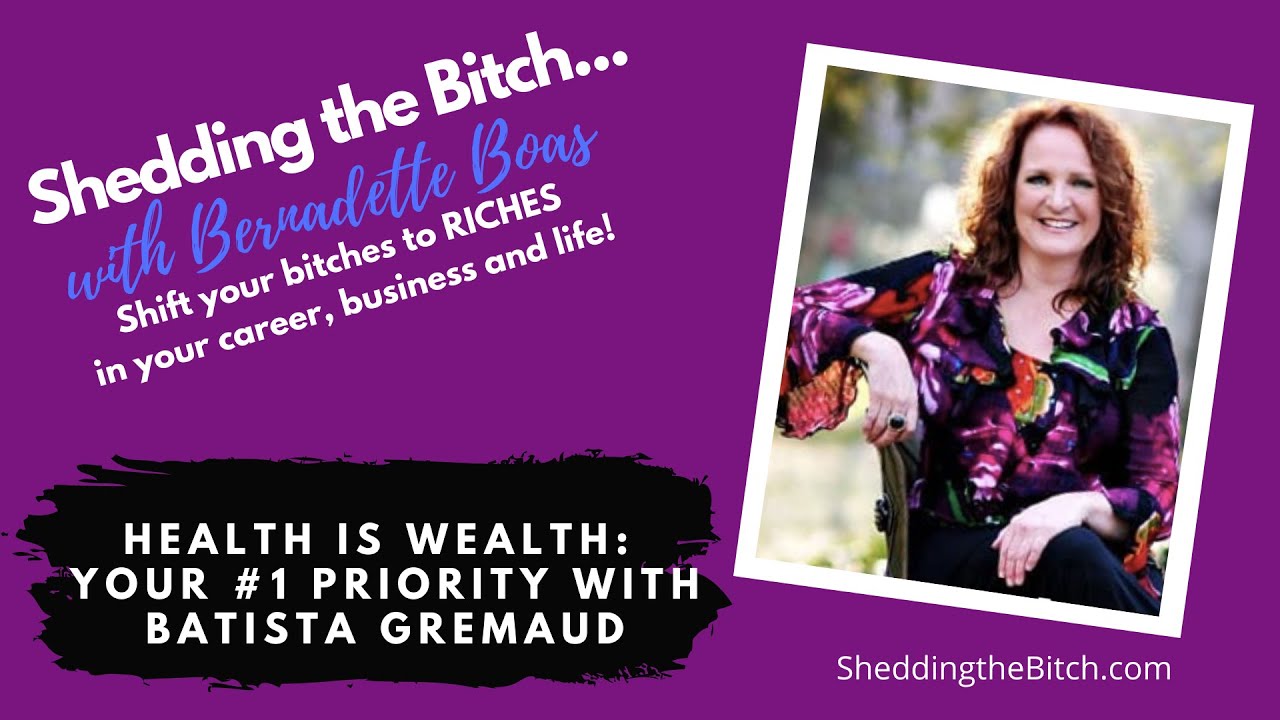
In this Shedding the Bitch Radio episode, host Bernadette Boas interviews Batista Gremaud, an international body designer, bestselling author of Feminine Body Design: Empowering Fitness for a Pain‑Free Life, and co‑creator of a female‑focused strength‑training system. Batista shares her personal story of transitioning from a professional dancer plagued by chronic injuries to a pain‑free, stronger woman after meeting Dr. Fitness USA. She explains the core philosophy of Feminine Body Design: women should train with heavy weights, honor their feminine energy of receiving, and avoid uncomfortable movements that stem from poor biomechanics. The conversation covers grounding, single‑task focus, and the detrimental effects of multitasking on cognition. Batista debunks common fitness myths—such as the belief that strength training makes women bulky or that cardio is the best way to lose weight—by emphasizing muscle’s role in metabolism and injury prevention. She outlines practical tools: an online mentoring platform, a mobile app with instructional videos, home‑workout adaptations using bands or household items, and a masterclass offered at a discounted price. Throughout, she stresses that health is wealth, citing that 80 % of North Americans suffer back pain, which harms productivity and business performance. The episode concludes with actionable tips: schedule 30‑minute workout appointments, stop multitasking, stay present, and honor oneself by prioritizing health.
Chapters
Hello and welcome to Shedding the Bitch Radio, where you can discuss, debate, and get advice on how to discover and shed the bitches of fear, insecurity, self-doubt, and negative mindsets so you can realize your dreams and life purpose and create and accelerate the riches you want in life. Join us here live every Tuesday at noon Eastern and dialogue with us at 818-572-2910. You can also chat with us at blogtalkradio.com/sheddingthebitch or share your stories on our website at sheddingthebitch.com. Whatever Whatever the bitch is that's holding you back from living your life to the fullest, it's not worth giving up the riches in life that you deserve. So call in now and let Bernadette Boas know what's holding you back.
818-572-2910. And today I'm so excited to be introducing you to Batista Grimo and just her work. And her unique take on how health is wealth, and your next priority for overcoming adversity, is just fascinated me. And it was this whole different angle, making sure that we are including our fitness and our health, mentally, physically, spiritually, all of it. So let me formally introduce you to Batista before bringing her on. Batista Grimo is an international body designer, Number 1 bestselling author of Feminine Body Design: Empowering Fitness for a Pain-Free Life. She's the co-creator of the Feminine Body Design online strength training mentoring system. She's the co-host of the Eccentric Principles of Bodybuilding and producer of the Dr. Fitness USA's show. She's a recipient of the most outstanding fitness programs 2019 by the Winner's Circle, Mastermind at Sea, contributor writer for the In the Limelight publication, featured as an expert authority speaker on the International Pain Foundation, presenter on various health summits such as Life Mastery, Girl, You Are Enough, Weight Loss Summit, and the Suicide Prevention Show. Let me see if there's anything else. Now I want to, before I bring her on, as I'm bringing her on actually, I want you to go to DrFitnessUSA.com and start even right now learning all about her as we welcome her into the show. Hi, Batista. Good. You might need to unmute yourself.
Sorry. Hi.
Hi, how are you?
I'm excellent, thank you. What about you?
I'm very good, very good. Now you're calling from a distance place. Where are you right now?
Los Angeles. Oh, oh, okay.
For some reason, and maybe because of your accent and whatnot, I thought maybe you were out of the country.
Um, but well, I am from Switzerland originally, but I do live in Los Angeles.
Nice, very nice. Well, let's dive into this. I love your whole angle and your whole take when it comes to what you do with Dr. Fitness USA, but also the books that you've written and the whole focus on, yes, we focus on fitness, but you really focus on the fact that health is your wealth. So what is it about this field that got you into it to begin with?
Good question. I was a professional dancer my whole life. So that was my profession. And the thing is, I had a lot of injuries. When I was in my mid-20s, I had a series of car accidents. You know, when it rains, it pours. Sometimes things happen, and it left me with chronic injuries. And over time, with dancing, over the injuries, it just got from bad to worse, to a point where I was literally facing losing my career altogether.
Right.
And yeah, and that was all that I had ever done. So it was like, now what, right? Right. Yeah. And I don't really believe in accidents or coincidence. I'm a believer in the power of, you know, the mind and the New Age philosophies and spirituality. So I was praying really hard to find something to help me, and that's when I met Dr. Fitness USA about 11 years ago. And the whole conversation I had with him was more than bizarre. And I think you met him, so you might know what I mean.
Well, do tell, do tell.
Oh, you have to work out from a female perspective, but you have to lift weights. Oh, but by the way, you have to lift heavy weight. But oh, by the way, we teach you never to do anything that's uncomfortable. Oh, and as a woman, you got to stop giving. You have to now really learn to receive. And you know, for me, I was a professional dancer, and I started dancing ballet. This is boot camp. This is very hard, and it's no pain, no gain. It's the show must go on. And I was a go-getter. I was all, you know, all in. I never gave up on anything. And I, you know, I was just— and this whole conversation was so bizarre. Lifting heavy weight, never doing anything that's uncomfortable. I couldn't lift a pound of anything. Okay, I had a frozen shoulder, I had chronic back pain, my neck was like always like this, you know, I had bad knees, I had my Achilles, everything, my whole body was falling apart. And, and, but you know, I, I would, I thought I knew everything.
Don't we always?
You know, I started dancing when I was 3 years old, and my whole life was about health, was about being fit, was about eating healthy, was about exercising. I wasn't like out of shape or unhealthy, you know, and I had really literally tried everything and nothing was working for me. It got really bad, so I was desperate. So I hired him, and with— yeah, within the first session lifting weight in the gym, which is what we— what he used to do then before I, you know, made a career transition. Now we have more opportunities, but that first session I was leg pressing 300 pounds. Yes, me who couldn't lift a gallon of water, I was chest pressing 25-pound dumbbells, and within literally a week, my backache was gone.
Yep.
And then within the following weeks, all my injuries started to disappear, right? Everything. I mean, I totally recovered my health. And my body in a matter of weeks. And I became— well, I married him. That's awesome! So that seemed like the logical thing to do. And I was floored. I was so curious and interested in the whole thing.
Why?
Right.
What is it?
Right.
Why does it work like this? Why, if I work with a personal trainer, which I had, it seems like we're doing the same thing, but here I'm hurt, here I'm not. And so this is, this was the beginning of this lifelong journey, nice, researching, trying to find the answers. And then through the process, I wrote the books, the two books. Um, the, the one that I am very dear is the Feminine Body Design Yep. Empowering fitness for a pain-free life.
Right, yeah, I wanna touch on that in a minute.
So anyway, that was my, that was the beginning.
And you're pain-free now?
I've been pain-free for 11 years.
Nice, nice.
My backache never came back, my injuries, all my injuries. I am, when I do go to the gym now, I leg press 650 pounds.
I bet.
And I chest press 135. I am stronger, healthier than ever, and I'm 60. I literally regained 15 years of my life or more in 10 years.
Nice. And, you know, when I was reading about you and looking into all this and looking at your books, I have to absolutely agree with you. I've been lifting weights probably since I was in my college years, I guess. Maybe not high school, but college. And to your point, that's why I laughed hysterically when you were talking about leg lifts, you know, leg lifts of some outrageous weights, because some of the guys in the gym when I was in my 20s and my 30s was like, what are you doing and how are you doing it? Because I definitely, you know, come from the same belief in the fact that you want to lift weights, but you want to, you know, lift some weight. And the fact that it does help, even just a few years ago— no, not even that, like a year and a half ago, I had a meniscus issue from Zumba, and I was playing a lot of pickleball. So I went to an orthopedic because it was bothering me, and he goes, no, keep playing and actually work harder on it and do some strength training, blah, blah, blah, blah, blah. And I did, and I haven't felt it since. I had it for about a year before I succumbed to it and went to my orthopedic. And he even agrees with what you're saying. So I think that's fabulous. I think—
And that's remarkable because that's very rare.
Right. No, no, he did. He's like, keep— especially because you would think from a meniscus, you don't want to move left to right. He's like, no, no, no, no, do, do, do. And it built up and whatnot. So strength training, I love that philosophy of yours. Now, from your book, what I loved, and you actually commented on it, because you actually commented that your now husband, I love that, your now husband talked to you specifically about the fact that men and women really have to approach their fitness, especially from a strength training and whatnot. Very differently. And you mentioned that, you know, women have to come, come at it from an emotion perspective and, and, you know, a heart perspective. So could you kind of explain more of that? Because I think it applies, I wouldn't you say, to even our subject of goal achievement this week, that, you know, that it definitely has, has to do with feeding that.
Absolutely. So there's many aspects of that. And one, the simplest one, I'll start there, is that we are estrogen-based, we're women, and men are testosterone-based. So there's male-female energies, and the male energy is competing, giving, you know, it's the doing thing. And the female energy is the receiving, the being. And so when you, when you go into a fitness, uh, when you go think about fitness in general, fitness in general is very male-oriented, okay? It's very much about no pain, no gain. The, you know, the show must go on. Come on, let's do more. And that's why people hire personal trainers, because they feel like they need to do that, because they are going to be accountable and they're going to be pushed beyond their limit. But we— this is male. We are female. And for us, even though sometimes we, we want to be like that, we still— our body after a while goes, hey, that doesn't really feel good, you know. So from, from a working out perspective We actually teach women never to do anything that's uncomfortable. Now, it doesn't mean that the workout is not going to be empowering and challenging in some way, right?
Right.
But when you do it with proper ergonomics and with the principle of grounding the body— grounding— because this is what I think is one of the main problems right now. Not only in fitness. I mean, in fitness is very obvious because people are jumping up and down, they are running up and down stairs, and they're doing this, then they're doing that, then they're on the phone, then, you know. But in business also, and this is why I like to tie in those two topics, is people are in their heads. They're all in their heads. They're not grounded, you know. But when you can ground the body and you can do one thing at the time, you can be present in the moment, you can become so much more effective and so much more powerful. And this is what happens with the workout, and this is what we teach. Because you know what they say, they say how you do one thing, you do everything, right?
Right.
They're habits. We're creatures of habits. So for us, we teach a system where the person is really going to be grounded and empowered. And then through lifting the heavy weight, and not for all exercises but only for key exercises, okay, then what, what happens is it's— it immediately strengthens your nervous system, your body, but also your emotional being. So it's like stress relief on turbo.
Yeah.
You know what I mean?
Yes.
It's immediate feel good. And then you get that brain-muscle connection. You can really be in the center of your being where now you own your power as a woman.
Right.
You know, and that reflects in every aspect of your life.
Sure. Confidence, sexuality. Yeah, absolutely.
Yeah.
Now, and productivity, and productivity, because you're more focused, you're more clear, you're more alert, you're more attentive. Absolutely. Yeah, absolutely. Now, question for you, because I wrote the word uncomfortable. I just want to dig into that a little bit.
Okay.
So there's, you know, when it comes to fitness specifically, there's uncomfortable meaning that there is something physically uncomfortable to you, you know, and, and you're worried that, you know, you're going to be pushing yourself and you're going to hurt yourself. But then there's uncomfortable, like, you know, in life, um, where people just mentally, emotionally, spiritually get uncomfortable because they like being comfortable. And yet you have to get uncomfortable, you know, to really experience change. So explain your uncomfortable when you say that they tell you or you tell women, you don't have to do anything that's uncomfortable. 'Cause that sounds contradictory to what a lot of us coaches say to our clients.
Yeah, so when, I know there's this saying, you gotta get out of your comfort zone to incur change and things like this. And there is some truth to this in life. Now you're not gonna go and jump off bridge, you know, you know what I mean. So there's uncomfortable to a degree, right?
Yeah.
However, when we talk about fitness, okay, if the— if it's uncomfortable, it's never going to be comfortable. If the machine— because a lot of machines, a lot of things are done, a lot of teachings are not taught, don't teach you to move in a biomechanically correct way. So a lot of times when we talk about fitness and, and it's uncomfortable, you think, well, it's because I'm out of shape, or it's because I'm too weak. When I get stronger, it's going to be comfortable. And so there is a tendency of wanting to push through that discomfort. And the truth of the matter is, if it's uncomfortable It's, it's just because it doesn't fit your body. There's something that's not right. The machine is at the wrong angle, or this is just a movement that is not good for you. It doesn't fit you, right? You know, so in that sense, in that sense, this is how we prevent injury and rehabilitate injury, because we always find a way where there is a comfort and where it feels good. When it feels good then you can reach those weight increases that are actually going to make the difference in the body of the stress release, the posture realignment, and all those benefits that we say that you couldn't get if you weren't able to actually reach that type of weight. So that's in that sense that I mean never do anything that's uncomfortable. I'm talking about the gym environment. But what happens is when you get that strength and you learn how to maneuver the discomfort, how to change the angles, and how to overcome that, that also reflects in your life because you become more— you also know better how to establish boundaries. You learn to say no to things that are not, that you know are not good for you.
Right.
You know what I mean? It affects in that sense because you don't, you don't want to. It's true, you got to get beyond your comfort zone, but you also have to realize and acknowledge that it's not for everything. There are things that are literally not good for you.
Right, right.
You know, and, and that's psychologically, but physically, I will give you another example. When you, when you learn weights and you learn the, the quality of the weight, how much weight weighs actually, you can also move in your day-to-day activities in a much different way because you know your limits. And for me, it made a huge difference with my injuries because a lot of times we don't know how much this chair weighs, or how much that bag weighs, or how much that piece of furniture weighs that we're carrying, or that kid we are bouncing up and down, or, you know what I mean? And so we do things during the day that we're unaware of that result in overuse injuries.
Mm, good point. Yep.
Yeah.
And so this is one way to to gauge and to learn how to move. You know, in 2009, I was one year into this process and I was already pain-free after one year, and both my parents died and I had to go back to Switzerland. Yeah, it was just a really hard time. My dance studio caught on fire, my parents died, the economy crashed. It was one of those periods of times.
Wow.
But the thing is my parents had lived in the house for 54 years. They would never throw away anything, and they were both artists. And I had to— I had for 6 months, I had to clean everything. And, and you know that I was able to do that and not reinjure myself.
Nice.
It could have not happened. And my point to this, because we are in a business summit, so my point to this is pain. I'll give you a statistic. 80% of North Americans suffer from back pain. How does that do for your business?
Yeah, really.
And that was before COVID before people were stuck in front of a computer.
Right, right. Yes, like I feel very slumped over and whatnot right now because I'm not in my usual position. But you're right. Yes, you're right. You're right.
You know, yep, yep.
Now, um, what other, what other, um, nuggets out of the Feminine Body Design, uh, would our, would our viewers or attendees really benefit from when it comes to kind of considering their health being wealth as far as if they take care of themselves, it spews over into everything that they do at work and in life. So what are some other nuggets from the Feminine Body Design, your book right behind you actually.
Yeah. And I even have it here.
There you go.
Yeah. Okay, a big one, and especially for women: learn to put yourself first.
Amen, amen, sister, amen.
First, even before, even before your children.
Say that again.
Even before your children. Yeah, because you're no good to anyone when you're ill. And you need to take that time for yourself. You need to take that time for yourself. And that is what Stephen was saying to me, that bizarre conversation we were having that first day we met. You know, as a woman, you've got to stop giving. And I'm going, what? You know, I want to save the world, right?
Right, yeah, right.
Well, that gets you so long and so far. There's a point where you just can't, and we need to respect that feminine energy. We have to respect ourselves as women, right? And, and we need to reclaim the power of receiving. So, but how do—
I mean, that sounds really easy and nice. Oh yeah, I gotta, you know, put my family first and I gotta receive. But I know for a fact, for myself and some, you know, a lot of other women, it's not as easy to actually put into practice. So how do you help women kind of put that into practice to help them see? Because some women don't even recognize that they're doing it. Some people think that, you know, some women actually think they're taking care of themselves because they just bought a nice dress or got their hair done or whatever, but they're really truly not taking care of themselves and putting themselves first. So what would you say to them?
So in our system, what we teach is we teach a strength training system that has all these benefits. So it will give you the brain-muscle connection and give you that centeredness and that grounding. So that's what we do with our clients. We teach them to do that because during that half an hour or 30 minutes, 45 minutes, 3 times a week, it's not about being a gym rat or do anything like that. But when you take that 45 minutes 3 times a week, then you start establishing a habit. This is the tool that we use because we know the effect it has in the whole life and everything. But not everybody is our client, so— right? So for those who are not, then you need to put it on the schedule. Schedule. If it's not on the schedule, it's not gonna happen.
Yeah. Especially you moms out there, right? Moms have schedules all the time. Yeah.
Yeah. So there is a point where you have to say— it's like, look at it this way. If you had a toothache, you would find the time and the money to go get your tooth fixed. Yes or no?
Yes.
Yes. But to go take that walk or to take that half an hour for yourself to actually exercise, unless you are real exercise, you know, you really like to do it. But a lot of people are falling way behind now, especially with the pandemic and, and the gyms closed. And now, you know, now it's getting worse and worse. So if you, if you are in that category of people, it's just so easy not to do it, not to take that time. And so you have to really look at your schedule and you have to put it in. So whether you are going to have a babysitter at that time, or maybe your significant other, your partner, you're going to organize your life so that for that one half an hour, it's going to be all about you.
Right.
Yeah.
You know, and if it's not on the schedule, it's not happening. There's too many excuses. And your website at that point can wait for half an hour. Go back to fixing your website or doing this. Because I hear so many people when we, you know, we present our offer clients, oh, but now I just joined this business growth meeting and now I have to fix my website and now I have to do this and that.
Yeah, yeah, it's, yeah, it's just, yeah, excuse management is what it is, you know, and they're just managing their life around their excuses. Yeah, I absolutely hear you. And when you even say just take 30 minutes to exercise, that exercise, you know, I pull it, I keep pulling it back because the exercise is physical, it's mental, it's emotional, it's spiritual. So it's not that, oh gosh, I don't want to put sneakers on and go out and walk or run or lift weights. It's more like you're going to go and rejuvenate and you're going to go and spend time with yourself and spend time with nature and maybe with, you know, God or your spirituality. And it's, so it's an all-around 30-minute appointment. It's not just, you know, what they all like, oh, it's, you know, because now it's getting dark in the morning. So the first thing I hear from people is, oh, it's cold and dark, you know. And so yes, yeah, I love that, to block it out on your calendar and treat it as an appointment is basically what you're saying.
Yes, absolutely. Just fit it in. Because even myself, you know, if it's not on there, I have to block it. Because these appointments, you know, people make appointments all the time and all of a sudden the calendar is and I'm like, what happened?
Right, right, right.
So yeah, yeah, yeah, yeah.
Um, so well, I certainly, um, we understand because I had a question of how all this fitness and focus on health is wealth impacted you, but we fully understand that now. Um, and so what would you also just share with our attendees in regards to some strategies and tips they can use around, you know, taking care of themselves, putting themselves first, blocking calendar? What else would you suggest for them?
Yeah, so I like to— and this is part of the book also, Dispels the Myth About Fitness— just educate yourself. Okay, there's a lot of misconceptions in the world of fitness. And if you are on a time schedule and you are busy, and so what you want to do is you want to maximize your time. And to this effect, you need to choose the activities that you're going to do. All right, like we see a lot of people, they want to lose weight. Everybody, even the skinny ones, they want to lose weight. Right? It's amazing. True. So what do you see people do? You see people do a lot of aerobics. That's one of the main misconceptions. So, uh, yeah, I'm on a treadmill, or I'm gonna go run or something because I want to lose weight. But you know, that's not your main activity for losing weight. Educate yourself. Losing weight— if you want to choose an activity to lose weight, of course Cardio is going to be good for your heart, for everything, but really what you need to think about is developing a lean muscle tissue so that you can boost your metabolism. Okay? So when you do a strength training routine, you're going to burn the calories while you're doing the exercise, but you're also going to continue to burn the calories for like 3 days after while the muscle recovers. Well, if you do aerobic, you're only burning the calories while you do the aerobic, and on top of it, you're not going to sculpt your body. So you're going to end up with maybe strong legs and nothing upstairs, right?
Yes, it's true. Right, right, right. Well, and, and help women understand, and we are getting into more of a, like, a strength training thing right now, but that's okay because strength training when you're working on your body, you're working on your mind. Because again, it's confidence, it's clarity, it's empowerment. Um, there's an old myth out there that, you know, strength training causes you to put on weight. And, you know, and then there's the other one about, you know, oh my gosh, I don't want to bulk up like a man. If I— like what you— when you were talking about heavy, doing heavy weight, Now I know that it's not true, but a lot of women also feel like, oh my God, I don't want to bulk up like a man. Help us with those myths, would you?
Well, I was one. I was a dancer, and I was that. I thought, no, I can't do this. I don't want to get bulky. It's a total myth. First of all, women don't have enough testosterone to bulk up like men. So there is no risk. Second of all, even if there was a remote risk, it takes so much discipline and work to even build a muscle, to even get somewhere. You know those competitors? They work day in, day out. You know what? There's very little chance that it's going to be you. You know what I mean? And having said that though, I do want to make a point is that muscle weighs more than fat.
Yeah. Yeah.
Okay. So what we recommend is that you don't worry too much about the scale, but more about the clothes, how they fit, because when you develop muscle mass, you're going to sculpt, you're going to start shifting your body, but the scale might not drop as much as you would like to, but just because you're building muscle mass.— but it's not going to be making you bulky. At the worst, it's going to make you toned and get rid of the—
Yes.
I have—
it's funny. It's funny. I play pickleball. And we'll go into that another time. But so it's a racket sport. And this arm is getting toned up. This one is, it's got the chicken wing.
So that's, and I'm glad you mentioning this because this is one of the things that we actually deal with because this is called overuse syndrome. And what happens is in terms of toning, you're right. You can see the difference. Right. But in time, these things can lead to overuse injuries.
Oh, sure.
You know, and so with a, with a good strength training system, you can prevent that because you can always be balanced.
Yeah, balance.
Yeah, exactly.
Yeah, yeah. Now I am curious, um, uh, so you, your, your, um, Feminine Body Design and then the work that you do with Dr. Fitness USA, you establish like an online mentoring program, or, and so help us understand exactly what that is and then because so many people, especially you're in LA, you know, I was thinking, okay, she's somewhere like in Switzerland, but no. But even if it's somebody in Ohio, you know, how do you work, you know, especially amongst, you know, the fact that we're in this lovely C situation, which I don't say the word.
Okay, good, good point. So yes, so thank you for asking. 11 years ago when I met Stephen, it was all done in the gym in LA. People were traveling, it was one-on-one. And, uh, so my vision was to be able to expand the, the business and to offer this program to more people because the value and my recovery was so amazing. So I researched and worked with him for 8 years. My vision was to put the system online So I had that vision way back then, and we did that 4 years ago.
Okay.
So 4 years ago, we started working online. The programs were still taught, the person still needed to belong to a gym then because that's where the good equipment is. And that's where, you know, we have a system, you know, we can get rid of backache in like a week or things like this. When we have the proper equipment. But we've been online for 4 years. We have an app. We have a whole gallery of specialized videos that we created over the years so the person can see ergonomically how we do it, where the angles are, the feet, the back, and whatever.
Nice.
And so we work through Zoom like that as well as with the app. Now, of course, in March when all the gyms closed, then we had to make a shift like everybody else. And so we developed programs that people can do at home.
Nice. Yeah.
So we have like a master class that we teach where somebody can come in and learn to even just use bottles or bricks or crockpots or, you know, whatever they have at home.
Sure. Sure.
Boomsticks, because we never worked out at home before that. We were always in the gym. So all of a sudden, overnight, the gyms were closed. We had nothing to do.
Right.
So we had to become very creative. So we have that, that we teach in the masterclass. And then we put together a whole system that people can do with workout bands.
Bands?
Bands, workout bands.
Okay.
Yeah, because workout bands, you can also increase and quantify the resistance that you're using. So, so you can do very similar things that we did in the gym and control it. So that's been very successful, and so now we have that to offer. So when the gyms reopen, we'll have this and this.
Yeah, absolutely. Well, I know our gyms have opened.
Oh yeah, where are you?
Atlanta.
Oh.
Yeah, so our gyms actually have been opening and, you know, they're limiting the number of people that can go in. They're limiting the amount of time you can be in the gym. They're, you know, requiring you to do certain things between, you know, between if you were to use the machines. There's no classes, I don't think. I don't trust going in there yet, so I haven't been there. And I do have weights and other things here in my house. So as a matter of fact, a couple of barbells are staring at me right now because I need to do that. I need to do that.
All right. So are you doing it? Are you keeping with the discipline?
Yeah.
Oh yeah. Oh yes, yes, yes. I am. Not to say that I don't fall off for a week, a month, a couple of months, but I'm pretty active and I'm pretty focused on ensuring that I'm always doing something.
Excellent.
Yes, yeah, yeah. So I understand that you do have a free gift for our attendees. So do you want to share what that is all about?
Yes, of course. So actually, I wrote the Sustainable Fitness for the People in Leadership Position. So there's for men and for women because we work with a little bit different energies. Summit is for both men and women, right?
Yes, yes.
Yeah, yeah. So that's what I was— that's what I figured. So I like to offer you that. It will talk about some of the things that we talked about today, but then of course the, the one for men, it goes more into testosterone and other a little bit different aspects. So there's two. And then of course I do have a master class that I, that I teach, and I have a few dates coming up and I would like to invite you to come and experience our world. So for $1, it's a $97 value, but usually I charge $97, but I would like to offer it for you to come and have fun with us.
So is the first one a white paper or is that what it is? I missed that.
The first one is like a report. It's like an ebook.
Okay, okay. So an ebook is the first one, and the second one is a masterclass, which I assume is a webinar.
Yeah, they call it webinar. I like to call it masterclass because I'm actually delivering value.
Right, right, right, right, right, right. Yeah, awesome. Okay, and I understand, and correct me if I'm wrong, they can just go to DrFitnessUSA.com .com for both of those, or is there specific URLs that we can share out, which we will, by the way?
Yeah, yeah, yeah. So there is a URL. I would— if I didn't give you the URL yet, I will. No, you did.
You did.
Oh, I did.
I wasn't sure if you wanted to just share it verbally, or we'll just make sure that it's, um, provided along with this video, uh, so they can get immediate access to it. And, and we'll be— and we'll be providing everybody like a one-pager with everybody's, all the experts' freebies. So we'll include it there as well.
Yeah. So you can, and if you go to drfitnessusa.com or drfitnessinternational.com, we have both website now, the report, the opt-in is on that page also.
Okay, awesome. So definitely.
But not the masterclass. So the masterclass you have to give the link.
Okay, awesome. So what would one last tip be, or maybe it's a couple of tips, that you would tell someone right now, especially when it comes to really focusing on working on their mindset and their fitness skillset in order to be achieving their goals? What would you suggest to them for them to start doing?
Stop multitasking. Quit today. Quit. Not in your fitness, not in your life, not— just forget it. There's research that shows that people that multitask have the cognitive— what's the word I'm looking for? The cognitive— I missed the word. Okay, of a 12-year-old. Oh, okay. Yeah, they compare it to a person that would have smoked marijuana.
Really? I have never heard that, but that's awesome.
Yes. Wow. So you think you're good at multitasking, you think you're accomplishing all— and so many people pat themselves on the back. Oh, I'm such a good multitasker. They do, you know, and they think it's such an advantage to be able to do this. It's not.
Right, right.
Well, not functioning.
Don't you see, don't you find that women find themselves to be multitaskers? And because they're touted as, oh, women, they are, you know, they're nurturers and they're multitaskers and blah blah blah.
But it's, you know, to your point, it's counterproductive. Yeah. And that's because we have a large area between the right and the left side of the brain, so we can think and feel simultaneously. And men is smaller, so the man is to think or to feel, one, one category. So it's a little bit different. So for some men, it's harder to multitask unless they're left-handed, uh, because then they can also do this. But for women, it's a disservice. It's a real disservice because at the end of the day, you're just accomplishing a bunch of tasks halfway, and it's going to take more time, and it's going to just— it's totally counterproductive. So just stop. Just learn to do one thing at a time, to do one thing at a time well, and to honor yourself. And even in your fitness, you know, leave the cell phone in the car, or, uh, you know, just—
what do you mean by honor yourself? I love that, by the way. What do you mean by honor yourself?
Just honor yourself by being present inside your body.
Nice. Inside your body, not, not just up here, you know, right, with all your task lists and all your worries and all your what are you going to do tomorrow. It's kind of like slow down, get still, be here now.
Exactly. And do what's in front of you and do it present.
Yeah. Yeah.
Because how you do one thing, you do everything. So you start with now.
Love it. Love it. Love it. And you brought it right back around. How you do one thing is how you do everything, which you also said at the beginning. So that's beautiful. So stop multitasking, ladies. Honor yourself. Batista wants to help you honor yourself. So thank you so much, Batista. This has been fabulous. Thank you. And I so appreciate you taking the time, but I want everyone, be sure to go to drfitnessusa.com or drfitnessinternational.com. Learn all about her, learn all about Steve. Learn all about what they do and also check into her book, Feminine Body Design. Check those out. There you go. And we'll share information in regards to that as well. Yeah.
And you know what? On the website, there is also a link to schedule a consultation. So come on. Yeah, yeah.
There you go. So just check her out, DrFitnessUSA.com. Thank you so, so much, Batista. I so appreciate it. We will see you soon. All right, take care, everybody. Thanks, Batista.
Thank you for listening to Shedding the Bitch Radio with Bernadette Boas. Join Bernadette every Tuesday at noon Eastern as she helps you shift your bitches to riches. And the dialogue is always going on at SheddingTheBitch.com. See you next week.
More from Bernadette



From Stuck to Leading, Episode 2 — Meet the 5 Inner Fears Destroying Your Leadership



