How to Beat a System That’s (Still) Rigged Against Women with Areva Martin
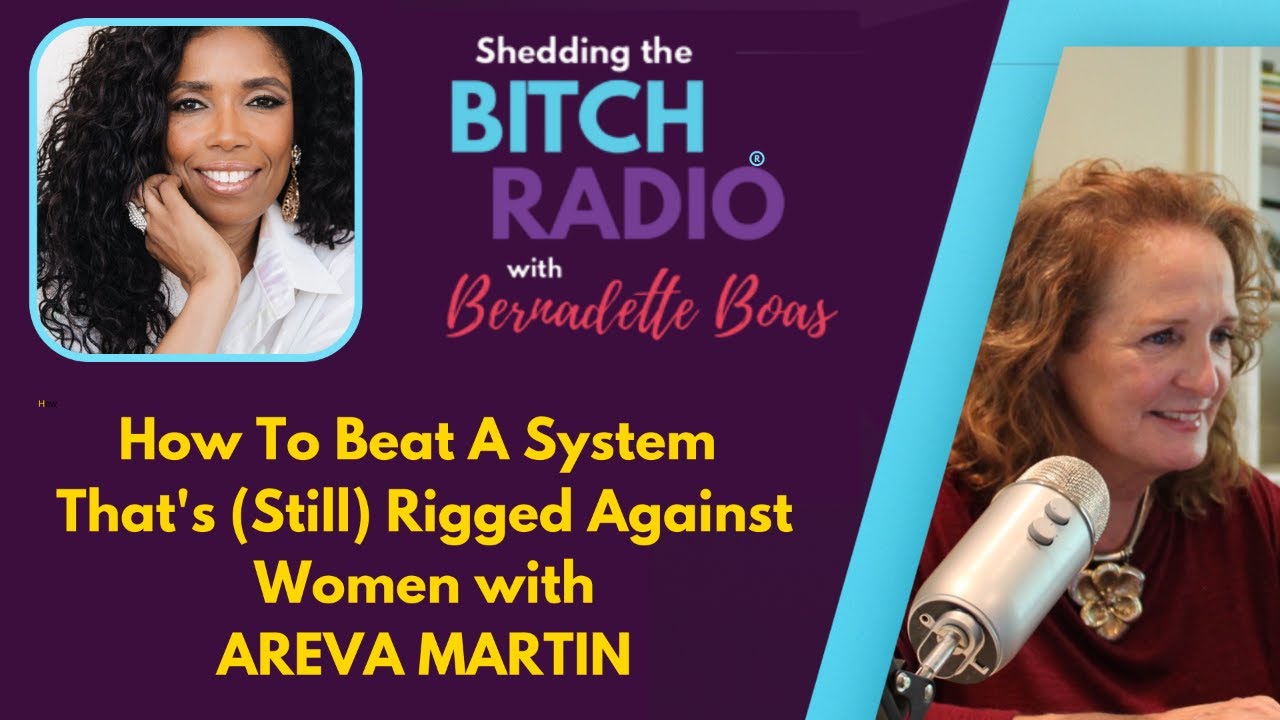
Civil-rights attorney Areva Martin discusses her book on the lies women are told, from the myth that hard work guarantees success to the idea that appearance doesn't affect a woman's value. She argues the fight must shift from equality to equity, and outlines practical strategies including personal boundaries, male allyship, and rejecting internalized stereotypes.
Chapters
Are you ready to create riches in your work and life? It's time for Shedding the Bitch Radio and TV, where you can discuss, debate, and get advice on how to discover and shed the bitches of fear, insecurity, self-doubt, and negativity so you can realize your dreams and life purpose and create and accelerate the riches in life you deserve. So let's welcome your ball of fire host, Bernadette Boas.
Good day, good day, good day everyone, and welcome to Shitting the Bitch Radio. And yes indeed, I'm Bernadette Boas. I'm so excited that you're here because this is a topic and a discussion that we must have, and we not only want to have it today, but we want to be sure that we continue, continue, continue having this conversation. It's all, all about how to beat a system that's still rigged against women. And I'm going to be introducing our guests in just a minute, but before we do, I just want to, as always, I want to thank our ongoing, uh, listeners and viewers as we air on all of the podcast streaming services as well as on Shedding the Bitch TV on YouTube. And you have been liking, sharing, um, rating, reviewing, commenting, and even giving us suggestions in regards to topics and our experts, which is fabulous. You're also though helping us find new eyes and ears to the program, and, uh, we are so grateful for that as we continue to bring you, uh, top-of-mind topics from, uh, women around the world— and experts, I should say— around the world. And we are always appreciate that. So keep those ratings coming and be sure to subscribe to, um, our show anywhere on your podcast streaming services as well as on Shedding the Bitch TV on YouTube. All right, the other thing, we want to thank our longtime and ongoing sponsor, North Georgia Tax Solutions. Debbie Snelling and her team provide full-service tax— I'm sorry, full-service financial and tax services to small to corporate-sized clients around the country, not just North Georgia. And she works also with individuals. So if you should have anything that you need from a financial and tax services perspective, please go to ngtaxsolutions.com and tell Debbie I said hi. All right, um, all right, let's introduce this subject and get into this conversation with our guest. Um, just two short years ago, six women ran for United States president. Fast forward to today, and women's gains have all but vanished. It started with COVID pushing women out of the workforce to care for their children.— culminating in women's stunning 15.5% unemployment rate. Even now, as women return to their careers, they're still light-years away from regaining their pre-pandemic momentum. The so what is this isn't a new story. Every woman throughout history has told it in one form or another. But the days of focusing on equality are over, says one pioneering advocate, author, and expert. And she is placing it on equity in 2021, which is a new buzzword, but we have to make it more commonplace. Now, her key message around this is that our society has lied to us, telling us that women don't deserve remedies that account for years of sexist systems, or that our current standing is equal to that of men. And our guest is a CNN legal analyst, recognized civil rights attorney, and social issues advocate. But society's version of equality only gives women access. Equity is needed to level the playing field. What we want you to be listening for and hearing today is why small-scale strategies to enact change ultimately fail and what to do instead. Dead. She's going to provide you 3 ways women can use boundaries to permanently reshape your future and simple steps to help men become powerful partners rather than passive allies in creating a more equitable world. Now, our guest is Areva Martin. She's an award-winning civil rights attorney, advocate, social issues commentator, talk show host, and producer. She is a CNN legal analyst, as I mentioned, and Harvard Law School graduate. Martin founded Martin and Martin LLP, a Los Angeles-based civil rights firm, and is the CEO of Butterfly Health Inc., a mental health technology company. She is a best-selling author. Martin has dedicated her fourth book, her fourth book, Awakening: Ladies, Leadership, and the Lies We've Been Told, to helping women worldwide recognize own and assert their limitless, limitless power. Welcome to the show, Areva. Hi, Areva, how are you?
I'm well. Hi, Bernadette, how are you? Good, great.
I was going to say gorgeous because that background of yours is gorgeous with those flowers.
Thank you. It's one of the things I did during COVID You know, we were locked down for many, many months and we all had to, uh, you know, decide what to do. We're gonna watch Netflix all day or, you know, stuff our faces with the foods we love. I did some of both of those, but then I decided to work on my fourth book, Awakening. But also I got into floral arranging. I always loved flowers, and I said, you know what, learn a new skill, right? You have all this time on your hand, uh, and you couldn't go out, you couldn't see people. So thank you. I'm still learning. A good friend of mine got really serious, so she's going to give me some tips, uh, but it's something that I find relaxing, and I've done this pandemic.
So you did those?
I did them. Yes. That's my Martha Stewart. I got my Martha Stewart on. Yes, I did those.
No, that's your Areva Martin. That's your— they're beautiful.
Thank you so much.
Yeah, yeah, they're beautiful. Let's see if you like hop from legal analyst, CNN commentator to florist.
Floral designer. Yes. I think we all have some creative pieces and parts in our personalities, just how they manifest themselves. And it doesn't have to be one way, right? It could be lots of ways.
Right. Oh, absolutely.
Floral designing is something I enjoy.
Oh, and it's beautiful, and it brings such, you know, light and airiness and energy. It's absolutely beautiful. Well, I'm really, really excited to get into this with you because I'm right along with you in that we need to do something, and obviously you're taking the reins in it. So help us understand your backstory to where it was important for you to turn this or to create this fourth book around awakening?
Well, my backstory is I grew up in North St. Louis. I grew up with really strong, powerful women, not a lot of money or no advanced degrees or big careers to think of, but a lot of wisdom and a lot of heart. I like to say, you know, these two women that raised my grandmother, my godmother, had a tremendous amount of grit and determination. So they worked hard at everything that they did. And they brought a lot of heart and passion to what they did. But I started thinking about Awakening really, you know, about 18 months ago or so, maybe almost 2 years ago. And really, the theme and the focus was crystallized for me after the murder of George Floyd, really thinking about the conversations we were having in this country around dismantling systemic racism and structural biases. And thinking about how some of those same conversations and some of those same structures that we were analyzing in the context of race also were relevant in the context of gender, that there were some structures in place in this country that had prevented women from achieving their best lives and their full potential. And that for many, many, many, many years, we often blamed women. We told women, work harder, lean in more. You know, do more, make more sacrifices, but not enough time, nearly enough time, I think, was spent looking at the systems. You know, one of the things I say in my book is you can't lean into a closed door. So no matter how hard we work as women, how much we do, there are systems in place that are just designed, you know, to, to, for our failure.
Yes.
But in any other way. So that was really, you know, the last 18 months or so have really helped me crystallize this conversation. I wanted to write about it. I wanted to challenge this country. I wanted to challenge women. I wanted to challenge men to start thinking about these issues in a different way.
Yeah, well, I absolutely— I have to point this out— I absolutely love the fact that you inserted the whole plat— uh, the whole conversation around men, because I often find— I don't know about you, I would love for your, um, take on this— I often find that we go out as women and we're beating our chest and we're having these big summits and these big conversations, and yet there's no men involved in those conversations.
Yeah.
Do you sense that? Do you feel that that's a disadvantage if we're not always ensuring— not always, but we're not ensuring that we're having them involved in the conversation?
Well, I think you hit upon something. And obviously in my book, I write about men and the important role that men play in us dismantling and rebuilding and reimagining our system. I think there's a place for those female-only conferences, female-only gatherings that we have. But I also think there is definitely room and opportunity and a need to bring men into many of these conversations. Because the reality is, men are still at the top of so many of the systems, so many of the corporations, so many of the businesses, the nonprofits, the electoral offices. We can talk again amongst ourselves and come to an agreement. But if we don't have the power to change, then, you know, we're just kind of talking to ourselves. So definitely we need men. We need our husbands, our brothers, our partners, our nephews, our uncles, you know, our grandfathers. We need them to understand what our plight is and the role that they play, uh, in one, either oppressing us, or two, liberate it, you know, being a part of our liberation. So I think there's definitely a role for men to play. Right.
And, and pointing out those unconscious biases that they don't really understand actually exist.
Oh my God, yeah. I, uh, you know, I don't think any of us, uh, can, you know, cannot think of a time that we were involved with a male, whether it's a work meeting or a social event, where, you know, man does something and you think, oh my God, did he just, you know, just talk over me, just You know, step over me. You know, did he just literally make me invisible? And then you'll say something to the guy, he's like, what? What? You know, what did I do? What did I say? Yeah.
Yeah. Mine was on the pickleball court the other day. My emotion is anger to men. Their emotion is they're just passionate about the game, you know? Anyway, we could go on so many different angles of this now. How did you select the 5 lies, which I absolutely love, the 5 lies that you highlight in the book?
So it's funny, Bernadette. I was on a TV show the other day. And they were introducing the book. And he said— this guy was moderating the conversation. He said, is this book 6,000 pages? So I said, I'm glad you recognize that there were so many lies that I could have written about. Obviously, couldn't write a 6,000-page book. But it was good to hear a man say, oh my God, I'm only 5, so, you know. Yeah, I had to do a lot of soul searching. I had to do a lot of revisions. I had to talk to a lot of people. I had to, you know, go over this lots of times with my editor because there were a lot of lies that we've been told. But I wanted to focus on those that I think most women hear all the time, no matter what your race is, no matter even what your age is or your background, that you're going to hear this at one point or another. And so, you know, it was after conversations with women, going through my own personal experiences, uh, that I was able to whittle down that 6,000-page book that my male friend suggested I should have written, uh, down to these 5.
Wow. Well, you can turn it into a series.
There are lots of other lies that definitely need to be called out, but I really just want to focus on, again, what I think, you know. And one of the reviewers that read my book said— one of the big reviewers, I don't know if it's Kirkus or Publishers Weekly Weekly talked about the fact that, you know, it isn't just a book about me or my personal experiences. It's really a book about the women that I've encountered in my professional life, my personal life, and these are the stories that I hear most from these women.
Yep, and which is what we need to really pay attention to and, and spend time with. So it's awesome that you captured, captured those because I was also taken, um, taken in by your title. Awakening, someone might look at that and be like, oh, here's another, you know, personal journey development thing. Whereas Awakening Leaders, Leadership and the Lies, um, I wanted that subtitle.
I needed it to be provocative. I wanted it to catch people's attention. Uh, and again, it's not my personal awakening. This is a call to action, a manifesto of sorts to all women to say, look, ladies, And men, we've got to wake up here. The definition of insanity is to keep doing the same thing the same way and expecting a different result. So we can't keep going the way we've been going and expect things to change. We really have to look at what's at the core of women's— when we look at our success, as you said, women made so much progress. We were super excited. We were rooting for all these women who were running for president. You know, it never happened before in this country. And then COVID hit, and women are— you know, we've been knocked back. So we make one step forward and then like 10 steps backwards.
Yeah.
So we don't want to keep repeating this for future generations.
Absolutely not. But I also need to point out, Areva, I think you came up with your title of your second book, the next book, the fifth book, and that is Call to Action: A Manifesto.
Yeah, I'm all about the action piece. You know, I wanted to raise awareness. I want to be provocative. I wanted people— I wanted to challenge people And I wanted people to say, well, what are those lies? You know, because you tell— you say that somebody's been lied to, of course the next question is, well, you know, what's the lie? So, uh, it was really important for me to, uh, just call it out. You know, we're in this era, you know, people say they're tired of everybody being so PC. So guess what? We're not being PC anymore. We're just calling it like we see it.
Absolutely. Pull no punches.
Yes, absolutely.
Um, so what would you say uh, have you— have been your biggest obstacles through your own journey that then really kind of resonated with you to be able to share? Because that's awfully vulnerable, um, and, uh, challenging for people to do. But what would you say your biggest obstacles have been?
I, I would say, you know, preconceived notions that, that women of color, we still suffer a tremendous amount from, you know, racist sexist, tired tropes about who we are and what we have to offer the world. You know, that we're overly sexualized, that we are promiscuous, that we are lazy. You know, the welfare queen that was invented under the Ronald Reagan administration. So a lot of those tropes, even though women like me, you know, gone to college, we've gone to graduate school, successful entrepreneurs, you know, we've overcome a lot and we've achieved what some people believe to be incredible success, we still suffer from many of the same sexist and racist tropes. So whether somebody is looking at me thinking, you know, here goes a quote-unquote welfare queen, they may, you know, again have some preconceived notion that women of color are you know, not as hardworking, not as hard-charging, not as aggressive about, you know, work. The trope that we're often loud, that we are angry, you know, if we assert ourselves, if we stand up for ourselves, we get labeled, you know, angry. So I suffer like all women do, and definitely women of color do, from, you know, antiquated, outdated stereotypes, right?
Right. So what would you say you did? Because obviously you're very successful, um, and, uh, you've accomplished so much in your career and in your life. What, um, how did you overcome it? What, you know, what can you share with other people about what you did to overcome it?
Yeah, I, I don't know if I overcame it as much as I, I became aware of it and I made a conscious decision not to allow it to hold me back. And to control those things that I can control. But, you know, there's still— again, the reason we talk about structural sexism, gender bias, racial bias is because there are some things we just can't control. But what I did was to say, okay, let me one, recognize it so that I don't think it's me, that I'm not crazy. I'm not making this up. So when these things happen, these microaggressions, these, you know, attacks occur that I don't somehow internalize it as something that's wrong with me, that I, one, call it out, and then two, I do the best I can with what I can control. So whether that's accepting that I can't control if you hire me, right? If I'm not the boss, if I'm not in charge of the hiring decisions, but I can go to that job interview being as prepared as I can be. I can do the work to position myself to be the best candidate for that job. So I can put myself in that position to be the best that I can be. And then sometimes, again, it's out of my control what happens. But just being that way, putting myself in that position, gives me confidence, gives me a sense of accomplishment. I'm not going to get every job. I'm not going to get every position. I'm not going to get every opportunity. But as long as I know I'm doing everything that I can control to the best of my ability, then that gives me a sense of purpose and a sense of accomplishment. Yeah, absolutely.
Almost like shutting everybody else out. And just— I love what you said about controlling what you can control.
Yeah. And I think too often, you know, again, as women, we internalize things we can't control. We then let that rejection, we let the, you know, the failure to get that promotion somehow be something's wrong with me. I didn't work hard enough. You know, maybe I didn't stay at the office that extra 2 hours like, you know, the guy, or I didn't go to that golf tournament, or I didn't do something. I think a lot of the books that have, you know, come out for women unfortunately tell women, do more, sacrifice more, do more, do more. And I really wanted to stop that train and say, wait a minute, we're already doing a whole hell of a lot. I mean, let's just face it, we're raising kids, we're working outside the home, we're leading the charge in government. We're doing a lot. Let's stop and look at maybe there's something wrong with the system and it's not anything wrong with us. So that's really what I wanted this book to do because I've seen so many women. I mentor a lot of younger women. And they're still asking questions like, can I have a successful career and have kids? And shouldn't we be past that? Shouldn't— why are we worried today that we have to make a choice? Choice. You know, no guy at 25 is saying, well, you know, I wonder if I'm going to climb that corporate ladder or have a family, right? Not having those kinds of discussions. And it's just troublesome, and it angers me that young women starting out in their careers are still having to decide, or think they have to make that binary choice— either I have a family or I have a successful career.
Is— are those belief systems, are they, are they coming out of the house, like the family? Are they coming out of the school? Are they coming out of the community? Are they coming out of all the— like the media? Let's throw the media on there. Oh, I'm out of all the above.
Yeah, I'm gonna check every box, uh, because it happens at home. You know, well-intentioned parents, you know, teach their young daughters differently than they teach their young sons. Because it's what they've been taught, right? It's habit, it's habitual. They bought into it themselves. And many times as parents, you know, we do the best we can and we do what our parents did. And sometimes we're repeating really bad habits that our parents had. So a lot of it's coming from home, definitely in the school setting, again, because that conduct has just been perpetuated for so long. It's robotic in many ways, you know, like boys are good in science and math and girls are good in, you know, some other kind of topics. And definitely in the workplace. So, you know, it's up and down. The— it's in the media, it's in the messages that we send to girls. That's why one of the lies I talk about in the book is about the message about beauty. That's lie number 2, that, that, you know, we tell girls on one hand, your value is not determined by your looks, but yet all of these studies show something to the, to the contrary, completely opposite. Yeah, you look a certain way, you're going to get more opportunities that you're likely to get past the first interview if you dress a certain way. You know, the beauty business for women in particular, multi-billion dollar beauty industry, and women are told these subtle messages, look better, look better, look better, be thinner, you know, be fit, be— you know, and but we say, oh no, we don't judge you. You know, we're not picking our candidates by how they look. That's a lie, right?
Now, I wasn't sure if you wanted to share what the lies were, or you want everybody to buy the book, which you should buy the book, everybody. Amazon, um, any bookstore, uh, and you, and you can always go to arivamartin.com as well and, um, and get this book. But did you want to share what those are?
Well, you know what, that was one of the lies. I'll share another one, and then they'll have to get the book together. And the one that I made number one, because this is one that was sold to me by my very well-intentioned parents, grandparents that loved me to death. I love them to death, so I know they weren't trying to do me any harm, but it was a lie. Sorry, Grandma. She's deceased, and I'm not— you know, I love her to death, so not a—
right, right.
This is my grandmother, who I hope I owe everything to, right? Because she was told the same lie. That's the problem. And it's that the system will recognize your hard work. So, you know, if you grow up particularly as a woman of color, Black woman, you're told you got to be twice as good. You got to work twice as hard. You got to show up earlier, you know, get there earlier, stay later, work twice as hard. And that's really ingrained. It's a big part of our culture as African Americans, particularly women. And I bought into that. And I pride myself on having this incredible, incredible work ethic. You can't outwork me. You give me a job, I'm going to be the person that's literally there an hour early. I'm going to stay an hour late. I'm not going to lunch. I'm not taking breaks. I can work around the clock, 24 hours, 48 hours, doesn't matter. I'm going to get the job done. And that's a wonderful trait to have. It makes you reliable. People like hardworking people, right? But the lie is that that was enough, that if you did that, that would be all you needed to do to get ahead. So I don't want to make people say, hey, you know, don't work hard. That's, that's right.
Right.
Right. Because working hard is a good thing and having a strong work ethic is still valuable in our society. But what my grandmother and godmother and my teachers and even a lot of my mentors didn't tell me was that that guy sitting next to you, one, may not be working as hard, and two, won't have to work as hard because there's some other systems and structures in place that are going to promote him and give him opportunities that you'll never get. And you'll never even that playing field by your hard work. Right. That's the part I wanted to make sure that young girls, younger women, and women no matter where they are in their age or their career life understand. That we've got to be smarter than that. We can't buy into that old "just work harder," which is what so many folks tell us.
Yeah, yeah. I was told, you know, you have to work hard to play hard, you know, or you have to earn it to get it. And yeah, I mean, it was good at the time, but it turned me into an absolute, like, maniac. But that's for another day. So, yes, I think it's very important. Are there ways for women that you would suggest to unlearn these lies and myths?
Yeah, first of all, you know, I think you got to be willing to acknowledge it. It's a very— can be a very difficult process because it involves you having to think about women that you love and men that you love, like your parents and your grandparents. And, you know, most of us are taught to revere our parents and our grandparents, so even the thought that we would you know, reflect on something that they told us and now have to reject it can be a painful experience for a lot of people. It can be, you know, they feel like they're being disrespectful or they're being ungrateful or, you know, they're challenging authority figures in their lives that they were always taught to respect at all costs. So I think, first of all, you've got to be willing to come to grips with your parents loved you. They do love you and they loved you and the information they were giving you was was given to you out of a sense of love. But it can be wrong, right? I mean, parents can be wrong. And as parents— and I'm a parent of 3, you know, I've had to say to my kids on many occasions, I was wrong about that. I thought it was X, but it was actually Y. So I think the first step for women is to be able to accept that your parents can be wrong and they still love you, and you can challenge information that your parents gave you and you still love them. That there, you know, doesn't disrupt that bond for you to challenge something that was, uh, said to you as a child. So I think that's the first step, and that can be, like I said, a painful journey for a lot of women. And I think the next thing is being willing to be open to the information and, you know, to, uh, you know, be willing to accept, like I said, the hard work. That was hard for me. I mean, I literally was told that every day of my life I lived it. I prided myself on it. I took a great deal of pride in that, in living my life that way. So even for me, having to come to grips with that, you know, wasn't a quick thing necessarily. And I still grapple with it and I still lean into those tendencies that say, no, just work a little harder, Areva. And sometimes I have to catch myself and say, wait a minute. You can't work your way through this. You've done every possible thing that you can do. So I think there's that awareness that women have to be willing to come into. And it takes time. Don't beat yourself up. Don't be too hard on yourself. This is not about punishing yourself. But it is about being willing to grow.
Yeah. I was fortunate. I'm one of 12 children. I have 6 brothers. And 5 sisters. And my dad was from the time of the Depression.
Oh, okay.
So even with that, he at least, you know, shared with the girls like, get out there, live your life, go after anything and everything that you want, don't let anything stop you, including men type of thing. Wow. So I was very— I mean, trust me, there was other, other stuff that, you know, that came in from the times. Um, but at the same time, I would— I was blessed to have you know, that. Um, but yes, it's, it's women just need to kind of— and I think for me, being 59, you also get to a place where you're like, I really don't care what anybody else thinks and what I should or shouldn't be doing. I know what I should be doing, you know.
And what, you know, I know you're doing the interview and you're asking the questions, but I am curious about how did you get to that place where you just said, you know, that this is about what's important to me?
I, I don't know. The interviewer turns in, or interviewee turns in the interview. Um, it just like all of a sudden in my like mid-40s, uh, I just had gotten to the, to a point where, um, I was kind of always doing my own thing, you know, beating my own drum as they would say. Uh, and but yet I was so— the noise around me just I just had to silence it. And I don't know, I just had this awakening. Everybody, that's her book, Awakening. I had this awakening and I just simply said, you know what, I cannot be concerned about the dos and the don'ts and you shoulds and you shouldn'ts. I just need to kind of listen to my heart and, uh, follow God and my faith. Um, you know, I think, you know, it just— yeah, it was just kind of a, a journey myself. But this is your journey.
No, you know, and the reason I ask you that is because I, you know, I don't know if you have to get to be a certain age, right, or if there's a certain upbringing. Something happens for women, and I've talked to so many women that have had that awakening moment where they say, you know what, I I, I, I, I, I understand that this isn't about mother, father, you know, partner, spouse. This is really about me. And, you know, when they get to that point, there's such a sigh of relief. There's, you know, there's— they get to exhale, right? They get to— you just feel like a huge burden, right, lifted off of you. And then you can just fly, you can soar, you can, you know, do those things which, you know, you know, excite you, that light your soul on fire, right?
And I think that's what your, you know, your story and even your book, um, mine as well, it will help women to really kind of see because it is the most liberating thing, you know, ever, um. And so if women can get to that point, that, you know, that's just What, what I think age only plays a role into it because you do get to a certain age where you're just like, you know, I've worked hard, I've played hard, you know, I've raised my children. I don't have children, but I raised my children. I've taken care of the community and my family, you know, it's time, it's time I turn it on me. Wouldn't you agree?
Yeah, uh, you know, there is such a sense of calm, I think, that comes over women. And, you know, and people say, hey, I'm living my best life, right? Yeah, I'm now making choices that, that really, you know, that are aligned with my values, my purpose. And it takes us a while to get there, and that's why I wanted to write the book. I wanted to help women again, like I said, understand that It's okay to let go of a lot of those stereotypes that we ourselves have bought into. So this isn't just about what others, in this case men, think about women, but oftentimes women, you know, we bought into a lot of the stereotypes and gender biases and limitations that have been placed on women. You know, we often have— can be our worst enemies. We can be the worst friend, friend-enemy to other women. We can be the most critical. We can be the most harmful to other women. So we also have to unlearn a lot of what has been indoctrinated into us over centuries. Right.
And I know you already started touching on it, but what would you say was— what would you say is the biggest takeaway from anyone reading your book, male or female? And if it's different for each, uh, but male or female, because I do think it's important, guys, um, and we do have men that follow, uh, Shedding the Bitch, is it's important for you to pick up this book. That's all I'm going to say. It's important.
The biggest takeaway for women is that you're enough, and you are— chances are, if you are picking up this book and reading it, you're already working incredibly hard. You're already doing a whole hell of a lot. And now it's about how do you help play a role in changing a system so that that system recognizes what you're doing and not keep stressing yourself out to do more. So that's the takeaway I really want women to take away, is that they have the power to change the system. And let's work on changing the system and let's go a little easier on ourselves because we've already done a lot. What I want men to take away is that we have a problem. And despite legislation, despite having a president, vice president in the White House that's female, a speaker of the, you know, our Congress that's a female, uh, governors around the state, uh, CEOs— although there are not that many of Fortune 500 companies, I think they're only 8 right now, uh, but despite the fact that you may have a woman in your life that looks like she has it all together, we have a problem. Because I think it's too easy in this country for us to look for men— and sometimes women, but definitely I'm talking to men now— to look at their wives or their girlfriends or sisters or some woman in their life to say, oh, she's super successful. Why are we talking about this? Women have gotten everything they wanted. And I've heard men say that, oh, come on, you guys, you know, you won that battle in the '60s or the '70s. So I want men to recognize, no, we still have a problem. We still have a huge issue and that we need them. And I really try when I talk, when I do speaking events and I'm talking to big groups, particularly groups of men, I appeal to them in terms of what I think will resonate. And that's what they want for their own daughters.
Yes.
So, you know, men love their daughters, right? Mm-hmm. And most, you know, good dads love their daughters. They want the best for their daughters. They want their daughters to have every opportunity. You know, I really try to get them to see, okay, that is going to be largely contingent upon how you treat other women. That it's not just about your daughter. Your daughter won't have that pathway to that unlimited, you know, potential if you don't use your your power to help pave the way for other women that you work with. And, you know, I want men to realize we need you speaking up. Yeah, we need you, uh, you know, taking the blinders off. And I give some really good concrete examples in the book of what men can do.
Nice.
So nice.
Well, that said, that, that's a great segue, um, to the question of Is there a way— because I'm thinking, oh my gosh, I would want to buy boxes of this if, you know, if I was in corporate and a leader and just pass it around to all of my leaders, you know, men and women. And is there a way for, you know, groups of people to come together and use this book together to kind of walk through, read through, and collaborate and talk about, you know, the content of your book?
Oh, absolutely. And I am working with Toyota, is one of my corporate sponsors, and I'm doing some events around the country with groups of women that Toyota sponsored through conferences, and they bought a large quantity of books. But there's definitely, on my website at arivamartin.com, there are opportunities for corporations, for book clubs, for, you know, social clubs, for professional women's organizations to definitely buy the book in, you know, large quantities. Uh, but it's a perfect book for your book club, for, you know, somebody that's working in HR. You may be working in, uh, the diversity and inclusion, uh, in your college, in your university, in your, uh, your business, and you're looking for a way to have a conversation, uh, about these topics and to bring both the men and women in your workplace together. It's definitely a great opportunity to do that.
Awesome. That's fabulous. That's, that's fabulous. That's exactly what people need to do and leaders need to do and provide to their teams. What women inspire you, would you say?
Yeah. One of the women I've been— and I was just asked this question recently, and the woman that immediately came to mind, young, young woman, is Simone Biles. I look at Simone, I look at her courage, her strength, her resilience. And one of the things I'm real big on is, is, you know, definitely reaching back, sending the ladder back, helping younger women. But I think there's so much that women of my generation, your generation, can learn from younger women. And I love the concept that, you know, when I talk to people about mentoring, it's never about, you know, just the experienced mature person helping the younger person, but it's a reciprocal relationship. And I think, you know, women can learn so much from Simone Biles. Here she is, opportunity of a lifetime to, you know, be a gold medalist, and she made a sacrifice, you know, just in the middle of what was the biggest opportunity ever. We know she's going to get a gazillion endorsements, and she stood to make millions of dollars, and she took time out and says, you know, my health, my mental health, is more important than my career. And this, you know, first of all, I'm going to get so many more opportunities. I'm a young woman, you know, so it's going to be so much more. And a lot of women wouldn't have the courage to do that. They would have just motored through because it was what it was expected of them. It's what they had been told they have to do. So I, I just have a tremendous amount of respect. And then after that she goes before the Senate committee. Yes. You know, this last couple of weeks, months, and courageously with her co-gymnasts, you know, speak up about the most vile sexual assault that happened to her and her fellow gymnasts. Yeah. And having the courage to do that. And I think people underestimate how much, how revealing and how vulnerable you are when you talk about mental health, which we know in this country is still very much stigmatized.
Yeah.
When you talk about sexual assault, which is still very much stigmatized. So here's this— I don't even know if she's 25 years old.
Oh no.
And she's done something that, you know, women 2, 3 times her age, you know, would never have the courage to do. Right. She's my hero.
Ah, that's awesome. And a great, a great, great one. A great hero. Yes, yes. And, and I agree, I have 22 nieces and nephews. Um, I, I think about 16 of them are girls, so it's just like, you know, you just want to sit there and go, oh, just go after everything that, you know— I mean, I went after a lot, but go after it. Do it, whatever you want. Don't let anybody stop you. Um, yeah, I love that message. I love that message. Uh, so what, what can women do? Or I guess, how should women talk to men in order to, to kind of pull them out of the, you know, of the shadows and help in this situation?
After they smack them upside the head?
Yeah, yeah, yeah, go ahead.
Let's assume no violence is involved in this conversation, that it's civil and no one's getting hit because we don't condone violence, of course. You know, I think you got to just come straight at them. You know, this is not a conversation that we should be tiptoeing around. I think we have to just say to the men in our lives, the men in our, you know, our circles, the men that we have some power and influence over because they're related to us and they work with us or they're friends, that we got a problem. I think we just have to say it. And we want them to— I think you quote some of the statistics that you'll find you find in my book, and you get them to see that— don't get fixated on one success story, because that's what people tend to do. It's, oh no, but what about, you know, X? And they forget that X is one person, and this country, you know, has 150 million women, you know, like we're half of the 300 million population, male, you know, if not more. So you can't take one example and, you know, generalize that across, you know, millions and millions of women. So it's saying to the men in your life, I want to talk to you. This is really important to me. And it's not— I'm not bashing you because I understand what you were taught. So I understand how you were raised. I understand the messages that are given to men. But I want to start having a conversation and a dialogue with you to see how, you know, so many of those messages were wrong. And look, you know, from wearing seat belts, you know, there's so many examples of things in this country that at one point we thought we were doing it right, you know, and then science comes along, research comes along and shows that we were doing it wrong. So people evolve, and that's a good thing.
Right.
All should be evolving. And so, you know, we have to be willing to recognize that when we know better, we do better. And so it's a conversation about, hey, we've evolved and let's, let's talk about what that evolution looks like.
Yeah. I love that. I love, and how you can help with it.
Yes.
Right.
Absolutely. Yeah.
And how you can help with it.
That's awesome.
Any last, I mean, yes, we could talk for forever, you know.
I mean, yeah, you know, I just— I want women to be empowered by the book. I want them to be inspired. I want them to be motivated. I want men to be equally inspired and motivated, you know. Do it for your daughters. Do it for the love— the women you love in your life. Do it for those women. I want women to buy the book for their spouses, their— the men in their lives. And I want men to buy it for the women in their lives. And let's get a conversation going. Let's, let's get talking. There's lots to talk about.
There's lots to talk about, and we can continue our conversation forever. But we don't have forever as time. So thank you so much, Areva. I so appreciate you being here.
Oh, my pleasure. Thank you for having me. Look forward to many more conversations like this, and best of luck to you.
Yes, thank you. And congratulations on the book. And everybody, I want to remind you, the book is coming out, uh, or is out, and you can get it at Amazon, you can get it at any bookstore, you can get it online. Go to arivamartin.com as well and check out everything that Ariva is doing because obviously she's a powerhouse. And, um, and just get the book, that's plain and simple, and just use it and try to help the conversation to move forward so we can all influence change. Wow, what a discussion! Thank you so much.
Thank you, appreciate it, Bernadette.
You're welcome. And for everyone, thank you so much for participating in today's— or joining us for today's, uh, discussion. If you want to learn more, please arivamartin.com. If you want to tune in each and every week, please check us out at Shedding the Bitch TV on YouTube. Go to any one of your podcast streaming services and like, follow, subscribe, comment, rate, and, uh, we will look forward to having you right back here next Tuesday at noon Eastern time. Thanks everybody, bye.
Thank you for taking part in Shedding the Bitch Radio and TV with Bernadette Boas. We would love to know what your biggest takeaway was. Go to Shedding the Bitch on Facebook or YouTube and leave a comment. You can also subscribe to the show on Apple Podcast and YouTube so you don't miss a single episode of the show. And with your input, we can help other powerhouse women just like you find the show and and decide if it's right for them. Learn more about Bernadette at balloffirecoaching.com. See you next week.
More from Bernadette



From Stuck to Leading, Episode 2 — Meet the 5 Inner Fears Destroying Your Leadership



