How to Bulletproof Your Career with John Tarnoff【Especially Over 50】
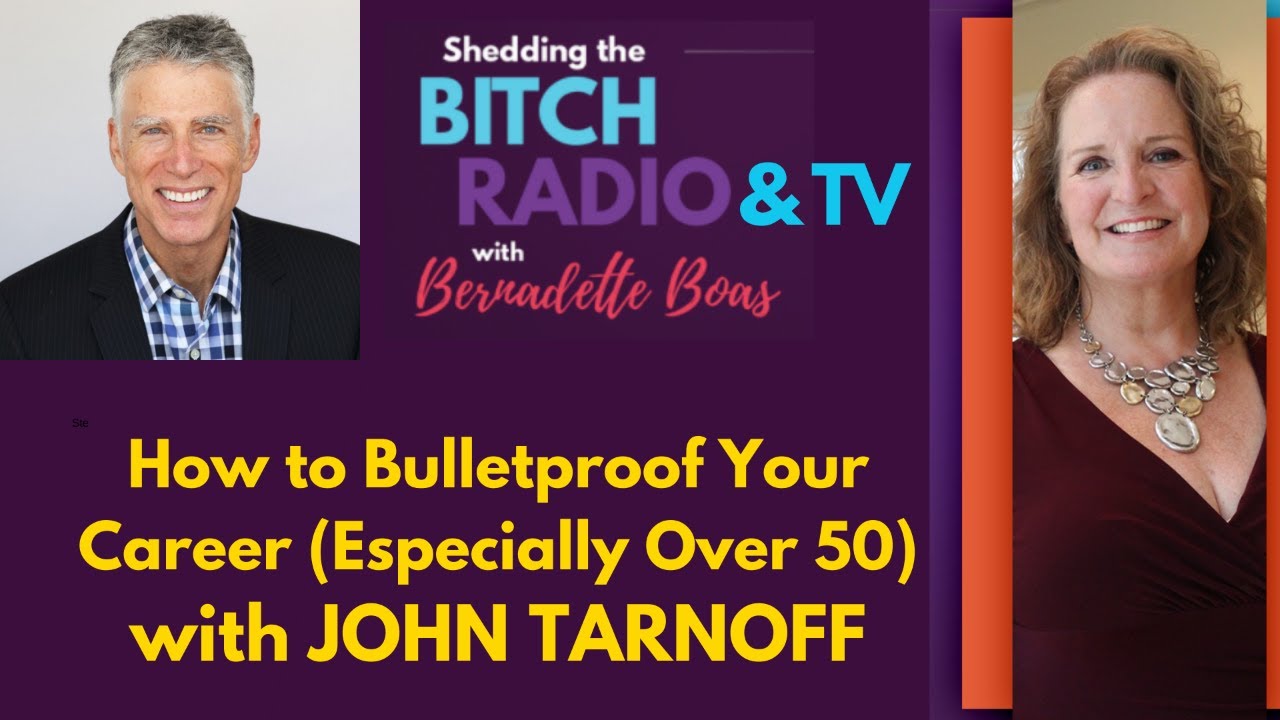
Career coach John Tarnoff explains how professionals over 50 can navigate job transitions when 80% of hiring happens through referrals, not posted openings. He outlines three obstacles: inertia, longevity, and ageism. His strategy focuses on building a strong LinkedIn presence, leveraging your network, and targeting specific opportunities rather than mass-applying.
Chapters
Your work and life. It's time for Shedding the Bitch Radio and TV, where you can discuss, debate, and get advice on how to discover and shed the bitches of fear, insecurity, self-doubt, and negativity so you can realize your dreams and life purpose and create and accelerate the riches in life you deserve. So let's welcome your Ball of Fire host, Bernadette Boas.
Good day, good day, good day, everyone, and welcome to another episode of Shedding the Bitch Radio and TV. I am Bernadette Boas of Ball of Fire Coaching., and I am so thrilled that you're here because I definitely want to ensure that all of you listen up, especially those of you who are over 50, because we're going to be talking about how to bulletproof your career. And for those of you who might be running your own businesses, a lot of what we're going to talk about, um, can be very, very, very translatable over into, uh, you as a business owner. So whether a corporate professional or a business owner, We want to talk about bulletproofing your career, especially, especially if you're over 50. So we'll get to that in just a second and introduce the subject and our guest. But before we do, I want to thank all of our new and ongoing viewers and listeners. With your help, we are growing and you are helping us with ratings and tweets and shares and posts and, and subscriptions and follows and likes. Um, across our platforms, because we do broadcast across any one of your podcast streaming services as well as on our Shed the Bitch TV YouTube channel. So be sure to go out to all of those platforms and let us know the guests you want to hear from and the topics you want us to talk about, because this is— this show is for you, and therefore we want to really bring you, uh, what you're looking for each and every week. All right. I absolutely have to thank our sponsor. ngtaxsolutions.com is a full-service tax and, um, a full-service financial services and tax organization that services small to corporate-sized clients on their both their personal and business needs. So should you have any, uh, tax or financial services needs for yourself or for your, your business, please reach out to NG taxsolutions.com. It's Debbie Smelling and her team who are fabulous, and let her, let her know I said hi. All right, um, okay, let's get into our subject for today, shall we? We're again, how to bulletproof your career, especially over 50. So inertia, longevity, and ageism— these are the 3 most important factors you're going to have to consider as you grow in your career and contemplate what is what is likely going to be a longer and more challenging professional future. In this conversation, we will talk about why these three factors are so important, what the challenges are to maintain and sustain your career, and the key paradigm shift you'll need to adopt in order to create a more secure, more meaningful, more purposeful career as you age. So I— we want you to listen for these three things, and then I'm going to give you a rich question to ground you in this conversation. OK, I want you to listen for why your LinkedIn profile is more important than your resume, why you should be chasing relationships and not job openings, why your experience may be overrated. I love that. And how to overcome your fear of an aversion to networking. Now, your rich question is something that as you come into this conversation, uh, you may be thinking, oh well, this doesn't really relate to me. And yet at the same time, this question kind of grounds you into the, uh, topic and allows you to consider what we're going to talk about for yourself. And then as we go in, the tips and the advice and the stories, um, may all provoke some sort of, um, direction and opportunity for you to learn from. All right, and that's what we're all about here in the Shedding the Bitch community. So let me introduce you to our guest John is an executive and career transition coach, speaker, and author who supports mid and late career profi— planning and achieving more meaningful and sustainable careers. Fired 39% during his 35 years as a film producer, studio executive, and tech entrepreneur, he learned how to turn setbacks into successes in a volatile business. He reinvented his career at 50. Earning a master's degree in counseling psychology to share his career lessons with others going through similar challenges. Since leaving entertainment in 2010, John has coached individuals, groups, and led career workshops for university alumni, including for UCLA's Anderson School of Management. Corporate coaching clients have included Bank of America, Bridgewater Associates, Levi Strauss, SoftBank, TD Ameritrade, and Thrive Global. He is the author of the bestselling Boomer Reinvention: How to Create Your Dream Career Over 50 and has been named a top influencer in aging by PBS Next Avenue. Welcome, John. How are you?
Great to be here, Bernadette. Thanks for having me on.
Oh, thank you for being here. I love, love, love this subject. Not because I'm over 50, mind you, but it doesn't hurt. But what was it? And obviously your, your introduction kind of painted some picture of it. But what was it that really caused you to say this was something that I need to go after? This is something that needs to get addressed when it comes to really bulletproofing one's career.
The wake-up call really was completely inadvertent, I was asked to do a TEDx talk in 2012. And I had already been out in consulting for a couple of years post my Hollywood career. I was at DreamWorks Animation for most of the 2000s.
Oh, wow.
And they were moving into steady state mode. I'm not a steady state kind of a guy. So we came to a surprisingly amicable for Hollywood parting of the ways. They kept inviting me to all the parties, which I think is a good indication that we were on good terms. But anyway, I was asked to do this TEDx talk, and the topic of the day was transformation. This is Long Beach Community Foundation. I had keynoted for them in the past. And so I said, well, do you want me to talk about what's been going on in the entertainment business and streaming and all of the technological changes? And they said, you can talk about whatever you want. And I've been reading up about how in the wake of the 2008-2009 recession, boomers, and now by extension people over 50, were having a really hard time recovering. They lost a significant amount of their home value, their retirement nest egg, and they were realizing— we were realizing that we were going to have to work longer save more and keep on the job. However, with ageism and outdated cultural norms, where are the jobs?
Right.
The common refrain is, "You're 55, you're 60, are you retiring soon? What are you going to do in retirement?" It's like, "Well, I'm sorry, I can't afford to retire." And there is Finally, I think in the last couple of years, a glimmering of awareness out in the economic and financial community that in fact retirement as we knew it is the thing of the past. And that even for people who do change their modality in their late 50s, early 60s, depending on all sorts of factors, financial being part of, part of the equation. Retirement is very different. It's no longer just, you know, go to Florida or Arizona and play golf. And, you know, it's, it's not that anymore at all. Wow.
And so obviously you, you made a big pivot. I mean, you decided after 50 to go back to school. School, and that opened up a huge, you know, opportunity.
Um, right.
Did you feel— are, you know, you talk about ageism, longevity. Is it because you felt it, and therefore that's what, you know, you're all— you wanted to solve that outlook for yourself, and therefore, and help other people do it? Or what, what was the provocation?
Sure.
Three factors.
I, I don't, I don't know that I, that I particularly felt ageism specifically. In other words, I don't feel that I was shut out of a job because of my age, but I kind of feel like I got ahead of it. I kind of saw this coming. And when I went back to school, I had just come out of the tech bubble. I had a startup that I had put together with a partner, and we'd raised a lot of money and had some big clients. And in the spring and summer of 2001, As those of you who were around then remember, the entire tech market took a dive.
Absolutely.
And we're kind of seeing a little bit of those echoes currently in the middle of 2022, but it was nothing. It's nothing like what it was back in 2001. So all of a sudden I was out of a job. I was out of a company. I had made this pivot over the prior 5, 10 years into technology from entertainment specifically. And I knew that I wasn't going to get hired back in the same kinds of jobs that I had been doing back in the '80s and early '90s. So I was looking ahead and I was thinking, well, what am I going to do? And that's when I decided to go back to school, not so much because I thought I was going to become a psychologist, although it turns out I've kind of used a lot of those skills as a coach. But I really wanted to know myself better. I really wanted to kind of do a reset and have this opportunity to look deep and analyze what I was about and figure out how I could present myself differently going forward in whatever it is that was going to come my way.
Right, right. And what do you, what do you find those three factors to be? It's inertia, longevity, aging. What is it about those three things that I'd love to know about? Sure.
So usually people think of, uh, of of different answers when you talk about what are the 3 factors that are applying to or, you know, affecting your career at this age. And when I say inertia, I mean this idea that you think that you're going to just be able to go along the same way you've always gone along. And it's a comfort zone question that a lot of people get into when they are at this age, they think, okay, I've been at work for 20, 30, maybe even 40 years. I'm just going to keep going.
Right, right.
And the, the world doesn't work that way. Again, we were talking about this a little bit before. People expect you to retire. There's all sorts of pressure to kind of push you out of the workforce. In fact, there is a really scary statistic. There was a study a few years ago conducted by the Urban Institute and ProPublica that just over 50% of all workers over 50 will get pushed out of their jobs one way or another.
50%?
50%. So one way or another, whether through layoff, you know, companies going bankrupt, you know, retirement, you know, pushing into a retirement offer, or health, health conditions, family conditions.
Right, right.
1 in 2 people will be out of their job one way or another in their 50s. So with that statistic in mind, you have to plan differently, right? If you think that you're just going to kind of go along all the way to retirement without a bump, right? So that's number 1, inertia.
Okay, okay.
Longevity is a complete reset on on the way we thought life was going to go. And this ties back into retirement, the idea of 65. Okay, well, what, what, what, who came up with the magic number of 65?
That's a good question.
It's Otto von Bismarck who came up with this at the end of the last century as a way of really assuaging the guilt of the factory owner regarding the plight of the factory worker. And so at 65, that was kind of deemed the age where people were no longer able to work in factories. So they were given a pension and they were going to live another 5 years, right? And we're still operating under that same mindset that there's some magic number at age 65. In fact, if you are, if you are 65 today, you have a 25% chance of living past 90, according to the Census Bureau. And every year you age beyond 65 improves your odds of living past 90. So the more you survive, the longer you're going to go.
Right, right, right.
And so if you're kind of in your 50s and you're thinking about retiring, so let me ask you, do you really want a 30 or a 40-year retirement? That's like a third of your life, right?
And not only that, John, but I like, I'm 60. I just turned 60. Mentally and even physically, but mentally, I don't feel 60. I feel like I'm 40. So you're always going to feel that way.
You're always going to feel that way. My mom was a really great role model for me. She was a businesswoman, lived till 89, and was going strong until her last day. And I said to her at one point, when she was getting up there, I said, so how does it feel to be in your late 80s? And she said, it doesn't feel any different. I don't understand it. It's the same. It's better than it was when I was in my 30s and 40s, right? So expect that we're just going to keep feeling this way, right, and defying the odds. So I'll tell you, I just turned 70. I don't feel 70. I don't think I look—
you don't look 70 at all.
I take care of myself. But I think it's not so much the outside, it's the inside, right? It's who you are on the inside. And, right, so this gets to the idea of inertia again, of kind of defying inertia and understanding that you're going to be living longer.
Yes.
But then ageism comes in because this is what we're fighting every day.
And that's the third factor, right, is ageism.
We're fighting this universal bias about what it is to grow old, and it is based on misinformation, outdated information. It's also based on fear.
Yeah.
And the idea that we don't want to think about what we're going to be like when we get old. It's the great unknown, right? So, what I'm doing, a lot of people are doing, you're doing, is to re-educate the world on what healthy aging looks like.
Yeah. Now, John, well, John, there's, there's countries out there, though, that have high regard and respect and revere these, you know, their seasoned, their seasoned popularity.
Yes.
You know, why is it? I mean, is it that fear factor that especially in America, you know, we put to, you know, the age, the number that we are?
I mean, there are a lot of factors. I wouldn't want to kind of dig into the weeds with you on this. I think it's just too complex. I will say, I think that even in countries where age is more respected, I think there still is this— and this is kind of a strange word to use for it— paternalism around older people, right? I think there are limiting views around the world about who older people are, what they can do, what they're capable of. And this is hurting our culture. This is hurting our economy. If in the 2030s, people over 65 will outnumber people under 18 in this country, which is happening, the age bubble is happening. What are we supposed to do with those people over 65? Are we supposed to to put them on all on Social Security? Are they, are they supposed to kind of just sit, sit in their chair? Right. Why don't we put them to work when they are fully engaged, fully capable, have great expertise, and to, to contribute back to the society?
Sure.
Why should we not, uh, allow them to make that contribution?
Yeah. So Based on all of that and those 3 factors, if someone was in a— maybe they're even in a career transition, not necessarily they're out of a job already, but they are, you know, but say they're looking for a job, they're in career transition, or they're even just sitting there questioning, you know, what's next for me over 50? What would you say, uh, you could look at as a mistake or do or don't you know, what would you say is the biggest mistake they're making and/or the biggest don't, you know, that they need to avoid? Right.
You had talked about paradigm shifts.
Yeah.
And I think that the biggest paradigm shift that we have to fight against is the way we go about looking for a job, because the knee-jerk reflex is brush up your resume, find open positions, send out the resume and a cover letter, send that out to 25, 50, 100 positions, and wait for them to call you back. Well, good luck. That's not going to happen today. The average recruiter spends about 7 seconds looking at a resume. 200— I think the statistic is something like 200 applications arrive for the average job within the first hour. It's 90% of people don't make it to the interview, right?
Oh, right, right, right.
So if you're thinking that that process is going to get you somewhere, you're sadly mistaken. And the reason for that is because of scale, because Employment hiring is, is broken today. They just can't keep up with the onslaught of applications to open positions. Further, I would say that if you're older, you're going to be— if you, if you go the conventional route, you're going to be shunted aside because ageism, of course, number one. But also because there's this perception that your skills are outdated. And in some cases, that may be, that may be true, right? So it is important to stay up on your skills. But I also think that you are more than your skills. You're not just some skills widget at age 50, at age 60. You have a lot more on the ball. You're a lot more strategic, you know a lot that younger people don't know.
Yeah.
But how do you get in there and convince them, right, of your value? Well, and so, so the, and the, the pivot is that you need to get off the idea that applying for a job through conventional channels is going to get you the job and move to thinking about your network. And building your network. That's the way you're going to do it.
And is that, and is that, um, online and offline?
Yes, but as things are, uh, online to such a great degree and work is so much more remote, particularly after the pandemic, than it ever has been, you really want to focus online for the majority of what you're doing, right?
So let me just back up and just ask a clarifying question so people understand, people might understand why the conventional way or the traditional way isn't working. Correct me if I'm wrong. I understood too, and I haven't applied for a job in a very long time, but they— but everybody should understand for from my understanding, they use automated systems to run your resume through. And, you know, unless there's something outrageous in there or very unique or distinct, it's just, it's getting, you know, kind of lost. It's vanilla against everybody else that's, that's also, you know, submitting theirs. Is that, is that what it looks like out there in regards to application submission?
Yes, there are. This is called the applicant tracking system. And this is, this is a raft of technologies that are used to scan resumes and to pick out the keywords that the employer is interested in.
Right.
And this goes back to the idea that you're not a widget. You know, there's so much more that you have to offer.
Right.
At age 50, 60, 70 than at age 20, 30, 40.
Yeah.
And, you know, I make this slightly disparaging remark that skills are for kids. Remember, tricks are for kids, skills are for kids. If you have— and, and with no disrespect to being a younger worker learning your way through your career— if you're at the beginning of your career, you're still learning, you're still apprenticing into your 20s, into your 30s, into your 40s even. Skills are important. That's what you have to offer. At the beginning, when you have nothing, you have your willingness to work hard. Then you have your skills, right? And that's what's fungible in your career at that stage. Beyond a certain point, you know more than just skills. You know strategy, you know how to use it, you know context, you have insight, you have experience. Mm-hmm.
Yeah.
Hard to get that through an applicant tracking system. You need to meet people who can recognize your value, right? So your network is your as they say, your net worth. But in order to bolster that network experience, you have to have, back to your mention earlier, a value proposition. You have to be really clear on the very specific set of deliverables and results that you offer as a professional.
Okay, so what does that look like? What is— you're answering my questions. What does that look like? What What is that?
I can just go on, right?
Yeah, yeah, yeah. What does that like tactically look like for someone?
Right, exactly. So, you know, we're used to thinking, particularly with years of experience, oh, I can do anything. What do you got? I have, I've, you know, I've done sales, I've done business development, I've done administration, I've done finance. You know, let me help you out. What do you need? That's the wrong approach. Employers want very specific solutions. They have very specific problems. And if you are an entrepreneur, the same question applies. Who is your market? If you make the mistake of saying, oh, my market is everybody, then as they say, your market is nobody.
Nobody. Yeah.
Right. So you want to apply this entrepreneurial mindset, this consultant's mindset to your employee career. You don't want to go in as an employee taking direction from a boss with that mindset. You want to go in as a consultant who is delivering results for a client. Yep. So you want to understand, A, what it is that you do best of all of the things that you can do. What do you do best? What do you love to do? Where is your greatest ROI, return on investment, for what it is that you do, the results that you deliver? Then figure out, well, is anyone buying that? Is anyone— does anyone need that? So you got to do some market research here around your value proposition, right? And once you have that clear, and you have that packaged up, and this is why LinkedIn is so much more important than your resume, because you get a chance on LinkedIn to actually explain and express the value proposition.
Ooh.
Now you're in a position to go out to your network and say, here's what I'm selling, here's me as a product. Do you want this?
Even from a job— and what you're saying is from a job search perspective, That's what the product is, is you. And that's what you need to convey and communicate out into your network.
Right. So you're not just looking for any job that you can do, right? Because that at the end of the day becomes a waste of time. It's a bad numbers game. You're going to be very, you know, your results are going to be very minuscule. Stack the deck in your favor, right? Apply to the jobs that only need what you are the best at providing.
Yeah.
You will get a lot farther. You'll get into a lot more interviews. You'll get into a lot more final rounds of interviews by doing it that way. You will be much more on purpose, on message. You'll meet people who will appreciate you more for who you are and what you do. And you will find yourself ultimately in a better position when you land.
Okay, so I want to get to the exactly how to do that from a networking or LinkedIn perspective, but I want to ask you from a coach's perspective, and you're the coach, how, you know, someone's listening, they're over 50, they are in kind of either they've lost their job or they're in a transition, they're feeling desperate for income and for a job, and, you know, and so they're listening to you, and yes, that sounds like, you know, the perfect world, but I need to pay my bills and eat. How do you coach them? How do you guide them to take the approach that you're saying and trust, you know, that that approach is the right way? What's your process for doing that?
Look, you, you have to take care of number one. You've got to put, uh, food on the table. So you have to engage in as many strategies as possible to make that short-term— if that's the case— uh, opportunity work out. So it may be that you're going to take a job short-term. Uh, maybe you've got some existing connections that can help you out in that department. Maybe you do apply to some jobs that are similar to the job that you just had. I'm not saying completely stop all of your activities and completely throw your attention into something new and unfamiliar.
Right.
You've gotta be operating on a number of different fronts for this to be effective. What I am saying though is that at the end of the day, what's going to work for you long-term is going to be much more of a network-oriented, value-oriented approach. Even in the short term, it's going to be more successful for you to apply to jobs where they can really see where you fit because of your background.
Yeah.
Because of your capabilities.
I love that.
You're gonna have to do a lot less explaining to them about why you're the right fit for this job if it's really clear in the existing resume, even without explaining the value proposition, even without doing the extensive networking. Short term, go for where your strengths are.
Yeah. All right. So good segue when it comes to networking. So what does networking look like today, especially like you said, a good majority of it should be online. And, you know, you emphasize LinkedIn. What does that actually look like today? Because I, you know, I know from my perspective, if one more person sends me another LinkedIn message selling me or pitching me something, I'm just going to choke, choke somebody. But what should it effectively look like to be successful?
Well, the first thing, and I think you bring up a good point, the first thing is that you're not selling anything, right? Stop pushing yourself on other people. And I think there's a clear demarcation on LinkedIn between the obvious marketing messages and the genuine peer-to-peer reach out. Yeah. So when you get a connection request on LinkedIn, I would say maybe 8 to 9 times out of 10— this is certainly my experience— it is someone who's trying to sell you something. But it's easy to find. You just look at their profile and see what their what they're about. And if it's clear, I mean, in my case, I am being bombarded daily with messages for people who want to help me grow my coaching practice.
Ah, it's exhausting.
Ignore, ignore, ignore. That's okay. You know, there's a lot more value to the platform than that. That's not going to sink the value of the platform for me. It's just a click. I can just, you know, send them away.
Good point.
So it's easy to ignore those marketing messages on LinkedIn. And when people reach out to you because of the business that you're in, commonalities that you have, and a genuine desire to connect with you and ask questions, provide value to you, that's when you know that there's something positive there. So in your hypothetical outreach, you want to connect to people with whom you share some kind of a bond, whether it is the work that you do, the attitude that you have about work, the industry you're in, the future. This is the mindset that you want to bring to the table. And this gets into the idea of thought leadership, which is kind of the cherry on the sundae of the career development process.
Yes, it is.
Right. So we all have to think of ourselves today as marketers and thought leaders, particularly if we are over 50. We have earned the right to be sages and to be experts.
Love that.
Love it. So use it. Express yourself. Have a set of points that you talk about in your career talk, in your career value proposition. Things that are the future of the business. I talk about inertial longevity and ageism, among other things, right? You, you always know if you're engaging with John Tarnoff on LinkedIn, he's going to be talking about something like that, right? And if you need a dose of that, well, then maybe you're going to reach out to him and, and follow him and listen to him, right? Similarly, I'm looking for people in my space. I'm looking for— I'm looking to connect. For example, I'll be totally kind of behind the curtain here with you. I love connecting with financial services people, with financial advisors, CFPs, etc. They've got clients who are looking at staying in the workforce, who are delaying retirement, who are trying to save more money.
Right, right.
Sooner or later, they may say, you know, If you're thinking about this, you should talk to this guy, Tarnoff. Maybe he can help you figure out a plan. So, but I'm not connecting with people to sell them on something, right? I'm connecting on people to share a perspective.
Yeah.
And I think that's an important distinction in how you engage with LinkedIn, right? I like to say you want to always be giving, ABG. You're always looking for a way to improve someone else's business, improve the quality of their lives. And that's where thought leadership is so important because that's how you get conversations going. And way down the road, someone is gonna come back and say, "You know, I'm making a referral. I'm introducing you to someone who really needs your help. See what you can do." That actually happened.
Well, it's happened to me multiple times, but there was a significant one that happened to me that I just thought, that was gone and over with. It was like a year and a half, you know, ago. And I was just— and yet I, you know, would continue with that thought leadership. I love that. Love it, love it. And, uh, the ABG, right? And love that too. Um, and the next thing you know, a year and a half later, I get this phone call. Do you remember me? And I'm like, oh, you've got to be kidding. So yeah, there's a lot, a lot, a lot of weight in what you just said. Said there. Now, when you, when you say that, when like your value proposition, and you know that when you're communicating that, that's also in your LinkedIn profile, correct?
Right. And one of the things I would say about that, just a little footnote on that, is that one of the big mistakes that people make on LinkedIn is they put their job title as their headline. VP Sales, ABC Company, right?
Right.
Your headline is an opportunity to describe 2, 3, 4 roles that you perform that move the needle.
Yeah.
So, you know, strategic marketer, not VP marketing, right?
Right, right, right.
Leader. Uh, you really want to genericize this so that people who read this go, ah, okay, this is a particular set, a particular constellation of capabilities that this person offers.
Right.
Now let me drill down here a little deeper and learn more.
Yeah.
And then this gets into the about section, which people mess up all the time. Most people think that the about section, if they have an about section at all, is about a dry third-person recitation of their experiences and skills. Proven sales professional delivering massive ROI across 30 years of, you know, consumer product.
Right.
Nobody wants to see that. It's kind of droning corporate speak.
Right, right.
The About section is, should be, an opportunity to express who you are and why you do what you do and to make an aspirational statement about where you want to go now in the future.
So first person.
First person, conversational. Imagine that you are meeting someone interesting at a cocktail party. And they say, "Tell me about yourself." And you say, "Well, here's what I do. But here's why I do it." When I was 15, and I have a great story about this. I was working with a guy who's a chief counsel in a licensing company. Been doing this for 20, 30 years. He had gone through the company through 2 or 3 changes of management ownership. And finally, in his 50s, they just said, you're gone. And he was devastated by this. This has been his life. But he loved the business. He would— this was all about sports licensing for university teams and professional teams. And he knew the licensing business backwards and forwards. And I said to him, so how did this all start? And he was talking about coming out of school and this and that. And I said, well, if you can find some kind of origin story, that might be really inspiring for people. So the following week he came back on the call and he said, I don't want to do this, but my wife says I should tell you this story. And I said, okay, what's the story? He said, well, when I was 12 years old, my first job ever was selling hot dogs at the minor league baseball park in my hometown. And that really kind of got me going on sports. It really was the beginning of my love of the sports industry. And, but I feel too embarrassed to put that in my about section. I said, no, no, no, you should lead with it. I said, it's so engaging. It's so endearing. It really gives people a sense of who you are as a real person. So he did it and it worked and it was phenomenal. And he really started to build some energy around that. And he went off to a convention. He was out of his company. He was kind of reluctant to go out and show himself. I said, no, no, you got to go to this convention because people are going to want to connect with you. You have this Rolodex a mile long. Let people know what you're doing.
Absolutely. Absolutely.
So he did. And a bunch of people said, oh, I see your new LinkedIn. I love that story. Yeah, you've got to make yourself accessible because that's the way that you're going to rise above the noise that's out there.
Yeah, I agree.
Everyone's unique in their own way. It's not that you're the only person who does what you do, but you're the only person who does it the way you do it and why you do it and why you do it. So, so express that, right? It's a conversation starter. It lets people in, and that's what you want.
I love that. Now, are you also a proponent of, you know, not only using your about in your header and whatnot, but actually contributing like that thought leadership, you know, making yourself visible by posting and contributing on a regular basis?
It's really important. It's really important that you engage and at the very least follow people that are in in your industry, people, they may be peers, they may be leaders, but people who have a community around them on LinkedIn and off LinkedIn, obviously, be a part of that community. Build relationships through the conversations that you have. And, you know, you may find that you're exchanging comments with someone and they may say, hey, why don't we get on a call?
Yeah. And how these things start and how— and if they don't, you know, if that person doesn't reach out and make that suggestion, how quickly, you know, like how many communications should someone wait to then say, hey, I'd love to chat, can we get on a call? Because some people don't like to be pushy, right?
I, I don't think there's a hard and fast rule about that. I would say that you've got to use your You got to use your instincts about it. If, if you find yourself in an exchange with someone, 2, 3 comments back, maybe they send you an article, maybe you send them an article, maybe there's some, there's some energy going on there. I would not hesitate to say, hey, why don't we get on a call? We've got a lot to talk about. I'm really curious to learn more about what you're doing. How you got to that position.
Yeah.
And this gets into a whole other question about informational interviews and the idea of going out there with a beginner's mind. If you're in a career transition, I don't care how old you are, how young you are, you need to be open to learning new things.
Absolutely right.
And through your curiosity, you are going to meet people develop relationships, right, and get new ideas that could be really actionable and successful for you moving forward. So love that. So be curious, right? That's— that is— that is so important.
Love that. Now I want to— I love— I could talk about LinkedIn all day, but— and ask you questions about it for our audience all day. But I do want to, um, I do want to understand, you talk about a hidden job market. What exactly is that? Because I'm sure everybody listening and watching would want to know.
Well, the hidden job market is where 80% of hiring takes place. And it is— it's kind of the— it's the— it's the iceberg, right? The top of the iceberg, the visible part of the iceberg, is Indeed and Monster and all of this craziness around resume submissions. But in fact, 80% of hiring takes place through referrals, whether it's internal or it's external. It's all about the referral network, right? So that's the underpinning of my whole methodology, which is be part of someone's referral network. Yeah, yeah, create your own referral network, right? Look at all of the people in your contact list on and off LinkedIn, and if it's off LinkedIn, you want to bring them on LinkedIn. You want to make sure that LinkedIn becomes your database.
Yeah, yeah, yeah.
And then think about, okay, well, who are these people? And more importantly, who do they know? So you wanna look at your second level connections on LinkedIn, which is going beyond the first level of people that you know. So first cultivate those people, make sure they're aware of your situation, that they're aware of your aspirations. 'Cause a lot of people, even if they are people that you know well, may not know what you're doing now. They may not know where you're going, where you want to go, what this pivot is now. So it's important for you to refresh them, reconnect with them, even if it's been 10 years, right?
Absolutely agree. That's awesome. That's huge. Okay, so the hidden market is, um, referrals.
Yes.
And nothing's to say— stop— nothing should stop somebody from saying, hey, You know, I'm looking at this opportunity at this company and I see that, you know, Joe, you know, would you be able to refer me into him? Exactly.
Exactly.
Yeah.
So you always want to know, you always want to look at, you know, it's a, it's a dance, right? There's no one way, one cookie-cutter way to do this. You want to be looking at your network. You want to be looking at companies that you're interested in, sectors, kind of copycat companies. In other words, if, for example, you, you want to work at Salesforce, just picking a, a big company out of the air, you know, you want to work in the CRM technology field, well, there are other companies in that field other than Salesforce, right? So you can start there, but then do some research around other companies that are doing new developments in CRM software, right?
Right, right. Because some people aren't aren't meant for the big companies. They, you know, they work much better in smaller— sure, you know, smaller companies. So just don't assume that you have to go to the big ones is what you're saying.
Exactly. I mean, it's really about— again, and this is back to your value proposition— your value proposition could apply across a range of different companies. So very often people will come to me and say, I'm interested in this kind of company, this kind of market cap. And I say, whoa, whoa, whoa, whoa, wait a minute, let's talk about the value proposition first. And think about where that value proposition applies, because it could apply to maybe 2 or 3 big companies, but it could also apply to 75 mid-sized companies. And there might be 2 or 3 maybe early-stage, well-funded companies with a great business model and great management where you would shine. So don't kind of shoot yourself in the foot by having these very rigid ideas about who you are, what you want to do. And I'm not going to work for this kind of company.
Right, right, right. Yeah. Because you could be losing out on huge opportunities for yourself.
Be curious.
Yeah. Be curious. Yes. Be curious. All right. So we covered a lot, a lot of all of that, especially when it comes to the 3 factors that are impacting, especially those that are over 50, impacting, you know, them kind of bulletproofing their career, what would you say is the one thing that they should like as of right now listening or watching this that they really should focus on and or even take action on? What is the one thing?
I am— what comes up to mind is something that you had mentioned in the intro, which is stop chasing open positions and start chasing relationships. Yes, that is the most important piece of advice that I can give you today. It's all going to be about your relationships, right? And I come from a business, entertainment business, which was never about the resume. It was always about the relationship. And while I had— I always had a resume, I never used my resume to get a job. Of those 18 jobs over the 35 years 1975 to 2010, it was always about the relationships.
Yeah, it's true. It is so true. When I left corporate in 2008, I was devastated that my Rolodex— old term— um, my Rolodex was so small, like the actual, you know, like, net contacts that I had, because I was in for 25 years and I did not and I did not nurture and I did not maintain those relationships. So I love, love, love that.
And that would be the corollary to my number one piece of advice, which is if you are in a job, don't think that you are exempt from having to work on your network. Being in a job is the best time to build a network because it's a lot harder to build a network when you don't have one and you need one, right?
Everybody thinks you want something from them.
That's right.
Absolutely. All right, so you have something for our listeners and viewers.
Yes.
Could you explain the 3 steps that they can get access to?
So amongst all the stuff that we've talked about today, um, I've distilled down 3 action steps that you can take if you are in a career transition, if you are looking to pivot to something new, or if you are between jobs and you're looking to get back up on your feet. Just 3 steps to consider. Out of all of the things that we talked to today, this is how I feel you'd be pretty well served to get going and get yourself back up in the saddle.
Yeah. Awesome. And so we're not going to give you anything more than that because you have to go to JohnTarnoff.com/3steps. 3 Steps and download it.
It's a lead magnet.
It's a magnet of action and change and of transformation for you.
Look, it's a way— if, if anything that I've said today resonates with you, then get onto my list, take a look at the ebook, uh, and stay tuned for more.
Yeah, I love that.
And contact me.
And contact him. Yes, johntarnoff.com. Yeah, but then you can add the 3— slash 3 steps to get that.
You can contact me on, uh, through my website. You can contact me on LinkedIn. I won't bite.
Yeah, you won't bite. LinkedIn, it's easy. John Tarnoff, that's all you need to know. Um, but definitely go to johntarnoff.com/3steps. John, thank you so much. This has been awesome.
Love talking to you, Bernadette. Thanks so much for having me on.
Oh, you're so welcome. And for everyone else, thank you so much for being part of Shedding the Bitch today. And be sure to check us out across platforms, whether it's your— any one of your podcast streaming services or on our Shedding the Bitch YouTube channel. And be sure to be back here next Tuesday at noon Eastern time for another episode of Shedding the Bitch. We'll talk soon. Bye.
Thank you for taking part in Shedding the Bitch Radio and TV with Bernadette Boas. We would love to know what your biggest takeaway was. Go to Shedding the Bitch on Facebook or YouTube and leave a comment. You can also subscribe to the show on Apple Podcasts and YouTube so you don't miss a single episode of the show. And with your input, we can help other powerhouse women just like you find the show and decide if it's right for them. Learn more about Bernadette at balloffirecoaching.com. See you
More from Bernadette



From Stuck to Leading, Episode 2 — Meet the 5 Inner Fears Destroying Your Leadership



