" Is The Way You're Working REALLY Working" with ➺ Wendy Ellin
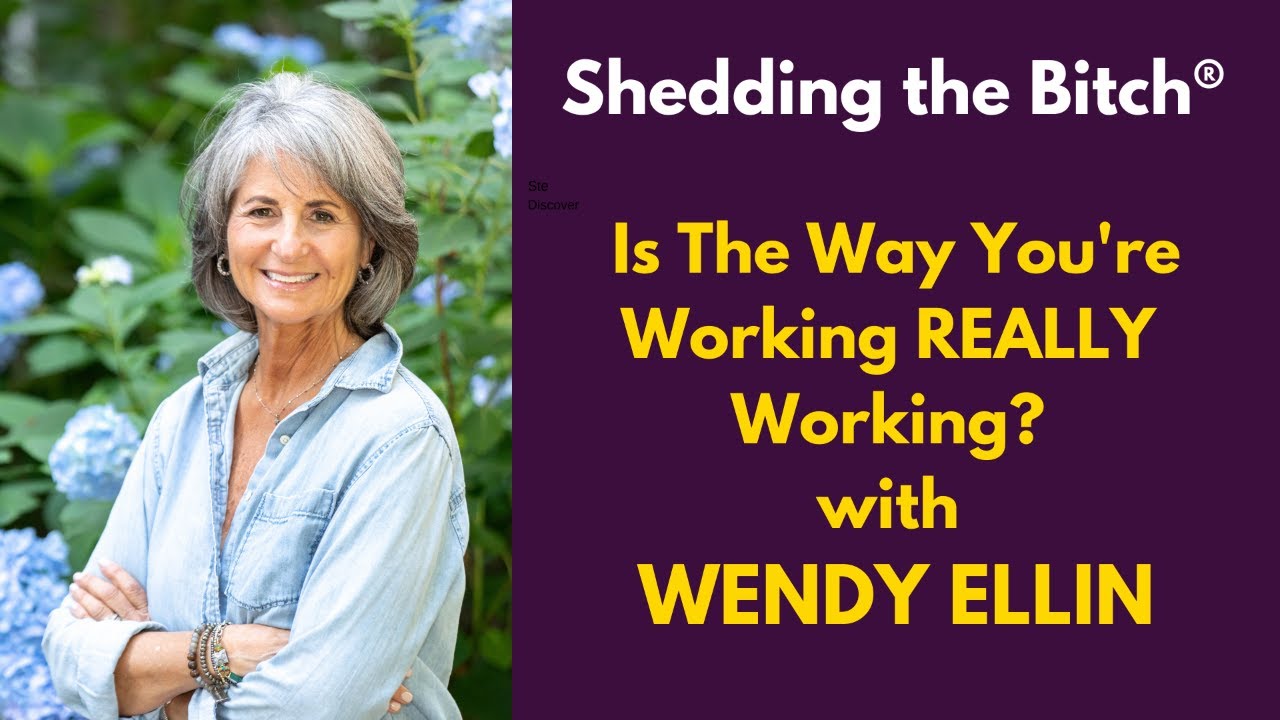
Wendy Ellin, a workplace productivity consultant, talks with Bernadette Boas about whether your current work system actually works. They cover decluttering your space and mind, the 80/20 rule, focused work blocks, and Wendy's 3P Academy approach to productivity, performance, and peace of mind.
Chapters
Are you swirling in chaos and overwhelm? Do you want to get your shit together so you can find some calm and focus out in front of you, front and center in your work and life? Today we are answering the question, is the way you work really working? And we're going to talk to Wendy Ellen, who is a workplace productivity consultant, all about it. So let's do it.
Are you ready to create riches in your work and life? It's time for Shedding the Bitch Radio and TV, where you can discuss, debate, and get advice on how to discover and shed the bitches of fear, insecurity, self-doubt, and negativity so you can realize your dreams and life purpose and create and accelerate the riches in life you deserve. So let's welcome your ball of fire host, Bernadette Boas.
Good day everyone again and welcome Wendy! How are you?
I am fabulous, thanks for having me.
Oh, you are so welcome. I am so excited to talk about this because who the heck doesn't want to get out of overwhelm and chaos? And how did you get into this line of work, especially around productivity?
Crazy shit, right?
Crazy.
So, um, I mean, I'm based in Atlanta, Georgia, but I travel all over the world. I have an international speaking side of my business, so that's what gets me out and on a plane and on stages all over the place. Um, I, I came from a radio sales background. I was in— and I was in sales before radio. I was in advertising sales. So I sold radio, I sold newspaper, I sold cable TV. And then, uh, and what I— when I was in the radio business for many, many years, Bernadette, I found myself observing the way people worked. I was kind of amazed I watched because I was always made fun of. People used to always say, well, she can't be very busy, she doesn't have anything on her desk. And I was super busy. I was always making my budget. I was always doing what I needed to do. But the difference between me and everybody else was one word. And that word is systems. I had systems for everything. I had a system for how I used my inbox. I had a system for how I dealt with paper. I had a system for how I dealt with my calendar. I knew how to set boundaries around my time. I was okay to say no, thank you. I was good about that. And I got ridiculed for it, for it. But I knew that it served me well. And I knew that the way other people worked didn't serve them well. And it wasn't that I was judging. I became very curious. So when I decided I was done with radio, I knew that I had a gift, and that was I know how to get things done in a way that serves me well. I have no stress about the way I operate, right?
Right.
That means from the time we wake up to the time we go to bed, all of us humans are faced with the same challenge, and that is how do we get shit done? I get it done in a way that serves me well. I don't have any stress around those moving parts, but most people do, and that's what causes the overwhelm.
Majority of people do. So it's like amazing where you don't feel that type of pressure, you don't feel that type of stress. Even when you were talking about that overwhelm, I was starting to like, oh, you know, you just like—
I don't, I don't, I don't feel that. Now I understand other people feeling that, and I can empathize with them, and I've lived it because I've seen it. I've sat next to people in cubicles who I overhear them going, where's that piece of paper I just had in my hand? I just took it from the printer, I just put it down, how come I can't find it? And I'm like, because you're a mess.
And you need me.
So I literally looked at the way I ran my life and I created a business around it. And 21 years later, I just rolled out a new product called Wendy Allen's 3P Academy, which is a toolbox that, that fuels productivity, performance, and peace of mind. I'll say it again: productivity, performance, and peace of mind, because they all are equally as important and they go together.
Right. Absolutely. That's fabulous.
And so here we are today, and you are looking for your clients.
Their end state of being is—
well, you know, let's back up a minute and talk about what the last 2 and a half years looks like and has looked like and what it's now created. So people are like, are we working at home? Are we working at the office? Is it a hybrid situation? Are we getting rid of physical buildings? There's so much chatter around these words. And then add to that wellness, burnout, Great Resignation. So much of what's going on in the world right now speaks to what I do. But what I want everyone to get clear on is this: COVID didn't make the world disorganized. COVID shed a light on what's been there for years.
Yes.
And now people are raising their hand going, I need help. And if they're not raising their hand and saying they need help, it's because they have shame around it.
Right.
And so— wow.
Wait, wait, wait. Don't move on from there.
Shame. You feel bad that you have clutter. You don't want me to come see your clutter because that speaks to who you are. But it isn't really who you are. You just don't know how to be any other way because you've not learned these skills. But they're completely learnable.
Right. And it's not just physical clutter, I would assume, either.
Mental clutter, electronic clutter, emotional clutter. Yeah, you name it.
Right, right. So the shame, the shame also has— would you say it has to do with them having never acknowledged it, even let alone address it?
I think a lot of people think that they have no choice but to live the way they're living all these years. How could they possibly live any different? You mean to tell me that I don't have to have clutter? How does that happen? Well, it's a process. I can teach you how to do it.
Right.
I've taught thousands of people how to do it.
Right.
No matter what they do, I keep saying to people, it doesn't matter what you do for a living. It doesn't matter who you do it for. And it clearly doesn't matter where. It matters how.
Right.
It is not— this is the tagline in my business. I'll keep saying it till I take my last breath. It's one thing to love what you do, but it's another to love the way you do it. And my business has never been busier in 21 years, but I have control over all the moving parts, right?
Right now. I love it. I love it. And you can tell how passionate you are about it.
I'm on a mission, woman, to literally get people to clean up their shit and have the life they deserve.
Yeah, well, because the other thing that jumped out at me too when you were talking is, and I thought that's where you were going with the COVID conversation, because it's— do you find that it's also not everyone else creating the chaos and overwhelm for you? You're creating your own chaos and overwhelm by how you're responding and what attachment you have to a lot of the external factors going on around you, wouldn't you say?
Yes. Let me start by saying this. Let me touch one thing you just said. Everything in the world is energy. We are all energy. Okay? I can't energetically create something for you. It's impossible to do. Your energy is creating your life. What you think and what you believe and what you speak is what you're living.
Right.
Okay? Yep. Ace, that's basics energy 101. We're all energy. When it boils down to it, this water bottle is energy and this business card is energy, and so are you and I. Yeah. So I know when I focus on what's working in my life, more of what's working comes into my existence because it's all energy. So when you're in a chaotic state and you're talking about the mess that you're in and the dysfunction that you're in, you're just going to continue to swirl in it.
Right. Right.
But if I can get you visualize what you want it to look like on the other side of working with me, Like, what if you had an organized business? What if you didn't have any piles on your desk? What if your email inbox was in control? You were in control of it versus it's controlling you. Right. What could that look like? What more could you do in your life? Could you buy an hour in your day that you could leave actually on time and go have a life? You know?
Right.
Because, and you know, and I have 5 rules of engagement. Sits right here on my desk. That I talk about in things like this, because when you stick to some kind of rules like this, your life will transform. Number one, show up every time for yourself and for others. Show up every time. It's number one for me. Like, I do what I say I'm gonna do. It's just how I'm wired, and it will take you a long way in your life if you do that. Right. Okay. Number 2, no more excuses. Everybody has a million reasons why they can't get organized. My kids, my dogs, my husband, my whatever, whatever. Because if you let excuses run your life, they will.
Yes.
Right. Absolutely. Number 3, keep making choices. Clutter is nothing more than the manifestation of indecision. Clutter is nothing more than the manifestation of indecision. You don't decide and you don't decide and you don't decide. You don't decide. Before you know it, you got a pile. Number 4, just do you. Stop putting on your phone all the apps that all your friends have when you don't even know what they do. And you're not even gonna use them. If I can't tell you what an app does because I use it, it does not belong on my phone. Stop doing what everybody else is doing. I don't care what they're doing that works for them. It works for them. You do you. And the last one is really important and it's the biggest one. And that is that there's this category in our life that's called it is what it is. I have a commute. Well, either get a job closer to your house or move your house closer to your job. Like, that's how basic and down to this is I am. It's like all the shit that falls into the category of it is what it is, if we can get really clear on that and put it where it belongs, then we can learn how to live around it.
I have to tell you, Wendy, That statement has literally— and I'm not, you know, dramatizing this— saved my life.
Yep.
It is literally about 4 or 5 years ago, I was just drowning in all that chaos and overwhelm you're talking about. And that set that statement. I started just echoing it and everything that I looked at, that's— I kind of bounced it up against it, that situation. Um, and it saved my life. So I absolutely love that. And that's your number 5, correct?
It should be number 1, but it's number 5 because, well, they're not in order of priority, are they? No, not at all.
Right, right.
Yeah. And it's really important. And when I get people to see that, it takes the pressure off. Like, it is what it is, okay? You know, people are quitting their jobs. We're gonna find the right people. You can do something to alleviate that, and you can do something that to do something to, to prevent that from happening, which is what I'm out there in the world talking about now. How do you offer something like this toolbox to your employees as a benefit to get them to stay and to get them to stay engaged and to get them to give you their best work? Because at least you deserve to get the best work out of your people, but they're burnt out.
And do you see a trend based on the work that you do around productivity? That's one thing, right? But I love the idea of the work that you do when it comes to cluttering the mind as well as the tangible around people. And do you find that even more and more, because you mentioned small businesses, but more and more larger organizations are recognizing that they have to start investing in that mindset side of it, not just the processes and the system side. So what you do brings both of those together, right?
Two things on that point. Number one, I really only want to work with the companies that get it. That have— that see— that, that are interested in creating this culture in their organization, right? I don't want to put a square peg in a round hole, right? But I'm also willing, if you don't get it, to bring it to your attention. And here's why. I went and I spoke at a conference 2 weeks ago for SHRM in Atlanta, and I was one of 5 speakers at the same time, so everybody had a choice. I didn't know how many people were going to be in my workshop, but when I got in the workshop, there was nobody there. And within 20 minutes, it was standing room only. There were close to 75 people in the room. And when I said to the crowd, why are you here? Tell me why you chose me above all these other people, because there were all interesting things to go listen, right? One by one, everybody sort of looked around, wanted to make sure it was a safe space, and said because I need it and because it was available to me. So I'm now going to corporations to say, do you even know what your people need? And if you don't, it's because you haven't asked them. But you don't know what you don't know. And a lot of people, when it comes to being disorganized, are suffering in silence because they don't want to tell you that they're a mess. So you've got to dig a little and say, you know what, I'm going to assume that if 75 HR people that were at this conference where I was speaking chose me, you better believe that half the people that HR to are also disorganized. Why don't we think about offering this as a benefit to them so that then you can hold them accountable to doing their best work?
Right, right. Absolutely. Absolutely love that. I absolutely love it. Now, you had mentioned in your own intro that from the moment you wake up to when you kind of end the day, you're always looking at how, you know, how your going about life and business and always creating processes and systems and ways to improve on it. What is the morning ritual that you follow and that you even coach or train others to follow to get them in a good state of being going?
So that's a great question, Bernadette. I don't— I can tell you, I can share with you what my morning ritual is. And then I can share with you that I just insist that my clients have a morning ritual, but it certainly doesn't need to be mine.
Okay. Love it.
You gotta do you. It's gotta work for you. I don't have any kids in my house.
They're grown.
I have a dog. She's pretty chill. I can spend 30 minutes every morning on a morning ritual. You know, parents of young kids, they're lucky if they have 3 minutes.
Right.
It doesn't always have to be morning either. You could have a ritual at the end of the day. Right.
Good point.
But I get up in the morning and I meditate and then I hydrate and then I move my body and then I write in my gratitude journal. I assess my day with my husband and I get to my MITs, which are my most important things every day, every day. Now here's the other thing. I'm not looking for perfection. I don't do this on the weekends. My weekends are free days. I get to do whatever I want. If I don't want to meditate, I don't first thing in the morning. So I'm 80% organized. I am only looking for 80%. It's the 100%, the 100% that people strive for. That, that allows them to quit because they figure if I can't get to 100, why bother at all?
It is so unbelievably true. So unbelievably true. And I'm starting a new challenge today, so I'm going to be thinking about you as I look at this measurements of my success or not. And I'm going to ensure that I'm not— because what you're saying is people over, over goal or like overestimate what it is that they can and want to achieve and therefore themselves.
They just don't have realistic expectations of what's possible. It's just not possible for me to go through my calendar and expect that everything that's happening on my calendar is going to happen. It happened today with you. You reached out to me to say, can we do 2:10? Of course we can.
Right.
You just have to— when people say to me, what do I do about unexpected interruptions? I say, expect them every day.
Right. It is what it is.
Yes, you know, I was getting ready to come back. I had an appointment this morning, and in between that appointment and yours, I was going to come back here and record a video that I need, that I owe somebody today. The yard guys are blowing leaves out of my office. Yeah, well, guess what? I didn't do the video. Now I'll do it this afternoon. I told her I get it to her today. I didn't tell her what time.
Yeah, I love that. All right, you also used the term MITs. Now you explained it, or you told us what MIT is, but help others understand how you use it and how maybe they could use it.
Okay, so my MITs are my most important things, and every day that changes. Okay, so the first thing I do, there are 3 rules of thumb for my to-dos. Okay, this is the way I prioritize every single day. This is really worth writing down. Number 1, the first thing I ask myself is, what must be done today? Must. Well, I needed to show up for you. I had a meeting that I showed up for. I have a doctor's appointment to get a steroid shot in my hip because I've been hobbling for 4 weeks now and it's enough already. And I gotta do this video because I am a woman of my word and I told her she would get it today. Other than that, there was absolutely nothing I must do. And there's still a lot of time that I could squeeze things in. So Following with the must-do is my next question is, what could I do today? So my coulds get put into those little pockets of time that I have, right? I want to order something from this woman's business card that I got this weekend. I could go online and look at her stuff. That's a could-do. It's not a must-do.
Right, right, right.
And I have a couple of other must-do things, could-do things that I could, that I need to, I need to do today. My daughter's getting married in 3 weeks. So there's a little bit of a list that I got going on. So get online and look at things that go in the gift bags for the out-of-towners.
Congratulations.
Thank you. The most important one is— so first there's what must be done today, what could be done today, what will be done this week.
Oh, okay. What will be done this week?
I commit to whatever's going on and floating in my life this week, I commit to getting it done by Friday end of day. Right. So that if I can't get it done today because the yard guy was here and I have tomorrow, then I got tomorrow. But as the, as the week progresses, I'm losing days and I'm pushing myself in a corner, and I don't like to do that. Yeah, I like to go into my weekend feeling like I earned it. So when you get really clear on, here's your list for the week, you're going to attempt to do everything, you're going to do what you have, what must be done, because they have hard and fast deadlines. Right? And you're going to filter in the could-be-dones where they can, but you're going to commit to by the end of the week what will be done.
Love that.
And it gives you some leeway.
Right, right.
It takes the pressure off.
I was going to say, it takes the pressure off that you have to do these things today.
Exactly.
But at the same time, it kind of holds you accountable, from what I'm hearing, it holds you accountable to be getting it done by the end of the week.
Yes. And let me ask— let me just say this. Are there times when I drag a to-do from this week to next week? Of course I do.
Of course.
Because it's life and it's normal and it's 80% again.
Yeah, it is what it is.
Right. And so that's my system for how I prioritize. Prioritize what must be done, what could be done, what will be done.
Right. I love that. I love that. I love that. Now, you also have talked about how— and maybe it's a system that you have— um, get a full day's work done in 90 minutes.
So here's the deal with that.
We all want to know.
When I look at what must be done today, what must be absolutely to a moral certainty, right, it could be done in 90 minutes. Okay, so when you look at Wilfredo Pareto, who was the Italian economist who studied wealth amongst countries in the 1800s, he discovered and he developed the 80/20 rule, which is known to pretty much everybody in lots of different instances, right? I certainly know that 80% of my business comes from 20% of my clients, as did my sales when I was in radio.
Amen.
Um, I, I, I'll, I'll share this with— in, in an arena that most women particularly will understand, and you will get this. 80% of our outfits come from 20% of our closet.
It's so true, right?
We wear the same shit every week.
It's so true.
Why don't we only have what we love? Why do we have to stand in our closet every morning and keep going like this with all the shit that doesn't fit us or doesn't make us feel good or whatever? Why do we just only— my closet is filled with only things I love and that fit me and that make me feel good. So in the morning, it's not a 20-minute decision. It's a mood thing. What am I in the mood to wear?
Right, right, right.
So when I, when I take this 80/20 rule and I, and I apply it to business, 80% of what really matters that you need to get done today can be done in 20% of your day. And 20% of an average workday is 90 minutes. But that means you don't answer your phone in the middle of working, you don't check your email, you're doing focused work, me and you. I'm not doing anything else but talking to you right now. I'm not on my computer, right?
Right.
That's what that looks like. And for a lot of people, they, they're like, oh my God, you mean, you mean I don't— I can't, I can't look at my email every time it pops up? No, no. Because here's what I say about that: if you respond to every email all day long that came into your inbox, you have essentially checked off Everybody else's to-do list but your own. And as I say, how's that working for you? It doesn't work for me, right?
So part of your systems and processes is, do you kind of allot some of these administrative things into certain, you know, time— time frames of the day, and then you just shut off?
I try and do two 20-minute sessions a day, one in the morning and one in the afternoon, of just Processing. Processing does not mean doing. I don't literally do what somebody that just came into my inbox to ask me to do just because I'm in that 20 minutes. I put that email where I need it next, and I do it when I have a reserved time to do it.
Okay, so processing is assessing what it is that's coming up and then putting it in the right place.
Exactly. It's like when I go to the mail and I get an American Express bill I don't immediately open the bill, come in my office, sit down and pay it. Right. I put it where I need to see it next.
Right, right.
And a pile is not an option, by the way.
Yeah, yeah. And a pile is not an option.
Not one of my options.
And what you're, you know, what you're saying is it sounds so logical, right? It's even— and it even sounds simple. But I'm sure only because there's so many people that aren't organized like that, you know, it's not as easy necessarily for people to implement.
No, because I'm trying to get you to change a habit that you've had your whole life. You're on autopilot. You don't think about creating a pile. You're not necessarily consciously going, okay, I'm going to just add more to that one. You're not thinking about it, right? You're literally on autopilot. And here's the thing, you can either live unconsciously or intentionally. I live intentionally. I set out to do what I intend to do, but the intention comes first, right? I'm not living accidentally, right? I'm not living accidentally. There's nothing about my life that's on accident. What I— what I would— what's happening in my life, I'm clearly creating.
Right. So your intention then leads to your attention.
Exactly. Exactly. But here's the thing, that's a learned skill.
Yes, it is.
And with time and accountability, which I wind up being the accountability for lots of people in the world, right? Um, it's doable when you start to feel how good it feels. That's what keeps you going. It's like Weight Watchers. You get on a diet, you lose 3 pounds. Oh, that feels really good. I could do this another week, right? All of a sudden 6 pounds, then it's 10 pounds, then people are saying something to you, right? This is true.
The, the other thing that you, uh, triggered for me was, um, in a positive note, um, was you had made mention that, you know, you're very present, you're here right now talking with me. And so does your work at all, and if so, what percentage of your work is actually also helping people to live in the present. It's almost like, you know, what's that book from Eckhart Tolle? Now.
The Power of Now.
The Power of Now. Does any of your work kind of lead into having to help your clients kind of get grounded in what's happening right now so they don't get all those distractions and that chaos and overwhelm?
Yes, because I keep them focused. And a lot of my clients I'm meeting on a regular basis, if I'm working on one-on-one clients and entrepreneurs that are mostly one-on-one, I'm doing that work. And then if it's through the 3P Academy, I got a bunch of modules that speak to focusing, not multitasking, unitasking, stay on one task at a time. I'm a real big believer in meditating. I learned it from my best friend. I never meditated. I was one of those people who were just like everybody else. I can't shut it down. I can't shut it down. Right?
Yeah.
That's an excuse. It's a good one, but it is an excuse because you can shut it down because you can learn to. And that really helps me stay, you know, help stay in the present. But I'm also— I think you first have to be willing to take responsibility for your life, right? I think that's one of the biggest issues in the work I do is just being willing to say whatever happened happened. I'm not going to look that way because I'm not going that way. I'm going that way and I'm going to look that way. And I'll use what happened back there as some great rules and lessons, right?
Yeah, absolutely.
But going forward, I, you know, I'm always like, I can't tell you how many times I've said just in this week, keep your eye on the prize. What's the prize at the end of the tunnel, right? What do you— I mean, I'm so forward-moving and thinking, and I see a vision for my life so clear, Bernadette, so clear. And honestly, just engaging with Home Depot has solidified I am 100% on the right path.
Right, right. And what confidence— I mean, it's exuding from you, the confidence, the clarity, the just the grounding, you know, the determination. I mean, who wouldn't— who's listening or watching, who wouldn't want, you know, just an ounce of that?
But then here's the thing, but don't confuse what I'm saying with not a lot going on, okay? Oh sure. Because the moving parts that are happening right now with my business— and it's really interesting because someone said to me yesterday, well, why don't you hire an assistant? And I said, well, here's the funny thing about an assistant. An assistant for most people usually takes off all those little things that they either can't do or don't do well. I do them well.
That's my jam, right?
So, you know, I'm trying to figure out what is that person if I were to hire to help me with the moving parts? What, what are their skills versus what are mine? Right, the little small moving parts, the details of my business do not stress me out.
I don't think that's the point they're bringing up, but we could have a conversation on that separately because I would agree with that person, um, that, you know, you could be going out and shining your shine that you're shining to us today all over the world, allowing someone else to do that other stuff even though you're really, really good at it, but that's for another—
No, you're all right. This— that's for sure. You know, I'm just really passionate about helping people, and this is so— this is— this— we— people need this now more than ever.
Oh, absolutely. I absolutely agree with you. So help me, um, and those listening and watching, if I have a difficult time setting boundaries, if I have a difficult time saying no, what is it that I could be do to kind of rein that in? Because obviously those things are also causing a lot of chaos and overwhelm for people, right?
Yes, I think no with options works better than just no, right? So if somebody were to come and stand by my door and say to me, do you have a minute? You know, how many times have we heard that? Do you have a minute? I have two answers for that. Number one is, is it really going to take a minute? Because most times it doesn't. But number And more importantly, I have a minute, but in 30 minutes. I'm in the middle of something. If I give you a minute now, I'm giving you half my attention. But if you can wait 30 minutes, you got 100% of me.
I love it. Yeah. I mean, what more can anybody ask for?
And some people aren't going to like it, but too bad, because you know what? My job is not to make— is not to please the entire world. That's a job I'm not willing to take on.
Right.
It's just not.
No one's job is. No one's job should be, right? That's your point. No one's job should be— they have to take care of themselves to be the best person for everyone else.
And they're going to respect you for putting those boundaries around your time. But if you don't put them around your time, they're going to abuse them and they're going to keep doing it because you allow it. It's like parenting.
I can't tell you how often I use the parent-child analogy in the work that I do. And then, oh my gosh, absolutely it is like parent, and I'm not even a parent, Wendy.
Yeah, I mean, you know, it's, it's, um, so it's just really deciding that this is who you want to be and how you want to live in your world, right? Right. Like, people come into my home and they're like, oh my God, this space is amazing. And I'm like, you could have this space too. You can have this space too. I created this. This was an empty house when I moved in, right? Right. You— and when I say that, they're like, 'I can?' I'm like, 'Yeah, you can.
Can you imagine what that would be like?' Is it that you find people just don't put a real high value on themselves, that they just don't see themselves as deserving or worthy of having all that, you know, that wonderful space or all that wonderful abundance in their life, and therefore they have to kind of switch that and shift that kind of mindset and belief in themselves.
Some people might think that they're not worthy. Some people don't think it's actually in their control. Some people have a million excuses, like their kids, and they're too busy in their jobs, and they're tired at the end of the day, and the last thing they want to do is pick up that pile or that mess in the corner. But if you live a different way, the mess will never be there. It's living a different way.
But aren't those excuses almost like their fears projecting out as excuses?
Yeah. And here's the thing. I meet everybody where they are, and there's no judge. If I had judgment around people, I wouldn't have a business. Honey, if you saw what I saw, oh my God, it would make your head spin.
You and me both.
So there's no judgment here. It's just I want to meet you where you are, but you have to be committed to doing whatever it's going to take. And some of that might not be so easy. Yeah, you've got to be committed to saying to your children, guess what? When you're finished with those Legos, they go in that bin and you don't get dinner until they're in the bin.
I was always— I always admired my sister who has 5 kids and they were crawling and they were taking their own diaper to the trash bin.
Love it.
How she did it. Yeah, but I just would sit there going, they're throwing away their own diaper. And she's like, it's just what you model and what you teach is what they're going to do. I'm like, alrighty then. Yeah.
So, you know, I don't blame anybody for the way they live. They didn't learn these skills. They evidently had not such healthy models, or they went and did everything opposed to— as opposed to what they were raised, right? My mom— I'm one of 5 kids, right? My mother had 5 children at one time, all lots of moving parts.
I'm one of 12. What? I wasn't gonna say anything.
Well, hold on a minute, your mother gave birth to 12 children?
13, actually. Yes.
God, yes. And did you grow up in an organized environment?
Very.
Okay, very.
Or my dad, you know, kind of, you know, appropriate to what you do, he kind of structured us like a corporate organization. Yeah, you know, everybody had their function, everybody had their role. You know, and it was the only way that you could, you know, effectively manage 14 people. And it, you know, and we're extremely organized, Wendy, and very clean and very in our place. And yes, yes.
I love that. I love that.
I love the work that you do because it is so liberating and freeing for those that you work with. And, uh, yeah, totally. So what would you— and we have, you know, I, I definitely want to hear kind of what would you share with our viewers and listeners in regards to what they could be doing right now once they're done here, um, to really kind of start moving in this direction of kind of getting their shit together and finding the clarity and the focus and even the energy and confidence that your type of work brings, would bring to them?
I would have to say that the thing that stresses most people out the most is physical clutter because it's right there in your face. You can't avoid it, right? It's in your space. So for me, that's instant gratification. If you can start to get rid of the physical clutter, things will start to open up for you. But you got to literally schedule a day on your calendar to stop what you're doing and go through that. So decide that next Saturday you're husband's gonna take your kids to the park for 3 hours. And for those 3 hours from 9 to noon, all you're gonna do is go space to space and declutter, right? Garbage bag, take a box for donate, and literally start loading them up. What can you get rid of? What do you not need? What do you not love? And, and really start to transform the space. Because once you start to live in a space that has less stuff, it starts to feel good. Yeah, you'll keep doing it.
Well, it opens up white space, as I'll call it. Like, it opens up literal space, you know, but even also emotionally, to where then you can breathe.
Absolutely, absolutely. You know, I always say my house is here to create joy. It's not here to create jobs. I don't look at my house and see in the corner that I have a pile I have to take care of, and I have something here I have to take care of. I walk in my house, I kick my shoes off, I sit on my sofa, and I rub my dog's underbelly.
Sweet, sweet, sweet. Now when you say about the decluttering, is part of your work— does it have anything to do with also helping them virtually or in person to declutter, or is it a situation—
there was a day where I used to only do that and that's all I did. I don't do that quite as much, but I have some clients, and even my corporate clients, part of the Part of what they're getting with the Wendy Allen's 3P Academy is a lot of live Wendy. This is a program that's on a technology platform that anybody can access. Any corporation can have any amount of people on this program. You get a loop. You bought, you licensed my product for a year. You have a user login and a password. You go on and you take this learning journey. Okay. It's a learning journey of 21 tiles, talks of all the different issues that relate to being organized. Part of what you also get is some live Wendy where I launch the program and I do Q&As throughout the 12-week journey and I wrap it up at the end. And for those that really need one-on-one help, they get it.
Right, right. That's awesome. Fantastic. Awesome.
Awesome.
Any last thoughts or inputs?
You know, I just really want to say that you can do this. You got this. You know, like, you totally got this. This is not as hard as you think it is. This is way more rewarding than you can ever imagine it would be. And that just like paying a house cleaner and paying a tailor to help you with things that you're— that are not your jam, get help.
Right, right. And what are some of the results that you've seen or transformations you've seen your clients go through?
Oh, people are making more money. People are having more time with their family. People are being able to exercise now. People are finding time to eat healthy versus eating on the fly because they don't have time.
Right, right. Yeah.
Um, they feel confident. They're just more confident human beings, right?
Yeah. And I love what you said about literally healthier. Oh yeah, physically, mental— mentally, emotionally healthier.
Every aspect. And then they like their job because, you know, people come to me and say to me, I don't really like my job. And I say, I don't think that's what it is. I think it's they don't like the way you're doing your job, right? Do your job different.
Yes, yes, there's a kicker right there. There's a hook right there in ensuring that someone's getting help is why not love the job that you probably loved when you started it, but yet things have gotten just real messy. Why not love it again?
Yeah, love the way you do it because when you love the way you do it, you will love what you do.
When you love the way you do it, You will love what you do. Ah, that's awesome! Wendy, Wendy, Wendy, Wendy, Ellen, thank you so much for being a part of Shaking the Bitch. We so appreciate it, and I'll so look forward to kind of, uh, staying connected and following you and seeing just all the great work that you're doing and seeing all the transformations you're making for those women out there, uh, and men, I would assume.
Yep, both.
And please check out her 3P Academy. Just go to WendyEllen.com, learn all about her and the work that she's doing, and be sure that not only you, but share it with your friends and your peers and your bosses as far as how, you know, you all can work together to let go of the chaos and the overwhelm and to get that clarity and focus that you need and want. Want. Thank you so much, Wendy, for being part of the program.
My pleasure. Thanks so much for having me.
You're welcome, welcome, welcome. And everyone, thank you so much for participating in today's conversation. And please check out all of our episodes at sheddingthebitch.com, and I will see you next Tuesday at noon Eastern time for another episode of Shedding the Bitch. Have a great week, everyone. Bye.
Thank you for taking part in Shedding the Bitch Radio and TV with Bernadette Boas. We would love to know what your biggest takeaway was. Go to Shedding the Bitch on Facebook or YouTube and leave a comment. You can also subscribe to the show on Apple Podcasts and YouTube so you don't miss a single episode of the show. And with your input, we can help other powerhouse women just like you find the show and decide if it's right for them. Learn more about Bernadette at balloffirecoaching.com.
More from Bernadette



From Stuck to Leading, Episode 2 — Meet the 5 Inner Fears Destroying Your Leadership



