Money Matters with Karen Ford
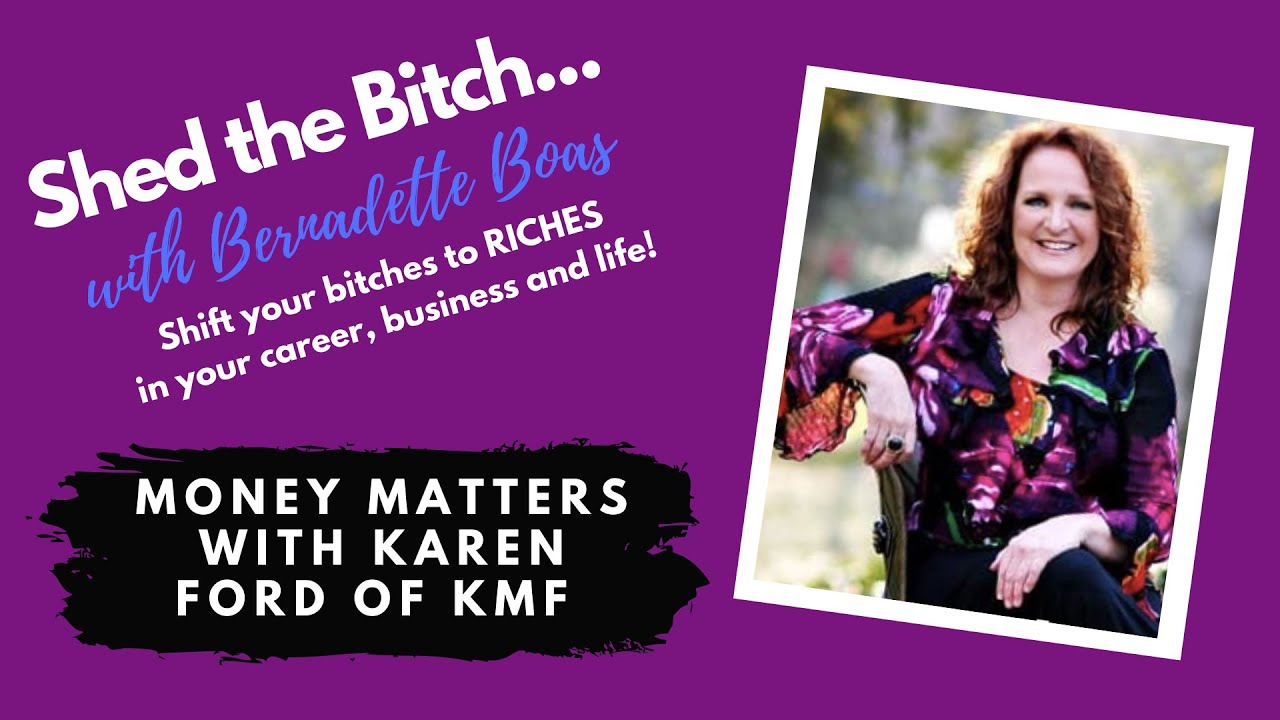
In this Shedding the Bitch Radio episode, host Bernadette Boas interviews master financial coach Karen Ford. The conversation covers the fundamentals of personal finance, beginning with the importance of a proper budget as the foundation for controlling money. Karen explains how everyday small expenses (e.g., daily coffee) erode wealth and why cash is "king" compared with credit cards, which can be a reward only when paid in full each month. She introduces the debt‑snowball method—listing debts from smallest to largest, paying off the smallest first, then rolling that payment into the next debt—to create momentum in eliminating credit‑card and other debt. The dialogue also touches on mindset shifts, such as using vision boards and positive self‑talk to break negative financial habits. Karen shares broader wealth‑building strategies, including choosing between traditional and Roth retirement accounts, investing in stocks, and buying pre‑owned real‑estate. The episode reflects on the current economic climate (COVID‑era unemployment and cautious spending) and offers practical tips for navigating it. Finally, Karen promotes her Amazon best‑selling book Money Matters, summarizing its chapters on budgeting, debt demolition, investing, real‑estate, and thought‑life transformation, and provides her contact information and social‑media links for listeners seeking further coaching.
Chapters
Welcome, welcome, welcome everybody to our next episode of Shedding the Bitch Radio. I am so excited that you are here on this beautiful, beautiful May day. We have a great conversation. Who doesn't love talking money? Actually, probably none of us do. So you can go to sheddingthebitch.com/radiopodcast and to find all of our episodes. You can also go to blogtalkradio.com and find the Shedding the Bitch channel. And then of course our Shedding the Bitch YouTube channel has all of our programs, especially those like today when we have our guests in our virtual or our physical studio. So you can check out all of those and plus other, other videos and tips and tricks out there as well. And then of course, we'd always love for you to become a Ball of Fire member on our ballofireconsulting.com site, as well as our Facebook private group, Shift to Riches. Trust me when I say you get tons of inspiration, education, and even entertainment out there. So think about joining that. Just go look for Shift to Riches private group on Facebook. All right. Today, today, today, today. We are talking about money matters and we're talking to Karen Ford of KMF Company. Hi, Karen.
Hello, how are you?
I'm good, how are you?
Wonderful, thank you.
Good, good to be here. Well, I'm thrilled you are, especially when it comes to money. So we're gonna be talking about debt demolish— demolition, debt demolition. I love that, I can't say it, but I love that. And Answering the question, credit card— are credit cards a risk or reward? So what you're going to listen for and what you are going to learn from this conversation is what, what is a budget and will it benefit you? How do I get rid of debt? And, you know, many of us are feeling it right now. What's the big deal about credit cards? That's an intriguing question. What's the big deal about credit cards? And then can I retire wealthy? Now, for Karen and anyone listening for the first time, we ground you in a rich question that's all based around the subject that we're going to be talking about. That way you can relate to it and you can listen for answers to your question. So your rich question for today is, what is that number one thing you're struggling with when it comes to money? And like I said, we don't like to talk about it, but you know what? We have to. We have to talk about it. We have to face it, all that kind of good stuff. So think about that. What's your number one struggle? Because most likely Karen will answer it, and if not, then you'll have all her contact information as we go through the, the interview, uh, so you can reach out to her. All right, now if you are tweeting with us, if you're posting and commenting with us, you can always use hashtags #MoneyMatters, #Budget, or #ShedTheBitch, of course. Now before we get started, I do need to thank a couple of organizations that have been huge huge contributors and partners to the Shedding the Bitch community and everything we do. And that is Deborah Parker of Parker House Virtual Services. She's actually my virtual assistant, and she does provide virtual assistant and social media support to small and medium-sized companies. If you want to learn more from her, please email her at deborahparker.va@gmail.com. Now I also need to thank Debbie Snelling of North Georgia Tax Solutions. Solutions. They are a full house, full house financial and tax services organization that also serves small to medium-sized companies. And you can go to ngtaxsolutions.com for more information. And no, she's not limited to Georgia. I was asked that recently. So she's not limited to Georgia, so she too can help you. Uh, so check out both of those, um, organizations. And if you'd like to be an advertiser or a sponsor to the program, please reach out to me directly, BernadetteBoas@BallOfFireInc.com, and my team and I will reach back out to you. All right, so let me tell you a little bit about our guest, Karen. Karen is a master financial coach, public speaker, entrepreneur, and author who has coached people with a variety of money issues, from just $500 in debt to $800,000 in debt. Yikes! She has coached folks with up to 86 credit cards and taught them how to pay down and pay off those credit cards in record time. Karen's mission is to inspire others to rid themselves of debt and build wealth. She encourages others to break the shackles of debt and gives valuable insight into building wealth so they can experience financial freedom. Who doesn't want that? Karen Ford's number one Amazon best-selling book, Money Matters, is is a discovery for many. This book is not only motivational but practical. She is an avid real estate investor who enjoys buying, selling, and flipping properties. She has even bought properties for as little as $10 and turned a few dollars into thousands. In Money Matters, she provides keys to demolishing— demolishing debt— demolishing debt shares how to budget correctly and gives principles in wealth building. Woo!
Woo! Woo! Woo! Woo! Woo!
So excited you are here, and this is such a great conversation, especially in these times right now. So before we get into specific things that I want to learn about you, do tell us a little bit about yourself beyond even, you know, what I was able to share in your bio.
Well, sure, it's my pleasure to be here with you. My history is I'm actually a registered nurse, but I haven't practiced as a nurse for several years. And I look at it like this, Bernadette, I look at it like as a nurse I helped people get healthy physically, and as a Master Financial Coach I help people get healthy financially. And I'm still helping people, but wow, it's amazing to me how many times people just don't have an understanding of how money works. And I want to see people win win financially. I want to see them win with money, with all of their endeavors.
There you go, people. Absolutely, absolutely. Now, I did want to ask, where are you calling from? What state are you in?
West Virginia.
Ah, West Virginia. And how are you guys handling everything that's going on? What's—
well, I think it's— I think we're all in the same boat, to be honest with you. Some people were unemployed and they're receiving unemployment right now, but we're slowly but surely opening up some businesses. Per the governor's, you know, statements. So I think it's just going to be a slow process, probably slower than what we had hoped or wanted, just like the rest of the continental U.S. Yeah, but we do what we can do right now.
So absolutely.
Yeah.
And from a, from a financial perspective, since we're talking money, what are you seeing out there as far as people's responses and what they're doing or not doing, um, as a result of this economic— I'll just be nice and say climate— that we're in?
Sure. Well, you know, I think it's a mixture of a little bit of everything. I've got some folks that are just not caring and they're spending, they're going online and spending. And then I've got other folks that are being somewhat cautious and watchful and not going out and spending money. And so looking at it from both perspectives, you know, I'm not saying that people can't spend. You can. Are you still working? So those are some questions we need to look at. If you're still working and there's no stopping with your job and you have the same income, then certainly, you know, you can spend. But if you are unemployed or you're receiving unemployment and you're unsure when you're going to go back to work, now is not the time to be Googling and buying things. Just need to halt that a little bit. It's amazing to me, you know, how sometimes people's mindsets work. And so not to do it out of fear, but just to do it to be cautious, right? And other people like myself, we're taking advantage because financially, because right now the market is low, and that is the time to buy, is when the market's low. But I have great hopes. I believe our economy is going to come back strong. It's going to come back better it's gonna come back brighter. And I— and, you know, not, not that everybody is thinking this, but I actually think it's gonna— when it comes back, it's gonna come back fast. I really do. And I'm looking at it from that perspective. Yeah.
Well, you know, being a money person, you probably have the pulse on it. So we'll look forward to it with you for it coming back fast. So tell me, what is— okay, So, and I agree with you. I think, you know, yes, a lot of people are spending, not even just in investments, but, you know, just picking up employees cheap, picking up products cheap, picking up materials cheaply. But what is the number one thing that someone should be doing to get control of their money?
Oh, the number one thing. That's a great question. The number one thing that people need to do to get control of their money is to learn how to Properly budget. Because, you know, sometimes we hear that word budget and we're thinking, ah, it's a 4-letter word, and it isn't. It's a 6-letter word. However— or 5 letters, look, I can't even count. But no, you know, the word budget, 6 letters, the word budget is something that's going to empower you. A budget is you telling your money what you want it to do instead of wondering where it went. Now I know that's a mouthful, but it's amazing how many people I've talked with. We just got done with tax season, right? People filed their taxes, they got those little W-2s in the mail, and they thought to themselves, wow, I made all that money last year. What happened to all that money I made? And when I— when people say that to me, I say, do you budget? And 99.9% of the time, unfortunately, they don't, because a person who budgets knows exactly where their money is going and where it went.
Right.
Some people have a great income each and every month, and they're thinking, what happened to all that money I made? You know, it's the, the $5 latte here or the $5 latte there. Many times it's not the— it's not the big truck payment, it's not the big car payment, right? It's not the vacation. Of their dreams that really cramp their style, so to speak. It's the little foxes that spoil the vine. It's the $5 latte. It's the drive-through fast food 2 or 3 times a week that people don't remember they spent that amount of money.
Right. And it's those recurring fees, you know, I mean, especially if you're buying up apps and then all of a sudden, and you use them one minute and you don't the next, you're spending hundreds of dollars potentially a month That is true. On things you're not even using, right?
That is so very true. You know, sometimes I think about Christmas time, right? We get ready to have our New Year's resolutions, and I— and people say, man, I'm going to join the gym, I'm going to really do what— do my part, I'm going to get healthy. And they go out and buy all this healthy food, and then they join the gym. I'm not opposed to anybody joining a gym, not at all. I believe in taking care of ourselves physically.
Right.
However, if you join a gym and you're paying, you know, $150, $300 a month, whatever it is, then go, then do it. But if you find yourself after 30 days and you've dropped off and now you're not paying that, or you're still paying it but you're not going, now's the time to cancel that gym membership. What things have you bought? What memberships have you joined? Magazines, whatever it is. Right, maybe you're not using and you're, you're spending it, you're paying for it, but you're not using it. I'm all for it. I love a cup of coffee myself. I am an avid caffeine consumer. But do I need to go through that drive-through every day at $6, $7 a pop?
Right, right.
I coached a young man one time and he was actually pretty good with his money. And I said, but I knew there was something going on here. I said, Do you buy coffee? He said, yeah. And I said, do you make it at home or what? He said, oh no, I drive through such-and-such a place every day on my way to work. I said, how much does that cost you? Long story short, he was spending $350 a month on that coffee that he had to have every day. Mercy. He didn't realize it though, because you know, a debit card, it's mindless. You're swiping it or using the chip. And so he decided he wouldn't make his coffee at home and get that treat latte. So he changed a little bit.
Yeah, if I heard $350, that's a car payment, you know. Yeah, absolutely. Well, so let me ask you something. Excuse me. Um, all right, so I'm a— is it fair to say, right, especially right now in this environment, is cash king, or are credit cards good or bad for us? What should we be considering when it comes to both of those things?
Cash is always king, whether it's now, later, earlier. Cash is always king. Because if I walk into a department store and I see a dining room set that I just have to have— obviously I don't have to have it, but let's say there's a price tag of $5,000 on it, and of course, you know, the salespeople are so kind and they say, oh, you don't have to charge it and have all those fees, we'll let you have it for 90 days same as cash. 91% of people that buy things on 90 days same as cash don't pay it off in 90 days, right? And then all those fees are added to it. So cash is always king, because if I go back into that same department store and buy— and want to buy that dining room set, but I have cash and say, what will you do? Are they going to sell it to me for $4,000? Yeah, because if they don't, I'll go somewhere else, right, that will sell it to me at that discounted price. Now you ask a great question, credit cards. I, I am an avid believer that credit cards can be beneficial for the right person.
However, the right person, not for the right reason, for the right person, for the right person.
Because if you don't pay those, that credit card bill off, each and every month to get rid of those fees, that interest rate, you know, and a lot of times they're so high, then you really shouldn't buy using a credit card. But if you're gonna pay it off each and every month and be exempted from any interest, then I say, okay, you can. Because some people I've talked with, they like the points, they use airline miles, that kind of thing. I totally get it.. But if you're not going to pay it off each and every month, it's going to be more of a risk than a reward to you.
Right.
Right.
Yeah. Well, it's going to be— you're not getting that bonus airline ticket because you're paying for it in the fees that you're paying.
Right. Exactly right.
Right.
That's exactly right. That's a mouthful right there. That's so very true. And so if you're, if you're going to get the benefit from it, then you need to get the benefit where you pay it off each and every single month. Right. So, and I've talked with people before where they had credit card— credit cards ranging from 6% all the way up to 33%. Yeah, that hurts.
Yeah, that hurts bad.
Yes, it does.
Bad. So, so let me ask you something. Um, so when you think about credit cards, but you also think about budgeting, And you talked about the fact that if someone has a good job and they are getting paid, they just need to be very well aware of how and where they're spending their money. But of course, as we make more money, all of our expenses want to— we want to take all of our expenses up. For instance, like buying a car. As opposed to spending $200 on a car, now I want to spend $800 on a car. And is that okay?
If—
is that okay?
Well, you can. I don't advise it. If you end up with a bonus or you end up with an increase in your income, it's almost like a lot of people think they have a stamp of approval. Oh, I made this much more money, I've got this big raise, so I'm gonna go out and I'm gonna trade that car in for a more expensive car. I advise don't do that. Bank that money because you're already living the lifestyle that you're presently living without increasing the amount that you're spending. And so, you know, trying to keep up with the Joneses— I mean, let's face it, most of the Joneses are broke. Yeah, they have that. Yeah, they have that house, but they've got a mortgage, they've got a second mortgage, they've got 2, 2.3 kids— not sure how that works— you know, they've got the dog, they've got the cat, they've got the boat, and a lot of their credit cards are maxed out. Yeah, so visually when you're looking at them from the outside, it looks like they have it all together, right? But many times they don't because their credit cards, you know, they're charging these things. You know, I grew up— I'm one of 7 children, and so that was really interesting because we lived in a house where we all had to share. We wore hand-me-downs. We had one bathroom. Not sure how we did that.
I'm one of 12, Karen.
Man, so you know what I'm talking about.
Yes, I know what you're saying.
You know, we were taught, you know, yes, I would have loved to live the lifestyle when I first got married, loved to live the lifestyle that my parents presently live. But many times people think, they forget it took your parents 20 or 30 years to attain that lifestyle they're presently living. We have to practice patience. And we, you know, we're in such a fast-paced culture and society right now. You know, we didn't like having to go somewhere, so we buy on Amazon, and it wasn't quick enough. So now we have Amazon Prime, and then that wasn't quick enough, and now there's Amazon Now where you're gonna get it at your door in an hour. Listen, let's practice a little bit of patience.
You'll save a lot of money.
Save a lot of money by not going out and doing that. And be patient with it. Listen, if you can say no to some things right now and say, I'll buy that in 6 months and start planning, or 3 months or what have you, first of all, you're gonna be happier because you're not going into debt for that particular item. And then in 3 months or 6 months when you do buy it, you don't have a payment because you saved up for that particular item. You're gonna appreciate it so so much more by saving up for it and paying cash for it.
Absolutely.
Cash is king.
Absolutely. Absolutely. So that $800 car, you know, put it off. It's not really that necessary.
That's right.
5 minutes after you get it, you lose tons of depreciation on it. That's exactly right. That's right. Yeah. Yeah. I've been there, done that. So not $800 though. I'm not that crazy. Now, so if someone out there does have credit cards and they have credit card debt and it's high, maybe not $800,000 as it was mentioned, but anyway, how can they and what can they do to get rid of that debt?
Well, first of all, one, and I know this is almost like a no-brainer, but I have to say this. If you want to get out of debt and you want to get rid of credit card debt, You have to stop using those credit cards because otherwise it's just a vicious cycle. You make a payment and then you go charge. You're spinning your wheels there. You're a cat chasing its tail. So stop using the credit cards and then make a list of your smallest debt down to your largest, smallest debt to largest debt on a sheet of paper, smallest to largest. Don't leave anything out. So let's pretend for a moment your smallest debt is a credit card that has a $100 balance on it and your payment is $25 a month. Well, once you pay that off, let's say your next debt is a $500 credit card balance with a $50 a month payment. Well, once you get rid of that smallest debt of $25 a month, you're not gonna pocket that $25 and you're not gonna spend it. You're gonna apply that $25 payment to the next credit card along with that $50 payment. Now you're going to tackle it $75 a month until it's gone. Right. It's called, it's called a debt snowball. And the reason we do that is because just like a snowball starts at the top of the hill, it's very small, but as it goes down that hill, it gets larger and it builds momentum. It's faster.
Yep.
And you know, we're not patient people many times. And so we want to see a quick win. Once you see that quick win, now you're more apt to stick with the program, so to speak. Yeah. And you're going to build momentum. And then once you pay that credit card off and you're thinking, I'm not really trustworthy, call, cancel it, cut it up. Because listen, if you have to have a credit card or you feel that you need a credit card, one credit card will suffice rather than 5 or 10 or 20.
Right. And again, I think the points and all these, you know, bonuses that you get with these credit cards, you know, I think people really have to think about the fact that if you're not paying them off, and you're paying interest, you're really not getting any bonuses. You know, I mean, exactly right.
Yeah, it's crazy, right?
Is credit card debt— of course, mortgages are someone's probably biggest investment. But oh yes, yeah, is credit card debt— I guess what other debt would there be? But is credit card debt, um, what really sinks most individuals?
I would say credit card debt is right up there, but cars too, because I've talked with people before where their income is, say, you know, let's say their income is $4,000 a month and they have a truck or a car payment of $900 a a month. I mean, I've talked with people with that, and I'm thinking, buddy, you know, your truck payment is more than what your house payment is. There's something wrong here, you know. And I get it, people, they like their vehicles. But the smart way of buying a vehicle is don't buy a brand new vehicle, get one that's just a couple years old. That way someone else already took the depreciation on it, number one. Number two, you're still going to have some kind of a warranty on it. Just make sure you don't— there's not a lot of miles on it. You're still going to have a newer vehicle, it's going to have a warranty, and it's going to have that brand new car smell because the car dealerships are going to make sure that it's spiffy and great for you. But don't take— don't buy the brand new car. You're really— it's just not— it's not a win situation.
It's— I learned that, like, I learned that about 30 years ago. That I bought my first pre-owned, I bought a pre-owned car and it was, it was from a dealership that just took pristine care of it and then had a program with it and yes, it reduced my, you know, reduced my payment and it looked as new as the next guy, so forth and so on. So yeah, that's awesome. That's awesome. Now I want to talk about, in our last few minutes, I want to talk about Money Matters, your book. So give us some ideas, because what you wrote is— and I don't have it right— oh yes, it's not only motivational, but it's practical. So give us an idea of what someone could find within your number one best-selling book.
Okay, well, Money Matters, I titled it that for a couple of reasons. Number one, money does matter. It really does. You have to have money to live on. And in the content of the book, I discuss matters of money. Money matters. So it's— I kind of coined it that way. But in this book, you're gonna learn how to properly budget. So if you never learned how to budget, this book is going to teach you how to budget. There's a chapter on demolishing debt, debt demolition. How do you do it? Where do you begin? How do you stick with the process? I always talk— I also talk about building wealth. Do you want to invest in a Roth IRA, a 401? What's the difference? Between a traditional IRA, a 401, a Roth IRA, you know. Do you want to seek in purchasing stocks? How do you go about that? And then also talk about real estate investing. But I also have a chapter on there about our thought life, because many times our thoughts become words, our words become actions, our actions become habits. And our habits become our lifestyle. So in other words, do you want to— do we want to keep saying, oh, I'll never get out of debt, I'll never get out? No, you don't want to keep saying that because now your words and your actions, your actions are going to follow those words. So even though you're thinking, oh, I'll never get out of debt, we have to do a switch. We have to flip the switch. And whether we feel like we'll never get out of debt, we don't want to say it. We have to say, oh, it's easy to get out of debt. Perhaps create a vision board so you can see yourself taking that vacation that you've always wanted to take.
There's mine.
There you go. There's your vision board. Do you want to see yourself out of debt? You know, put that on the vision board. Put on the vision board what you want to see happen for your life, not what you're presently experiencing. Absolutely. Words are powerful. And we can produce what we're saying with our words.
I'm telling you, if some people listening are going to go, is she Bernadette's sister from another mother? Uh, because that's— those are, you know, we talk about, you know, what you focus on expands, and your dominant thoughts, you know, rule your behavior, and those kind of things.
That's it. Absolutely true. Absolutely love it, love it, love it, love it, love it.
All right, in our last minute or so, what last tip would you provide everybody? And then I'm gonna make sure you— everyone has all your information to get a hold of you and to get your book and all that kind of good stuff.
Okay, so one last tip, I would say one last tip would be no matter what kind of financial situation you're in right now, whether you have a lot of debt, maybe right now you're, you're getting unemployment because of the predicament that we're in right now, there is hope. There is hope for you because if you're still breathing, there is hope for you. And if you got into debt, you you can get out of debt, right? So there is hope for every individual, no matter what the situation it is.
Yeah, amen, sister.
There's hope.
There is hope. And, you know, and all anybody has to do is, you know, take that hope and reach out to Karen and let her help you. Let her help you get that financial freedom. Don't focus on the debt and the expenses expense and all that. Focus on the financial freedom that you want and what you're gonna do with it when you have it, but you're not gonna spend it. Ha!
That's right.
All right, so I want to make sure everyone has your information again. Her book is Money Matters, and of course you can go to Amazon and look up Karen Ford Money Matters and find her number one best-selling Amazon book. At the same time, go to her website, karenford.org, karenford.org, and Her Facebook page is Money Managing Awesome. Everybody, you need to, you know, be liking that page right now. As well as on LinkedIn, you can obviously find her on by Karen Ford and look for her pretty face and the fact that she's Money Matters and then she's a financial coach. There's a, there's a couple digits behind Karen Ford, but you'll be able to find her. I found her very easily. So you'll be able to find her on LinkedIn as well. But definitely reach out to her on KarenFord.com. She also— I'm sorry, I'm sorry, KarenFord.org. Also, her email address, if you want to jot it down so you can reach out to her, is KarenB1008, so that's 1008, at Hotmail.com. This has been awesome. Thank you.
I've so enjoyed it. Thank you so much. My pleasure.
Yeah, thank you, thank you, thank you. And for everyone here in the Shedding the Bitch community. I look forward to having you right back here next Tuesday at noon Eastern time for another episode of Shedding the Bitch Radio. Thanks everybody, bye!
More from Bernadette



From Stuck to Leading, Episode 2 — Meet the 5 Inner Fears Destroying Your Leadership



