Preserve Precious Memories with Sparkling Writing, Guest Carla D. Bass
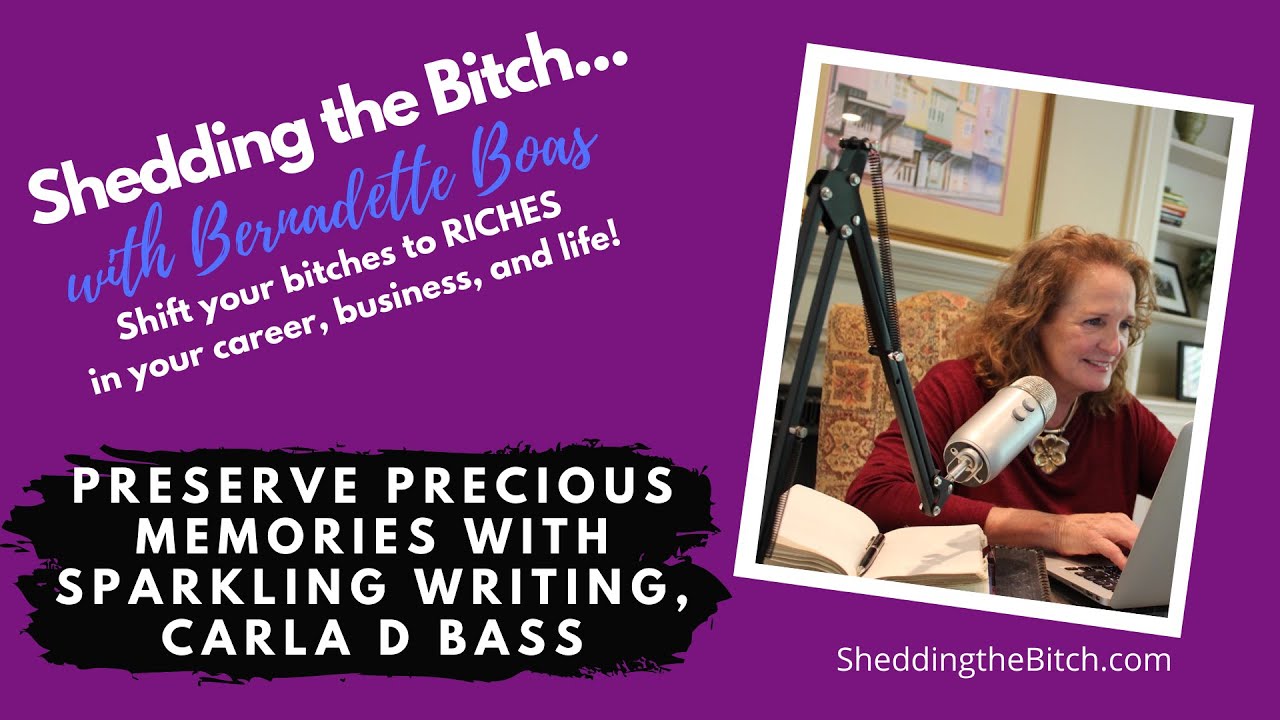
In this Shedding the Bitch Radio episode, host Bernadette Boas interviews retired Air Force Colonel and author Carla D. Bass about preserving holiday memories through compelling writing. The conversation begins with Carla’s back‑story—how a need to write winning award nominations for her squadron led her to develop “word sculpting tools” and a career teaching powerful writing. Carla outlines six reasons to pause and capture holiday moments, ranging from personal reflection to creating future joy and positioning for better times. She then shares a practical “data‑collection blueprint” of ten categories of holiday content (childhood memories, adult additions, new traditions, funny anecdotes, favorite movies, carols, gifts, recipes, parties, and worst gifts). From there she walks listeners through a strategic writing process: gather data, prioritize, outline, know the audience, and write with punch. The core of her method is the word‑sculpting toolkit—using strong verbs, cutting redundant words, and avoiding space‑hogging language—to give prose sparkle and panache. Carla explains how these techniques apply to any writing genre, from holiday newsletters to resumes, grant proposals, and fiction. The episode promotes her book Write to Influence (four parts: strategy, word‑sculpting tools, applied writing, exercises) and three free e‑books (standout resume, performance review, grant submission) available at writetoinfluence.net, and invites listeners to explore her coaching services. The episode closes with a reminder of the next show and a call‑to‑action for the audience to capture their memories and improve their writing.
Chapters
Hello and welcome to Shedding the Bitch Radio, where you can discuss, debate, and get advice on how to discover and shed the bitches of fear, insecurity, self-doubt, and negative mindsets so you can realize your dreams and life purpose and create and accelerate the riches you want in life. Join us here live every Tuesday at noon Eastern and dialogue with us at 818-572-2910. You can also chat with us at blogtalkradio.com/sheddingthebitch or share your stories on our website at sheddingthebitch.com. Whatever Whatever the bitch is that's holding you back from living your life to the fullest, it's not worth giving up the riches in life that you deserve. So call in now and let Bernadette Boas know what's holding you back. 818-572-2910.
Welcome, welcome, welcome everybody to another great episode of Shedding the Bitch Radio. And of course we're coming to you both on BlogTalkRadio or any of the streaming services that you may download your podcast, as well as on our Shedding the Bitch Facebook page. You'll see our lovely faces. And then, and by the end of the day, you'll also be able to go to our Shedding the Bitch TV channel on YouTube. So take a look at that. Be sure to subscribe, like, comment, um, anything that will allow us to get more eyes and ears on our Shedding the Bitch program. And that said, I want to thank the, the new followers, the new viewers, the new listeners that have been coming to us. It's absolutely so exciting, and I'm so, um, thankful and feel so blessed to have you providing us feedback and likes and subscriptions and ratings and all that kind of good stuff, uh, because it certainly helps us make sure that we're bringing you the best, uh, program that we can bring you. And of course, that means we have to absolutely thank our ongoing listeners and viewers. If it weren't for you, we wouldn't be finding these, uh, these new listeners and viewers, because you are also leaving comments, giving me feedback and ideas for the program. You're leaving subscriptions and ratings, um, and likes, and we can't be— we can't be more grateful. To you for that. So thank you so much and continue doing it, because like I said, as many eyes and ears we can get on the program will allow us to help people shift into a place where they can really create riches in both their work and their life. Now, this episode is being brought to you by North Georgia Tax Solutions. They are a full-service financial and tax service provider. And yes, it sounds as if they're here just in Georgia, but no, they service, small to corporate size clients all over the country. So reach out at ngtaxsolutions.com and tell Debbie Snelling, uh, the CEO, I said hello. That's ngtaxsolutions.com. All right, so let's get into this because leading into the holiday season, which we are, right, we definitely don't want to leave anything behind. And what that means is all the great memories that you are experiencing. So our conversation today is all about preserving your holiday memories with sparkling text. Love it, love it. And so basically what we're going to talk about is how holiday memories are fleeting. We need to preserve and pass them on for posterity in captivating blogs, newsletters, and seasonal cards. Learn how to do just that with literary panache and have a blast in the process. So today we're going to be talking to renowned author and speaker Carla D. Bass, Colonel in the Air Force, though retired, and she's going to explain exactly how to do that. Now what I want you to be listening for is you do have a story to tell. Each of us have a story to tell.
I do.
And there's, and there's 6 reasons why you should tell your story. There's 10 types of fun holiday tidbits of information that you should gather up and strategies to spin that compelling tale into great content. You're going to also hear tips to compose holiday correspondence people will actually read and insight to lend sparkle to anything you compose.
Love it, love it, love it.
So I want to formally introduce our guest, Carla D. Bass, Colonel of the Air Force, though retired. She's authored the book Right to Influence, which has been— which has won 8 national-level awards. Carla is also an entrepreneur, acclaimed speaker, and adjunct university instructor. Her forte is helping people achieve goals by leveraging the power of their own words. For 40 years, Carla has composed products for Congress, the White House, generals, and ambassadors, as well as hundreds of performance reviews, budget submissions, presentations, and executive-level correspondence. Carla now coaches clients such as government agencies, corporations, privately owned businesses, NGOs, academia, and individuals. She does resumes and grants, marketing, contract bids, college application essays. She covers these and and more in her book, popular virtual sessions, and private coaching opportunities. The second edition of Write to Influence contains 70 additional pages incorporating material developed from her many, many workshops. Carla's military assignments— I needed to say this because this is cool— her military assignments have been in Hawaii, Washington, D.C., Germany, Korea, Turkey and Bulgaria. Oh my gosh, there's so much to talk about. How are you, Carla?
I'm fine, thank you. And yes, it has been a wild, wild ride, and I've loved every second of it.
I, I don't blame you. I mean, what— how much fun is it to— well, in the past it's been more than, you know, holiday memories, but at the same time, how exciting is it to, to just put your words and your thoughts and ideas and into things that actually kind of make major decisions for the, for the country as well as for individuals. That is so exciting. So, but I always like to kind of go back a little bit. So give us your backstory of how then everything that you've done in your career has led you to really being, you know, kind of someone that helps other individuals to write for influence?
Sure. I'm gonna start it really quickly with the advice my father gave me, who was also a retired Air Force colonel. When he commissioned me, you know, the "I do," he told his second lieutenant daughter 3 pieces of information. The first was, put blinders on, stay focused on your job, don't get caught up in office politics. The second was, "Always take care of your people and they will take care of you." And the third was, "Keep your sense of humor." So with that as a backdrop, here's how my current journey began. When I was a Lieutenant Colonel, I was a squadron commander in Hawaii. When I assumed command of this 480-person unit, it was the most losing unit in the state for quarterly and annual professional awards. What that meant is these super talented young men and women who deserved to win because they were really good lost all the time. Why? Because their bosses could not write winning nomination packages. So, so you, Bernadette, could be the most brilliant staff sergeant But if your tech sergeant boss can't tell your story, you lose. So that was hurting careers. It was hurting families' ability to send kids to college. It had all these really bad ripple effects. I had to fix it to take care of my people. So I took 3 days vacation time, and I sequestered myself in a cabin, and I analyzed my writing. And out of that came what I called the word sculpting tools. Which are now part 2 of my book. I taught my guys how to write, and in no time at all, we began sweeping the awards. We, we won all of them. And then the other units came to me and said, Colonel Bass, could you teach us too? Which of course I did. But what just blew my mind was for the next 15 years, wherever I went, I taught that it just kind of followed me along. I had no idea there was such a vacuous need back then, right, to learn how to write powerfully. That was 20 years ago, and, and if anything, that need is even more pronounced now than it was back then. But that's how the journey began, and the two battle cries that I developed out of that— one is powerful writing changes lives, because it does.
It does.
It opens doors to opportunities. And, and the next is that powerful writing is the lifeblood for successful organizations to defend, um, defend budgets, to attract clients, to attract talented employees. Anything you need to persuade somebody else to, to agree with you, that takes, uh, powerful writing or communication. So that, that's the backstory.
Well, that's awesome because I just actually was on a call with about 56 fellow entrepreneurs and we were even talking about how they need to be able to tell their story. And yet so many of them struggle to convey exactly what we're talking about. What you're, you're sharing is, you know, who are they and, and, you know, what do they mean to the world and what's their impact on the world and how are they going to contribute? So yes, I absolutely agree. And I've learned that just in the 12 years I've been on my own, um, is how important it is to be able to articulate, uh, in writing what it is that you want. Um, you know, so you can actually influence the outcome. That's awesome. That's awesome.
Now I know what, what your fellow entrepreneur— I'm sorry, I was gonna say what your fellow entrepreneurs were, were wanting to know is Precisely what I teach, right?
Well, and therefore I'll be sharing not only this broadcast with them, but I'll also make sure that I share your information with them because I did. I was sitting there scribbling because I was preparing you, you know, for this this morning, and then I get on this call and all of a sudden the next thing you know there was two different avenues that it went, and one of them was down this this avenue of writing. And I thought, oh, this would be great to share with them. Absolutely great to share with them. So, um, let me ask you this. So people are overly taxed at the holiday season. Why is it necessary for them to take time and really capture what they're experiencing, the memories that they, you know, at— well, at the time it's not a memory, but why should they capture those, those, you know, experiences that they're having?
Yeah, I, I put a great deal of thought into this since you and I first communicated, and I've got 6 really good reasons why someone should pause and do that. The, the first is treat yourself to a quiet moment. We are all so stressed nowadays, not only with the, the economy and COVID. Quiet moments are really valuable, so go find a quiet corner and reflect on your Christmas memories past. Okay, so it's like a trip down memory lane. We often don't treat ourselves to that kind of recollection. That's the first reason. Second is for posterity. For those of you who still have grandparents out there, when was the last time you asked the grandparent, "What was, what was Christmas like when you were a child?" So we're talking capturing family history while they're still around to remember it. Whether it's sitting them down with a tape recorder or, or scribbling notes like crazy. And the next is, if you do that, this could also make a wonderful Christmas present. So if the grandchildren sat down with the grandparents and did this, first of all, it's a great experience for the grandchildren to actually take on this kind of a project. Second, it's great interaction between the grandchildren and the grandparent. And if they do this in secret, it would make a fabulous Christmas present for the parents.
Right.
Well, it's just a super gift if you can stop and do that.
Yeah, I'll— before you move on, I'll also kind of confirm that I have 11 brothers and sisters, but I have 22 nieces and nephews.
Oh my golly.
Yeah, but I have 22 nieces and nephews. And I would even add that it's not only great for the grandparents, but it's even great for the parents, you know, and their aunts and uncles. If the kids were to do that, because we had a group of our nieces and nephews do that exact thing, I would say, I don't know, 2 or 3 years ago, and, and give it— give a snapshot to each one of us. And oh my gosh, it just, you know, it even led to a, you know, a private Facebook group that's all about sharing those type of things. It's fabulous. So awesome. All right, all right.
Okay. Number 4 is you might promote an aha moment for somebody else. So for example, and I do not recall where I got this idea, but somewhere like 2 decades ago, I came across the concept of reindeer dust. And so for my children, on Christmas Eve, you know, reindeer dust is a mixture of oatmeal, confectioner's sugar, and glitter. And so every Christmas Eve, I take my young children out on the front doorstep, and we would throw the reindeer dust up in the sky. So the confectioner's sugar makes it linger in the atmosphere a little bit. The glitter helps catch the attention of the reindeer as they're flying by, and the oats is something the reindeer would eat. So I found that idea someplace else. So my thought is, if you sit down and record your Christmas memories and those of other people in your family and then share them, other folks might be able to find nuggets that they then can incorporate in their own family traditions.
Beautiful.
So that's that aha moment.
Beautiful.
Number 5 of my 6 reasons is just to bring a smile to other people. The greatest gift anybody can give me anytime is to make me smile. And if you can't do that during the holiday season, I mean, honestly, when can you do it?
Right.
And then the last one is to position ourselves for better times. At some point, the world will get back to normal, and we're going to have some kind of a halachic blowout for Christmas. I mean, every tradition I can possibly think of, I'm going to execute all of them. So it's gathering all of this positive energy so that it can just burst onto the scene when, when the world gets back to normal. So those are 6 reasons that you need to stop and capture these memories.
Yeah, it's so true. But I have to go back to your very first one, just taking a breath and really appreciating, you know, right now, like appreciating the very, you know, moment in time that you are having those great experiences. Uh, because I don't know about you, Carla, but I'll look back at like even Well, fortunately I can remember last year, but some Christmases, some like big holidays, and I couldn't tell you anything from them because they've all just become a blur within the number of years that are passing by. Um, but at the same time, because I really didn't sit and capture them and appreciate them, and I'm a journaler, so I journal, you know, all the time. So I, you know, I so appreciate these 6 tips, and I know our listeners will as well. So I know your book, Write to Influence, and I do want to mention that they can also just find that as well at writetoinfluence.net. Can they find your book?
Yep, it's— yeah, the book is available on Amazon and Barnes Noble. It's online.
Okay, great.
So they can get it either there, or I've got links to it from my website. So either way.
Right.
Okay.
All right.
Yeah, I want everybody going to your website because then they can learn about you and whatnot. So I know in Write to Influence—
go ahead.
Oh, that's okay, that's okay. I know in Write to Influence you present many strategies to compose a compelling product. So which of these apply to like, you know, this special holiday messaging that we're, we're talking about and preserving these holiday memories?
Okay, the, the first one is, is gather data, and this applies to if you're, if you're doing your resume or whatever. First, get, get your little figurative bushel basket and gather, gather your data. And I've got 10 types of fun data that we can get to for gathering the data. And then, uh, once you've gathered all this wonderful richness of memories, create an outline. You Assuming you've only got so much time and so much space to communicate, which is one of my principles of right to influence. Every author is constrained by two things. You're constrained by time. Readers are busy. And you're also constrained by space. So now that you've got this wonderful bushel basket of data, prioritize it. And then outline. What story are you going to tell? And then in what order? And then write with punch. And we can get to that.
Yeah, that's—
yeah, there's one other strategy I forgot, which is really important, is you have to know your audience. One of the biggest flaws in the Christmas newsletter— and you've received them for years, I know I have— is the individual who's writing the Christmas newsletter writes one newsletter for Everybody. The problem is I don't care about the third cousin twice removed who just had a baby. So the, the point here is know your audience. So as you are sorting out the information from that figurative bushel basket, have one chunk of information for close family members who do care that that third cousin had a baby, and then have other information for, for more distant family members or just friends. But segregate the information. Know your audience.
Right.
Well, and I'll add one too, just because you made me think about something. I would add also, you, you know, people actually have turned these type of things into books because they then kind of tailor a story around them to convey, you know, a message, whether it's of hope or peace or you know, whatever the case might be. So you might also even be sharing your writing to so-called strangers, of which— and the reason why I bring this up is in my book, I put pictures at the end of it, and people were like, well, we rarely see people put, you know, photos in their book. And, and I was like, well, it's, it's my personal story, and how do I write about my family and my friends and my peers and my work without really showing it as well? So, um, yeah, awesome. Yes, absolutely, absolutely. Excuse me. Awesome. Um, so when you say you have to know your audience, uh, you know, kind of— I— you just described it, but really, what is it that people need to be asking themselves, um, in regards to really knowing your audience?
Well, anything that you write, and I mean anything, whether it's a blog, whether it's an article for a magazine, or whether it's a bid for a contract, anything you write, you need to write from the perspective of the intended recipient. You have to write to the audience's need. Write it from their perspective. So, so for example, if you were writing a contract bid, What, what are the holes that, that, that requesting company is experiencing? How can you help them? It's not, it's not here, I'm great, these are the capabilities I have. It's the exact opposite. Here's how I can help you. Same thing for a resume. It's not, it's not hire me because I'm so great in all these areas. It's I recognize your need and I am so skilled at fixing your problems. These are exactly your holes. That I can fill. That's what I mean by knowing the audience. And then associated with that is speaking the right language. So if you're trying to convince Congress to buy a multibillion-dollar computer system, these are policymakers. So you need to explain in terms that they're going to understand, not in data storage capability or processing capability, you know, no technical terms. So you have to use the right language for the right audience. So that's all part of knowing the audience.
Yeah.
And writing to their needs.
Right. Yeah. No, I love that. And it's funny, you make me laugh because, um, obviously you're— you have a technology data background, as do I. And I'll never forget when I first started and I didn't know how to talk tech. All I talked was business. And so then it was like, you know, they say— they used to call us translators, the business coaches, the consultants. Because we had to translate what they were saying in the, you know, I's and O's worlds into, you know, kind of dummy it down for the business side of it because we don't understand all that, you know, all that tech talk. But you're absolutely right. You have to talk to the audience that you're hitting up. So another one of your strategies is to frame your communication using questions. And I love this. So how does that apply?
So let's pretend that you're the granddaughter and you're going to go interview the grandparent for, for the holiday memories. Develop a list of questions before you sit down with that individual. So for example, uh, Grandma, what was your earliest childhood Christmas memory? Or Grandma, what was your most favorite gift that you received? Or what was the most difficult Christmas you ever experienced? Did Santa Claus come to your house? Did your parents practice, you know, the fable of— I will never say Santa Claus doesn't exist, by the way, but did you guys play Santa Claus? So develop a list of questions designed to elicit all of those wonderful tidbits. What was your Christmas dinner like, Grandma? Did you really walk to school in 10 foot of snow? You know, so that's what I mean by, by framing your story with questions.
Right, right. It's also, it's also really getting to know not only kind of that situation or that experience, but that person, that essence, that being, right? By just really being engaged with a whole list of questions. That will help to uncover really the, the kind of the meat of that particular experience or memory, right?
Yep. I mean, some of these grandparents now, they, they grew up in, in homes where they cooked in the, in the fireplace. Many of them had outhouses as opposed to in-house running toilets. I mean, there are still, there's still that generation around now that, that young kids today have no concept of what it was like back in the day. You know, these folks grew their own food. There was no grocery store. There was no Wi-Fi. There was no Zoom. None of that existed. So, this is a wonderful experience if you, you know, frame the questions and then sit down and pick their brains.
I have to agree because all, like I said, I have 22 nieces and nephews. And, you know, so some of us are 30, 40, 50 years older than the younger ones. And so they don't even have the concept of like living without a phone and living without texts and living without, you know, a computer. And so those make some really funny, you know, and eye-opening aha moments, as you call them, when we have conversations with them.
They need They need to know that. They, they need to know the family history and what it was like back in the day. It gives them perspective that many of them still lack because no one has explained it to them.
Right, right. No, it's, it's, it's true. I absolutely, absolutely love that. And how do you— I, I love the whole sparkle that you talked about in, you know, in the description of our conversation today. So how do you infuse sparkle into your writing?
Well, now we're getting into the word sculpting tools. So once you've got yourself a draft, you go through and, and sentence by sentence, you get rid of the wasted words, the useless words, the redundancies. So you go from one page of stuff— I mean, good news, you've got one page of thoughts— but once you're done weeding it out, you've got half a page of solid, hard-hitting stuff. So for example, one of my word sculpting tools is, um, it's called "Verbs Are Your Friends, Rely on Them." And the way I explain this is, if you can imagine a hard-boiled egg. Now make the hard-boiled egg 6-foot tall and focus on the yolk. The yolk is the verb. The white stuff all around it is the bureaucratic blather that ubiquitously people smother verbs in this stuff. So For example, demonstrate the validity is validate. Provide warning is warn. Work collaboratively is collaborate. I mean, I can go on and on. I've got SCADSA. Give the ability to is enable. Gain benefit from is benefit from. So sentence by sentence, you look at your verbs and you figure out, is there a way that you can say it more Slicely. What's the real verb that's hiding within all that white stuff? Peel away the white stuff, go for the verb, and that's one way that makes your writing more crisp. Another, another of the word sculpting tools that also does a similar thing, it's called don't use words that hog space. Now there are 3 ways of doing that. I only share one because we've got so much other things to discuss.. But for example, in an expeditious manner equals expeditiously. In the aftermath of is after. On at least one occasion is at least once. So again, go through your draft sentence by sentence and look for those words that hog space. So once you're done adding, going through and word sculpting the text, that gives sparkle. And, uh, and then look for verbs that have got panache and pizzazz, I mean pizzazz, and, and, and really grip you. Uh, don't go for the, the, the normal run-of-the-mill. Use your imagination and stretch to find colorful verbs.
Yeah. And apart from like a thesaurus or a dictionary, are there other tools that you have found that, um, you know, our listeners could be using to to do that apart from their imagination? Because some, some imaginations are a little bit stifled.
Well, you know, people, people say, or they ask me, okay, Carla, if, if I read a lot, I'll be a better writer. Is that correct? I respond, it depends on what you're reading, because there are so many horrible authors out there. You can actually, uh, you can actually erode your writing skills if all you input is, is bad writing. So, right. To answer your question, Dean Kunz, Dean Kunz is my new go-to author. Diana Gabaldon is another. And there's one book by Daniel Silva called The Heist. I've got that baby so underlined and earmarked. These authors know how to use hard-hitting text with sparkle and metaphors and analogies and great verbs. So there's a thesaurus, there's your own imagination, or read authors like that, and you'll discover really great verbs, and you'll inculcate them, though you'll absorb them yourself, and then they'll come naturally.
Yeah, yeah. No, no, no, absolutely. And, you know, if I don't have regrets in my life, um, because I always have an opportunity to kind of, you know, change it and live it, and reading is one of them. I do a lot of writing and journaling, like I mentioned, And I, I would read a lot of, um, kind of self-help and business books, but fiction, it's like I'd rather write it, you know, as opposed to read it. And I won't say that I regret that, but at the same time, I, you know, I know I have an opportunity that I just need to be picking up, you know, books on a regular basis. So yeah, I love that. I love that. Um, So what are— I mean, what tips we, you know, I know there's so many. Um, if there were one thing, one thing that you told somebody about, you know, capturing their memories and making them sparkle with panache, um, what would you say that should be for them?
Well, it has to start with gathering the data. Because you want to make sure that you gather it first. And then once you have secured it, once you've captured it, then you're no longer at risk of losing it. You've got it someplace. And, you know, you can always subsequently go back and draft or repackage or revise or parcel it out in different products. But capture the information. I guess that would be, that would be the most important thing because you're trying to preserve it. You can polish it later, you can word sculpt it later, but go out and, and, and, and preserve it.
Right. Well, and you mentioned that there's a bunch of stuff within that. So what would you say within the data? What to, you know, what tips do you have within that? Good.
Okay, so I came up with 10 different types of data. Each one of these can be like a little bushel basket. The first is your own childhood memories. And think back as far as you possibly can. So for me, for just for example, it was, you know, Santa Claus's presents were always unwrapped and they were separated in a different part of the tree. Family's gifts were always wrapped. I still have a light bulb from World War II that my mother and her father hand-painted because back in those days they could not obtain colored lights. So if you wanted colored lights, you bought white ones and hand-painted them. So, so, you know, capture your own memories first. That's the first. And then second is build on those. So what memories have you as an adult added to what you brought to your marriage or to your adulthood from being a kid? So, I'd mentioned the reindeer dust. I decorate the house like crazy now. My mom didn't do that. I'll have a scavenger hunt for the most significant present. I'll make my son actually follow all these clues around the house before he finally finds the big present. That was a new tradition. We give hellacious Christmas caroling parties. So, those are— that was number 2, is how did you build on your own childhood? Number 3 is start new traditions. Now, the Elf on the Shelf, I love the idea, but that came out after my kids were grown and gone. So, so if they were young ones again, I would have done the Elf on the Shelf. So always, always kind of keep your radar going for what new traditions can you incorporate, especially if you've got young, young children. Fourth category would be what's your funniest memory, your Christmas memory. My example was I picked up my, uh, my son and his girlfriend at Dulles Airport one Christmas Eve. I got dressed up in a full-up Santa Claus suit. I mean, beard, boots, the whole bit. And so Santa Claus went walking into the airport. He didn't recognize me, gave him the big old bear hug, and, uh, and that was one of my funniest Christmas memories. Number 5, what's your favorite holiday movie and why? Number 6 would be, how about your favorite Christmas carols? I have a tie for two. One is Robert Goulet singing Ave Maria, which is just breathtaking, and the other is Barry Manilow singing Because It's Christmas, because he captures that magic of childhood on Christmas Eve. Number 7 is what's the best gift that you ever gave? What's the, uh, um, next, uh, favorite holiday dishes, the recipes? Is there a story behind these holiday dishes? Um, number 9 was what's the best holiday party that you've ever thrown or ever attended? And number 10, what's the worst gift that you've ever received? And so for me, um, worst gift was when I was a kid, we would get the underwear and socks wrapped up and as Christmas presents because my folks weren't so well off, they had to buy those things anyway, and they just turned them into Christmas presents. Yep. And before I forget to mention this, not everybody has been blessed with that Hallmark Christmas or Norman Rockwell. There are lots and lots of memories out there, what— where either the, the military family has been separated over the holidays, or you've got the single parent trying his or her darndest to make Christmas special for the child. Those memories are important too, because they show perseverance, dedication, persistence, courage.
Love.
So even, even those memories need to be captured.
Sweet.
I think that was my 10.
That is beautiful, beautiful, beautiful. All right, so I want to mention, because I, I won't forget, but I want to mention it now. Um, so you have a lovely giveaway, um, and it's all about 3 free ebooks, um, the first being Write to Win: A Standout Resume. The other is Write to Win a Performance Review and Write to Win a Grant Submission, which is available on her homepage of writetoinfluence.net. And it's information about wide-ranging opportunities for virtual presentations or private coaching is also available there. But we've been talking about holiday memories and that kind of thing. But please share with us some information about these 3 free ebooks that would help, especially it's the time of year that people are writing performance reviews. They are, you know, still looking for jobs. They are looking to write, you know, grant money for the first quarter, so forth and so on. So give us a little bit of tidbit of what these ebooks are all about.
These, these are, these are new in just the last couple of months. And the reason I picked these particular 3 topics is because people out there are— they're suffering with this whole COVID environment and loss of jobs. And where people needed grants before, they need them desperately now. So I figured the 3 best ways I could help people would be to take the principles, the strategies, and the word sculpting tools and apply them specifically to those 3 products in great detail. And so that's what I've done.
That, that's awesome. Now, and I, uh, to clarify too, is your word sculpting tools within your book Write to Influence? That's where they would find your words?
Let me quickly describe. Yep. So the, the, the book is divided into 4 parts. Part 1 is the strategy. I teach writing like an inverted triangle. You first have to strategize your message, and there's all sorts of strategies on how you do that. Part 2 of the book comes down to the pointy end of the triangle. That's where you, that's where you apply the word sculpting tools. So all the word sculpting tools constitute Part 2 of the book. Part 3 of Write to Influence is those things applied to— there's a chapter on the, uh, the essays for college applications, resumes, presentations, grants, elevator speeches. Writing reports, and there's one or two other chapters as part of Part 3. All of this stuff applied to real-world products. And then Part 4, I include 200 exercises with the answers, and I do this in the format of before— here's a horrible example— after— here's the answer— and analysis. So you can actually watch how I transform the horrible piece of writing into something that's concise and precise and compelling. So that's part 4 of the book, is the 200 exercises.
Wow.
And then you mentioned, um, you mentioned this, uh, 70 extra pages. Is that part of those 4 parts, or is that over and above that?
Nope, that's part of part 3. So, so what I— the first edition came out in 2017., and then the public libraries here said, hey, Carla, can you write, can you do a workshop for us on college application essays? Well, I hadn't done one, but by golly, I can. So it was a, you know, my thanks to the local libraries. It was because of them that I developed, well, them and other customers too, but it was because of them that I developed the workshop on grants, on college essays, on resumes. And so resulting from all of those workshops, I took all that material and, and just transformed that into new chapters.
Nice, nice, nice, nice, nice, nice. Now, um, I, um, I'm going to expect, but though we're talking, or there's been mention of both, um, holiday memories, but then these business things like resumes and grants and whatnot, Would you say that all of that, um, has kind of a foundation of storytelling, and therefore any type of storyteller that's out there that— who wants to write, you know, um, a book, a fictional book, who wants to write a blog, who wants to write, you know, an article, they can learn from these word sculpting tools and these other resources that you're providing?
Yes, it applies to everything. I even— I even do a workshop workshop called Spin That Captivating Tale. In fact, I did a virtual workshop for a— it was a San Fernando Valley branch of the California Writers Club. But yes, anytime you're writing anything, again, you're constrained by time and space. You need to be able to prioritize the most important stuff up front and then back it up with the ancillary information. If you're writing fiction, You need to write something where the reader hangs on every word, not a swimming pool book that if you're floating in a pool and it goes in the water, no big deal. You haven't lost much. So everything that I've shared applies to both fiction and nonfiction, to blogs. You know, the idea is to capture the attention and retain the reader's attention. And to do that, you need the hook. You need that captivating first sentence and you have to make the words flow and, and each second count. It's all about communication.
Oh, there's a great ending statement. It's all about communication. It's funny because I just posted something about that today, actually, because I'm all about words matter. So that's fabulous, fabulous, fabulous, fabulous. All right, everyone, I want you to take a look at writetoinfluence.net. I want you to look all through it. I want you to look at Carla's background and her great, you know, story and history. At the same time, take advantage of these, of these free ebooks: Write to Win a Standout Resume, Write to Win a Performance Review, and Write to Win a Grant Submission. But at the same time, her book Write to Influence, because I can only imagine, and the whole world, word Sculpting tools definitely has my interest. So, um, you know, if you're an entrepreneur or a career professional, you absolutely need to be able to write with sparkle and panache. I love it, love it, love it. I want to thank you so much, Carla. This has been fabulous and a great— and a great, um, entry into the holiday season too.
Thank you.
You're very welcome. You're very welcome. Everyone, please righttoinfluence.net and take advantage of what she has to offer and all of her incredible background and expertise. All right. And then stay tuned for an episode next Tuesday at noon Eastern time. We're going to be talking about assessing 2020 and getting ready for 2021. That'll be our next episode of Shedding the Bitch Radio. I want to thank everyone for for joining us today, as well Carla. And we will see you right back here for another one next Tuesday at noon Eastern time. Take care everybody, bye!
Thank you for listening to Shedding the Bitch Radio with Bernadette Boas. Join Bernadette every Tuesday at noon Eastern as she helps you shift your bitches to riches. And the dialogue is always going on at sheddingthebitch.com. See you next week!
More from Bernadette



From Stuck to Leading, Episode 2 — Meet the 5 Inner Fears Destroying Your Leadership



