Slow Down to Go Fast: A Proven Change Leadership Framework for Lasting Success
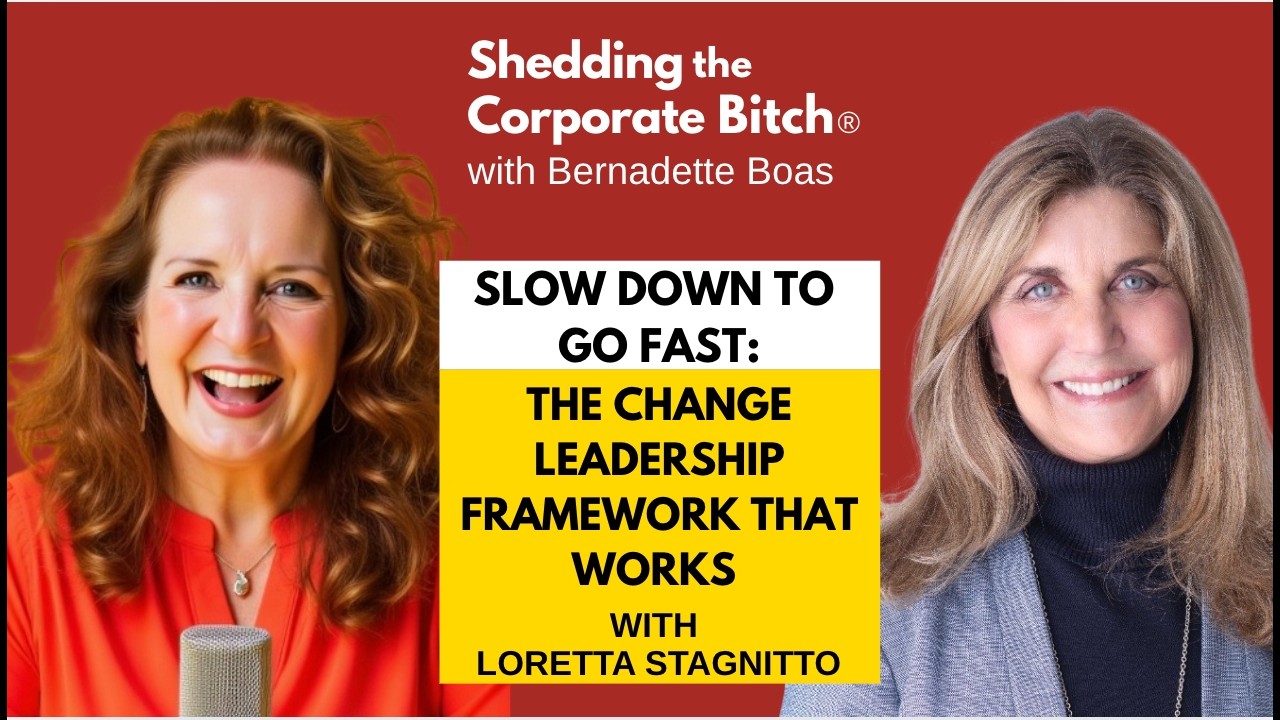
Loretta Stagnito explains how leaders can sustain performance during rapid change by slowing down. Her four-domain framework covers culture, leadership behaviors, people development, and bench strength. She recommends distinguishing what you control from what you cannot, then building structured plans instead of reacting.
Chapters
In this episode, we are diving into a reality every leader feels but few openly discuss: how to maintain high performance in high-pressure, unpredictable environments. With rapid AI growth, shifting markets, and constant change, leaders are navigating more uncertainty than ever. And what I hear consistently from mid-level and senior executives is this: it's exhausting. The cycle of unpredictability impacts culture, focus, energy, and ultimately results. With our guest Loretta Stagnito of Loretta Stagnito Leadership Associates, we'll explore a practical 4-domain framework focused on building a positive, high-performing culture, practicing effective leadership behaviors, actively developing people, and strengthening your leadership bench. The key? Slowing down to go fast. You can learn more about Loretta at loretta-stagnito.com. Because great leadership isn't about avoiding pressure, it's about performing through it. Stay with us.
Welcome to Shedding the Corporate Bitch, the podcast that transforms today's managers into tomorrow's powerhouse leaders. Your host, Bernadette Boas, executive coach and author, brings you into a world where the corporate grind meets personal growth and success in each and every episode. Let's do this.
Loretta, welcome, welcome, welcome!
How are you?
Thank you for having me.
Oh, you're very welcome. Our topic is all around change, and God knows— he actually does— how much change and how much adaptability we need to have right now in these times because of all the pressures and everything that is changing at such a rapid pace. Help us understand what is it about change that drew you in to really wanting to focus on it as part of what you practice and the work that you do?
I think that it's because change is so constant. It happens all the time. And I don't know about you, but over the past several years, it just seems to be all the time, all the time, all the time. And I think in my history of coaching and in corporate and all that, change always happened. But the pace is so different now. And as a result of the pace of change, I see a lot of burnout. I see a lot of not knowing how to move in uncertainty. I see a lot of leaders losing their aspirations because there's just so much change. They get burned out or they give up. Or things like that. So I, I think it's a combination of seeing so much of this and seeing so much change always happening that it's like, how do we address this? Because it's not going to change. It's not going to change.
I, I heard a CEO on an Instagram or a TikTok being interviewed, and he said our visions used to be 5, 10, 15 years out.
Yes.
And now it's more like 2 to 3, and even then, of course, plans were always meant to be changed, but even the 2-year doesn't stick for very long right now.
Exactly.
And, uh, so when you think about senior leaders, even, and CEOs, what is the biggest factor that they're dealing with other than the rapid But what is it that's creating a lot of this change?
Well, I find leaders just like, oh no, not another leadership change. Oh no, not another market change. Oh no, not another budget change. Oh no, not another layoff. So I think it's just all of those things that are constant that people— it's not like you can say, oh, I've been through a zillion leadership changes. I know what to do. Might be a leadership change this week. It might be a market change next week. It might be a structural change. The following week. So it's just constant all the time is what I see.
Where does technology, AI, uh, tariffs— where do all of those play in?
They create— they are big culprits to the change, right? Tariffs, not something we expected. And then the tariff, the amount of the tariffs changed and whether you were having to deal with them or not changed, and how are we going to pay for the tariffs changed. All those things I saw. AI in particular, because who's adopting, who's slower to adopt, what job— jobs are being eliminated, all of those things. What do I need to do in order to not be eliminated? So I think that it's— there's so much of that that it's not only the change, but the anxiety around the change. When even the, what is it called, the forward-thinking anxiety. Oh no, I'm going to get anxiety because this is going to change and that's going to change. And then even thinking of the physical, the people aspects of that. So because of all that, people leave their jobs, people get burned out, people have to take different positions, structural changes happen.
And then generational differences now.
I mean, differences, right? Baby boomers leaving, Gen X is coming in having a whole lot of different expectations about what happens in the workplace, especially regards to anxiety and burnout and their mental health and those sorts of things, what those expectations and how do we meet those expectations. So there's so much as leaders that you have to be thinking about. And to the point where we talk a lot about imposter syndrome, and we tend to think about that with women in particular, but there's a lot of research out there that shows that there's a lot of CEOs, men and women, that go through imposter syndrome, not simply because they don't have the confidence, but because there's so much change. They haven't had to deal with all this change.
Yes.
So they don't know what to do. So they feel uncertain about it. Right. And then it creates maybe not as much of the uncertainty, anxiety, but certainly enough to make you think about, do I really know what to do? I've never really experienced this before. I can't lean on what I've experienced before because this is so new.
And the pace is moving so fast. They're like always feeling like they're trying to catch up. Some people like myself, some people thrive in chaos to where they get laser focused and they step back and they go, okay, they pause and they go, okay, I need to sit down and work, work on a plan. And then others are very haphazard, right? Would you say there's a majority act in a certain way, and therefore what they need to do is X, Y, and Z?
I think it depends on, as a leadership skill, how well do you deal with ambiguity in general? And to some, it's my superpower is putting structure around chaos. And in other instances, it's around, I don't have that skill. How do I function in this? I think it comes back to if that's a superpower of yours about how to create structure around chaos or how to flourish in ambiguity, then what is it that you do? Do you step back? Do you put a plan around it? Do you think it through? Do you create your vision and say, this is where I think we're going to go, knowing what that ambiguity is, or not knowing there's ambiguity, but at least these are the things I can be certain about? Or do you get paralyzed by it and then end up saying, I don't I don't know how to deal with this ambiguity. And so therefore I'm going to be paralyzed or my performance or my team's performance is going to be impacted by it. I think the answer in both instances is exactly what you said. How do you plan, right? How do you either— that putting that structure around ambiguity does mean stepping back and thinking about what can I control and what can I influence and how I can deal with it.. But if it's not something that you're skilled at, or if it's a skill that you're building, then one of the ways to do that is to be able to step back. Step back and look at the— and say, where are we right now? But I go slow to go fast. So you step back, you look at what are you dealing with, you look at what the ambiguity is, you look at what you can actually control and what you can't. And then you break things down, you make it easier to be able to deal with it. So I think in both instances, whether you're skilled or not, how you build that, that skill is coming up with your plan, coming up with creating that structure, that within the chaos, within the ambiguity.
Because at least the plan will give you boundaries and give you a framework and some degree of stability and confidence.
Right, because you know where you're going. You actually see, okay, what can I be certain of and what is still uncertain? And so if these are the things that I can be certain of, then how am I going to reach those goals? How am I going to get there? So what can you be certain of? And then how do you plan around that? And even having options. All right, I might not be certain, but I think this is where we're going. So this is option 1. If it changes, I have option 2, I have option 3, but that plan and taking that step back and doing it with yourself through reflection and, and then doing it with your team as well through feedback and input and recognizing where you are, where you need to be, and does it match to where the rest of the team is? Because if you think, great, to get through this ambiguity, we're going to put this plan and we're going to go from here to here and it's all going to be great. But if you haven't brought your team along, And if you haven't brought everyone else along and if you're making the assumption, well, this is where I'm going to go and this because I'm good at this and this is what I'm going to do, but not taking the time to bring those others in, then you're not going to be effective because it's you, but you're not going to get there unless your people come with you.
Right. So you said a couple of really key things I want to have you reiterate on.
Yes.
Even drill into. One is For many people, I would think if they could really get a clear understanding of what's in their control and what's not in their control first, right? And they can take all the things that they can't control off the table. That brings down the pressure point. And then you talked about the team and what are your thoughts on the control, but what are your thoughts also on This is the time when you're under change, under massive pressure. This is the time to really go back and assess and ask your team members about their skills, their talents, their gifts, because they may have things that they could bring to the table that haven't been needed before, or maybe they haven't raised up, or maybe you haven't asked. So can you talk on both of those things and drill into what leaders could actually do to get their hands around all the change that's happening?
Yeah, I think the very first step when you think about change happening, sometimes as the leader, we move quick, we move quicker because we've either known about the change for a while or we've had maybe a voice in the change. And so we get there a lot quicker. So we make the assumption that, all right, well, I'm here, so my team is ready. But whenever there's a change, and, you know, it requires people to change as well, you have to look at what are the emotions that those people are going through. Maybe it's almost like it's the end of one and the new beginning of the new change. When you're at the end of that, whatever the old thing was that you're trying to change from, people experience different things. They maybe, they experience anxiety, maybe they feel sadness and grief because, you know, what they did, what their purpose was assigned to what they were doing, and now they have to do something different. So I think your first step as a leader is to check in on the team, where they are in that phase cycle, and how do you move them. Your job is to transition their mindset, not only the things that they do, but the mindset that they have to get them to buy into the change, which means helping them recognize what is going to stay the same, what might be changing, what's the benefit of the new change, where will we be getting there. So really spending that time thinking about not just the what of the change, but the how. How am I going to get folks to move there? And by doing that, you have to assess first where they are and then make the assumption that, okay, based on where they are— and everybody's going to be different. Some people move to a lot quicker. So make that assessment first from a mindset standpoint, where they are in the change. What are their emotions? How do I bring them along? What can I be doing to help them emotionally move into the change from a mindset perspective? I think that's one thing that your job as a leader to do. When you think about the second piece, when you said going back and assessing skills and, and, and, you know, where each member is, when you think about just good leadership hygiene in general, it's always about knowing what you know, getting feedback, checking in, matching what you think, you know, your awareness is, and does it match to what others see you? And then do you have a particular plan or framework that you're following to really be able to be an effective leader no matter what changes? So I have like a 4-pillar framework, and one of those is how well, you know, do you develop your team? So how well do you develop your culture? How well do you develop not only your individuals, but the team in general? How well do you manage certain leadership practices that help move the team along? And how well do you build your bench? So when I think about what you said about assessing skills and different things like that, you should be doing that all the time, right? Because your role as the leader is to develop your people, to know where they are, where they want to be, and how do you help them get there. To know who are your strong players, who are all your A players, who are the ones you need to develop, who are the ones that may not make it to where you want to go. That's just part of natural leadership, whether there is change or not change. So, and that's when I also think about all that ties into a plan. So, to be able to— and when you're creating a plan, what do you do? You go do some analysis. You figure out where you are. And then, you do your analysis and you get your data, if you will, whether that data is market conditions, whether that data whether that data is your own personal reflection or what you know about the team. You get your data, you get where you are now, where you need to be going, and what the gap is. And then you build your plan around that. So is it a plan around those things I talked about? Maybe you have a great culture. And so you're thinking, well, I don't need to change that, but I don't develop my people as well. I don't develop my team as well. So here's the opportunity to do that. Or I don't have bench strength when I think about, is there succession planning going on throughout my entire organization? I think it's all of those things that you should be doing naturally as a leader that makes you effective. And if you're doing that, then the change is sustainable because you're just incorporating it into what you're already doing. I think what happens instead is there's so much change and the change creates so much workload. And there are so many different goals and priorities that leaders sometimes just become the hamsters on the treadmill and they execute. And they don't stop and take a step back and say, what's going to increase my performance? What's going to help my team? And instead, they're just focused and doing.
They're doing, doing, doing, doing, doing.
And then, when they don't hit their goals, or when they're— then they step back and say, 'Oh, I wonder why.' Well, I never slowed down to go fast. Right. So that's why, if you can incorporate all these regular leadership practices against sort of these 4 pillars, then the change should be a lot easier because you're just— it's not about the change. It's about how you are incorporating it into all those things you're doing against those four pillars, if you will.
You also talk about how the framework of reflecting, gathering feedback, identifying focus, and building the plan, right, is absolutely critical to get through everything that you just spoke about.
When you're thinking about your business, you have a strategic plan on how you're going to get to all of the goals and things. It's your strategic plan on how, how are my people? So they have to match. You have to have both, right? So many times we know our goals and objectives from a strategy standpoint, which is what I call the what. But what's your strategy on the how? How are you going to do that? Because if you can't do it by yourself, right? It's your people that are going to do it. So leaders absolutely need both. And then, so how do you develop your plan? Around your people, around your culture, around the development of your people, those things.
What do you suggest or advise leaders who are leaning more into the execution, the doing, and getting them more into the looking at the workload, prioritizing it, getting it to the right people at the right time to do the right things, as opposed to just everybody just trying to check off their to-do list. And yet it's not leading to impact, or it's not moving the needle or moving them forward. What do you tell them that they need to do?
Slow down to go fast. So I guess when I think about that, how do you know you're going to achieve your goals if you just have this bottom-up approach. But when I think about that, I think at the bottom, right? All these things that'll lead to this, right? Versus this is where I'm going. What are the things I need to do in order to get there? So you think about it more from a top-down approach than a bottoms-up approach. I think a lot of leaders are in the bottoms-up approach. And if I get there, and then what happens is they don't meet their goals. And if you're always executing, number one, you're going to burn yourself out. Number 2, you're going to burn your team out, or people are going to leave, or they're going to quiet quit, or you're going to have a retention problem. And so it's going to create all these additional things that you have to put energy towards. Whereas if you had this plan, if you were checking in, and I think what it also means is you have to build the capacity as a leader to do this. So it's not so much just what is my work. My work is doing those things that we talked about. So therefore, when I think about my day-to-day and how I structure my time, I have to have— there's only 40 hours. Well, there's more than 40 hours in a week, but we only have so much time that we can actually do this because we only have so much capacity as individuals and humans to begin with. So to be able to manage your own capacity Meaning, and I, a lot of times I think about it as, and I work with clients when I say, here's all the things that you need to do. Let's bucketize all those things. What is the percentage of time that you're spending in all those areas? And those buckets include things like building my team, coaching my leaders. You build in that capacity versus I'm the one doing all the deliverables. I'm the one that's managing everything. All I'm doing is delegating to get it off my plate. Those sorts of things. I think it's being very strategic about all of that. And, and then being able to build your plan and work your plan that way, but building your own capacity as a leader to do that so that you don't burn yourself out and you don't burn your teams out.
The thing that I was thinking about when you were talking about top-down versus bottom-up is bottom-up is you're working on things that aren't a priority. You're working on things that aren't tied to the strategic plan, and your people are especially working on things that aren't really going to lend itself to making that strategic plan. Because we all know how many— how often the employees are just thrown work to do with very little thought, with very little linkage. They don't even know the linkage back to the plan, right? And so you're actually, as a leader, you're actually being very ineffective for them.
Yes.
If you're working bottom up.
And it creates a lot of other things like, what's my purpose? How do you know? How do my goals tie to the strategic goals? So if you're not spreading those goals down from this vision and getting everybody to connect to that, then you're creating things like, well, I don't know how my job maps to the goals. I don't know what all this busy work is. Like you said, I'm just having priorities. And I'm hoping when it comes time for my promotion or for my review and we go through my goals and it's then the leader says, well, yes, you did all these things, but it really didn't move us forward. What were you doing as a leader to help them get there so that they knew from the very bottom how each of those goals all along the way maps to the top goal? So being able to start at the beginning, start at the top, saying, this is what I want to achieve in 3 years. These are the strategies. Therefore, these are the particular goals. And this is what this leadership level and this leadership level and this leadership level all the way down to the individual contributor level, all how it all maps to it. That's why goal setting is so important. That's why cascading goals down and having people be responsible for their own goals as well and taking them through that process. Not, here's your goals, team, just go do it, you know, and if we all get there. So it's all of those things. When you say bottoms up versus top down, it's like peeling the onion versus, well, if I stack all these things and then I'll get to a goal. Well, great, you accomplished something. But was it something that was important that moved the business forward or added additional value to the business?
What do you advise them in order to sustain high performance, especially when it comes to being under extreme pressure and urgent timelines and uncertainty? What would you say to them?
From the sustainability piece to it is, if you are following these pillars, if you are managing the staff, if you are building your team, if you're helping them with constantly having conversations about priorities, are these the right priorities? This is what I need you to do this week. No, put that priority aside. So if all those things are happening on a regular basis, then you're just going to get there no matter what the uncertainty or what the change is. Because you're almost adding that structure to chaos. It doesn't feel as chaotic. Yeah, all this uncertainty, a lot of change, but we're dealing with it because I have a really good culture, because I'm really managing my culture. I have a very strong team because my team is motivated. They know I'm being delivered, being developed. I'm getting stretch assignments. My team functions really well together. There's no competition on our team. I trust you as a leader. I trust you will be transparent with me. I trust that when I give you feedback, you'll take it. So all of those things, if you're doing all those effective behaviors and managing your culture and growing your people and doing it all the way down, I know how happy the people are who are the individual contributors that report maybe 4 layers down from me. But I still know what they aspire to. And what they do well, because I care about that, because I may be gone someday. And if I want it to be sustainable way after I leave, then if I build this correctly, then it will be sustainable. And I can leave with integrity that says, I built a strong team. It's okay. Or if I leave and take a different position within the organization, you feel really great because your team is still high-performing because you've done that job as a leader.
Yes.
Not because you've done all the work yourself and you've done all the deliverables yourself and you've done all the strategic planning yourself.
What an aspirational goal. Really? You know what? Quite honestly, what a leadership goal.
What a great leadership goal. I think about a lot of women leaders that I've coached that were in high positions that leave for maternity leave, or they're— and I'm like, the best thing you can do is when you come back, take on a different role or have less responsibility within your organization to the point where, you know, your leader can say to you, your team's been running so great, I'm going to give you this now. Yeah, build this because they're doing all that. And if you can do that when you're gone for 3 months because, you know, you've built a team or however long you go for, because you know you've built a team and when you come back you can grow and you can take on different things as well. What a great leader.
But I want you to also then touch on, if you would, what kind of feedback should leaders be seeking? Because some people just assume what it is. But what are the different types of feedback that you would advise leaders to gather from their people? What would that be?
I think there's two things that come to mind for me. I think the first is leaders talk about self-awareness and how self-aware they are because they know their values and they know, you know, where they're coming from and they know what they do creates high value. But my first question is, does that internal self-awareness match external self-awareness. So do people see you the way you see yourselves? Do people talk about your accomplishments and think about your accomplishments the same way you think about yourself? So the first type of feedback should be anything that would help match that so that you, as the leader, we get a really good sense of perspective on, do I see myself the way other people see me? So that's the first thing I think about when I think about feedback and building sort of internal and external self-awareness. The other piece is I always think about it against some sort of a model, a leadership framework, as we talked about. Strengths. What do they do well? What are their contributions to the organization? Do they have any effective leadership behaviors, any blind spots? How well do they build their culture? How well do they build their team? Do you know what their accomplishments are in the organization, what their contributions are? So being able to not just get general feedback— what do you think of XYZ as a leader?— but asking really specific questions so that anybody you're gathering the feedback from can give particular perspective that's actionable, that you know that you can address, and that they can give you feedback that's constructive, as opposed to, yeah, great leader, or I don't like the way they yelled at me, or whatever. What are you going to assess against? A model or a framework as well. And then how do I ask those specific questions? Because then when you have that feedback against those models, then you can say, oh, this is great. People think that my leadership practices are effective. So I don't have to focus on that real as much. Oh, but I'm not really developing my staff the way I should, or I'm not developing my team. OK, great area of focus. Or I thought I had a great culture. But now I'm hearing from folks that it's not such a great culture. What do I need to do? So this way, we don't boil the ocean.
Yes.
But we get specific data that we can put actions against. And then we can come back and measure it. So when we go back, we can say, go back to ask them, all right, I really was working on my behaviors, or I was really working on building my staff. And it's 6 months later, it's a year later.. And you ask the same questions and you get the feedback and that makes it measurable.
Yes.
Well, so it's not one thing just to get the feedback and say, okay, thanks, because people aren't going to stop giving you feedback if they don't see you're acting on it. It's getting the feedback. It's acting on the feedback, which means having the plan, addressing those certain things. And then it's going back and measuring against that. And have I moved the needle? And what do I need to fix now? And it's constantly being able to have that benchmark. If you will.
Love it. Love it. And then you also have a self-aware leader quiz.
I have, yes.
And so talk for a minute on that and we'll share how they can go ahead and access that.
Yes. I talk about a— there's quizzes that you can go to on my website that you can talk about how well you do against these 4 leadership pillars. How well do I manage my team or build my team and individuals on my team? How well do I build my culture? So you can take the assessment and then depending on the feedback, it might say you're great or you need these few things or whatever you might do.
Now, when it comes to dealing with change and everything that we've been talking about, yes, what would that one thing be when it comes to them? What do you suggest that they do to really begin to manage and lead through change? As effectively as possible?
I think the first thing they need to do is step back and think about, am I in change fatigue? Is it yet another change? How am I going to be? Do I have the energy? Can I be— can I move this change forward? So assess yourself, assess your energy, assess your burnout level, all those things. You get to the part where you say, OK, I'm good, I can move this forward. Then you talk to your team and your staff and you say, where are you, Bernadette, in this change? Where are you? And some may be saying, I'm really nervous. I'm scared. And some might be saying, I'm ready to go. So how am I going to help you? How am I going to help the other person? So getting, figuring out where other members of your team are in regards to that change. So it's the feedback. It's the data. It's making sure that what I think maps to what's really happening out there. So take that step back, query the team, ask the right questions. Come up— there might be some low-hanging fruit. You can say, "Oh, I can do these two things tomorrow and it's going to help." You can say, "I can build this thing that every day I'm going to check in with this person until I move them along." So you'll know what to do. But the first step is step back and say, "Well, before I just move, charge the hill to do this other change and make the assumption that everybody is going to come along." Take the time, step back, assess yourself, assess where the team is, put your action plan together, and then move into the change.
Awesome. All right, everyone, I want you to go to loretta-stagnito.com. You can find her self-aware leader quiz there. Please go and follow her on Facebook and Instagram, Loretta Stagnito Leadership. And then on LinkedIn, it's Loretta Stagnito.
That's right.
So be sure to follow her. Be sure to check out her website and figure out what you could be doing to really become a change leader. Loretta, thank you so much. This has been fabulous.
Thank you. And I really appreciate that conversation.
Reflect, gather feedback, identify focus, and build your plan. If you are one, as Loretta mentioned, who struggles when dealing with extreme uncertainty, with chaotic pressure coming from all areas of the business, then her mantra of slowing down to go fast is extremely appropriate and extremely powerful. Think about it. Slow down to go fast. So her Four Domain Framework of that— reflect, gather feedback, identify focus, and build your plan— is a great platform for you to step back, take a pause, and really spend time on thinking through how you're going to get you and your team through whatever chaos and whatever change is going on. Powerful conversation with great tips and strategies for you to use. Be sure to share it with your team members, your peers, your managers, and anyone else who also is feeling the pressure of the ongoing change and chaos that is happening and is creating a lot of stress and anxiety for not only yourself, but for the team members that are there to support achieving those goals and objectives even through all the transformation that's going on. I'll look forward to seeing you for another episode of Shedding the Corporate Bitch. Bye!
Thank you for tuning in to today's episode of Shedding the Corporate Bitch. Every journey taken together is another step towards unleashing the powerhouse leader within you. Don't miss any of our weekly episodes. Subscribe to our podcast on Apple Podcasts, Spotify, or wherever you love to listen. And for those who thrive on visual content, catch us on our Shedding the Bitch YouTube channel. Wanna dive deeper with Bernadette on becoming a powerhouse leader? Visit balloffirecoaching.com to learn more about how she helps professionals, HR executives, and team leaders elevate overall team performance. You've been listening to Shedding the Corporate Bitch with Bernadette Boas. Until next time, keep shedding, keep growing, and keep leading.
More from Bernadette



From Stuck to Leading, Episode 2 — Meet the 5 Inner Fears Destroying Your Leadership



