Stop Struggling to Lead with Cynthia Corsetti
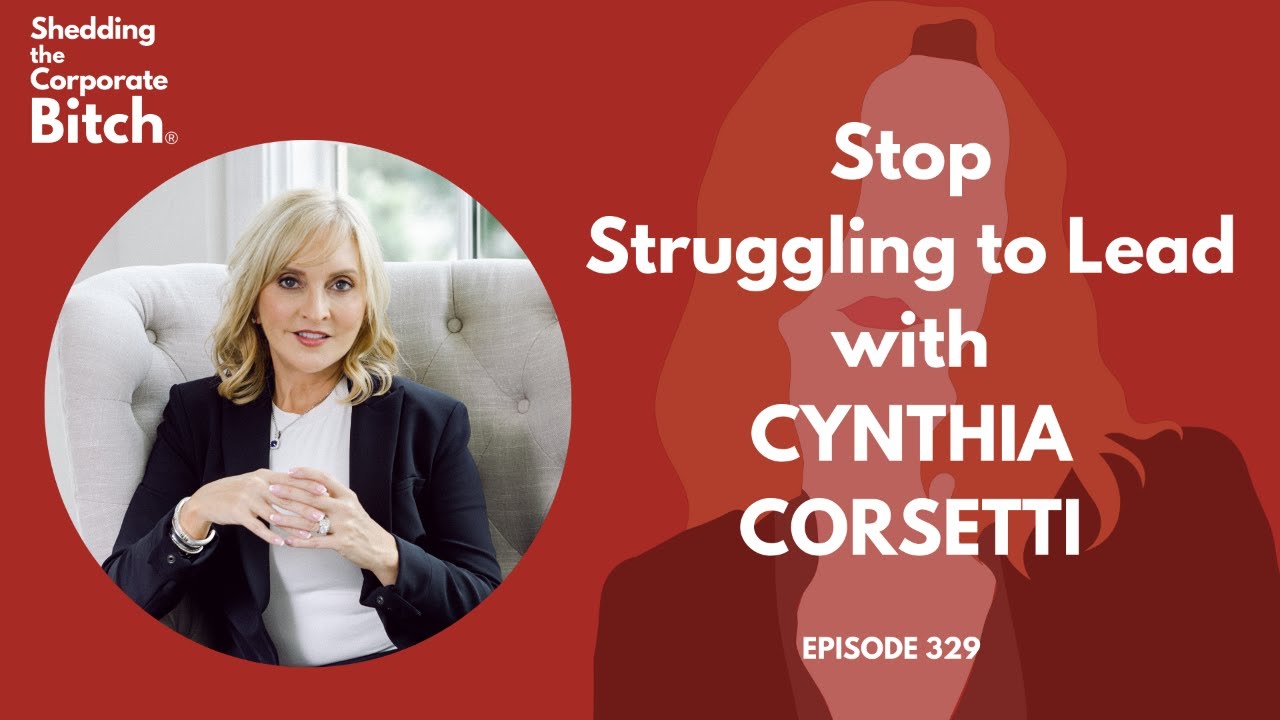
Executive coach Cynthia Corsetti explains why newly promoted managers struggle to lead: promotion doesn't teach leadership skills. She uses a CARE framework (Clarity, Authenticity, Responsibility, Engagement) and a 360° feedback method that reveals the gap between how leaders see themselves and how others perceive them.
Chapters
struggle to be strong leaders while others are transformational and they make it look so easy. According to our guest Cynthia Carcetti of Cynthia Carcetti Coaching, the biggest mistake leaders are making is assuming that they are leading when they are simply and actually just managing. So we're going to dive deep into what the true struggles are that many of you are having to be strong and true leaders. We'll talk about how to become a transformational leader and the support system you need to put into place in order to be successful. We're diving into that and so much more during this episode. Welcome, welcome, welcome to Shedding the Corporate Bitch, the podcast that transforms female corporate executives into powerhouse leaders by showing them how to shed the challenges and overwhelm along with any fear, insecurity, self-doubt, and negativity holding them back. I'm your host, Bernadette Boas of Ball of Fire Coaching, bringing bringing you powerhouse experts each week to share tips, advice, and sometimes tough love that will allow you to create the riches in your work and life you deserve. So let's do this. Welcome, Cynthia. How are you on this beautiful day?
Hey, thank you so much for having it. It is a beautiful spring day and I'm really excited to be here.
Oh, Well, you're very welcome. I'm excited to talk to you about this because I do think that too many leaders out there tag themselves as leaders, and yet, as you will say and explain to all of us, they're not necessarily true leaders. But before we get there, share with us a little bit about Cynthia.
So I am Cynthia Corsetti, and I'm an executive coach. I'm here in Pittsburgh, Pennsylvania. Um, where I planned my whole life to not be still in the— in this cold weather by this time, but it just never worked out. So here I am still in Pittsburgh. But yeah, and I'm, uh, I'm looking forward now— we're just getting into the beginning of golf season, so I'm kind of excited about that.
Oh, awesome! You play?
I, I play frequently, not necessarily quantity and quality are disconnected in this.
That's quite all right. I get that too. I've learned how to pick up the ball and keep walking. Yeah, that's the best thing that I can do when I get out there. That's awesome. That's awesome. Well, we want to talk about, as mentioned, why individuals struggle to be true leaders. So first off, before we get into the differentiation and then what makes a true leader, what are those challenges that you're coming across? You're an executive coach. What are those challenges that individuals, we'll call them right now, are having when they are actually put into a role that requires a lot more of them?
I think the biggest challenge is that people assume that just because they get a promotion and they move up the ladder, that leadership skills are just going to naturally flow in and they're automatically going to turn on a switch one day and I have this new title. And now I'm a leader. And what they're missing is that leadership is a full-time job and it's on top of the job you already have. So just like you have to learn the technical skills and the background and the day-to-day of the task of your job, you also now have to have a whole entire toolbox of learning how to lead. And most people don't get it.
Right. They don't get the toolbox or they don't get that that's what they should be focused on?
I guess both. But when I said it, I meant that they don't get the toolbox in part of their— like, it's not something you're learning at school. It's not something that— like, organizations try a little bit. They'll do some leadership. They'll have a workshop here and there. But to really embrace leadership as the responsibility and the job that it is, It requires skills, and you have to build those skills over time.
Right, right. And so this assumption, you know, from individuals that just because they, you know, get people assigned to them, they're now leaders. What do you see when it comes to— what are their struggles when it comes to leading people? Because that's what it is. Like you said, it's not technical anymore. It's people, and people can come with a lot of stuff. So what are those struggles they're having specifically?
I think a big one is self-awareness, and that's a huge problem that I see in leaders across the board. They believe that they're being perceived in a certain way. They believe that the the people on their team are getting what they're saying, that they're understanding, that they're on board, that they respect them, that they're an open-door leader. They believe all of these things. And the reality is often very different. And because they get into this role, now all of a sudden they think, I'm the leader, so I have to make sure this gets done. They start micromanaging, they start bottlenecking, they create bottlenecks. So there's just a whole lot of pieces, and they need the self-awareness so they can stop by and say, Am I coming across the way I think I do?
Or I want to.
Yeah. Or yeah, I want to.
Or I want to. And what is the impact on their people when they do start micromanaging or they do start falling into these traps and these challenges and struggles that you're talking about?
The employees become enabled. Right? So why would I solve a problem if I can run to you and you're going to solve it for me? It's like unconscious. It's not like they're consciously thinking, I'm just going to be a lazy bum and I'm going to let you solve all my problems. Right. But what happens is, as a leader, we talked about it's a full-time job, right? Part of that job, the most important part of that job, even more so than moving the organization forward, is developing the people. Because without developing the people, the organization isn't going to move forward. So I can't develop if you're not pushing me. And if you're solving every single problem that I have, we're getting nowhere. And then I become the bottleneck as a leader. I'm sometimes solving the wrong problem because that person doesn't even know what to ask for.
Right. And break down pushing for me, if you would, because when I heard that immediately from you, I thought, Okay, they're not pushing me, which could be a good thing or a bad thing, but they're also not challenging me. They're not giving me opportunities. Kind of what does pushing mean and what are you observing out there?
So, okay, maybe, maybe pushing was probably not the best choice.
Oh yeah, no, it was a good word. Yeah, yeah.
But what I mean is, I guess, pushing someone outside of their comfort zone, pushing them to When someone comes to you as a leader and they're expressing a problem or a situation, I can listen to you on a surface level and I can give you solutions. I can jump in and try to help you, or I can recognize the fact that whatever you're saying to me right now probably isn't the real problem. And I can keep peeling back that onion by asking questions until I get to the root of the problem. And then I can start asking you, what have you already tried?
What—
why hasn't that worked? And then, then finally, what is the support you need from me? Because they don't necessarily know until you push them out a little bit from that easy fix of, I'll take it to her and she'll fix it, right?
I love that. Okay, that totally is clear. Now, when do you find that those individuals that are getting promoted and, and now they have more responsibility, they have more leadership, uh, they have more people. Are they having— is one of their challenges that the fact that they're having a hard time cutting the, you know, cutting the ties to them being almost a doer versus a leader? Like, they're still wanting to do the— what they're smart at and what they're good at, you know, get down into the nitty-gritty, and they're having a hard time pulling away?
I think that's part of it. But what do they say? What got you here is not what will get you to the next level.
Right.
And I don't necessarily think that it's so much that they don't want to let go. I think a lot of, especially new leaders, when you first become an executive, I think that they're afraid that if they step back, they won't be considered worthy of being in that role. They believe that solving the problems is what makes them valuable as a leader. And so that's why they don't give up. It's not because they want their hands into everything so that they have no sanity in their day.
No, I can absolutely see that. I can absolutely see that. And so they— what does it take for them, or who does it take from them to actually then kind of look up and realize that this perception that they have is disconnected from the reality? Like, are they coming to that awareness? You talked about self-awareness, or is someone, you know, kind of guiding them to that direction?
And that's what's— it's kind of interesting that you say that because, granted, we'll do 360s in organizations and they get that peer feedback and all of that. And they get it that way. But when you first start having a conversation with a leader and you're talking about executive coaching, their first thing that goes on in their mind is, that's remedial. That's if there's a problem. I think I've got it. And because they don't have the self-awareness they don't even know when people are giving them those clues that they're off. So it's really important. Like, leadership is something that's, that, that's not one and done. You don't go to a seminar or read a book or do something like that. No, now I got it, I've got this. It's something that is just constantly on the move. So having— that's, of course, I think, having a coach who is like by your side walking down that path with you. Because when, when you call me up and you're like super psyched about something, I'm saying, that's great, I'm excited for you. And did you look under this rock over here? Because I think you might be missing something.
Right, right, right. No, and it's true. And, and do you find too that— let's— you, you brought up 360s. And do you find too, go— going back to self-awareness, that They could read all of this content in this black and white context, and yet they still, for whatever reasons, which maybe you have an idea of, aren't picking up on the fact that that content is someone's reality of how they are behaving or how they are leading or not leading. And How do you get someone to actually kind of acknowledge that and really be open to receiving that versus saying, oh, no, no, no, well, that was just one person or one case, and they're denying it?
So there's a couple of things here. First of all, when I do 360s, I do interview 360s. So I'm not into the 27 people said this. I say, give me 7 to 8 of the people you interact with the most in your organization. I want some peers, I want some subordinates, I want some supervisors, I want somebody outside your organization, I want your wife, I want, you know, your husband, whoever it is. I want those people, and I schedule 45-minute interviews where I ask them all the same questions, right? So that I have a dialogue. So when I go back, I can really talk about themes and patterns, not who said what, but really give them more than just a 360. So I kind of like that approach. And the other thing I always I share with them is a story about myself when I was an executive VP. And I'm like, I'm in HR, so I've got this. I know what I'm doing. I'm a people person. My door is always open. I was like rocking it. And we did 360s. And when it came back, I was like, I'm reading it. And like all of my peers, people at my level loved me. But people down lower said, she's unapproachable. She doesn't talk to us. She's not— I was like, I, I was like, no way, I know this stuff. So if I can be that far off from my reality, and, and what they— then, and you said it right, the perception is the reality for that person. So it doesn't matter what I think I am, it 100% matters how they perceive me, right?
But how do you get a— I'll call it stubborn for for being nice or egotistical, on the other extreme, individual to actually get to that point to where they say, obviously there's something there?
Honestly, if they are not receptive in the first place, if they don't— when someone comes to coaching in any way, they have to come because they want to improve. They want to keep growing. So if they come with this attitude that I don't have anything to grow, then they're honestly wasting their time. And I have turned down clients for that very reason. I only work with, like, high achievers, right? I don't work with remedial stuff.
Right, right. It's not, it's not worth the time. It's more of a headache than if they're not willing to change. I, you know, you probably are like, I can't get you there.
Yeah, I learned early on, if they're, if the organization's calling me because without me you're going to get fired, you're just going to get fired 3 months from now. So instead of me executive coaching you, let's go into my career transition program.
I laugh, but it is a true scenario, so I don't want to disrespect that for anyone, right? But it is so, so true. Now, someone can come into that— I would expect, um, that somebody can come to you with initial apprehension because, one, they, they just are now filled with fear and paranoia and concern but yet they have a desire to consider and maybe shift. So there are people— would— do you find that there are people that are willing to, they just need a little bit of a nudge, but they also need to know that they're— they have the, the support?
They do. And, and I think a lot of that comes when they're willing to— the coaching relationship is pretty critical at that point. That trust has to be there. And once they have that trust, they will open up and be vulnerable. And that's the place— that vulnerability is the place where transformation begins.
Sure.
It is true that if they're open, at least to hearing it out. Yes.
Yes. Yes.
Yes.
So that's a great segue because you do talk about one needing to be a transformational leader. But I want to lead into that with So we've talked about the struggles. What are those few skills that are must-have for one to be a transformational leader? And then how do they get there? We'll talk about that afterwards.
So some of the biggest skills that leaders need to create transformation is, first of all, primarily they need to learn how to listen. To truly hold space for someone, to not be thinking of their answer while the other person is speaking. Like, listening is a critical, critical leadership skill. So is coaching. A good leader will have excellent coaching skills. And people— that's another word that people throw out there. Oh, I coached her for this, and I coached him on this. And it's like, no, you didn't. Like you mentored, you gave advice, you counseled, and I'm sure it was very valuable, but coaching is very different. You have to know how to ask those questions. You have to know why you're asking those questions, and you have to let that person find their own answer. That's the difference.
Boing, boing. I wish I had a little like, you know, cheering section that I could put on. Yes, you're absolutely right. And I love the fact that you differentiate it for everybody. Mentoring versus coaching, two very critical things, but two very different things. Right. Okay, so skills, listening, coaching. Is there anything else, the big ones, before we get into the how?
Well, there's obviously conflict resolution, but all that comes from self-awareness. All of that comes from understanding yourself, understanding that. That's why everything that we do in our leadership program is is around 4 pillars of leadership. That's what CARE is: Clarity, Authenticity, Responsibility, and Engagement. And if you master those 4 pillars, everything that you do is going to lead to transformation.
Yeah, awesome. All right, so that's another great segue. So we need transformational leaders, and many people out there listening a lot of them will kind of be like, oh, this— now we're getting into the woo-woo stuff, right? And yet it isn't. No, it's, it's not. It's part of being human, actually. So help us understand your take and your, your framework around helping someone really evolve and transform into a transformational leader.
So first, I kind of like to describe That wasn't my dog for once. First, I'd kind of like to describe what— how transformation really happens, right? It's not this big, like, the heavens light up and it's like, I am transformed. It's a million little insights that change over time. So if I am trying to make— if I'm trying to be a transformational leader, I need to transform the people that work under me. I had one leader tell me on a call just last week. He said, "You know, I can't believe the difference I see in how I view leadership. It's not about having the answers. It's about helping people see their potential and helping people change their insights just a little bit.". And that's the beginning of transformation because his insight of what leadership is has shifted.
I love that. I love that. And opened up, hopefully, to even things that aren't necessarily comfortable for them. Is that right?
Right. 100%. Yeah.
Yeah. Awesome. So you described care, but I'd like for you to go into it a little bit deeper and how you work with your clients to really you know, help them to see that this structure can be very, very beneficial to how they are developing, as you mentioned, and coaching their people?
There are several ways that we work with people. The best way is hybrid, right? I will tell you the best way is hybrid. So the way we run Care to Lead is I am, and I specialize in the C-suite. Like, me personally on my team, I am the C-suite coach. So anybody with a C in front of it, they're going to be on in my cohorts. So if we say go into an organization, well, Jacqueline, my, my other facilitator, and myself will go in and I will work with the C-suite. And we work with them in a group setting as, as a cohort, and I work with each one of them one-on-one. So that that's combined. Jacqueline's doing the exact same thing with down in the organization. And then we'll come and we'll do live workshops plus virtual meetings, you know, weekly and monthly as groups. So, so that there's this long process. And the reason we do that is because when the people at the top are a) bought into what they're learning and they're learning the exact same language and the exact same pillars and the exact same thing that the people down here are learning, it makes sense to everyone. I'm not hearing you.
Oh, I said absolutely. Absolutely. Yeah. No, absolutely. So those 4, could you describe them to us again?
Yeah. And this comes with 15 years of working with executives, right, to really realize what's important. And the first one is clarity. There are so many times when a leader is getting head nods and people are taking notes and smiling and nothing changes in 3 months. And the leader comes back and says like, why isn't this done? It's because there was no clarity. They really didn't understand, didn't know how to ask the question. So clarity in the messaging is critical. Authenticity. People will see through BS so fast, it's not even funny. So if you cannot be, and if you don't even know what it means to be authentic, that means you have some self-work to do, right? What, what are your core values? Who are you? Who do you want to be as a leader? How do you want to show up? It matters. I have my clients transition between activities, right? How do I want to show up on this meeting? Who do I want to be when I walk in the door? Who do I want to be when I get home? How do I want to show up to my family? Like, all of that matters. So I have them transition between each one so that they can be their most authentic self in every circumstance.
And then before you move off of authenticity, do you ever find someone who says, oh, I am authentic, this is, this is me, and yet again, perception and reality, you know, they, they discover at some point that, oh my gosh, I, I was masking, or I was, you know, fabric— not fabricating, but I was disguising who I really was.
What I explain to clients is they may be authentic to that part of them, but I always have them pretend for a moment with me that their, their life is this giant bus and they step onto the bus. I want them to look back at— I want them to look at every single seat on the bus, and in every single seat is a version of themselves. And some of those versions are the kid who didn't make it for cheerleader and she's crying and she's sad. And some of the versions are the ones who, who, you know, climbed Mount Everest or did something amazing. And some were weak and some were strong and some supported. But all these people exist within you. And it's your job just to decide who's driving the bus at any given time. So when I want you to be authentic in this moment, you need to look back at that bus and say, okay, I'm going into this meeting and I need somebody who's not— I need the part of me that's going to pull out the most clarity, the most academic, the most talented person. And I'm going to pull that one who got like straight A's and, you know, aced the SATs. That's who's going to drive the bus right now. So when you realize that those pieces of you are there and they are, they're always going to be there, you just have to learn who's driving at any given time. Then you're authentic.
I love that. And plus, I'm so— I'm such a visual person. I was literally seeing every one of them, every one of those seats filled with all my various personalities. Yeah, and that's for another conversation. Yeah, so I love, love, love that analogy. And do you find— because you, you know, you mentioned some deep questions that someone would need to ask themselves. And here we're thinking C-suite. And so there's probably, you know, many of our listeners who are on their way up, but they're not quite there yet. And they have this idea that, oh, if they reach the C-suite, they don't have these mindset, these, you know, these lack of confidence type of challenges. What would you say to them?
I would tell them that for coaching executives, at that level for as long as I have, one of the most common things I've heard is that the reason people have gotten to that position isn't because they're talented, isn't because they're smart. It's because they are scared to death of failing. And so they're there because of all these things. They pushed ahead. But I look at it as all these little issues. Maybe got you here because you pushed really, really hard and you got up to the C-suite. So you think all this has gone away, but really what it is, is it's like a beach ball and it's— you're holding it under the water, and eventually if you don't figure it out, it's gonna smack you right in the face, just like that beach ball.
So I took you off of, um, or you finished A, so then we go to R.
Okay, so that's responsibility. And what I teach in our programs is everybody has 100% responsibility. We are like the— can I swear on here? We are like the bullshit-free zone. Like, when you come to me and you say, well, we didn't get it done because IT didn't do their job. Like, that's fine. IT didn't do their job, but we can't control that. What is in your control? Did you follow up with IT? What else can you do? Because when you don't do that, you're a victim. If you don't take responsibility, you are a victim because it's going to happen again and it's going to happen again and again and again. But as soon as you say, hmm, IT didn't get it done this time, so next time I'm going to make sure that I follow up with IT. I'm going to make sure I see if IT needs any support, and I'm going to make sure way before the deadline if anything's falling apart. Now I'm empowered. Because I'm not just putting it out there on IT and say, oh, well, they didn't get back to me.
Love it. Love it.
Love it.
Okay, so then we move on.
And that would be engagement. That's the last piece, is keeping people engaged, which is a— that is where you dive into really sharpening your coaching skills a lot and building trust within the people in your organization. Creating ways— we like to do a lot of cross-functional peer— that's why we're starting these cohorts outside of organizations, because research shows that leaders grow when they have peer support. So they grow together, they learn from one another. And we do a lot of that in engagement. We teach peer coaching and how to do it. But that can only go so far because this peer and this peer, they don't know what they don't know. So then we have to bring in knowledge transfer, and that's engaging with people up higher, but it's done in a structured way so it doesn't turn into a bitch session. It turns into a productive conversation that transfers the knowledge from where it is to where it needs to flow.
And then what do you do when engagement might go upwards? But is there any engagement downwards to then make sure that they understand kind of the effects that what it is that they're doing and how they're doing it is having on their, on their people beyond the 360s? But do you actively get them also a part of this framework working, you know, kind of with their people?
Well, that, that's especially when we work with organizations. We do. That's why I'm in the executive and Jacqueline's in the other. But we bring them together 4 times a year in a very structured way in a live full-day workshop. So everything else we do is virtual. Like, my one-on-ones are virtual. My group coaching with the executive team is virtual, and Jacqueline's doing the same thing. But 4 times a year, we come live in person, do a full-day workshop. So all of these skills and everything come together, and we've built rules of engagement, and we've built trust and psychological safety. We've worked really hard on those things in these groups. So now there can be dialogue and you can hear one another and you know the questions to ask. So yeah, that's all part of the knowledge transfer.
That's fabulous. And what is your response when someone might say, well, that one, do they ask you, how long is this going to take? Can we get this done in like 3 months, or, you know, what is this really going to involve from a time perspective, let alone investment perspective, but from a time investment perspective?
Well, if someone, someone has to understand, like I said, that it's not a one and done. I have literally have clients who have been with me for 8 years, 9 years, that because they, they see it as a partnership. And it's a growth thing. So, even if we're in an organization, right, and we're coming to the end of the year engagement, then the engagement just switches a little bit. It changes. It doesn't— it evolves because they evolve. And if you think that you're ever really done learning, then you're probably not in a— you're probably in a leadership position you shouldn't be in.
Is that because they should be advanced or because they shouldn't be a leader if they're not thinking that they need to grow?
Any leader who doesn't believe that they need to grow is going to become very stagnant, very stuck in their ways, and their organization is going to become stagnant and stuck in its ways. And that's where you get into that rub, right? It's that push against— we saw a lot of it after COVID, right? Now these people want to work from home, and some of these leaders like, couldn't wrap their arms around that. We have to continue to evolve and grow as our workforce does, and we cannot do that in a vacuum.
Absolutely agree. Which brings me to wanting you, before we wrap up, wanting you to share more about your Care to Lead cohorts. I'll put the information up so those of you who are watching can check out the website, but I'll also mention it once you're wrapped up. So share with us a little bit about that so we have a good understanding of that.
Yeah, I am so excited about this one because when we were doing this work within organizations, some of the leaders started coming to us and they said, we absolutely love this and we'd like the opportunity to do it across industries, like people in the C-suite from another company. And so we can mix and match and sometimes being in a leadership role is a little bit— you always have a mask on, right? There's, there's this part of you that isn't willing to be 100% vulnerable around your own peers. So we created CARE cohorts. And these are— we have C-suite cohorts that you have to be in a $25 million or above organization in the C-suite. And you can join that cohort where you will interact on a monthly basis for 2 hours very structured. It is not like a coffee clutch. It is a majorly structured, highly facilitated 2-hour session where you're going to build bonds, you're going to support one another. We're going to sharpen your coaching skills as you coach one another through dilemmas and challenges and share wins in a completely confidential, private, and safe space. They're really small. We won't go over 9 people in a, in a C-suite cohort. Then we have— right now we're doing a Women's Leadership Cohort, which is, um, the same thing, only we take 15 is usually our max. We try to stay at 15. Sometimes we can go to 20, but we really prefer to keep max at 15. Same thing, they meet together, um, for 2 hours, and it's monthly. And but the bonds they build and the things they learn, they support one another, they're building a network. So there's a lot of things going on. And then we have a Rising Leaders cohort that we're starting for people that aren't quite at the VP level. They're manager, director, but they're trying to get there. So we have those same cohorts happening, going on. And one of the questions, and I'll put it right out here, it is not a free cohort. People are like, oh, you want me to join this cohort and you want me to do peer support? This is a facilitated, expertly facilitated, we world-class stuff in these groups. So it is a pay-to-play, but you are playing with the absolute best people out there. So we are thrilled about them, right?
Well, and I have to tell you, um, it also— I'll put a plug in for you because it also, it just expands one's, not only their knowledge and, and it, you know, enriches, you know, and enhances their leadership style, but it expands their network. It expands the opportunities that might, that might be in front of them. Um, and I think it's an absolutely fabulous, fabulous, um, program. So congratulations on that. And for anyone who's interested, you can learn more about the Care to Lead cohorts at CynthiaCrescetti.com/Care. Is there any last minute big tip or piece of advice that you want to give those out there that are just sitting there as a manager but really want to become a transformational leader?
I think the biggest thing that I could say to someone who wants to be a transformational leader is start by transforming yourself. Know your own values and know what it means for you to be a leader. That's the starting point. It's like the flight attendant always tells you, you know, put your mask on before helping someone else. That's my advice to someone going there.
That's awesome. And you can learn more about that as well at CynthiaCrissetti.com. Cynthia, thank you so much. I so appreciate you coming in and sharing all this awesomeness with us.
Thank you so much for this opportunity. It was so much fun talking to you. I appreciate this.
Oh, you're very, very welcome. Again, go to CynthiaCrissetti.com for all the information about Cynthia and her team and the programs that she has, because you do deserve to be a transformational leader, and you can be. You can be. Wow, what a powerhouse conversation with Cynthia. What did you walk away with? So let me tell you what I walked away with, and then I'd love to hear from you as far as, um, what did you take away from today's conversation? Uh, Cynthia talked about leadership is a full-time job. And indeed it is. Also, the fact that the biggest struggle many managers have in becoming a leader is self-awareness. And tied to that, she raised up the whole concept around perception versus reality. And we actually had an episode just recently that you can go back and listen to or watch around perception versus reality. She talked about how what you— what got you here is not going to be what gets you to the next level. And therefore, what are those changes? What are those considerations? What is that support system you need to put into place in order to ensure that you are upleveling yourself for the next opportunity? And then lastly, she talked about her Care to Lead program, and, and she introduced to us cohorts, care cohorts. So what did you walk away with? And if you missed, you know, any of those tips and pieces of advice that she gave, then go back and listen to it again or watch it again and be sure to share it with others within your network if they are interested in really understanding what they need to do to go from a so-so manager into a powerhouse leader. I am so glad that you are here with us this week, and I'll look forward to having you right back back here for our next episode, and be sure to go to sheddingthecorporatebitch.com for all of our previous episodes. Take care everyone and have a fabulous, fabulous week.
More from Bernadette



From Stuck to Leading, Episode 2 — Meet the 5 Inner Fears Destroying Your Leadership



