Stop Trying to Fix Everyone with Kristine Conway
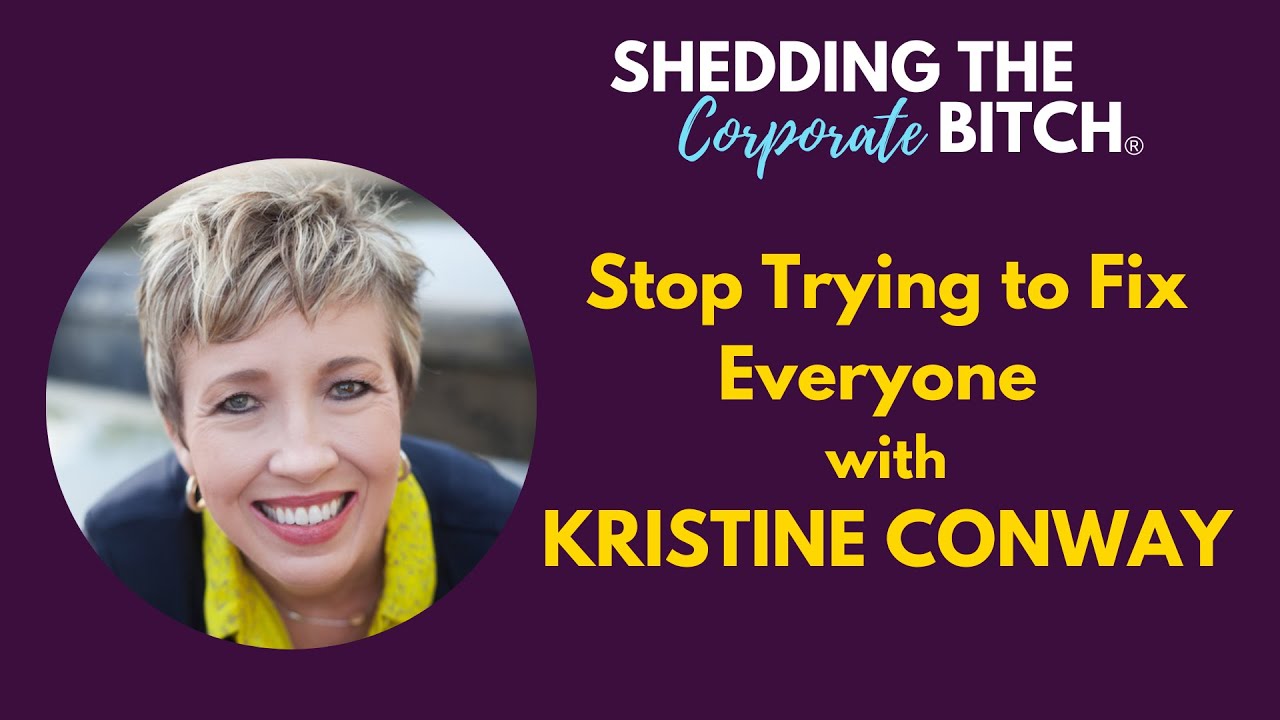
In this episode of the "Shedding the Corporate Bitch" podcast, host Bernadette Boas interviews leadership coach Kristine Conway about the pervasive habit among leaders—especially women in corporate roles—of trying to "fix" others. Conway explains that this fixing habit stems from a sense of responsibility and a desire for control, which often disempowers teams, lowers morale, stifles innovation, and creates a culture of silence. She outlines a practical 90‑to‑180‑day onboarding framework for new leaders that emphasizes sitting with the team, learning individual skill sets, and communicating a transparent plan to prevent whispering and over‑control. The conversation moves into psychological safety, highlighting the importance of leaders listening last, encouraging open dialogue, and measuring soft‑skill outcomes (e.g., ROI of $145,000 saved when a CIO stopped "solutioning" and instead empowered his staff). Conway discusses common resistance to coaching, the role of assessments and 360° feedback, and the necessity of data‑driven measurement for emotional‑intelligence competencies. The interview concludes with Conway introducing her book, Obligated No More: A Journey to a Guilt‑Free Life, and sharing how guilt, especially among women, drains energy and limits decision‑making, urging listeners to practice saying "no" and to live without unnecessary obligation. Throughout, the dialogue is conversational, supportive, and occasionally tough‑loving, offering actionable advice for female executives seeking to shed control, build psychologically safe teams, and lead without guilt.
Chapters
Welcome, welcome, welcome to Shedding the Corporate Bitch, the podcast that transforms female corporate executives into powerhouse leaders by showing them how to shed the challenges and overwhelm along with any fear, insecurity, self-doubt, and negativity holding them back. I'm your host, Bernadette Boas of Ball of Fire Coaching, bringing you powerhouse experts each week to share tips, advice, and sometimes tough love that will allow you to create the riches in your work and life you deserve. So let's do this. I am so excited as I'm talking to Christine Conway all about how many of us well-meaning leaders, parents, and partners are fixated obsessed on solving the problems of others. Could you be that type of person who swoops in to save the day, or have you considered that you could be doing more harm than good by doing so? Christine is going to help us find out if your fixing is the real problem to solve and answer the question many of you ask her is, why aren't I getting the results I expect? Welcome to the show, Christine. How are you?
I'm wonderful. Thank you for having me.
You are so welcome. I'm really excited about talking about this because I really do think too many of us are trying to fix other, other people. But before we get there, I always love to get our guests, you know, acquainted with our listeners and our viewers, or vice versa. And so tell us about you, where you live, what you do as hobbies. Tell us a little bit about Christine.
Okay, so I am— I, I live in North Dallas in Texas, United States, but currently I am logging in to with you in Panama, which links to my hobby. And I love to travel, so I'm in Panama for the month of December and I love doing that, love seeing the world, love experiencing new cultures.
That is fabulous. And you could work anywhere, so Yes, yes, before it was cool.
Yes, before it was cool.
That is so true, that is so true. So moving into the subject of, um, fixing others, uh, was this something you dealt with, or why is this particular subject matter, you know, so, you know, important to you and such a key part of what it is that you do?
Well, it keeps coming up. It's one of those common threads with— regardless of what level of, um, individual that I'm working with, they are frustrated with not getting the results that they want to get. And it's hard for them to see that they're actually the one causing some of that problem because they're coming in and wanting to fix things as they've done in the past, but you've got a team now, and that team has collectively so many more talents than, than you do. And when you come in with the power of being the boss, right, your solution is usually the solution nobody questions. And guess what? You're getting the results based on, on your own solutions most, most of the time. So that is something that really comes up, and I have found that it's really difficult for leaders to give up that control.
Okay, great, because that's exactly what came up for me when you, when you said that. So it is a control issue.
Yeah, yeah.
And where is this control issue coming from?
Well, you know, I think that most of the time it's a sense of responsibility. You know, they want things to go right. They, they know that they're being held accountable for getting the things done, and it's on them ultimately as a, as a leader. However, you know, you've got to be able to trust the team that you've hired or that you've inherited or, you know, that you've been given. And you've got to be able to get to know those talents and those skills, and you've got to let them, let them do something so that you know how, how well they can or cannot perform, right?
So if we looked at a day in the life of a leader and say the person— we'll make it somewhat easier than someone who's been in their position for a while. Say it's a new person coming into their position. And in order to prevent, you know, that over-controlling, what do you recommend to your clients to do, for that leader to do in order to ensure that they're all of a sudden not going to go boop and try to take over? Because I think it has to do part with them predominantly, but also with the team. So what are some ways for someone to do that?
Yeah. So that's really when we talk about assimilating to your new role, right? One of the things that I encourage leaders to do is sit with your team when you first get there. I mean, when you're, when you're a new leader, you've got about 90 to 180 days of grace to where, you know, you can go in and you can actually have these conversations and get to know people, find out what's been, what's been tried, what hasn't been tried, uh, what are the barriers, who, what are the profiles of people. You know, one of the things that I've done in the past is have people show me their resume You know, let me know what you've been doing. And many times leaders don't know what skills their, their team has. And so if you know that, and then you know what's been tried or what barriers have been there, that gives you information and it brings people in and it saves you a lot of time. And it, you know, new leaders, they want to come in, they want to make their mark, they want to do the things right, and it's a little bit slower process, which we don't like. We like fast things, we like easy hits. And getting to know your team is, is, is really the best thing that you could do to help minimize the control. You know, that control gremlin's still going to come out from time to time, but yeah, yeah, yeah.
Well, I have an interesting question for you because, um, I know someone that's confronting this themselves So similar to that scenario you just painted, however, they're sitting back and they are kind of watching and observing and getting to know, you know, the people around them. And this is more getting to know peers and their manager, but they're in a new leadership role and there's some whispering around the fact that, where is she? Like, why is, you know, why isn't she stepping up? Why isn't she speaking up? Why isn't she inserting kind of what her observations are. And she's roughly 4 months in.
Yeah.
And so, you know, when you said the 90 to 180 days, so what would you share with that type of individual and, you know, new leader as far as kind of when is it time to recognize that you do need to start? You know, it's great that you're learning and you're asking questions just like you said.. But then when do you start inserting yourself and kind of making changes?
Or, you know, I think it's a gradual process. I mean, there's going to be small things at the very beginning that can— are easier done, right? You're not going to reorg your first week there, right? Right. Hopefully.
Right. I was just thinking that some people may.
Yeah.
Yeah.
Um, and the other thing is to be transparent with individuals. You know, the whispering, um, if you, if you know that it's happening, or even to prevent it from happening, to be able to talk to people, let them know what your plan is. You know, the first 90 days, here's what I'm doing and here's why.
Yeah, that's great.
That is something a lot of people miss as well, right? Because it's like, oh, it's my secret plan. No, let them know what you're doing, right?
Right. So then there isn't questions or whispers. And it's not that the whispers are bad, but more so what you're saying is, from what I understand, is that they wouldn't even have those whispers had you shared kind of your approach to assimilating onto their team.
Absolutely. Absolutely.
Yeah. Yeah. I like that. I like that a lot.
Okay.
So I kind of diverted a little bit, but, um, so when it comes to fixing and, and, and control, and I certainly know this subject about trying to control everything and everybody. I've let go of that now.
Yeah, you're working, right? We never let go of it completely.
No, we don't. No, we don't. You're right. You're right. But I shed a good part of it. But what are some— what are the impacts to the team members Beyond just the fact that, you know, someone is, you know, I'm trying to think of that word, not parachute. Is it parachute parents?
You know, hovering, hovering, they're hovering, managing and all that. Yeah.
So what, what are the, what are the employees, team members kind of feeling and taking away from that?
Well, when you, when you do that, you're disempowering people. And you are essentially discounting the value that they bring to the team. So there's a lot of morale that can go down. It definitely does not encourage teamwork and, you know, bringing things up, because, you know, why should I bring things up? You know everything that you're going to do. I'm just waiting for orders. And it stifles innovation. I mean, who wants to bring up a new idea when you know, the boss has got all the answers, right?
Right, right. And do you see that the best construct of a leader could be that they do come in just like you said, they kind of talk, listen, ask questions, try to understand the, you know, the skills and the gaps of their team, um, and even kind of, do you advocate being the last person to speak, like allow the team members to have their voice and to kind of get it all out there, uh, whether it's about an issue or about it, like you said, innovation. Yeah, the leader kind of steps in and just says, yeah, that's the point.
Because then you get, you get more data, you know, it's all about data. And the more, the safer environment you provide for employees, for peers, for the organization, the more data you're going to get. I mean, you think about these leaders who are controlling, and, and nobody tells them stuff except what they want to hear, right? So yes, speaking last is a, is a wonderful technique to do because then you don't, you don't get the echo chamber, right?
Right. And you use a great word, safe. So there's a lot of talk about psychological safety. I think that has a lot to do with our subject matter around individuals that try to fix everyone. What is your viewpoint in psychological safety and what is being psychologically safe in a work environment? What does it look like to someone?
To be psychologically safe in an environment, that means that I can speak up and I can ask a question or I can bring something up and I'm not going to be penalized for it. I'm not going to be made fun of. I'm not going to be shut out of meetings and all that stuff that happens, you know, in corporations, which are ridiculous. But I'm going to be, you know, appreciated for that. Even if it's not a great idea, I'm not going to shame you.
Right, right, right. And to the person who— to the leader who takes your advice and they go and they listen and they listen and they ask questions but they're just doing it to kind of check off the list because they're still going to go with what it is that they want to do.
That's the worst thing ever.
What do you say to that? And how do you— how do you— even if they're right, shouldn't their employees be right sometimes?
Yeah, I mean, right is— right is something that we can all get together on. You know, I love that. Yeah, it doesn't have to be my way or their way. I mean, we can all add to the rightness of it. And yeah, yeah.
So a leader should do what they can to take their people's input, even if—
yeah, yeah, yeah. Because sometimes, you know, you can come into an organization, you go, oh, I know what's wrong here. And you might be 60% right, but if you've gone out and you've talked to people and you've gotten their concerns and you bring that into your solution, because it's no longer your assumption, no longer your thing, it's here's what I'm hearing and here's what I'm seeing and here's where I think we should go, let's discuss this, pros and cons. Now that everybody says, no, I don't want to do that. Well, I've gotten all the data, and based on my experience, this is where we should go, and here's what I need you to do to support it.
Right, right. Yes, because silence is buy-in, right? Is that what you're meaning by that? Silence is buy-in. So if you don't disagree or don't raise a voice, then you're pretty much accepting whatever it is that then is passed down to you.
Yeah, and you know, and I'm glad you brought up silence because that's one of the things that if you're getting silence, you're not asking the right questions and something else is going on. So for, from a leader's view, silence needs, it needs to really be translated into, I'm not, they're not safe enough to speak.
Nice, nice. And if you would, because I think it's a great lesson for someone to take away with, because I love those like snippets of, you know, verbiage that someone can walk away with. Your statement about right is something we can all—
we can all— we can all contribute to, you know, we can all be a part of that.
Yeah, I love that. I love that. Right is something we can all contribute to. Christine Conway, make a note of that.
I am—
I love words, so I love these, uh, short statements like that. Uh, okay, so, so when it comes to the person who's, you know, trying to fix everyone, and when they're trying to— what is, what does fixing mean? It's not— is it just the fact that they want their way and they want, you know, their direction, or is it more even about that other person?
Oh, it's, it's about all of it. So I'll give you a, I'll give you an example. So I did an ROI study on a leader. He was a CIO of an organization that implemented certain competencies like asking powerful questions, um, getting to know his employees, listening, you know, these things.. And he was able to come back. He was with me for a year, and he was able to come back and identify that by having people that came to his office for a solution, or showed up on his screen, you know, because we're all virtual, um, they would come and they would, they would, they would ask about things for him to solve. And he started understanding the pattern after he was, you know, really exposed to the content and, and the work of becoming a leader coach. So he started realizing that there was a pattern there. So he started sending them back. He goes, well, you go find out, bring it here, and then let's discuss. And there were some other impacts there. He had peer relations that, that got better. He was able to even save money in infrastructure. He came back, and because he stopped— and I will use his word— solutioning It was over $145,000 impact.
Wow, wow, that's awesome.
So it wasn't just him, it was by him not solutioning, it was allowing, empowering others to think about better things, make better decisions, save money, and then be able to come back. And he was now able to think about strategy.
Right, right. Yeah, absolutely, absolutely. So when I hear someone's trying to fix someone, I'm even kind of getting it more personal about— they don't like the way I do something, so they're asking me to be somebody I'm not because they're not comfortable or they're not aligned to the style that I am.
Like the way you may send emails or the way you address people in meetings, things like that.
Correct. Is that also in this realm of everyone?
Yeah, absolutely. Because when you think of leaders, we— or if you think of humans, let's just say humans— you think of humans, we, we feel that the way that we present to the world is the way to be presented to the world, right?
Yeah, absolutely.
Because why would we do something that was not correct, right?
Right.
So we, we unconsciously— and that's the key, it is unconsciously— we unconsciously want others to act like us because that's acceptable. We know how to deal with that. Then you start, you know, vanilla coating everything because now There's no diversity in that. So if I don't like the way that you're presenting yourself in meetings, I want to talk to you about that and say, okay, so I noticed how you shut down Joe when he brought up XYZ. I'm not sure how that helped us get to the end of the meeting quicker, how we understand, you know. And so that way I'm, I'm staying curious about it. I'm not judging you, right, when you show up.
You know, right, right. I love that. Not judging, you're just asking questions to understand by curiosity why someone behaves the way they behave.
Yeah, because we judge all day long. Yes, all day.
Yeah, it's true. It's very true. It's true. All right, well, I'm gonna have to make a note of that and come back. Um, judge all day long. Um, so you have this individual who is controlling, trying to fix everyone. Do they see that? Like, when you start— when they— how do they even get to you? Because I know for me, when I was— my blind spot was so huge that there, you know, it took boulders to knock it down. Yeah. Um, so how do they kind of recognize that they need Christine?
Well, unfortunately, sometimes they are told that they need to fix something and they need to fix it now, which is my least favorite client. My favorite client is that they have seen things happen. Maybe they've lost a job, maybe they've gotten passed over for promotion. Again. And they're starting to see little things that say, hey, well, maybe it's me, right? Um, there are people— I mean, I work in organizations and I bring in, uh, training for large groups of leaders, and they'll be leaders within the group that think that they don't need this, right? So we do assessments, we do 360s, which, you know, I have a love-hate relationship with that, but sometimes Sometimes it gives them a little bit of data, right, to kind of crack the— kind of, kind of open the door a little bit. And then— and that's another reason that I work with leaders, you know, for a minimum of 6 months, and I do training for a whole year, because it's not an overnight fix. They didn't get that way overnight. Overnight, right?
Yeah.
So, so assessments, um, exercises that we do outside, you know, here This is what I'd like for you to do in this meeting. How do you feel comfortable doing that? Oh, that's going to be terrible. Well, would you try it and see what kind of results you get, right? And get them to look at their results. You know, if, if you're in sales and it's December and you're just now realizing that you're not going to make your mark, well, maybe you should have been talking to your sales team back in April. I'm just thinking that maybe that could have helped you.
Right.
You know, being able to look— and when you get it down to the money, that makes a big difference because that's— that's, uh, people feel that unfortunately more quickly than they feel anything else, right?
Oh, absolutely. Oh, absolutely. So that's funny. Types of people: they're told that they have an issue, um, or they start seeing something. And, um, fortunately I work with a lot of the told um, and seen, because I was that person. So when you do work with the person that is told— yeah, um, even the person that starts seeing it, but they're probably a little bit more interested in learning more— um, is there a wall up? I mean, do you have to deal with a lot of resistance in regards to like, why am I here, and I don't need this, and that kind of thing? And what do you do about it. Because what I want to get across to those listening and watching as well is what is the impact if they don't? That's really what I want to get across.
Yeah. So one of the things that I have learned over the years is that that initial meeting, especially if it's a sponsored situation, right, is that I have that leader, which is usually the CEO, and that client, right, the sponsor-client, me. And we talk about that, and we make sure that everybody's on the same page. That— and when they hear their CEO say, if this behavior doesn't fix, I don't have room for you in my organization, that helps. But if that CEO or that leader is not able to say those things. I could say it all day and it's not going to matter, right? But they've got to be able to see that, right? Um, and even with, you know, given the greater territory or a greater responsibility, this is dependent. You have to have these behaviors changed. And then we, then we work on measurements. So, you know, like right now, how many people come to you and confide in you that they can't do their job or whatever? Well, nobody does. Okay, well, how many deadlines or how many projects have gone south without you knowing about it until it's too late? Ooh, a lot. Okay, now we have two measurements. Yeah, yeah, yeah. So, right.
Okay. All right. That's good. Yeah, but because that must be a hard nut to crack.
It is. And data helps. I mean, the more black and white data you can get them to see the better.
Right, right, right. Okay, and the impact I want— so let's get to the impact, because the impact could be what?
The impact could be that they no longer have a job. The impact could be that they don't get that promotion. Um, you know, sometimes the impact could be that they, they continue to hate their job.
Thank you. Yes. Yes, and they're miserable. They might not want to acknowledge that they're miserable, but they continue to be not fully exploiting their skills and talents.
Is that absolutely—
yeah, I have to admit, so I'm the perfect story for— of getting fired because I was a nasty leader. Yeah. And I just wish— and I don't hold any any animosity. I don't regret anything I do in my life and whatnot. However, that said, had I been told that it was a risk to my ambition and to my goals, let alone to my salary and position and power that I had at the time, um, I was so egotistical and very ambitious that I would have changed. Yeah, there might be sides of me I wouldn't have changed right away. However, I was never told. So, would you also say, would you also say it is critical that the leaders, like you said, a CEO may not want to say something to one of their leaders, but it is absolutely critical that leaders step up and say something. It's not fair to their employee.
Oh, that is the worst thing that you can do to anyone. Um, you know, any relationship, if you want to take it all the way out, is keep something from somebody that could be— that whatever they're doing could be harming their relationship with that individual, their progress through, through something. And we don't like to give feedback. I mean, it's I mean, we'll talk about people in the hallways and do the whisper. Oh, and hey, let's do a reorg so we can get rid of the last 10% of people who aren't worth it. No, well, why don't we talk to them?
Right, right.
You know, it's hard.
Yeah, it is hard. And I want to get to that. But do you see anything changing as a result of so much conversation and so much work being done in not all corporations, but in corporations around emotional intelligence, around communications, around servant leadership. Have you seen kind of a shifting to where, you know, conflict management is a top, you know, training conversation?
Well, I've seen it be more acceptable, and I've heard the words more. But the actions are still not following the words. You know, we've got people that really get it, right? Because that's one of the things that I— foundational pieces is emotional intelligence, because I think, I believe that leaders have to get a grip on that, and they have to have a grip on change management because they— I mean, oh my gosh, leaders change. They're directing and impacting change all day long, right?
All day long.
And so to have that emotional intelligence and to be self-regulated in such a way that allows you to stay in conflict long enough to come in with a good solution— those are the great leaders. And it's, it's one of those things that has to be modeled by the top. It has to be modeled, and it has to be rewarded.
Acknowledged, right? Would you say it has to be also measured before it can be rewarded? Should they also be tasking goals and measurements to their leaders to then be able to—
yeah, I'm, I'm big on measurement because, you know, I, I walk into organizations and, you know, coaching has a reputation that's kind of scattered, right? And it's— you have to be able to measure. So if you think about self-regulation, for instance, you know, it's one of the big ones with, with emotional intelligence. How many times have you left a— how many times have you left a meeting, you know, throwing your hands onto the table and slamming the door? Well, in the last 6 months, probably 7. Okay, that's measurement. How many people quit on you, right? You know, how many times have you dominated a conversation and, and everybody was silent? Well, like, that's like every meeting. All right, well, that's measurement, right? So being able to do that, and, and it takes a while for people to see that because they think of measurement as something like you can like a dollar or a, a widget, right? But it's experiences that you can count. Because if you, if you make me feel like an incompetent person because the way that you treat me and you couldn't regulate yourself well enough in this meeting, I'm costing you money. Because when I leave that meeting, I'm not getting right to work.
Right.
I'm probably going to take the rest of the day off or I'm going to do something else and it's not going to be something to help move this project along.
Right. So soft skills can be measured as much as hard skills can. And stop using the excuse, leaders, that they can't do it. Because don't you— do you find that many leaders use it as an excuse not to define goals and measurements because they just don't want to see?
Well, They don't want to do that, and they don't, they don't want to have that hard conversation of, dude, you're just not nice, and here's why. You know, you don't self-regulate, you, you don't show any empathy, and here's what those words mean, right? I mean, right, gotta have conversations.
Yeah, I love it, love it, I love it. Okay, I want to take you into a different subject. Of which your book centers on. Okay. And that is around how to live guilt-free. So, and I'll, as you start talking and I, after I ask you a question, I'll bring that or tell us the title of your book, if you would.
Yes. So it's Obligated No More: A Journey to a Guilt-Free Life. And I wrote that several years ago. Because of some of the themes that I was seeing with clients as well as with myself. There's a lot of, uh, self-discovery in that book. And we, we get trapped, especially women. I mean, men do too, but I hear it more from women. They're more vocal about that, is that, you know, they have to do this, they have to do that, and Everything is a choice. They're, you know, our socialization, our upbringing, you know, because our moms did this, or, you know, society expects us to do that. We feel kind of guilty when we don't volunteer at PTA, but you know what, they'll accept a check too, right?
Right.
And, and there's that guilt feel— feeling that, that just drains us. I mean, it's one of those energy-draining emotions that we feel. And most— like, I want to, you know, this is not evidence-based, but I feel that it's about 90% of the time when we feel guilt, it's because somebody else is pushing that onto us, and it's not anything for us to be— feel— to feel guilty about.
Right, right, right. Just because it was done yesterday doesn't mean it has to be done today and that you have to be the one to do it.
Yeah. And I can say no, right?
No. Yeah.
No, I can't do that for you. No, I can't take on that project. No.
Right.
It's a really simple word, but very hard to say.
Yeah. And I want to mention to everyone
More from Bernadette



From Stuck to Leading, Episode 2 — Meet the 5 Inner Fears Destroying Your Leadership



