Tapping Your LeadershipFlow with Croft Edwards
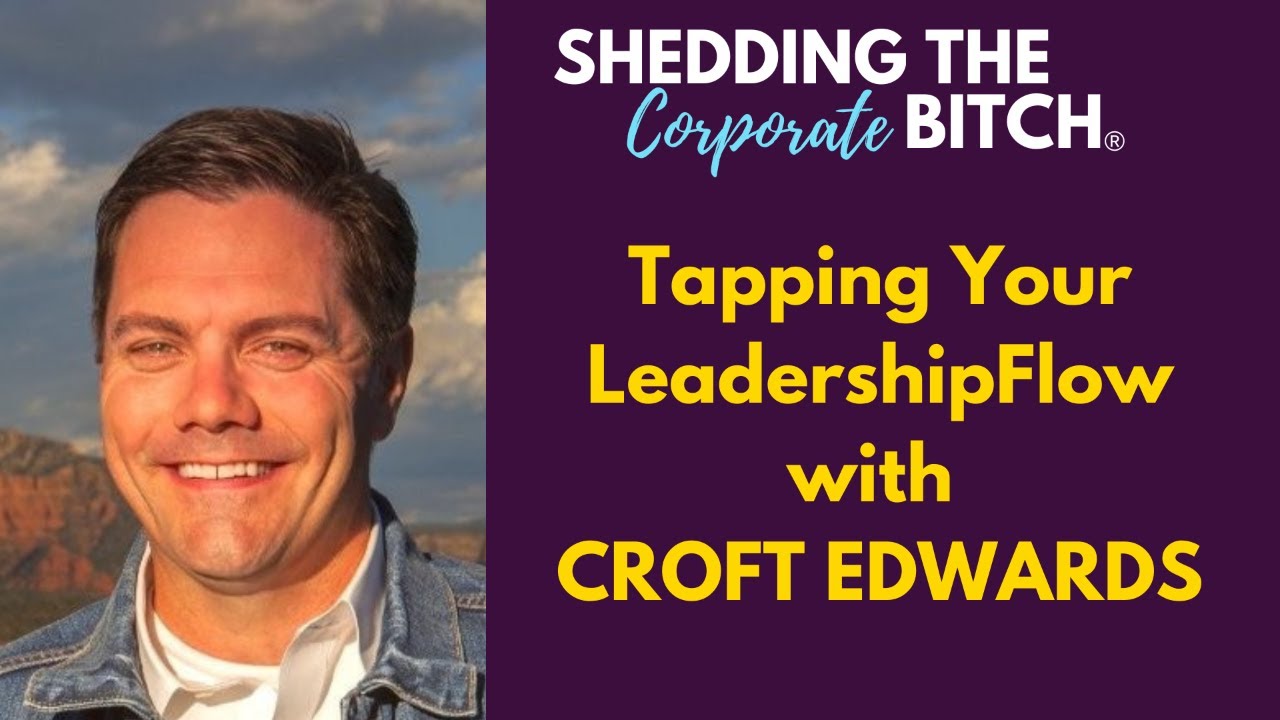
Leadership coach Croft Edwards describes his Leadership Flow methodology, where leaders enter a zone of peak performance through self-mastery, embodied listening, and vulnerability. He emphasizes practice through regular Leadership Flow Dojos and argues face-to-face interaction is essential for building trust, drawing parallels to how the Army develops leaders systematically.
Chapters
Welcome, welcome, welcome to Shedding the Corporate Bitch, the podcast to help you transform into a powerhouse leader by shedding the challenge and overwhelm along with your fear, insecurity, self-doubt, and negativity holding you back from creating riches in your work and life. My name is Bernadette Boas of Ball of Fire Coaching, and today my guest will answer this powerful question about leadership. If flow is the state of ultimate human performance and leadership flow is the state of ultimate performance as a leader, how do we as leaders tap into our leadership flow to become our best and bring out the best in others? My guest today is Croft Edwards of Croft and Company, Inc. Please help me welcome Croft. How are you?
I am great, Bernadette. Great to be here.
I am thrilled to talk to you about this, and I got very intrigued and pulled into the whole conversation when it came— I kept reading things about you and about your book, which we'll talk about as well, and I kept seeing this leadership flow as one word, um, and I was very intrigued by that. So can you help us understand what is that, and then What does it mean to you and the work that you do with your clients?
Yeah. So if I go back to kind of the genesis of this, I've always been interested in this subject of what is leadership and, and how do people— why are some people effective leaders, others aren't? And as I was rebranding my company, my branding partner, this brilliant lady, helped me with this. And one of the things is we started to kind of dive into this, she said, you're a flow junkie. And what she meant by it was I was somebody— I do a lot of woodworking at the time, I ran a lot of marathons, and I'm one of those people that really, I wanted to find my, my flow. And as I started looking into it, I realized what she was saying was when, when I was at my best, when I was just doing what I'm doing, when I was so absorbed into something, that's when I produced my best work. And then started to explore that idea of leadership and flow. And then I realized, or my assessment was, is that as a leader, if I bring out the best of my team, then collectively we're going to bring the best out of the organization. So how do I do that? And then that became my methodology and that became how I started to look at it and explore it. And here we are today.
Wow. Wow. And Would you say that there is a lack of flow? So where is the disconnect that you feel that— and I guess we can call them leaders, but I would think true leaders are in their flow. So if they don't have leadership flow, what's missing?
Well, the biggest thing when I look at my methodology, I think the biggest challenge we have as leaders is ourselves. So how do I get me out of the way so that I can show up to the people on my team as an offer to say, let's have a bigger conversation, let's, let's produce bigger results. But to do that, I can't get triggered by my team. I can't get in a place where I'm frustrated with them and then I show up, I'm chewing their tails because I'm unhappy or whatever the case may be. I've got to be in my best so that I can bring out the best in them. And then that's the practice of how do I create a place where people are finding flow themselves? They're wanting to show up, they're wanting to do their best work. And then my role is to help facilitate that.
Right, right, right. And what, what might they be saying to you to give you indications, even to give them indications that something they're doing or not doing is not working, and therefore they need this type of methodology?
Well, so, you know, you say, what are they saying? Well, actually, it's the way I look at it. I— my, my background is as an ontological coach, and ontology is the study of being human. So when, when somebody says something to me as an ontological coach, yes, there's the linguistic aspect of it. They said X, but there's two other components which I'm actually listening for. One is the emotional state in which they said X, whatever it is. And two, what is the body they're in in that moment? So if I say I will, and the mood that comes out is frustration and my body says I will, but I'm going to do it begrudgingly, that's not likely going to be them bringing out their best. So how do we, how do we start to listen differently as leaders? Because I can't tell you how many times I'll see a leader, you know, they'll come in and they'll, they'll break their organization and then everybody says, yes, we'll do it. But they do it in a mood of, for instance, resignation. And the leader thinks, OK, now I've got it. We're going to do this. We're going to accomplish it. But what they didn't hear was the resignation in the people's voices. They didn't see the resignation in the body. So their listening was not complete. And in most organizations, moods and emotions are really kind of taboo unless they're those good emotions where you show up and you do good work. But if you think about it, if I'm completely pissed off or frustrated with something, the good news is I have to actually care about something to be frustrated about it. So generally, if I'm frustrated at work, what it means is I care about doing something. But for whatever reason, I can't get it accomplished. So as a leader, how do I help that person turn the frustration into more of a curiosity, more of a playfulness, or whatever the case may be, so that they can actually start to produce the results? So we look at moods and emotions. And then, and then the bodies— in most organizations, people are completely completely, uh, blind to the body. Uh, we're— we kind of—
you mean the physical body?
Literally the physical body, right? Oh, go ahead.
No, that's what I was going to ask. Is it the physical body?
Yeah. So, so the, the idea in a lot of organizations is we're brains on a stick. And so the body is this device that who— the Creator created so we could get from meeting to meeting. But the, the body is actually the domain of action, right? Every action we take as human beings involves our body. So thinking involves our body. Well, if you just follow that idea, the brain is part of a limbic system. And guess where all of the sensors for the brain are? They're the body. The eyes, the mouth, the hands, the heart, the genitals, whatever it is, that's where we get are information that the brain then processes. Well, if I'm disconnected from my body, I'm very cerebral. I've got stories, I have logic, all those things. But the emotional component, the body's missing. And then as a leader, if I can't see that, I'm missing such a huge part of the conversation.
Right, right. And how would you say this virtual world we live in now, and, and just even this Zoom environment that we live in, how has that affected even more so whether or not a leader is really good at reading and understanding and using the body as much as the listening in order to support their team members?
So I'll, I'll talk out of both sides of my mouth here.
Right.
The reality is, whether good or bad, Zoom-type platforms are becoming more common. But the flip side is, I think actually Zoom is— there's a lot of limitations on it for many reasons. You know, for instance, one of the things is people sit in Zoom, we tend to fixate on ourselves. There's research saying that the audio and the visual aren't always synced up. And so what happens is our brain is hearing things and it's a millionth of a second off, but the brain's going, I got to spend all this energy getting this to work and blah blah blah. So it doesn't work. And at the end of the day, human beings are designed to be intimate. We're designed to be in close quarters. We're designed to work together. We're community beings. So I say that both my wife and I work remotely, but it's— there's a lot of limitations to it. And so you can't get past the need to know somebody. And so if you're going to build a high-performing team, you can do it on Zoom, but there's got to be a lot of face-to-face because it's the conversations between the meetings, the conversations during the meetings where you and I are sitting off the side looking at each other. And where I can sit as a leader and I can see my whole team. Whereas Zoom, we feel kind of like robots and I have to sit here for an hour and I'm just going to act like I care. And it's really hard when I do some— sometimes when I'm doing really transformational coaching, I'll— I actually, my preferred method is the phone because what it allows me to do over face-to-face, I'd rather do face-to-face. But if I can, I'd rather do phone than Zoom because on the phone, I can get in my body.
Yes.
And so I do, right? I do a lot of listening with my body. And so sometimes I go, you know what, I need to, I need to, I need to get up and move, or— right. Whereas it feels more formal, like you're sitting in front of the principal on Zoom. So I actually think, uh, I don't think— I think people are going to be sold a bill of goods thinking, oh, this, this remote stuff is perfect. It isn't. I think there's limitations, and I think what's going to become a competitive advantage are the teams that get back together so that we can be humans again.
Sure. Or at least, do you work with your clients to— if they aren't going to get to get back together again full time, do you help them at least create a hybrid type of, you know, program or approach to where Yes, some are, some are remote, some are maybe in the office. It's not full-time, it's part-time. It's at least we get face-to-face once a month or once a quarter. Do you work in support?
Not, not so much what I do. I do a fair amount of facilitation. I do very little Zoom-type events. If I do, it's like an hour here, an hour there. I do almost all of my actual— when I do cultural interventions, it's on the ground, face-to-face with people in the same room. It can work. It's just, I think my assessment is people have developed a little bit of an overreliance on it. But, you know, I'm a coach, so I have clients all over the U.S., all over the world. And I obviously couldn't do it without technology.
Right.
But I do— if you give me the choice, Would I rather be on Zoom? Would I rather be on the phone? I'd rather actually be on the phone because what it does is it shuts my eyes off and I listen with my body more. It's true. At least my assessment. And I just am more connected with people. I, I think that way. But, uh, don't get me wrong, Zoom has its place and, and a lot of— there's a lot of value. You and I are having a great conversation because of Zoom. Where I think it really starts to lose the value is when you get multiple people on the screen. One-on-one, I don't think it's as bad of a— I think it's, it's actually fairly adaptable one-on-one.
Right, right, right. But I would assume some of your corporate clients or your clients are struggling with how to make these interactions amongst their team members as effective as possible when we have this kind of remote, in-office, maybe even hybrid type of environment. How do we get that leadership flow, which I—
well, and then that's where it's, it's even more critical that we have leaders who have the awareness, both somatically in the body and emotionally. So they're not just listening for the words. They're actually listening to the story. They're listening to the body behind the words.
That's what's the biggest struggle, getting them there, getting them to really actively listening and paying attention from the body perspective, what, what's the biggest challenges you work with, with your clients?
So I think the biggest challenge is people think they can go to a weekend-long event or a 2-day event and then all of a sudden they have the skill. I'm a huge proponent of practice. And so give an example. One of my clients right now, we're doing a leadership, a deep leadership intervention. And so we do what's called the Leadership Flow Dojo one day a month. And I'm on the ground and in the room with the people. And we really focus on how do we start to have these conversations. But most importantly, we practice them. Right. Because if you think about it, whatever— I'm 53 years old. If I have been having conversations, I've been practicing them a certain way this whole time. And if I need a new skill, I have to learn a new practice. So it'd be like, okay, I want you to be good at golf. I'm going to send you to a one-day course with a golf pro, and then I expect you to play in a tournament next week. Right? Right.
Yeah.
Leadership can be practiced. Conversations can be practiced. And the organizations that I've seen that are good at it, they practice it on a regular basis.
Yeah, I love that. I love that. So when you say practice as well, Are you putting them through kind of structured exercises? Are you using situations they're dealing with right then and there? What can they be thinking about as leaders listening and watching us today to really consider what can they incorporate into their, you know, weekly, monthly practice?
Well, so first of all, we have to have— whenever we're learning something new, we have to have the distinctions. Okay, so if I'm a woodworker, so if I was to take you out to my woodshop and you had never seen any woodworking tools, you wouldn't have any ability to utilize my woodshop right now. But I could give you the distinctions and say, this is a table saw, this is a this, this is that, whatever it is. But just because you have the distinction, you don't have the actual embodied practice. So you have to embody— when we actually learn something, we embody it, right? So I have teenage daughters that I'm teaching to drive right now, and I can sit there and say, oh, you know, my daughter— we have a 5-speed, and my one daughter is struggling with the clutch. And for me, I can say, no, just feather the clutch, lightly let it out. But she doesn't have that embodied phenomenon yet. She can't actually do it. Because she hasn't practiced it enough. So we've got to actually practice whatever it is. And leadership— here's the beautiful thing— leadership is a practice, but most organizations don't actually practice it. They do a lot of on-the-job stuff. I've always said if somebody was to say, here's a blank check, you get to go do whatever you want to do to develop leaders in an organization, I would say, okay, here's my— where I'm going to start. Is the senior leadership team. And I'm going to put them through the dojos, and we're going to keep practicing and practicing. And as they get better at it, they're going to start teaching the dojos. They're going to actually start leading leadership or teaching that, because if they can't teach it, it means they aren't embodied with it. So if, for instance, I've been brought in and, hey, our our junior leaders aren't holding people accountable. Well, I know where they're learning that. They're learning it from you. Because if you're not holding them accountable, they don't know how to do it. So if you want them to be accountable, you've got to start holding them accountable, right? Which is a skill, which is a practice, which they don't do. So a lot of times, um, I— the— my one client right now is absolutely my favorite client in some respects of all time because the owner of the company is very much a student of this same discourse that I've— my background is in, and she is the primary practicer in the organization. So I get to then come in with these distinctions, and, and she's been practicing it for 5 years herself, and so we're starting to have these new conversations And she'll, you know, none of us is truly masters. We're always beginning. But it becomes like a dojo for martial arts where in a traditional dojo, the white belts show up and they're on the mat with the black belts and the brown belts and the blue belts and all the different belts. And everybody's practicing the same thing. But the difference is, as a white belt, as a beginner, I'm just learning the basic moves. But the black belt, which— who has done this hundreds and thousands of times, is learning how to teach the basic moves. And it's through the practice that they're learning the new distinctions. Back to that idea of embodied distinctions. So I can't do something until I can actually feel it in my body. So if I want to have conversations around emotions in my organization, I'm going to have to practice that. Right, right. What happens is when I start learning how to do that, I don't practice it good or well. So what happens is then I look bad, and so I go, I'm not going to do that, I'll just, uh, uh, yeah, no, I've gotta, I gotta be vulnerable, I gotta learn to practice. And the more I practice, now I can open up bigger conversations.
Yeah, so I love it.
It's all— so back to your original question. I think that the limitation is practice. We think that, oh, I should be good at something. You know, you see this all the time, people going to the gym and 2 weeks later they quit going to the gym because they go, I'm not seeing any progress. Well, no.
Right, right.
You're not going to see it after 2 weeks. It's going to be weeks, months, years. And if you see somebody who's an elite performer in any field, the one thing I can tell you is they've been practicing a lot.
Yeah, well, it's almost like, it's almost like that analogy. Well, the, this, the story that goes around in regards to Einstein taking 9,000 times the attempts to make a light bulb.
Edison. Yes. Yeah.
Or I'm sorry, Edison. I'm sorry, Edison. Thank you. And, you know, so it takes repetition. It takes, you know, that practicing. But you brought up an interesting word that I think too gets kind of washed over and not focused on a lot. And it, it's so imperative, I would expect, in the work that you do, and that is vulnerability. So you had, you had made the comments they have to be vulnerable. And how do you get leaders, you know, to, to be that? Because like you said even earlier, moods and emotions and all that touchy-feely, that's, you know, typically not— that's taboo, you know, in the workplace oftentimes. So how do you get leaders to be vulnerable so they do kind of tap into what it is that's keeping them from leadership flow?
So the place I've started is I start by saying we're going to have some conversations. And we're going to start talking about the things that we don't know how to talk about, we don't talk about. The other place that I really go the most is get people in their bodies. So, because the body cannot lie, right? It takes a very, very good actor to cause the body to lie. But when that person embodies something, they're actually thinking that way, right? So Tom Hanks is a brilliant actor, Meryl Streep's brilliant actress. But when they become that character, they embody that character. So what we do to start to get people to be vulnerable is, well, we start by being in a room. We take out all the chairs and we get in our bodies. So a simple example is, let's say you and I are in the room. I'll have people walk in the room and then I'll say, find a partner and pair up. And just stand face to face with that partner. Now, you'd think that's a pretty simple thing to do in theory, but you want to see people's bodies betray them, have them do that, right? And what things will happen, like for instance, they'll turn their body, they won't look at the person, their eyes can't connect. I've had people leave the room, I've had people The moment they start to do this, the— they get very emotional, tears start coming. Well, let's say you and I are doing it and I've got tears coming, I'm crying. That's going to have a— some sort of response in you based on the observer you are.
Sure.
So here's Croft being vulnerable, and let's say people seeing a man cry makes you uncomfortable. All of a sudden, my behaviors are affecting your behaviors. And so it's that practice of— and, and so we do this, and then I'll say, okay, now walk and center in the room again. Now find a new partner and do it again. And here we are 3 minutes later doing the exact same thing, but the person across from me now I have a different emotional reaction to.
Yeah, yeah.
So the body, the body— I make the statement the body is the Holy Grail of leadership. Because I, I can only have the conversations that my body will allow me to have. So if we're going to be very intimate and open and talk about something like trust, but my body is uncomfortable there, people will know that. So you've probably seen this where a leader will say something like, I don't know why nobody comes to my office. I have an open door.
Okay, sure.
Yes, I know why they don't come to your office, because your door's open physically, yes, but you're not an open conversation. Yeah, so if you want an open conversation, I have— if you think about an open conversation, that means we can talk about whatever you want to talk about, including let's say you think I'm a jerk. Let's have that conversation.
Right, right.
And that's what I love when we start to get there, because what will happen— one of my mentors is known for kind of being a jerk to a group of people when he starts his facilitation, and he's doing it very purposefully because eventually somebody will say, you know what, fuck you. And his response is, ah, now we can have a conversation.
Oh, so he does it intentionally. Yeah, for that type of—
because what happens, somebody will finally say what they actually think, and his response is, great, now let's have the conversation that we've been avoiding for the last 25 minutes.
Right, right.
And the term he used— and my mentor is a man named Fernando Flores. I've never actually been in the room with him, but I'm greatly influenced by him. But the term he uses is cordial hypocrisy. And cordial hypocrisy happens in organizations where you you and I are sitting across from a table from one another. You think I'm a jerk. I think you're a jerk. And we both smile and, oh yeah, how are you today? Yeah, right. That's what's actually stopping us from being vulnerable and have a conversation. Because if I think you're a jerk, my practice is say, Bernadette, I want to have a conversation because actually the behaviors you're doing are affecting me this way. And I want to have us, us to have a conversation. That makes us have, or creates a space for us to have a bigger conversation. But I can't do that if I get uncomfortable with that, right?
Right.
So it's the mastery of myself so that I can say, hey Bernadette, let's have a bigger conversation. And to do that means we may have to get— we may have some difficult conversations. It may be uncomfortable. And I'm willing to try it if you are.
It's true. Yep, it's true.
That's how we start back to the idea of leadership flow. See, if we can't have these conversations, if you think I'm a jerk and we don't talk about it and I don't create a space for us to have that conversation, we can't create a higher performing team.
Right, right. Absolutely. Absolutely. Now, you mentioned a couple of times That Leadership Flow is a methodology. Is it, is it, is there any particular structure that, you know, you can share with our listeners and viewers in regards to exactly what that looks like?
Yeah. So as I started, when I went back and I started kind of exploring what does Croft think and what's my methodology, and I started this idea of flow. I realized there was 4 things that I said at a lot of clients. And the first was, the organizational culture you have is 100% perfect to get the results you're currently getting. So if you want these results, just keep acting how you show up. But if not, you're gonna have to shift the culture. And you're gonna have to do that very specifically about what you want. So, so the first place is, The first part of the methodology is creating culture and expanding capacity. So we have to create the container for this to happen.
Right.
The second thing I always said was the most important role of a leader is to build or to have a clear vision of the future and to build other leaders to create that future. Well, that turned into visioning the future. We have to have a clear— not a, not a mission statement of we make X. But how do we actually want to show up?
Right. Yeah, I love it.
And then to do that, I have to have other leaders and teams who are aligned with that, who have the same way, you know, that we're all in this together. We have that bigger team commitment. And then in its core, I've always said the most difficult person you'll ever have to lead is yourself. And so at the core of leadership flow is self-mastery. My practice Croft is getting me out of the way. I've got to continually learn. I've got to continue to explore my body. So for instance, I've got to explore language. So, uh, I've recently started to become more and more into yoga, uh, for a couple reasons. One was I used to be a runner a lot, and I'm just not enjoying running as much. But I also— my practice now, my edge in practice is in yoga, and I'm learning things about my body. I'm learning that, okay, There are certain things I can't do in my body. So if I want to get better, I'm going to practice. So at its core, Leadership Flow is about self-mastery so I can get myself out of the way to have the conversations I need to have with others.
Now, say you create this culture and that foundation, you're— you work on the visioning. And then the third part, if I— correct me if I'm wrong, is, you know, ensuring that all the people within it kind of, you know, are grounded in that. What happens— what happens when that third element is very fractured in that you don't necessarily have all the team members that you need on board, bought in, supporting what it is?
Well, if it's happening and I'm not having the conversations then I'm actually the issue. If it's happening, and there are, let's say there are people who don't buy in, then the conversation I actually need to have is, do you want to be a part of this team? But see, I have to be comfortable to go to people and say, hey, you may not be a fit for this team. And high-performing teams, there, there are conversations that high-performing teams have that others don't. And one of them is, are you committed to what we're committed to as a team?
Yeah.
And if not, the conversation we have to have is if you can't commit to this, then we need to find somebody who can and we need to get you down a path that's gonna better serve you.
Yeah. Now, is there one or more of those four? What, what do you refer to them as, Croft? Are they stages of leadership?
No, it's not so much stages. It's, it's just the different aspects. Or the domains or the distinctions in Leadership Flow. You could say the columns or the foundational principles, so to speak.
Right. And do you find one to be more— you have to go deeper, one more, you know, heavy and involved than another? Or can they all be pretty weighted?
At the end of the day, it's always self-mastery. Right. So the senior leader of an organization determines. Right. So a distinction we use in our discourse, the distinction of politics is politics is the conversations about who gets to have which and what conversations. So the leader says, here's the conversation we're going to have effectively, ineffectively, or going to be missing. So if the leader doesn't have those conversations, that's the breakdown. Yeah. Now, if you look like Good to Great and Built to Last by Jim Collins, they said great organizations have Level 5 leaders. They don't have the heroic leader where I'm in charge always. I actually agree with that. But it takes a leader that's so good at conversations that they don't have to have their ego involved and they don't have to be the, you know, the one leader. So there are leaders in our world that we know of in organizations because they're always out front and they're always talking about them, them, them. Great organizations, you don't really know who the leader is.
Yeah, I love that.
But, but in that organization, those leaders are very good at having conversations.
Right.
So it's always the self-mastery piece. As a leader, my biggest challenge is me. There's no way around it because if I want the organization to go a certain direction, I do it. So the analogy I used to use is Give me an organization and put Mother Teresa in charge of it, and the next day fire her and put George Patton in charge of it. They're going to be different organizations because each one's going to have different conversations. Not getting into politics, but we've had in the last two presidents two very different conversations, right? Very different directions. And I would offer part of the breakdown is we don't actually have a shared outcome. Because we're so divided. One side wants to go this way, one side wants to go the other way. And so we have to be real that at some point either we have to find a third conversation where we're all together, or one of the two conversations will win out. Um, and, and I'm not getting into the politics of that, but, but you have to have, uh, the ability to have those conversations. And whatever the conversation the leader has Right. Those are the conversations we'll have effectively, ineffectively, or we'll be missing.
Well, because yes, we don't want to get into necessarily how that relates specifically to politics, but that is a typical scenario, don't you find, in, in businesses is there may be one, you know, who kind of disagrees and is disenfranchised against where the direction and the, the, the vision is for the company. And therefore there is these breakdowns and there, and if the conversation can be changed, there could be some reconciliation.
And many times those conversations are hidden. So it is kind of guerrilla warfare. You and I are having a conversation. We don't like the boss. And so we're over here. And, and that goes back to the cordial hypocrisy is if we want to have— we got to have the actual conversation. If you don't trust me, we're going to actually have to have the conversation.
Right.
Right. And any, any type of organization that there's healthy Conversations is because we've actually had the conversations. We can't just go, yeah, we're not going to talk about that. And I've been in organizations where we don't talk about that.
Right, right. Sure.
We're limited on what we can actually do in this organization.
Yeah. And do you find that's pretty much because they haven't practiced or mastered dealing with conflict, having difficult conversations, really actively communicating and listening and understanding?
Yeah, I would say that. And in some— now they have practiced having conversations, but the conversations are ineffective. Yeah, right. But then they keep— yeah, so they keep practicing that, and they're good at that. So that's why if we're going to actually create a higher performance organization, one of the fundamental things we're gonna have to do is practice. We've got to practice how we want to have conversations. My background's the Army, and one of the things the Army does very well— I tell people, if you go out and you say, here is an Army lieutenant colonel, I can, with a few questions, I can tell you every school they've been to, what roles they've had, how they will tend to act as a leader. And the reason I can say that is the Army is very clear on here's what we want people to look like. So an Army general I can tell you a lot of how they're going to react. Now, I'm not saying that the Army's way is the perfect way as far as what conversations they have. But I am saying they're very good at creating leaders that can be replicated. And as evidenced by 200+ years of names like Eisenhower, Grant, Sherman, you know, Colin Powell, Schwarzkopf, George Patton, all of them followed a similar path to develop how they think and act as a leader.
Right.
And it's an institution. I go back to the idea of the lieutenant colonel, a typical Army lieutenant colonel in a 20-year career. If you throw in college and/or the military academy, out of 24 years, they're going to spend 7 or 8 years in school learning how to be a leader. And at each level they learn. So when I became— when I was a cadet, I learned, here's the basics, how to read a map, how to walk, Then I became a second lieutenant. Here's how you do this. And then I went off and I practiced it. And then I came and became a captain and learned how to do it on a bigger scale, and then a major in a bigger scale. And it's always practicing those skills. That's how you create leaders. And again, I'm not saying the Army does it perfectly, but what I do well is they have a structured process of developing leaders and at every level of the learning, one of the key teachers is the more senior leaders. So when you get— the Army has pre-command courses for future commanders, and inevitably every one of those courses you have senior leaders in the Army coming saying, this is what I want from you. These are the behaviors. This is where we want you to learn. And that's right now as an organization, that's how you develop high-performing leaders, you have to practice, right, having those conversations.
So it goes back to what you said earlier about almost like train the trainer.
So they—
the leader gets trained and they practice to then be able to train and practice their people, and then those people train and practice down. And it's— yeah, I love that.
And that's why I think the most important role for a CEO, if you really want to create a future in the organization, A senior leader has to say, how am I going to create the next future, the next generation of leaders? Right. And I have to be a part of it. Yeah. Yeah.
How often do you have leaders asking that question?
They don't. Most it's how do I get this quarter's profits, you know, and that's a whole nother conversation we get into. So it takes a mindset. But again, I go back to the Army because of my history there, but they have a history of a school system this develop leaders continually. Yeah. At the Command and General Staff College at Fort Leavenworth, where every major goes through, when you go on the wall, what's so interesting is you see like some of the honor graduates, right? Their names, you know, because of their place in history. So they went through that school and they— oh, there's that name on the plaque. And oh, wow, I know that general from over here. And, and it's names like Patton and Eisenhower. David Petraeus and places like that, they all went through that program to develop leaders because we practice having those conversations.
Yeah, I love that because, you know, I see it as reinforcement and sustainability, but I love how I love how it's almost kind of that legacy passing down and developing the leader you want in the future.
And I can't develop a leader who is— if I want them to do something, I have to be able to do it myself to teach them how to do it.
Yeah, right.
And if I want, for instance, we want to talk about emotions, I've got to be able to talk about emotions.
Yeah, yeah.
I can't abdicate that and have a trainer come in and, hey, we're talking about emotions, but you, the senior leader, aren't.
It won't work. Right, right. And that happens a lot.
In my assessment, it does. Yeah. Well, and by evidence, there's very few elite performing organizations.
Yeah.
But there is research that says that there is a correlation between the amount of money or capital invested in training and development and the return on investment with your organization. Yeah.
Oh, sure. I bet. I bet. Would you have any on the top of your head? Would you have any examples of those elite high-performing companies?
I used to be. I don't— I, I do know it used to be. I remember the name Pfizer was on there. Um, I know like in Good to Great, Collins talks about, uh, a lot of those organizations spend that. Uh, back in the day, uh, my wife used to work at GE, so I know a fair amount of GE. And GE, for instance, when they rolled out Lean Six Sigma, uh, they spent the first year, they spent $225 million on starting to teach their leaders this.
Wow.
So they were sending leaders of, of GE to University of Michigan for a year at a time. And I know people that went to Japan to learn lean manufacturing, and GE was paying them for the year, year and a half they were in Japan learning this. So it's a commitment to learning. We teach, you know, we teach people that work on a simple machine. We send them to class. But the one thing we very rarely do is send leaders to classes about how to have effective conversations.
I agree. I—
that's a— yeah, it should be. That should be priority number one.
Right. I can't disagree with you at all. At all. So could you share with us some information or some tidbits in regards to your book? Perfectly Square. I love that.
Well, that was— so when I wrote the book, I got— I've got to write something I know. I'm a woodworker and it's a narrative story. I designed it to be a 2-hour read. It's a quick story. It's fun. It's set in a woodworking supply store that was called Perfectly Square. And I got that— my dad taught me to do woodworking and he'd always just say, you know, you got to make that perfectly square. And I learned. But, you know, it's one of those simple things. But everything I build now, I'm always aware of, if the foundation isn't square, the entire project won't be square, right? So, so then it's just a— it basically is an unfolding of the methodology through a story. And how do you start to create the organization you want to create? Uh, it's the, the subtitle is Learning to Lead and Transforming a Company. And so it's about that. And so basically my, my methodology wrapped up in a in a 2-hour read.
That's awesome. And, and those type of— forgive me, I'll call it a fable— but those type of stories is, are so much, uh, easier to digest and to kind of instill than if it was a how-to type of, of book. You know, when it's kind of painted in, in a real life scenario, or at least a made-up scenario that someone can apply to their real life. Yeah, yeah, that's, that's been the feedback.
People said they liked the story, which kept them. And I tried to write each chapter just enough that they go, and at the end there's enough to go, okay, I want to see what happens in the next chapter.
Right. So, right.
It's, you know, I wouldn't say it's, you know, it's not the most dramatic book ever written, but the story holds up and it's, it's a good, good read that, you know, and I've gotten a lot of feedback that, you know what, it was— I didn't feel like I had to read a 300-page book on leadership that I just found Exactly.
So, and could, could a team, you know, could a team take it and kind of extract out where, you know, your methodology appears and kind of work on asking themselves questions around, do we, are we cultivating a culture, you know, which stands by our X, Y, and Z? And are we creating that vision and having that, those team members committed and Yeah.
Yes and no. They could start. But the flip side is it would take leaders that have been practicing the Distinctions. So the book makes it seem easy. But the challenge is in a 2-hour book, I can't show you how much practice is involved. Right. So I've been literally— yeah, I've been literally studying this discourse, you know, coaching in the body for almost 20 years. And I've been studying leadership for 40 years, and I don't mean that as like give up. But one of my teachers, Julio Alaya, who's a profound teacher on this, somebody said to him one time, oh, Julio, I'd love to do what you do. And he said, ah, it's very simple. You simply have the same conversation every day for 30 years. Right. And so if you want to build a high-performing company, it's very simple. You got to start practicing every day for 30 years.
Right.
So we can get there.. But the flip side is how do elite performers do that? They practice.
Yes. And that, that's what I'm taking away from this, Croft. And would you want our listeners and viewers taking away from it is if there was one thing, you know, that you really focus on to really become a high-performing leader and a team of leaders is to practice, or is there something else?
Well, there's a follow-on book that I'm in the process of starting to write, which is on the idea of practice. Because that is, that is the one thing in our society is kind of minimize that you don't need to practice. Yes, you do. Yeah, because you're already, you're already practicing something, right? But B, if I want to get good at something, I have to practice. And unless I'm that rare savant in something, I have to practice. And you look at elite performers, what they generally do better than most people is they practice better.
Absolutely, absolutely. If you want to be elite in anything, I would, you know, I— it would take practice. Yeah, I love that. I love— so you need to keep us informed of when that book is available.
I got two books that I'm working on before that, so it's coming. But, uh, I'm working on my practice as a writer, so I'm a beginner sometimes as a writer, and it I'm not perfect yet, so I just keep practicing.
I totally understand, completely understand and appreciate that. So I would want to share with anybody, please pick up his book, Leadership Flow: Perfectly Square. It's on Amazon. You can also go to his website, which is croftandcompany.com, and learn more about him and what his team and what they do and how they can support you. But thank you so much, Croft. I've absolutely loved this conversation. I have to Thank you, Bernadette.
Thank you for having me on and best of luck as you go down your endeavor of, of how you're doing what you're doing. So thank you so much.
I appreciate that. Thank you so much. And for everyone else, please visit CroftandCompany.com. Check out his book, Leadership Flow: Perfectly Square. And also I want to mention, follow him on Twitter and LinkedIn. @Croft Edwards. So be sure to, be sure to, um, tune in next Tuesday for another episode of Shedding the Corporate Bitch. And until then, have a rich and prosperous week, everybody. Take care. Bye.
More from Bernadette



From Stuck to Leading, Episode 2 — Meet the 5 Inner Fears Destroying Your Leadership



