The Leadership Shift that Millennials Are Forcing On You!
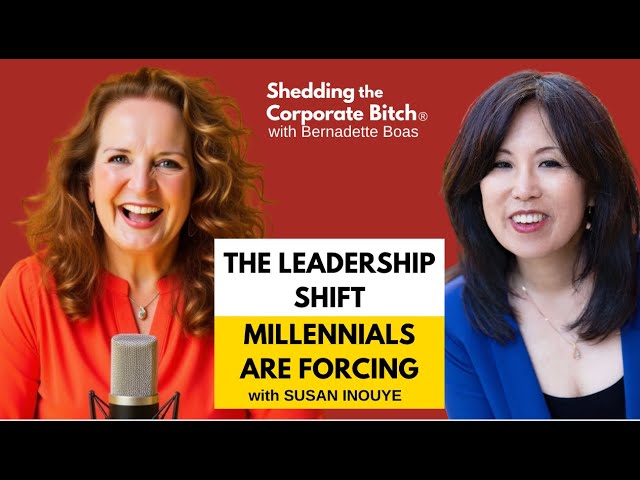
Executive coach Susan Inoue describes Sabona, her gift-centered leadership framework built on five shifts: from control to connection, conformity to acceptance, expectations to intentions, authority to authenticity, and profit focus to belonging. A case study of a millennial sales rep shows how recognizing his gifts and reframing metrics led to higher retention and his manager's promotion.
Chapters
Imagine stepping into your next leadership role and instantly seeing every person on your team, not as a stereotype, not as a generation, but as a human being whose potential unlocks the moment they feel truly seen. Welcome to the show. I'm Bernadette Boas. Today's episode pulls the curtain back on one of the most pressing challenges leaders face right now. Guiding a diverse multigenerational workforce through rapid change without burning out in the process. We're diving into Solbona Leadership, the art and practice of I see you, a powerful shift that moves beyond stereotypes, beyond assumptions. Our guest Susan Inoue, executive coach, bestselling author, and co-founder of Solbona Leadership, joins us to tackle the perfect storm leaders walk into when stepping into a new role, the hidden pitfalls that sabotage work-life balance, and why traditional command and control methods fall apart with today's workforce. You'll learn how Sabona leadership, moving from control to connect, from conformity to acceptance, from authority to authenticity, and from bottom line myopia into belonging. Create teams that rally behind rapid change instead of resisting it. By the end of this conversation, you'll walk away with a blueprint to achieve more by doing less, lead with deeper intention, and unlock the human needs that every generation shares: to be heard, to contribute their gifts, and to find meaning and purpose in the work that they do.
Welcome to Shedding the Corporate Bitch, the podcast that transforms today's managers into tomorrow's powerhouse leaders. Your host, Bernadette Boas, executive coach and author, brings you into a world where the corporate grind meets personal growth and success in each and every episode. Let's do this.
Susan, welcome, welcome.
How are you? I'm Bernadette. It's really good to be on your show. I'm excited.
I'm excited to have you, especially because this is actually a new framework, a new concept for me that we're going to be talking about when it comes to sabona leadership. And so before we get into that though, yeah, I love our listeners and viewers to get to know our guests on more of a personal level, more away from the resume and really understand who they are as a person. So could you share with us a little bit about Susan?
Yeah, I think the theme that has always permeated my life is that I've always wanted to make a difference in people's lives. So when I was young, I would volunteer in the missions. I would feed the homeless on Thanksgiving Day and doing those things, it gave me meaning and purpose and touched my heart. And so what I did was I tried to find other ways to make a difference. And that's when I discovered the transformative power of films to change lives. And I was fascinated. And what eventually happened was, is I ended up in the film capital of the world, Los Angeles. I was on scholarship to the University of Southern California. Go Trojans. And I graduated with honors with a bachelor in mathematics and a minor in music. I did something more practical to please my Japanese American parents. But it was several years later, I remember the American Film Institute was having a competition through the Directing Workshop for Women. And against all odds, I was one of a small select group of women that was chosen to get a $5,000 grant to do a 30-minute short.
Wow.
And yeah, lo and behold, I'm— and I was so passionate about changing lives through film. And also about telling my grandfather's story, who he was interned in the concentration camps in America. And so I raised over half a million dollars in donated services and goods. I raised thousands of dollars and I got some of the top people in Hollywood to work with me. And Solo was my film. It went to festivals, it won awards, and I ended up in the office of Kathleen Kennedy. Who was then the assistant to Steven Spielberg.
Wow.
And I thought, oh my gosh, my life is gonna change forever. It did, but not in the way I thought so. I couldn't get hired, Bernadette, as a first-time director. Mm. And finally, a TV producer friend of mine, he pulled me aside and said, Susan, I hate to tell you this, but it's much easier to hire a first-time man director than it is a woman. And I was crushed. And I was, yeah, as I started to reflect on why it is that I wanted to do films, and it was really to help others transform their lives. I realized that it started with transforming my own. And that's when I got it, got into studying very deeply and fiercely with teachers from the world of doing to teachers to the world of being. And it was one day that a business colleague of mine, she came up to me and she said, Susan, I want some of that. And I went, what, what do you want? She said, I've seen your positive transformation. I want you to coach me. I'm starting my own business. Now you have to understand, back then coaching was not popular. And I was working for a national company in sales. Okay. But she was persistent. And I said, okay, okay. And as I worked on myself becoming a better person and leader, and I coached her to do the same, two things happened. I became the number one sales producer in this national communications company. And she made her first million in her first year. And I'll never forget, she looked at me and she said this, is how you're gonna make a difference in people's lives.
That is one hell of a powerful story, and I absolutely love it. And it now helps me understand why you might be focusing on this one very transformative area of leadership, and it's called sabona.
Yeah.
Did I say that correctly?
Yes. Sabona.
Yeah. Can you help us understand what is it? Why do you feel it's so important? And then the part, I love the part about where the millennials fit into this.
Yeah.
Yeah.
Maybe I can tell you how I found it because I, how I found it was so accidental in some ways. I was getting calls from executives complaining about their younger generation, which happened to be millennials over 13 years ago. And there was so much pain and suffering between generations. Execs would say, Susan, who would quit their job without another one to go to? Or Susan, I just got a call. This was an HR director from the mother of one of my young people telling me she had good tips on how to better work with her son. So it was, there just was a lot of angst between these generations. An executive client of mine, he knew that I was looking for answers and I wanted to find something that was not just grounded in education, but really grounded in proven results. He took me to the ghettos of South Central Los Angeles to meet this gentleman called Tony LaRay. He had been a successful businessman who had sold his business and for the past 10 years, he had been transforming, saving the lives of thousands of inner city millennial youth through his mentoring programs with unprecedented results. The name of the nonprofit was Youth Mentoring Connection. And so I, I was just fascinated. He had gone, Bernadette, he'd gone into the community, asked these young people what it would take to engage with him. And they told him, and what he developed over that decade was what he called the gift-centered approach, which was at the heart of Salbona leadership. And Salbona was Zulu for "I see you," as in seeing the whole person. And yeah, and he invited me to one of his mentoring sessions and I said, yeah, I went and I gotta tell you, I was taken aback because here was a community of people of different generations, genders, ethnic backgrounds, and the deep connection that they had between each other and the way they engage each other that brought out the best in who they were. I remember saying to him, you need to mentor me. I need to take this into the corporate world because I saw a way of not only helping my execs, but helping them create cultures of belonging. And so that's what he did. Just to let you know, Salbona and the gift-centered approach is now in over 30 countries. And it became the subject of my book, Leadership's Perfect Storm. And yeah, which became a bestselling, number one bestselling book, the end of 2018 when we launched it. Oh yeah.
Wow. So what is it about sabona that transforms organizations?
Sure. So sabona means I see you. And we have found that when we see and accept people for who they are, they in return see and accept us for who we are. And a different conversation unfolds, not one where we're lecturing to each other, but one where we're listening and learning from each other. I have found in all my conversations as I go do keynote speaking to groups of people, millennials will come up to me and they'll tell me many needs. But the 3 needs that keep echoing is they want to feel heard, they want to use their gifts, and they want to have meaning and purpose in their lives. Now you have to understand when I ask the other generations in the audience, how many of you want that too? Every hand goes up because it's not a generational need, it's a human need. And so the way that we do that in Salbona, the way to feel heard is to connect and receive. The way to be able for them to use their gifts is for us to see the gifts. And the way for us to be, for them to have meaning and purpose is for us to create as leaders a culture where they feel a part of something greater than themselves. And so the steps in the book are the 5 leaderships. And those, that is the way to be able to start to create the kind of culture that's needed today and what this younger generation wants.
And I definitely want to get into those 5 steps, but let me ask you this. Why is it so difficult for leaders of people to really focus on understanding each of their team members and the gifts that they have so they can get the most out of them?
Let me put it this way to you. We, as human beings, we are born with gifts to bring into the world. And usually what happens is the people that trigger us have what we call the other side to our gifts. So I'll give you an example. If someone has the gift of planning, and that's maybe one of many gifts, right? They see the world through planning. Everything they plan. I had a VP of marketing. She planned her emails. You plan everything, right? But the other side to the gift is what we're blind to and need to learn. And it's the opposite. It's usually how the gift is defined. But if I were to ask you, what do you think is the other side to the gift of planning?
The other side of the gift of planning.
What do you think is the opposite?
Like brainstorming, creating, kind of dreaming.
Yeah, you're getting there. It is letting go, going with the flow, and being in uncertainty.
Yes.
People that plan have a hard time because when things don't go according to plan, they freak out. What happens is that we get triggered by people who have the gifts that we don't, because that's not what the way we see the world.
Okay.
And it's not so much a generational thing. It is a thing of how we are born and the perspectives that we see the world through. So a person who's the gift of planning will see someone that goes with the flow and makes decisions like, say according to their intuition, and they'll say, wait a minute, have you analyzed or have you looked at everything and let's plan it out? So they get very upset with people who just say, yeah, let's do it like this. But what they don't understand is if we develop the other side to our gift, like if a planner develops this, turns their blind spot into strength and they have the capacity to plan and go with the flow. Then when we integrate it together, that becomes balance. And now all of a sudden they can see the world in a different way, through a different lens than they've seen it before. And that's when we start to appreciate people for who they are. When we start to observe and look at their actions and see what is the gift that is trying to come out.
Yes.
Because even in bad behavior, Bernadette, there is a gift that's trying to come out.
Yes. Bad behavior definitely is screaming for attention on something that they're trying to—
they're trying to show you their gift. This is what I do and how I do it. And you're going, well, but I don't want that right now.
In a lot of cases. Absolutely. All right. So you mentioned the 5 steps of going about this. Sure. Could you walk us through briefly each one of those steps and how they could be leveraged?
Sure. Maybe what I can do is I'm thinking I can share maybe a story on some of them and I'll just go through others. So the first one is we have to, the Salbona leadership style, we have to shift from control to connect and receive. We have to shift from conformity to see and accept. We have to shift from expectations to intentions. We have to shift from authority to authenticity, and we have to shift from bottom line myopia to belonging. So if we go to the first, which is from control to connect and receive, leadership is going away from command and control. That doesn't work with younger generations. They want you to connect with them. And connection is not connectivity or communication. It's how I feel when I'm with you. Now, receiving— this is a very overlooked quality of leadership. We as leaders tend, because we're taught to give, not to receive. But building the body of a leader who's able to receive ideas, thoughts with openness and curiosity is able to receive praise, criticism, help is such an important part of leadership. Love that. Yeah. Now the second one, from conformity to see and accept, we have to understand that one of the biggest sayings of millennials is one size does not fit all. They want to be seen as unique individuals, not part of a mass herd. And so to be able to see and accept them for who they are, good and bad, is important. Can I give you this story? Because this is a powerful one that happened when I was working for a client. I'll call— I have to substitute the name. I'll call her Kathy. She's the director of tech support. And I was working with execs in the company, not with Kathy, but one day she came up to me and she said, Susan, I need your help. And I said, what's going on? She said, I'm going to have to fire one of my best people, Jack, who happened to be a millennial, at the end of this week because he's not meeting his monthly quota of new customers served. And Kathy tried everything. She said, I've tried everything. Now she was brought up on command and control. So in command and control, we use the carrot and the stick. And she used incentives. She used reprimands. Nothing was working. And so she said, I just don't know what to do. I talked further to her with her and I talked to her about gifts. And I said, tell me, what do you think are Jack's gifts? And there was a blank stare. And this is not unusual because gifts are what we're born to bring into the world. We do them without thinking about it. It's just who we are. And so I reframed it. I said, Kathy, why did you hire him? And her eyes lit up and she said, oh my gosh, Susan, He is not any other tech rep. He doesn't talk down to our customers in that techie language. He easily gains rapport with them. They call for him by name. He's also really great with helping out the other tech reps on the most challenging issues, because he's great with solving problems. I said, okay. She said, but I have to fire him. I said, all right. I said, let's step back and see a bigger picture. I said, if we see a bigger picture, let me ask you, do you know what his retention rate of the existing client base he has than any other rep? And she looked at me and go, why? I said, because he might be retaining more, bringing in less new clients, but retaining more, and he may be more profitable. And she went, oh. So I said, find out and get back to me. So the next day in the late afternoon, she called me and she said, oh my gosh, you'll never believe it. Jack has the highest retention rate of his customers than any other rep, and he is more profitable. I said, great. Use that bias time with your boss and let's brainstorm. So we did. Now, remember I said within bad behavior lies gifts, and I asked her, what is the gift that is trying to come out in his bad behavior? And she thought about, she said, wow, generosity is one because he takes so much time helping other people out and they take up his time. I said, yeah. And he says, he's also so, he gains rapport with people easy. Customers talk to him for over an hour and we want them to talk to him, talk to them for like about 30 minutes, like, but they love him. And he, and so she went on, he's analytical, he's intellectual, he's detail-oriented. He's a good trainer and coach because he coaches the other people, his other members of his team. And I said, okay. I said, how can you redirect the gift so it better serves you, the organization, and Jack? And she came up with a great idea. She said, how about we have him create a training manual with all of his secrets? I said, that would be great. But how about if you took that training manual and had him train the entire department? She said, oh my gosh, even better. I said, you gotta go to him and acknowledge his gifts and see if he'd be open. So she did. He was flattered and he said, of course. Now we did many things, but long story short, what happened is that the company got a new training manual. He trained the entire department. Productivity and retention went up across the board.
Nice.
The third thing that happened is because he broke down what he did so well, he started to see where he could be more effective and efficient. And now he was making his monthly quota of new customers served. And lastly, they had 3 straight years of the highest retention rate. And Kathy was promoted from a director to a GM.
Very nice. Very nice.
So much different from the carrot and the stick. If you don't do this, then you'll do that. Because if you start with an exec being able to discover their own gifts and their own blind spots and be able to work with them from the inside out, like the pebble in the pond, all of a sudden they understand. It's about observing my people, observing their action. What gift shows up in that action? Not just when I see them, but through their emails, through instant messaging, through text, through Zoom calls. Every time they do something, they're telling you what their gift is. And if you know what that gift is, you know how to motivate them. You know how to influence them. And You know how to praise them, which makes them feel valued. Gift-centered praise is so powerful. So even if I give them some really simple things, the ripple effect is so huge that they start going, oh my gosh.
So what is it that managers, leaders that are listening and watching us today need to really understand about the younger generations that are in the workplace that are probably on their teams to get the most out of them? What do they need to understand about them?
I think they— I'm gonna go back to Salbona. They need to start to be able to see their gifts through the actions and be able to not just recognize the gifts, but the gifts have so many byproducts. Like I said, it can tell you how they are motivated. It can tell you If you know the gifts of your people, and I don't mean doing some kind of an assessment where the gifts are given to you. The key is you need to observe them and you need to observe the actions because now you know specifically how the gift shows up. If someone ha— you know, if I'll give you an example of another one of my clients, a business owner. After she— we started here, she started to see the gifts in her people. She, oh my gosh, there's a lot of people in the wrong position. We restructured it. She put different people in different positions. We doubled her profits in one year. Okay. Now we did other things, but the key is that it ripples out tenfold. And why I keep going here is because I can leave your audience with 50 different things to do and they won't remember anything, but if they understand and realize we enter through the portal of gifts. That's where we start and we deepen that and it can go in so many different directions. Right. People, people, when you praise the gift, and I'm not talking about general praise, because in general praise, Bernadette, thanks for putting my stapler back in the drawer. It's general praise. But if I say, Bernadette, I notice that whenever you borrow things from me, You put them exactly where they are supposed to be, where you found them. That gift of organization is so needed in our team. And I was just curious, how could we use that in other projects that we're doing? Now it's not about putting the stapler back in the drawer. It's about searching because I now praise your gift. And when you praise someone's gift, oh my gosh, they feel so valued and seen. And now they look for other ways to be able to use organization within the culture.
So it goes back to, they feel heard, they are using their gifts. Gifts.
And finding meaning and purpose. Yeah, absolutely.
And purpose behind it. Give us some technical, tactical dos and don'ts when it does come to working with millennials over and above find their gifts? What is it leaders and managers need to understand about the younger generations? Like you had mentioned earlier, they need to feel, they don't want command and control. What are those things that they need to know as far as what the younger generation accepts or don't accept, doesn't accept?
Okay. So let me give you something from a Gallup study that was done. That was basically said that millennials are changing the fabric of the world. And it tells us what the past is and what leaders today have to understand about what the present, present is. So they say we have to go from my paycheck to my purpose. We have to go from my satisfaction to my development. You need to develop your people. From my boss to my coach. Bosses today have to be coaches. And coaching is not about lecturing. Coaching is about seeing their gifts, asking them questions. And oddly enough, I can tell you, when you develop yourself, you see the world differently, and the byproduct is a lot of other things. You have to go from my annual review to my ongoing conversation. No more once a year you telling me what I did wrong. Tell me along the way so I can correct it.
Yes.
You have to go from my weaknesses to my strengths. I don't want you coming in every single time that I do something wrong, and that's the only time I see your face. And then you have to go from my job to my life. It's no more about leaving myself at home and bringing another person to work. We are whole human beings. They believe we are whole human beings, and I need to bring all of myself to work. And if I bring all of myself to work, I will be better for you as, as an employee, as a leader.
Yeah.
And so much more powerful.
I love, absolutely love that. And it actually is a segue to a bonus section. Of conversation I want to have with you. Because we were having this conversation before we came on. And that is when you were talking about they need to learn to be a coach. They need to learn to identify the gifts. Many organizations, when there is challenging economic times, you could say like what we're going through right now. One of the first areas that they look in cutting is training and development, which includes the things that we were just talking about that they need to focus on. They need to be focused on developing themselves as coaches. They need to be focusing on how to be a true empathetic, authentic leader. So what is your pet peeve with that position that companies take when it comes to reducing budget, if not cutting it all out? When it comes to tough economic times?
Yeah, I think, Bernadette, when we have to downsize and lay people off, we have a smaller group of people that are available to us. And if we are going to survive in challenging times and thrive, we need them to be the best of who they are. The reason why Oregon companies and even executives cut the budget out when times get challenging is because they don't see a direct connection between developing and growing your people into the best leaders possible and an increase in productivity, revenue, and profitability.
Yes.
However, the best companies and the most successful companies and leaders, they see The connection, and this was shown in a survey that was recently done this year, 2025, by the state, by Gallup, the State of the Global Workforce. And what they found is that the companies who continue to develop their managers saw that there was not a decrease in engagement. And in fact, their managers were more engaged, which made their people more engaged, which helped to increase their productivity, their revenues, and profitability. You have to understand too, in this survey, they said that 79%, 79% of employees worldwide are disengaged. And this is costing the global economy $438 billion. In US dollars in lost productivity. And it points to the fact that 71% of managers are disengaged. Managers are the closest to the employees. They're the ones that if they're disengaged, their people follow.
Absolutely.
And so it's so important to continue that growth and development. And Maybe I can share you a story of one of my clients. That would that be okay?
Absolutely.
Okay. So I'll call her Samantha or Sam for short. So Sam is the regional manager and senior vice president of an international bank. And she came to me in 2010 during the downturn in economy when banks had a sullied reputation. I think we all remember those times. And her bosses said to her, you just need to wait it out. There's nothing really we can do. But she felt that, wow, there must be something we can do. And she said to me, Susan, even if I increase our book of business by even a small percent, that would be better than nothing. And I said, okay. Now I told her, Sam, where we're going to start is on you becoming a better person and a better leader. And I remember at the time she looked at me and she said, like, she couldn't understand, how does that have to do with increasing our book of business? And I said to her, increasing your book of business, increasing profitability is a byproduct of many things we can't control. But what we can control is within you. And that is becoming a better person and better leader, because when you become the best of who you are, You're like that pebble that I drop into the pond and your goodness touches everyone in the pond. And so I know she didn't quite still understand, but she was in a lot of pain and she said, okay, what's to lose? And I said, great. So we started working. We entered through the portal of Salbona. Sam discovered that she had many gifts. One of her gifts was analysation. She was great at analysing numbers. She was financially savvy, all those things. But she discovered that she analysed numbers the way she analysed people, with a lot of right/wrong judgements. She also discovered she had the gift of compassion, but she blocked it with her wrong judgements. And so our journey started. This helps me to open up to where we start. So I had gotten complaints from her employees that she never listened. She was never present for them. She never praised them. She always chastised them for things they did wrong. So they didn't really like talking to her. I said to her, okay, this is where we're gonna start. So we start with quieting her mind through mindfulness practices so she could drop into her body and connect within herself so she connect with her people. As she connected with her people, she became present, open, and curious to receive what they were offering. And they started feeling connected to her. They started to feel valued because she actually listened. Now, the other thing, when we quiet our mind, we can drop— and by the way, this is all backed by neuroscience. We can drop into the heart and develop its intelligence through practices of appreciation, which we did. That opened up her compassion and she began to see the gifts in her people and she started to praise those gifts. She started to put them in areas where they could blossom and succeed. And this is really so cool. We did a lot of other things, but what happened was Within a period of 6 months, that region increased their book of business by 50%. By the end of 12 months, they were at 150% of their goals. The end of the year, they were the number 1 region in the bank. And one of her people, I'll call him Jim. He was a BD, BD officer, business development officer, who at the very beginning told me she was the worst leader he ever had. At the end, I get a phone call from Sam saying, Susan, you'll never believe what happened. I said, what? She said, I was in a room full of my bosses with Jim. And I thought, oh my gosh, what did Jim say? And Jim stood up, she said, and said I was the best boss that he had ever worked for because I listened, because I valued the people. And she said, who would have ever known that me becoming the best version of myself would have all of this happen?
Wow. So the bottom line is companies should not cut their development budget. Their development budget.
Because it's their people that can become creative and find ways around what's going on. And this is so key. It is helping them to grow in another way. But you can't do that when you cut the budget.
Because people need— those managers, those leaders need that support. They need that development. They need that self-awareness to be pointed out. They need that sounding board to strategize and work through problems that they get too much in their head when they're in the confines of all everything that's going on around them.
And most people are in certain paradigms.
Okay.
In human development, we say the paradigms of the I, the we, the it. When we are good in a paradigm, it's hard to see things in another paradigm. And this is where coaches are good. We say, hey, you're going east looking for a sunset. Turn around. Oh my gosh, there's a sunset. Right. You were just headed in the wrong direction. They can't do that on their own because they are not grounded in those other paradigms. So as coaches, we help them to see what they can't see.
Absolutely. I love that. Love it. What one last tip would you give someone that when they finish this conversation, watching it or listening, that they could be doing to even take a small step to get big results? What would you recommend?
One thing you can do is you can send out an email to 5 people who you trust and not in your organization. It doesn't have to be in your organization. It can be your wife, your spouse, it can be your kids and ask them, what are my gifts? What do I do so naturally well? And then what do you think are my blind spots and have them define the gifts and the blind spot. And do it to people who will be honest with you, who you trust, who have your best interests at heart, and get that feedback because you'll be so surprised at what comes back. I've had executives say, Susan, I never knew that I, I was this good in this area, or that certain things that are my blind spots, I'm still doing. It helps us to start to see ourselves in a way that other people see us, because we all think that we're so great at certain things and we are, but a lot of times it doesn't come off that way to other people. And if you start with people that you trust, you're more likely to believe them and could go, oh my gosh, maybe now I need to get a coach. Or something. Help me in these areas.
This has been fabulous. And I know you've mentioned your book a couple times and I want to make sure everybody's aware of it. It's called Leadership's Perfect Storm: What Millennials Are Teaching Us About Possibilities, Passion, and Purpose. And they can pick that up on Amazon or on your website, SusanInoue.com. Susan, thank you so much. Much. This has been a fabulous conversation, but I want to remind everybody, be sure to go to SusanInoue.com/shedding to learn how you can get a copy of her book, buy her book as a whole, or even engage with her, with her services. So be sure to go to SusanInoue.com/shedding. Susan, thank you so much.
Thank you, Bernadette. It's been a pleasure.
I have to admit, sabona leadership is a new concept to me, a new framework, but she laid it out so beautifully and it hit my heart directly because I know so many of us, including myself, is always looking to be heard, to be seen, to have our gifts leveraged, and to have meaning and purpose in our life. What other reasons are there to life, if not to have meaning and purpose, to be heard, to be seen, and to leverage our gifts. And so what a powerful conversation. And we added that additional bonus discussion, as I mentioned, around the need for companies to really take a hard look at finding other ways to cut costs, to reduce budgets, than to Eliminate Your Training and Development. And we, she and I found it very important to talk about because of what we are seeing. We need leaders that are even that much better at leading their people during difficult time, during challenges. It's more important than ever to provide your leaders the support, the sounding board, the guidance, the advisement, the correction, the highlighting of strengths, blind spots, areas for improvement. Now more than ever, teams and individuals need to have the resources for them to uplevel themselves in order to work through these challenging times. And I loved her example of a client that as a result of investing, even while cutting back on spending, they were able to make that, that leader a better leader and drive greater revenue, greater profits, greater bottom line. And that, and I should say greater team productivity. And so I just felt it was really important for us to have that bonus discussion in order for all of us to understand the risks that you also can be faced with, with any of the decisions that you might make, especially as we are entering and walking into a new year when it comes to training and development in your people. If you enjoyed this episode, please share it with your colleagues, with your peers, with your team members. Help them to understand this leadership framework, SABANA, and have conversations about it as far as what could you be doing differently today to learn and leverage the gifts of your people, even your own gifts. And by doing that, you could see a major transformation in both your team effectiveness and your own leadership. And be sure to go to ballofirecoaching.com/podcast so you can subscribe, follow, and like on any one of your podcast streaming services or on our Shed the Corporate Bitch TV YouTube channel. Until next time, I'll see you soon.
Thank you for tuning into today's episode of Shedding the Corporate Bitch. Every journey taken together is another step towards unleashing the powerhouse leader within you. Don't miss any of our weekly episodes. Subscribe to our podcast on Apple Podcasts, Spotify, or wherever you love to listen. And for those who thrive on visual content, catch us on our Shedding the Bitch YouTube channel. Wanna dive deeper with Bernadette on becoming a powerhouse leader? Visit balloffirecoaching.com. To learn more about how she helps professionals, HR executives, and team leaders elevate overall team performance. You've been listening to Shedding the Corporate Bitch with Bernadette Boas. Until next time, keep shedding, keep growing, and keep leading.
More from Bernadette



From Stuck to Leading, Episode 2 — Meet the 5 Inner Fears Destroying Your Leadership



