The Nonverbal Mistakes That Undermine Leadership Presence (and How to Fix Them)
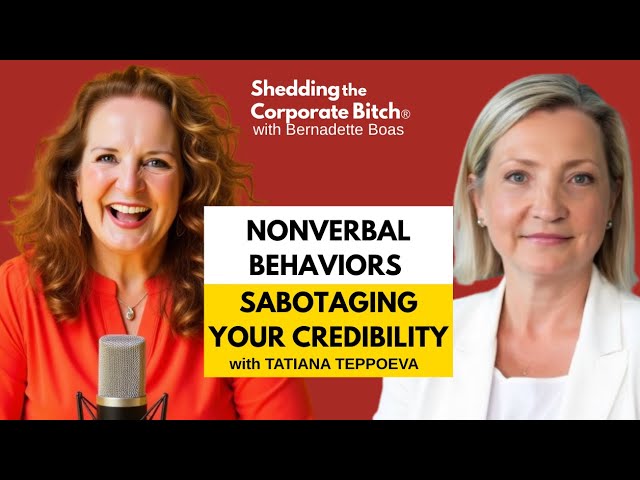
In this episode of the Shedding the Corporate Bitch podcast, host Bernadette Boas interviews Dr. Tatiana Tapova, founder and CEO of The One Nonverbal Ecosystems, about the critical role of nonverbal communication in modern leadership. Tapova explains how nonverbal cues account for 50‑70% of all communication (up to 93% in emotional contexts) and why leaders often neglect this half of the message. She outlines her "Nonverbal Ecosystem," a framework of nine core nonverbal elements—body language (with 14‑21 sub‑categories), voice and speech, proxemics (space), appearance and grooming, posture, gestures, facial expressions, micro‑expressions, and contextual cues such as seating position. The conversation delves into how personality profiling informs the interpretation and adaptation of these signals. Tapova identifies three common nonverbal pitfalls that erode credibility: (1) signals that are inappropriate to the context (e.g., attire, sexual or overly aggressive gestures), (2) overt aggression or hostile gestures, and (3) self‑undermining behaviors—especially among women—such as shrinking posture and quieter voice. She stresses that mismatches between verbal claims and nonverbal signals instantly damage trust because observers subconsciously prioritize nonverbal information. The episode also introduces Tapova’s free guide, "5 High‑Stakes Signals to Master," which applies an 80/20 principle to focus on the 20% of nonverbal habits that yield 80% of impact. Practical advice includes recording oneself (both on‑camera and in‑person), reviewing silently to spot gestures, filler words, and posture, then seeking calibrated feedback from trusted peers. Boas and Tapova conclude that both individuals and managers share responsibility: leaders must model aligned nonverbal behavior and give constructive feedback to their teams, while employees should become self‑aware of the signals they emit. The episode ends with calls to action for listeners to download the guide, follow the podcast, and engage with Boas’s coaching services.
Chapters
Welcome back to Shedding the Corporate Bitch podcast. I'm Bernadette Boas. If you lead teams in 2025, this episode isn't optional, it's essential. Today we're tackling the silent crisis inside modern leadership: how to project real authority without slipping into tension, mixed signals, or on-camera burnout. Emotional intelligence still accounts for more than half of our job performance. Yet leaders everywhere, men and women, are struggling with the pressure to look confident while managing stress that leaks through every one of their micro expressions. And that's why our guest, Dr. Tatiana Tapova, is here. She's the founder and CEO of The One Nonverbal Ecosystems. And she spent years decoding the behavioral patterns that make or break credibility in high-stake moments. Tatiana shows you how to read your own signals, regulate before you respond, and create instant alignment between your words, tone, and intention. In global and hybrid teams, this skill isn't just helpful, it is the new currency of influence. Now, your takeaway from today is that presence is no longer about performance, it's about precision. When your signals match your message, trust rises first. Learn more about Tatiana at tatianatapova.com as we get into this conversation.
Welcome to Shedding the Corporate Bitch, the podcast that transforms today's managers into tomorrow's powerhouse leaders. Your host, Bernadette Boas, executive coach and author, brings you into a world where the corporate grind meets personal growth and success in each and every episode. Let's do this.
Tatiana, how are you? Welcome.
Thank you, Bernadette Boas. So happy to be here. I'm good. How are you?
I am good. I am good. I'm actually very intrigued by a conversation around nonverbal behaviors that are tripping up a lot of corporate professionals and leaders, and we need to get to the bottom of it. But before we do, I love my listeners and viewers to get to know our guests on a more personal level. So could you share a little bit about Tatiana?
Wow. So much to say. I have two sons, two dogs, and maybe it's interesting, I have an Etsy store where I offer my ribbon embroidery and some supplies. And proud that I have 4.9 customer satisfaction score there in 6,000 sales.
Wow. Now I've never been someone who could sit down long enough to embroider. But the output, the products are just lovely. And what— and it's, it has to be a very therapeutic hobby or skill to do, just to sit down and be able to embroider a scarf or a blanket, whatever the case might be. So that's fascinating. Transitioning over to our conversation, what I found very unique about you and your business is it's focused on a subject a lot of people talk about around emotional intelligence, executive presence. And yet you take a very specific look at nonverbal behaviors that get in the way for leaders to really show up with authority and with presence and with credibility. So what caused you to look in that specific niche? What were you fascinated about?
My journey started long before. When I was 16, I had Dale Carnegie's How to Win Friends book as my manual on the table, right? And I also read different philosophers, Nietzsche and other folks, but I didn't choose this side of my profession and my interest at that time because it was not well Wade. I'm also a materialistic person, so I went into economics and later into data science. I've been in tech for 17 years. Oh, wow. And I think with being in tech and having AI patent in United States, I went too much maybe into numbers and algorithms, and I was missing this human connection. So I brought back what I had early in my years, all those interests, and I started looking into this direction. And now I have over 20 certificates in coaching and nonverbal intelligence and personality profiling. So this is really fascinating, but having two sides, one is numbers, analytics, tech, that I have a lot of experience with, and human connection, like putting them together is really bringing a lot of results. Much faster, much efficiently. So I'm fascinated in leveraging those two sides for me and for my clients.
And I have to agree with that. And I never really thought about it because I come from a tech background and a lot of data, a lot of analytics. And I found the same type of evolution when I started doing a lot of personal and professional development work. But I never really connected the two, making it very powerful for an individual and for a leader. So what do you find to be kind of the ecosystem? Your business is called Nonverbal Ecosystems, which I found also fascinating. So what makes up the ecosystem when it comes to nonverbal behavior?
Great question. So let me first mention that nonverbal represents 50-70% of our communication. So it's at least half. So often we, or leaders, neglect this half. So that brings the importance of nonverbal communication in general. And in some communications, when it's about emotions such as love or anger, if it's a conflict or love, expression, then nonverbal actually represents 93%, up to 93% of the overall communication. So if we neglect this piece, then we are missing a lot. So I wanted to bring this awareness that it's very important to pay attention at least as much as we pay to verbal communication. And we spend so much time preparing for, usually, and both of us know that from our past tech careers that Content, right? Content, content first. So now talking about ecosystem, I put together nonverbal communication as different elements and nonverbal. It's not just body language and it's not even body language and voice. It's actually 9 main elements. And sometimes you can even add more. Main ones that I'm focusing on is personality profiling, because often personality profile and personality type defines How we behave under stress, what we are motivated by, what we fear, what trigger points exist, et cetera. So knowing who you are or who your employees are, we can tailor our messaging or our approach or even our schedule to address, to adapt better to our personality type or our employees or whoever we communicate with.
Right. And we can also adjust our nonverbal cues, behavior to others, as well as some of those other things you mentioned, correct?
Exactly. So when we talk about nonverbal, we can adapt nonverbal communication to our own style. We can also see what our strengths and weaknesses are. We all have strengths, and this is also neglected often and forgotten. Each of us has something great that we can leverage more, and we don't, unfortunately. And also a few things that we can highlight, but it doesn't mean that we all need to now stand like that. You probably saw many politicians, they have this gesture on, on the photographs, and sometimes it looks natural, sometimes it looks artificial because you see like they do it intentionally, but it doesn't feel— fit the picture. Or this particular personality. So knowing your nonverbal communication style, what will elevate your presence versus looking like a performance or undermining you is very important. So combination of two. And as you mentioned, the tailoring, tailoring your conversational style or your messaging is very important too. It's even in sales, not just in leadership, not even only in interview, job interviews where we want to portray ourselves as experts, right? But it's also in sales. If I know what personality type is in front of me, I know how to adjust. One of those very common things that we know about is mirroring. So it's a good approach if we don't go into details, but we can go much, much, much further into more details. And person will get a feeling, oh, I feel something interesting, something good about this person. I feel so connected. And you probably felt it in your life and don't recognize, like, why? Nothing special about this person. They didn't do anything like in particular to intrigue me or fascinate me. But you feel so attracted and you feel like, oh, I have known this person for years, or I want to buy from them or get a job or to hire someone. And it can be completely opposite. We feel like so disconnected. We feel like something weird, but it doesn't sit with me. And if we don't have the skill on nonverbal communication, things that we can recognize, person wouldn't know. They just feel that something is not working. But if you do, then you can pinpoint, oh, this was anger microexpression. Here it was two-wide gesture. Here it was voice change or whatever. So we can pinpoint specific things that didn't land. This me, for example, as a personality type of who I am.
So before we move too far off though, you mentioned that there's 9 attributes of nonverbal. So what are some of those? Because like you said, some people are thinking, oh, it's just that I, it's my gestures and it's my tone of voice, but there's a lot more involved. So can you walk through at least those 9?
I will just mention a few. I don't want to overcomplicate it because it's already a topic that's underappreciated, I think. So main is the most, it's body language and body language on its own has many categories. I look at 14, sometimes I look at 21 within body language itself. Next one is voice and speech. There are also different categories. We can talk about tone, pause, and filler words and many other things. Then we can talk about specialness in terms of space. So special, where we are located, how close we to someone or to something. Oftentimes we don't pay attention, but a simple example would be if I get to someone too close, right? And especially in real life, but also on Zoom, if we have, for example, online interview or meeting. It can be intimidating, right? Or it can look like passive, or it can send other signals. And we oftentimes don't realize what we are sending out. So a special awareness is very important. And in some cultures you can approach someone very close and they get used to that, like being in public transportation all the time, being close to each other. In US, for example, it'll be too close. And many people feel uncomfortable, so it'll be already putting some kind of disconnect between you two, even everything else is perfect.
They're invading your space. And so it's, you know, 3 feet, stand at arm's length and I'll be very engaging. Get real close and all of a sudden I feel threatened.
Yes. Yes. And another one, that style, how we dress, how we show up, how we groom. Oftentimes I saw even in leadership meetings, some come with some worn out after many laundry cycles t-shirt and they try to speak to high leadership, it's not the best impression that we would like to make. Or if I wear a very short skirt to an interview that maybe even just a regular office, or maybe it's something working with the customers and it may be, how else can she dress? I don't know. I'm skeptical. They can't maybe ask directly what type of clothes What kind of clothes do you wear to work? So they judge based on what we show them. Yes. So they make their conclusions based on that. So those would be the main ones. But when I work with clients, then we look into all the aspects that—
other things that I don't know how many professionals really focus on is would you throw these into your ecosystem? And that is where someone sits at a table. How someone walks in a room, how someone— you mentioned tone and, you know, that those things, but those other type of more subtle but very powerful indicators, are those in your ecosystem as well?
Definitely. And actually, I'm smiling because there was recently a post on LinkedIn about sitting at the table, and a person who posted, they said, oh, if you sit over there, then it means that if you sit 'You are number one.' It means that. And I reposted it with my critique. So first of all, it's super important to know the context because maybe I need to pick up kids and I need to leave 5 minutes earlier and I don't want to disturb anyone. And if I sat in the corner next to the door, it doesn't mean that I don't care or passive or whatever. It means that I need to pick up my kids. Maybe it's unusual event today for me. If someone is sitting up front, they may have another reason. Maybe they're helping with some tools, markers, whatever it can be, right? It doesn't also immediately tell us that it's proactive leader. Yeah. So we need to see the context. If it's your employee, then you can see, oh, on all the meetings, all the events, I observe that this person is not participating, sitting in the corner on their phone, et cetera. So then we have context. Maybe same employee is engaged on some meetings but not the others. Then there would be a question: is it about who is presenting? Maybe their managers, they don't feel comfortable. Maybe it's someone they had interaction and felt interrogated and they don't want to engage. Maybe it's not their expertise and they don't feel that they should contribute. So there could be multiple nuances. And I recommend that consider the context. As far as the door opening, I even have it as an exercise when I work with the clients. It's one of the exercises, how we show up. Do we try to sneak in a little bit? Can I get some space in this room? Or do we open like we belong? So even on a small section in this video, you already can see how my presentation changes, right? Whether I show up like opening up door a little bit, right? Or if I open it like that, we definitely look at all those nuances. We need to pay attention.
But I think it's important two ways, right? It's important for the individual to pay attention to what it is they're doing that they're projecting out. And then managers need to pay attention, like you said earlier, to all the various people they engage with, especially their direct reports, to ensure that they're also given observations and feedback. Is that— would that be a fair statement?
Yes. And I can refer to my today's LinkedIn post. I just posted about 5 types of sabotage that employee can do at work, sometimes intentionally, sometimes not, and how to recognize them. Before people even get hired. So how we can catch those clues during these interviews, what questions to ask to recognize those traits and see if you can correct or if you would like to move on to a next candidate. But it's also important for managers themselves, what kind of messages they send to their employees. Do they encourage them to work harder and be more efficient? Or do they encourage behaviors that is not really positively contributing, maybe gossiping behind people's back, maybe something else. So it, like you said, it's exactly a two-way street.
Yeah. And managers/leaders have to pay attention that and recognize how they show up, they're transitioning to their people as acceptable. And therefore, if there are certain behaviors you don't want from your people, you can't be projecting them. Is that fair?
Of course. Yes, of course.
Okay. What are those specific behavioral patterns that actually break one's credibility in the eyes of the other people? What if you were to tell someone, you have to be careful with these 3 things, or it'll impact your credibility and the respect other people have for you. What would those be?
First, I would say that it's inappropriateness to the context. For example, if I'm start doing like some sexual signal, something like that in the office environment, or vice versa, if you are in an intimate relationship or something and then you behave like a boss or something strange, like these people feel immediately that out of context, it's something strange is going on and credibility is lost, if not from one event, then from two or three for sure. So making appearance also, like we talk about short skirt and things like that, be appropriate for the event where we communicate. The same with nonverbal style. And of course verbal as well. If you say something weird, inappropriate, it also will be strange. And it will not land with people. The next one, I would say it's being aggressive and using aggression gestures. For example, I'm telling you that this is very important point and we need to deliver this project by next Monday.
Yes.
How does this finger feel?
Horrible.
Horrible.
I look sometimes at brands' advertisement and I even contacted one brand, also have a few posts on LinkedIn about that. When brands try to deliver one message, but it works not in the same direction. And the one that I'm highlighting is not doing it intentionally. They just made mistakes in how they portray their product nonverbally with the human. So after aggression, and it's not just finger, it's also putting your fingers like that, not keeping them together and crossing someone. So people feel that they're cut. So we need to go this way, right? Or something like, if we are showing it, it's better to keep your hand together, have open palm to people, and have a smoother gesture. So this is one also from aggression. And the third element, you ask about three. So the third one would be undermining your authorities, like especially for females. Making yourself smaller. And maybe I'm exaggerating physically because I have limitation in our space on this video to show. You don't see the whole body, but when we try to make ourselves smaller before, because we don't feel comfortable, new people, new message or something like that, we use different gestures and movements to make ourselves smaller and voice quieter. And maybe instead of saying, we should do this, we ask, what do you think about that? We are trying to appear more approachable, more agreeable, and eventually it undermines our messaging and we feel smaller, we look smaller, and people perceive us smaller, not as credible as we are. And it's very unfortunate. I interviewed so many females. And males during my career. And this is what I'm seeing, that unfortunately females tend to lower, minimize, and undermine things that they've done.
No, absolutely agree with you. Absolutely agree with you. And you'll see it amongst some men too, but predominantly, yes, is something that women have a tendency to do too often. As an extension to the credibility that we talked about, What also degrades trust that someone might feel toward their manager, for instance, as a result of the way they are coming across nonverbally?
This is a great question, and it's actually also very nuanced. First thing that we know, even with children, that we need to show our behavior, how we do, and this is what kids learn from us. The same at work. If manager says one thing but does another thing, this doesn't land. Maybe he or she will be forgiven once or twice, but not on ongoing basis. So it's not only talk, but do what you preach. And next thing that would be when nonverbal doesn't align with what we say. So this nuance, miscommunication in our own thing. Is really very important nuance that we often miss. For example, I'm so confident. I'm so confident today. You can't imagine how confident I am, and I would be the best candidate for your position. Yeah, I've done many great things. What would you feel like? Would you feel that I'm confident or the opposite?
Yes. Let me just explain for our listeners who are not watching us. So her example was her kind of making herself smaller and meeker, and yet she's trying to convince you that she's confident.
Yeah. And now I will straighten, open my shoulders, have great posture and say, oh, I'm really afraid to be here. I don't even know if I can pass this interview. It doesn't resonate. So this is what we see often when verbal and nonverbal don't match. And guess what do you think people believe if it happens? They believe nonverbal. This is subconscious. We read nonverbal signals more than we read verbals. If there is disconnect, they prioritize— they— we prioritize nonverbal ones. So this is something important to keep in mind. So I would say those two things are most important to start watching for.
And you just triggered something for me too. Have you ever been with someone who is disagreeing with you, but yet they're nodding yes? Or just the opposite, they're agreeing with you, but they're like verbalizing and their body language is shaking no. Would that be something that someone needs to tune into because that person's message and their body are not congruent?
Yes, in general, but it also depends on the context. I've watched many people who would agree, but they say, but they shake their head from one side to side. And for some it's just natural habit. They just constantly do it, whether they agree or disagree. It's the same when you cross your arms. People say, oh, if someone is crossing their arms, it means that they're closed. They don't want to communicate, or they are not sharing something. Maybe they're even lying, but maybe it's just a habit. Maybe it's just comfortable for them crossing legs when we see, or maybe this person is just cold, simply cold. So context is super important so we don't judge by one appearance. And don't extrapolate it on everyone's style.
All right. So I just like wrap that whole thing up with one statement you just made. Don't judge. Look for the context. Look for the patterns. Look for the consistency in their behavior as opposed to judging one or two times. Now, you have a fascinating guide It's called 5 High-Stakes Signals to Master. Could you share a little bit with us about that? And I'll make sure everyone has the link as to where they can go and get it.
If it fits well with what we talked about. So some of the things that we need to pay attention to, some of the things that would help to make most impact. I like to use 80/20 rule in my nonverbal assessments and coaching as well. Because we don't want to fix everything. We want to highlight what we already doing well. And if you can identify, you can leverage it to your advantage and to other people's advantage so they can read you better, they can understand you better. Or if it's something that we would like to correct, we point out that 20% that we need to work on to deliver 80% improvement in what impression they are making. So this is a guide that will talk about many of the things to start paying attention to if they haven't yet.
And would that be— if I asked you for one major tip for someone to do right now as we wrap up this episode, what would it be that someone could start doing to really tune in to their own self-awareness of their nonverbal behavior?
Guide, of course, is good, but we also would like to see what is not working. And the easiest to do that on their own, if they're not ready or would like to start on their own first, is to record yourself. Record yourself and make sure if you present online and you present in person, do both, because we behave differently. On those two, but honestly, we even behave differently and show our nonverbal signals differently in different communications, whether it's at work or with relatives or somewhere else. So whatever is the most important, record yourself and watch without sound. Watch without sound first, make a note what you liked, what you didn't, then watch with sound. And see how your previous points align. Maybe there is something to add to one or second list. And then if you feel comfortable, ask your friends, relatives to watch and give their feedback. Just only if you feel comfortable with their feedback. And feedback is not always fair. Keep that in mind. They're not experts in nonverbal communication. And you can also go as far as to ask your coworkers and you can even do exchange. And then from your list, you can decide what you want to work on. One thing I will add, our brain likes safety. So oftentimes when we look ourselves at our own videos or when we listen to ourselves, we often don't notice things that we are doing. For example, my clients, they don't notice that they say and use filler words or sounds. It just escapes. The same with gestures. Many clients, majority misses some of the important clues that they're sending. For some reason, our brain doesn't want to see it. So that's why I'm encouraging to also get feedback.
Wonderful. This has been fabulous because that last one about recording yourself was just golden. And even though I'm on camera all the time, I really need to start paying attention to myself because I certainly hear my word uses and my filler words when I go to look over the transcript after it's been edited. So I, I make sure that I'm constantly self-assessing and correcting myself. So I love that. That was a golden nugget of a tip. Thank you so much, Tatiana. This has been great. I want to mention to everybody, you can go and get her guide. And I'll make sure that it's in the show notes, tatianatapova.com/decode, and you'll find access to that guide. Thank you so much, Tatiana. This has been fabulous.
Thank you, Bernadette. And I'm very helpful to be here with my insights. And hopefully we all start improving our nonverbal signals and making it more and more pleasant for each other to communicate with.
Absolutely. Thank you. Thank you. What a fascinating conversation. I do a lot around emotional intelligence, yet at the same time, I really found it unique that Tatiana has a specific focus on nonverbal behaviors, especially because of the fact that, as she mentioned, nonverbal is actually 93% of the influence that we have or the success that we have or the leadership that we have with other people. 93%. I found this fascinating because we really do need to spend more time self-reflecting, as we talk a lot about here on Shutting the Corporate Bitch, and really working to make some small shifts if we really want to be a powerhouse leader. And reminder, if you want her free guide, The 5 High-Stakes Signals to Master, then just go to tatianatapova.com/decode. We'll put it in the show notes for you as well and all on all of our posts so you don't miss it. And as we wrap up, let me remind you as well to follow, subscribe, and like Shedding the Corporate Bitch podcast. So you don't miss a single episode or a single expert. As well, share it with your colleagues and your team members. Have conversations about it so all of you can be working on elevating your leadership so you're all powerhouse leaders. I'll see you next time.
Thank you for tuning in to today's episode of Shedding the Corporate Bitch. Every journey taken together is another step towards unleashing the powerhouse leader within you. Don't miss any of our weekly episodes. Subscribe to our podcast on Apple Podcasts, Spotify, or wherever you love to listen. And for those who thrive on visual content, catch us on our Shedding the Bitch YouTube channel. Want to dive deeper with Bernadette on becoming a powerhouse leader? Visit balloffirecoaching.com to learn more about how she helps professionals, HR executives, and team leaders elevate overall team performance. You've been listening to Shedding the Corporate Bitch with Bernadette Boas. Until next time, keep shedding, keep growing, and keep leading.
More from Bernadette



From Stuck to Leading, Episode 2 — Meet the 5 Inner Fears Destroying Your Leadership



