The Value and Importance of Emotional Intelligence with Phil Johnson
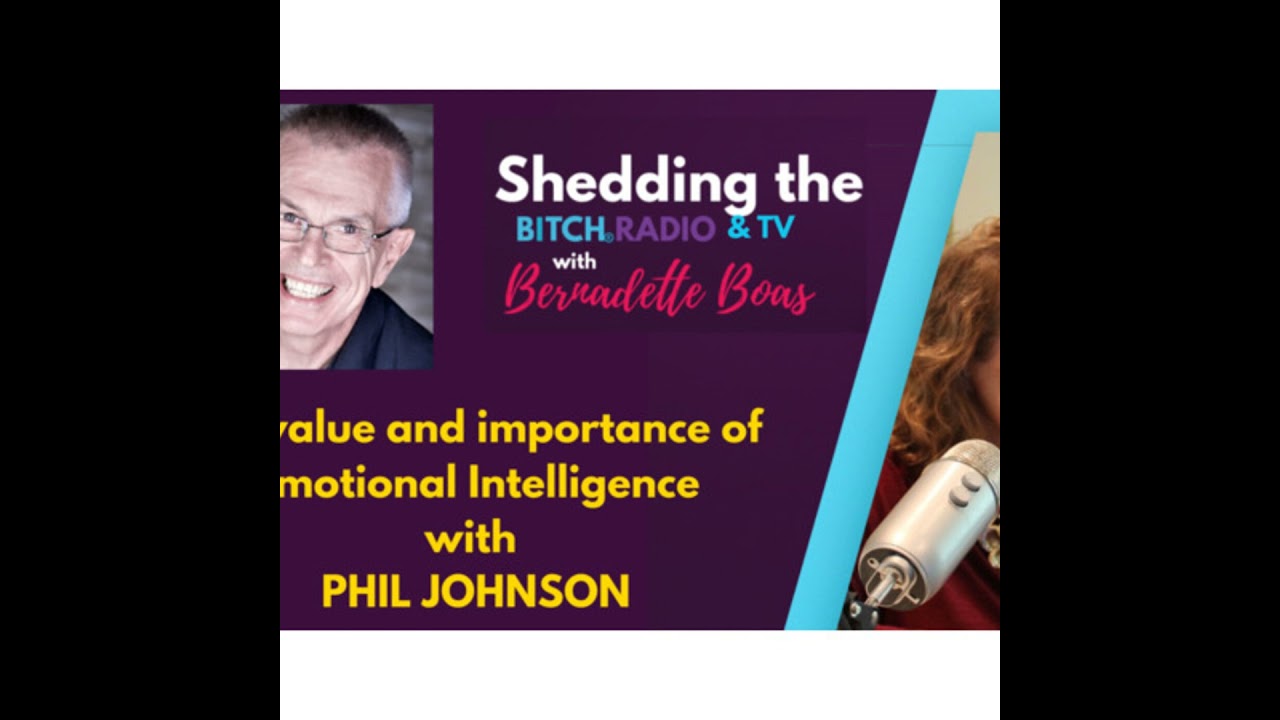
In this Shedding the Bitch Radio episode, host Bernadette Boas interviews executive coach Phil Johnson, founder of the Master of Business Leadership (MBL) program, to explore emotional intelligence (EI). Phil defines EI as the emotional labor required to leave one’s comfort zone, develop self‑awareness, raise consciousness, and become an inspirational leader. He explains that motivation stems from pain or passion, and that the brain’s amygdala, entrenched habits, and sociological resistance are three primary barriers to change. Phil describes how people often give away their energy through "victim habits" and how stopping this energy loss builds EI. He illustrates the massive ROI of EI with a penny‑doubling analogy and cites a trillion‑dollar "trust economy" where emotionally intelligent organizations outperform competitors. Apple is presented as a case study that hires for EI and creates a high‑trust customer experience. Practical steps include identifying a compelling desired result, creating a vision board, and committing emotionally to that goal. Phil shares his personal weight‑loss story as an example of EI in action. The conversation concludes with a call to action for listeners to engage with Phil’s MBL program, LinkedIn newsletter, and to begin their EI journey.
Chapters
Are you ready to create riches in your work and life? It's time for Shedding the Bitch Radio and TV, where you can discuss, debate, and get advice on how to discover and shed the bitches of fear, insecurity, self-doubt, and negativity so you can realize your dreams and life purpose and create and accelerate the riches in life you deserve. So let's welcome your ball of fire host, Bernadette Boas.
Good day, good day, good day everyone, and welcome to another episode of Shedding the Bitch Radio and TV. And today we are going to talk about emotional intelligence and why it's really, really, really critical and important and very valuable for you to understand exactly what it is and how it could benefit you at work and at life. But before we get there and before I introduce our guests, I want to just thank all of our new and ongoing listeners and viewers. You are catching us on any one of your podcast streaming services such as Apple Podcasts, BlogTalkRadio, Stitcher, and a number of other streaming services, as well as on our Shedding the Bitch TV YouTube channel. And you are liking, subscribing, tweeting, sharing, rating, and leaving us comments about the topics and the experts you want to you want to hear about. So please continue to do so, so we can get more eyes and ears onto the program, so we can help them shift from bitch to rich in their life. Now, I also need to thank our sponsors at North Georgia Tax Solutions. Debbie Snelling and her team are a full-service financial and tax services organization that services the entire country, and they have offices in various cities, and they provide support to both entrepreneurs and to corporate organizations, even from a personal perspective and a business perspective. So if you have any financial or tax services needs, please reach out to NG Tech Solutions at ngtechsolutions.com. A more local sponsor is our very own Up Top Roofing of Atlanta. Jay and his team do fabulous home services and roofing, um, work, and, uh, he is just absolutely top-notch when it comes to his customer service and delivery. So if you are in the Atlanta, Georgia area and you have any home services or roofing needs, please reach out to Jay, tell him I said hi at up-toproofingofatl@yahoo.com. All right, let's get into this subject for today. We are going to be talking about the value and the importance of emotional intelligence. And why is it important? What is emotional intelligence? How is it developed? So if you're not familiar with emotional intelligence, this is the episode for you. And then we're going to talk about why it's important and how it can influence your success at work and at home. Now, for any of our relatively new, um, viewers and listeners, I like to position a rich question to you which will help you ground yourself in the topic for today. So you might join us and say, oh, emotional intelligence, uh, this doesn't really relate to me. Well, I can pretty much assure you that our guest will hit a spot that is very relevant to you. So your rich question is simply, what do you know in regards to emotional intelligence? What do you know, which means what do you not know, when it comes to emotional intelligence? And then that way As we get into the conversation and he starts providing tips and, and strategies and reasons why it's very valuable and important to you both at work and at home, you can then answer that question for yourself. All right, let me introduce our guest, Phil Johnson. His first 20 years, it was as an executive which began in the semiconductor industry. For the past 24, 21 years, he has been an executive coach teacher and mentor dedicated to helping executives and organizations bet on themselves by developing their emotional intelligence. As founder and CEO of the Master of Business Leadership program, Phil offers members the opportunity for an extraordinary life filled with exponential success. MBL program alumni are living in the U.S., Canada, UK, Europe, Japan, Germany, and other countries around the world. So help me welcome Phil Johnson to the program. How are you, Phil?
I am great, Bernadette. It's a pleasure to be on your show.
Yo, I'm— I appreciate you being here because the subject of emotional intelligence, um, often goes over people's heads, and yet if they really get a good understanding of it, um, it, it can become a simple, a simple, uh, part of their lives that has huge, like like you said, exponential success for themselves. So before we get into all that though, tell us a little bit about you. Where are you calling us from? Where, you know, what, what, what is Phil all about?
Well, I'm cold where I'm in Toronto, Canada.
Nice.
I'm 68 years old. I've been on this emotional Intelligence Emotional Labor path for the last 54 years.
Wow.
I was born with dyslexia and that helped me to develop the abilities that I— that enabled me to do what I've been doing for the last 21 years. So I can— I don't know how much detail you want to hear but I It's a— I've had quite a challenging upbringing.
Right. Well, what was the— what was the kind of the springboard into this particular area that you've become an expert in?
Two things. First of all, being born with dyslexia caused me to do a lot of what I now refer to as emotional labor because my brain doesn't work the way most people's brains work. It's kind of like a blind person that develops great hearing. So, I needed to rely a lot more on my emotional intelligence as opposed to my intellectual intelligence.
Hmm.
Hmm. The second motivator was the death of my mother of breast cancer on December 3rd, 1967. In January of 1968, I decided I wanted to do this work, and I've been on, I've been on this path ever since for the last 54 years.
Wow.
Wow. Okay, so I do want to hear more about MBL, but at the same time, let's make sure everyone, you know, initially understands what emotional intelligence is. And if you would, maybe what it isn't, because I think there's a lot of confusion in people's minds as to what it is.
Great question. Very simply, emotional intelligence is developed by doing the emotional labor of leaving our comfort zone in order to achieve better results than we're currently getting. So if you think of it, If you have a desired result that you want to achieve, you need to leave your comfort zone in order to go and achieve it. And there's significant resistance to that happening, both biologically and sociologically. So you have to— when you leave your comfort zone, it automatically triggers anxiety and fear. And the process of moving through that fear towards what it is you're trying to achieve, the emotional labor that requires is what develops emotional intelligence. Actually, it develops emotional— it does 3 things. It develops our emotional intelligence. It increases our consciousness of what's going on in us and around us. And it develops inspirational leadership.
Okay. So let's break those three things down though, because one is, and why I brought up what it isn't, is, you know, I've heard that people say, well, it's just about self-awareness.
Sure.
And I, you know, isn't that just an element of it though?
Well, it's, it's, it's, it's about raising self-awareness is another way of saying consciousness and presence. And so, yes, that's true. We can't get— in order for us to get better results than we're currently getting, we need to raise our level of consciousness.
Right.
So that's true. And that process of raising our level of consciousness requires us to develop better habits that enables us to do that. That process, you develop better habits. It requires us to leave our comfort zone and go through the anxiety that that creates, the emotional labor that requires.
Yeah. Well, it's almost like no pain, no gain, right? You have to get uncomfortable in order to really go after the change or what it is that you want. Is that right?
Yeah, that's very well put. There's only two sources of motivation that will cause us to leave our comfort zone. There's only two things that will cause us to leave our comfort zone and do the emotional labor that requires. One is pain. The other one is passion. So very few people are connected with their passion. So those individuals that are motivated to move outside of their comfort zone are usually driven by pain. By pain, an urgent desire for better results than they're currently getting. In my case, my pain was dyslexia and my mother's death.
Right.
That motivated me to move towards a desired result that I was more connected with emotionally than the fear of moving outside of my comfort zone. So if the connection we have with our desired result isn't greater than the fear of moving outside of our comfort zone, we won't do it. We won't move out of our comfort zone. We may want better results than we're currently getting, but we will not be willing to do the emotional labor that getting those results requires.
But then you said there's only two reasons— or there's two reasons, and one of them is passion. Can't one kind of push through and get out of their comfort zone addressing, you know, addressing the pain, but then that as a result of that work, all of a sudden they start getting passionate about something.
Exactly.
And that allows them to then move.
Well, they both do, but you're right. In the journey, very often the initial motivation is pain, a desire to get away from something. But as you develop your emotional intelligence, your motivation begins to shift from trying to get away from something to moving towards something. So you're moving from a motivation based on fear or pain to a motivation based on passion or love.
Right, right, right. And why— What have you found in the work that you've done? Um, because it, it sounds so depressing that, you know, we have to want pain in order then to move our, you know, to move ourselves. Why is it so hard for human beings to just do it because, you know, Phil's telling us we should, and I'm not necessarily in a lot of pain right now, but I do want a change?
That is a great question. You are a master at asking fantastic questions. There are 3 primary sources of resistance to change. But before I tell you what they are, I want to tell you why the development of our emotional intelligence is so important, why it's so important to deal with these barriers we have to change. We're facing a tsunami of change with a 500-million-year-old brain that doesn't like change. So some scientists estimate that in this century we could experience the equivalent of roughly 20,000 years worth of change. Never happened before.
Wow.
So change is increasing at an exponential rate. Wow. And we've got a 500-million-year-old brain that doesn't like change, and I'll explain more about that shortly. So whether we like it or not, we're all being ripped out of our comfort zones. And the only— that's going to create increasing levels of drama, chaos, and conflict, and I'll explain why. So that the only thing we can do to try and better navigate our way through the accelerating, the exponential rate of change we're facing is the development of our emotional intelligence. Let me explain why. So there's two primary sources of biological resistance we have to change, and there's one sociological source of resistance. Let me explain all three. The first one is our amygdala. It's part of our old lizard brain that's been trying to keep us safe and alive for the last 500 million years. And the way it's done that is by making sure that we never leave the safety of our cave or never leave the safety of our comfort zone. And if we do, it secretes a hormone into our bloodstream called cortisol. It causes the executive center of our brain, our prefrontal cortex, to shut off, and we go into what psychologists refer to as an amygdala hijack. We go into fight, flight, or freeze mode. Some people lash out, some people run away, some people freeze like a deer in headlights. And when that happens in conflict situations, people die. And when it happens in business or personal situations, relationships die. We burn trust. So here's an analogy. If you think of your amygdala as a very frightened 4-year-old child, The development of our emotional intelligence acts like a big sister or a big brother to quiet the amygdala response down and better enable us to feel the fear and anxiety that change and innovation always creates in us, but it allows us to move through it towards the vision of our desired results as opposed to allowing that anxiety to keep us trapped in our comfort zone. Okay?
Okay.
All right. That's the first biological source of resistance.
Okay.
Is our existing habits. See, we're only conscious about 3 to 5% of the time. The rest of the time we're relying on our habits to determine our behavior and our results. So once you develop a habit, it's there forever. It's a— it's— we develop our habit through our actions. It's called— it's actually a neural network pathway that gets created in our brain. And we can develop new habits at any age. It's called brain plasticity or neurogenesis. So even though we can develop new habits at any age, the new habits are gonna be weaker than the old habits, even if they're better. So there's gonna be an internal battle between the old habits and the new habits for control. So that's the second source of biological resistance to change. The third source is sociological, meaning that the people around us don't want us to change.
Yeah.
Because if we change and start to get better results, maybe they're gonna have to change and that scares the hell out of them.
Right.
And the best way to ensure they don't have to change is to make sure we fail. So they can say to us, "Hey, you know, I told you." And get your head down and shut up and get back into the herd with the rest of us.
Yeah.
So there's 3 primary sources of resistance to change that we need to overcome in order to develop our emotional intelligence.
And which one of those three, the amygdala, existing habits, or our sociological environment, which one would you say is the easiest or, or the first thing that someone can start addressing should they want to go down this path and know that they want to change and need to change?
The good thing is that as you go down this path, you address all of them at the same time. Let me give you one other piece of— let me give your listeners one other piece of information. And it's something that I've been proving over the last 21 years. And then I'm gonna give you an example of a trillion-dollar-a-year company that's using what we're talking about. Okay.
Okay.
So when we're born, as I said, we're not born with a conscious mind. Our conscious mind doesn't begin until we're about a year or so old. But we are born with an unconscious mind. So we immediately start wiring up our brain. We immediately start creating the neural network pathways that become our habits in order to survive, in order to get food, fit in, all of that.
Survive.
Survive.
Right.
And a lot of those habits are what I call victim habits. They're habits that cause us to unconsciously give away our energy. And we do it in a myriad of ways, how we communicate, listen, take responsibility, make decisions, all sorts of ways. And when we do that, it creates an energy deficit in us. E equals mc squared, energy can't be created or destroyed, it just changes form. So that when we're unconsciously giving away our energy over here, We have to replace that energy by simultaneously looking to steal the energy of other people over here. And that dynamic is going on inside of everybody, everywhere, all the time, all over the planet, unconsciously.
As long as they unconscious, or as long as they don't know it consciously that they're acting in a victim type of mindset, correct?
Correct.
Okay.
Okay. So what I show them in the MBL program is how they're giving away their energy, and I give them better habits to practice to stop doing that. And when they stop giving away their energy, their need to steal the energy of other people goes away. And it's in that process that they develop their emotional intelligence, that they become more conscious about what's going on in them and around them, and they become more inspirational leaders. So all three of those things are results that happen by learning to stop giving away your energy.
Right, right, right. But are you also saying, like, I had asked about whether one can be worked on before another can be worked on, and you said all three of them are affected. So are they all kind of dependent on each other?
Of course.
And they're— and yet I can't start working on my habits right now versus worrying about if I'm, you know, playing victim or if I'm allowing other people to pull me down because they don't want me to succeed. Or, you know, I'm kind of more sequential, I guess, in what can I do first, second, or third, knowing that all of them, all of those steps will affect all three areas.
I'll give you an example. But yes, everything is all interconnected, including all of our habits. Our habits are all interconnected to produce our behavior and our results. So here's an example of how people often give away their energy in their listening. The key to authentic listening is not to take anything personally. If how I feel about myself is based on how you feel about me, who's in control of me? Me or you?
You.
No, you are.
No, well, I'm sorry. I was relating it the other way around to me. I am. I'm controlling you.
Right, because I'm giving you my energy to determine how I should feel about me. If you like me, I like me. If you don't like me, I don't like me.
Right. Correct.
I show people how to stop doing that, and that's one of the ways they become more conscious, emotionally intelligent, and better leaders. And we're doing this— think about social media. We're crying for people to like us. We're basing how we feel about ourselves based on— see, that's an ego-based fear.
It's so true.
So it gives you a sense. Of how baked in this victim, this unconscious victim mentality is.
Right, right. It's so true. It's so true. And yet, yes, and we could tell that to people and they're just like, whatever, you know, because they don't see, they don't see that in themselves.
They don't. Let me give you an analogy. Let me, uh, so in my career I've generated I've helped organizations generate over $1.5 billion in revenue. And I can tell you that it's directly related to level of emotional intelligence. Directly. I've worked with people running multi-billion-dollar companies with thousands of employees and Harvard MBAs and PhDs and been a faculty advisor, everything in between. See, people, We were— our educational system and our employment system has failed us. And they failed us dramatically by focusing on intellectual intelligence, and they've done little or nothing to develop our emotional intelligence. Let me give you an example. So our ability to do intellectual labor is largely genetic. If you've got a high IQ, Your parents have a high IQ, their parents had a high IQ, and you inherited it. So let's say that— let's equate intellectual intelligence with somebody getting $10,000 a day for 31 days. So at the end of 31 days, you've got $310,000. The development of emotional intelligence is not genetic. It's something that anybody can do. It's based on your actions.
Right.
So look at that as a penny doubling every day for 31 days. Day 1, you've got a penny. Day 2, you've got 2 pennies. Day 3, you've got 4 pennies. Day 31, you've got $10.7 million. Day 40, you've got over $5 billion. Day 50, you've got over $5 trillion. The point is it doesn't take any more effort to go from day 1 to day 2. Day 30 to day 31 than it did to go from day 1 to day 2. But it's a journey. It's a consciousness-building process. So the ROI, the ROI from developing your emotional intelligence is never-ending. It's massive. Another way to look at it is think of an iceberg and think of the 1/10 of the iceberg out of the water as intellectual intelligence and the 9/10 under the water as emotional intelligence. Developing our emotional intelligence to work with our intellectual intelligence creates a massive results multiplier.
Okay. So, yeah, so the company that you were talking about, or the companies that you were talking about that had allowed you, and you helped them to, you know, to generate more than a billion dollars in business, and you said it was because of emotional intelligence. Where was that sitting? Was that sitting at the CEO level of which then he pushed it, that he or she pushed it down? Was it sitting— where did it kind of emanate from?
It's been all over. It's been all over. But I would say, I would say if I were going to make a general statement, that it it often comes from the middle of the organization, not from the top of the organization. Although it has come from the top of some organizations, but for the most part, the people at the top of the organization have the least amount of emotional intelligence.
Right. Well, yes, I can see that.
They're going to be the last ones to see it.
Right. Okay, so, so kind of what you do with MBL is you provide programs to kind of instill emotional intelligence, um, not only in one person but in the culture and in everything that they do, in order for them, you know, individually and then collectively, correct, be able to kind of transform how they go about doing business.
Yep.
Okay, so you had mentioned a trillion-dollar company. Yep.
I'm going to give you an example of a company that you're going to recognize as soon as I tell you who it is, that all of your listeners will recognize. I'm kind of baiting the hook here. But their primary focus on hiring and promoting and developing is on emotional intelligence. How?
In what way?
They look for it in the interview process. There's a number of ways you can determine a person's level of emotional intelligence.
Sure.
But that's what they're looking for. They're less interested in what the person knows about their products and services. They can teach them that. But the scarce commodity they're looking for, the most valuable commodity they're looking for, is above-average levels of emotional emotional intelligence.
And is that at any position, or is that at certain key positions? It's at any position.
And that company is Apple. And that's why, if you've ever been into an Apple Store, that energy you feel is an example of a more emotionally intelligent environment. And that energy is different than the stores surrounding it.
Sure, absolutely.
When you, when you go into an Apple Store, they're not trying to sell you anything. They're trying to understand your pain and offer a solution if possible. Whether you buy anything or not is secondary to them wanting to serve you. They want you to have a great experience, and maybe you'll tell your friends and maybe they'll tell their friends.
Right. Now, but in, in, in a practical sense, does that mean that not only are they looking for it in the hiring process, but they're also probably training and developing it? And what it looks like practically, what it looks like, because this is where people have a hard time with emotional intelligence, but what it looks like practically is that those individuals, let's say an Apple Store, all the, all the, you know, customer service people in the Apple Store, they are genuinely and authentically interested in you. And what— and they— and you mentioned listening before, and they are, they are, you know, intently, um, purposely actively listening so then they can kind of be compassionate and understanding.
Let me give you another piece of information.
Is that right?
Let me give you another piece of information. Because we've evolved from herds, tribes, we've lived in society, we've lived in culture, it's, it's been important for us to develop the ability to sense whether somebody's trying to eat us or help us. So we have these specialized brain cells in our prefrontal cortex that we've evolved called— brain scientists call them mirror neurons. I call them bullshit meters. That's why you can have a conversation. You can walk into a room and sense the energy in the room.
Right.
You can have a conversation with somebody and sense whether they're being real or not, whether they're trying to help you or trying to use you. So you can't fake being authentic because we pick up on it.
Right.
We have these built-in sensors.
Yeah.
So developing our emotional intelligence demonstrates trustability. And there's something called the trust economy because of the accelerating rate of global change. We're having to rely on the people we trust more and more to help us make decisions. Sure. Trust economy is growing much faster than the traditional economy. It's currently estimated at over $1 trillion a year in business. So as we learn to lower our walls and stop giving away our energy and stop trying to steal the energy of other people. We're actually demonstrating trustability.
Yeah, I would— yes, yes, I understand that. Yes, yep, that's great. Yep. Well, because to your point, aren't you saying that once an individual becomes a lot more self-aware, a lot more astute to what they're, you know, what's working for them, what's working against them, who's draining their energy, who's gaining their energy, they're learning more confidence, they're learning more to be more open and therefore more trusting.
Yes.
Right?
Yep. See, that's one of the byproducts, that's one of the characteristics of emotional intelligence. There's a—
Is what, trust? Is trust.
Confidence.
Confidence. Oh, confidence. Yeah.
Yeah. I was going to say something, I forget what I was going to say.
Um, well, can you define— because I don't want it to pass, um, just so easily— can you define what you mean by a trust economy for those that, you know, might be sitting there going, what is this man talking about when it comes to it being a, you know, a trillion-dollar industry or whatever? What do you mean by trust economy? What does that look like business-wise?
Okay. If you're in sales, and we're all in sales.
Oh yeah, every one of us, yep.
If your walls are up, you're not really trying to serve the person, you're trying to understand how to manipulate the person to get their money, to get the business. Mm-hmm. And that's what comes across in your energy level. If your walls are down, the other person will pick up on it. And they'll pick up that you're, hey, you're truly interested in me, you truly want to, you really want to help me. If somebody trusts you, you may not have the best technology or the best pricing, but if they want to work with you, they'll find a way to work with you.
Right.
They don't want to work with you. They'll find a way not to work with you, right? Even if you have the best technology and the best pricing. So developing your— get ready for this. Here's a, here's a phrase for you. Developing your emotional intelligence will enable you to out-care your competition.
Oh, I love that. I love that. Is that a Philonism?
It is actually. The biggest Yes, it's, um, will self-care, but repeat it. Well, developing your emotional intelligence will enable you to out-care your competition.
I love that. Yep, I love that.
And the biggest pieces of business always go to the trusted advisor.
Yes, yes.
So they're going to give, you know, the most critical, the most mission-critical pieces of business are going to go to the people they trust. Others may get business that falls off the table, but it will be a fraction of what they could be getting if they develop their emotional intelligence.
Right, right, right. Yeah, I absolutely love that. So what would you suggest to our viewers and listeners as far as what they could be doing with the information that they're hearing right now and seeing right now. And they could go back and rewind and, and listen to this multiple times to capture the different concepts that Phil is talking about. But what would you say would be one practical thing that they could start doing in order to work their way, apart from reaching out to you, which I just put up your LinkedIn, LinkedIn reaching out to you, what could they start doing to really get on the EI bandwagon?
It's always the same thing for everybody. And the first step is always to develop a strong emotional connection to a desired result that motivates them to leave their comfort zone. That's always— see, that that strong connection, that emotional connection to a desired result becomes the fuel for the journey.
Right, right.
Without that, you're not going anywhere.
Yep. Yeah. Is it almost like I talk about the why spot? You know, it's almost like find that why that'll allow you to— is that the same that you're saying is that desired result?
Yes, yes. Okay, so that desired result, that motivation to achieve that desired result needs to be stronger than the fear that gets generated by your amygdala when you leave your comfort zone. Right, right. So the desired result, what you're trying to achieve, has to be stronger than the fear of starting down that path.
Yep, yep. And, you know, in simple terms too, I'll never forget having this conversation with someone, and I so wish I knew you then. So I— and about emotional intelligence, when I was talking with this woman, and it actually turned out to be a— turned into a dear friend and a client of mine, but this was many years ago. She was— she was as desperate as she was to lose weight, and she still— it wasn't stronger than the fear of the fact that other people— the sociological that you talked about— that other people don't want her to lose weight and they keep sabotaging her to lose when she tries to lose weight, because then what would they do if she changes? What will they do if she grows? What will they do if, you know, she transforms? Um, and it's always, always pained me, and I wish I had your words that you're using today to kind of express to her kind of the path that she would need to take in order to get to that point where, you know, her desired result has to be stronger than that sociological fear.
Can I, can I share my screen with you? I don't know if we can do that.
I'm not sure if we can either. Okay.
Yeah.
And plus, we're on radio.
So, okay. So I lost 104 pounds. In 2 years.
Oh, wow.
I went from when I was 58, 10 years ago, I decided I weighed 283 pounds.
Wow, I would never, ever.
And it's just weight I had put on over the years.
Right, sure. I just can't see it. I, you know, I just can't imagine you that way, but go ahead.
I decided I love what I do and I want to do it for as long as I can. So I decided I needed to dump some weight. So I looked at what I needed to be for my height, and it was 195 pounds. So I actually went from 283 to 184.
Wow.
In 2 years, and it went just like that.
Wow.
I lost an average of 0.7 pounds a week. It's pretty, almost a pretty straight line. Now, all sorts of ups and downs, but—
Sure.
But the reason I was able to do that was because I made a commitment to doing it. An emotional commitment to myself that fueled, that drove my actions.
Okay.
And that commitment was stronger than the anxiety that I experienced every day along the way.
Right, right.
But I never lost, I never lost track of the end result.
What do you do for that? Do you like put up a sign? Do you like, you know, the people are always looking for kind of how do I hold on to or how do I represent my desired results?
You could create a vision board. I have a vision board. That's one of the things I use, right? The vision board is a reminder of what it is I'm seeking to achieve.
Nice.
It's my why. It's a reminder of the importance of the work I'm doing.
Right, right. Wow, that's amazing. How long ago was that?
Which?
That you lost 100— that you lost all that weight. How long has it been?
10 years. It was— I started— well, hang on. I started in September of 2011. And by December of 2013— oh, right, you did say I'd lost 104 pounds.
Nice, congratulations! And you've kept it off, obviously.
Most of it. Yeah, all of it.
Yeah, yeah. Nice, nice. All right, so we all need to get to the point where— would you say that we know ourselves and what makes us tick?
No?
We just need to find that desired result?
We are— we hardly know ourselves at all. We're not very far away from being Neanderthals bumping into each other. We have— we know almost nothing about who we are and other people. That's why the world is the way it is.
Right.
We have a long, long way to go. The challenge we really have is that we're facing a century of rapidly accelerating change with a 500-million-year-old brain.
Right.
That takes an awfully long time to change.
Yeah, it's— that's—
so, um, we need to be developing our emotional intelligence to be able to deal with the anxiety that change— that the changes we're facing and will continue to face is going to create in us. We need to be developing our emotional intelligence to deal with the fear and anxiety, the drama, chaos, and conflict that change automatically triggers in us.
Right.
Quite frankly, I believe we're at a tipping point as a species. If we don't change our trajectory dramatically in these next couple of decades, I don't think we make it out of here. All right.
Oh, oh.
I'm not, but it's not, that's not a negative. That's not a bad thing.
Right.
It's, it's, it's, We've gotta start facing reality. We're dealing with things like climate change and CRISPR-Cas9 gene editing technology and AI and other pandemics. And we've gotta learn to make better choices without making mistakes. Mark Twain once said, "If the only way mankind can learn is through experience, I see no hope for mankind." So in other words, if the only way we can learn to not put our hand on the stove.
Right.
By putting our hand on the stove, we're assuming that we can do that and be around to learn from it.
Right. For a long time.
There are some things that you've got to get right the first time. Yeah. You don't get a do-over.
Right.
Right. That requires us to develop a higher level of consciousness by developing our emotional intelligence.
Okay. So, um, So one can go and really kind of dig deep to find that desired result that they want. That's the first step. The first step. And how can you support them in that?
I use that— I guide them. I'm like a Sherpa. If you have the motivation, I can guide you on the path to developing your emotional intelligence, to raising your level of consciousness, and to become a more authentic, trusted leader. But if you don't have that motivation, I can't help you.
Right, right. So some— so someone listening or watching first needs to dig deep to find that motivation, that— and which turns into commitment, right? And, and, and then maybe identifying that desired result. But maybe they're not even clear on that, you know. Then you can help them get clear on that because I, you know, I know for myself, there was many years where I really never acknowledged what it was that I really wanted. And many people deal with that. They're just afraid. They think they're boasting. They think that they're taking things for granted. Yeah, so you can follow them along.
You're right, Bernadette, that the connection we have with that vision gets stronger and stronger as we move towards it. So, but initially you have to have, you have to have the motivation to begin the journey.
Right, right. Yep. Right, everyone, you heard it from Phil, your Sherpa. You now have a Sherpa in your corner and that's Phil Johnson. So definitely check him out, link in with him. His LinkedIn handle is Philip JP Johnson. And you can, you know, hook into him, reach out to him there. You can also sign up for his newsletter, and I will be providing this for those of you listening and/or watching. I'll provide these links as well in all of the content that we put out there. But there is a newsletter that he provides that he has— how many people? 5,000?
5,000. I just started it a few weeks ago.
Wow.
I'm pleased with I'm pleased with the number of people that are subscribing. It's on LinkedIn, by the way. It's a LinkedIn newsletter.
Right. That's fabulous. Fabulous. Fabulous. And then, you know, ask him simply, all right, I am motivated, but I'm kind of unclear and feel a little lost and just need some guidance from a Sherpa. And therefore, Phil can be your guide. Phil, thank you so much. It's been very, very— I love this whole subject. And yet I've learned so many new things. I have like notes, um, so I so, so, so appreciate you being part of the program.
I'm honored to be with you, and I, I appreciate the work you're doing.
Oh, well, you as well, you as well. And thank you very much. And for everyone out there, um, please check him out. I'm going to put up his LinkedIn one last time because again, once you link in with him, you can get his newsletter and you can kind of reach out to him as well in a message. Um, get the help you need to really kind of really understand how emotional intelligence can help you succeed in all areas of your life. Love it, love it, love it. All right, and then for everyone in our community, um, I will look forward to having you right back here next Tuesday at noon Eastern time for another episode of Shedding the Bitch Radio and TV. So you all have a prosperous and rich week, and we'll talk soon. Bye everybody.
Thank you for taking part in Shedding the Bitch Radio and TV with Bernadette Boas. We would love to know what your biggest takeaway was. Go to Shedding the Bitch on Facebook or YouTube and leave a comment. You can also subscribe to the show on Apple Podcasts and YouTube so you don't miss a single episode of the show. And with your input, we can help other powerhouse women just like you find the show and decide if it's right for them. Learn more about Bernadette at balloffirecoaching.com. See you next week.
More from Bernadette



From Stuck to Leading, Episode 2 — Meet the 5 Inner Fears Destroying Your Leadership



