Travis Crutcher talks Toxic Leadership and the Damage to Businesses
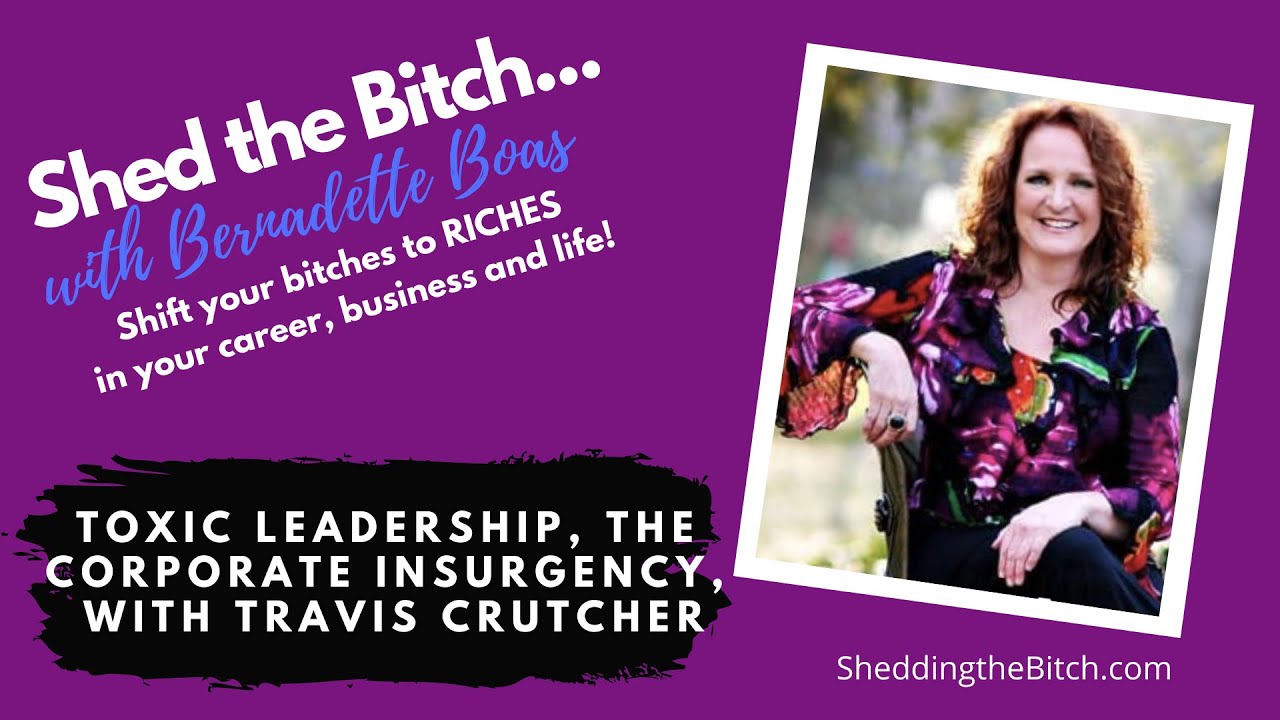
In this Shedding the Bitch Radio episode, host Bernadette Boas interviews retired Army senior NCO Travis Crutcher about the damaging effects of toxic leadership and how to counteract them. Crutcher defines toxic leadership using a military insurgency analogy, highlighting fear‑based control, undermining of order, and self‑centered decision‑making. He explains how such behavior drives turnover, stifles innovation, erodes morale, and spills over into employees’ personal lives, creating anxiety and disengagement. The conversation pivots to servant leadership as the antidote, distilled into the simple mantra “you eat last,” emphasizing personal connection, trust, and empowerment. Crutcher shares concrete tactics for individuals stuck under a toxic manager—using checklists, leveraging trusted peers, and practicing resilience skills like reframing catastrophizing thoughts. He also stresses the importance of building trust through first‑name culture and sharing credit, drawing on his military experience. The episode concludes with practical resources: Crutcher’s Above Average Leadership website, podcast, YouTube channel, and contact information for listeners seeking help.
Chapters
Hello and welcome to Shedding the Bitch Radio, where you can discuss, debate, and get advice on how to discover and shed the bitches of fear, insecurity, self-doubt, and negative mindsets so you can realize your dreams and life purpose and create and accelerate the riches you want in life. Join us here live every Tuesday at noon Eastern and dialogue with us at 818-572-2910. You can also chat with us at blogtalkradio.com/sheddingthebitch or share your stories on our website at sheddingthebitch.com. Whatever Whatever the bitch is that's holding you back from living your life to the fullest, it's not worth giving up the riches in life that you deserve. So call in now and let Bernadette Boas know what's holding you back. 818-572-2910.
Welcome, welcome, welcome everybody. Happy, happy, happy day and welcome to Shedding the Bitch Radio. Yes, of course I'm Bernadette Boas and we have actually a great conversation today. We always do. But I love talking about toxic leadership, as you all know. After all, you're listening to Shedding the Bitch Radio. But before we get into all of that, just welcome to all the new listeners that might be joining us for the first time. Welcome, welcome, welcome. We love having you, whether you are downloading our podcast on any one of the streaming services, or you are joining us on our Shedding the Bitch TV YouTube channel. Seeing our lovely faces. And if you're an ongoing regular visitor to the program, then thank you so much for your support and for your regular attendance, your listenership. And please feel free— we'd love it if you did— be sure you're liking, you're following, you're subscribing, you're rating whatever you can do to kind of share and talk and, and review our program, leaving us comments about what you like, what ideas you might have for future discussions, anything that would allow and ensure that we are getting our messages across to even more and more people. So your likes and follows and shares and ratings help us tremendously, whether that is on Blog Talk Radio, whether it's on Apple Podcasts, iTunes, or any of the streaming services, and on our Shedding the Bitch TV YouTube channel. So we certainly would welcome your input to that. Lastly, I need to thank our sponsor of this particular episode, North Georgia Tax Solutions, and Debbie Snelling and her whole team. Now she services the entire country, not just Georgia, and she provides full-service financial and tax services to small to corporate-size clients. So you can learn more about her, reach out to her at ngtaxsolutions.com. Now, like I said, today we have our smiling guest Travis with us, and we're going to be talking about how the negative effects of toxic leadership has on an organization, how to find it, and how to overcome it. Basically, toxic leadership is one of the biggest disconnects between top-tier leaders' expo— espoused values, processes, and desired outcomes, and those that are trying to influence. It's like a malicious game of telephone where the end state is typically a far cry from the intended message. It causes individuals to feel disenfranchised and can rob an organization of people, potential, and ultimately profits. I love that— people, potential, and ultimate profits.
Love it, love it, love it.
So what you want to be listening for— and then I'll give you your Rich question and explain that— but what you want to be listening for is what toxic leadership looks like and how to spot it. You want to hear— listen for the negative effects toxic leadership can have on an organization, key principles to inoculate in order to combat toxic leadership and results of leading without toxicity and the benefits of all parties involved. Now, for Travis and those listening for the first time, we like to ground our conversation in a rich question. And a rich question is one that is relevant to this topic that you can think about how it relates to your life. And whether it is at work or even at home when it comes to toxic leadership. So your rich question today is, what or whom creates the biggest amount of havoc for you in your work or career? So what or whom creates the biggest amount of toxicity at home or at work? Think about that. Because it might bring up some, "Ooh, you're right." And then I'm sure our guest will give you all of the tips and advice that you would need to be able to confront it, address it, and overcome it. All right? But let's learn a little bit more about our guest. Travis Crutcher is a retired infantry senior noncommissioned officer and Ranger. He served in multiple senior leadership positions both statewide as well as deployed, or states-wide as well as deployed. During his time in service, Travis cultivated his leadership style and helped junior leaders develop into the next generation of dynamic leaders. Since retiring from the United States Army, Travis has continued his work to help companies, leaders, and individuals unlock their potential. He does, he does this by sharing over 15 years of leadership experience, candid real-world stories, scientifically proven resiliency methods, and applicable interpersonal skills. By including— but I'm sorry, by inculcating— oh, I messed that up— Travis's methodologies, leaders are empowered to get clarity, increase influence, and make lasting Sustainable Impact. Wow, that's a— no, that's a mouthful, but that's powerful. That is so powerful. So welcome, Travis. How are you? I am awesome.
How are you today, Bernadette Boas?
I am fantastic. Fantastic. So before we get into all of that, tell us a little bit about yourself personally, and then how did you get into this area of We know a bit about it, but why is it so important to you to be kind of deep into the area of business that you're in? Sure.
So personally, I mean, the big important stuff about me is I'm married to probably the most resilient woman on the planet. She started dating me in 1997. So, oh wow, full, full gangster cred. And I got 4 awesome kiddos. My oldest is Levi, and then I've got 3 girls right behind him, Riley, Maddie, and then Hannah rounding up the set. So they are now, and have been since '97, the motivation for pretty much everything I do.
Yeah, I don't blame you. And I, you know, I don't blame you. That's beautiful. That's beautiful, beautiful, beautiful. Now while I, um, kind of prepare the next question, check your sound because all of a sudden you went very low in, um, your volume.
Better? A little bit better, really?
Yeah, that's good. That's good. Yeah, I'm not sure what that might have been. So why this issue? Obviously, you were in top leadership positions while you're in the Army. When you came out of the Army, what did you see? What did you experience that made you then kind of say, hmm, we need to be addressing these toxic environments that are out there?
You know, I was very fortunate in my career. Really only encountered, I think, over the entirety of it, from private to senior noncommissioned officer, maybe two what I would consider toxic leaders. And so I was very fortunate in having seen, you know, good leadership throughout my career. And there were so many things that were just norms for us, stuff that were just standard behaviors of any leader. And then when I transitioned to the civilian sector, I know there's a lot of civilians listening, so no offense, but to me, it was— there was a drastic lack of what I would consider genuine leadership. And a lot of times what I've seen, it's not even that they don't want to, it's that most leadership programs that are used for training don't really equip them to know how to lead effectively, if that makes sense.
Oh, that absolutely makes sense. It's a world that I live in as well. So, and as you can see in the behind me, it's certainly something that I actually created that toxicity, let alone, you know, work to overcome it as well. So where's your sweet spot? Like what is, what really, you know, do you hone in on and, you know, kind of help to solve when it comes to working with, you know, your clients? What do you see out there and experience?
I hate to boil it down to one phrase. However, it's my ultimate goal for anyone I work with is to get them to inculcate servant leadership. And going back to the previous point, you know, always there's a lot of— I mean, companies spend hundreds of thousands, if not more, dollars on these leadership programs for their management teams and their executives. Yep. And I have been privy to one where they've got a slide that says servant leadership. I'm like, okay, here we go, we're talking my language. And the instructor goes, servant leadership. And to the vacant faces, they're like, uh-huh. Never an explanation as to what it was or how to apply it. So, mind totally blown by that.
Wow. Well, of course, because he obviously— he or she obviously assumed everyone understands what servant leadership is.
Sure.
And yet, no. When you see those blank faces, it means A little bit more, please. I'm not quite sure what you're talking about, right? Yeah, yeah. So what are some— what, in your view, what are some of the characteristics of a toxic leader?
So I, I like to use it. It's a pretty extreme analogy, but if you, if you allow me to, you know, elaborate a little bit, it'll make sense. Um, I, I think toxic, toxic leadership is very akin to an insurgency. So I kind of draw it to something I'm familiar with. Spent a lot of years fighting insurgencies, and they have a tendency to do certain things across the board, no matter where in the world they are. They like to undermine good order and discipline, right? Like to undermine the governing body. Whatever they're saying, they want to undermine it. Number 2 is they really enjoy ruling by fear. And that's— and it And what's really strange about it is initially there's a lot of pushback towards that toxicity, but because they rule through fear, eventually people start to drink that, you know, funky Kool-Aid and follow suit. And then you end up in this like cyclic loop of toxic leaderships raising new toxic leaderships. So you'll have those folks who've been with an organization 8, 10 years and they won't even know that what they're doing is toxic because that's just what they were shown from the day they got there.
Yep, yep, yep.
And so that, you know, step one is identifying what it looks like. And, you know, I think of it because there's not a— there's not a Jeff Bezos, there's no CEO of any company on the planet today who doesn't know how important the people are to their organization.
Yeah.
Yes. And toxic leaders are very much about me. And not about the people. And so what happens is, no matter what, what new innovation they've come up with at this level, the corporate level— I use air quotes because it's corporate gets thrown around like a bad word a lot, you know— um, whatever innovation is come up with at that level that is subsequently supposed to make the job of the doer exponentially easier, right? You've got that toxic leader in the way undermining that level of leadership, saying they're doing this to make our lives more difficult. All they do is hunt the negative and they never extract the good.
So from a characteristics perspective, so I heard fear, right? What does that look like? So if I wanted to, if I wanted to pay attention to and make sure I'm able to identify, um, in, you know, whether it's at work or at home, um, a toxic environment What— and how does that fear-based individual, you know, how— what are they projecting?
Man, like any good dictatorship throughout history, really, they, they like to— their, their way is the right way, period. They will harp on— and don't get me wrong, processes are important, but they will harp on processes to the detriment of a team, you know. They will, they will force the function of the company goal rather than focus on the collective goals of the individuals. You know, they're very detached from what a people-centric leadership role is supposed to look like. And so it's very— do because I said— that's a big one. And if you were to challenge these folks with all the things they espouse that you're supposed to execute at such a high level with, well, can you show me how to do it? I mean, that's your first telling moment because they're not going to have a clue how to do what they're telling you to do.
Yeah, no, I would absolutely agree with that. I mean, you know, just from personal experience, that fear could also be— what, you agree, would it be looking like intimidation, you know, grandiose expectations, not even high standards, but grandiose expectations, very demanding, very— it can even— do you see like curtness and abrasiveness and demeaning and diminishing. You know, would you describe toxic leaders in those ways as well?
I, I think condescending is a better catchment for that because a lot of times they know they can't get away with saying what they probably want to, right? And the other thing when it comes to theories is they lead in a repercussions-based way, in a negative way and a consequences way. And now don't get me wrong, I'm not saying that you've got to walk, you know, the respective area of your employees and pat them on the back every 5 seconds. I don't believe in participation trophies, but I do believe in showing appreciation. And when, when the only reward for me showing up and giving 110% is my paycheck, I'll go get that someplace else.
Yeah, yeah.
And that's where that talent loss comes in, because people will walk away and There are people who will take a pay cut to get away from that kind of leadership.
Sure, sure. Well, and that brings me to my question of— I'm running through my head all the scenarios and what that looks like, but what is the impact to the people receiving this toxicity from— well, I don't even want to call them a leader because they're not a leader if they're in any way, you know, living in, you know, causing other people to live in fear, right? But what is— what are the individuals being impacted by this person? What are they feeling, experiencing, dealing with?
I mean, so, you know, I don't think that there's a company on the planet that wants turnover, but that is easily going to be the quickest thing that this results in. Because when those folks— when you get that job application, you get that call back and they say you're hired, everyone's excited. It doesn't matter what the job is, everyone's excited. And I believe that there's not a person on the planet that doesn't want to succeed. And so whether they're pushing carts at the grocery store, you know, in the back of a successful thinker's head is, I'm going to be the leader of this company one day. And if that's where they're hitting the ground running with that mindset, and then they get hit with this toxic leadership that, I mean, it stifles creativity, it cripples innovation. You know, there's no way to have a good idea because you don't matter to that leader. And so you feel trapped. And so instead of coming to succeed every day, now you're stuck in the job. And anyone who's ever been stuck in the job knows just how, how soul-crushing that can be, right? It's just miserable.
Yeah.
I mean, you start to have a miniature panic attack when you pull in the parking lot, you know, and you know, oh, I'm here for 10 hours. You got to be joking. And so, and then, and it also, you know, that bleeds out to the team because you, you may have that one person that's been there and they're your apex predator. You know, they can come in and knock out anything with very limited or no operational oversight. And that toxic leader is going to start what I call performance punishment. And it's going to be, I'm going to overtask you every time because I know you can. And so now you've got your, your killer who could come in there and run it single-handedly, 2 months of that, they're disenfranchised. They're calling in because it's Tuesday, and by Wednesday they're finding a new job. And so your talent pool diminishes so quickly. The innovation is zapped from that kind of leadership. Right.
What— so then they obviously, you know, forget about the talent turnover in the workplace, but those— and those individuals leaving and looking for another job. But like you said, I mean, it's creating such emotional havoc on that individual that to where they go home and it could be very kind of life transforming in a negative, bad way, right?
I mean, you know, you got to figure most folks spend the vast majority of their awake life at work. And so if it was just start to finish miserable, you're not a real nice person when you walk through the door. It doesn't matter how cute your puppy is, you're like, get away from me, you know. It doesn't matter. And, and so what happens then— so it's, it's so unfair on so many levels, you know. And I know not everything's going to be fair, but you got this leader who is, is not treating you like a human at all. There's no dignity, there's no respect. And so you're getting hit that way, and then you're just— you're paying it forward in a negative aspect when you get home because you're not very much fun to be around because you walk in a surly bear, and no one wants to be around a surly bear.
Right, right.
And you know, it's— and the other thing too, Bernadette, is there's— it's something that I went to some training for a lot of resilience skills that folks, you know, they're skills for a reason. And if you don't practice mindset stuff, you're going to carry that home and you're going to be a miserable person to be around. And go ahead.
No, go ahead. No, no, no, go ahead.
And so, you know, The reality is, man, in a perfect world, every leader would not only be able to not be toxic, but they would spend time like, I don't know, mentoring their folks, making them better human beings, empower them with some skills to make them a better husband or wife or daughter, whatever it is, you know.
Yeah. So when you say mindset, um, while you, you mentioned the skill and that being even mindset, um, so are you saying mindset is the number one skill people should be looking at? And what does that look like for a lot of people? Because when you talk corporate, you know, as you said, corporate, you know, kind of that word gets thrown around and used in different ways. But when you think business, people aren't necessarily walking around going, "Ooh, ooh, ooh, I gotta pay attention to my mindset." So what does it look like to this career corporate professional or even business owner? That they really need to be paying attention to in order to ensure that even if they have a toxic leader, they have the, you know, they have the will and the power and the confidence to address it and to handle it.
You know, I was very influenced by a lot of my leaders, and I'll never forget one in particular. And he is— his name is Buck James, and he was like our version of Hal Moore. He was incredible, right? The man's name was William, but he legally changed his name to Buck. I mean, he was that cool. And he was our battalion commander, you know, and I met him when I was a day one private in the military. So I couldn't have been lower on the totem pole. And there was a life-changing moment that happened probably my first, into my first month of being in that organization. I was walking by him and as I approached, I saluted him and gave him a greeting of the day. And he said, saluted me back, said, "How's it going, Travis?" Blew my mind. Blew my mind that this man knew not only who I was, But it wasn't just private, it wasn't just Crutcher. This guy knew my first name. That's a big deal because he's got like 600 of us to worry about and he knows this guy's first name. Yeah, I think any leader, especially top-tier leaders, you, you have to stay connected, you know. And it was something that I carried throughout the rest of my career when we would come and a general would come to visit my guys and I would get nervous. Hey, look, he's going to ask you questions because he doesn't know anymore. Like, get down there with your people and ask them, how, how is this new widget working out for you? You know, stay connected. And that, at that high level, that is the epitome of servant leadership— coming down with your folks and showing them that you really care. You're here to hear their complaints. You're here to get some downrange feedback and figure out how to make things better. Because at the end of the day, you know, innovation is what is going to drive that company forward, no matter what it is you're doing.
Yeah, absolutely. Well, and I love how you kind of brought it full circle. And we don't want to be that person, that speaker that you dealt with that never explained what servant leadership was and how to, you know, how to do it. We might not get into all of that, but so for those listening that may also not be familiar with servant leadership, let's go ahead and explain that just so everyone's on the same page.
Sure, I like to oversimplify and then explain, so I'm going to do that. But for leaders in the military, it was real simple. You could sum it up in 3 words: you eat last. You know, and that was with everything. You slept last, you ate last, you called home last, you wrote a letter last, everything last. And people kind of get it, they get it a little misconstrued in their head because they think that means, oh, I don't matter. That's not what I'm trying to tell you. What I'm trying to tell you is you have put yourself in a leadership position. Here's the deal. No one played follow the manager when we were kids, right? We all played follow the leader. Anyone can manage. You want to be a leader. That means like when I walk through the door, Travis problems stop. And I have to overplan. I've got to have 5 contingency plans for everything coming my way that day so that when the first 3 fail, we can still succeed and I can make time for you. And you've got to be that. You've got to insulate your folks from the madness that is outside work so they can focus on what they've got to focus on there. And if that means hearing about Fluffy getting hit by a car, or if that means hearing about Junior going on the walls, you take 3 seconds and listen. Because a caring leader does that. And it takes so little effort to make an impact in someone's day. And the next thing you know, they're jumping through flaming hoops over shark tanks for you. Because you gave them 3 minutes that week. You know what I mean?
Yeah, yeah. No, that's— I love that explanation. I love that explanation. So what kind of impact can a good leader have on their people that is totally, you know, opposite of a toxic leader? What impact can they have to their— they're an individual, to a team, even to the company?
Sure. I mean, you know, we kind of live off a philosophy of be, know, do. So if you want to be the leader, you have to know how to lead and then do that. So all the things I'm telling you to do, I better know how to do it. And when you lead like that, when you truly lead by example, it's not just an impact, it's an impact with massive ripples. Because, you know, if I'm doing my due diligence, I'm making sure that my subordinate leaders are trained to be as proficient as I am. See, a lot of leaders get scared. They hoard information from their folks because they think if they know as much as me, I'm replaceable. No, no, no. You're promotable because you can do it and you can train it. So that's a big deal for people to realize. And so if they are as proficient as you are, then you've got your little ninja assassins that run out and affect everything. You know, your little Padawan learners for Star Wars people out there that that are going to go out, and it's just going to be a cyclic thing in the right direction. Just as, as toxic leadership can take root and then infect an entire organization, good leadership— here's the other brilliant thing about great leadership— is if you start doing it, you're going to make people angry. Your peers are going to not like you at first because all their people are going to go, I want to go work for that person, I want to go over there.
Yep.
And it's not because you're easy, but it's because there's one standard and everyone, to include yourself, lives by it.
And, you know, can I conclude that what percentage of— I'll change the question. What percentage of all of this is coming from— of your stance on servant leadership, what percentage of it is coming from your military experience, even more so than your— your personal experience since retiring?
100% of it. I mean, you know, I'll give you 98, you know, because I've only been retired for about 4 years. But, you know, I use it as a joke, but there is truth to it. And some leaders will ask me, you know, when I'm talking to them or coaching them or whatever, they'll say, you know, how do you know this works? And I will explain to them very candidly, if I can get grown-ups to run at bullets, you can get them to show up on Wednesday.
You know, oh my God, that is so true.
That is so true, you know. And because people forget, like, they think I'm the leader, I'm in charge. No, you're the leader, you're responsible, you're accountable, right? And you have to come at it from that perspective because at the end of the day, the first thing you're gonna sell those folks is you. They've got to believe in you, they have to trust you. And there's, I mean, so many times I could tell you in my military career where the mission was not fun and it was going to go longer than we thought and it was going to be ugly. And I would tell my fellows straight up, hey, this is going to be rough and it's not great. And half of them didn't want to be there in the first place. And they would go, all right, let's go. Because they were following me. They weren't following the mission. They weren't following the instate. They weren't following the corporate goal. They were following me.
Yeah, yeah. Well, to that point, and you brought up trust, which has been a big theme of my week, it seems, um, with my, uh, with my clients and, uh, the work that I've been doing all week. What, you know, what percentage of leadership do you feel trust plays a part?
Boy, I mean, it is It is the piece of it that without it, you fail 100% of the time. I mean, because here's the deal, and you know, that, that little lesson I learned from Buck James when I was a little private, I carried that with me. You know, I did some sniper operations, and we're supposed to go by rank, and I'm in charge, blah blah blah, right? When we were by ourselves, it was all first names. Here's the deal, what, what happens when you do that, when you're, when your subordinates understand that they can trust you is you create a bond mentally. You know, there's an unbreakable bond there where they go, okay, I'm not just a number, but he knows me, he knows my spouse's name, he knows my birthday off the top of his head, he knows my favorite color. All those little things add up to creating something. You know, those folks will follow you anywhere you ask them to go, but they have to trust you. Yeah, because at the end of the day, you know, it when that new corporate wingding comes out, or the new scanning thing, or the new widget tool, whatever it is, if you're that leader they don't trust and you say, we're going to do this, it wouldn't matter how good it was for them, they're already going to question it.
Yeah, yeah, yeah, it's true, it's true. And when— so let's turn it around. So a toxic leader, let's go back to the beginning where we started with toxic leader. When it comes to this trust, just because it's been a major theme A toxic leader and trust, how do they work together?
Well, they don't. They don't at all. You know, and the reality is, a genuine toxic leader, even if they don't realize they're doing it, they'll on a very regular basis undermine that trust. One of them I see pretty much all the time is, you know, if I'm the leader and I'm given these 12 tasks, I'm responsible to get done, period. So if we— and man, this concept makes people's brains hurt— but as a leader, I truly believe you need to give away all the credit and take all the blame. And because at the end of the day, their successes or failures are a direct result of your leadership. Yep. But those toxic leaders, buddy, They want to go, "I did it," when it wins, and if it fails, they're going to throw you right under the bus.
Yeah, absolutely, absolutely. So, um, you, you kind of stated it already, but what percentage of the toxic leaders— because, can I— are you called in to help with someone who is a toxic leader? Is that your core sweet spot and your idea, you know, the ideal avatar that you work with?
You know, most of the time they will identify themselves, but not like if I'm giving a keynote somewhere and I'm just talking about leadership principalities and, you know, sharing some anecdotes or whatever. And once I get to the topic of toxic leadership, this is the only time the good leaders ever dime someone out because you'll see 20 sets of eyes look right at Jim, you know, so we all know. And I try not to address it, but I'm like, okay, so there might be one or two in the audience. But it's great because, you know, without putting anyone on, on front street, everyone wants to win, everyone wants to succeed. And so generally, you know, just their peers silently hold them accountable. They'll get them on the edge of their seat a little more. They'll put the phone down and start taking some notes, you know. And so typically it's, it's someone going, hey, things are broken, how do we fix it, you know? And And that— but the reality is, because humans are involved, toxic leadership's always going to be involved.
Yeah, yeah. But do you think that they're saying that something's broken and it's me, or is someone pointing out that something's broken with someone else?
It's almost always it's someone else.
Yeah.
And it's, it's really— it's been refreshing because I can count 5 times off top of my head when the person who said something's broken at the end of working together, it was me. I'm like, yeah, I know, I knew that after we talked on the phone the first time, but I didn't want to say that.
Yeah, self-awareness, right? It's all about self-awareness, being, you know, very much aware of how you are putting yourself out there, wouldn't you say?
And it, you know, it's one of those things that if you get to a certain level, you kind of lose perspective. And so, I mean, how many times have you had a Like text is the worst thing on the planet because you can't infer anything from text, but we always get our feelings hurt over text, you know? And so what it boils down to a lot of times is not necessarily what they're saying, how they're saying it. And so the messaging gets lost because of how it's received. And typically, you know, tweaking that a little bit and what do you really mean by that? Oh, yeah, it doesn't sound like that, does it? They figure it out pretty quick.
Right, right. Jeez, it's crazy. So what would you say, What are some tips? How do you advise? Let's go back to the Rich question. So how would you advise someone who maybe is noticing it and kind of recognizing it, but they're not quite sure, so they're not necessarily approaching it or going to someone for help? How would you help them get over that so they either are saying, "No, it's not a toxic environment," or, "Yes, it is"?
Um, so this is— you're saying someone who's being led by a toxic leader?
Yes, yes.
Um, man, you know, it's one of those things where if you can go to a checklist and say, I liked my job when I started and now I hate it because of this, it's not a very long list to figure out that's why. Unfortunately, you know, at that— and it's really going to depend on the company. Some companies have fabulous open-door policies. And you may not have to go that far. Some, some leaders, even if they're toxic leaders, are open to talk. And so typically, you know, I like to solve things at the lowest possible level. So if you've got someone that, you know, you trust, that's a peer that can maybe intercede for you over that toxic leader, then that's probably the way to go. Because the reality is, and you know, it's not, it's not this huge grandiose problem, it's just one that infects so badly. For every organization that's got one toxic leader, they've got 10 really great leaders.
Yeah, yes, yes.
And so those are the ones you go to and say, hey, look, like, I really love my job, or I really love what I do, I really love the people I work with, I just can't seem to figure out what I'm doing wrong here, you know. And even though you know you're not wrong, when you go to that other leader and put the onus on yourself, right, they're going to go, oh, you work, you work for Jim, I got you. I'll go talk to him.
That's, that, yeah, that's good. That's good. I really, yeah, I absolutely like that. And so, so engage somebody on their level, on the toxic leader's level, for some help and some support and guidance. What else would you suggest? What other tips or advice would you have when it comes to just dealing with a toxic leader? Because like you said, I would ask, what would you tell a toxic leader? But if they're not self-aware, they're never going to hear it and really understand it. So what would you tell other people in regards to—
You know, it's like we talked about, you get stuck, you know. So maybe that person is, for financial reasons, job market reasons, whatever the case may be, they're stuck there and they know they're going to have to just suck it up and keep moving. That's when you're going to have to work on some self-resiliency skills. You know, one of them that I rely on— shoot, they're skills for a reason. If I don't use them, I get bad at them. You know, I got to practice these things. Um, but one of them in particular is it's just keeping things in perspective, you know. So when you get into that parking lot and you're having that miniature panic attack, you start catastrophizing, right? So it doesn't matter what one you do, if it's Scattershot or whatever it is, you're in that parking lot catastrophizing because your brain is going to worst-case scenarios as soon as you see that building. So that's great. That's human nature. You're gonna go to the worst-case scenario 100% of the time. That's just default, you know, that's survivability for our, for our brains. You want to get eaten by tigers. And so then what I challenge people to do then is, okay, so you've got your left limit of worst-case scenario. I always challenge people to think of something on the far other side, the far right limit of best-case scenario. And it's, you know, the analogy I like to use is you wake up at a party and and you walk outside and your car is missing. Everyone instinctively goes, my car's been stolen. And I go, sure, maybe, or maybe Xzibit knows you like slushies and he's got your car at Pimp My Ride putting a slushie machine in the back. And see what did that do? It made you laugh. Yeah. So by doing that, going way off of, you know, way left or right of center, it shocks you out of that catastrophizing mindset. It makes you laugh and you go, that's not gonna happen, right? And neither is this one. And so the reality is somewhere in the middle, and we can narrow it down to that middle. That's action we can take. That's something we can plan for.
Yeah, that's brilliant. I'm never gonna forget this slushie. I want to sit in the back of my car. That's what I want.
And then you gotta— he's gonna do that to your collar at the end, so be ready for it.
Exactly, exactly. That's awesome. All right, so I want to make sure that everyone knows how to get a hold of Travis. First off, go to aboveaverageleadership.com, email him at aboveaverageleadership@gmail.com, and his— he does have a podcast, so, you know, you could be leveraging and taking advice and joining in with him as well. His podcast is Above Average. Love it. And then what other means can people get a hold of you, Travis?
If you really want to, you know, if you can tolerate more of this, there is Above Average Leadership on YouTube. Typically what I like to do is I'll do a short abridged version of the podcast. So if you don't have time for a long-form conversation or you don't want to read a blog post, I'll try and give the same, you know, condensed version of whatever the topic for the week is on there. And occasionally, you know, I'll I'll have a client tell me something, or I'll see another leader doing this, and it'll— the, the Batman genes of justice will kick in, and I'll have to make a video. So yeah, that's on Above Average Leadership on YouTube.
Yeah, that's awesome. Above Average Leadership also is just awesome as well. Um, so thank you so much. This has been—
thank you, Bernadette.
Yeah, this is really awesome. And, and everybody, please make sure you go and check him out. And learn from him. And especially if you are dealing with a toxic leader, be sure to reach out to him, aboveaveragel leadership@gmail.com. Seek his help, seek his support, engage him within your organization. Let him help you, your team, and, you know, the whole organization to, if not rid toxicity, at least, you know, minimize it and get it down to its its itty-bitty little self and eventually eliminate it. All right? So check out Travis at aboveaverageleadership.com. Thank you again, Travis. I appreciate it.
Thank you. It's been awesome. I really appreciate it.
And everyone, I'll look forward to having you right back here at Shedding the Bitch Radio. And if you did enjoy this conversation with Travis and I, then please be sure that you like and comment and be sure to do the same on Apple Podcasts. On our YouTube channel, Shed the Bitch TV, and also on BlogTalkRadio. And I'll look forward to having you right back here next Tuesday at noon Eastern time. Take care, everybody.
Bye.
Thank you for listening to Shedding the Bitch Radio with Bernadette Boas. Join Bernadette every Tuesday at noon Eastern as she helps you shift your bitches to riches. And the dialogue is always going on at sheddingthebitch.com. See you next week.
More from Bernadette



From Stuck to Leading, Episode 2 — Meet the 5 Inner Fears Destroying Your Leadership



