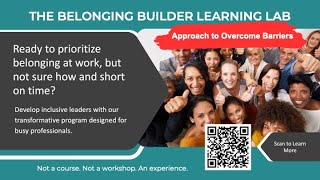
Beth Ridley outlines four barriers stopping people from embracing inclusive behaviors: confusing DEI language, fear of saying the wrong thing, workshops that don't stick, and lack of time. The Belonging Builder approach tackles each one with plain language, small discussion groups, quick wins, and short frequent lessons instead of one-off training.
Chapters
I first want to speak a little bit about the guiding principles and the approaches that we took in developing this that make it again, I can't even call it a training because we do everything of, you know, learning from what doesn't work with training to have sustainable results. We tried to find a better way, a different solution. And we really thought of, like, what are the barriers to people embracing new habits, new skills, and in general, but specifically barriers around doing that with topics related to inclusion and belonging and how do we overcome those barriers in this experience? So the barrier number one that we solve for is honestly, people just don't really, really know what this is all about. And this speaks to some of the content that I got in, got into in previous webinars. You know, let's be honest, words dei these days, those are kind of fighting words in organizations. People immediately tune out. So I like to think, I think people like me because my approach is really approachable. I don't believe anybody needs to get a PhD in this stuff. It's not rocket science. But it does have to be relevant and it does have to speak with people, and it does have to draw people in rather than make people come up with reasons why they shouldn't engage. I like to position things with simple language, approachable content relevant to any role in the organization. You don't have to be in HR for this to make sense and be relevant to you. So we just took like a super practical, hopefully a little bit of a fun approach to this to draw people in. The second barrier is, especially when it comes to inclusion and belonging, people are just kind of afraid to engage. You know, our cancel culture. One mistake and, man, you know, they could be paying for it forever. They just don't want to embarrass themselves or hurt someone else because they feel ill equipped to engage across differences. So our solution here is again, in those small groups, those small discussion groups, the small cohorts that go this through this together, there is a safe and brave space for people to talk candidly, to work through maybe some of their fears and concerns, to step outside of their comfort zone in a controlled environment with lots of time to practice inclusive behaviors with each other before sort of, you know, going prime time with it. So they build their confidence and they start to realize, you know what? This is not that hard. I can do this. Even if someone doesn't consider themselves, again, to be diverse, they have an opportunity to tap into what makes them unique as the first step of having more courage to engage with what makes other people unique. Even if it's unfamiliar to them. The third barrier is, you know, a common problem with training. What do you do after the workshop is over? So the way that we solve for this is give people a lot of tangible, practical examples of how to implement this. We want people out of the discussion mode into the action mode as quickly as possible, because you learn and get better through action. And so lots of tangible examples that people can use to apply immediately, like right away. We call them quick wins that people get all throughout this content so that they can start flexing new muscles and practicing so that they have a lot of ways to continue this authentically going forward. And then the fourth barrier, I probably should have put this number one, because this is the biggest barrier that is a blocker for even getting started. People just as like, no time. Folks are busy. I appreciate that. And I want them to pour as much energy into their day jobs, the job that they're getting paid for as much as possible. So we really tried to think about how do we streamline this as much as possible and almost provide content in more like micro doses, so small bits of content more frequently. That accomplishes two things. One, it's doable in busy schedules. And, and also it keeps it top of mind because the biggest challenge to showing up with a more inclusive mindset is people just get busy and they default back to their normal ways of doing things. So if we can, through this experience, have fewer touch. Sorry, have more frequent touch points, but really, really, really bite size that it fits into busy schedules, it's. It's a, it's an asset. And so I'll talk a little bit more about that, of how we accomplish that.