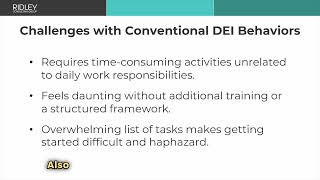
Beth Ridley reflects on her experience teaching inclusive leadership and explains why common DEI best-practices often fail in practice. She describes three classes of shortcomings—time-consuming extracurricular activities to build intercultural competency, impractical workplace actions like sponsorship without training, and long, haphazard checklists—then introduces that she developed three recommended behaviors that are simple, workplace-relevant, and broadly applicable.
Chapters
After having done this work for many, many, many, many years, I often get that question. I'm all in, what do you want me to do? And the truth is, a lot of times leaders just want to be told what to do again because they are busy. And I would try to deliver an answer to them. And I didn't have good answers on my own when people first started asking me, what do I do to be a better inclusive leader. But I went to the well of more conventional DEI resources and best practices to answer that and to give them, hey, do this. Take these steps. These are the behaviors to be an inclusive leader. And I will be honest with you, it really always fell short for several reasons. So I want to tell you and explain the roadblocks that I came up against when I was first trying to answer that question. Here's what it means to be an inclusive leader. Do this. So the first challenge, I guess I would say, with conventional DEI best practices around what it means to be an inclusive leader, is that a lot of the actions, frankly, they just took too much time outside of work. The requests were more extracurricular because it was really all about strengthening your intercultural competency. So in other words, how to understand and relate to people who come from different cultural backgrounds, different identities, different demographics. And the only way to do that is to immerse yourself in other cultures to broaden your perspective. So that means reading books, listening to podcasts, going to museums, meeting and spending time with people, all of which I believe in. I think that is so important. The challenge is, again, people are well meaning and they're busy. It was not getting done. Maybe a leader might be like, oh, yes, I took your challenge and I listened to a podcast, but they're not doing it enough consistently to actually make a difference. So challenge number one, the activities were just too time consuming and unrelated to daily work responsibilities. All right, fine, learned that. So let me give them action steps, behaviors that they can do at work related to work still didn't go quite as I was hoping. So a lot of those best practices were, how can you contribute to advancing inclusion and belonging at work? And some of the conventional wisdom were things like, be an ally, sponsor underrepresented employees at work, make sure you're offering equitable opportunities. Also very, very important and very daunting. It's really hard to ask a leader to go from zero to sponsor underrepresented employees without adequate training or some type of framework or initiative to support them. So in many cases, they just sort of backed off because it was more than they could bite off. And also, again, without proper training and the structured framework, these things can actually go pretty wrong if not done well. So that wasn't a slam dunk either. So then I was just like, whatever. I'm keeping this simple. I'm coming up with just my everyday acts of inclusion, really simple things that leaders can do in their day to day. And that was approachable and easy to do, but it didn't translate to meaningful impact because at the end of the day, it was a random list of tasks people felt like you could check off a box. Honestly, the list was so long, people were kind of like, yeah, I don't even know where to start. And it was a little haphazard. It wasn't quite strategic enough. All right, So I learned by things not going well, right? And I took a pause and I said, I got to come up with something better. Some behaviors that align with the true essence of diversity, equity, inclusion. But at the same time, the actions are clear. They're simple, digestible, doable in the day to day, no matter what your role is in the organization, not just relevant to folks who work in hr. That was my challenge, and I spent a lot of time thinking about this to come up with my three recommendation behaviors that hit the mark. I.