Inspiring Inclusive Leadership Webinar
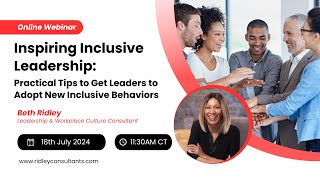
Webinar (30-minute format) led by Beth Ridley of Ridley Consulting Group presenting practical strategies for inspiring inclusive leadership and workplace belonging. Ridley frames the work using the ADKAR change model, emphasizing the Desire and Knowledge stages in this session. She advocates simple, brief, strength-based interventions and shares one emotion-focused reflection question plus three core leader behaviors (self-awareness, curiosity about others, and behavior change to seek understanding without needing agreement). The session includes examples, a short Q&A, and promotion of her Belonging Builder program and upcoming webinars (Aug 6 reinforcement-focused session; September open Q&A).
Chapters
Good afternoon, everyone. Thank you so much for joining. For those of you who don't know me, I'm Beth Ridley and I lead Ridley Consulting Group. So we are a consulting shop and we help companies develop inclusive leaders and build workplace cultures of belonging. Before I dive into the content for the webinar today, what I want to do is just take a moment to share with you the why behind the work that I do and why I'm so passionate about it, and why I love it so much. So I firmly believe that leaders really have to embrace inclusion as a core leadership competency in order for organizations to be successful in this day and age. And that is because our workplaces are simply too diverse, too complex, and frankly too stressful to not prioritize inclusion and belonging. Also, we sort of find ourselves in a situation now where frankly, a lot of these conventional DEI related initiatives at work, companies are kind of dialing back on them a little bit, maybe in response to backlash or budget cuts or both. It is what it is. But the necessity around diversity, equity, inclusion, the ability to engage all employees never goes away. So that just means it becomes more of a more incumbent on leaders to lead with an inclusive lens in their daily interactions, in their daily decision making, in their daily leadership, how they show up the responsibilities even more on leaders in absence of some of these initiatives that we're doing that on behalf of companies. So that's a little bit about my why I think this work is so important for that reason. And frankly, I also believe that the leader's primary responsibility is to create an environment where everyone can thrive. Not just some people, but everyone can thrive by recognizing and appreciating differences, knowing that all employees are different. How can we be flexible on our approach so that we can create that sense of belonging in everyone? So if a leader really isn't able to do that, in my opinion, they're not an effective leader in this day and age. They may be a very competent subject matter expert, but not really a leader. So my guess is most of you on this webinar have accountability for people and culture in your organization. So I'm pretty much, you know, preaching to the choir here. I also appreciate that getting other leaders in your organization, on board to proactively embrace diversity, equity, inclusion, inclusion and belonging and make it a priority is not always easy. So what I wanted to do is help you by once a month doing a webinar to share my personal tips and strategies to help minimize indifference and resistance to this work around inclusion and belonging among the workforce in general. Leaders in particular. And I'm keeping them to just 30 minutes because you're busy. I get it. So I just want to share a couple of practical tips in the webinar, get you back to work, and hopefully feel equipped to apply some of the things that I'm sharing right away. So that's the inspiration for why I do what I do and why I started these webinars. So for this webinar today, there's two things that I want to cover. I really want to give my tips for sparking that innate desire, that emotional connection with wanting to be an inclusive leader. To really get leaders who aren't really thinking about this to kind of lean in and want to do more. And then once we've piqued their desire, I want to share with you my three foundational inclusive behaviors. I recommend all leaders start with in order to demonstrate being an inclusive leader and really plus up their leadership skills. So my recommendations are very digestible, they're very doable and very practical. So I want to share those. Then I'll save time at the end for Q and A. So as questions come to mind, do put them in chat. Aaliyah is here to monitor chat for me and make sure that we get to your questions at the end. Very good. Okay, so let's see. Diving in. Oh, you know what, sorry. Before I dive in with my first tip, a couple of things. I just want to share a little bit of context so that you appreciate, like how I go about my work. I align everything I do to the ad car change model. So that doesn't mean, you know, whether it's a one hour webinar or a multi year consulting engagement, if we are asking leaders and employees to do something new, that is change. And change can be anxiety producing, as you know. So I want to make sure I'm thinking about what are all the levers that I can pull to make sure we're bringing someone along on that change journey more effectively. So everything from making sure we're creating the awareness for why change needs to happen, the innate desire to want to change, the knowledge of what are the actions I should be taking, and the ability and the reinforcement to take those actions consistently. So my first webinar that I did in June really focused on the awareness piece. So really building the business case for why inclusion and belonging and inclusive leadership matters. And again, minimizing resistance and indifference to the business case by using language that better resonates. Right. I think these days if we sort of lead with dei, frankly I'll Just be honest. Those are trigger words in some organizations. Those are fighting words. And I just got to the point where I was tired of debating the merits of dei. I just if I'm going to talk to you, I want to engage you in how do we create a more inclusive culture, a thriving workplace culture, and sometimes simple language shifts using words that are more intuitive, more approachable, more relevant to anybody's job in the organization if they don't work in hr, go a long way to bring people along to create that awareness. If you missed that webinar, it's called Words that Win. I'm going to put a list of the resources in chat. Actually. Aaliyah, do you have that list of resources? If you wouldn't mind copying and pasting and put them in chat? I'm going to mention a number of resources as we go, so I want to make sure you have links to everything. I am also recording this webinar, so afterwards I'll send the recording out to everyone who registered on all along with those list of resources. So that was a really good webinar, if you missed it. But it's kind of good to watch because, you know, first thing on the change journey is awareness. For this webinar, today, I'm going to be focusing on the desire piece. And again, how do I actually pick more of that emotional desire beyond the business case for leaders to want to step up as inclusive leaders? And the knowledge piece, in terms of the call to action, what's the ask of them? So that's the Adkar change model. I think it's really important to anchor everything in change best practices. The other thing that guides my work, I have my own homegrown guiding principles. Again, things that I know to be true in terms of bringing people along and minimizing resistance and indifference and just sort of appreciating the barriers to wanting to embrace inclusive leadership and prioritize it a little bit more. So the first thing is, you know, everything has to be simple for people who do not work in hr. They are not seeped in thinking about this stuff all day long. So words and concepts that are so intuitive to me, not so much to other people. And I don't want anyone to feel like they have to have a PhD in this work in order to show up as a more inclusive leader. I want them to just do it. So I really try to use words and language that's understandable, immediately relatable and intuitive. No one wants to feel stupid. And so I think it's really worthwhile to take the time to think about simple ways to communicate even complex topics without watering down the impact. So that's one thing that really guides me. The other thing that guides me is stuff has to be short. Probably the biggest barrier to leaders wanting to embrace inclusivity as a core competency is they just don't have time. They're too busy with their day jobs. And so, you know, I always think about how can I communicate something in as a digestible format as possible. I do a lot of explainer videos that people love because I challenge myself to. They cannot be more than four minutes. People are used to watching YouTube or TikTok videos. Like two to four minutes is kind of all you have to bring somebody along. And so the ability to take big concepts and boil them down to something short and digestible, it's a skill and I'm proud that I can do it really well. And a lot of people are like, all you do is these two minute videos. Like, do you know how much work goes into a two minute video? I appreciate that people are busy. And then the third guiding principle is I always want to build on a leader's strength, right? Another big barrier to leaders taking action around inclusion and belonging is that they don't want to screw it up. They don't want to misstep and maybe embarrass themselves or cause harm to others. So it's a little intimidating because it's just new for them. And so I always want to point out what someone is doing well because most leaders, honestly they are doing aspects of what it means to be an inclusive leader innately. And few people are like woeful in this area. And if they were like that bad, they probably not leaders anyway. So I always want to point out what they're doing well just to give them the confidence and the encouragement, like keep doing this and take one more small step so that they have the courage to take a step forward. And any step forward is progress. Okay, so that's a little bit about my own guiding principles. So I want to dive into how my tips and techniques, my personal strategies in terms of boosting that sense of desire to embrace inclusive behaviors. So I do start first with just the business case. I talked a little bit about that when I covered how do I create the awareness at this rate? There is so much data out there making the case for why inclusion and belonging, is good for employee well being, better engagement, collaboration that leads to better decision making and outcomes, recruiting, retention, all that good stuff. It's really important to lay the case for that, but I'm not going to cover that today. What I want to do is jump straight to the desire piece. So building the business case is really good, but it really speaks to more of the analytical side of what's good for business and the head. I think to get that desire, you got to pull on those emotional strings a little bit and speak to the heart. So I have a lot of questions like self reflection questions that I pose to leader to get them to think about them as a leader, their aspirations as leaders. What does leadership mean for them to make that more emotional case. I'm not going to share with you all of my questions. I don't want to give away all of my trade secrets, but I am going to share the question that I think works better than most, most of the time. So the one reflection question that I want to share with all of you that I pose to leaders, if I'm doing like a workshop, for example, is reflect on a leader who made you feel like you matter, who really inspired you, who got you, who made you feel that anything was possible and you felt brave to take risks. Who is that leader and what characteristics or behaviors made them stand out. So I posed this question because most people have one person that comes to mind and frankly, when they think about that person, they go to a real happy place. It's joyful, right? To reflect on those memories and to think about someone who really poured themselves into you and what that felt like and what it meant for you. It usually leads to a lot of storytelling. Sometimes I gotta like, cut it off and be like, okay, we gotta move on here. Because people want to share about the leader that was really impactful to them. So it really sparks talking about and positioning inclusive leadership from a place of inspiration, also from a place that's familiar. And it also helps leaders sort of tap into. They can personally feel and recall the transformative power of inclusive leadership. So it doesn't feel like an abstract concept. It immediately felts that, you know, that emotional connection. So I posed that question. People really think about it. Then I also asked them, so you know, how about you? And if I were to pose this question to members of your team, would their answer be you? To what extent are you being that kind of leader that was so impactful in your own life? And what would it take for you to be able to be that kind of leader more to more people and more consistently? Is that something that you would want to be able to do? And who's going to say no to that? And so that's really a great way to again, connect with someone emotionally, speak to the heart and spark that desire to want to step up their leadership so they can be exceptional leaders, sort of channeling the exceptional leader that they had in mind. So that sort of speaks, sparks the desire. So then the next step is great. Beth? Yeah, I'm in. What do you want me to do? What do I do? So after having done this work for many, many, many, many years, I often get that question, I'm all in, what do you want me to do? And the truth is, a lot of times leaders just want to be told what to do again because they are busy. And I would try to deliver an answer to them. And I didn't have good answers on my own when people first started asking me, what do I do to be a better inclusive leader. But I went to the well of more conventional DEI resources and best practices to answer that and to give them, hey, do this, take these steps. These are the behaviors to be an inclusive leader. And I will be honest with you, it really always fell short for several reasons. I want to tell you and explain the roadblocks that I came up against when I was first trying to answer that question. Here's what it means to be an inclusive leader. Do this. So the first challenge, I guess I would say, with conventional DEI best practices around what it means to be an inclusive leader, is that a lot of the actions, frankly, they just took too much time outside of work. The requests were more extracurricular because it was really all about strengthening your intercultural competency. So in other words, how to understand and relate to people who come from different cultural backgrounds, different identities, different demographics. And the only way to do that is to immerse yourself in other cultures to broaden your perspective. So that means reading books, listening to podcasts, going to museums, meeting and spending time with people, all of which I believe in. I think that is so important. The challenges, again, people are well meaning and they're busy. It was not getting done. Maybe a leader might be like, oh, yes, I took your challenge and I listened to a podcast, but they're not doing it enough consistently to actually make a difference. So challenge number one, the activities were just too time consuming and unrelated to daily work responsibilities. All right, fine, learned that. So let me give them action steps, behaviors that they can do at work, related to work still didn't go quite as I was hoping. So a lot of those best practices were, how can you contribute to advancing inclusion and belonging at work? And some of the conventional wisdom were Things like be an ally, sponsor underrepresented employees at work, make sure you're offering equitable opportunities. Also very, very important and very daunting. It's really hard to ask a leader to go from zero to sponsor underrepresented employees without adequate training or some type of framework or initiative to support them. So in many cases, they just sort of backed off because it was more than they could bite off. And also, again, without proper training and the structured framework, these things can actually go pretty wrong if not done well. That wasn't a slam dunk either. So then I was just like, whatever. I'm keeping this simple. I'm coming up with just my everyday acts of inclusion. Really simple things that leaders can do in their day to day. And that was approachable and easy to do, but it didn't translate to meaningful impact because at the end of the day, it was a random list of tasks people felt they could check off a box. Honestly, the list was so long, people were kind of like, yeah, I don't even know where to start. And it was a little haphazard. It wasn't quite strategic enough. All right, So I learned by things not going well, right? And I took a pause and I said, I got to come up with something better. Some. Some behaviors that align with the true essence of diversity, equity, inclusion. But at the same time, the actions are clear. They're simple, digestible, doable in the day to day, no matter what your role is in the organization, not just relevant to folks who work in hr. That was my challenge and I spent a lot of time thinking about this to come up with my three recommendation behaviors that hit the mark. I will not go into detail the research that I did to come up with these behaviors. I actually talk about and explain it in my most recent LinkedIn newsletter, which is in that list of resources that Aaliyah hopefully put in chat or you'll get after this so that you can appreciate it included observations, tapping into my own leadership journey, interviews. I just say all that so you know I'm not making this up and pulling it out of my hat. There's three. There are three behaviors. So as simple as they might seem, a lot of thought and research went into them. Okay, so without further ado, here are the three. Let me explain them a little bit.
So.
So when leaders ask me, great, what do I do to be a more inclusive leader? I say focus on these three things. Number one, be self aware. What does that mean? It means really do understand and appreciate your own unique strengths, identities, backgrounds, life Experiences and lean into that and be as authentic of a leader, leaning into innately who you are as possible. We need more examples of authentic leadership. So yay, because be proud of who you are at the same time, also be humble enough to know everything that makes you special is just what makes you special. Everyone else has their own unique identities, backgrounds, life experiences that make them unique. And by the way, everyone then based on their unique identities, sees the world, sees work differently than you. We just have to appreciate that your way is just your way. The way you see things is just the way you see things. I know that sounds so simple, but the truth of the matter is in the haste of our day to day, our default is everyone thinks how I think because I'm reasonable, you know, and we don't pause to consider there might be another way to look at this. There could be something else or what may I be missing? And before we know it, because we were just in a rush to get our work done, we rush to make decisions and we sort of have incomplete knowledge and they weren't quite as inclusive or thoughtful as they could be. So one, be self aware. Two, once we're sort of laying the groundwork for more self awareness, we can then be more curious of others. So once we can admit we don't know everything, we sometimes may be wrong. The limitations of our own life experience. You just gotta ask, you gotta ask others to understand their life experience, understand how they see something, invite in their perspectives. And so when we do that, we broaden our own perspectives and we start to replace our own innate assumptions that we all have with a little bit more empathy and insight. And then the third inclusive behavior is, hey, the more we ask, we're gonna hear stuff that we don't like. That wasn't my idea. Oh, sorry I asked. I'm interacting with people. How can they think that way? What kind of life experience or background? Whoa, no, no, no. Not my values, not my beliefs. And then that gets challenging. And I think unless we acknowledge that this is why a lot of people are kind of like stiff arming around inclusion and belonging because they feel like now I got to change my beliefs. This is, and this is, you know, I don't want to be all woke, you know, I think the way I think and I'm doubling down on that. So I really, really emphasize it is not about changing your own beliefs or values. It may not even be changing your mind about anything. But I am asking you to change your behaviors, especially as a leader, appreciating that you work with people who are different than you. Fact. And so we need to seek to understand, not agree, but seek to understand, especially when we don't agree. And simply by understanding, we become more self aware, which allows us to become more curious. And it really sort of creates, you know, these three behaviors really work well together as sort of like a flywheel for someone to be leading in a more inclusive way. So that's sort of the magic of these three behaviors. They're so simple, they're very intuitive, but they, they pack a lot of punch, I will say. So the other thing is, after I introduce this, these behaviors, I then ask leaders, so what are you already doing in this space that's doing well? That, that, that maybe comes naturally to you, that you sort of lean into and you do well, and everybody has an answer. And again, I really want to emphasize their strengths. And so then there's like a lot of sharing. Like, I do this and they have tangible examples of how these behaviors get demonstrated at work. And what I love about this is these behaviors are simple but strategic, but also flexible enough that people can demonstrate them in an authentic way. And that's really important. I really want to reinforce there is no one way to be an inclusive leader. We need always that still lay the foundation for, for, for people to feel that sense of belonging. So that's sort of like a relief to people. They're like, oh, I can do this and I can do this my way. I don't have to be restricted to like any one way. So when I ask leaders, how do you already do this? They share their ideas. And there's nothing more inspiring than leaders, you know, sort of like giving ideas and sharing what they're good at in this space with each other. And it really fuels like sort of collective energy and thinking around this. So I've facilitated these kind of conversations long enough that I've collected a list of a bunch of examples. These are just a few of how leaders, again, not experts in this at all, talk about how they demonstrate inclusive behaviors. So, so, Aaliyah, if you wouldn't mind putting that, that summary sheet in the chat so that you have examples. People need examples to spark their own ideas of how they will authentically be an inclusive leader and bring these behaviors to life. So those are the examples I have. Okay, so then it leads to, okay, you're already doing something. Well, what is one new thing that you can do that you're not already doing? And, and I really emphasize that you can implement right away, right away, mean tomorrow, because none of this is rocket science and it's all relevant to how they show up day to day. Most people have an answer and it's not hard and they're more than happy to follow through on this. And if they struggle, I say think back to that leader who we talked about that inspired you and what would they do? And then they're like, oh, they would do this and can you do that? Oh, yeah. Yeah, I can. So that's the desire and the knowledge leads them up to taking action. Of course, taking action consistently so that it's meaningful is the next piece. That's where the rubber hits the road. Not talking about that today, but I am talking about that August 6th. So that's my next webinar and I'm going to talk about my tips, my strategies to drive accountability and reinforcement of these inclusive behaviors so they add up to meaningful impact. I'm going to be focusing on my Belonging Builder inclusive leadership program that takes leaders from awareness all the way up to reinforcement. More information about that. You'll get a link to register so you can kind of complete this story about how I bring leaders along that will complete three, three webinars for me. So in September, I'm just going to pause and do an open live Q and A. So catch up on the recordings if you need to and then show up with all of your questions. More than happy to answer them. I'm hoping September is a good time because as you start doing your planning and budgeting and thinking about how you want to carry this work forward in the new year, I hope you think of me and my team. Aliyah's on this call. There are many ways that we can help you, and the best way to figure that out is schedule a call with me, a no risk, no obligation call. I want to hear where you are in your journey, what tips helped, what didn't, what are you doing? How can we maybe support you? So yeah, you also have a link including this QR code. Last thing, recap. And I'm going to go to Q and A. I can stay after if you have to drop off. I'll answer Q and A in my newsletters if you have to drop off, but I can stay a little bit longer. Recap. Make sure that you're speaking to the heart, not just the head. Keep things really simple. People learn by doing. Get them doing, get them out of the classroom, get them doing and then make sure it's flexible. There is not any one way that this needs to be done. With some framework, some structure, people can then Step up and be an inclusive leader in their own authentic way. Aaliyah, questions? What questions, if anything came into chat?
No questions at this time, but very. A lot of folks are saying thank you. This is great information. Great resources so far. Only that. Does anyone have any questions that you'd like to share out? I can go ahead and read that all. We have a question from Kerry Wilson.
Oh, hi, Carrie.
Okay, so how do you help slash, support, slash, push folks to move past the fear, concern, usually unaware that by seeking understanding, it might water down or negate their own thoughts or feelings? In other words, they say slash, think. I'll seek to understand your perspective, but I can't acknowledge or believe that it's the case.
Yeah. And I think that's part of it, is just recognizing that that is a big barrier. Right. And so. And I do a lot of exercises so people can appreciate what does it feel to understand, which requires a lot of listening and maybe repeating back what you heard without necessarily having to agree or to change your mind. And if in conversation with someone, the goal is to not win them over with your point of view, but truly to understand that is winning. Because at the end of the day, even if you understand, you become wiser, you become more thoughtful in your perspective. And I know a lot of leaders are concerned, like, well, you know, somebody may have an idea. We just can't do that. And that's fair. That very well may be. But I also think a lot of times we don't consider how an idea may impact where we're going or impact the result. It's always good to know what people are thinking, and that is a reality. People have different ideas, perspectives, and experiences. And if your ultimate action or however your decision or your interaction is not wise enough to know how other people are viewing or experiencing something, you are at a disadvantage. So I think it's something that just needs to be talked through, and then most people sort of get it. But I think exercises which, Carrie, you will be doing because you're doing the Belonging Builder program, they will actually be able to practice what it feels and looks like to listen, understand. Because most of us at work, we're kind of trained to. The only time I open my mouth is to convince somebody of my point of view. But again, that's old school leadership. We're talking about new school leadership. Thank you for the question. Yeah. Yeah. Any other questions? Okay. Well, class dismissed.








