Interview on WTMJ Upswing radio show (April 2024)
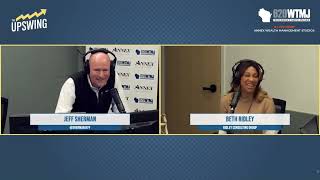
Beth Ridley, a corporate leadership consultant, discusses her book 365 Ways to Ask: How Was Your Day?, which offers daily conversation prompts for families. She argues DEI should not exist as a separate department but be woven into everyday leadership, requiring humility about your worldview, courage to ask questions, and genuine effort to understand differences.
Questions this video answers
365 Ways to Ask: How Was Your Day?
Three
About 25 years
Chapters
It's time for the Upswing on wtmj, showcasing businesses, entrepreneurs and community leaders throughout the great state of Wisconsin. Here's your host, Jeff Sherman. Happy Friday, Wisconsin. Happy Friday, Milwaukee. This is the Upswing, obviously. We're following breaking news here on WTMJ this morning. So we will break in as needed. I have wanted to do a show about corporate culture, work, life challenges, recharging and reconnecting to what matters most and just kind of get to the general truth and reconciliation and curiosity issues that surround us all with our wonderful work and personal lives. So today's guest and we'll have an abbreviated show today. But, you know, that's okay. Things happen as they're meant to. Beth Ridley. I have several guests coming up. We're scheduled to talk about mindfulness and kind of work related recharge tactics. So look forward to that in the coming weeks. Beth Ridley joins us today. And probably serendipitous almost that, you know, I want. She has a really good book that the Sherman family has used over some dinners to discuss. Now, when our kids come home, how do you ask them the right questions about their day? And, you know, before we kind of get into some of the meatier topics around workplace and culture issues that that Beth is a true, true expert on. Beth, I wanted to talk a little bit about your book again. As I told you, as we are planning for the show, I couldn't find the book that you gave me a couple of years ago, so I'm going to have to get another one. But we have used it at home. It is called 365 Ways to Ask, how was your day?
Yeah.
How did that come to fruition?
First of all, Jeff, thank you so much for having me. It's so great to reconnect with you, but on the radio.
Yeah.
It's been a while. And believe it or not, you were one of the first people I met when I moved back to Milwaukee, my hometown. But I left for a really long time, literally 20 years ago. Wow.
Yes. And I remember the coffee meeting we had when you were kind of thinking about, hey, should I leave corporate America and start my own consulting job? So.
That's right. And that was fun.
We've crossed paths so many different times. So it's great that you've taken the time to be with us today. I truly appreciate it.
Yeah. Thank you so much.
Yes. So talk a little bit about your book, please. The 365 days to ask, how was your day? It's for families and kids, so.
Yeah.
Sit down at the dinner table, at least at the Sherman household. If I say, how was your day? Sometimes I get blank stares, especially with news of the day. How do you explain those type of things to kids? And you're a mom of three, correct?
I'm a mom of three. I consider myself to be a workplace leadership expert, not a parenting expert. So I'll answer your question, but take it with a grain of salt. I will say I have three kids. We've got kids about the same age, and they did turn out okay. Ish. So I feel like 80% confident in my answer. So I think, like, you know, to talk to kids about anything especially difficult topics, it's really about laying the foundation of trust from the beginning. Really hard to pick up on a challenging conversation if you already don't have that foundation. And that foundation of trust really comes from just a habit of open dialogue. Now, I learned from my own kids. At the time. When we published the book, I had kids. One in high school, one in middle school, and one at elementary school. And when they would come home from school, I always ask, how was your day? Because I was actually interested. And I got either crickets or for a one word answer or just.
It was great.
Exactly.
We had a test.
Yeah. And it frustrated me so much. And I said, you've got to be kidding me. Why cannot you. Why can't you just answer and talk to me? And they said, your questions are so boring. You're going to get a boring answer. So I said, oh, really? Well, what would be a better answer? And they said something like, you know, if an alien came and abducted the teacher, which teacher would I want them to take? And I was like, that's great. You know, if that's what you want to chat about, I'm happy to do that. Give me more questions. And they each came up with a few more. And then the light bulb went off. And I said, I pretty sure I'm not the only parent who has this problem, so why don't we publish a book? And they were quite excited at first. And I said, you know, 365 questions. That's a question a day. They each wrote maybe 20. I was like, all right, well, we still have like 300 more questions to go. So I said, I'll pay you a quarter a question. They maybe did 20 more sentence matter.
That's good.
Then it got to a point where they got burned out. I said, all right, no one's getting their phone devices or Atari access until you write all the questions. And they did. And Then we invited their friends over and we literally, you know, market tested it. So the questions are kid proof. Their friends said, I'm not answering that one, or I love that one. So I like to say the book is filled with questions written and approved by kids. So there are questions that don't suck to get your kids talking. And yes, it's small. Leave it in the kitchen, leave it in the car when you have any downtime. So you only need 30 seconds, pose a question and start that open dialogue that builds the foundation of trust, that then you can have more challenging questions, especially as they get older and the topics that they're engaged in are more too.
Right. Because we all get home from the work day and we have a lot on our minds and we want to decompress, but yet at the same time, we want to reconnect with our family. So what are some of those questions? And you have two versions of this book. Correct. There's one for toddlers and elementary kids, and then there's one for the tweens.
Correct. Now I actually have three.
Three, so.
So toddlers, and then I call them tweens. So think middle school, high school. And then a lot of people who bought the book, like moms, they said, oh, do you have a version for my husband? So I didn't publish that yet, but I was like, I have a workplace version. So same thing. But like questions that you would ask at work to spark more meaningful relationships. But like an example of the one for little kids, like toddlers, it would be like, you know, did you use crayons or markers more today? And, you know, then, then that leads to like, well, what did you work on? You know what I mean? Like, leads your teacher smile today.
You know, things like that that are going to draw in the personality a little bit.
Yeah, exactly. For teens, it might be like, you know, what made you laugh today? Or did you receive a compliment today? Did you give a compliment today? Just little things that, you know, they wouldn't mind asking or even fun questions. I know. Like, one of my son's favorite question was, if any type of beverage could come out of the water fountain at school, what would you want it to be?
What do you get for that answer? Gatorade.
You hope it's Gatorade.
Yeah, that's right. That's right. Maybe the low sugar version is the best one. All right, so are you using those books consistently in the Ridley household?
Well, now two of my kids are in college, so I don't. Okay. All right. Yeah. And my, My youngest is a sophomore in high school and he's just not even home much. But we did exhaust the books, I would say. So I do feel like we have that open door for conversation for sure.
Very good. All right. Beth Ridley joins us today. Beth combines 25 years of leadership and management consulting experience with expertise in diversity and inclusion and positive psychology to help companies achieve thriving workplace cultures. She also is the author of several books that we just discussed. But we come back from the break. We're going to talk deeper workplace discussion issues. And I want to get into some of my latest project work around dei. And I know you have some really interesting insights around DEI leadership and all the things happening in the workplace today. WTMJ News time is 10:30. ABC News and local headlines are coming up next. We'll also explore feedback in the workplace. There's a big difference now between generations in terms of how we want to be approached and what those insights look like on how you communicate, how you create culture, how you don't minimize the employee burnout that maybe everyone's kind of feeling today, especially in light of everything that's happening in the world. We'll head to ABC News now. We'll be right back after this. This is THE upswing, and I'm Beth Sherman. Welcome back to the Friday episode of the upswing. Joining us is Beth Ridley, corporate leadership and workplace expert. Beth, appreciate you taking the time here on a Friday morning to be with us. So a lot of my meetings in the last, I don't know, we'll say the last three or four years have involved partnerships, conversations with corporate marketing VPs that start with DEI and diversity, equity, inclusion, positioning, relationship building, hiring. And ultimately, what does that advertising and messaging mean for corporate America? Well, in nowhere has the importance of communication and relationship building faded in the workplace or anywhere for that matter. It seems like investing in DEI at work, it's not a fad, but has it run its course or is it running running its course? I'd say it's even more important, just not as straightforward as it used to be. But I would love your opinions because I know you counsel many of your clients around dei.
Yeah. I think right now the most popular question I get is, is DEI dead or on life support? And then usually when people ask that question, they proceed to tell me why it is. And so I just decided that I'm going to be kind of bold and I'm going to be like, yep, it's dead. It actually is. In fact, it should be dead. And what I mean by that is in the traditional sense that we've been thinking about it, which is usually if an organization is lucky, they have a chief Diversity and Inclusion officer or a person in HR who it is their accountability to move this work forward. And that is never a way to actually create an inclusive cultural belonging where it's like the accountability of like one or two people.
Culture is not a department.
It's not a department. So I say absolutely, that is dead if that's what you think DEI is, but what it really is that like, just like you said, Jeff, the need to appreciate that every human at work is different. So diversity always exists. You're always going to be have a need to as a leader to lead people who aren't like you or you sometimes don't feel super comfortable with. You have to create an environment where everybody can thrive, right, to support the business. So the need for DEI is dead in the sense that it's up to hr. DEI is leadership. To me, I make no distinction. If you are not a leader who can lead a diverse team in an inclusive way, you are not a leader in the modern sense of the word. So DEI is leadership. That's it. Every time you say leadership, you are talking about diversity, inclusion and equity is just the need to be flexible in our approach.
Do you ever get the question what does it mean to be good at diversity, equity, inclusion? How do you answer that? For companies and CEOs, I get the.
Question all the time. And because people think it means I have to know everything there is about different cultures and, and I have to always have the right thing to say. And that immediately turns people off because people are afraid. It's a scary topic and no one wants to say anything to put their foot in their mouth, embarrass themselves, hurt feelings or get canceled. But I like to tell people that's not what it means to be good at dei. Being good at DEI is really three things. One, an appreciation of the way I see the world based on my background and life experiences is my way. Everybody has their way. I have to be humble enough to appreciate everybody looks at the world differently. Two, because I don't know everything, I have to be courageous enough to just ask. There is nothing wrong with asking. That's the only way that we learn. And then when I ask and I hear something that's not my idea, goes against my own values or beliefs, is very different than my own background. I have to at least seek to understand, not agree, not like, but at least to understand. It's just those three things you do not need to be an expert. You do not have to change your own beliefs. You just have to modify and work on your behaviors a little bit.
Yes. Seek first to understand. That is a very, very good advice. When we come back for the break, we're going to continue our conversation with Beth Ridley. Beth is a corporate executive turned organizational transformation consultant. We're going to talk about family and balance. And Tori Lowe from 101.7 the truth is going to join us to tell us what's coming up on Saturday in the community. This is the upswing. I'm Jeff Sherman and you're listening to wgmj. Welcome back to the Friday edition of the Upswing. Beth Ridley, corporate consultant around inclusivity and everything that we can do to make ourselves even better at work each and every day, joins us today. Beth, if you want to follow her on LinkedIn, I would truly, truly recommend it. She's had some wonderful posts lately and we're going to do this the next time Beth comes back. But she's been kind of diving into loneliness in the workplace. It's a, it's a big topic with some really big questions and some creative solutions, too. So we're not going to dive into that right now. But I really recommend that you follow Beth on LinkedIn to get some insights there. So Paul Graham, Paul Graham is a venture capitalist, co founder of Y Combinator that really helped kind of scale, scale Airbnb and Stripe and some other tech companies. Paul once said it's hard to do a really good job on anything if you don't think about it in the shower. And I think his point was, Beth, that passion drives success and you got to work hard and you got to be in it each and every day in the workplace. What are your thoughts about mirroring passion and drive in the workplace? Is it all in or can we come at it from a little different lens?
So I think being a really effective and impactful employee or leader or professional always starts with passion. Like I think we choose our line of business or our work is there is something about it that interests us mostly. I mean, sometimes we actually just need a job, but for the most part, we might select our job because there is something that aligns with either our aspirations or, or our values or something that interests us. So I do agree with that. And a lot of us spend a lot of time thinking about work, maybe thinking about ideas, how we could do it better. The challenge is by the time we get to work, that passion often gets snuffed out.
Meetings, zoom calls Everything else we have to do.
People aren't interested in our ideas. They want us to stay in our, you know, in our, in our box. They're not asking or when we offer, you know, they say, thanks, but no thanks. And so you start to, over time, think, well, what difference does it make? Do I really matter? And slowly but surely the passion gets just snuffed out and then it's just a job. And again, that's the role of leaders is to create that environment where, you know, people are excited about their job because they feel that they matter and their contribution does matter. And they're not afraid to share an idea or share their honest opinions. And they're not just relegated to, oh, I have to say whatever I think my boss wants to hear to not get fired. Or I'm afraid of saying something because people will laugh at me or I'll stand out in the wrong way.
So when your clients or CEOs ask you, you know, how can I be a better role model in my company to help make workers more successful, what's your answer?
You know, I think one of the simplest things to do is just sort of get in the habit of asking, what do you think more often during the day? And it could be in every conversation because I think a lot of times old school leadership is, I'm the smartest, I know everything, it's top down, it's my way. And the challenges and the opportunities at work are so complex. No one person has all the best ideas. So just sort of sprinkling in. No matter what you talk, you know, the conversation is with someone in team meetings and one on ones, just pause for a minute and say, well, what do you think? And I think you might be surprised and delighted by the answers. And it also makes people feel important, like, oh, you care what I think? Okay, I'm a little bit more interested now.
I'm walking past your desk. Let's take a look. 45 second walking meeting and discuss something that may not be on your plate right now. Why not?
Right, Exactly. And also admit when maybe you don't know everything and say, hey, I'm kind of struggling with this because it shows a sense of vulnerability. And again, people want to be needed. People want to be looked to and you know that, that, that they're adding value. And sometimes they don't know that if you don't admit where maybe you could use an idea.
Very good. All right. I like to ask especially experts in the workspace to define success. How do you define success in your life? Beth?
The definition has definitely changed over the years, but now that I consider myself kind of like old and wiser and have had so much work experience behind my belt, to me, success really comes down to do you have the ability to do what lights you up inside, you know what I mean? Like, work takes up so much of our day. Our mental capacity, is it something that brings us joy where we feel like it lights us up inside? And when we have that, we are the best versions of ourselves, for ourselves and for others.
Very good. That's a wonderful way to head into the great Milwaukee and Wisconsin weekend. Beth Ridley, corporate executive turned organizational transformation consultant, wonderful person. I appreciate you taking the time out of your day to be with us on the upswing here. Have a great weekend. Wisconsin's Midday News with Greg Mancik and Jessica Tai is coming up next.








