Interview with Alvin Ailey Dancers
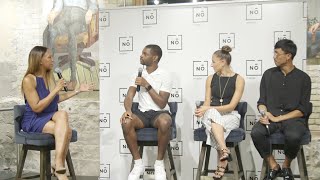
Marcel Wilson Jr., Grace Briganzi, and Carl Pom Scobero from Alvin Ailey 2 talk about their paths into dance, their mentors, and what Alvin Ailey's legacy means to them. They discuss the physical and emotional demands of the work and preview their Dance Fest performance, which includes 'Road to One' and 'Ebb and Flow'.
Chapters
Welcome back to KNOW Studios live. How's the crowd doing? Let me tell you, we have had a jam packed evening of Art of Dance, and we are about to cap off this wonderful evening with our keynote dancers here. Our dancers from the Alvin Ailey 2 Dance Company in New York City, literally just off the airplane. All right, so hang with me, guys. I know it's been a long day traveling, but everybody wants to get to know a little bit more about you, about Alvin Ailey, what we can see tomorrow. So I'm going to have you each introduce yourselves. So first, tell me your name. Tell me a little bit about how you got into dance, and then how you got into Alvin Ailey, specifically.
So my name is Marcel Wilson Jr. I'm from the Bronx, New York. And my story with dance is basically before I started dancing, I was a musician. I played the seven instruments. My main instrument was the alto saxophone.
So you played all the instruments?
Played all the instruments, Basically, yeah. And I went to a performing arts high school on the Upper east side of Manhattan called Talent Unlimited High School. And all of my friends were dance majors. And I felt really lonely.
Oh, wait, so you succumb to peer pressure and became a dancer? You actually succumbed to peer pressure?
Yes. So since I wanted to be with my friends, I was like, I want to change my major. So I changed my major to dance, and I've been doing it ever since.
Yeah. And what kind of dance did you start out with?
I started out predominantly doing ballet. Okay. I trained for about 25 hours a week doing classical ballet just because I knew that I started very late. I started at 15 years old, so I knew that I needed to do a lot of work in order to catch up to be.
Yeah.
I was gonna ask you, I mean, to say that you switched your major and started dancing in high school. I mean, for any other career that would be. Oh, you started so young, but did you feel that maybe for you started maybe a little bit later than some of your peers?
Oh, I definitely started late. Like, I know usually people start around, like, in the range of like three to five.
Oh, yeah. That's really.
And I'm 15, saying, I want to.
Start an old timer senior citizen.
Right. And I discovered Ailey my junior year of high school. And fun fact, I had to audition for the school six times before I was accepted.
Yeah.
And when I got there, I saw the second company, Ailey 2, in rehearsal during my lunch break. And that's when I decided, like, this is where I wanted to be. This is what I wanted to Do.
Yeah. That's great. I love the fact that. And thank you for sharing that, that you auditioned six times. Right. I think that's a great message for everybody to hear that, you know, if at first you don't succeed, I mean, if your heart is in it, you gotta keep trying. Right?
Yeah.
That's amazing.
Yes.
I love it. Okay, my dear.
Hi, my name is Grace Briganzi. I'm from Westport, Connecticut, and I started dancing when I was three. Like, every girl, I feel like, just goes into a little ballet class, kind of gets her feet wet. And it just started like that. And I did other sports growing up in middle school. And then it got to a certain point where I kind of was at this crossroads of, like, if I want to commit to this, it's going to take up my time, it's going to take up a lot of my hours. And.
And what sports were you doing?
I was doing basketball, softball, and soccer.
And do you feel that that cross training helped you with dance? It helped you be an overall good athlete?
Definitely. And also in terms of just, like, my drive and passion and like, a positive sense of competition, I think that really helped me push myself being in that competitive environment and kind of like bringing it into dance and knowing how to use it, especially in audition settings. And so once I decided to go with dance, I just was like, all in. And I stayed at the same dance school from age 3 to 18, and then I went to the Ailey Fordham BFA program, and I was there for four years. I was a dance major. Yeah, Fellow. I was a dance major and a business minor, which was a lot, but totally worth it. And then I apprenticed my first year out of college, and then I got into Ailey 2, my second year. So that's kind of my story.
I love it. I love it. All right, and your name and how did you. A little bit about your dance background and your path to Ailey.
Hi, my name is Carl Pom Scobero. I'm originally from Porterville, California. When I started dancing as a gift from my third grade teacher, I was creative but very disruptive. And so she was like.
I need.
To find an outlet for this child so he will pay attention. And so she signed me up and paid for the entire first year of dance lessons.
Oh, my goodness.
My parents tried to put me in other organized sports. Didn't take to it, but dance was the one thing that I could take.
That's amazing.
Yeah.
And I just.
Okay. What is the name of your teacher who did this?
Lynn Wise.
Okay. And you still shout out, is she here?
I'm not.
Okay.
But if she sees this.
Hi. Thank you so much, Ted.
And Lynn Wise.
You owe a lot to her. Right. I mean, who knows? Right? A disruptive child. She found a really creative and productive path for you.
Yeah. It was an immense blessing that up until now, I don't think I really grasped the magnitude because it has set me on an entirely different path than I think anyone had intended or imagined for me.
I love it. All right, so three very distinct paths to dance. Now you're here together, right. With Ailey 2 Company. What does that mean for you? Right. So did you know much about Alvin Ailey before joining the company and maybe just say a little bit about his legacy or what you know about him that. That you channel or that's an inspiration for you?
I think for me, Ailey wasn't originally what I had wanted to do. I really was focused on pursuing the more ballet route. And when that didn't work out for me, I had to look into different avenues because I still wanted to dance, even if that didn't work for me. And that's when my grandmother told me about Alvin Ailey, and I did research into it, and I didn't really know much about it, but I knew, like, the school was, like, top notch, like, one of the best schools in the world. And that's what led me to audition for the Ailey Fordham BFA program as well. And when I was in the school as a student, I did a lot of research on Alvin Ailey. And when you're a student in the school, we're always taught about his legacy and his history. And I think that's what resonated with me the most, is that his saying that dance came from the people and should be given back to the people is something that I firmly believe in, because I think that dance is not for me. It's also to provide the audience with an experience and to share my story and the stories of various choreographers with the world. And it was amazing for me that there was a place that was solely dedicated to that, and that's what attracted me to the company so much. And I feel like, for me, it's an honor to be a part of the company because we're all embodying this man's legacy, even, like, so many years after his passing.
Yeah.
It's a really big deal.
Yeah. Yeah. That's beautiful. Thank you. How about you?
Yeah.
I mean, being in Ailey 2 is kind of still surreal for me. Before I was in the Ailey Fordham BFA program. I did two summers at the Ailey Summer Intensive. And I remember my first year, I was in the junior division, so I was, like, really young, and I saw all these Aile 2 members. And then the next year, I went and I was in the professional division, and they were in my class, and I was like, oh, my gosh, the way they move. They're like, athleticism, but they're still, like, somehow graceful and soft. Like, I was amazed. And that was my first kind of introduction to the company. And then throughout the school, I got to see them perform, and I just fell in love with, like, this. The, like, hunger and the drive that you feel on stage. And I feel like that was what Mr. Ailey stood for. And he just, like Marcel said, dances for everybody. And for some crazy reason, it's this outlet of emotional expression that. That connects people from different countries, like, different languages, that passes so many barriers. And it's honestly just such a gift that we get to share this with people and hopefully touch people when we perform. And hearing people talk to us after is, like, the most rewarding thing. That's why we do it.
Yeah. And is there a lot of mentorship that's happening? So I know that you were sort of. When you were exposed to the more advanced dancers, the more experienced dancers, just being around them was super inspirational. But was there, like, a lot of mentoring and sort of, like, working with you as a younger dancer coming up?
Yeah. So I like, Carl, I kind of credit my mentorship to my dance teacher, Nancy Zindel. She, like, took me in my junior year of high school. It was right after I did that summer intensive, and she was like, okay, we're gonna do privates. We're gonna really go for this. And there were days, like. And I'm sure all of us dancers have had it in other, like, work environments, too, where it's just like, I kind of want to give up. Like, I don't know if I can really keep doing this. It's a lot of work, and, like, you just start to lose it. And then you have these amazing moments where you get into Ailey 2, you do your first tour, and you're, like, overcome with emotion of. This is why I had those terrible, terrible days. Because now the highs are so incredibly high. So there's a lot of, like, physical mentorship, but also just emotional, like, I would imagine.
Yeah, yeah, yeah. So actually, Carl, I was gonna ask. Right. So it's really hard work to get to your level, and I'm sure there was days when you just don't feel like it. Do you ever want to have a hamburger? I'm just asking, does that mean you have to dance extra hard tomorrow? So, like, if I eat a hamburger, I'm like, I gotta run an extra mile. In your mind, are you gonna dance extra hard tomorrow to work that off?
No.
I think that's the thing that a lot of people don't realize about dancers is how it is very physically demanding, but it's also very emotional. And so there are little things that you give yourself. Like on very bad days, I will get a big Mac and a six chicken McNugget and a large fry.
You have no idea how much I love hearing this. You have no idea how much the rest of the world is like, thank you. You're not that much different than us.
If it makes the rest of the world feel better. Before a show, my pre performance meal usually consists of either chicken wings, a double bacon cheeseburger, or a full rack of ribs with fries. No, you would in fact be just like you guys.
But actually you'd in fact be my favorite person. But look at how thin you are. So now I hate you. Very good to know. I love it. Very good to know. Yeah. So physically demanding, emotionally really demanding. But the reward is that you give to. You have the ability to give back, just like how you are all inspired. So we're hoping that tomorrow at Dance Fest there are going to be lots of kids in the audience. Right. And it may just be the performance that they see from you that lights the spark in them. Right. So what are you guys hoping for tomorrow? What's a little bit of what we can anticipate?
So tomorrow we're performing one full work and an excerpt of another work. The excerpt you're going to see is entitled Road to One. We're going to be performing the men's trio. And Road to One is really a work that speaks on mentors, is choreographed by a man named Darrell Grand Moultrie. And he was inspired by his mentor who had passed away at the time. So in that process, he really wanted us to think of a mentor that impacted our lives and how we give back to them, how we pay homage to those mentors. And that's what the piece is about. So you'll be seeing a men's trio from that. And Grace is performing another piece called Ebb and Flow.
Yes. So I'll be performing a duet with another one of our dancers who came with us, Kyle Martin. It's a duet called Ebb and Flow, choreographed by our artistic director, Troy Powell. And it's about really just the ebb and flow, just like of water, but in the sense of bodies moving as one and together and how one motion reacts to another. So it's a female duet, but it's not necessarily meant to be construed as romantic. It could be brother, sister. It could be, you know, friends, best friends. So it's a really open to interpretation, and it's just all about how simple movements can kind of change one another.
I love it. I'm intrigued. Carl, anything else you want to add for tomorrow?
Yeah, it's just such a joy to perform these works. We've. We've had a little bit time off, and so revisiting them is. Is an interesting way to find, like, new inspiration, and hopefully we'll make new, bolder decisions tomorrow and inspire people in the audience.
Yeah. So how much do you. So you rehearse. You rehearse and then you perform. But how much is the energy from the audience a factor in your performance? Day of.
It's. It's very important because, again, as. Like, I don't think as dancers, we communicate this very well, but the audience feeds us. And so there are performances where the audience were, for lack of a better word, are very dry. And it's. And it could be like, in the middle of a tour, we've just gone off the bus. Like, we're all broken and aching, and we just need a little bit more sometimes. But, like, once we get that, like some of the audiences in Europe, it was. It's just this thunderous applause. Such beautiful heart. You can feel the love from the audience and how they view dance. And it makes us feel like we did our job. Like we did the best we could.
And we did it well. I am gonna say Milwaukee is not dry. We are juicy like your hamburger and chicken wings. We're gonna be juicy like that, Tom. All right, so we are at no studios. So this is a collaboration space, a social club for artists, creatives, entrepreneurs. So a lot of people who give their all in order to pursue their passion, and it's not always easy. So maybe you could each just tell us, like, what. What is your go to inspiration, or what would you share with other up and coming artists in order to, like, stay. Stay with it and continue to pursue what really fulfills them.
Okay. For me, I. When I have rough days, because they will happen. No matter where you are, whether in your dream company you're not, you're going to have really rough days. I always try to think about why I started. And for me, when I started dance, it wasn't because, like, I saw the Nutcracker and, like, I wanted to do that. It was because I wanted to be with my friends. I had fun. It challenged me. And because it's fun and it's challenging, that's what keeps me going. It's not. I just had to learn that no matter what external factors happen, I can't allow it to shake my joy for dance. And I think that's what keeps me going. And just looking back on, seeing how far I've come, sticking with it and working through all those rough moments really does help me keep pushing forward.
So remember your why always be tapping into the joy? If you're really not enjoying it, that might be a sign that you might want to move on to something else. And reflecting on big and small wins to keep you motivated during the hard times.
Yes.
Perfect. How about you?
What I've really come to find that pushes me is, is the work. So it's kind of interesting because I feel like the work is sometimes what we get frustrated with. And of course that happens, but without the work, the rewards aren't as good. So I find this joy and the grit of just hours and hours in the studio trying to get something, and that's what keeps me pushing and pushing, knowing that I can do it. It's just a mental thing, knowing I can get there. I know I've done it before, I can it do do it again. So that when it happens, it's like, that's the moment I've been waiting for. Because I think you never want to feel like you've arrived, and it can feel like that. Like he was saying, if you get into your dream company, well, I'm here now. What type of thing. But there's always room for growth, and that's what we get from ourselves and we hear it from our artistic staff. There's always something new, and it's every performance, there's something new to bring, there's something we can change. There's ways to interact with each other. There's just a lot of room for growth. And so I think that's what I would say is just continue to find new outlets for yourself. And also, don't be afraid to stray from your love and find other things that you love because it feeds into your current passion. So, like, doing I love to cook. Like, finding ways to be creative outside of dance can help enhance that.
Yeah. Yeah. So kind of an interesting balance between just having an inner self confidence, but not getting too cocky and realizing that it's a big world out there and to be curious, continue to be curious and explore. Because all those other experiences really help to feed and fuel the dance.
Absolutely.
Okay, Carl, bring us home. What words of advice or wisdom do you have for us?
So just to preface, I came into ALIA II in a very unconventional way. And so the very first half of my experience with ALI II was very rough and very emotionally straining and mentally straining. But I realized that I just need to lean into my discomfort, just accept it, see that it's just a process of the growth. And that if the tunnel is this dark and I'm still running and it's been like four hours and I'm still in this tunnel, that just means that the outside is going to be all the much more pretty.
Get comfortable being uncomfortable sometimes, right?
Yes.
All three of you are so impressive. You each have such unique backgrounds, but amazing inspiration. I will say one thing that I've noticed really important women in each of your lives who have helped to motivate you. So whether that be an aunt, a mother, a teacher. So I just want to note that.
Amen.
Don't know what the men were doing, but the ladies were on point. Anyways, so much enjoyed talking to you. You all are impressive. Just sitting in the chairs. I can't wait to see what you're going to do when you're moving tomorrow. But thank you so much for being part of Dance Fest and coming to visit us in Milwaukee and here at no Studios.
Thank you for having us.
Thank you.








