MRA ED&I Leadership Conference: Make Diversity a Differentiator in Meetings
Beth Ridley (founder & CEO, Brimful Life) presents at the MRA ED&I Leadership Conference on how to "Make Diversity a Differentiator in Meetings." She frames DEI as a mindset and leadership competency that can be advanced through small, consistent actions — specifically by leveraging everyday "micro moments" (especially meetings) to surface differences, establish shared purpose and order, and practice inclusive communication. Key takeaways: broaden the definition of diversity beyond visible traits, leaders must model inclusive behaviors, meetings can be redesigned with simple steps (assess personality/working styles, ask "What do you need to be your best?", set purpose and meeting rules, and use listening/seeking-to-understand/empathy techniques), and these practices can rapidly improve decision-making and culture (illustrated by a nonprofit board case study). The session concludes with Q&A on practical leader behaviors and learning strategies for inclusive language and presence.
Chapters
All right, welcome back from break, and we want to say a big thank you to Saint A for your support of today's event. I'm delighted to introduce our next speaker, Beth Ridley, founder and CEO of Brimful Life. A tenured corporate leader and management consultant with more than 25 years of experience, Beth works with leaders to strengthen leadership teams and transform organizational cultures. She believes positive and inclusive workplace cultures inspire us to dream big, learn more, lean in, and become better. She is passionate about simplifying and demystifying D and I for leaders and joins us today to help us make diversity a differentiator in our organizations. Welcome, Beth.
Hi, Deidre. Thank you so much for having me.
We are so happy to have you here today.
How are you? I'm happy to be here. I love the topic of diversity inclusion.
I know it is one of your passions, and I have to tell you, and it's probably just not my feeling, but many that know you know that you have great knowledge and skills as a leader from your background, but you're also just very humble, even though you know a lot about how to lead people effectively and a lot about how to successfully create a inclusive culture. So I'm so happy to have you here today, and I know you're going to put in some great stories and share with the audience as well.
Yes, absolutely. That's my goal.
All right, I'll let you take it away.
All right, thank you so much. All right, well, very great to see everybody virtually. Actually, I can't really see you, but thank you for joining this session. So, yeah, the topic that I'm going to talk about is how to make diversity a differentiator in meetings. And like Deidre said, I'm really all about simplifying and demystifying this topic because I think sometimes people feel intimidated by it or. Or they think if I don't have a ton of resources, can I really make progress in this space in my organization? And I'm here to tell you, yes, you absolutely can. And we're gonna talk about how to use meetings as a wonderful vehicle to do that. All right, so let's get started. Next slide, please. All right, so just a little bit about what I hope to accomplish in our 30 minutes together. Like I said, I really wanna just simplify and demystify. What do we mean by diversity inclusion?
So.
So that you feel that you can lead with confidence in this space, no matter where you are in the organization. We're going to talk about the roles of micro moments, and I'll talk about what Micro moments are but meetings as being one example of how powerful these small little things that we do through our day to day experience at work, that we can really use that to shift the culture to be more inclusive. And then finally, I want to leave you with some really simple inclusive communication skills that you can learn and apply right away when you get back and you join your zoom calls or your meetings in person if you're doing that so that everyone can contribute to fostering a more inclusive culture.
Next slide please.
So this is important. I just want to level set a little bit with my own philosophy around this. If you can go ahead and share the bullet points. You know, my own personal feeling in the space of diversity, equity, inclusion is that we sometimes just make things way too hard. Again, it can be somewhat of an intimidating topic. I think people are, you know, they're kind of afraid of maybe saying the wrong thing or embarrassing themselves or you know, offending someone and so they tend to maybe shy away. And I can tell you, you know, I've been a diversity company comes down to some simple principles and that's really about starting off with treating people the way that you would want to be treated as a start and then just having some curiosity about people so that you can ask them how they would want to be treated. And that's really the fundamentals around diversity and inclusion. And and I learned this, I've had the opportunity to lead and work in five different countries. And so I've always had to figure out really quickly how to bring people together across language differences, cultural differences, differences in traditions. And it always really came down to those simple things. Even if I didn't understand the language or the culture. I start with how do you want to be treated? And then just be curious enough to ask people around me how they want to be treated. Those are the fundamentals for diversity, equity and inclusion. And I'll talk a little bit about how you incorporate that in your day to day leadership. The second thing about my philosophy is that, you know, diversity, equity, inclusion, it is in fact really, really good for business. I'll talk a little bit more about that, but I think that's important to just recognize. I know a lot of organizations and leaders are now leaning into and doubling down their efforts around diversity inclusion in their workplace. Maybe in inspired by social inequity and social injustice being at the forefront of our minds really since the death of George Floyd. And I think that is fantastic as a motivator for leading into this space. But I think the only way to make it Sustainable and sustainably build a culture of inclusion is when you recognize that it is in fact good for business. It's a moral imperative. It's also a business imperative. And then lastly, culture change, you know, which can sound super big and hard to do. Culture change within an organization happens when leaders and individuals do small things consistently. Consistency is the key. I take this away from my many years having worked for a very large management consulting firm. I would drop into different businesses to help them with these big strategies. The strategies that got implemented were the ones that were easy to do and leaders could do them consistently. So I really take take that small things making a big impact mindset to the work of diversity and inclusion. Because it's all about building a sustainable culture of inclusion.
Next slide please.
All right, so this is something that if you could respond in chat, hopefully I'll be able to see your responses in chat. I just want to gauge where you are or where your organization is. Broadly speaking, would you consider yourself at a level one, two or three on your D&I journey? So one, if you're really just thinking about how to get started but no real action has been taken yet, Level two, if your leaders and employees have been engaged in conversation and some type of education around diversity, equity, inclusion, or level three, if you feel that you know what, you are really integrating diversity, equity, inclusion within the way you do business, it is a part of your culture. So I'm hoping that I can see folks responding if you're able to via chat. I don't know if I can see.
So.
Okay, we don't have that capability. My fault. So anyways, don't tell me via chat. Tell yourself and benchmark for yourself where you are in terms of level 1, 2 or 3. Next slide please. All right, so some of the biggest barriers that people articulate either in terms of just getting started if you're not even at a level one yet, or making progress in advancing if you're at a level one or two. And that is we don't have diversity in our organization. Our leadership and most of our employees are all men or all white. So how can we get started if we don't have diversity? You know, I'm well intentioned, but I just don't want to say the wrong thing. So this whole space is uncomfortable for me. Or we don't have budget right to make a serious effort. So I want to say that all three of those things, we can throw them out right away. Diversity, equity, inclusion is not scary. You have more diversity in your organizations that you can work with to build a culture of inclusion than you think, even if you're led by all white men. And you don't need any budget because it's all about mindset.
All right, next slide.
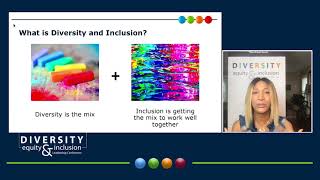
So here's where I wanted to simplify and demystify diversity inclusion to really get you to understand and appreciate at a minimum basic level what this is all about and what you can do with zero resources. So first level setting. Diversity is the mix, the differences. And inclusion is what helps to get the differences to work well together. It bridges across difference. A culture of inclusion bridges across difference. Without inclusion, diversity on its own can lead to a lot of dysfunction and discord. So you need that inclusion piece. It's kind of like the glue that makes the diversity work well together.
Next slide, please.
All right, so let's start first with diversity. This is a really important slide because I think when people think of diversity, they only think in terms of visible diversity. So those. Those primary dimensions of diversity that we can see. So that would be like race, gender, age, that type of thing. And I think when we limit our scope of diversity to just those primary factors, three things happen. First, we don't. We underestimate the diversity that you actually do have already in the organization. So beyond just physical diversity that you can see, there is a plethora of things that make each person really unique. And that diversity includes things like life experience, educational background, even personality types or leadership style types, sort of where we grew up, all that stuff all factors into diversity. And like I said, when you don't broaden your lens of diversity, you overlook the diversity that already exists. And a lot of people think, oh, we don't have any people of color, let's hire more. And I would say, slow down, start building a culture of inclusion by just harnessing and tapping into and better appreciate, better appreciating the diversity that you already have. So you're building a culture of inclusion. So when you do bring in people that have diversity that are more visible and they may be the only ones, they're stepping into a more welcoming, inclusive culture. The other challenge with not broadening our scope of diversity is that we don't allow everyone to see how they benefit from. From contributing to a culture of inclusion. So the broader that you can say, like all these dimensions of diversity that comprise someone, we want them to feel comfortable bringing all these dimensions forward into the workplace. And when people can see that everyone benefits from leaning into building a culture of inclusion, you'll have more engagement, you'll have more ambassadors. And also, when an organization only leaves the work of building a culture of inclusion to people that represent the primary dimensions of diversity, people of color or women, it is exhausting to put this on their shoulders. As a woman of color, I'm telling you, it's exhausting. We need everyone to be part of it. You cannot build a diverse and inclusive culture if you're not inclusive of everyone contributing to the effort.
Next slide, please.
Okay, so that's diversity inclusion. Like I said, it's sort of the glue that holds the diversity together, the glue that enables people to bridge across those differences, to harness diversity for good. And really, all it is is a mindset. It is just a mindset. And it's really about being curious about other people and wanting to learn about other people. The biggest barrier to inclusion are our own. And the only way that we can break through or overcome our own implicit biases is by replacing our biases with empathy and understanding. And the only way to do that is to increase your data points around the human experience. And the only way to do that is to interact with humans. And I think that's where people are like, whoa, timeout. That's where it gets scary and uncomfortable. I actually have to engage with people who think differently than me, who've had different life experiences than me. Yes, you do, because that is the only way that you can broaden your perspective of, like I said, increase your data points around the human experience. And that is how you replace assumptions or biases that have been ingrained in us, either through media or limited experience or false information. And so that's the work around diversity inclusion. And, yeah, you don't need to.
Have.
An expensive strategy or tons of training or anything like that. It is the work that you can do internally. And I like to tell people, start by reflecting on your own personal social circles. Who do you spend time with as you move through the day? Who do you choose to spend time with and where? You don't have elements of diversity in your own personal social circles that may be reflective of where you have some implicit biases. And those are exactly the type of people who are different than you that you should engage so you can start to appreciate, again, the breadth of the human experience that just broadens your mindset around differences so you're able to bridge across differences in a more effective way.
Next slide, please.
So the work of doing this, the work of building an inclusive mindset, I really think it is you're developing a leadership competency. And in fact, I would argue probably the most important leadership competency in 2020 and beyond. Because, sadly, we are so divided. There's been so much emphasis that's been put on everything that makes us different. And that does seep into the workplace, right? So race, gender, age are the tip of the iceberg. Think, politics, religion, beliefs, all of that can't help but seep into the workplace. So those individuals, those leaders who can bridge across differences, who can welcome all these rich perspectives into the workplace and harness that diversity for good, are going to be the exceptional leaders. Because there is ample research that shows diverse workplaces lead to better outcomes. But I want to tell you, it's not just the diversity, it's the inclusion too. Like I said, diversity without inclusion can be dysfunctional. So that inclusive culture that pulls out and taps into the diversity that every employee brings leads to better decision making. When you can look at a problem or a challenge or an opportunity from multiple perspectives, it leads to more thoughtful decision making, better decision making, usually more innovative decision making. Better decision making leads to better business outcomes and financial performance. And also, by the way, because of those things, that more innovative, you know, sort of inspiring, inclusive environment is really great for recruiting and for retention of top talent. Not just your diverse top talent, but just top talent. And so all of these are fantastic outcomes. You want more leaders in your organization leading with an inclusive mindset so that you can benefit these or reap the benefits of having a diverse and inclusive culture.
Next slide, please.
Okay, so hopefully I've sold you on why leaning into this space is a good idea and you don't need much to do it. Just sort of the. The willingness maybe to get outside of your comfort zone a little bit. But how does one person begin to shift the culture? Let's just say, yes, you're doing that work and you're trying to replace your own biases with empathy and understanding. Now what? How do you bring that to work in any meaningful way to shift the overall culture? All right, so here's where micro moments are going to help you with that. Micro moments are just like the tiny little experiences that happen every day, but they add up and over time, it becomes the overall employee experience. So when we were pre Covid, like physically in buildings, those would be everything from what's your experience waiting for the elevator and getting on with your colleagues? Do people talk? Do they chat? Are they quiet conversations that you have at the water cooler? In most cases, most of the workday for professionals is spent in meetings. So I like to say micro moments is. Sorry, meetings is one of the biggest micro Moments that adds up to the overall employee experience. So that could be one on one meetings, team meetings, project meetings, department meetings, whatever. We spend our life in meetings at work. So let's take advantage of meetings, because when employees think of the overall employee experience, they really are thinking of the compilation of all these micro moments, and most of them tend to be meetings. So if you want to change the culture in your organization, change and influence those micro moments.
Next slide, please.
All right, so I zoomed in on micro moments as being a great way to change the culture. I need to zoom out a little bit just to sort of show you in context, like where micro moments fits within an overall culture transformation effort. This is a very simplified approach that I take with my clients when we're talking about culture transformation. And this framework would apply no matter what you want to change about the workplace culture. Diversity and inclusion is one example. But like I said, D and I needs to be a business imperative. So we start first by talking about what are your business strategies and outcomes that you want to accomplish, and what are the behaviors that you need employees to embrace in order to do that? So it's sort of like the strategy is what you want people to accomplish. The culture is how you want that work to get done. And that's really the secret sauce. A lot of people do what you. A lot of organizations or companies do what you do. It's the how you do it that's the differentiator for success. So that's why really thinking about the values, the behaviors, the culture is so important. So we start with, why does diversity, inclusion, and equity these principles, how do they support the strategy and the work that you want to do? Then we say, okay, if you're shifting the culture and you first understand why these D and I principles matter to the business, leaders have to first lead by example, right? You can't ask everybody else to adopt certain behaviors if leaders aren't genuinely leading by example. And this is where the micro moments come in. So leaders have tremendous influence over the tone of the culture every time they step into a meeting, every time they log on to a zoom call. As a leader in that meeting, you are setting the tone. And so what you do in those micro moments is really setting the course for the behaviors that everyone else is going to embrace in the organization. So then once leaders are consistently setting that tone, you can expect and encourage employees to be flexing new muscles around diversity, equity, inclusion, you know, with giving them positive feedback and reinforcement. And then at a certain point, once everyone has sort of practiced and they understand why these behaviors matter for the, for the, for the outcome of the business. You need to start requiring it.
Right.
A part of how you do your job. It is a. The table stakes. The expectation is a criteria for how we hire. You're holding now people accountable. So that's sort of like the overall transformation. But I want to zoom back in on just the meetings and how we're going to use meetings as a way to shift the culture to be more inclusive and simple. Simple steps that you can do that right after this conference.
Okay, so next slide, please.
All right, so three ways to use meetings to foster a culture of inclusion. First, we are going to uncover and understand differences that are represented in the meeting. We're going to figure out how to bridge across those differences using purpose and order, and we're going to practice inclusive communication skills. So let's walk through each one of those three steps. Very simple.
Next slide, please.
Okay, so step number one, you can go ahead and show the content on there. Thank you. Both sides would be awesome. Thank you. Thank you. Thank you. All right, so if you recall that. That the circle chart that I showed you in the many, many dimensions of diversity beyond just the primary ones. So let's start there. Let's just assume you have more diversity represented in that meeting, you know, than you gave credit for or you bother to sort of uncover. So one place to start around differences is just sort of like difference in leadership style or personality traits. And this is sort of an easy one. It's not particularly loaded. It's not a hard place to start. Like, it might be hard to talk about race in a meeting. So if that's uncomfortable, don't start there. Let's practice what it means to build a culture of inclusion around differences that don't make that much of a difference. And then once you build that muscle memory of how to bridge across differences, you can apply it to more challenging differences, perhaps. So if you just as an example, let's just say everybody's gathered in the meeting, it's a regular meeting. You've never really bothered to appreciate sort of the different strengths or personality styles of people in the meeting. So take some time to do that with some personality assessments, some strength finders. I have examples of for fee ones as well as free ones. It doesn't matter which ones you use, but it's a way to start to say we care about the different perspectives that are embodied in everybody. And we're going to take the time to create an environment where we want you to bring that Forward in our meetings for better decision making.
Next slide, please.
So you take the assessment, then the simple exercise that you want to do, this is work that you would do outside of the meeting is just to talk about it. So here are some examples. And I know you guys will get these slides, so you'll have these just examples of discussion questions. It almost doesn't matter what people like to talk about themselves. They start to feel valued as an individual when you ask questions about how are you wired? And how does that play out in work? But I think the most important question question to ask is the last one that's bolded. What do you need to be your best as part of this team? How often does anyone ask that? Right, so everybody has different needs in terms of how to be their best, right? And some people are introverts and they need maybe the questions or the materials for the meeting sent in advance so that they can digest and be more forthcoming with their ideas. You know, people are wired differently to simply asking that you're going to bring out the best in everybody. And these are simple things that are just hardly ever done because we don't pause enough to invest the time.
All right, next slide, please.
Okay, so step be more forthcoming with their ideas. People are wired differently simply asking that you're going to bring out the best in everybody. And these are simple things that are just hardly ever done because we don't pause enough to invest the time.
All right, next slide, please.
Okay, so step two, you've sort of harnessed and tapped into the diversity that is amongst everybody in the meeting, well beyond the physical diversity. So now the question is, how do you start to bridge across those differences? Right? So two things that you can do, establish purpose and order. So purpose, one thing that is common for all humans, and again, doesn't matter. The dimension of diversity that defines you is feeling a sense of purpose and meaning to the work that you do. So I think in order to really bring people together and to coalesce, you want to bring people together around their common purpose and cause that everyone is focusing on from a business standpoint. So it's always nice to have people share their whys and make that emotional connection between who they are and the work that they do. And then also a really simple one is, you know, for leaders or anyone in the meeting to remind everyone at the top of the meeting why this meeting matters to the bigger picture, to the bigger meaning and purpose. How many times do you step into a meeting and you just launch into the agenda and you start to Feel like you're just here, you're powering through, you're grinding through. It might be your fifth zoom call for the day. And a great way to again create that inclusive culture is to pause a little bit, set the purpose so that no matter where you're coming from in terms of your perspective, people are reminded why they are showing up. And that way you sort of bring some commonality around why we are all here and your making that connection between purpose and meaning which everyone wants to feel. Then secondly, just create some order. Right. I think again, a lot of times we don't reinforce or intentionally articulate sort of codes of conduct or rules of conduct for the meeting. What is going to give us a sense of order. And when you're establishing your own sense of order for the meeting, reflect back on the conversation that you had around what do people need to be their best in the meeting? And again, maybe you want to say, I've got a lot of people who just love to talk a lot. We're going to set a time around how much we can talk, or we're going to limit how many questions we're going to drive to decision or we're going to make sure that we send information in advance. So we're kind of accommodating the different needs and styles that everyone needs to contribute and be their best. Simply having that conversation honestly helps people feel like they feel valued and, and their voice matters. And so that is really laying the foundation for an inclusive culture.
Okay, next slide please.
So third and final step is about. I think there's one more. Yep, thank you. Practicing inclusive communication skills. Right. So again, like I said, inclusion is really a mindset and so it's really about pausing and reflecting and being thoughtful before you open your mouth and be reactive is about. I think there's one more. Yep, thank you. Practicing inclusive communication skills. Right. So again, like I said, inclusion is really a mindset. Again, we all have our own internal biases and assumptions that often lead how we behave, what we say, what we do. And so it's really about pausing and reflecting and being thoughtful before you open your mouth and be reactive in a non inclusive way. So the biggest battle with building an inclusive again, we all have our own internal biases and assessive culture and leading by example is just feeling like it's okay to pause and reflect, to slow down just a little bit and to be a little bit more thoughtful and intentional about the tone you set when you open your own mouth in a meeting. So some inclusive communication skills to do that first, make sure that you are leaning into how you engage with other people with genuine curiosity. And that means you're going to do equal parts listening as well as talking. Allow other people to share. Listen, listen, listen, listen, listen is a really important one. Number two, this is a really important one. Lean into conversations seeking to understand, not necessarily to win an argument or even to agree. We don't often have a lot of examples of that in our workday. For whatever reason, I think we're just sort of conditioned to think. Every time I open my mouth, it's to make a point, it's to get people to agree with me, it's to win the argument. That chills and stifles this environment where people feel like ideas and thoughts and perspectives, even if not used, are valued enough to be heard. And so seeking to understand. I don't necessarily have to agree with everything that's coming out of your mouth, but I believe there is a always something to be learned. I'd rather hear what you have to say than not hear it at all. The third one is demonstrate patience and respect. And this is kind of related to the second one. Your way is just your way. It's a big world out there. A lot of people with a lot of thoughts and you know what, may not agree with them, may not use that idea, but, you know, respect the human, even if you don't like the idea. And then finally, make sure that you're acknowledging and expressing empathy to people. When you're asking people to share what they think, it can be scary depending on what your culture is like. You're asking people to be vulnerable. You're asking people to say what they really think and not just double down on what they think the most senior person in the room thinks. That's how you get confirmation bias and you weaken your decision making. You want people to actually tell you what they think from multiple perspectives. And so even if you don't go with someone's idea, acknowledge that they spoke up, and you bias and you weaken your decision making. You want people to act a lot of ands instead of buts, right? So I hear what you're saying, but we're gonna do this or bully, tell you what they think from multiple perspectives. And so even if you don't, I think this, that just makes someone feel like, why did I talk anyway? So I hear what you're saying, and here are my thoughts, far more inclusive. All right, so these are easy things that everyone can apply, and you can start doing it on your zoom calls today.
Next Slide, please.
Okay. So, yeah, you can go ahead and add everything. I know I'm right at that 30 minute mark. So I'll take maybe just one minute to kind of make it real with a, With a case study. So this was a client I worked with last year. It was a nonprofit board. And they were actually very diverse when it came to the primary dimensions of diversity. They had people of different ethnicities, gender, age, sexual orientation, from all different, like, professional backgrounds. But they were really challenged in their meetings. They could not come to agreement. There was a lot of talk and arguing. The arguments started to get personal and disrespectful. Disrespectful. And at the end of the day, you know, a lot of people were considering getting off the board. It just was not a pleasant experience. And decisions just sort of ground to a halt. They couldn't. They were not being productive. So they called me and they said, we actually have a diversity problem because we have so much diversity. Like, you know, people aren't respecting different perspectives that someone may have because they're a woman, because they're of color, because. Because they're gay or whatever. So I was like, well, this is interesting. So I went in, I did a diagnostic, and through interviews, I uncovered they have a diversity problem, but not in the way that they thought. It has absolutely nothing to do with. They have a lot of diversity in terms of the different primary dimensions of diversity. When I interviewed people, I appreciated that they all had different change style preferences, different risk tolerances that were inherent to them. So every time they got in a meeting, you had a few people who were like, why are we debating these tiny little things? I'm already thinking 10 years ahead, we need to go here. They were the visionaries. Then you had other people on the other end of the spectrum, a lot of attorneys and accountants, and they were like, incremental change. We want to do this right, right. Slow down. We need to look at all the details. And you had a lot of people in the middle who were looking around be like, you know, I'll go with whoever is talking the loudest because this is uncomfortable for me. So what did we do? We did those three steps. One, we uncovered the differences in change style preferences. They hadn't done that before. They didn't even appreciate that. Oh, my goodness. Among the 15 people on the board, we're all wired differently in terms of how much risk we are just inherently comfortable taking, how quickly we or not we embrace change. So we just kind of put that out on the table. Then we Talked about, given our different change style preferences, what do we each need? And said what they needed. And some people said, you know, I just need more time to digest. And some people said, I think out loud a lot. I talk while I'm thinking out loud, so let me do that, but then allow me to change my mind. So we sort of use that to say, okay, here are our rules of engagement in the meetings that we're going to follow so that everyone feels that, you know, they can be themselves, but we've got some structure around it. Everybody talked about again, anchored in why they are volunteering on this board. And then at the end of the day, we summarized all that in a quick little cheat sheet if you want to go to the next slide. We sort of memorialize all these conversations. We reminded people of the many dimensions of diversity that make us all up beyond super superficial, what we need to be effective in the meeting, why we are part of this board, the different change style preferences that we need to value and respect, and then rules of engagement. And every time they show up for a meeting, they bring us forward and they say, we're going to hold ourselves accountable for using this and practicing inclusive communication skills. And the person who is already thinking 10 years ahead said, I don't necessarily agree with the person who wants to incremental change, but I'm going to create the space to hear their ideas. And what they started to realize is when they slowed down and realized the point of the conversation is not to win the argument, but to seek to understand and make better decision making, they were able to see how these different chain style preferences, when you could bridge across them, was actually super healthy so that they got comfortable saying, all right, we can take bolder steps, but the only way that we're going to take bolder steps is if we listen to the people who are telling us these are the details that we need to sort and work out. And so literally, it was just in an afternoon, by doing that work and practicing these inclusive communication skills, holding themselves accountable for doing that, they shifted the culture of that board in a day and they were able to move forward in a far more collaborative, inclusive approach. So I'm going to stop there because I know we're running out of time. If you want to go to the next slide, and I'm going to turn it over to questions or to Deidre if you have any questions.
Yes, Beth, we have a couple questions and I want to first start off and say thank you because there were many different points within your presentation that definitely Hit me. And I will definitely utilize and implement as a leader. You talked a little bit about leaders modeling behaviors and I want to get into practical examples and ways in which you've seen leaders do this and how they've gotten employee buy in at organizations that don't have a D and I culture or inclusive mindset.
Oh. So yeah. Give you actual examples. Yeah. I think the best ways that leaders do it, again, a lot of this is just sort of like slowing down and being a little intentional and being a little curious about the people in front of you. So some of the best ways that leaders have been able to shift the culture is being more present with the employees that are around them and asking them questions about who they are their weekend. I mean, making people feel like you're interested in them. And I think that is really sort of like the easiest thing that a leader can do to set the tone that doesn't require any money. And it may just require an additional 30 seconds in your one on ones or in your interactions with people. But again, I think leaders underestimate the tone that they're setting. And if you're simply again, trying to tap into your ability to be genuinely curious about other people, that is how you sort of create this environment where people feel safe and comfortable being themselves valued and respected for who they are in the many dimensions of diversity that comprise all of us.
I definitely agree. I think today's workforce is looking for their organization to not just talk about inclusion and what it means to them, but really address how inclusion feels within the organization. And I love the fact that you talked about micro moments. That is my favorite, favorite thing that you shared today. So speaking of micro moments, how do you recommend leaders educate themselves on how to be inclusive in meetings? You talked about inclusive communication skills, but we know language is important. So how do you recommend leaders educate themselves in this area?
Yeah, I think the first thing that leaders can do, Again, an additional 30 seconds in your one on ones or in your interactions with people. But again, I think leaders underestimate the tone that they're setting. And if you're simply again, trying to tap into your ability to be genuinely curious about other people, that is how you sort of create this environment where people feel safe and comfortable. And just remember that this is really a mindset and a skill set that you can develop and you can develop it over time. And I think again, one of the best places to do it is, is to just reflect on your own social circles and where you can do more work and stretch yourself outside of Your comfort zone in order to practice having dialogue, to learn from other people who are different than you. Right. In the process of doing that, you being themselves valued and respected for who they are in the many dimensions of diversity that comprise all of us.
I definitely agree. I think today's workforce is looking for their organization to not just talk about inclusion and what it means to them, but really learn courage.
You learn resilience, all these things that you're expecting your employees to be able to do. And I would say practice doing that. Pushing yourself outside of your own comfort zone, surrounding yourself with people who are different than you, being curious, learning and then sharing with people how you are progressing on your journey. Right. That gives people the license for them to want to take risks, to be encouraged, to be vulnerable, to step outside of your comfort zone, to know sometimes that it's okay to slow down and be present with the people who are around us and not always have to be in business execution mode because then you're not feeding the culture which is the enabler of successful business. So those are just really some simple things. But I think as long as leaders think that this is a mindset, it's almost like a lifestyle. Right. There's no gold prize at the end of the DNI journey. There's always the opportunity to get better.
And it's just address how inclusion feels within the organization. And I love the fact that you talk about about micro moments. That is my favorite thing that you shared today. So speaking of micro moments, how do you recommend leaders educate themselves on how to be inclusive in meetings? You talked about inclusive by continually saying.
I'm not going to overlook every opportunity to learn from someone, to listen to someone who's different than me, and to appreciate their life experience.
Thank you, Beth. I just love that that was so deep. We appreciate you taking the time to share with us today and join us at the conference. So thank you so much. Communication skills, but we know language is important, so how do you recommend leaders as much?
Thank you, Deidre.
Now I'd like to introduce you all to three of MRA's sister employer associations. We will hear from Capital Associated Industries in Raleigh, North Carolina, the Employers association in Charlotte, North Carolina and Mid Atlantic employers associate themselves in this area.
Yeah, I think the first thing that leaders can do again is just remember that this is, this is really a mindset and a skill.
From Philadelphia, Pennsylvania. We are delighted to welcome them and collectively their three set that you can.
Develop and you can develop it over time. And I think again, one of the.
Best places 300 members to conference today.
Hi, my name is Siana. I am senior Employment Counsel and head of Diversity, Equity and Inclusion Services at the Mid Atlantic Employers association mea. MEA is a nonprofit member based organization. If I had to describe MEA in one phrase, I would say we help businesses grow. We help them overcome obstacles to growth in the areas of talent acquisition, HR and compliance. And we apply that same approach to diversity, equity and inclusion. There is no mistaking it. We are at an inflection point in larger society and within our workforces around the world.
To do it is to just reflect on your own social circles and where you can do more work and stretch.
Yourself country and how leaders and organizations respond to those DEI issues and opportunities within their workforces will very much impact their ability to maximize their growth. As we move through this point in time and beyond, we are delighted at MEA to be able to support our members in that regard.
Outside of your comfort zone in order to practice having dialogue, to learn from other people who are different than you. Right? In the process of doing that, you learn.
Hello, my name is Cynthia Daniel. I'm a Senior HR Consultant with cai. I first want to thank you for joining our Diversity, Equity and Inclusion Leadership Conference co sponsored by CAI and tea. We are both employer associations that support member companies in North Carolina in the area of human resources.








