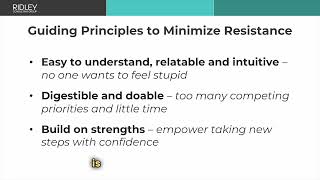
Beth Ridley shares three principles for inclusive leadership: use plain language so any leader can engage, keep learning to 2-4 minutes because time is scarce, and build on what leaders already do well to make inclusion feel achievable rather than overwhelming.
Chapters
The other thing that guides my work, I have my own homegrown guiding principles. Again, things that I know to be true in terms of bringing people along and minimizing resistance and indifference and just sort of appreciating the barriers to wanting to embrace inclusive leadership and prioritize it a little bit more. So the first thing is, you know, everything has to be simple for people who do not work in hr. They are not seeped in thinking about this stuff all day long. So words and concepts that are so intuitive to me, not so much to other people. And I don't want anyone to feel like they have to have a PhD in this work in order to show up as a more inclusive leader. I want them to just do it. So I really try to use words and language that's understandable, immediately relatable and intuitive. No one wants to feel stupid. And so I think it's really worthwhile to take the time to think about simple ways to communicate even complex topics without watering down the impact. So that's one thing that really guides me. The other thing that guides me is stuff has to be short. Probably the biggest barrier to leaders who wanting to embrace inclusivity as a core competency is they just don't have time. They're too busy with their day jobs. And so, you know, I always think about how can I communicate something in as a digestible format as possible. I do a lot of explainer videos that people love because I challenge myself to. They cannot be more than four minutes. People are used to watching YouTube or TikTok videos. Like two to four minutes is kind of all you have to bring somebody along. And so the ability to take big concepts and boil them down to something short and digestible, it's a skill and I'm proud that I can do it really well. And a lot of people are like, all you do is these two minute videos. Like, do you know how much work goes into a two minute video? I appreciate that people are busy. And then the third guiding principle is I always want to build on a leader's strength, right? Another big barrier to leaders taking action around inclusion and belonging is that they don't want to screw it up. They don't want to misstep and maybe embarrass themselves or cause harm to others. So it's a little intimidating because it's just new for them. And so I always want to point out what someone is doing well, because most leaders, honestly, they are doing aspects of what it means to be an inclusive leader innately. And few people are, like, woeful in this area. And if they were like that bad, they probably not leaders anyway. So I always want to point out what they're doing well, just to give them the confidence and the encouragement, like, keep doing this and take one more small step so that they have the courage to take a step forward. And any step forward is progress. Okay, so that's a little bit about my own guiding principles.