NO Studios Live: 48 Hour Film Team
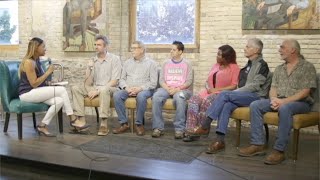
Jim, John, Holly, and Ethleen formed a team for a 48-hour film festival, meeting the night before. They drew school drama with politics as their genre, had to use an extension cord as a prop and include a government worker character, and finished their script by 11 PM. They shot their film 'Our Future' at the NO Studios theater, mostly acting in it themselves.
Chapters
All right, so, Jim, let's start with you as production supervisor. All right, so tell us a little bit about this competition and how you assembled or how this fabulous team ended up coming together.
Okay, so the day before this is a 48 hour film festival. So the day before that film festival, what four of us the night before met for the first time. We sat in a room upstairs on the rooftop and went around and said, okay, what kind of gear do you got? What do you do? What's your name? You know, who are they? Starting with the basics and tried to figure out who was available, what we could do for the weekend and who wasn't there. And it was. It was trial by fire, learning how to work with each other and who can do what. And it actually worked really well that we all just sort of said, okay, you do that, you do that. And I'll let others say about how well that worked. I thought it worked really well.
Yeah. Which is really surprising because you get a group of strangers together and, you know, you only have 48 hours to gel. So, John, you are working as team lead. Right. So among other things, it seems like everyone wore a lot of hats, but team lead, I would imagine a big role because you got to get people gelling and working together as a team quickly. You don't know each other how. What was your approach? What was your strategy?
Well, it depended on the number of people that showed up. The first day that we had the meeting with Jim, we were going like, okay, now we're four. And then Friday night, when they actually did the drawing, a couple more people showed up, and everybody fell into the role pretty naturally. You know, everybody kind of had a sense of what they could do. I did have most of the photographic equipment and the editing equipment, so that kind of put me in that spot right away. I don't think anyone else really had any photo, any video cameras or anything like that.
So you're showing up day one with your equipment.
Yep.
Okay. And nobody else had any. And just to be clear, you're making a movie and no one else had equipment. Okay.
You know, it took.
You were definitely in.
Yeah, yeah. And it was kind of scary at first, but then these other people showed up, and I think the people that. It's really interesting. You get people that would be. It's almost like there's doers and there's talkers about it, you know, stuff like that. And these people are all doers, I guess, for lack of a better version or lack of a better word, because, I mean, they didn't know what they were getting into either.
Yeah.
And it'd be a lot easier, you know, Saturday morning, like a Friday night going like, I don't think so. Yeah. But these people were courageous enough really to jump off a cliff and give this thing a shot because of their love of art or something like that.
Yeah.
And that's really knit them all together anyway. We're all sort of dumb.
Yeah.
And. And didn't know what we were going to get into.
And.
And then as. Just because of the personalities of the people, it was pretty easy to get them to jail.
Yeah. All right, so Hollywood co writer, no pressure there. You have a short. You don't even have 48 hours to write the script because you got to give enough time to act and film and edit and all that stuff. What was your inspiration and mindset going in?
Well, I don't know if you know how the $48 film works, but you pick a genre, you're not able to just say, okay, this is the genre that I want. It's random drawing. So you have no clue what you're going to get. And we got. What was it? School and.
School and Politics.
School and politics. It was school and Politics.
School drama.
School drama and then politics. So of course you hear in the background, like, that's going to be a hard one. You know, how are we going to come across this? And there was a suggestion of doing politics with. With it. And I'm like, I don't know about politics. There's so much politics out there right now. Let's do something else. Let's do something to do with the school shooting, but let's do it from a different perspective, one that they haven't seen before. And then we kind of spent like an hour, hour and a half hashing out those details. And we wrote a couple pages, you know, not too much on it. And you don't want to write a lot of pages because it's only supposed to be four to seven minutes. So on the rule of thumb is one page is one minute normally. So after we kind of hashed that out, I said I would take it home, work on it some more, send it off if anything needed to be changed to it, added to it, obviously, with the other co writer, we went back and forth a couple times on what to change, how to change things. He did some mock ups of other things and literally I think we had it done by what, 11 o', clock, I'd say.
Nice. So how many hours in are we so far in this whole 48 hours.
I think it started at, I want to say, 6:30, 7 o'.
Clock.
Officially started at 7 o'. Clock. We talked about it. By 11 o', clock, the script was done.
Okay, Clark, fellow co writer. All right. And you did not know Holly before showing up right now. What was that experience like? Because I think it's just hard to just like, even collaborate with family members on something like a written script. You have a short turnaround time. You got to become fast friends.
Well, part of the whole thing was. Yes, indeed, the first meeting we had, which is at this garden center down on the south side of Milwaukee. All the teams were there, all 13 teams were there. And when we got handed out that we were going to be doing a drama and had to do with school or politics, we talked about it. And as Holly said, we very quickly, although it ended up being political, we very quickly just said, well, we're going to concentrate on the school. And then they also give you two other things you have to include in the story. They give you a prop, and everyone. All 13 films have to use the same prop.
Okay, and what was that?
That was an electric cord, an extension cord.
Okay.
And then also there's a character who has to be named, and that character has to be a government worker of some sort. So you have to work that into the script as well. And then the third thing, there's a line that every script has to use, and it was, psst, come here.
Okay.
So you've got to tap all these elements and work it into it. As Holly said very quickly, we decided there was going to be a school situation, and certainly the school under fire. How we're going to pull that off didn't really gel right away, but I would say we actually had the concept dumb within 10, maybe 15 minutes at the. Was mostly Holly took on the major script. I added some ideas to it, and we went back and forth, as she said. And then once we had that in mind, John, in essence, because he was the director as well as the shooter, had to then form this script into his vision of it, because you have to have someone be the person who's going to make those decisions.
And then at some point, you've got your actors. Right. So you hired actors that were more than just you on the stage or all of you acted.
That was the other thing. Okay. So we. We had the setting, and we, of course, use the no studio theater for our setting, which is very handy for that.
Yep.
But basically, we were the crew, we were the writers, we were the directors. And we were the actors.
Okay.
All right.
So we didn't hire anyone.
Okay. All right, So I love it. So now let. So some essentials here. The name of the movie title.
Our future.
Our Future. And then when we have the opportunity to see all our future, we will see all of you in the film. Actually, most of you.
Let's see. Jim. Jim was not physically in the film.
Okay.
And John was not physically.
Okay. And then what was your character?
I was kind of.
Oh, sorry.
Just scary par.
I was kind of a parent of.
Okay.
But you don't know what kind of a parent I was.
Okay. Okay.
I can't give it away.
The suspense. The suspense. Okay.
Can't give it away.
Ethleen, what character did you. Yeah, I was a parent. Okay.
But I'm not gonna say.
Well, maybe some kind of a crazy period. Yeah.
Kim Lades.
We did have one actor who's not here. That was Ed, and Ed played the AV operator for the theater that we were in. It was basically a small theater off to the side in a high school. And so this was a special event for a small group of parents.
Yeah.
And we kept saying. And I was. I got to be the named character because they had to give a guy a name.
Yeah.
So I got to be the named character.
Nice. Nice. So, Holly, you've never done anything like this before, right? This is your first time?
I've been working in the film industry since 2004.
Okay, so do you share Ethleen's reflections that this team came together quickly as a family and nobody cussed each other out was like a remarkable, like, unusual. It literally was nothing short of a miracle.
Yes. I've worked on big sets, small sets, and this would not have been possible if it wasn't for no studios. So I give all the props in the world to no studios for giving this opportunity for us to meet as a family and as a team and coming across with this product that we did finish within 48 hours?
Yeah.
You know, it would not have been possible without them. And all the sets that I've worked on, you're talking the Married Gentleman, the Dark Knight Wanted, Public Enemies. I've worked on all kinds of sets, and you see everybody in the background running around and people cussing at this person and then throwing this there and throwing that chair over there. And, you know, they're getting frazzled and frustrated, and they're working 12 to 14 hours a day. And with everybody here, we had our own little niche. And that niche was able to have all the niches filled in which we could finish everything that we needed done for this project. And normally that doesn't happen.
So do you feel like it was just sort of the luck of the draw of who came together? Did you guys just get really lucky?
It was meant to be.
It was meant to be.
It was meant to be. It was definitely meant to be.
I like that. Very nice. Okay, so then now, John, reflections. You've had some sleep. No. You still haven't had any sleep. You're still traumatized by the experience. Just some reflections on how you felt about the whole experience.
I think they're a lot of fun. Obviously I'm a bit of a junkie for them. It gives me a real chance to do more filmic style things. I've been basically a commercial editor, you know, stuff like that for a long time. And it's all pretty much just like, you know, marketing and stuff like that or commercials for this or that. So these projects give me the chance to sort of do something that I like a lot more.
Yeah.
And just like the rest of us, we're extremely grateful to Know Studios for helping us do this.
Yeah.
You know, for helping us provide the whole thing, you know, for being inspiration to us. And I think that's part of why we became a team so quickly is because we sort of shared lot of the interest in doing something like this, you know, And I think that's kind of why it wasn't hard for us to gel.
Yeah.
Because in one way or another, we were all seeking the same thing.
Yeah.
And. And I look forward to doing more with them. And now that we know each other a little bit better, it'll be a little easier to plan. But you know, basically, all in all, even though it didn't turn out perfect.
Yeah.
You know, it's still. It's still a good game.
Now you mentioned that everybody sort of came with their own little niche and was able to slot in. But it sounds like you also wore some new hats. Would you say that you learned some new skills through this too?
Well, there's definitely stuff that I picked up equipment wise, you know, and I mean, you know, just in terms of a good way to utilize my equipment for doing things like this. There was a couple of snags, speed bumps along the way that I went. Like, I wish I would have thought of that first, you know, kind of what they're talking to about rendering things like.
Like that.
So I think that, you know, that was a good thing and it was worth it.
Yeah. Nice. So, Jim, what has been being part of this team and part of this project meant for you.
As many people have said already, yes, this was, it was great that we did the thing that we were going to do. We had 48 hours to make a film and we did it. And that was amazing that we did. Or a miracle actually, as you said. But I think the journey was as important or actually probably more important. I will probably work with everyone on this stage again, Maybe on another 48 hour film festival, maybe not. But I'll definitely work with everyone in some way or another. And in fact, we've already had, I think everyone here has had conversations with everybody else about, hey, the next thing they want to do, you know, and that, that building, you know, I come from theater world, you know, normally, and you know, it's building ensemble and this, you know, a few other people have said, you know, we, we were on ensemble right away, you know, where we trusted each other to fill in the gaps or just know that, okay, what I do well might not be what you do well, but I'm going to trust you to do the thing that you, that you do well. And it, it is something that I, I'd never done before. I'd never been on a film set before and I want to do it again. Yeah, absolutely. And I want to work with all these people again.
Yeah.
And that's important.
I love it. I will. Kudos to everybody. Right? You really push yourselves outside of your comfort zone. And along the way you learned some new skills, you challenged yourself, you met some great people. But it sounds like most of all, you forged some friendship. So best of luck if you come together again as a team for the next 48 hour film. And next time you're going to map the route to the finish line. And that's going to be the secret to success. Well, hey everybody. Hands in. Two, three. No studios. Congratulations, everybody. Thank you.
Thank you.








