No Studios Live: Adam Gabornitz
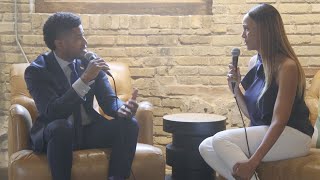
Adam Gabornitz, adopted from Honduras and raised in Milwaukee, works as a social architect building the city's tech and entrepreneurship ecosystem. He runs the IMMKE Festival series and supports the Blueprint Cultivator accelerator for women and people of color on Milwaukee's north side.
Questions this video answers
Honduras, at about six months old.
The team has been around about 20 months; Adam has been at it about one year.
Three events: one in December, one in March, and a third in June (with another hoped for in early fall/September).
Chapters
Hello and welcome to no Studios Live where we have the chance to meet the amazing members who comprise our amazing community here at no Studios. So today I have the pleasure of spending some time with Adam G. And I'm gonna leave it at that. And I'm gonna let you say your last name and also tell us the very interesting story that comes with your name.
All right, great. So the last name is Gabornitz and I can probably count on one hand the amount of people that have gotten that right on the first try. But the name is kind of unique and I share this with people all the time. There's no other Gabrinitz in the world. And it's because it's a combination of my mom's last name and my dad's last name that they put together. So my mother is Gaber, my dad is Nitz, and my sister and I are the only two Gabor Knitz's that are around. So kind of a unique way of putting our names together.
I love it. It's like self fabricated last name. That's really cool.
Pretty much.
But tell us a little more about your. Your parents and their origin because that's also completing this really interesting story that makes your name.
Yeah, absolutely. So my story is kind of unique because I was adopted and I was brought here to the United States from Honduras when I was about six months old. And my parents were wanting to have a family, couldn't have children of their own. And when they brought me over to the United States, my father also got the opportunity to be involved in entrepreneurship, so moved us out west to the Waukesha area. And their story was kind of different and unique because at that point in time, the 1980s, to adopt a little brown kid from Honduras was a little bit different. But it was an amazing experience to watch them raise me and my sister be entrepreneurs and just kind of live a life that you didn't see a lot of people living at that time. So taught me a lot of really cool things.
I love it. Well, we're so glad that they did because now you're sitting here with us. And the other thing I'm going to say about Adam is you're one of the early adopters of no Studios. So early on when we met, you were like, tell me a little bit more about this so called no Studio studios and how might I use it for some of the things that you're working on. So why don't you tell us a little bit about what you do and how you've been using no Studios. And when Adam and I talked, I was like, how do I introduce you? And he gave me his very long title at Northwestern Mutual. I said, no, scrap that. I'm going to call you a social architect. And that resonated with you.
I did.
So why don't you start from first with what does a social architect mean? And what do you do? Like, how do you bring that to life and then how you've been using no studios?
Sure, Absolutely. So the social architect thing kind of rang really true to me because I feel like a lot of the work that I'm involved in is creating environments and communities that feel very social. So the work that I'm involved in is really growing Milwaukee as a tech hub. And I've been at this for about a year now. The team's been around for about 20 months. And the focus of it is really four main areas. We're trying to grow a strong tech entrepreneur ecosystem, trying to build identity, trying to find and retain technology talent, and also make sure that we're building community from the north side to the south side and everything in between. So when you told me a little bit more about what you all were doing here at no Studios, hits right on the identity play.
Natural fit.
Natural fit. Right on the play of how we're building up entrepreneurs. Because all these folks in here in the creative space are doing their own thing and making sure that it's a place for community and a place for everybody. So the first thing we wanted to do is try to host an event here to not only get people in here, but also just to share the great message of everything that you guys were doing and give us a cool place to host things.
And you've been hosting a couple of events. They've grown in popularity, so give us a flavor for what they're like and when you might host another one.
Yeah. So what we've been doing over the last. What's the third time was back in just June here is that we hosted IMMKE Festival and Im Mke Fest is pretty simple. It's basically saying, how are we raising up the voices that are a little bit different and unique in the city of Milwaukee in this entrepreneurial space? And telling the story that you are mke, I am mke. We are Mke. And it's the third one that was done back in June. And really the focus around it is kind of community building. Everybody gets to come and hang out for a little while. Then it's about five to seven different lightning star talks where all the different entrepreneurs get to tell a little bit about their story. Kind of have a call to action, so to speak. Then some. Some more community building. So did one December, did one in March, did one back in June. And ideally, we'll be able to get another one here sometime in September, early fall.
I hope so. Love the work that you're doing, and obviously you're really passionate about it. So where does that come from? Your own personal interest, your own motivation about what you do? Just tell us a little bit about what. What drives you personally. Yeah.
Yeah. It's one of those things that as I've gotten older and ideally wiser.
He said older.
As I've gotten older and ideally wiser.
At the ripe age of no, go on.
Little bit older. A little bit older than that. But being able to feel like what I'm doing is impactful. I think that was one of the things that really attracted me to this job opportunity, was you have the resource and the power of an established organization, but being able to go out and try to make impact. I don't know. Maybe it stems back from the idea of adoption and saying that I was given a chance at a really kind of Freudian level. But the ability to say that I feel like I'm here for a reason and I need to spend my time trying to make things better is just kind of a very intrinsic thing for me. It's always been there.
I love it. And I love the fact that you are a no Studios member because you're bringing that energy to our membership. And clearly you're really good at what you do because you genuinely are passionate and excited about Milwaukee very much. Say a little bit more about that.
Yeah. So growing up in the suburbs was kind of interesting, but the minute that I graduated from high school, I came right back to Milwaukee. So I went to University of Wisconsin, Milwaukee. I think what was interesting about my parents, they did a really good job of bringing us to the city. So it wasn't just go to the suburbs, never come back kind of thing. And I always loved the city. I love the energy. So when I got an opportunity to do some work in Milwaukee, throughout most of my career, it's been great to just be able to see things grow and ideally see things improve. There are challenges, but I feel like there are people trying to do awesome things, and I just want to be a part of that.
Yeah. So I love it. Adam, you're working on so many interesting things. Give me one thing that you're super excited about that you're engaged with lately.
Yeah. So it's actually the continuation of something that we started last year and it's called the Blueprint Cultivator program. It's put on by Q and Khalif El Amin, two young brothers that grew up on the north side of Milwaukee. And it's basically an accelerator program focused around tech, advanced manufacturing and E commerce, specifically for women and people of color on the north side of Milwaukee. So the second cohort just graduated a couple of weeks ago. And it's something that we have been one of the sole corporate sponsors of. So to be able to push something like that forward, to look at entrepreneurship, to look at tech and look at underrepresented founders, it's been an amazing thing, not only for our city, but really on a national level because oftentimes women and people of color are getting left behind when we're talking about the tech and the entrepreneur conversation. So it's been something I've been really pleased to be a part of.
Totally. So one of the things that you're doing that I'm personally really excited about is you're really able to bridge this gap between the corporate community and the creative community. I think the events that you're holding here at no Studios is a perfect example of that. And this seems like the perfect location to bring those worlds to together. I would love to see more corporate members here at no Studios because I feel like with all the change, with all the innovation that is required in corporate, the corporate sector these days, tapping into that creative talent, that creative mindset, that creative process is really, really important. So I don't know if you agree, but maybe you could, you know, what are your thoughts on that?
Yeah, I totally agree. I think that one of the things that a space like this and just really getting outside the corporate walls in general offers is an ability to break things, ability to do things a little bit differently, think differently outside of the box if we want to be cliche about it. But one of the things that I love about the creative community here in Milwaukee is that they are national caliber. And when people think about creativity, they're thinking about the things that are happening in Milwaukee. But sometimes we, especially in the corporate space, don't think about it the same way. So I think for us to kind of reach across and figure out where other people have some strong expertise and bring that back in, but also try to empower it and share the story. Yeah, I joke with people all the time. And I'm not a filmmaker, you know, I don't. I don't do some of those types of things. But being around those people enhances my life.
Right.
And ideally, when we're around those folks as well, we can bring them into the fold and do different things that way. So got one really quick, cool story.
Yeah.
So last year, this would have been last November, we partnered with a few local filmmakers here in Milwaukee to do this thing called, called Milwaukee Forward. So if you Google it, it's a video and movie that we put together, four minutes long, that basically is a short film. And we did that because we didn't want a corporate feeling thing with PowerPoints in it. We wanted something that felt like it was from the community and from the creative spaces. These guys did an amazing job. It was all local actors, it was all local filmmakers. And we have this thing that feels and looks a lot different than normal, and that's something we could not have done on our own. So be able to give people opportunities to share their gifts is amazing.
I love it. So maybe fast forward, what do you see coming out of your work? And how do you even see maybe the corporate sector or Milwaukee? In what ways will we be different? I don't know. Fast forward a few years from now.
Yeah. I see technology and the things that are happening in the creative spaces to be at the forefront of the conversation. So I really see us talking about how Milwaukee is a tech hub. I really see us talking about how if you're looking for opportunity, you. You're looking for innovation. You're looking at an opportunity to break things and do things differently, come to the city of Milwaukee. And in some ways, our city has been built on tradition. It's very blue collar by nature, and I'd like us to build on those things and have them be a little bit more future facing. So, yeah, 2022, 2023, when someone's talking about Milwaukee, they're talking about it, hey, you want to start a company? This is the place to go, place to be.
And how do creatives and artists plug into that? Where do you see them fitting in with that future vision that you painted?
I think first and foremost, it's storytelling. I think about the Midwest, and we're not always the best at getting up and talking about how great we are at things, because we're great at a lot of things. So obviously, when you look at artists and you look at filmmakers and you look at people that take pictures, they're telling stories. And the best storytellers in the world are the ones that can do the movies and do the films. So I could see the voice kind of like what your brother's done as being somebody who's going out there having success but then saying, hey, remember Milwaukee, Here are things that are cool happening here and telling a story better than anybody can ever do. I mean, the filmmakers and the artists, those are the ones that tell stories that move people.
So, Jeff, our cameraman, reminded me talking about cool, your whole you just embody cool. You're like a walking cool.
All right, Can I add that to my job title, too?
Yeah, just.
I'll add walking cool to my job title.
Social engineer and walking cool.
Walking cool. I like that.
As my kids would call it. Hipstie. I like that. So tell us a little bit about. Give us a couple cool tips.
Yeah.
If other people watching wanted to be cool, like Adam G. The only one, three things that they should be doing.
Oh, man. First and foremost, you got to figure out what cool is to you. And despite what everybody else is doing, figure that out and be really true to who you are. Yeah, I think that's really important. I think the second thing is be willing to tell your truth. Be willing to get up and say things that may not always be popular, but you know when you go home at night and go to sleep, that you spoke your truth, and that's an important thing. And the third one is find cool friends, Hang out in cool places. Yeah, you can always feel cool if you're in cool places.
Right. So studios.
Like no studios. Exactly.
I like that, though, for sure. I think being cool starts with being yourself. Right. Otherwise, you're just an imposter.
You're just an imposter. They're not cool.
They're not cool at all.
They're not at all.
Well, Adam Gabinets. Did I get that right?
Pretty close, Gabriel. Pretty close. I told you. One out of five. One out of five.
The one and only. Literally. Literally, the one and only. Thank you so much. I appreciate it. Thanks for telling us about a little bit about your life story and the cool stuff that you're doing here at no studios.
My pleasure. Thank you for having me.
All right, awesome.








