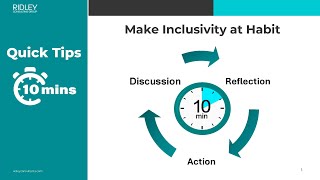
Beth Ridley recommends blocking 10 minutes weekly to build inclusive leadership habits. Reflect on a leader who made you feel you mattered, try one small inclusive behavior in your next meeting, then share what happened with your team. The cycle repeats: reflection, action, discussion.
Chapters
I think 10 minutes is a reasonable amount of time to ask somebody. Most people have 10 minutes if they're serious about, you know, embracing new habits. And so I like to think of what can you do in 10 minutes on a regular basis, in small doses, but more consistently so, if you think about 10 minutes a week should be dedicated to either reflection, action, or discussion about the action to really reinforce behaviors. Or if you have 30 minutes a week, you can do 10 minutes reflection, 10 minutes of action, 10 minutes discussion in the same week. But just none of these touch points that I'm going to talk about, how I use them, or the suggestions that I have for how to do reflection, action, and discussion. It. It does not take more than 10 minutes, so it's doable starting with the reflection. Everything starts from intention, right? We need intention first before we take. If you don't do any formalized program, if you're not going to methodically walk people through some type of change journey to build them up as inclusive leaders. The easiest way to get to have people understand and have the desire to be a more inclusive leader is to have them reflect on this question. And I would actually have people. I would have people put 10 minutes as a recurring 10 minutes on their calendar with this question copied and paste in the calendar in entry so that they actually do it. But have them think about who's a leader, who made you feel like you mattered, made you feel that sense of inclusion and belonging, and why. So what were those characteristics or behaviors that made them stand out? I can guarantee you whoever they think of and however they describe those behaviors will fall in a bucket of the inclusive behaviors that I preach. I won't go into detail, like why I lean so heavily in these three inclusive behaviors. Watch my July video, because I totally unpack how I got here through a lot of trial and a lot of error. But these are solid. These are sound. So no matter who somebody envisions as that leader who made them feel like they mattered, they'll come up with something that falls within the definition of inclusive leadership. That's all they need to know right now. They've got the awareness and the desire of what it means to be an inclusive leader. Then I tell them, take that spirit of whoever you thought of, and how can you do something that they did that you're not doing in your meetings? Again, be able to implement immediately. Don't need to be an expert in this, but, you know, meetings have lots of opportunities to rethink how you do. Meetings all have three parts. The stuff you do before the meeting, how you conduct yourself during the meeting, the things you do after the meeting. These are just actual real examples that other leaders gave me after pondering on this question. And I always tell them, you know, think of what would insert the name of the leader that you came that made you feel like you matter, Do. Right. So in my case, this gentleman I worked for as a management consultant, what would Reggie Van Lee do? He's my inspiration. He was a masterful, inclusive leader, made everyone feel like they mattered. What would he do? And he did some of these things I noticed. And what are the ones I'm not doing? What's one that I can try and do? Most of these things in the course of a meeting do not take a long time to do. They will not take 10 minutes. So no excuse, right? That's your 10 minutes of action for the week. And then I think sharing and having the expectation that you're going to talk about what you're doing helps to reinforce that accountability. So if you want to make inclusivity a habit among a team, a leadership team, can you carve out 10 minutes a week, 10 minutes biweekly, 10 minutes a month in that leadership team meeting for one leader to share what they're doing, right? What they reflected on who that leader was, that made them feel like they mattered, those characteristics that they are trying to emulate a little bit more in their day to day interactions and just share what they're doing for feedback, for encouragement, for idea sharing. And then maybe each meeting a different leader will share. It just holds them accountable for taking this seriously. People will prepare for what they're expected to talk about and they'll give thought to what they're expected to talk about and they'll take action based on what they're thinking. So this sort of is the game plan to make inclusivity a habit. And then you circle back again on that circle with more reflection time. This time they don't have to go back to who's a leader that inspired me, but, but it's more. Now that you've taken action, how did you demonstrate inclusivity this week? What can I do to improve next week? Take the action and then go back and share and then do the personal reflection and it just creates a, a cycle.